
You open an email from your broker-dealer and see a request for documents, a notice of an internal investigation, or a warning that your Form U5 may contain a disclosure you dispute. Perhaps a regulator wants your testimony. Perhaps your firm has terminated you and is demanding repayment of a promissory note. At that moment, the question what is a securities lawyer stops being academic. You need counsel who understands how one event can affect your registration, reputation, compensation, employment, and ability to remain in the industry.
A securities lawyer for a financial professional is not just a deal lawyer who prepares offerings for public companies. The right defense counsel helps control the first response, preserve evidence, evaluate regulatory exposure, protect employment rights, and choose between negotiation, arbitration, or litigation. The work is practical and time-sensitive because an advisor's career can turn on the wording of a regulatory response or termination disclosure.
The Advisor-Defense Role of a Securities Lawyer
A registered representative receives a FINRA inquiry on a Friday afternoon. The firm calls it a routine review, but the letter demands communications, account records, and an explanation of a client interaction. The representative considers replying immediately, adopting the firm's wording, and trusting the matter to fade.
That response can create a record the advisor later has to defend. A securities lawyer identifies who issued the request, the authority behind it, the applicable deadlines, and the records that may exist. Counsel also tests whether the response could affect a parallel employment, licensing, or compensation dispute before the advisor provides a written statement or agrees to sworn testimony.
Federal securities regulation rests on the Securities Act of 1933, the Securities Exchange Act of 1934, and the Investment Advisers Act of 1940, which together provide the statutory foundation for regulating securities offerings, markets, and investment advisers. The Georgetown Law Library's overview of federal securities regulation summarizes that framework.
A career defender, not only a corporate advisor
A corporate securities lawyer may concentrate on registration statements, prospectuses, offerings, governance, or transactions. An individual financial professional faces a different set of immediate decisions:
- Can I answer this demand without creating a contradiction?
- What records should I preserve before changing firms or devices?
- Can my employer describe my departure this way on Form U5?
- Could a client complaint become FINRA arbitration or a regulatory case?
- Does a CFP Board notice require a separate response strategy?
The advisor-defense lawyer works across federal securities law, SEC requirements, FINRA rules, state regulation, employment agreements, arbitration clauses, and firm supervision. A general business lawyer may understand a contract yet miss how a resignation dispute can become a Form U5 issue, or how an incomplete regulatory response can threaten an advisor's ability to remain in the industry.
The practical question is not whether a rule was violated. Counsel must determine what happened, what can be proved, which records control, and which response protects the advisor without sacrificing credibility. That often requires coordinating with the firm while preserving the individual's separate interests.
For an introduction to the compliance duties surrounding financial professionals, the Advisor Momentum SEC guide provides useful regulatory context. Once a notice, investigation, termination, or dispute arrives, a regulatory compliance attorney can assess the specific facts, deadlines, and response obligations.
Practical rule: Treat the first notice as evidence in a potential proceeding, not as an ordinary business email.
Core Practice Areas in Advisor Defense and Compliance
The most useful way to understand securities counsel is to identify the problems the lawyer handles. A financial professional rarely needs abstract advice about securities law. The immediate need usually involves a complaint, an investigation, a termination, a compensation dispute, or a record that may follow the professional through future employment.
A securities lawyer may handle several connected matters at once:
Regulatory investigations and examinations
SEC, FINRA, MSRB, and investment-adviser obligations require firms to translate legal duties into operating controls. Lawyers advise on written supervisory procedures, books-and-records retention, disclosure calendars, surveillance, escalation procedures, and responses to examinations or investigations. For an individual advisor, that can mean preparing a factual submission, reviewing communications, identifying inconsistent records, and preparing for testimony.
FINRA Rule 8210 is particularly important because it permits FINRA staff and adjudicators to require information, documents, and sworn testimony from persons subject to FINRA jurisdiction. FINRA also describes authority to inspect and copy books, records, and accounts within a person's possession, custody, or control. A securities lawyer manages the response while protecting the advisor from avoidable admissions and preservation failures.
FINRA arbitration and investor disputes
Investor claims often involve alleged unsuitable recommendations, misrepresentations, unauthorized trading, supervision failures, or account-handling problems. Defense counsel evaluates the pleadings, identifies the relevant account documents and communications, develops the factual narrative, and assesses settlement against the cost and risk of hearing.
This work differs from ordinary business litigation because the record may affect licensing, disclosures, employment, and future regulatory review. Advisors should also understand the separate questions raised by securities fraud claims, including whether the allegations concern intentional conduct, negligent conduct, disclosure failures, or a contractual dispute presented in securities language.
Employment and breakup disputes
A departure can trigger claims involving restrictive covenants, client-contact rules, deferred compensation, production credits, bonus calculations, and repayment of transition financing. The lawyer reviews the employment agreement, promissory note, recruiting package, firm policies, and communications surrounding the departure.
The legal issue isn't always “employment” or “securities” in isolation. A termination can produce a compensation claim, a Form U5 dispute, a regulatory inquiry, and a customer complaint. Counsel must coordinate the response so that a position taken in one forum doesn't undermine the advisor in another.
CFP Board disciplinary matters
CFP professionals face a distinct professional-discipline process. The CFP Board states that it enforces its Code and Standards through peer review, and that Enforcement Counsel may send written notice identifying allegations and requesting documents and information from the professional under investigation. Counsel can help organize the response, test the factual allegations, preserve procedural rights, and address the professional consequences of an adverse determination.
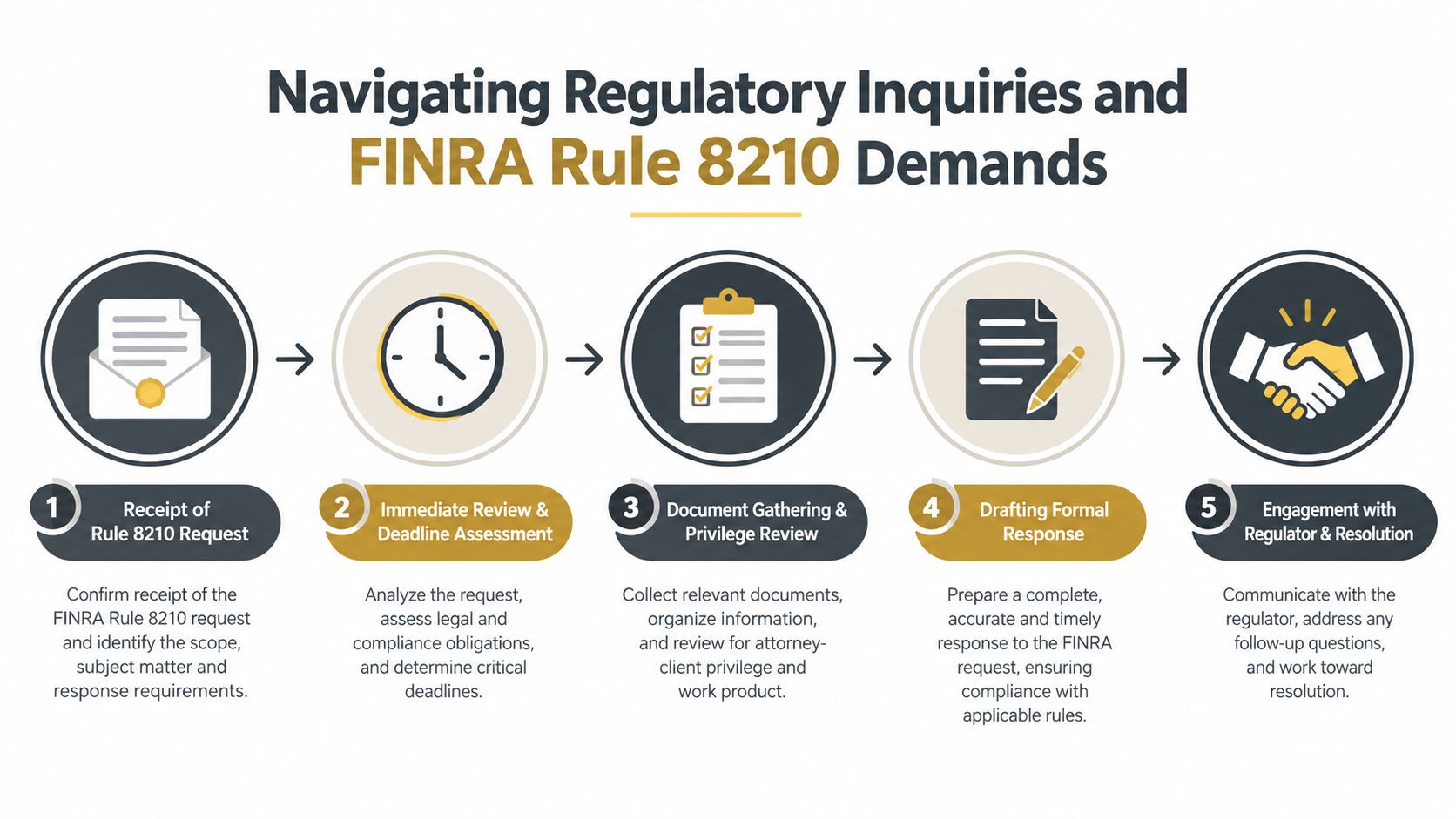
A lawyer's value lies in connecting these matters. The advisor doesn't need separate, disconnected answers if one event affects regulatory reporting, employment rights, and compensation. The defense strategy should account for the entire professional record.
Navigating Regulatory Inquiries and FINRA Rule 8210 Demands
A Rule 8210 request isn't a casual request for cooperation. FINRA may require a member firm, associated person, or another person subject to its jurisdiction to provide information, documents, and sworn testimony in connection with an investigation, complaint, examination, or proceeding. The rule also reaches books, records, and accounts within the person's possession, custody, or control. The governing rule is available through FINRA's information and testimony request guidance.
The first response
Start with preservation, not explanation. Don't delete messages, alter files, replace devices, clean up cloud folders, or ask colleagues to summarize records before the relevant materials are secured. Industry guidance recommends issuing a document-preservation memorandum within 24 hours of receiving a Rule 8210 request and collecting materials from relevant custodians.
That 24-hour preservation window is a practical defense measure, not a substitute for reading the actual deadline in the request. The lawyer should identify the requested categories, custodians, systems, personal devices, archived communications, and overlapping firm investigations. If the advisor has changed firms, counsel should address both the records that may remain with the former firm and the records in the advisor's current possession.
A disciplined response process
Read the demand precisely. Identify every requested category, deadline, testimony date, and defined term. A broad request may require a targeted objection or clarification, but the advisor shouldn't ignore it.
Preserve and collect. Secure email, text messages, CRM entries, notes, calendars, account records, and relevant personal-device material. Don't rely on a single search term or one custodian.
Separate facts from advocacy. The response should answer the request accurately. It shouldn't contain speculation, blame, or unnecessary conclusions that create new issues.
Prepare for testimony. Sworn testimony requires more than reviewing a draft response. Counsel prepares the advisor to listen carefully, answer only the question asked, distinguish memory from records, and correct an error rather than guessing.
Track parallel consequences. The same facts may appear in an internal investigation, Form U5 discussion, customer dispute, employment claim, or CFP Board matter. A response that resolves one problem can create another if the forums aren't considered together.
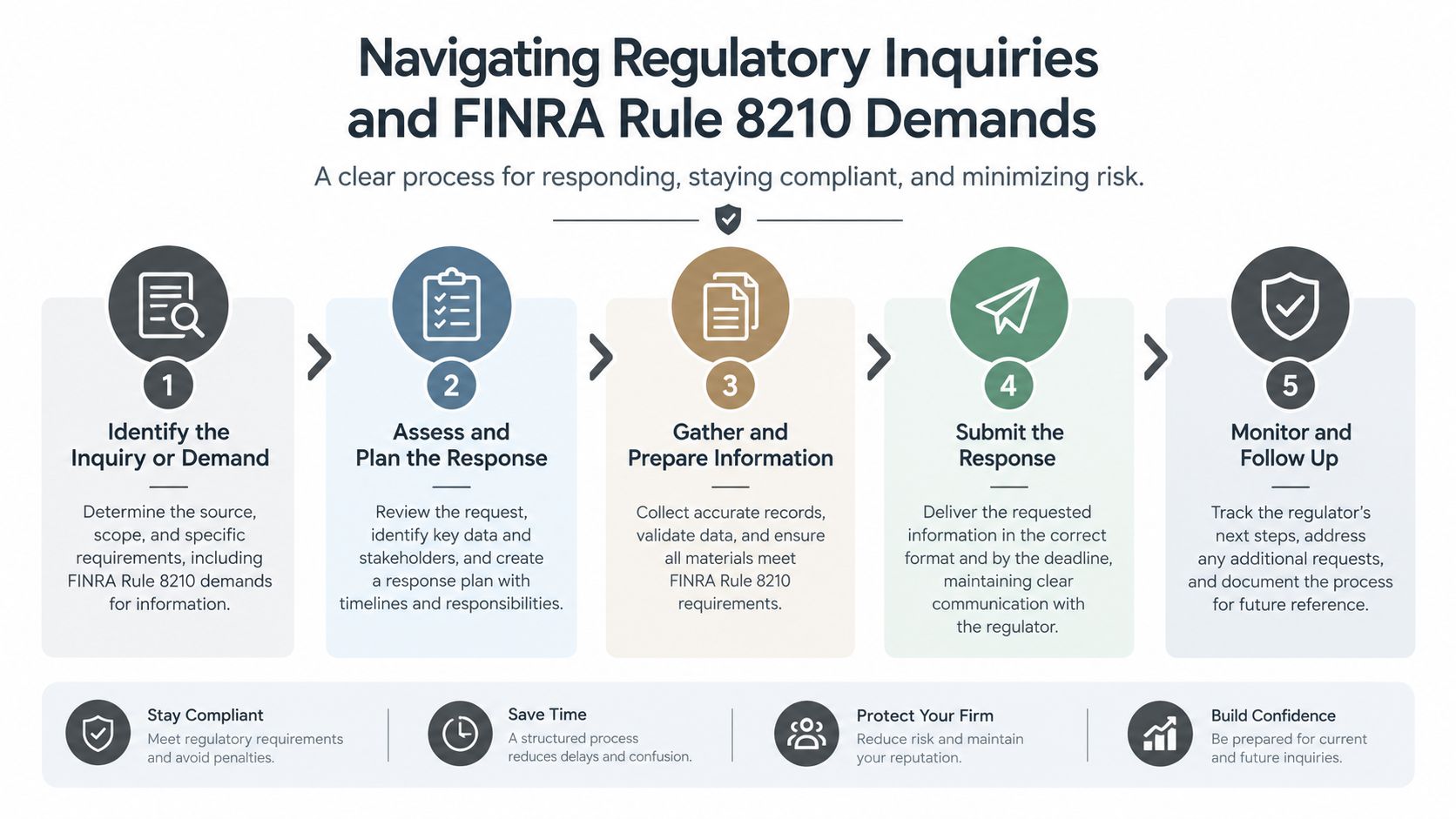
FINRA states that firms and associated persons under its jurisdiction must provide requested materials. It may seek severe sanctions for failure to respond truthfully or completely, including expulsion for firms or a bar for associated persons. That's why FINRA Rule 8210 defense requires evidence management, deadline control, and testimony preparation, not merely a persuasive letter.
A fast response matters, but an unexamined response can be worse than a carefully negotiated one.
Managing Form U5 Issues and Transition Disputes
A Form U5 dispute can affect both the regulatory record and the next employment conversation. FINRA's Form U5 contains disclosure questions that apply to full terminations and amendments, and the SEC form shows that disclosure questions are built into the U5 process. The practical point is simple: the language isn't a casual description of a departure.
Negotiate before the record hardens
An advisor leaving a firm should review proposed termination language before accepting that it's final. Counsel examines the stated reason for termination, the chronology, internal investigation materials, performance records, complaints, and any agreement governing the departure. The lawyer may negotiate clarification, challenge inaccurate wording, or preserve a record showing why the disclosure is disputed.
A resignation doesn't automatically eliminate risk. If the firm believes the advisor engaged in conduct requiring disclosure, the firm may still report that information. The advisor's response should be factual and precise, not emotional or accusatory. A short, well-supported explanation can be more useful than a lengthy narrative that introduces collateral allegations.
Compare the regulatory and economic tracks
Form U5 and transition economics often move together, but they require different remedies.
| Issue | Primary concern | Common legal response |
|---|---|---|
| Form U5 wording | Future employment and regulatory scrutiny | Review, negotiation, amendment, or challenge |
| Promissory note | Repayment of upfront transition financing | Contract analysis, defenses, negotiation, or arbitration |
| Deferred compensation | Withheld credits or vesting disputes | Agreement review and compensation claim |
| Client transition | Restrictions and alleged solicitation | Contract interpretation and regulatory coordination |
A broker-dealer may demand repayment of a promissory note after termination or a move to another firm. The advisor may also contend that production credits, bonuses, or deferred compensation were withheld. Those claims can proceed alongside a U5 dispute, but counsel should avoid treating the economic demand as a reason to accept inaccurate regulatory language.
The Form U5 and FINRA disclosure resource provides useful context for the record's importance. In a contested matter, arbitration may address compensation and contract claims, while a separate process may be needed to challenge the regulatory disclosure. Early review gives the advisor more options than waiting until a prospective employer asks for an explanation.
Career-protection principle: Resolve the wording and the money as related problems, but don't trade an accurate professional record for a short-term settlement.
When to Hire a Securities Lawyer Versus Other Counsel
The right lawyer depends on the source of the risk. A standard wage dispute may fit an employment practice. A commercial litigator may be appropriate for a straightforward contract claim. But once a dispute involves FINRA jurisdiction, SEC scrutiny, Form U5 language, client allegations, or professional registration, securities counsel should participate early.
The distinction is especially important when the firm's stated reason for termination affects the advisor's next job. A lawyer focused only on employment damages may miss the regulatory significance of a U5 disclosure. A lawyer focused only on securities compliance may overlook discrimination, unpaid compensation, restrictive covenants, or promissory note defenses.
A practical decision matrix
| Crisis scenario | Primary legal need | Recommended counsel type |
|---|---|---|
| Unpaid wages with no regulatory or licensing issue | Wage and contract analysis | Employment lawyer |
| Ordinary commercial contract dispute unrelated to registration | Contract interpretation and litigation | Business litigator |
| FINRA Rule 8210 request | Compulsory response, preservation, testimony preparation | Securities defense lawyer |
| Proposed or disputed Form U5 disclosure | Regulatory record and employment consequences | Securities lawyer with employment experience |
| Termination involving discrimination and U5 allegations | Coordinated employment and regulatory strategy | Securities lawyer working with employment counsel |
| Investor complaint or FINRA arbitration | Securities claims, records, and industry procedures | Securities arbitration counsel |
| CFP Board investigation | Professional discipline and written response | Securities or professional-discipline lawyer familiar with CFP Board procedures |
| Promissory note and deferred compensation dispute | Contract defenses, compensation, and arbitration | Financial-services litigator |
The economics of enforcement also require careful judgment. The SEC reported 456 enforcement actions in FY2025, including 72 investment adviser or investment company matters and 39 broker-dealer matters among stand-alone actions. The SEC's reported monetary relief totaled $17.9 billion, including $10.8 billion in disgorgement and prejudgment interest and $7.2 billion in civil penalties, as stated in its FY2025 enforcement release.
Those figures don't mean every advisor faces an SEC case. They do show why a lower case count doesn't necessarily mean lower individual risk. A selective enforcement environment can still produce severe consequences in the matters regulators pursue.
Technology can support legal work, but it can't replace judgment about privilege, testimony, credibility, or strategy. Resources such as legal AI for lawyers may help with organization and research workflows, while counsel remains responsible for the legal decisions and the client's response.
Typical Processes and Outcomes in Securities Defense
Most defense matters begin with uncertainty. The advisor may have received a regulator's letter, learned that the firm is investigating, discovered a disputed U5 entry, or received a demand for repayment. The first legal task is triage, identifying the immediate deadline and the possible forums before anyone commits to a position.
The broader structure comes from the federal securities framework established by the Securities Act of 1933, the Securities Exchange Act of 1934, and the Investment Advisers Act of 1940. Those statutes explain why modern practice combines disclosure, market conduct, adviser regulation, and enforcement. FINRA and other self-regulatory regimes add operating and disciplinary procedures that shape the advisor's day-to-day exposure.
The usual sequence
Initial assessment. Counsel identifies the sender, authority, deadlines, agreements, relevant records, and immediate employment consequences.
Preservation and collection. The advisor preserves communications and records. Counsel builds a defensible collection process and determines what materials require review for privilege or confidentiality.
Fact development. Interviews, chronology, account records, supervisory materials, and employment documents help distinguish what happened from what the firm or regulator alleges.
Response or negotiation. Counsel may submit a regulatory response, negotiate with the firm, challenge a proposed disclosure, or communicate with opposing counsel. The response should be consistent across forums.
Formal proceeding. The matter may proceed to FINRA arbitration, a disciplinary proceeding, an SEC administrative matter, or litigation. The defense then turns on pleadings, discovery, testimony, expert or documentary evidence where appropriate, and procedural deadlines.
Resolution and record management. Possible outcomes include dismissal, negotiated resolution, amended language, settlement, award, or an adverse determination. Counsel should also address what the outcome means for future registration, employment, disclosures, and related claims.
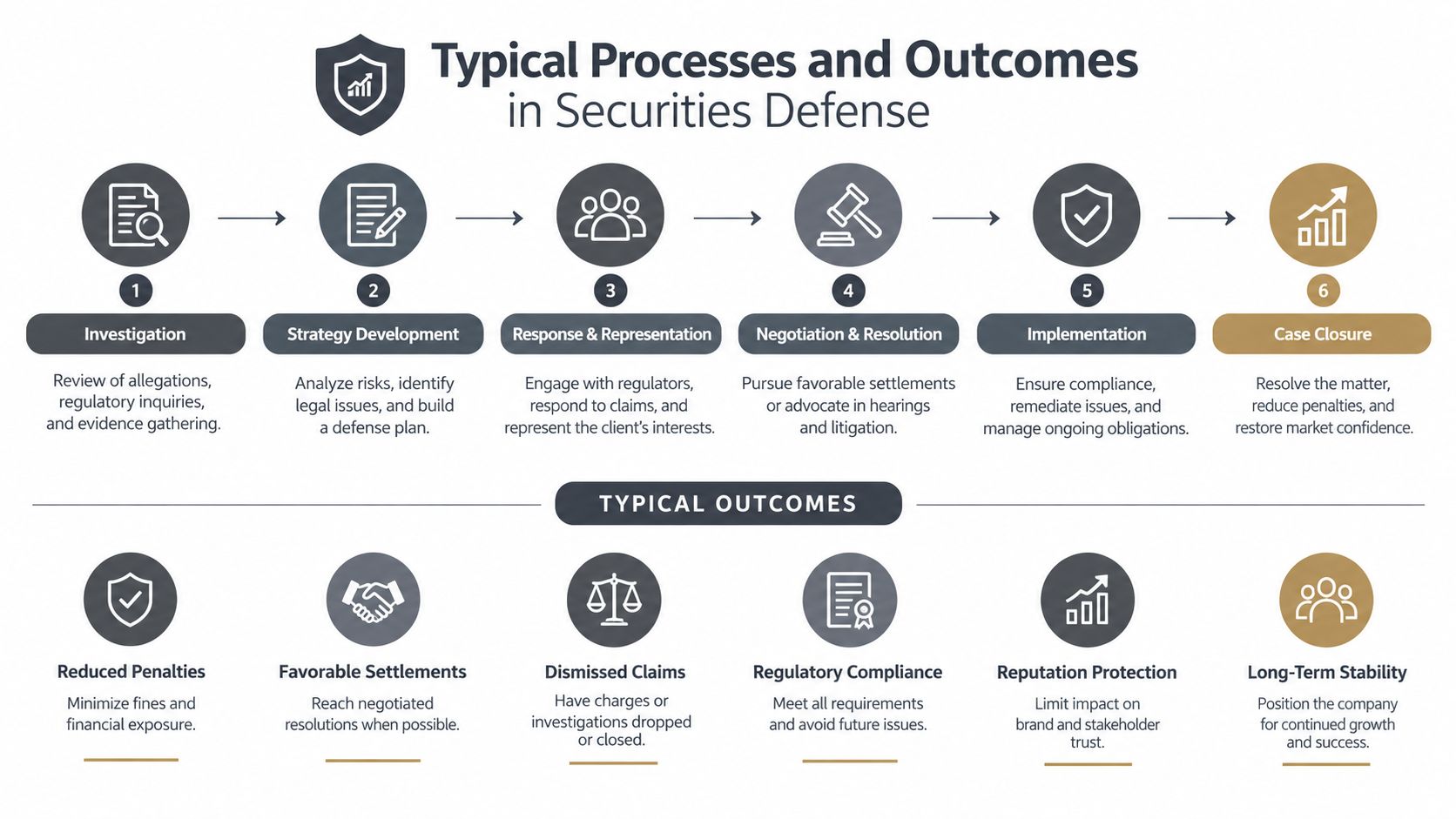
Settlement and litigation each carry trade-offs. Settlement can limit expense and uncertainty, but the wording may affect the advisor's record and future explanations. Fighting may protect the advisor's position, but it requires sustained attention, documentary discipline, and tolerance for a longer dispute.
Expungement, when available, is a separate strategic question rather than an automatic result of winning an employment claim. Counsel evaluates the governing rules, the nature of the record, the available forum, and the evidence supporting removal or correction. Advisors should ask about the practical result, not just whether a legal argument sounds strong.
Frequently Asked Questions for Financial Advisors
What does a securities lawyer do for an individual advisor?
A securities lawyer helps financial professionals respond to regulatory inquiries, FINRA investigations, investor disputes, Form U5 issues, CFP Board matters, employment-related departures, and compensation claims. The lawyer's role may include preserving records, preparing testimony, negotiating with a firm, defending an arbitration, or coordinating overlapping proceedings.
Does a CFP Board notice require a lawyer?
The CFP Board says its enforcement process uses peer review, and Enforcement Counsel may send written notice identifying allegations and requesting documents and information from the CFP professional. A lawyer can help determine what the notice alleges, organize the response, identify factual gaps, and avoid statements that create unnecessary professional-discipline or employment consequences.
The CFP designation can carry substantial professional importance, so treating the notice as ordinary correspondence is risky. Counsel should review the deadline, requested materials, applicable standards, and any related SEC, FINRA, state, or employer matter.
Can an advisor defend against a promissory note claim?
Yes. The defense begins with the documents, including the promissory note, recruiting agreement, employment agreement, compensation plan, termination provisions, and any release. Potential issues may involve the reason for termination, payment calculations, contract interpretation, firm conduct, arbitration requirements, or whether the broker-dealer complied with its own obligations.
The advisor shouldn't assume the demand is automatically valid, but shouldn't ignore it either. A prompt review can preserve defenses and prevent the economic dispute from becoming entangled with an inaccurate Form U5 response.
Should I wait until the firm files an arbitration claim?
Usually, no. Early counsel can review proposed disclosures, preserve evidence, communicate through the proper channel, and assess whether negotiation is realistic. Waiting may leave the advisor reacting to a completed U5 filing, a missed response deadline, or a record assembled entirely by the firm.
What should I do after receiving a regulatory letter?
Preserve relevant records, avoid deleting or altering communications, don't speculate in writing, note every deadline, and contact securities counsel before providing a substantive response. If the demand involves sworn testimony, preparation should begin well before the testimony date.
Kons Law represents financial professionals in securities arbitration, regulatory inquiries, investigations, disciplinary matters, Form U5 disputes, and related employment and compensation claims. If you want to discuss your business law matter, contact Kons Law at (860) 920-5181 or visit Kons Law to request a consultation.
