A compliance officer at a broker-dealer receives a proposal for a new advisory arrangement. The compensation formula seems defensible, but its interaction with disclosure obligations and supervisory procedures isn't obvious. The business team wants an answer before launch. The compliance team wants something more reliable than an optimistic internal memo.
That is where an SEC no-action letter has traditionally mattered. It gives a firm an opportunity to present its actual facts and legal reasoning to SEC staff and obtain an indication of whether the staff would recommend enforcement action. That indication isn't a substitute for a rule, an order, or advice from securities counsel, but it can materially affect how a firm assesses regulatory risk.
For financial advisors and broker-dealers, the practical question has changed. The SEC's pause in substantive responses to most Rule 14a-8 shareholder-proposal requests during the 2025–2026 proxy season means firms can't assume that submitting a request will produce the familiar staff signal. The right response is not to stop analyzing the issue. It's to build a more disciplined process for deciding when to seek staff guidance, when to use another relief path, and when to proceed on a documented judgment that may later be tested.
When an SEC No Action Letter Actually Matters
A financial advisor is preparing to offer a new service to clients. The service involves an arrangement with a third-party provider, a revised compensation structure, and disclosures that don't fit neatly into the firm's existing templates. The governing rules are relevant, but they don't answer every operational question. The compliance officer has two choices: approve the arrangement based on an internal interpretation, or ask the SEC staff whether it would recommend enforcement action on the proposed conduct.
Guessing carries a familiar problem. If the interpretation is wrong, the firm may face an enforcement inquiry after the product has launched, client communications have circulated, and supervisors have approved procedures built on the same assumption. Correcting the issue later can involve remediation, amended disclosures, compensation adjustments, and difficult conversations with clients and regulators.
The value of an advance position
A favorable letter can reduce uncertainty because the staff has reviewed a defined set of facts and the requester's legal analysis. It can help a firm decide whether to launch a product, revise a compensation model, or use a particular disclosure approach. It can also give senior management and the board a clearer record for approving a risk-sensitive business decision.
The protection is narrower than many business teams assume. The staff responds to the facts presented, not to a broad business concept. If the firm's actual arrangement changes, the letter may no longer address the conduct. A letter also doesn't immunize the firm from private litigation, state-law claims, supervisory failures, or conduct outside the request.
Practical rule: A no-action request should be treated as a targeted risk-management exercise, not as an application for blanket approval.
Why the stakes extend beyond one transaction
The SEC's no-action practice is used across multiple regulatory channels. The SEC's no-action, interpretive, and exemptive letter archives cover Corporation Finance, Investment Management, and Trading and Markets materials. That breadth matters to advisors and broker-dealers because an issue may involve securities offerings, investment company regulation, broker-dealer conduct, trading activity, or overlapping obligations.
A request can be especially useful when the facts are concrete, the business need is real, and existing rules or staff materials leave a material gap. It is less useful when the firm wants a hypothetical blessing, hopes to avoid doing its own legal analysis, or expects the staff to resolve a question that belongs in formal rulemaking or litigation.
What an SEC No Action Letter Is and How It Functions
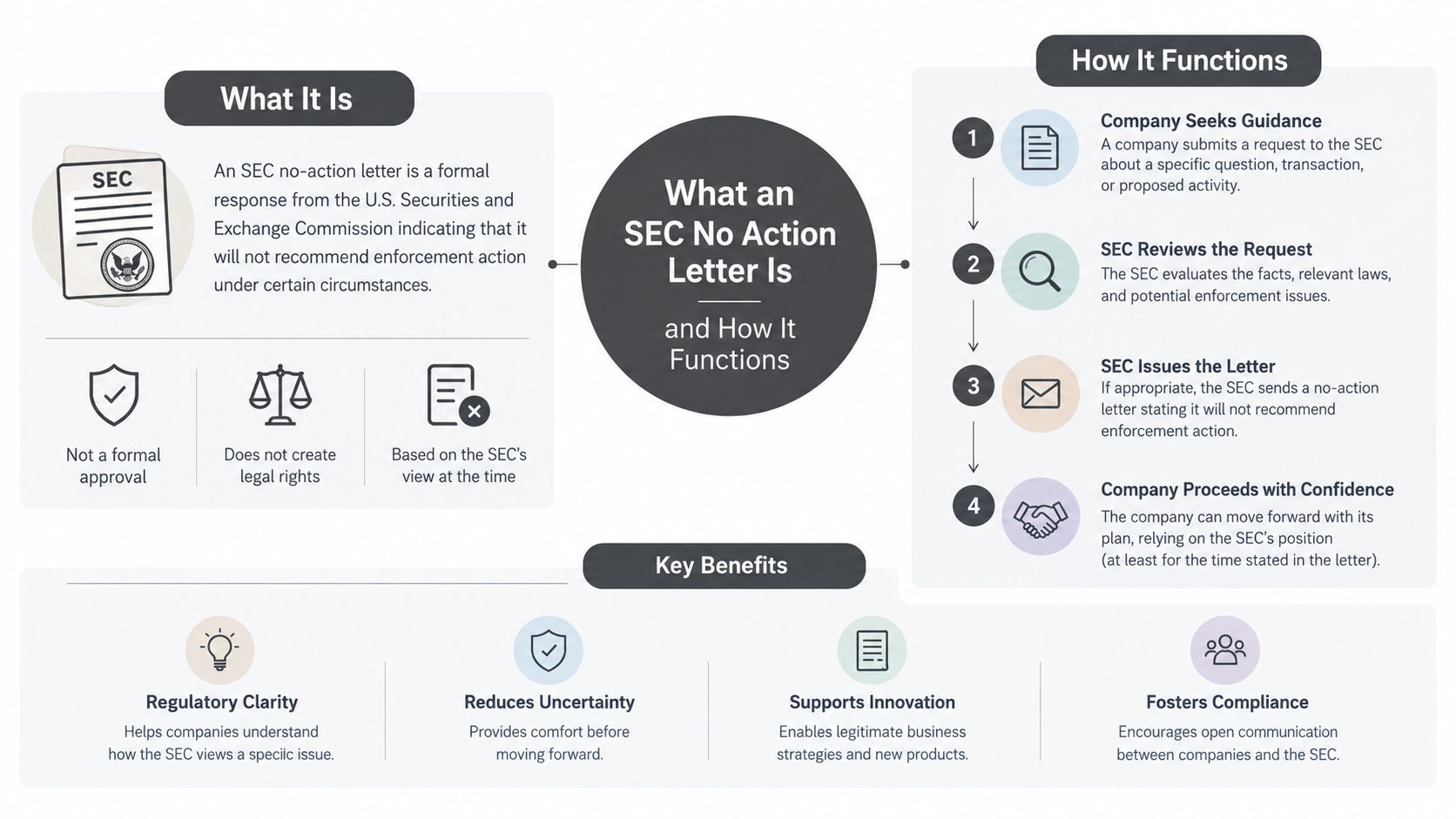
An SEC no-action letter is written staff guidance stating that, based on the facts and representations in a request, the staff wouldn't recommend that the SEC bring an enforcement action if the requester proceeds as described. The letter reflects the staff's position. It isn't a statute, a Commission rule, a formal adjudication, or a binding order.
The simplest analogy is a conversation with a regulator before taking a planned route. You provide the map, identify the road, explain the vehicle, and ask whether staff expects to object. A favorable response can make the route more defensible, but it doesn't rewrite the traffic laws or guarantee that every future trip under different conditions will receive the same treatment.
What the letter does
The request usually presents:
- A specific legal issue: The firm identifies the statutory provision, rule, or subsection that creates uncertainty.
- Complete factual circumstances: The staff needs enough information to understand what the firm plans to do, who is involved, and how the arrangement will operate.
- The requester's analysis: The firm explains why its proposed conduct should not result in enforcement action.
- Defined representations: The firm commits the usefulness of the response to the facts and conditions it has described.
The staff's response can provide meaningful enforcement clarity for that situation. It may also become a useful reference point for counsel and compliance personnel evaluating similar facts, although staff positions remain fact-specific and don't operate as binding precedent.
What the letter doesn't do
A no-action letter doesn't replace formal SEC rulemaking. It doesn't amend a rule, create a private right, or bind a court. It also doesn't eliminate the need for truthful disclosures, supervision, books and records, or ongoing review when the business model evolves.
The practice has deep institutional roots. SEC archive coverage shows posted Corporation Finance materials beginning after January 15, 2002, while the Investment Management archive begins on or after January 1, 1993. The SEC's investor glossary describes no-action letters as part of a broader compilation of staff interpretations across several divisions. A 1970 report referenced by the Administrative Conference of the United States estimated that Corporation Finance was issuing approximately 5,000 letters per year, while also noting that precise statistics weren't maintained for all no-action letters. Those records show longstanding reliance on staff positions, but they also show why the historical record isn't a single complete database.
For background on how SEC staff activity can develop into a broader regulatory matter, financial professionals can review Kons Law's discussion of SEC investigations involving securities professionals.
Legal and Practical Effects for Financial Professionals
A favorable no-action letter can change a firm's risk assessment, but it doesn't transfer responsibility from the firm to the SEC staff. The requester still owns the factual record, the implementation process, and the obligation to stay within the described conditions.
For a financial advisor, that may mean updating disclosures, training personnel, and monitoring a compensation arrangement. For a broker-dealer, it may require revisions to supervisory procedures, escalation protocols, or communications review. The letter becomes one part of the compliance file, not the entire defense.
Reliance has boundaries
A firm should ask four questions before treating staff guidance as operational permission:
- Are the facts identical? Small changes in product structure, counterparties, compensation, client eligibility, or communications can matter.
- Are the representations accurate? A response based on incomplete or inaccurate information won't support a confident reliance position.
- Has the policy environment shifted? Staff positions can change, and a later Commission action, court decision, rule amendment, or new guidance may affect the analysis.
- Does the issue involve separate exposure? A no-action position may address SEC enforcement risk while leaving FINRA, state-law, contractual, employment, or private litigation risks unresolved.
A firm also shouldn't cite a favorable letter mechanically. The better practice is to compare the letter's facts with the proposed conduct, identify differences, and explain why those differences do or don't affect the analysis.
The strongest reliance file shows both what the SEC staff addressed and what it did not address.
Internal controls still carry the load
Compliance departments should translate the letter into implementation controls. That can include a written procedure, designated approvals, employee training, periodic testing, and a process for escalating changes to counsel. If the business team later modifies the arrangement, someone should determine whether the change requires a new legal analysis or a supplemental request.
The absence of a favorable letter doesn't automatically mean the conduct is prohibited. It means the firm lacks that particular staff signal. The firm must then decide whether existing authority, an alternative relief mechanism, or a carefully documented internal position provides enough support.
No-action guidance also doesn't settle private disputes. Advisors dealing with compensation, termination, or securities-related claims should assess those issues separately, as explained in Kons Law's overview of private securities transactions.
How the SEC No Action Letter Request Process Works
The SEC's published procedures reward precision. A request shouldn't read like a general policy essay or a request for informal approval of an entire business plan. It should identify a defined legal problem and give the staff the facts and analysis needed to answer that problem.
Build the legal question first
Start with the exact statutory provision or rule subsection. The request should identify the names of the relevant parties and explain the relationship among them. The staff won't answer a letter involving unnamed parties or a hypothetical situation, so the request must describe an actual proposed arrangement.
Then write the factual narrative. Include the facts that affect the legal analysis, but remove background that doesn't help the staff decide the question. The SEC's Division of Trading and Markets guidance recommends keeping facts concise and limited to the precise problem at hand.
A useful drafting sequence is:
- Define the conduct: State what the firm will do, who will do it, and for whom.
- Identify the uncertainty: Explain the rule or statutory provision that creates the question.
- State the requested position: Say precisely what the staff is being asked to confirm.
- Explain the safeguards: Describe restrictions, disclosures, controls, or conditions that support the request.
- Address contrary authority: Deal directly with rules, prior letters, or interpretations that could undermine the position.
Make the analysis yours
The requester should provide its own legal analysis rather than asking the staff to perform the work from a bare factual description. That analysis should connect each material fact to the requested position and acknowledge limitations. Overstating the conclusion can damage credibility, particularly when the staff can identify an adverse authority that the letter ignores.
Confidential treatment requires care. The Trading and Markets procedures state that a confidential-treatment request should be separated into a different letter. Mixing confidentiality arguments into the substantive request can make the submission harder to process and can obscure the legal question.
Keep the submission credible
A concise letter is not a superficial letter. It should be narrow, complete, and candid. If the request depends on a particular client population, transaction sequence, disclosure, or supervisory restriction, say so plainly.
The firm should also preserve the submission file, supporting documents, drafts, factual confirmations, and implementation records. Those materials may later help demonstrate that the firm identified the issue, investigated the facts, sought advice, and implemented the position in good faith.
A regulatory inquiry or Wells Notice can require a different response strategy than a request for prospective guidance. Firms should avoid treating those processes as interchangeable, and should obtain advice on the appropriate Wells Notice response when the SEC has already identified potential enforcement concerns.
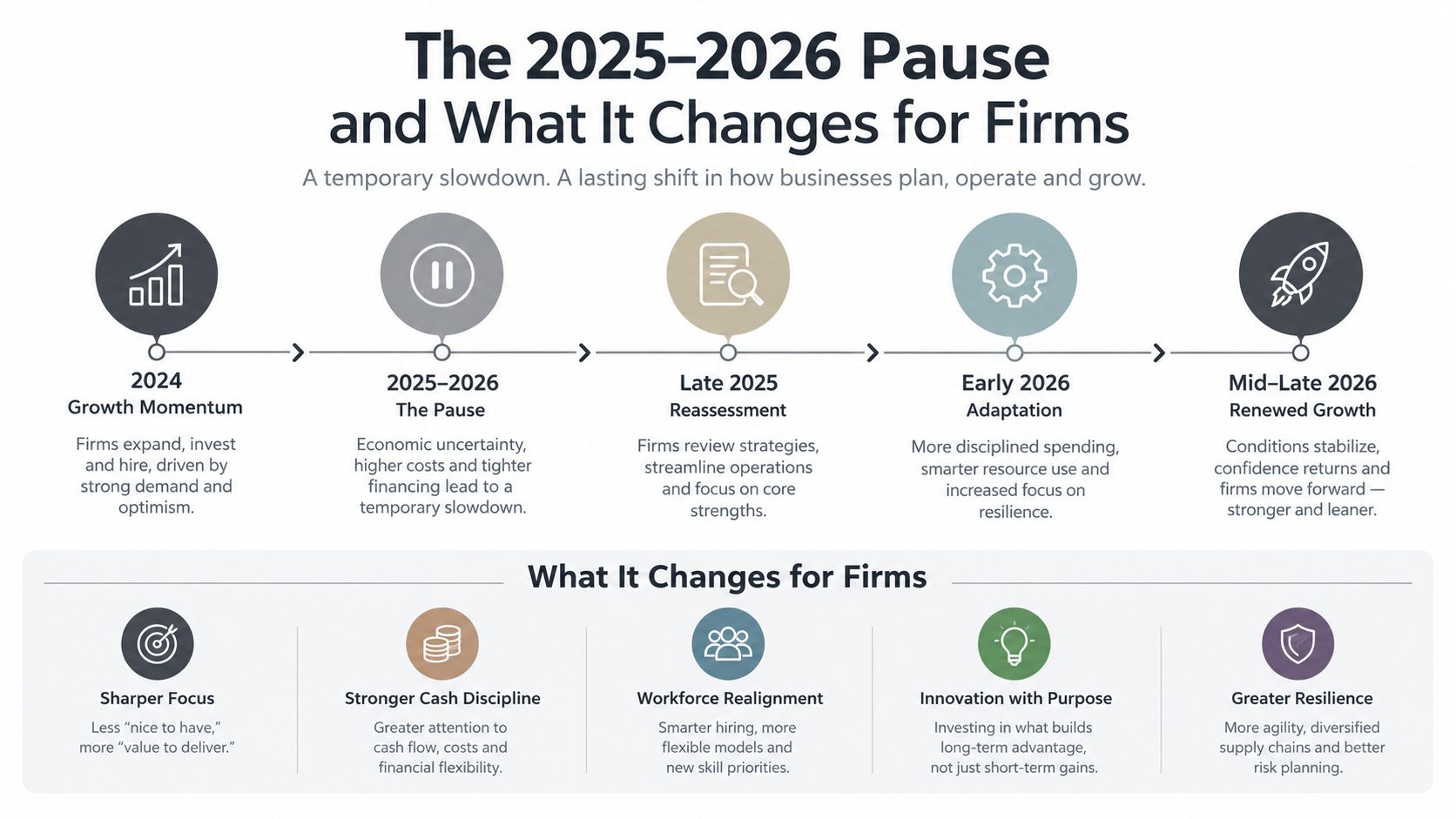
The 2025–2026 Pause and What It Changes for Firms
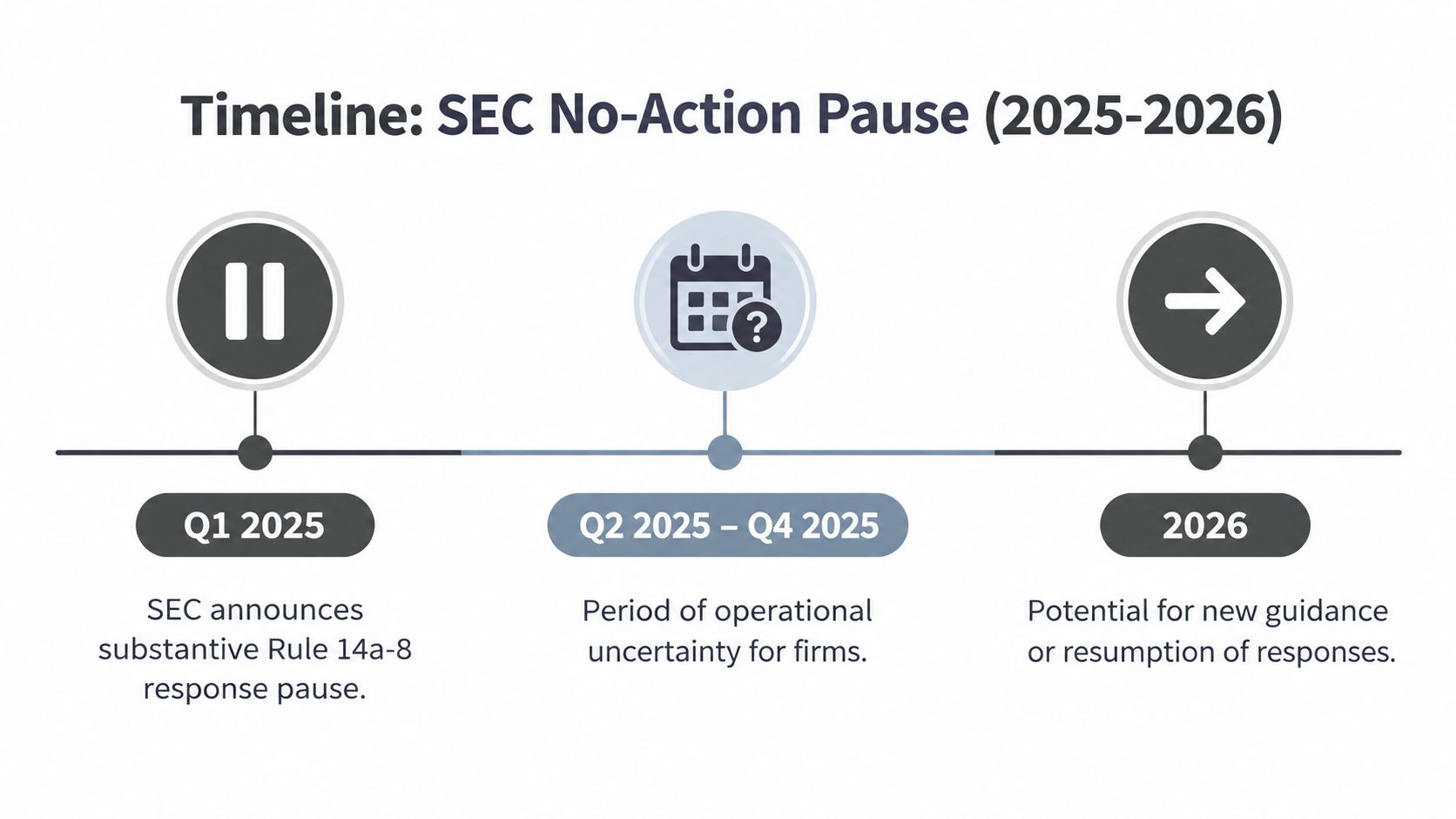
The most important operational development isn't merely that the SEC changed its Rule 14a-8 process. It's that companies and their advisors can no longer build a proxy-season plan around receiving substantive staff feedback on most exclusion grounds.
On November 17, 2025, the SEC said it would pause substantive review of Rule 14a-8 requests for the October 1, 2025 through September 30, 2026 proxy season, while continuing to review the state-law “proper subject” path under Rule 14a-8(i)(1). Reuters later reported that the freeze became effectively permanent in August 2026. Those developments shift the decision from “What will the staff say?” to “Can the company defend its decision without the staff saying anything?”
The old calendar no longer works
Under the former model, a company could submit a request and use the staff's response to shape proxy materials, shareholder communications, and escalation plans. That response might support exclusion, encourage negotiation, or signal that inclusion presented less risk than continued dispute.
A no-response regime creates several practical consequences:
- Earlier legal analysis: Counsel and compliance teams need a defensible position before proxy deadlines, not after waiting for staff review.
- More board involvement: Directors may need to weigh litigation, governance, reputational, and investor-relations consequences directly.
- Greater litigation exposure: A proponent that disagrees with exclusion may challenge the decision in court rather than addressing the dispute through staff correspondence.
- More careful disclosure planning: Proxy drafting, risk factors, explanatory statements, and communications should account for the absence of staff concurrence.
- Stronger records: The company should preserve the factual investigation, legal authorities, deliberations, and approvals supporting its decision.
Financial professionals should watch the downstream effects
Financial advisors, broker-dealers, proxy consultants, and governance professionals may not be the formal requester, but they can still feel the consequences. Their clients may need advice on investor communications, meeting preparation, board materials, or the treatment of proposals that would previously have been tested through the staff process.
The 2024 proxy season illustrates why the staff's position has practical importance. A Harvard Law School Forum analysis reported 259 total no-action decisions by May 1, 2024, compared with 167 at the same point in 2023. Among proposals that weren't withdrawn, companies obtained exclusion 139 times in 2024 versus 76 times in 2023, and the exclusion success rate rose to 68.4% from 56.3%. The analysis reported withdrawals at 21.6% in 2024 and 22.1% in 2023, indicating that the increase in exclusions was driven by substantive decisions rather than a major change in withdrawal behavior. It also described the 2024 exclusion rate as roughly comparable to the 69% average from 2017 to 2020. These figures appear in the Harvard Law School Forum analysis of SEC no-action statistics.
The lesson isn't to assume that past staff outcomes will repeat. Prior letters are fact-specific, and the current process places more responsibility on the company. Firms should treat historical decisions as analytical materials, not as automatic clearance.
Alternatives to Seeking an SEC No Action Letter
A no-action letter is only one tool. The correct choice depends on the question, the urgency, the desired level of legal certainty, and whether the firm needs relief from an existing requirement or only an interpretation of how that requirement applies.
Match the tool to the problem
| Path | Best fit | Main trade-off |
|---|---|---|
| No-action request | A specific, fact-bound enforcement question | Staff guidance is limited and nonbinding |
| Interpretive request | Uncertainty about the meaning or application of a provision | The response may clarify interpretation without granting broad relief |
| Exemptive order | The firm needs relief from a statutory or regulatory requirement | The process can require substantial facts, conditions, and review |
| Formal rulemaking | The issue affects a broad class of market participants | More durable policy, but slower and outside one firm's immediate control |
| Internal legal opinion | Existing authority supports a defensible position and timing matters | The firm bears the risk if regulators or courts disagree |
| Existing staff materials | The facts fit established bulletins, FAQs, or prior guidance | Analogy may fail when the facts are materially different |
An interpretive request can make more sense than a no-action request when the central issue is the meaning of a provision rather than enforcement discretion. An exemptive order is more appropriate when the firm is asking the SEC to permit conduct that would otherwise fall within a statutory or rule-based prohibition.
Internal analysis is not a shortcut
When no formal relief is available, a firm may need to proceed under an internal legal opinion. That opinion should identify the governing authority, explain factual assumptions, address adverse arguments, define implementation conditions, and state what changes would require review. It should sit alongside supervisory procedures and not in place of them.
Existing staff bulletins and FAQs can be efficient sources of direction, but firms should verify that the materials address the same conduct. A prior staff position may be helpful evidence of an analytical approach without guaranteeing the same result.
The trade-off is straightforward. Waiting for staff guidance may produce greater comfort but can conflict with a commercial deadline. Proceeding on internal analysis preserves flexibility but increases the need for documentation, escalation, and monitoring. The worst option is an undocumented decision based on a vague analogy to an old letter.
Actionable Guidance for Advisors and Broker-Dealers
Financial professionals should decide early whether the issue calls for staff guidance, another form of relief, or a documented internal position. The decision should turn on the nature of the legal uncertainty, the consequences of being wrong, the availability of established authority, and whether the facts can be stated precisely.
Use this practical screen:
- Escalate externally: Engage securities counsel when the issue affects a new product, compensation structure, disclosure model, registration exemption, client eligibility, or a material supervisory procedure.
- Define the facts: Create a written fact record and identify every representation on which the proposed legal position depends.
- Test alternatives: Compare a no-action request with interpretive guidance, an exemptive order, existing SEC materials, and an internal opinion.
- Document the decision: Record the authorities reviewed, unresolved risks, approvals, controls, and conditions for revisiting the analysis.
- Prepare for scrutiny: Preserve drafts, committee materials, training records, communications, and evidence that the firm followed its procedures.
- Monitor change: Reassess the position when the business model, counterparties, disclosures, client population, or regulatory environment changes.
For firms managing their public-facing educational material, legal analysis should also work alongside a clear digital strategy. Outrank's advisor SEO guide offers useful context for organizing financial-advisor content without replacing the underlying compliance review.
Kons Law represents financial professionals and businesses on securities-law matters, regulatory inquiries, compliance questions, and related disputes. Its regulatory compliance attorney can help evaluate whether a staff request, alternative relief, or documented internal position best fits the facts.
If you want to discuss your business law matter, contact Kons Law at (860) 920-5181. The firm can help financial advisors, broker-dealers, and business owners assess regulatory uncertainty, prepare defensible compliance documentation, and respond to SEC-related concerns. Visit Kons Law to discuss your situation.
