You're not calling a lawyer because you want to. You're calling because a deadline just landed in your inbox, a compliance person at your firm wants a draft response by tomorrow, or an examiner has asked for records that should have existed months ago. If you're a financial advisor, that's usually how regulatory trouble shows up, not as a dramatic lawsuit, but as a letter, a disclosure question, a document request, or a complaint that can shape your career if you answer it badly.
A regulatory compliance attorney is the lawyer you want when the issue is less about generic business advice and more about how your records, supervision, disclosures, and response strategy will look to a regulator, a self-regulatory organization, or a future arbitration panel. For financial professionals, that usually means FINRA, the SEC, the CFP Board, or a state securities regulator, and the work often turns on whether your file tells a clean story before anyone starts asking hostile questions.
When a Financial Advisor Actually Needs This Kind of Help
A registered representative gets an 8210 letter asking for on-the-record testimony and documents. A CFP professional sees a notice that a complaint has been filed with the CFP Board. A former employer sends a draft Form U5 with language that sounds harmless to the branch manager and career-ending to the advisor.
That's the moment to stop improvising.
Practical rule: if the notice comes with a deadline, treat the deadline as real and the first draft as dangerous.
The mistake most advisors make is waiting until the issue feels “serious enough.” By then, the employer has already written its version of the facts, the regulator has already framed the question, and the record is already missing the one document that would have helped. The work of a regulatory compliance attorney is to slow that down, identify what forum you're in, and make sure your response doesn't create a second problem while you're trying to solve the first.
That matters because these matters are rarely abstract. They arrive with a paper trail and a clock. A FINRA response is not the same thing as a CFP Board submission, and a Form U5 dispute is not just an HR fight with a better suit on. The forum determines the document, the document determines the strategy, and the strategy determines whether you're building a defense or writing an exhibit for someone else.
For a broader sense of how business and defense work connect, this business defense attorney overview helps explain why advisors need counsel who understands both the legal issue and the underlying operations.
The right mindset is simple. Don't ask, “Do I need a lawyer after this gets worse?” Ask, “Who is going to control the written record before this gets worse?”
What a Regulatory Compliance Attorney Actually Does
A regulatory compliance attorney in financial services is not just a document reviewer and not just a courtroom lawyer. The job splits into three overlapping functions, and the best counsel moves across all three without dropping the ball.
Rule interpretation, program design, and response work
First, the lawyer interprets the rules that apply to your business, whether those rules come from FINRA, the SEC, the CFP Board, or state regulators. That's the part many assume. It's important, but it's only the beginning.
Second, the lawyer helps design the controls that make the rules usable in real life. That means written supervisory procedures, advertising review processes, escalation paths, record retention, and internal documentation habits. The job gets practical here. A rule that nobody can follow is not a compliance program, it's a liability waiting for an examiner.
Third, the lawyer responds when a regulator or self-regulatory body asks questions. Sometimes that means a written response. Sometimes it means assembling documents for an interview. Sometimes it means defending the firm's version of events when the other side has already decided what the story is.
A useful analogy is a structural engineer. You do not hire that person only after the roof collapses. You hire them to specify the load-bearing plan, check the weak points, and make sure the building survives inspection. A good regulatory compliance attorney works the same way.
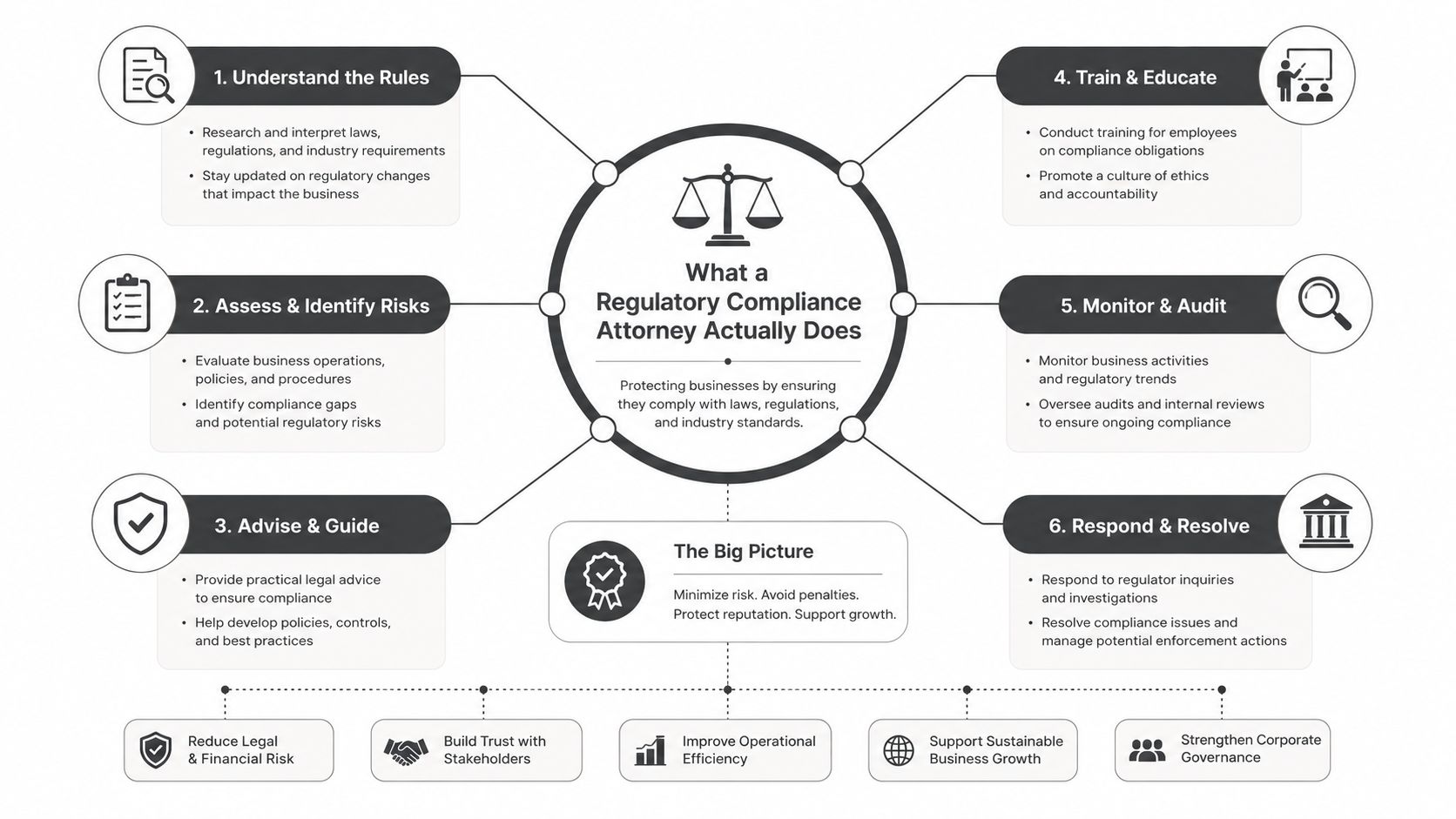
For a plain-English breakdown of how this role fits into a firm's operations, see this regulatory compliance explanation.
How this differs from adjacent lawyers
A general business lawyer can draft contracts and handle corporate housekeeping. An employment lawyer can handle a termination dispute. An in-house chief compliance officer can run the internal program. But when the matter involves a disclosure question, a regulatory investigation, a supervision record, or a disciplinary filing, you need counsel who understands how those pieces fit together.
The difference is not academic. Regulatory work lives and dies on process, not just argument. If the file is messy, the best legal theory in the world won't help much. If the file is disciplined, the response gets easier.
The other reason this specialization matters is that professional regulation is its own ecosystem. The ABA's National Lawyer Regulatory Data Bank exists as a national repository of public regulatory actions involving lawyers in the United States, which tells you something important about the profession as a whole. Regulation is not an edge case. It's built into the structure.
The Regulatory Bodies and Documents That Drive the Work
The forum controls the strategy. That is the first thing advisors need to understand, because the same facts can play very differently depending on who asked for them.
FINRA, the SEC, the CFP Board, and state regulators
FINRA is where many advisor headaches start. The common documents are Rule 8210 requests, Wells-related correspondence, and Form U5 issues. The attorney's job is to protect the record, manage deadlines, and make sure the response doesn't hand FINRA more ammunition than it already has.
The SEC matters differently. The focus often includes recordkeeping, adviser regulation, and examinations or investigations that turn on books, records, and supervisory controls. In those matters, the attorney is looking at the logic of the compliance program, not just the isolated document that triggered the inquiry.
The CFP Board is its own lane. A complaint there is a written disciplinary matter, and the response has to be shaped with precision because the record can affect both reputation and designation status. State securities and insurance regulators add another layer, especially where registration, supervision, and local licensing issues overlap.
For RIA-specific issues, the compliance resource for RIAs is a useful reference point.
The documents that matter most
A regulator usually wants one of four things. A written explanation. A preserved record. A specific correction. Or a clean admission against interest if the facts are already bad. Counsel needs to know which one is in play before drafting a single sentence.
| Regulatory Forum | Common Documents | Counsel's Role |
|---|---|---|
| FINRA | 8210 letters, Wells notices, Form U5 disclosures | Control the response, protect the record, and challenge overbroad or inaccurate characterizations |
| SEC | Examination requests, recordkeeping files, policy records, investigative correspondence | Test the supervision structure and preserve evidence of compliance |
| CFP Board | Complaint notices, written responses, supporting exhibits | Frame the facts carefully and address conduct without overexplaining |
| State regulators | Licensing records, filings, notices, investigative requests | Resolve local issues without letting them spill into broader exposure |
A clean response is not the same thing as a defensive response. Regulators notice the difference immediately.
The tactic changes with the document. A Form U5 amendment request is partly a negotiation with a former employer. A CFP Board response is a submission to an enforcement process. An 8210 response is a deadline-driven evidence exercise. If your lawyer treats them all the same, you're paying for confusion.
How an Engagement Actually Unfolds
The first call should be short, factual, and unsentimental. The lawyer needs the forum, the deadline, the involved parties, the business history, and the exact document that triggered the issue. You need to know whether the matter can be handled on a phased basis or whether it requires immediate document collection and a fast written response.
From intake to written response
After intake comes the conflict check. That matters more than many advisors realize, especially where the firm that employed you is already a client of the same law department or outside counsel. If there's a conflict, you need to know it before anyone starts trading strategy emails.
Then comes the engagement letter. In this space, fees are commonly hourly, flat-fee for discrete phases, or a hybrid structure when the scope is predictable. A Wells notice response is often the kind of matter where a phased approach can make sense, because the work can be broken into document review, drafting, submission, and follow-up. A bigger multi-forum dispute is usually harder to price that neatly.
A serious lawyer will also issue a document preservation instruction right away. Don't wait for the regulator to tell you what to keep. Preserve emails, texts, supervisory notes, advertising drafts, account paperwork, and any internal discussion that touched the issue. If you destroy the record, you've made the next problem worse.
The client's job and the lawyer's job are different. You gather the facts, locate the records, and explain the business. The lawyer turns that into a response strategy, a declaration, or a negotiation position that can survive scrutiny.
Timing and cost discipline
A FINRA 8210 matter can move fast, and the client has to act fast with it. A CFP Board matter often takes longer, because the written exchange and review cycle can stretch out. In both settings, cost rises when counsel has to reconstruct facts from scattered sources or chase records across multiple states and business units.
The practical answer is to phase the work. Get the preservation step done first. Then produce the response draft. Then decide whether settlement, amendment, or escalation makes sense. That is how experienced counsel keeps spend under control without cutting corners.
Building the Records That Prevent the Fight
The best compliance work is boring, repetitive, and written down. That's the point. If your process cannot survive a document request, it wasn't much of a process.
The records regulators actually test
Advertising review should leave a version history. Supervisory approvals should identify who reviewed what and when. Social media should be archived, not casually managed in someone's phone. Gift and entertainment logs should exist. Continuing education tracking should be current. Personal and firm accounts should be separate, because mixed records create mixed explanations.
Each one of those items answers a question a regulator will eventually ask. Was the communication approved before it went out? Who supervised the representative? What did the firm know when it knew it? Did the advisor follow the firm's process or improvise?
That is why a regulatory compliance attorney who focuses on prevention spends real time on controls, not just reactions. The record is the defense.
For a useful outside resource on how to organize those habits, the compliance documentation playbook is worth reading because it treats documentation as an operating discipline, not a filing exercise.
Why this matters in advisor disputes
In a Form U5 dispute, contemporaneous records can be the difference between a corrected filing and a permanent stain. If the termination language overstates misconduct, the advisor's files can support a correction request. If that fails, those same records help in arbitration or litigation because they show what really happened before the employer's version hardened into a filing.
The same logic applies to complaints. A CFP Board filing that accuses an advisor of misleading conduct often turns on whether the firm's own review logs, emails, and supervision notes show a different story. If the files are clean, the response gets more credible. If the files are sloppy, the other side gets to tell the narrative.
For the formal piece on supervisory structure, review this written supervisory procedures definition.
Bottom line: if you want leverage later, build the record now.
That means making documentation a weekly habit, not a crisis habit. The firms and advisors who win these matters usually did one thing right long before the notice arrived. They kept records that made sense to someone who had never met them.
Three Case Examples Financial Advisors Recognize
A real advisor's problem usually falls into one of three buckets. The names change, but the pressure points don't.
The Form U5 fight
A departing representative reviews a draft Form U5 and sees language that suggests client harm, when the actual issue was a messy transition and a compliance team trying to protect itself. Counsel starts by comparing the termination language to the internal emails, branch records, and production notes. Then counsel pushes the firm's compliance and employment teams on what can be removed, softened, or clarified before the filing goes live.
The outcome often turns on two decisions. First, whether the advisor preserved the contemporaneous record before leaving. Second, whether counsel stayed focused on the filing itself instead of getting distracted by the broader breakup. If the firm refuses to correct the disclosure, the next step is usually a claim or arbitration theory that matches the facts, not a sentimental argument about fairness.
The CFP Board complaint
An advisor with the CFP designation receives a complaint that reads worse than the actual conduct. Counsel drafts a written response that is disciplined, direct, and supported by the advisor's supervision history. The point is not to overshare. The point is to show that the firm knew about the process gap, the advisor disclosed it, and the record does not support the harshest version of the complaint.
That kind of response can shape the result. It may not erase the problem, but it can keep the matter from becoming a public sanction when the file supports a narrower resolution. The decisions that matter most are the ones made early, especially what gets admitted, what gets corrected, and what gets left out.
The deferred compensation and promissory note dispute
A broker-dealer wants repayment of an upfront loan after the advisor moves firms. Counsel looks at the promissory note, the production-credit history, and the state-law defenses that apply to the contract claim. These cases are part law and part accounting, which means the record of compensation allocation matters as much as the legal theory.
The sharpest outcomes usually come from two moves. One, force the claimant to prove the exact balance with clean records. Two, challenge clauses that are broader than the facts support. Advisors lose these cases when they treat them like HR disputes. They win when counsel treats them like contract and records cases.
How to Choose the Right Counsel for the Matter
Don't hire the first lawyer who says they “handle compliance.” That phrase covers too much and proves too little.
What to verify before you sign
Start with bar admission and forum experience. A FINRA arbitration may be filed in a range of hearing locations, and the lawyer needs to be properly admitted in the relevant state or work with local counsel. Then check whether the lawyer has handled the forum you're in. FINRA, AAA, JAMS, and CFP Board proceedings are not interchangeable.
Ask direct questions on the first call.
- How much of your practice is regulatory defense? You want someone who lives in this space, not someone who dabbles in it.
- How many FINRA hearings have you taken to award? Settlements matter, but hearing experience tells you whether the lawyer can try the case if needed.
- Who reviews the documents? You want to know whether a senior lawyer is doing the analysis or whether the file is being delegated into the void.
- What's your fee structure for this type of matter? If the answer is slippery, expect the same from the rest of the engagement.
A strong lawyer will also tell you what they won't do. They won't guarantee a result. They won't pretend a weak record can be fixed with confidence alone. They'll tell you whether the problem is amendment, defense, negotiation, or litigation.
Red flags that should end the call
If the lawyer has never appeared in the relevant forum, keep looking. If they won't talk candidly about fees, keep looking. If they talk in generalities about “protecting your license” but can't explain the document that started the problem, keep looking.
The best counsel is usually the one who can explain the risk in plain English and then show you the next three moves.
That is what you need in a financial-services matter. Not theater. Not jargon. A lawyer who knows which documents matter, which deadlines control, and which facts will move the other side.
The Real Value and Your Next Move
The common mistake is thinking a regulatory compliance attorney only matters after the letter arrives. That's backwards. The value is in building records and controls that make the first letter less damaging and the second letter less likely. FINRA inquiries, CFP Board complaints, Form U5 disputes, and deferred-compensation fights all get easier when the underlying files are disciplined and complete.
If you want to discuss your business law matter, contact Kons Law at (860) 920-5181.
A CTA for Kons Law.
