
FINRA Rule 8210 grants FINRA the authority to compel testimony and documents from members and associated persons at any time and place during an investigation or proceeding. It doesn't create a universal response period, and missing the date specified by FINRA can lead to discipline, including fines, suspension, or a bar.
The request often arrives when an advisor is already under pressure. A compliance officer forwards a formal letter, a former firm is involved, and the questions appear broader than the underlying issue. The instinct to respond immediately, explain everything, or ignore the request until counsel is available can all create problems. A disciplined response starts by treating the letter as both a regulatory obligation and a legal event.
What Is FINRA Rule 8210
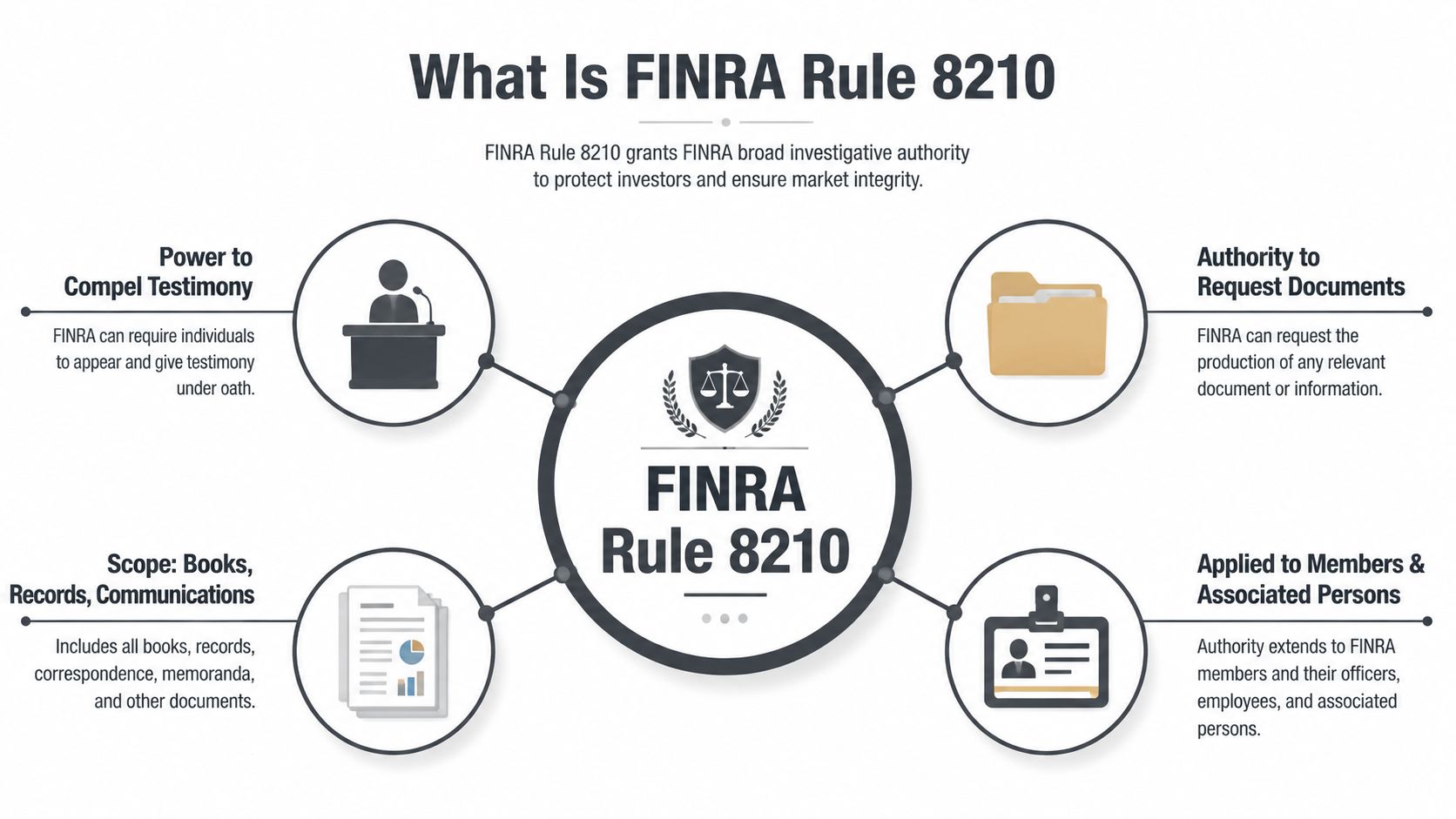
FINRA Rule 8210 gives FINRA authority to require member firms, associated persons, and other people within FINRA's jurisdiction to provide information, documents, and testimony. The rule applies in connection with an investigation, examination, complaint, proceeding, or other inquiry. FINRA can request books and records, communications, account information, business documents, and sworn testimony, subject to the rule's jurisdictional limits and applicable legal protections.
The practical point is simple. A Rule 8210 request isn't an ordinary compliance questionnaire. It is a compulsory demand from a self-regulatory organization with the power to pursue disciplinary consequences when a recipient fails to respond, responds late, or provides incomplete or misleading information.
Why advisors receive these requests
FINRA may direct a request to a broker-dealer, an individual representative, or another person subject to its authority. The request might relate to a customer complaint, trading activity, outside business activity, private securities transaction, supervisory issue, advertising, books and records, or information connected to another respondent.
The scope can feel disproportionate because FINRA often needs surrounding facts before it can determine whether a violation occurred. That doesn't mean every demand is beyond challenge. It does mean that an advisor should identify the legal and factual scope before preparing a substantive response.
The response needs structure
Start by preserving the request, attachments, transmission records, and all potentially responsive materials. Then separate the questions into categories, identify information held by the firm or third parties, and flag topics involving privilege, confidentiality, personal data, or disputed facts.
Technology can help organize records and preserve a defensible review process. Advisors evaluating options to find finance compliance technology should focus on access controls, retention, searchability, and audit trails rather than assuming a software platform replaces legal judgment.
Historical Context and Scope
Rule 8210's current force reflects a long regulatory development. Its lineage traces back to NASD Section 5, which was redesignated on September 1, 1969. FINRA later amended the rule in 1992, 1996, 1997, 1998, 2008, 2010, and 2013, according to the FINRA rule history.
Those amendments matter because they show how the information-gathering power developed rather than appearing fully formed. The rule moved from a narrower industry framework toward a detailed mechanism for obtaining information needed for examinations, investigations, and adjudicative proceedings. Advisors who treat an 8210 letter as a routine request from a former employer miss that broader institutional purpose.
The 2013 expansion
The SEC approved a major amendment effective February 25, 2013, expanding the rule to state that FINRA staff and adjudicators may inspect and copy information in the possession, custody, or control of member firms, associated persons, and other persons under FINRA jurisdiction. The amendment also addressed service on attorneys representing those parties. Those details are central when records sit with a firm, a lawyer, a vendor, or another custodian rather than directly with the individual receiving the request.
The phrase “possession, custody, or control” deserves careful attention. Physical possession isn't the only relevant question. An advisor may need to determine whether a firm, employer, affiliated entity, service provider, or agent can access responsive material and whether the advisor has a practical ability to obtain it.
A wider compliance environment
The rule operates within a larger network of securities oversight. Readers comparing FINRA's role with the broader network of regulatory agencies for banks should keep the institutional distinction clear. FINRA is a self-regulatory organization, but its rules can create direct professional consequences for registered individuals.
The historical trajectory also explains why advisors should build response procedures before a request arrives. The obligation isn't limited to a local office or a single document system. FINRA's recent notice emphasizes that Rule 8210 applies to members and associated persons wherever located, while proposed electronic-only service and filing would move the process toward faster, more automated delivery. That direction increases the value of a careful intake process, particularly for advisors working across firms, jurisdictions, or cloud-based record systems.
Advisors should also understand how suitability and customer-information duties fit into the wider framework. FINRA Rule 2090, discussed in this guide to FINRA Rule 2090, is a separate obligation, but records created during customer onboarding and account review may become relevant to an 8210 inquiry.
Responding to a Request Properly
The first response should be controlled, not improvised. A Rule 8210 letter normally identifies the requesting staff member, the subject matter, the materials or testimony sought, and the required date or time. Confirm that information before anyone begins collecting documents or drafting explanations.

Start with the deadline
There is no universal Rule 8210 response deadline. The FINRA staff member issuing the request specifies the date or time for response, and failure to meet that specified deadline can lead to disciplinary action. FINRA's FAQ also instructs recipients to promptly raise any request for additional time with the requesting staff member, as explained in FINRA's Rule 8210 information and testimony FAQ.
Don't wait until the deadline is nearly over. If the request covers extensive records, involves a former employer, requires translation, or raises privilege concerns, send a written extension request promptly. Explain the concrete reason for the requested time and propose a realistic production schedule. Silence looks different from a documented, good-faith effort to comply.
Validate the scope
Read every definition and instruction. Identify:
- Requested categories: Separate documents, electronic communications, account records, and testimony.
- Time periods: Confirm the dates and whether the request reaches earlier or later conduct.
- Custodians: List the people, devices, firms, and systems likely to hold responsive information.
- Response format: Determine whether FINRA expects native files, searchable documents, written answers, or testimony.
- Unclear language: Ask targeted questions rather than guessing what FINRA intended.
The safest response isn't necessarily the longest one. Produce responsive, organized material and explain clearly when a requested item doesn't exist, isn't in your possession, custody, or control, or requires access from another party. Never fill a gap with speculation.
Prepare for testimony separately
Document production and testimony create different risks. A written response can be reviewed, corrected, and supported with citations to records. Testimony is immediate, sworn, and vulnerable to imprecise answers.
Counsel should help develop a chronology, identify personal knowledge, separate recollection from assumptions, and prepare the advisor to answer only the question asked. Practical preparation principles also apply to testimony settings described in this deposition preparation guide. Preparation isn't coaching a false answer. It is preventing avoidable confusion.
Privilege and Confidentiality Defenses
A Rule 8210 request is powerful, but it isn't a license to disregard every recognized legal protection. Advisors sometimes make the opposite mistake, assuming that the word “privileged” ends the discussion. Neither position is safe.
Attorney-client privilege may protect confidential communications made for the purpose of obtaining or providing legal advice, but the privilege belongs to the client and can be waived through disclosure or careless handling. Business advice, ordinary compliance communications, and documents merely copied to a lawyer may not qualify. The analysis depends on the communication's purpose, participants, subject matter, and treatment.
Preserve the protection correctly
The advisor shouldn't refuse to answer or withhold an entire category without explanation. A defensible process usually involves:
- Identifying potentially privileged material. Separate legal advice from underlying business facts and documents.
- Restricting circulation. Preserve confidentiality and stop unnecessary forwarding.
- Creating a privilege log when appropriate. Describe the document sufficiently to support the claim without revealing the protected substance.
- Producing nonprivileged portions. A privileged email doesn't automatically shield its attachments or independently existing business records.
- Raising disputes promptly. Ask FINRA staff to discuss the issue and document the position taken.
Practical rule: Privilege is an objection that must be asserted carefully, not a reason to stop communicating.
Confidentiality raises a different question. Customer information, employer records, personal data, and proprietary business material may require secure handling, redaction, protective arrangements, or coordination with the firm. Confidentiality alone doesn't necessarily defeat an 8210 demand. It may instead affect the method, scope, and safeguards for production.
Challenge overbreadth without creating a refusal
A request may be duplicative, vague, or broader than the apparent subject of the inquiry. Recent developments make the challenge question more important. In 2026, an SEC opinion in DiPaola held that FINRA could enforce a demand for testimony after a Wells Notice, while vacating the sanctions imposed for noncompliance. A separate external review recommended a formal forum for challenging overbroad requests and guaranteed response windows, as reported in this review of proposed changes to FINRA's enforcement program.
That combination doesn't make every request unenforceable. It does show why an advisor should preserve objections while continuing a constructive dialogue. Ask FINRA to narrow duplicative categories, clarify custodians, sequence productions, or explain why a requested subject is relevant. If the dispute remains material, counsel can evaluate procedural remedies rather than forcing the issue through noncompliance.
Consequences of Noncompliance
The most damaging response is often the one that seems easiest at the time. An advisor misses the deadline, sends an incomplete production, refuses testimony, or answers selectively because the underlying investigation feels unfair. FINRA can treat that conduct as a separate failure to cooperate, even when the original allegations remain unresolved.
FINRA has stated that it barred more than 730 brokers and associated persons during the prior two years and that more than one-third of the enforcement cases resulting in individual bars involved Rule 8210 violations. FINRA's discussion of Rule 8210 and investor protection connects those violations to failures to provide documents, testimony, or other requested information during examinations or investigations.
How a response problem escalates
Consider an advisor who receives a request for communications and testimony. The advisor believes the request is excessive, does not ask for clarification, and produces only a small sample. When FINRA follows up, the advisor misses the next date and later claims that the firm possessed the remaining records.
That sequence creates several issues at once:
- Timeliness: The advisor didn't meet the date specified by FINRA.
- Completeness: The production may not address the request as written.
- Credibility: Explanations about record access can appear inconsistent.
- Separate exposure: The failure to cooperate can become an independent disciplinary issue.
The FINRA Sanction Guidelines state that an automated submission more than 30 calendar days late generally is alleged to constitute a Rule 8210 violation in certain filing contexts. That benchmark doesn't create a universal deadline for every request, but it demonstrates that timeliness can carry a concrete disciplinary significance in particular settings.
Sanctions can affect the career itself
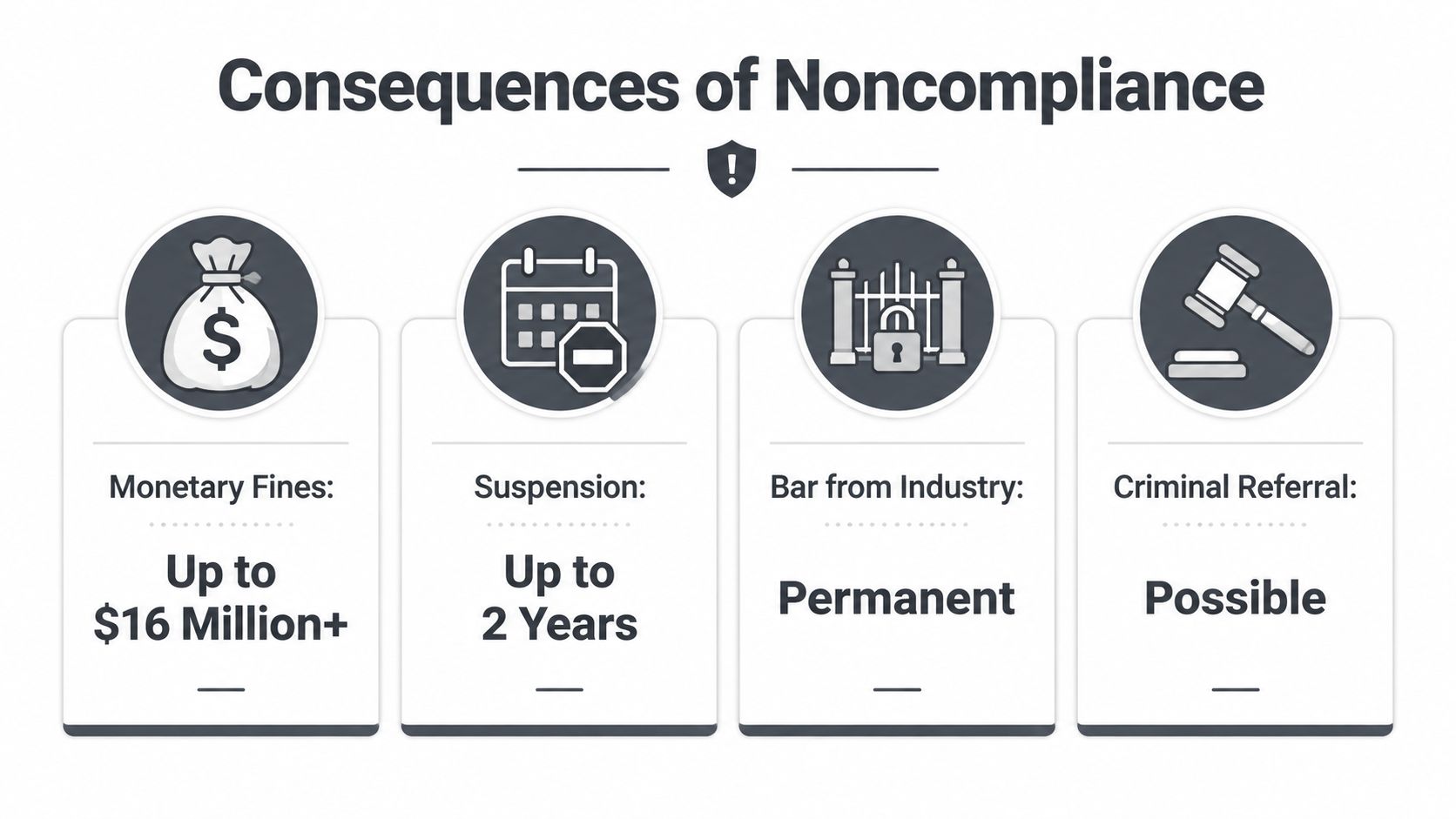
A published FINRA matter states that, for failing to respond timely to Rule 8210 requests, the Sanction Guidelines recommended a fine of $2,500 to $37,000 and a suspension of up to two years. In aggravated circumstances, the respondent was barred from associating with any FINRA member in any capacity, as shown in the published disciplinary decision.
The outcome depends on the facts, including the nature of the request, the respondent's conduct, aggravating or mitigating circumstances, and whether the failure was corrected. But an advisor shouldn't assume that a disagreement over the underlying allegations excuses cooperation. A bar can end a FINRA-regulated career, while a suspension or fine can affect employment, registration, reputation, and future disclosure obligations.
For advisors facing separation from a firm, the relationship between a regulatory response and a Form U5 can be especially consequential. The issues discussed in this resource on Form U5 and FINRA matters should be evaluated alongside the 8210 strategy, not after the employment record has already hardened.
Strategic Response Checklist
A strong response combines speed with restraint. The advisor needs to demonstrate cooperation without surrendering accuracy, privilege, or the ability to challenge an unreasonable demand. That balance is easier to maintain when the response is managed as a project with a written record.
The first day
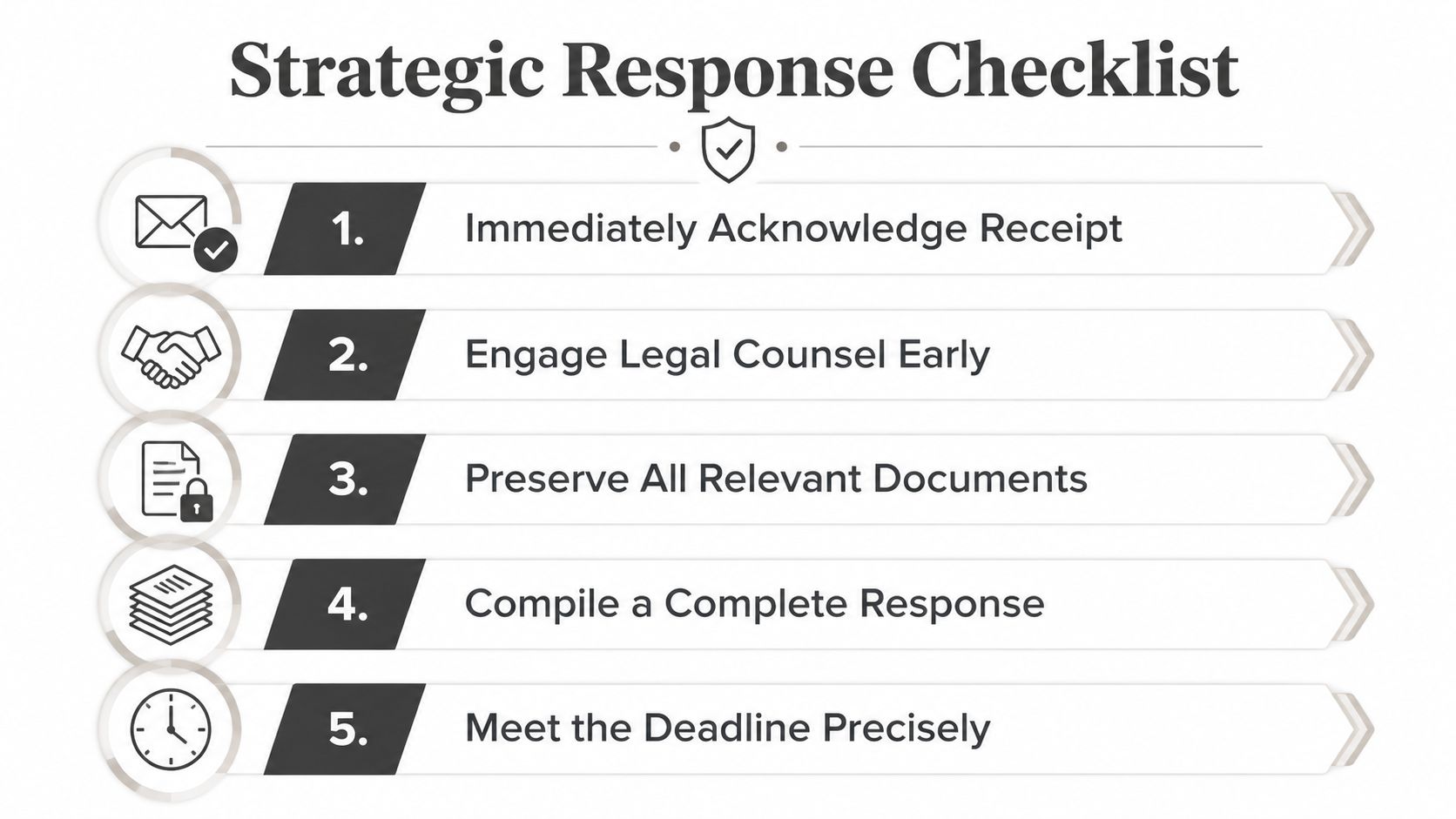
Acknowledge receipt. Confirm that the request was received, identify the person coordinating the response, and avoid substantive commentary until the scope is understood.
Engage counsel early. Counsel can assess jurisdiction, privilege, employment implications, Form U5 risk, and whether the request needs clarification or a staged production. Early review also prevents an advisor from making an unnecessary admission in an informal email.
Build the record before answering
Preserve relevant email, text messages, collaboration-platform records, personal devices used for business, handwritten notes, calendars, and firm correspondence. Don't delete, edit, or reorganize files in a way that changes metadata or obscures the original record.
Create a response matrix with columns for the request number, responsive custodians, likely documents, privilege concerns, factual owner, status, and production date. The matrix gives counsel and the advisor a shared control document. It also exposes gaps early, while there may still be time to obtain records from the firm.
Handle testimony as a separate workstream
Prepare a chronology that distinguishes what the advisor personally did, what the firm instructed, what the records show, and what the advisor merely assumes. Review key documents before testimony, but don't memorize a scripted narrative. Accurate testimony often requires saying that the advisor doesn't recall, needs to review a record, or cannot answer without information held by another person.
Protect employment and registration interests
A Rule 8210 matter can overlap with termination, compensation, customer disputes, or a proposed Form U5 disclosure. Preserve employment agreements, internal complaints, performance records, separation communications, and prior explanations. Those materials may matter if the firm later characterizes the departure or regulatory issue in a way the advisor contests.
A complete response is not the same as an unfiltered response. It is organized, truthful, timely, and supported by a documented process for handling objections.
Meet the deadline precisely, or obtain a written extension before it expires. If a production will be staged, confirm what will be delivered first and when the balance will follow.
Contact Kons Law for Expert Defense
A Rule 8210 request places two choices in front of an advisor. One approach is to respond alone, move quickly, and hope the explanation is sufficient. The other is to obtain legal advice early, preserve the record, coordinate with the firm, identify legitimate objections, and respond in a way that addresses the request without expanding the dispute unnecessarily.
Neither counsel nor any technology can change the facts. Counsel can, however, help determine what the facts mean, separate protected communications from responsive business records, prepare the advisor for testimony, and evaluate whether FINRA's characterization is incomplete or inaccurate. That work becomes particularly important when the inquiry overlaps with termination, compensation, Form U5 language, or a later securities arbitration.
Kons Law represents financial advisors and brokerage professionals in regulatory inquiries, FINRA investigations, disciplinary matters, securities arbitration, and Form U5 disputes. Its regulatory compliance attorney resource addresses the type of early legal coordination that can help an advisor protect the response process.
If you want to discuss your business law matter, contact Kons Law at (860) 920-5181. Don't wait until a deadline has passed or testimony has been scheduled to determine how you will protect your professional record.
Kons Law can help financial advisors assess a FINRA Rule 8210 request, preserve relevant records, prepare responses and testimony, and address related Form U5 concerns. Visit Kons Law to discuss your matter and arrange a consultation.
