
You're an advisor leaving a brokerage, reviewing a transition package, or waiting for a bonus the firm says it can't release. The agreement may look familiar, but the money often turns on details buried in production-credit definitions, vesting schedules, termination provisions, promissory notes, and side agreements with servicing entities. By the time the dispute becomes obvious, the firm may already have treated deferred compensation as forfeited or applied an offset against an alleged debt.
A broker compensation agreement is not routine paperwork. It's the document that defines what you earn, when the firm must pay it, what happens after departure, and whether a disputed amount becomes a negotiation, a FINRA arbitration claim, or a repayment demand. The practical question is not whether the agreement appears fair at signing. It's whether the language will still protect your position when the relationship ends under pressure.
Why Your Broker Compensation Agreement Decides Your Paycheck
An advisor can perform exactly as expected and still lose a compensation dispute because the agreement never clearly answers what was earned. A payout formula may refer to “production,” while another document uses “eligible production.” A bonus may be described as payable after a measurement period, but the plan may reserve the firm's right to change the formula before payment. A deferred amount may appear on internal statements without a clear vesting trigger.
Those gaps matter most at three points. The first is hiring, when an advisor accepts a grid, bonus plan, transition payment, or recruiting package. The second is a move between firms, when production credits, promissory notes, and forgivable loans interact. The third is termination or resignation, when the firm decides whether pending compensation remains payable and whether it can offset that amount against an alleged debt.
Practical rule: Treat every compensation document as part of one economic deal, even if the firm separates it into a grid, bonus plan, offer letter, promissory note, handbook, and policy manual.
The agreement usually binds the advisor and the broker-dealer, but the payment chain may include a team, branch, registered investment adviser, practice entity, or third-party servicing entity. That structure can create separate questions about who calculates compensation, who receives client-related revenue, who employs support personnel, and who has authority to change the payout terms.
An advisor evaluating a transition should also distinguish employment compensation from ownership economics. The discussion of how being an equity partner works can help clarify why an equity interest, profit allocation, and employee payout are different rights. Calling someone a “partner” doesn't automatically resolve whether the person owns an interest, receives a contractual bonus, or remains dependent on the firm's compensation plan.
The same discipline applies before signing. Advisors should ask direct questions about payment dates, post-termination rights, and the consequences of a Form U5 event. A useful starting point is this guide to questions to ask a broker, particularly when the answers will affect a transition or employment decision.
The central lesson is simple. A compensation agreement protects a paycheck only when it defines the paycheck with enough precision to survive disagreement.
Essential Clauses Every Broker Compensation Agreement Needs
A strong agreement starts with definitions, not promises. “Revenue,” “production,” “net revenue,” “client assets,” “eligible accounts,” “house accounts,” and “chargebacks” should each have a stated meaning. If a formula depends on data maintained by the firm, the agreement should identify the report used, the calculation date, and the process for correcting an error.
Build the payment formula around verifiable inputs
The agreement should state how production credits are assigned when multiple advisors serve an account, when a team splits revenue, or when a client changes representatives. It should address reversals, refunds, unpaid invoices, corporate accounts, and revenue received after a client transfer. A formula that looks objective can still produce conflict if the firm alone controls the underlying records and can reclassify revenue after the advisor leaves.
Payout timing deserves equal attention. Identify the event that makes compensation payable, the payment date or payment window, and whether the firm may delay payment while reviewing a compliance issue. If review rights exist, require a written explanation and preserve the advisor's right to challenge the calculation.
Deferred compensation and bonuses need more than an eligibility statement. Specify:
- Vesting triggers: State whether vesting depends on continued employment, production, client retention, a measurement date, or another event.
- Payment timing: Identify when vested amounts become payable and whether the firm can postpone payment.
- Forfeiture limits: Separate unearned amounts from compensation already earned or vested.
- Clawback conditions: Define the conduct or event that permits recovery, the calculation method, and any notice requirement.
- Termination consequences: Address resignation, termination without cause, termination for cause, disability, death, retirement, and a Form U5 event separately.
A firm may need protection against fraud, chargebacks, or regulatory losses. An advisor may accept a narrowly defined clawback to obtain a better upfront package. The agreement should connect the recovery right to a documented loss rather than allow an unrestricted cancellation of compensation.
Keep records and remedies usable
The contract should identify which documents control if the offer letter conflicts with a compensation plan. It should also state how amendments become effective and whether the firm can make retroactive changes. A written acknowledgment process is important for referral arrangements and other payments that may implicate registration rules.
Indemnification language can also affect the financial consequences of a dispute, especially when the parties allocate responsibility for regulatory costs, client claims, or third-party conduct. Advisors and firms reviewing that risk should consider how indemnification clauses in contracts interact with compensation and compliance obligations.
Finally, preserve access to records. The agreement should provide a process for obtaining production reports, statements, bonus calculations, and post-termination account records. Without the underlying data, an advisor may know the firm's calculation is wrong but lack the evidence needed to prove the amount.
Red Flags and Costly Drafting Mistakes to Avoid
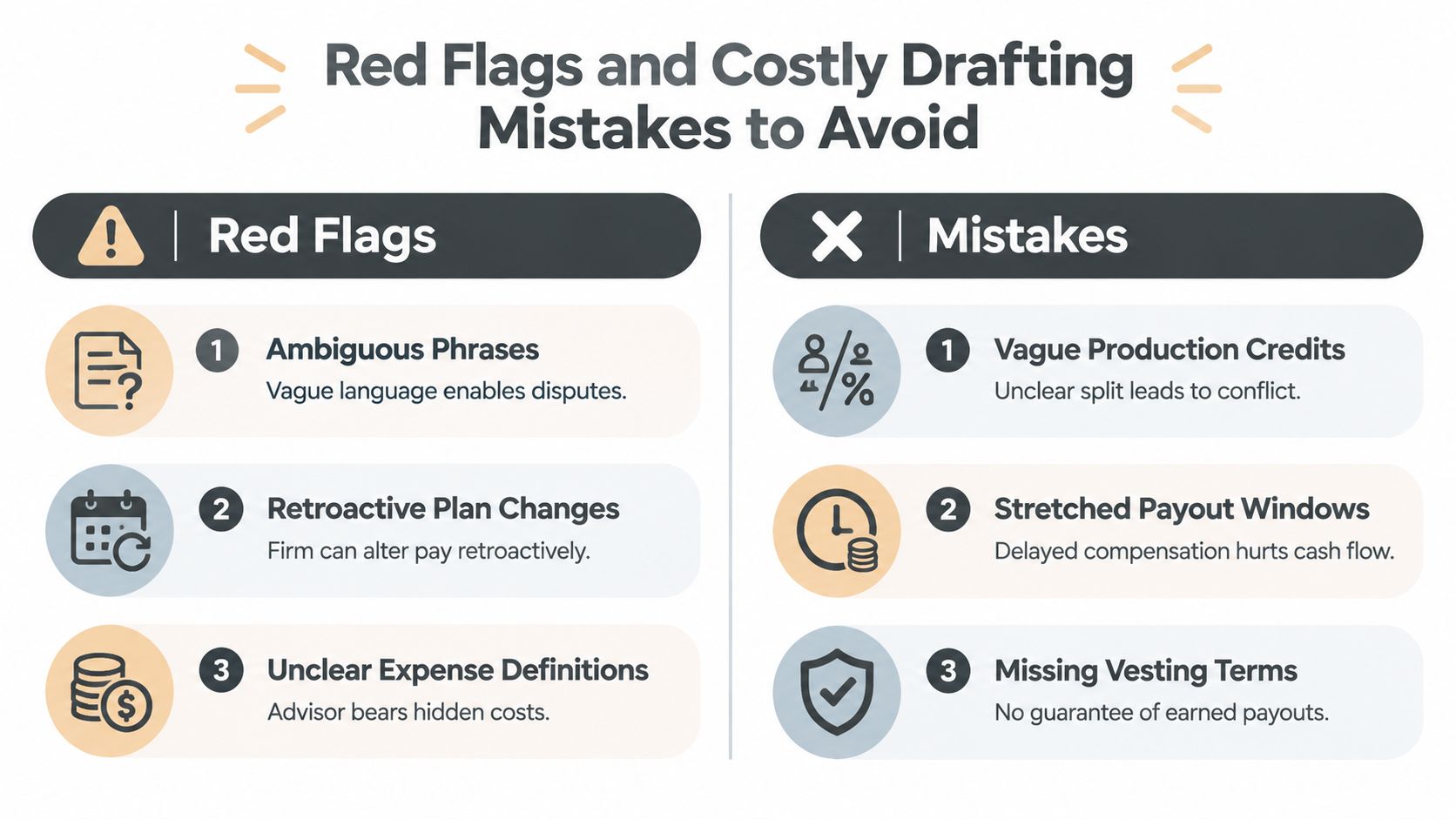
The most dangerous compensation language often sounds reasonable. Phrases such as “in the firm's discretion,” “subject to company policy,” “eligible production,” and “amounts determined after review” can give a broker-dealer flexibility that effectively defeats an advisor's expectation of payment. Flexibility has a legitimate business purpose, but it should have boundaries, timing, and a review process.
Retroactive plan changes create a particularly sharp problem. If a firm can alter the formula after an advisor has generated the revenue, the advisor may argue that the firm changed the bargain after performance. If the agreement instead permits changes before a stated measurement period, the firm has a stronger position. The drafting must distinguish prospective administration from retroactive reduction.
Reported FINRA disputes illustrate how much can turn on payout language. One reported award granted former brokers about $1.167 million in deferred compensation, while another matter resulted in approximately $3 million paid to former brokers over deferred-compensation claims, as summarized in the SEC-filed compensation materials. Those outcomes don't establish an automatic entitlement for every departing advisor. They show why vesting, forfeiture, and proof of performance can determine whether a claim produces recovery or nothing.
Watch the third-party payment chain
Third-party servicing entities, hybrid W-2 and 1099 staffing, and referral layers can create Rule 2040 exposure. FINRA Rule 2040 states that a member generally may not directly or indirectly pay compensation, fees, commissions, or similar allowances to an unregistered person when the activity would require broker-dealer registration. The rule permits limited foreign finder arrangements only when specific documentation, customer acknowledgment, disclosure, and record-retention requirements are met, as described in FINRA Rule 2040.
FINRA's 2026 PSE guidance adds a practical concern. Written servicing agreements must bar unregistered personnel from securities-related activities and prohibit bonuses tied to transaction-based compensation paid by the broker-dealer to the PSE, according to FINRA Regulatory Notice 26-12. A payment labeled an administrative bonus may still create trouble if the economic reality rewards transaction activity.
The agreement should identify each recipient, the services performed, the source of payment, and the compliance controls governing the arrangement. It should also prohibit support personnel from soliciting, negotiating, or effecting securities transactions unless properly registered and supervised.
Promissory notes can reverse the economics
Transition packages often combine upfront compensation with a repayment obligation. If the advisor leaves or is terminated, the firm may demand repayment under a promissory note and attempt to offset unpaid compensation. FINRA's Rule 2341 framework is relevant to these arrangements, and a 2026 enforcement example reported that a former Wells Fargo broker was ordered to repay about $1 million in promissory notes, as reflected in FINRA's Rule 2341 materials.
That risk should be addressed before signing. Ask whether repayment is reduced over time, what event accelerates the balance, whether termination without cause changes the obligation, and whether the firm may apply a compensation offset. A note that ignores those questions can turn a recruiting benefit into a significant post-employment liability.
How to Review and Negotiate Stronger Compensation Terms
Negotiation works better when each side separates economic value from enforcement mechanics. A firm may refuse to guarantee every future bonus, but it may agree to define the formula, preserve records, and pay amounts that have vested. An advisor may accept a performance condition, but should resist language allowing the firm to cancel earned compensation merely because employment ends.
| Issue | Firm-favorable position | More protective alternative |
|---|---|---|
| Production credits | Firm may reclassify credits under policy | Formula, data source, and correction process are written |
| Deferred pay | Continued employment required through payment | Vested amounts survive specified departures |
| Clawback | Broad discretion to recover compensation | Recovery tied to defined conduct or documented loss |
| Plan changes | Immediate or retroactive amendment power | Prospective changes with written notice |
| Termination | All unpaid amounts are forfeited | Earned and vested amounts remain payable |
| Promissory note | Entire balance becomes due on departure | Repayment schedule addresses cause and timing |
The most important ask is usually not a higher headline payout. It's a clear calculation mechanism. Request a sample calculation using realistic account and production data. If the firm won't provide one, ask for the fields used in the calculation and the report that will control. A formula that can't be tested before signing is difficult to challenge after departure.
Trade concessions without surrendering earned pay
A firm may insist on discretion over future incentive plans. That can be acceptable if the agreement confirms that a plan change applies prospectively and doesn't affect compensation already earned or vested. Likewise, a clawback may be reasonable for documented client refunds or proven misconduct, but not for an undefined business disagreement.
Referral and finder arrangements require special care. FINRA's foreign finder exception includes requirements involving foreign parties, customer disclosure, written acknowledgment, retained records, and trade-confirmation disclosure, as set out in FINRA's foreign finder rule text. The agreement should identify who handles each requirement and prevent the advisor from being responsible for compliance steps controlled by the firm.
Documentation is part of negotiation, not an afterthought. Keep the offer letter, compensation grids, plan versions, production reports, emails, account-transfer records, and written explanations of any adjustment. For a broader approach to preparing for difficult deal discussions, advisors and owners can review these negotiation skills recommendations.
A practical compromise often looks like this: the firm retains control over future plans, while the advisor receives defined treatment for revenue already generated, vested awards, pending accounts, and termination without cause. That division respects the firm's need to manage its business without leaving the advisor dependent on an after-the-fact interpretation.

Enforcing Payment and Resolving Disputes Through FINRA Arbitration
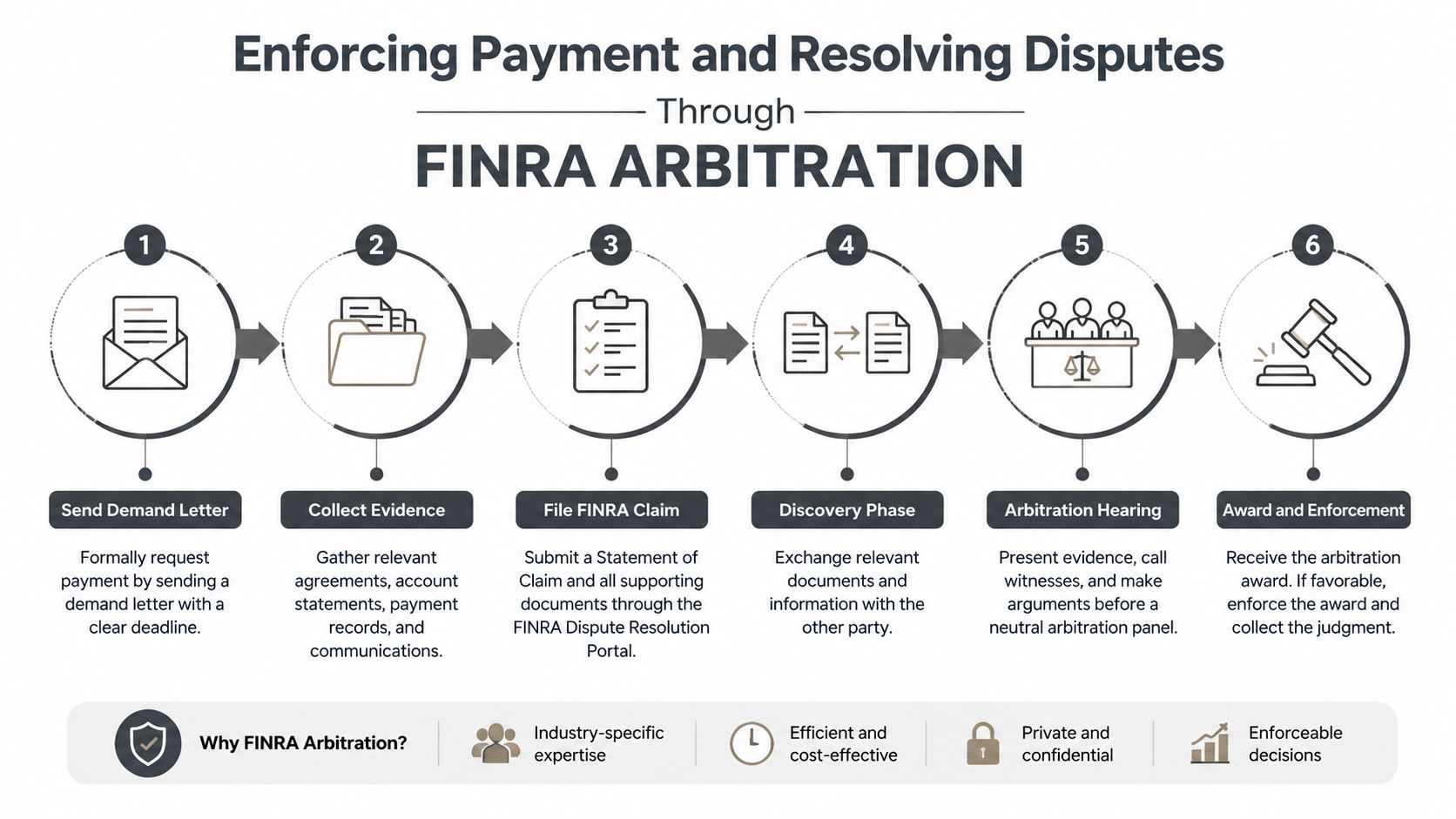
When compensation is withheld, start with proof rather than outrage. Gather the signed agreement and every incorporated plan, then compare the firm's calculation with production reports, statements, client-transfer records, and payment history. A demand letter should identify the contractual provision, state the amount or calculation method, request the relevant records, and set a reasonable response date.
FINRA materials expressly include employee compensation or termination among disputes that can be arbitrated, and FINRA makes awards publicly available through its arbitration awards database, as described in its arbitration process materials. Eligibility still depends on the parties, claims, agreement, and applicable deadlines, so counsel should evaluate the forum before filing.
A disciplined enforcement sequence
- Preserve the record. Save agreements, plan versions, payroll data, production reports, correspondence, termination documents, Form U5 materials, and promissory-note notices.
- Send a focused demand. Explain the calculation and identify the requested payment, records, and contractual basis. Avoid unnecessary accusations that distract from the proof.
- Analyze offsets separately. Determine whether the firm is withholding compensation, demanding repayment, or doing both. An offset may raise different contract and employment issues from the underlying payout claim.
- File the appropriate claim. If FINRA arbitration applies, plead the contract terms, performance, payment default, defenses to forfeiture, and any related termination or regulatory facts with precision.
- Use discovery strategically. Seek the reports and policies that controlled the calculation. Compare treatment of similarly situated advisors only when the evidence supports a relevant legal theory.
- Plan for collection. A favorable award is not the end of the matter. FINRA states that monetary awards must be paid within 30 days, and the award may require further court procedures if the losing party doesn't pay.
The March 22, 2024 outcome reported by InvestmentNews shows the potential scale of these disputes. A FINRA panel ordered Morgan Stanley to pay just over $3 million to seven former advisors in a deferred-compensation dispute involving 15 former advisors, with claims filed on September 20, 2022, as reported in InvestmentNews coverage of the arbitration outcome. The result doesn't replace contract analysis. It demonstrates why a deferred-pay dispute can remain financially significant after employment ends.
If the firm is the claimant, the same process runs in reverse. Review the note, repayment schedule, acceleration clause, credits for prior payments, and any defenses based on termination or contract breach. Do not assume the firm's ledger is correct, and do not ignore a demand because the disputed amount originated as recruiting compensation.
For broader context on forum selection and strategy, see this discussion of securities arbitration. The right strategy may involve negotiation, arbitration, court confirmation, judgment enforcement, garnishment, or liens, depending on the award and the debtor's assets.
Protect Your Compensation With a Clear Next Step
Review your broker compensation agreement before a transition becomes urgent. Start with the documents that determine the money: the production-credit formula, payment dates, vesting triggers, bonus conditions, clawback language, termination provisions, plan-amendment rights, and any promissory note. Then identify who calculates the payout, who receives each payment, and whether a servicing entity or referral arrangement changes the compliance analysis.
Your evidence should tell the story without relying on memory. Retain signed agreements, every applicable plan version, account and production reports, pay statements, emails about adjustments, written notices of termination, Form U5 materials, and promissory-note correspondence. If the firm says compensation is forfeited, ask which clause applies, what event triggered it, how the firm calculated the amount, and whether the payment had already vested.
Review at the moments that matter
- Before signing: Test the formula with examples and negotiate definitions, payment timing, and amendment limits.
- Before transitioning: Reconcile production, pending revenue, deferred balances, loan obligations, and client-transfer terms.
- After a payment dispute: Send a focused written demand and preserve the firm's explanation.
- After termination or a Form U5 event: Obtain the complete compensation record and evaluate employment, regulatory, and contract issues together.
- Before filing: Confirm arbitration eligibility, deadlines, available remedies, and collection prospects.
The strongest agreement doesn't eliminate every disagreement. It narrows the dispute to verifiable facts and prevents one party from rewriting the bargain after performance. If the language leaves vesting, forfeiture, offsets, or third-party payments open to interpretation, early legal review is usually more useful than waiting for the first missed payment.
Kons Law handles contract drafting, compensation negotiations, commercial disputes, collections, creditors' rights matters, and securities arbitration involving financial professionals. Its attorneys can assess a broker compensation agreement, a deferred-compensation claim, a promissory note, or a termination-related payment dispute and develop a practical path forward.
If you want to discuss your business law matter, contact Kons Law at (860) 920-5181. Visit Kons Law to discuss drafting, negotiating, or enforcing compensation terms before a disputed payout becomes a larger employment or regulatory problem.
