You're reviewing client files when an enforcement attorney calls. A Wells Notice will follow. The letter identifies proposed violations, requests a response, and gives you little time to decide whether speaking will improve your position or create additional risk. Meanwhile, your broker-dealer, employer, state registrations, professional designations, and disclosure obligations may all become relevant.
A disciplined Wells notice response starts before drafting. First, understand what the notice means, then evaluate whether a submission serves your interests, preserve the record, address parallel disclosures, and use the available response period deliberately. The right strategy may involve a detailed submission, a narrowly focused response, or no submission at all.
Understanding the Wells Notice Process
The first reaction is usually personal. A financial advisor sees the words, imagines a public enforcement action, and starts drafting a defense before identifying what the SEC or FINRA staff alleges. That sequence creates avoidable problems. A Wells Notice signals that staff intends to recommend enforcement action, but it isn't itself a formal charge or a final decision by the Commission.
Read the document as a proposed case outline. Identify the conduct at issue, the rules or statutory provisions staff believes apply, the people and transactions involved, and the relief staff may seek. The response must address the allegations presented, not every grievance connected to the investigation.
The process has a clear historical origin. In 1972, a committee chaired by former Senator John Wells recommended that securities regulators give prospective respondents notice before bringing formal charges. FINRA later described the purpose as giving the recipient an opportunity to submit a written Wells Submission explaining why formal charges aren't appropriate. FINRA's Regulatory Notice 09-17 also states that an associated person must report a written Wells Notice on Form U4.
Practical rule: Treat the notice as a procedural opportunity, not as a finding of liability.
That distinction matters, but it shouldn't create false comfort. The staff has reached a preliminary enforcement view, and the document may affect your professional life even before any complaint is filed. A registered person may face employment questions, internal supervision, customer concerns, and disclosure analysis alongside the agency process.
You should also separate the notice from the broader legal risks associated with a notice of intent. A concise overview of those risks can help frame the difference between a proposed regulatory action and a final adjudication, particularly when considering legal risks of notice of intent.
What to examine immediately
Create a working chart with one row for each allegation. Include the alleged legal element, the evidence identified or implied by staff, the facts you dispute, the documents supporting your position, and any factual concessions that require careful treatment.
The notice may also reveal what staff considers important through its description of proposed relief. A request for an industry bar, monetary relief, or other sanctions presents different strategic concerns than a narrower allegation involving supervisory or reporting conduct. Don't assume the remedy discussion is secondary. It may influence settlement posture, employment consequences, and how you organize the response.
If you're unfamiliar with the agency process, Kons Law's overview of SEC investigations provides useful context for understanding how an investigation can develop into a proposed enforcement recommendation. Your immediate task, however, is narrower. Preserve the record, secure counsel, identify the deadline, and decide whether a Wells Submission is worth making.
Deciding Whether to Submit a Response
A Wells Submission is optional. The SEC's Enforcement Manual describes it as an opportunity to make a submission, not a requirement, as explained in the SEC Enforcement Manual. That choice is the central strategic question, yet many explanations treat responding as automatic.
The decision should turn on what the submission can accomplish and what it may expose. A strong response can correct a factual misunderstanding, identify missing evidence, challenge an element of the proposed violation, narrow the requested relief, or give decision-makers a reason to reconsider the recommendation. A weak response can preserve damaging statements, reveal defense theories, and create inconsistencies that staff may later use.
| Consideration | Responding may help when | Silence may be preferable when |
|---|---|---|
| Factual record | Staff appears to have misunderstood documents, chronology, or responsibility | The record is already complete and additional facts won't change the analysis |
| Legal theory | A targeted argument defeats an element of the proposed violation | The submission would reveal a defense without correcting a material error |
| Parallel exposure | The response can be coordinated across regulators and employers | A related criminal or separate regulatory matter creates heightened disclosure risk |
| Remedy | Mitigating facts may affect the scope of proposed relief | You're already pursuing a settlement strategy that doesn't depend on a merits submission |
The collateral consequences deserve separate analysis. FINRA states that receipt of a written Wells Notice must be reported on Form U4, which means the notice can enter the professional record even though it isn't a formal charge. The disclosure may prompt questions from an employer, compliance department, regulator, or professional organization. A later separation can also raise Form U5 issues, so counsel should coordinate the investigation response with employment and disclosure strategy rather than treating each filing in isolation.
A decision process that preserves flexibility
Start by asking what staff is missing. If the answer is a document, witness account, chronology, or legal authority that directly undermines the proposed theory, a submission may have substantial value. If the answer is that you disagree with the agency's policy judgment, broad disagreement is less likely to persuade than a structured challenge tied to legal elements and admissible evidence.
Next, identify what you'd have to concede to tell your story. Some explanations require context that can't be presented without acknowledging facts that may later be harmful. Other cases turn on a clean documentary record where a focused submission can correct the agency's interpretation without exposing a broader defense roadmap.
You should also model the parallel consequences before choosing silence. Review Form U4 obligations, possible Form U5 language, state registration effects, employment agreements, customer communications, and professional designation requirements. A response that helps the SEC analysis but creates an inconsistent employment disclosure can solve one problem while creating another.
For attorneys assessing these trade-offs, a regulatory compliance attorney can help coordinate the agency response with the professional's wider reporting and workplace obligations. The choice shouldn't be made because responding feels courageous or silence feels defensive. It should reflect the evidence, the legal theory, the potential remedies, and the consequences outside the enforcement file.
Navigating the 2026 Timeline Extensions
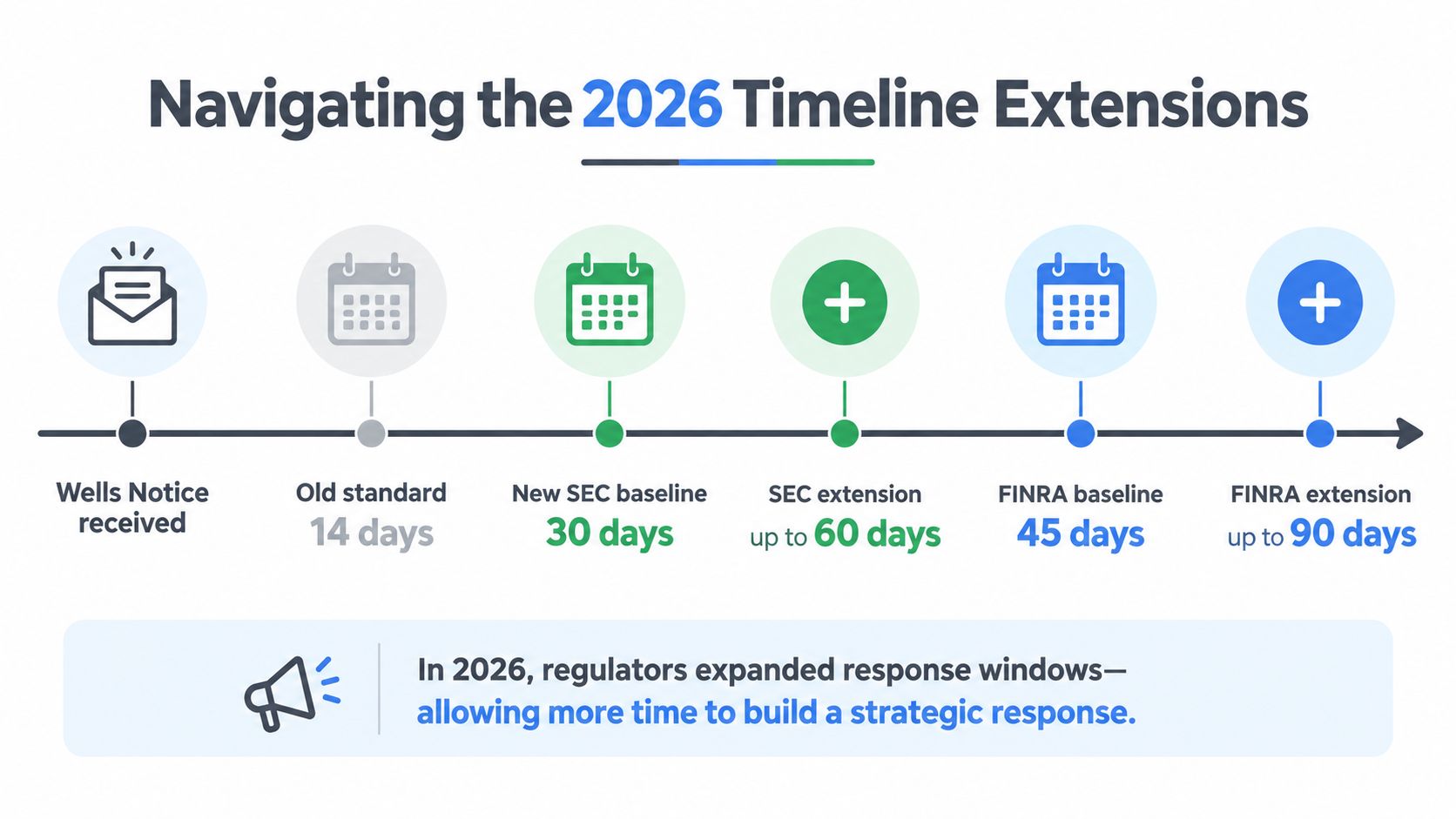
The SEC changed the practical timing analysis in 2026. After revising its Enforcement Manual on February 24, 2026, the SEC extended the standard Wells Notice response period from two weeks to four weeks, or 28 calendar days. The update was described as the first substantive change to the manual's Wells timeline since 2017, according to Morgan Lewis's securities enforcement roundup.
FINRA separately announced that its enhanced Wells process extends the response period to 30 calendar days, absent exigent circumstances, as described in the SEC announcement regarding the Enforcement Manual updates. Those periods are longer than the older practice, but they aren't permission to delay. A Wells notice response still requires factual reconstruction, legal research, exhibit preparation, internal review, and coordination with affected organizations.
The first 72 hours
First, confirm the trigger date. Save the notice, transmittal email, delivery record, attachments, and any instructions about format or page limits. Ask counsel to confirm the operative deadline in writing. Don't rely on an informal estimate of “about a month.”
Second, stop unsupervised communications. Direct substantive questions from staff, customers, colleagues, or journalists to counsel or the appropriate compliance contact. Don't delete, edit, annotate, or reorganize potentially relevant files in a way that changes their original state.
Third, preserve evidence. Implement a litigation hold covering email, messaging platforms, personal devices used for business, customer files, trading or recommendation records, supervisory materials, and relevant calendars. The hold should identify custodians and systems, not just tell employees to “save everything.”
Fourth, secure the investigative record. Ask counsel to identify what non-privileged file content staff will provide and whether additional access, transcript material, or clarification is available. The updated SEC guidance directs staff to be more forthcoming about salient, probative evidence and relevant non-privileged file content, allowing the response to target disputed facts and legal elements, as summarized by JDSupra's discussion of the updated SEC Enforcement Manual.
Fifth, establish parallel disclosure controls. Assign one person to track Form U4, Form U5, state, employer, and professional-organization questions. The response team and employment counsel must use consistent facts, while recognizing that each disclosure may have different wording and timing requirements.
Use the additional time intelligently
The longer window supports deeper preparation, not longer rhetoric. Build a chronology, interview witnesses, test staff's interpretation against original documents, and identify whether a pre-charge meeting, reverse proffer, transcript review, or post-Wells meeting could clarify disputed issues. FINRA's 2026 enforcement-review recommendations urged that Wells submissions generally receive no fewer than 30 days and discussed practices including reverse proffers, transcript access, and post-Wells meetings, as described in its enforcement program recommendations.
Drafting an Evidence-Based Submission
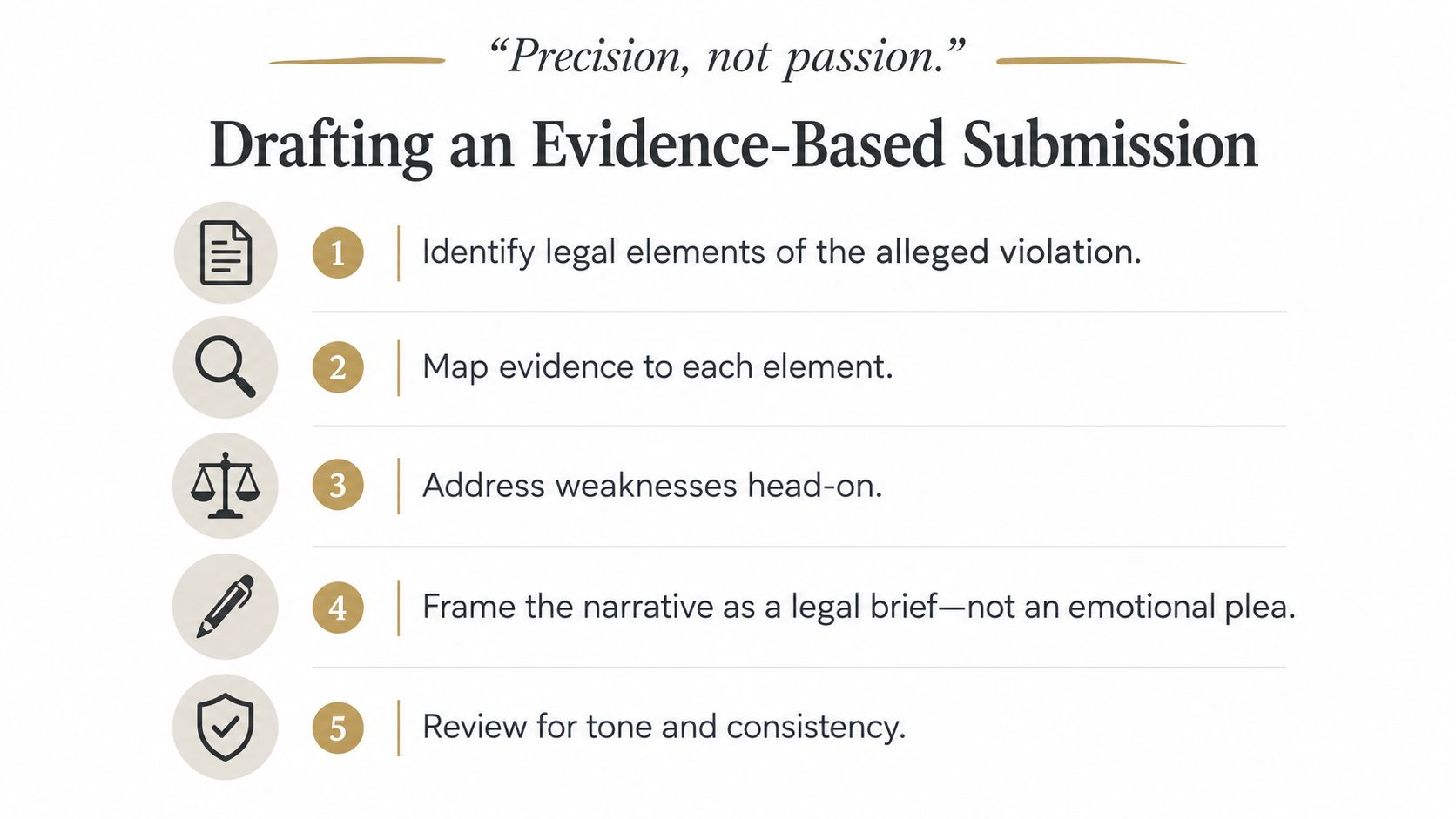
A persuasive Wells Submission resembles a focused legal brief. It shouldn't read like an angry letter, a personal apology, or an untethered account of everything that happened during the investigation. The strongest structure follows the notice's allegations and gives the reviewing officials a simple path from legal element to evidence to conclusion.
The SEC's updated guidance emphasizes concise, evidence-based submissions addressing disputed issues, exculpatory facts, unfavorable precedent, and litigation or programmatic risks. Staff is also instructed to be more forthcoming about probative evidence and relevant non-privileged file content, which makes a careful record comparison especially valuable.

Build the legal map first
Begin with the proposed violation, not the narrative. For each allegation, identify the required legal elements and ask whether staff has evidence supporting every element. Then separate facts that are disputed from facts that are undisputed but legally insufficient.
A useful internal matrix includes:
- Allegation: State the proposed violation precisely.
- Required elements: List what staff must establish.
- Record evidence: Identify the documents, testimony, and data staff relies on.
- Contrary evidence: Cite the original record that undermines the allegation.
- Legal response: Explain why the evidence fails to establish an element or supports a different conclusion.
- Remedy analysis: Address proportionality, customer impact, remediation, supervisory context, and practical litigation risks.
That matrix may never appear in the final filing, but it prevents a common failure. Writers often spend pages explaining motives while leaving an essential legal element unchallenged.
Write for a skeptical decision-maker
Use headings that track the notice. Put the strongest threshold argument early, then support it with record citations and carefully selected exhibits. If a witness statement matters, identify the relevant testimony and explain why it changes the legal analysis. If an expert would materially clarify market practice, valuation, supervision, or another technical issue, use expert analysis selectively rather than adding a decorative opinion.
A practical memorandum writing guide can help with organization, issue framing, and disciplined analysis, but a Wells Submission has its own procedural demands. Follow the notice's instructions, preserve confidentiality, and confirm that every factual assertion can be supported by the record.
Drafting discipline: Precision, not passion, gives the reader a reason to change the proposed recommendation.
Avoid broad claims that staff acted unfairly unless the point directly supports a legal or procedural argument. Avoid speculation about what other witnesses “must have meant.” Don't include settlement proposals in the merits submission. Keep admissions narrow and accurate, and distinguish a factual concession from agreement with staff's legal characterization.
Make exhibits do real work
An exhibit should answer a question. Use a short exhibit description that tells the reader what to look at and why it matters. A policy manual may show the supervisory standard. A customer communication may establish what was disclosed. A chronology may demonstrate that an alleged omission occurred after a decision had already been made.
Coordinate the submission with requests made under FINRA rules and information produced during the investigation. Counsel handling a FINRA matter should understand the significance of FINRA Rule 8210 and ensure that the response doesn't conflict with prior production, testimony, or written representations.
Conclude with the requested action. If the facts support termination, say so and explain why. If the record supports narrower allegations or reduced relief, identify the practical resolution that follows from the evidence. The submission should leave the reviewing official with a defensible reason to modify or decline the recommendation.
Evaluating Settlement and Litigation Risks
Filing a Wells Submission doesn't end the matter. It changes the decision environment. Staff may ask questions, request clarification, discuss possible resolutions, or continue toward a recommendation. Your counsel should treat every interaction as part of a broader strategy, not as an informal conversation detached from the record.
Settlement and litigation require different investments. Settlement prioritizes control over allegations, admissions, sanctions, undertakings, timing, and public language. Litigation prioritizes preserving objections, testing evidence, developing discovery positions, preparing witnesses, and building a record for a hearing or court.
| Path | Potential advantage | Principal cost or risk |
|---|---|---|
| Settlement | Greater control over scope, wording, timing, and practical obligations | You may accept findings or relief that affect future employment and registration |
| Administrative defense | A formal forum to challenge the allegations and develop the evidentiary record | The process can consume substantial time and resources while keeping regulatory exposure active |
| Federal litigation | Judicial review and litigation tools suited to certain legal and factual disputes | Public pleadings, discovery burdens, and adverse rulings can increase reputational and financial risk |
Post-submission engagement can provide information, but it isn't a guarantee of staff's ultimate position. A request for clarification may mean staff is testing an argument, not conceding it. Conversely, a willingness to discuss narrowing allegations may create an opportunity to negotiate a more manageable resolution.
Keep collateral damage in the negotiation
A settlement should be evaluated beyond its monetary terms. Consider industry restrictions, supervisory conditions, customer communications, reporting language, Form U4 or U5 consequences, state licensing effects, and professional designation issues. An agreement that appears efficient may be unacceptable if its factual wording creates a new employment or registration problem.
If litigation is likely, begin preparing before formal charges. Identify witnesses, preserve institutional knowledge, collect missing documents, and assess whether any prior disclosure could become an impeachment issue. In FINRA matters, the applicable procedural rules and hearing posture can differ from an SEC action, so review the FINRA Code of Procedure rather than importing assumptions from SEC practice.
The best settlement position often comes from credible litigation preparation. Staff is more likely to take a defense seriously when counsel can identify the disputed evidence, explain the legal weakness, and demonstrate readiness to litigate. But litigation preparation doesn't require rejecting every resolution. It gives the professional the information needed to decide whether a negotiated outcome protects the career and business better than a contested proceeding.
Strategic Defense Checklist and Next Steps
A sound Wells notice response strategy should produce a written record of decisions, not just a polished submission. Use this checklist:
- Calendar the deadline. Confirm whether the matter is SEC or FINRA, calculate the applicable response period, and request any extension early.
- Preserve evidence. Issue a litigation hold and protect original emails, messages, documents, testimony materials, and customer records.
- Choose the response posture. Decide whether to submit, respond narrowly, seek engagement, or remain silent after analyzing merits and collateral risks.
- Build the allegation matrix. Map every proposed violation to its legal elements, supporting evidence, contrary evidence, and requested relief.
- Coordinate disclosures. Review Form U4 and Form U5 issues with counsel, and maintain consistent factual descriptions across employer, regulator, state, and professional disclosures.
- Draft for decision-makers. Use concise headings, record citations, relevant precedent, focused exhibits, and a clear requested outcome.
- Prepare for each result. Plan for further staff contact, settlement discussions, a modified recommendation, formal charges, or no action.
- Control communications. Limit internal and external statements to approved personnel. Guidance on Ciphar secure communication frameworks may help organizations structure communications during a sensitive regulatory matter.
Kons Law represents financial professionals in regulatory inquiries, FINRA matters, securities arbitration, Form U5 disputes, and related employment and business-law issues. If you want to discuss your business law matter, contact Kons Law at (860) 920-5181.
Kons Law can help evaluate whether a Wells Submission advances your position, develop an evidence-based response, and coordinate Form U4, Form U5, employment, and regulatory risks. Visit Kons Law to discuss your circumstances and begin a focused response strategy.
