
It's Monday morning, and a compliance officer is already dealing with an urgent request from a regulator. The firm may know the representative, the customer, and the transaction, yet still struggle to locate the email review, outside business activity approval, supervisory note, or disclosure that proves the firm acted properly.
That problem captures the modern meaning of regulatory compliance requirements in financial services. Compliance isn't one policy manual or one annual certification. It's a layered operating system involving federal regulators, self-regulatory organizations, state authorities, professional bodies, vendors, and the firm's own supervisory procedures. A useful program must identify who owns each obligation, when the control runs, what evidence it creates, and how the firm responds when something goes wrong.
The Compliance Stack Most Advisors Don't See Until It's Too Late
A mid-sized broker-dealer receives a FINRA Letter of Request for Information about a registered representative's outside business activity. The chief compliance officer expects the response to be routine. Then the search starts.
The representative's disclosure appears in the CRM, but the approval email is in an archived mailbox. A supervisor remembers discussing the activity but can't find a written review. The branch inspection file contains a reference to the issue, but not the supporting evidence. The firm has policies, yet it can't quickly demonstrate that the policies operated as written.
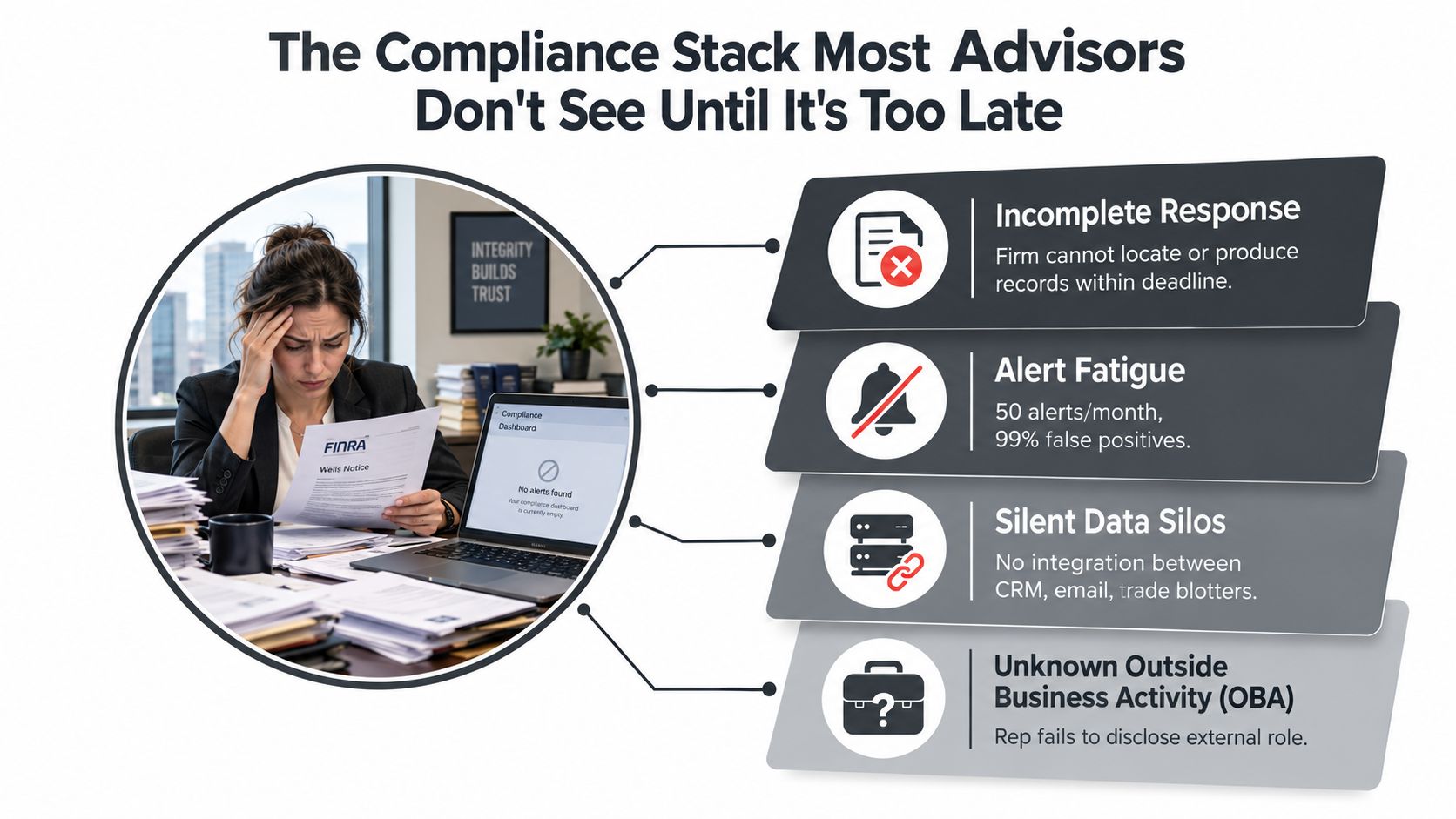
That is where the compliance stack becomes visible. The firm may have SEC registration, FINRA membership, state securities obligations, anti-money-laundering controls, advertising review, suitability or fiduciary procedures, and electronic recordkeeping requirements. Those layers don't run in parallel. They overlap around the same representative, client, communication, transaction, and supervisory decision.
A regulatory inquiry exposes the connections. A missing OBA approval can become a supervision issue. A communication about the activity can raise advertising or books-and-records questions. A failure to preserve the underlying correspondence can turn a manageable inquiry into a response problem.
Practical rule: A policy that can't produce its own operating evidence is only a promise.
The same principle applies to written supervisory procedures. The question isn't whether the firm has a section addressing outside activities. The question is whether the assigned supervisor reviewed the activity, applied the stated criteria, recorded the decision, escalated exceptions, and retained the evidence in a retrievable format.
Compliance obligations have also become more complex across business functions. A widely cited 2025 global compliance survey found that 85% of respondents said requirements had become more complex over the previous three years. The survey describes compliance as reaching products, governance, reporting, tax, sustainability, IT systems, data, ethics, workforce, health and safety, and trade and sanctions obligations. The World Bank's regulatory governance dataset covers 186 countries, reinforcing that regulatory compliance is a worldwide operating concern, not a single-market problem. PwC's Global Compliance Study provides the survey reference.
Registration, Licensing, and the Federal-State Divide
Registration gives a financial firm permission to operate, but it also creates an ongoing supervisory relationship. Think of registration as a driver's license paired with operating rules. A commercial pilot's certificate is a better analogy for a complex firm, because the permission depends on the aircraft, route, qualifications, maintenance, and continuing oversight.
A broker-dealer generally operates through SEC registration and FINRA membership. Its registration and personnel records run through systems such as Form BD, CRD, and individual Form U4 filings. The firm then carries continuing duties involving supervision, financial responsibility, books and records, communications, training, and disclosures.
An investment adviser follows a different route. Depending on its business and regulatory status, the adviser may register with the SEC or with state securities administrators. Its primary disclosure document is Form ADV, while investment adviser representatives may need state licensing and representative-level filings. Registration does not end the analysis. Each jurisdiction may add notice filings, examination authority, financial requirements, or representative obligations.
Registration pathways by entity type
| Entity Type | Primary Registration | Key Forms Filed | Supervisory Trigger |
|---|---|---|---|
| Broker-dealer | SEC registration and FINRA membership | Form BD, Form U4, CRD records | FINRA and SEC supervision of firm activities, personnel, finances, communications, and records |
| Investment adviser | SEC or state registration, depending on applicable status | Form ADV and state filings | Advisers Act or state adviser obligations, including policies, disclosures, and review duties |
| Investment adviser representative | State licensing or notice filing where required | Form U4 and CRD records | State oversight of representative conduct, qualifications, disclosures, and activities |
| Dual registrant | Combination of broker-dealer and adviser registrations | Form BD, Form ADV, Form U4, CRD records | Overlapping broker-dealer, adviser, FINRA, SEC, and state requirements |
The federal baseline doesn't erase state obligations. A firm may need to track continuing education, fingerprinting, net capital or financial responsibility requirements, state notice filings, and changes to personnel disclosures. The exact duties depend on the entity, registration status, activities, and jurisdictions involved.
The practical distinction between credentials matters too. A Series 7 qualification doesn't answer every state-law or adviser question, and a state representative license doesn't authorize every broker-dealer activity. Advisors comparing the Series 63 and Series 7 should treat the exams as parts of a permissions framework, not interchangeable badges.
Supervision begins when registration is granted. The firm must know which activities each person may perform, which jurisdiction permits them, which disclosures apply, and which supervisor owns the review. A clean registration record with weak activity monitoring still leaves the firm exposed.
The Four Core Regimes Every Financial Firm Must Run
Four operating regimes appear repeatedly in examinations because they connect daily activity to documentary evidence: anti-money laundering, advertising, client obligations, and recordkeeping. Each requires more than a written statement of intent.
Anti-money laundering
The Bank Secrecy Act and FinCEN rules require covered firms to maintain a written AML program suited to their risks. The program generally addresses customer identification, suspicious activity detection and reporting, escalation, training, and independent testing. Examiners may ask for the written program, independent testing report, training records, customer identification procedures, alerts, investigations, and documentation supporting suspicious activity decisions.
The common failure isn't always the absence of a policy. It's a program that doesn't match the firm's products, customers, transaction patterns, or vendor arrangements. A useful anti-money-laundering compliance program connects risk assessment to monitoring and then preserves the reasoning behind decisions.
Advertising and communications
Investment advisers must address SEC Marketing Rule 206(4)-1 requirements. Broker-dealers must apply FINRA Rule 2210 and related communications standards. The review process should identify the communicator, audience, approval authority, content version, supporting substantiation, filing requirement, and retention location.
Examiners commonly request advertisements, social media posts, website changes, testimonials or endorsements, approval records, disclosures, and evidence that the firm monitored actual use. A pre-approval stamp without substantiation won't answer whether performance information, hypothetical results, or third-party statements were presented fairly.
Suitability and client duty
Broker-dealers must apply Regulation Best Interest, including care, disclosure, conflict, and compliance obligations. Advisers operate under a fiduciary obligation, which requires attention to duties such as care and loyalty. Broker-dealers also face Form CRS obligations when applicable.
The evidence usually starts with account-opening materials, customer profiles, investment rationale, recommendations, conflict disclosures, exception reviews, and complaint files. The compliance question is whether the firm can show why the recommendation was appropriate in context, not merely whether a form contains a signature.
Recordkeeping
SEC Rule 17a-4 and FINRA Rule 4511 govern important aspects of broker-dealer record preservation. Retention schedules, electronic storage, access controls, supervision of vendors, and prompt retrieval must work together. The traditional concern about WORM storage now sits alongside technical requirements involving electronic record maintenance and third-party recordkeeping.
SEC recordkeeping became more technical after the 2022 amendments to Rule 17a-4. The amended requirements concerning electronic records, third-party recordkeeping services, and prompt production became effective January 3, 2023, with a compliance date of May 3, 2023, as described in FINRA's books and records checklist. Weak indexing, incomplete email archiving, and vendor misalignment can delay a response when the regulator asks for records.
| Regime | Principal Rule | Core Program Element | Common Exam Finding |
|---|---|---|---|
| AML | Bank Secrecy Act and FinCEN rules | Written risk-based AML program, CIP, monitoring, reporting, testing | Testing or monitoring doesn't match the firm's actual risks |
| Advertising | SEC Rule 206(4)-1 and FINRA Rule 2210 | Approval, substantiation, disclosures, filing, retention | Content was used without adequate review or support |
| Suitability and client duty | Regulation Best Interest and adviser fiduciary obligations | Client profile, recommendation analysis, conflicts, disclosures | Files don't explain the recommendation or conflict review |
| Recordkeeping | SEC Rule 17a-4 and FINRA Rule 4511 | Retention, electronic preservation, access, prompt retrieval | Records are incomplete, inaccessible, or not produced promptly |
Where Federal Rules End and State Rules Begin
A multi-state firm should route each issue by asking three questions: what entity is involved, what activity occurred, and where is the person or client regulated? That decision is more reliable than assuming the federal registration determines every applicable rule.
The SEC generally oversees federally registered investment advisers and registered broker-dealers under federal securities laws. FINRA oversees its members and associated persons under its rules. State securities administrators retain authority in important areas, including state-registered advisers, investment adviser representatives, broker-dealer agents, certain notice filings, and state enforcement.
The National Securities Markets Improvement Act framework can preempt some state requirements for federally covered securities and certain federally registered advisers. It doesn't eliminate every state role. States can still regulate areas reserved to them, examine entities within their authority, and enforce antifraud provisions. A firm registered with the SEC may still interact with state securities divisions and state attorney generals.
| Topic | SEC | FINRA | State |
|---|---|---|---|
| Entity registration | Federal adviser and broker-dealer registration | Membership and associated-person oversight | State adviser, representative, agent, and notice requirements |
| Supervision | Adviser compliance programs and federal conduct rules | Member supervision, communications, records, and examinations | State supervisory and examination authority |
| Advertising | Adviser marketing requirements | Broker-dealer communications standards | State-specific conduct and antifraud rules |
| Records | Federal books, records, and production requirements | FINRA retention and examination requirements | State recordkeeping and examination expectations where applicable |
| Enforcement | Federal investigations and proceedings | Self-regulatory investigations and discipline | State investigations, administrative actions, and enforcement |
Use the regulator's own authority as the routing rule. FINRA questions a member firm's supervision and associated-person conduct. The SEC focuses on federal securities-law compliance. A state regulator asks whether the firm or representative complied with the state permission and conduct framework.
Building a Compliance Program That Actually Works
An effective program combines the adviser framework under SEC Rule 206(4)-7 with the broker-dealer supervision framework under FINRA Rule 3110. The labels differ, but examiners ask a similar operational question: who identified the risk, who owned the control, what evidence shows it ran, and what changed after the review?
Start with a written supervisory procedures index. Each policy should identify the applicable rule, responsible owner, review frequency, evidence location, escalation route, and last revision. A document that only repeats regulatory language doesn't tell a supervisor what to do on Tuesday morning.
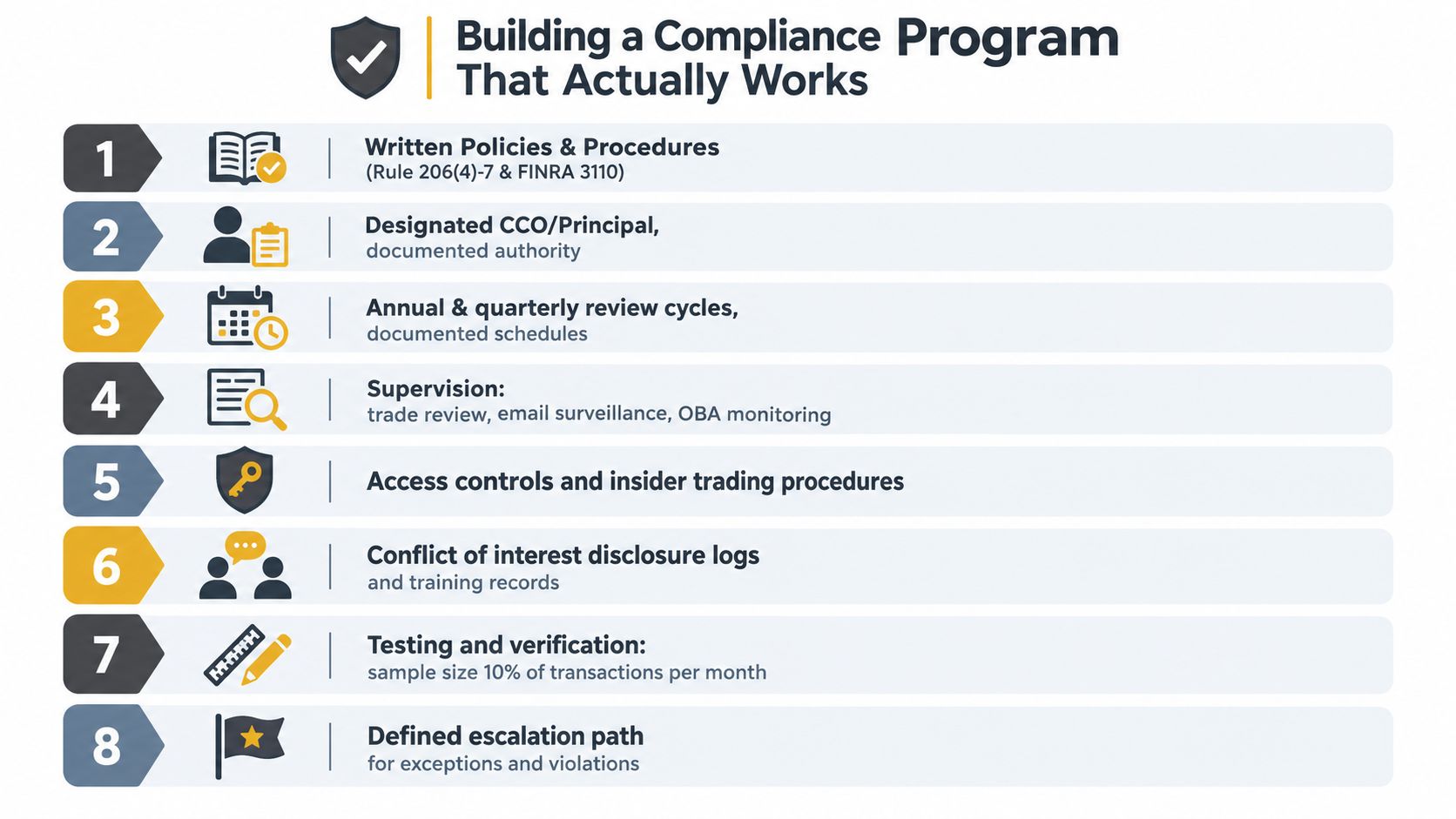
The operating components
- Written procedures: Explain the activity, responsible person, approval path, exception process, and retention requirement.
- Designated authority: Give the CCO or responsible principal documented access to management, information, budget, and escalation channels.
- Review calendar: Schedule annual reviews, periodic testing, branch reviews, communication surveillance, and regulatory filing checks.
- Supervision: Review trades, emails, outside activities, conflicts, complaints, and unusual patterns using documented criteria.
- Training: Tie training records to actual risks, including new products, advertising practices, cybersecurity, AML, and conduct.
- Testing and verification: Record the population tested, selection method, reviewer, findings, corrective action, and closure.
- Escalation: Define when an exception goes to senior management, legal counsel, a committee, or a regulator.
- Governance reporting: Provide management or the governing body with open issues, aging, remediation status, and unresolved risk acceptance.
The visual includes a transaction-sampling example, but firms shouldn't copy a sample size mechanically. Sampling must reflect the risk, population, transaction type, testing purpose, and documented rationale. A small sample with a clear methodology can be more defensible than a larger sample selected without explaining what it was designed to detect.
Evidence standard: A reviewer should be able to reconstruct the control without interviewing the person who performed it.
Technology can help, but it won't cure unclear ownership. Firms evaluating whether to replace spreadsheets with compliance software should first define the obligations, evidence, approvals, and escalation paths the system must support. Software is useful when it centralizes evidence and creates accountability. It doesn't make a weak procedure adequate.
A firm assessing its broader corporate compliance program should also map regulatory controls to governance, vendor management, incident response, and business ownership. That prevents the compliance function from becoming an isolated repository of policies no operating team follows.
Risk-Based Prioritization for Limited Compliance Bandwidth
Small and mid-sized firms rarely have unlimited compliance staff. The answer isn't to treat every task as equally urgent. Rank each obligation using three variables:
- Regulatory exposure: What consequence follows if the control fails?
- Examination focus: How likely is the issue to appear in an inquiry, examination, complaint, or thematic review?
- Remediation cost: How difficult will it be to reconstruct records, correct client impact, or redesign the process after failure?
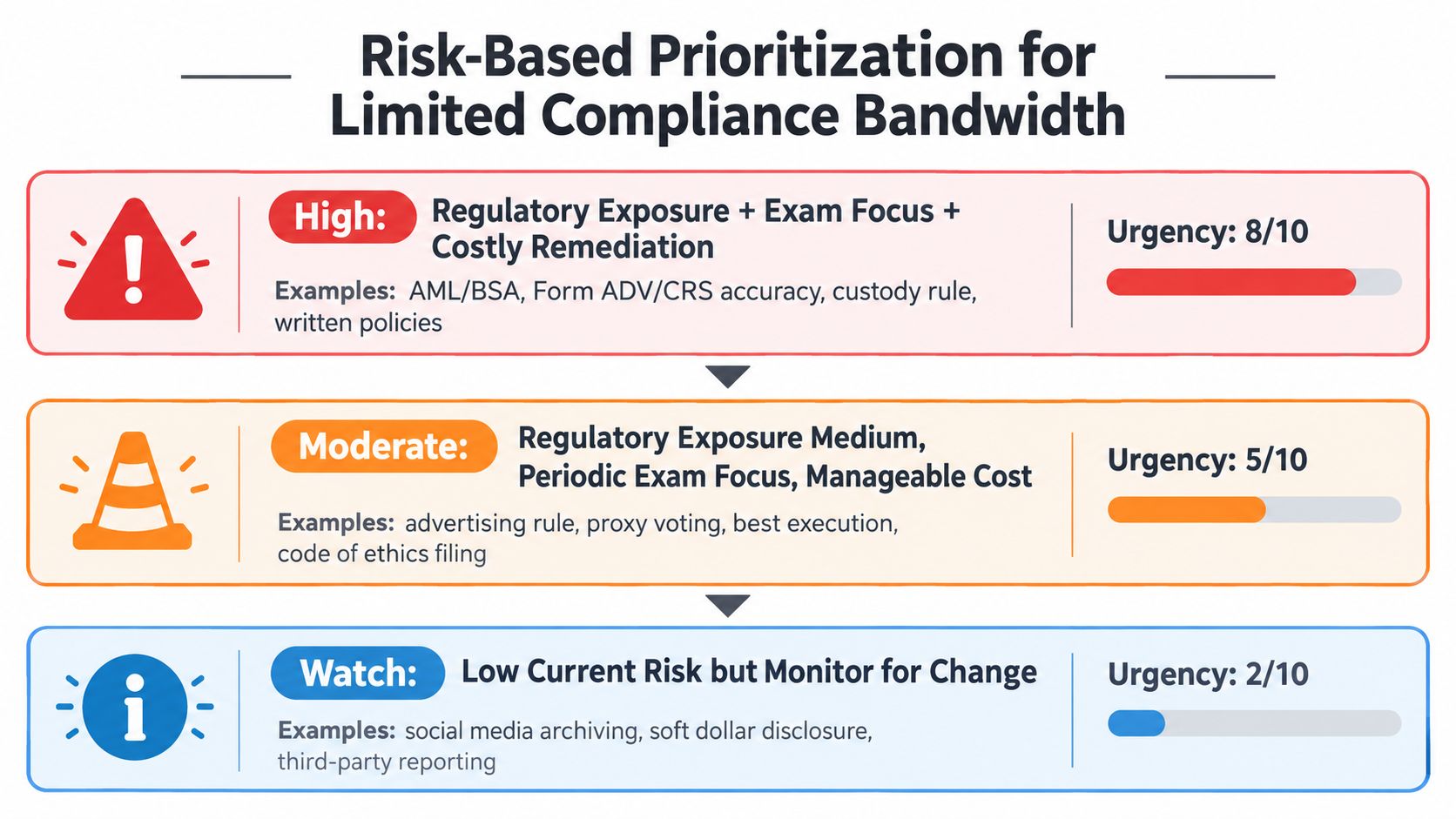
A practical priority register can use High, Moderate, and Watch categories. The category should reflect the firm's actual business, not a generic industry list.
High priority
Put AML and BSA controls, Form ADV and Form CRS accuracy, custody analysis, written supervisory procedures, cybersecurity, and response readiness near the top when they apply to the firm. These areas combine regulatory significance with the potential for expensive reconstruction or client harm.
Moderate priority
Advertising review, proxy voting, best execution, code of ethics administration, continuing education tracking, and vendor due diligence may require steady attention but can often be scheduled through recurring workflows. They shouldn't disappear from the calendar because they aren't the first remediation target.
Watch level
Social media archiving, soft-dollar disclosure, and third-party reporting deserve monitoring for business or regulatory changes. A Watch classification means the firm has a control and a review date. It doesn't mean the obligation is optional.
A team of one or two people can create a register with columns for rule, business owner, evidence, last test, open exception, exposure, examination sensitivity, remediation effort, and next action. Sequence work by the combined score, then reserve time for new inquiries and deadline-driven requests.
The regulatory compliance market's expansion reflects why firms need this discipline. One industry estimate placed the global market at $23.18 billion in 2025, up from $21.16 billion in 2024, and projected $34.62 billion by 2030, with a stated 9.5% CAGR, as reported in compliance industry market research. Those figures are an industry estimate, not a reason to buy technology. They do show that organizations are spending more resources to manage increasingly complex obligations.
Why a Checklist Mentality Is the Biggest Compliance Risk
A completed checklist proves that someone checked a box. It doesn't prove that the firm exercised judgment, investigated an exception, or corrected a control failure.
That distinction matters when written procedures exceed actual practice. A firm may certify that supervisors review outside activities, communications, and transactions, yet retain no review notes, inconsistent samples, or unexplained exceptions. During an examination, the mismatch between the policy and the file can become more important than the policy's wording.
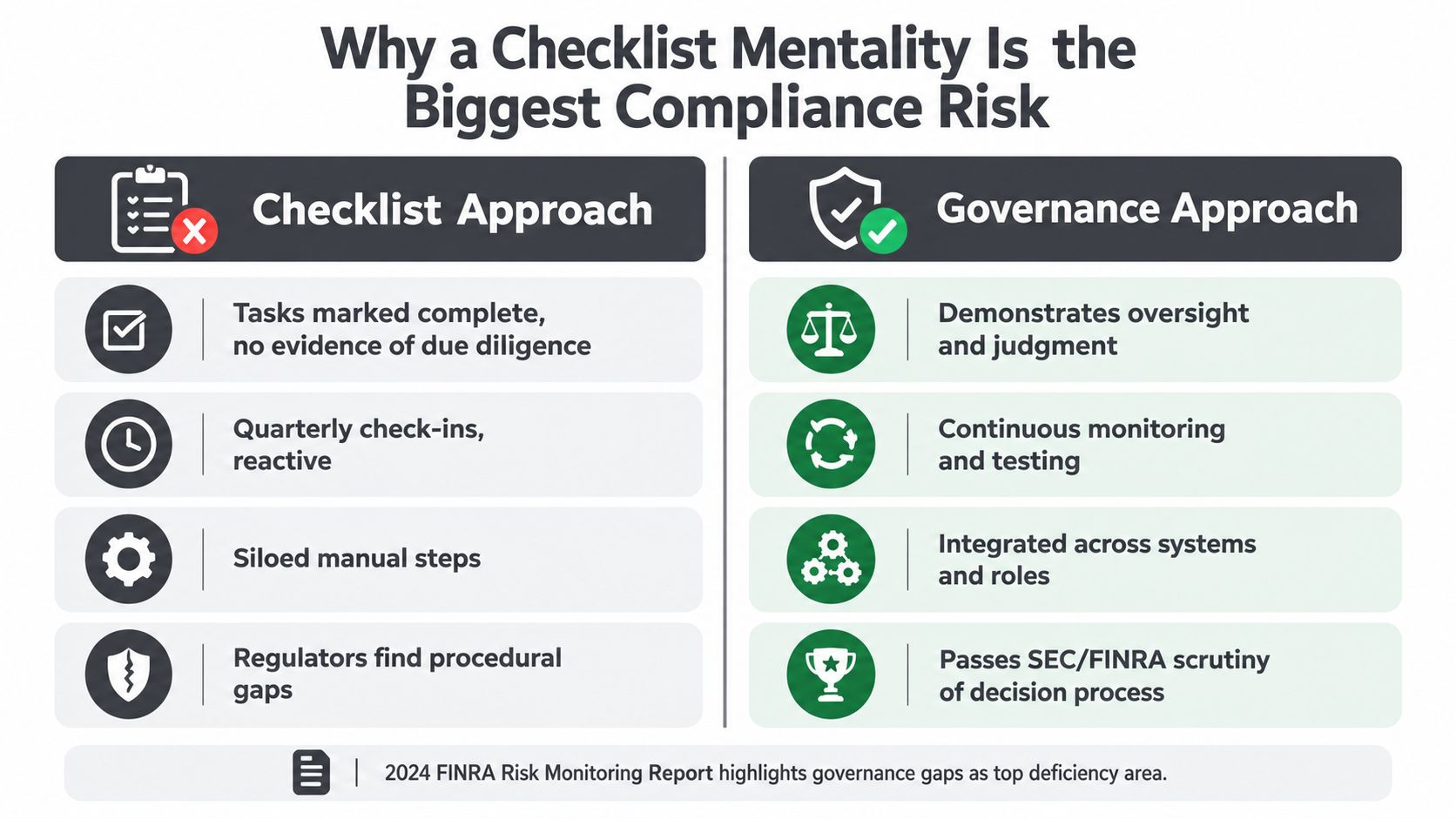
Attestation is not substantiation
An annual certification says the responsible person believes the program is operating. Substantiation shows the underlying evidence: the population reviewed, the exceptions found, the decision-maker, the escalation, the remediation, and the follow-up test.
The difference appears in ordinary files. A marketing review log may say “approved,” while the supporting performance calculation sits elsewhere. A suitability review may show a completed form, but not the analysis supporting the recommendation. A cybersecurity policy may exist, but vendor access reviews and incident decisions may be undocumented.
Ask this before signing a certification: Would a third reviewer, reading the files today, reach the same conclusion recorded last quarter?
Governance requires feedback
A governance-based program treats findings as information about the control. If email surveillance produces recurring false positives, the firm should document how it adjusted the review criteria. If a branch inspection identifies a repeated gap, management should record ownership, deadline, interim protection, and closure testing.
The 2024 FINRA Risk Monitoring Report is identified in the assigned visualization as highlighting governance gaps as a top deficiency area. That message aligns with the practical examination experience reflected in FINRA's supervisory framework. Regulators want to understand the decision process, not see a sequence of completed administrative tasks.
The diagnostic is simple. Pick a recent annual review, advertising file, AML test, or complaint response. Remove the person's memory from the process. If the file no longer explains what happened and why, the firm has a checklist, not a defensible control.
Turning Requirements Into a Defensible Operating Standard
Return to the FINRA inquiry involving the representative's outside business activity. A defensible firm doesn't need a perfect history. It needs a reliable way to show what the representative disclosed, who reviewed it, what facts informed the decision, how the firm supervised the activity, and what records support the response.
That standard can be reduced to four operating questions:
- Who acts? Name the supervisor, principal, CCO, committee, or business owner.
- When do they act? Identify the trigger, deadline, review cycle, or escalation point.
- How is evidence captured? Specify the system, document, approval, test result, or communication record.
- How is deviation corrected? Record the exception, responsible owner, remediation, deadline, and closure test.
FINRA Rule 8210 creates a direct obligation for firms and associated persons to provide information, documents, and sworn testimony when FINRA requests them in an investigation, complaint, examination, or proceeding. The rule also authorizes inspection and copying of books and records within a person's possession, custody, or control, regardless of location. FINRA explains that failure to respond truthfully or completely can result in expedited proceedings and sanctions up to expulsion for firms or a bar for individuals. FINRA Rule 8210 should sit in every response protocol.
If more time is needed, FINRA says the request should be raised promptly with the requesting staff member, as described in its Rule 8210 information and testimony guidance. A response team should centralize the request, preserve relevant records, assign custodians, screen for privilege, track productions, and document any burden or scope concern.
This week, create a one-page gap map for AML, advertising, suitability or fiduciary duty, and recordkeeping. Compare each regime with the firm's last testing cycle, open findings, evidence location, and response owner. Then rank remediation by examination exposure and the cost of reconstructing proof.
CFP-designated advisors should add a separate professional layer. CFP Board's enforcement system permits sanctions including private censure, public censure, suspension or revocation of certification rights, and temporary or permanent bars from applying for or obtaining certification. CFP Board also states that administrative orders may issue when a respondent defaults by failing to acknowledge or answer a notice. Its enforcement process and case histories database show that public disciplinary orders can include sanctions and continuing education undertakings.
A regulator may not punish an imperfect program because it has limits. The greater danger is an unverifiable program. Every regulatory compliance requirement should connect a responsible person to a deadline, evidence, escalation, and correction.
If you want to discuss your business law matter, contact Kons Law at (860) 920-5181. Kons Law advises financial professionals and firms on regulatory inquiries, FINRA investigations, Form U5 issues, compliance policies, and related business disputes. Visit Kons Law to discuss the facts and response strategy for your matter.
