A familiar scene plays out in advisory firms every week. A regulator asks for records, a client dispute lands on someone's desk, or a departing advisor issue suddenly turns into a document hunt. The first real test usually isn't who remembers the facts. It's who can produce the record.
That's why record retention requirements matter far beyond back-office administration. If your firm can't locate the right email, account document, or message thread in the right format, the problem quickly shifts from the underlying issue to your supervision and books-and-records controls. Busy advisors often think of retention as a calendar problem. In practice, it's a lifecycle problem and a channel problem.
A client text about a beneficiary update doesn't live in only one compliance bucket. It may be a communication, an account record trigger, and part of a larger supervisory file. That's where many retention programs break down. They rely on a generic chart when what the firm really needs is a map.
Introduction Why Record Retention Can Make or Break an Exam
The pressure usually starts with a simple request: produce the records. An examiner asks for communications with a client, account opening materials, notes tied to a recommendation, or documents showing what changed and when. If your firm can pull those records quickly and coherently, the conversation stays focused. If it can't, the exam can widen fast.
Why missing records changes the whole discussion
When records are incomplete, the issue stops being only about suitability, supervision, disclosure, or client instructions. It becomes a credibility problem. Regulators and arbitrators tend to ask a practical question first. If the firm really supervised the activity, where is the record of it?
That's why record retention requirements deserve the same attention as advertising review, branch supervision, and complaint handling. Records are the evidence layer beneath all of them. They don't just help you answer questions later. They shape how confidently your firm can respond in the moment.
Missing records rarely stay a records issue. They often become a supervision issue.
The advisor's problem isn't just timing
Many advisors know there are baseline retention periods. Fewer know how those periods attach to different triggers. Some records run from creation. Others run from account closure, replacement, or update. That difference matters because a firm can have a neat folder structure and still apply the wrong clock.
The confusion gets worse once modern channels enter the picture. A conversation may begin by email, continue by business text, and end with an account form. Each piece may need to be retained differently, even though the advisor experienced it as one client interaction.
A practical way to think about the topic
The most useful way to approach retention is not as a giant list. It's to ask three questions:
- What type of record is this
- What event starts the retention clock
- Where is it stored, and can the firm retrieve it in a compliant way
That framework keeps the analysis tied to what firms do each day. It also helps explain why a generic “keep it for a few years” answer isn't enough for broker-dealers, RIAs, and hybrid firms facing real regulatory scrutiny.
How Record Retention Requirements Work for Financial Professionals
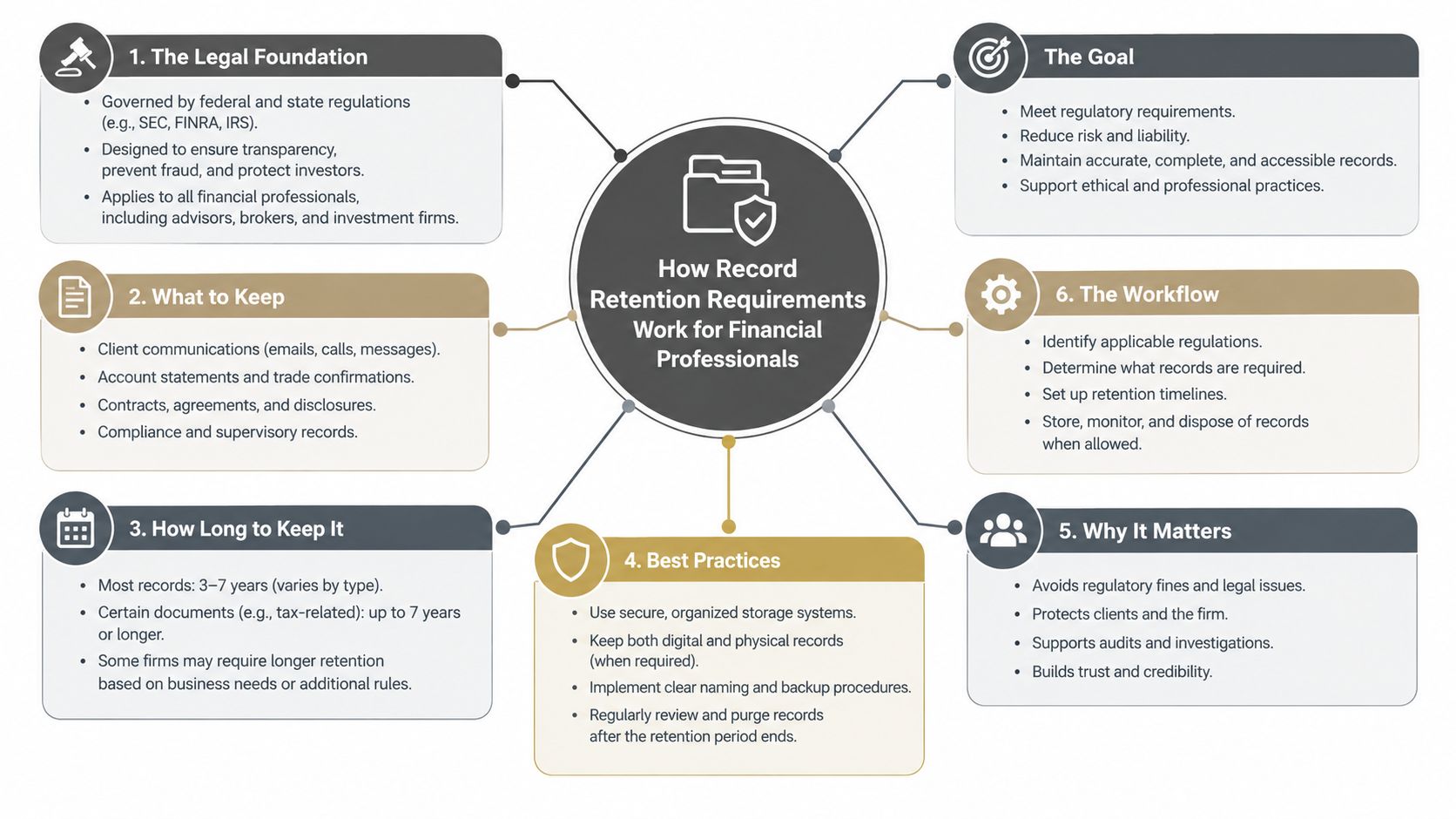
An advisor answers a client by email, confirms the same point by text, and later updates the account profile in the firm system. It feels like one conversation. For retention purposes, it is usually several different records, each tied to its own rule set, storage expectation, and retrieval standard.
That is the starting point. Record retention works by channel and by lifecycle trigger, not by a single firmwide countdown.
Retention rules sit in layers
For broker-dealers and many hybrid firms, the first layer comes from SEC and Exchange Act recordkeeping rules. FINRA adds a second layer, including a default preservation rule for records that are required to be made and kept when no more specific FINRA retention period applies. Advisers also need to account for the Advisers Act framework where it applies, which is one reason hybrid businesses should review retention as part of their broader RIA compliance considerations.
A practical way to read those layers is to ask which rule answers three separate questions:
- What category of record is this?
- What event starts the retention clock?
- What format makes the record acceptable when regulators ask for it?
That approach helps avoid a common mistake. Firms often know the headline retention periods, but they attach them to the wrong record or the wrong trigger.
Different channels create different retention jobs
Email usually falls into the communications bucket. Texting can fall there too, but only if the text is business related and sent through a channel the firm supervises and captures. Account forms, new account data, trade records, blotters, and financial ledgers are different again. They are not just messages. They are books and records tied to the firm's core business functions.
A useful analogy is a medical chart. A phone call with a patient, a prescription, and a lab result may all relate to the same visit, but the clinic cannot file them as one undifferentiated note. A financial firm faces the same issue. One client interaction can produce a communication record, an operational record, and an account record, and each one may need a different retention treatment.
This is why firms get into trouble when they rely on a single mailbox archive or a general cloud backup and assume the requirement is covered.
Storage format matters as much as the calendar
Retention is not only about keeping data somewhere. The record has to remain accurate, protected against inappropriate alteration, and retrievable in a way the firm can use during an exam or investigation.
In practice, regulators expect firms to be able to find records by category, date, account, representative, or communication source without a long reconstruction project. A backup copy helps with disaster recovery. It does not by itself create a compliant retention system.
If your system preserves messages but cannot reliably classify and retrieve them, the retention program is incomplete.
Accessibility also varies by record type. Some records need to remain readily available for part of their retention life, while others are judged more heavily on whether the firm preserved them correctly and can produce them promptly. That distinction becomes more important once firms add texting platforms, collaboration tools, archived email, and scanned documents into the same environment.
Retention also intersects with privacy
Records often contain customer financial information, identification data, and internal supervisory notes. So retention decisions should line up with privacy and information-security controls, not sit in a separate compliance binder. Advisors who want a refresher on how customer information duties fit around recordkeeping can review this Gramm-Leach-Bliley Act summary.
The practical point is simple. A good retention program maps the record to its channel, maps the channel to the governing rule, and maps both to a storage method the firm can defend. That is how busy advisors turn a confusing rule set into a system they can follow consistently.
Key Timelines and Triggers Every Advisor Should Know
An examiner asks for a client email, the new account form it led to, and the customer profile that was updated a month later. All three relate to one client relationship. They do not share the same retention clock.
That is where many firms stumble. They memorize the retention period, then miss the event that starts it. In practice, the trigger matters as much as the number of years.
The three clocks advisors should separate
A useful way to organize this is by channel and by lifecycle event.
First are foundational financial and accounting records. These usually follow a creation-based clock. The record is made, preserved, and kept for the required period, often 6 years for the applicable record class, as noted earlier in the discussion of Rule 17a-4.
Second are business communications, such as email and similar correspondence about the firm's business. These are generally kept for at least 3 years, and the first 2 years must remain in an easily accessible place. For advisors, that means the retention question is not only whether the message exists, but whether the firm can get it quickly from the system where it is stored.
Third are account records tied to lifecycle changes. This is the category that causes the most confusion because the clock may start when the account closes or when customer information is replaced or updated. For certain customer account record information, the retention period is at least 6 years after the earlier of those events.
A simple analogy helps. Some records run on a kitchen timer you start when the document is created. Others run on a parking meter that starts only when the client or account reaches a specific event.
Core retention periods, mapped by trigger
| Record Category | Minimum Retention | Trigger and Accessibility |
|---|---|---|
| Foundational financial and accounting records | At least 6 years | Usually measured from creation for the applicable record class |
| Business-related emails and similar correspondence | At least 3 years | Measured from the communication date, with the first 2 years kept in an easily accessible place |
| Certain customer account record information | At least 6 years | Measured from the earlier of account closure or the date the information was replaced or updated |
| Other records without a more specific period | Often 6 years | Trigger depends on the governing record category, commonly the date made or the relevant account event |
| Payroll and employment tax records | At least 4 years | Runs from when the tax is due or paid, whichever is later, under Treasury Regulation 31.6001-1 as summarized here |
Why the trigger matters more than firms expect
A creation-based rule is the easier one to administer. You save the record, note the creation date, and calculate the destruction date.
An event-based rule needs more from the firm. Your system has to recognize that an account closed. It also has to recognize that a customer address, beneficiary designation, or other covered account information was updated, because that change can start a different clock for that version of the record.
This is why retention schedules built as static spreadsheets often break down. A spreadsheet can list periods. It usually cannot monitor the account lifecycle events that determine which period applies to which record version.
A retention period without a trigger is a file box with no label. The records are there, but no one can say with confidence when they can be destroyed.
Accessibility is a separate question from storage
Advisors also need to keep two ideas separate. How long must we keep this record? and how quickly and reliably can we produce it?
That distinction shows up most clearly in communications. An email archive may preserve a message for the full retention period, but the rule may also require that message to remain easily accessible for part of that time. Account records raise a different challenge. The issue is often less about the mailbox and more about whether the firm can tie the right version of the record to the right account event.
So the practical test is channel-specific. For email, ask when the message was sent and whether it remains readily retrievable. For account records, ask what changed, when it changed, and whether that update started a new retention analysis. That channel-and-trigger map is what turns a generic schedule into a system an advisor can follow under exam pressure.
Modern Communication Channels and Why One Message Creates Multiple Records
A generic retention chart tends to treat communications as one category. Real advisory work doesn't look that tidy. A client asks a question by text, sends a document by email, confirms a decision in chat, and updates account information through a form or portal. One conversation. Several records.
Why channel-by-channel mapping matters
FINRA's oversight discussion shows the gap clearly. Public guidance often explains baseline retention periods, but firms need a channel-by-channel map because modern workflows blend email, instant messaging, and business texting, and one interaction may create multiple records with different clocks and accessibility rules, as noted in the 2026 FINRA annual regulatory oversight report section on books and records.
That means your firm shouldn't ask only, “How long do we keep communications?” It should ask, “Which systems generate records, what category does each record fall into, and who owns retrieval?”
One client exchange can split into several obligations
Take a simple example. A client texts an advisor asking to update a mailing address and follow up on a transfer question. The advisor responds by text, later sends a confirming email, and operations updates the account record.
That single exchange may create several separate items:
- The text thread becomes a business communication that has to be captured and retained through an approved channel.
- The email follow-up becomes another communication record with its own retention treatment.
- The account update may fall into an account-record category where the retention trigger turns on closure, replacement, or update, not on the day the text was sent.
- The supervisory evidence may include review logs, exception reports, or workflow notes showing the firm monitored the interaction.
Different channels create different operational risks
Email usually has mature archiving tools. Texting and chat often don't, unless the firm deliberately deploys them. Voice communications may add another layer, especially when firms use recorded business lines or integrated communication platforms. For teams evaluating how voice records fit into broader communication capture, this overview of business call recording options can help frame the operational side of retention.
The policy side has to match the technology side. If your WSPs allow or restrict certain channels, the records program must mirror that decision. Firms revisiting those controls should align retention with their written supervisory procedures framework, especially where texting, chat, and off-channel communications create exam risk.
The safest retention map is not “all messages go here.” It is “this channel creates this record, owned by this system, with this trigger.”
Building a Compliant Retention Schedule and Policy That Works in Practice
A defensible retention policy is less about prose and more about architecture. The firms that handle exams well usually know where each record class lives, who owns it, what event starts the clock, and what stops ordinary destruction.
Start with an inventory, not a template
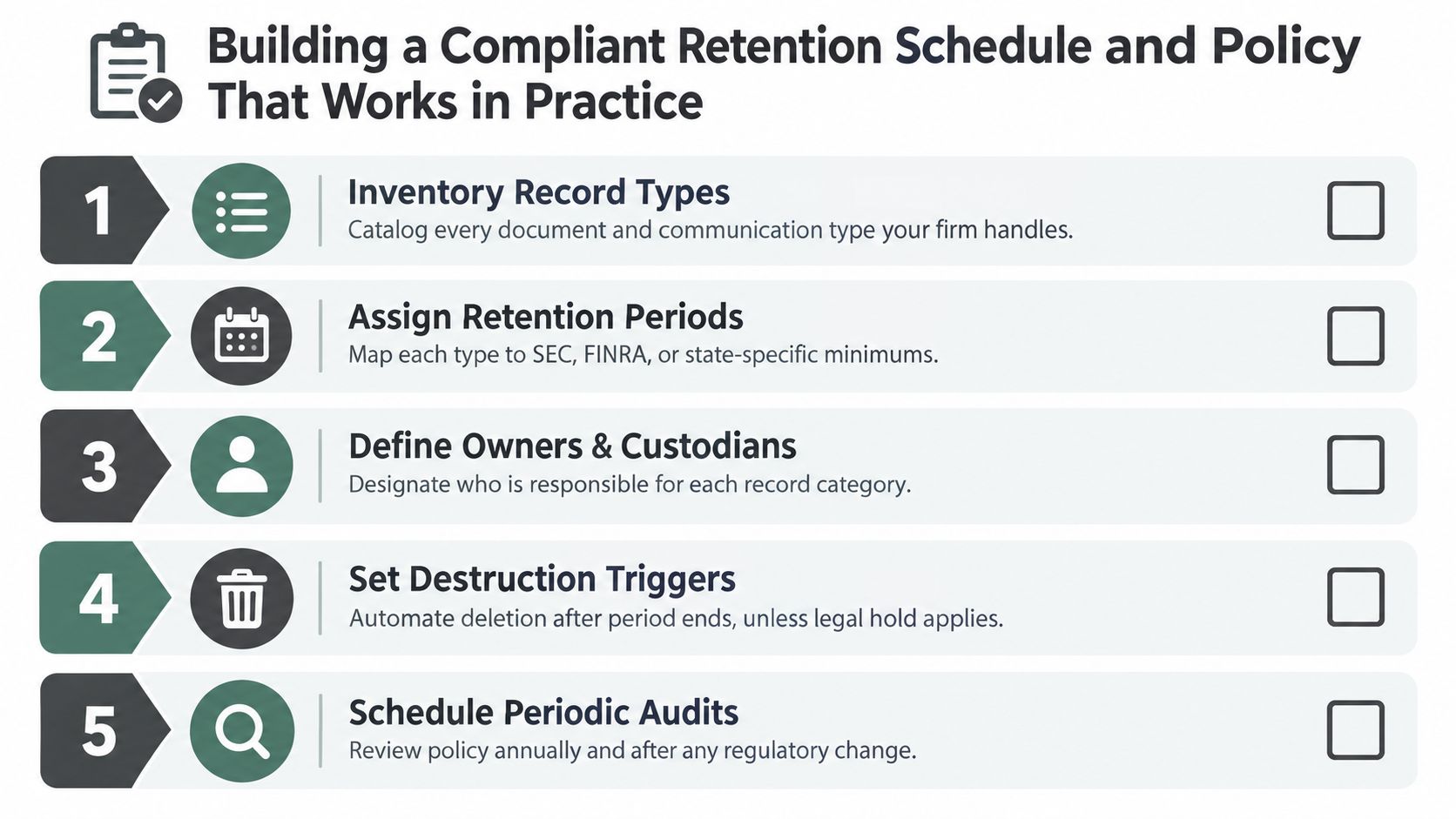
Templates are useful, but they can also hide gaps. Begin with a working inventory of what your firm creates and receives. That includes email, CRM notes, account forms, onboarding files, exception reports, compliance attestations, archived texts, recorded calls, payroll files, and vendor records.
A practical inventory should answer four questions:
- What is the record
- Which system stores it
- Who is the custodian or owner
- What event starts and ends the retention cycle
Build the schedule around real operations
Once the inventory is complete, assign retention periods by record class and document the trigger in plain English. “Six years” isn't enough. Write whether the period runs from creation, account closure, payment, update, replacement, or another event.
Then test whether your systems can apply those rules. A retention schedule isn't operational until the firm can carry it out across real tools like Microsoft 365 archives, messaging capture platforms, payroll systems, and customer account databases. Informal file shares and ordinary backups usually create confusion because they preserve data without applying record logic.
Five controls that make policies usable
Some firms improve quickly by focusing on a short control list rather than rewriting the whole manual.
- Assign owners clearly: Someone in compliance, operations, HR, or IT must be responsible for each record family.
- Match policy to technology: If the policy says texts are retained, the firm needs an approved capture method.
- Track lifecycle events: Account closure, replacement, and update dates should feed the retention decision.
- Control destruction: Deletion should follow policy and pause when legal holds apply.
- Train frontline staff: Advisors, assistants, and supervisors need to know which channels are approved and which records become official business records.
For a broader nonfinancial perspective on drafting and updating retention policies, firms sometimes find outside operational checklists helpful. This guidance from Reworx Recycling is one such practical resource for policy structure and disposal planning.
Don't isolate retention from AML and investigations
Retention controls often fail at the handoff between departments. Compliance may understand communications retention, while operations handles account records and HR handles payroll files. That fragmentation creates blind spots during investigations. Firms should connect retention planning to adjacent programs such as their anti-money laundering compliance program, because document preservation rarely stays inside one department once regulators start asking questions.
One legal resource some firms use when disputes or inquiries arise is counsel experienced with advisor records, internal investigations, and regulatory responses. Kons Law handles business and regulatory matters involving financial professionals, including issues where communication records, account files, and employment-related documents become central to the defense.
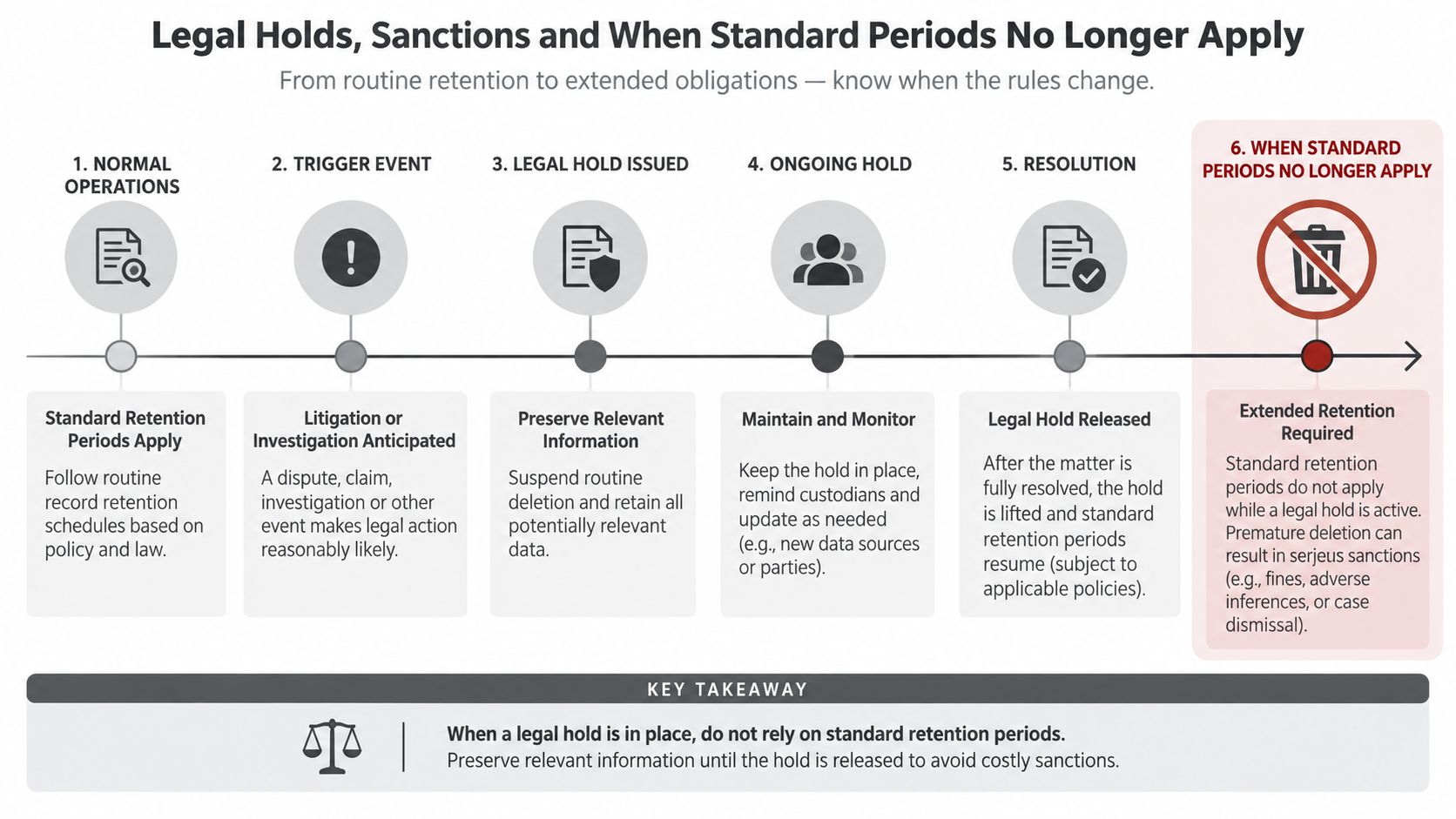
Legal Holds Sanctions and When Standard Periods No Longer Apply
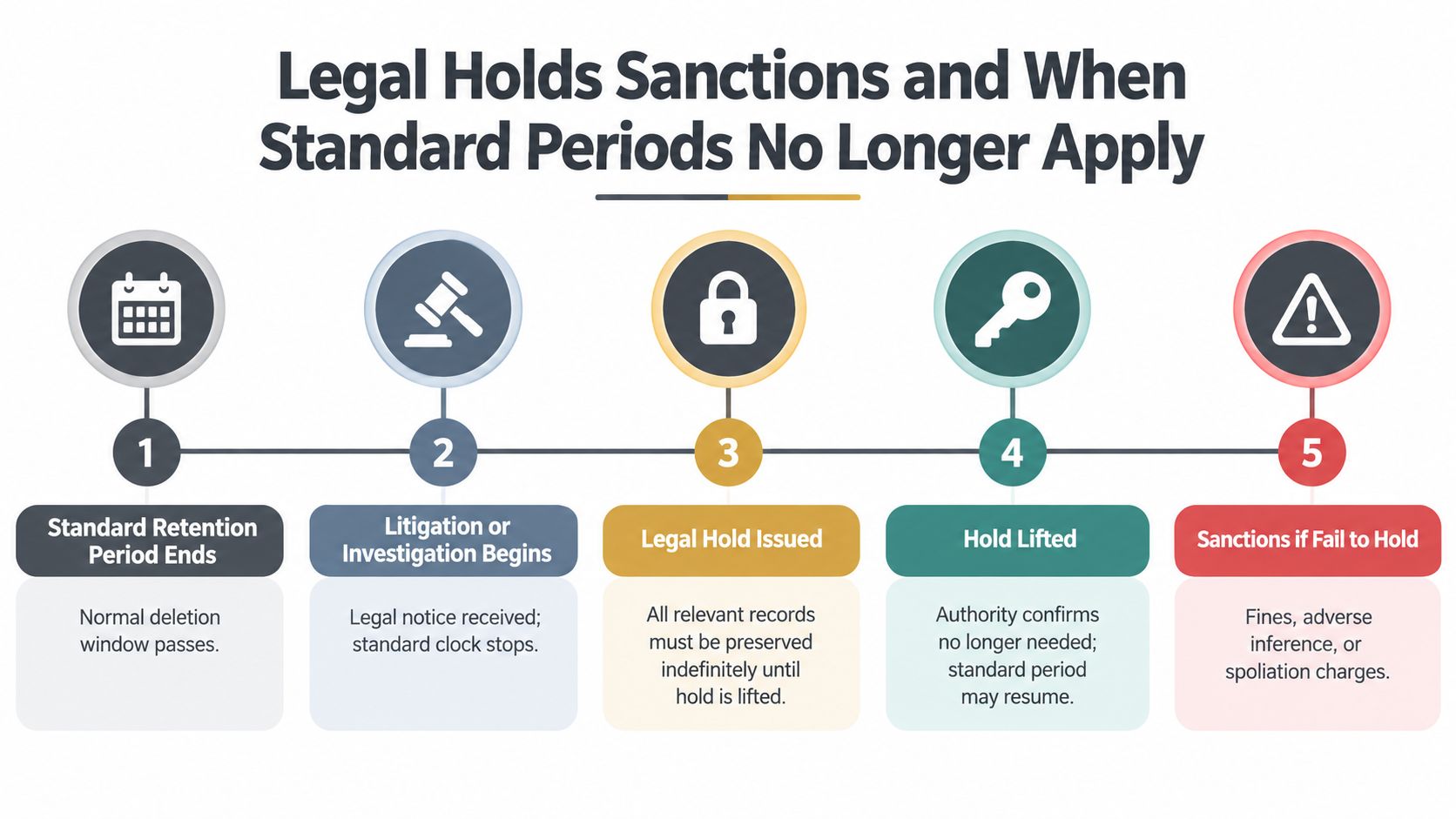
Standard retention periods are only the beginning. They tell you the minimum ordinary rule. They do not tell you when destruction must stop.
A legal hold overrides the ordinary schedule
When litigation, arbitration, a regulatory inquiry, or another formal dispute is reasonably anticipated, a firm may need to suspend normal destruction for relevant records. That includes records that would otherwise be deleted under a routine retention schedule. The important operational point is speed. Once the issue is identified, the firm should preserve potentially relevant records across all affected systems and custodians.
Firms often need counsel. A hold has to be broad enough to preserve what matters, but focused enough to be manageable. If your firm is already responding to an SEC matter or anticipates one, legal planning should be tied to the response strategy used in SEC investigations.
Sanctions rules show why one-size-fits-all answers fail
A separate complication comes from overlapping regulatory regimes. A notable 2025 development was OFAC's extension of sanctions-related recordkeeping from 5 years to 10 years, effective March 21, 2025, as described in this analysis of the OFAC rule change.
That change matters because it shows retention is no longer uniform even across related U.S. compliance areas. A firm that assumes every sensitive record can follow one standard rule may miss a longer obligation tied to sanctions, blocked property, or related investigations.
Standard schedules answer “how long in the ordinary course.” Legal holds answer “what cannot be destroyed now.”
Questions firms should ask immediately
When a matter arises, the fastest useful questions are usually these:
- What event triggered preservation
- Which custodians and systems may hold relevant records
- Do any records touch sanctions, blocked property, or cross-border activity
- Has routine deletion been paused everywhere it needs to be paused
Those questions are simple, but they prevent the common mistake of treating the legal hold as a memo rather than an active operational process.
Putting It All Together and Next Steps for Your Firm
The firms that manage record retention requirements well usually do three things consistently. They classify records by type, tie each category to the right trigger, and make sure their storage and retrieval tools match the rule. That sounds basic, but it's where many exam problems begin.
A workable action plan
If your current policy feels too generic, start with a short internal review.
- Map your channels: List where business communications and account records are created.
- Check the trigger logic: Confirm whether each category runs from creation, closure, update, replacement, payment, or another event.
- Test retrieval: Ask a practical question. Could your firm produce the right records quickly if a regulator asked today?
- Review destruction controls: Make sure ordinary deletion can stop promptly when a dispute, investigation, or legal hold appears.
When counsel helps most
Legal review is especially useful when your firm faces overlapping duties. That includes advisor departures, Form U5 disputes, compensation disputes, customer complaints, FINRA inquiries, or SEC investigations. In those moments, records aren't only historical files. They become evidence, defense material, and sometimes the difference between a narrow issue and a wider enforcement problem.
If you want to discuss your business law matter, contact Kons Law at (860) 920-5181.
Kons Law advises businesses, investors, and financial professionals on the legal and compliance issues that often surface when records, communications, and supervision come under scrutiny. If your firm is reviewing its retention practices, responding to an inquiry, or dealing with an advisor dispute where document preservation matters, visit Kons Law to learn more or discuss your situation.
