A corporate compliance program isn't just a thick binder of rules that sits on a shelf gathering dust. Think of it as your business's internal navigation system—a formal set of policies and procedures designed to keep you on the right side of the law and ethical standards. It’s all about proactively steering clear of trouble before it happens.
What is a Corporate Compliance Program, Really?
Imagine trying to drive through a new city without a map, traffic lights, or even a speedometer. You might eventually get where you're going, but the risk of getting lost, causing an accident, or racking up expensive tickets is sky-high. That’s what running a business without a compliance program feels like.
This program is your company’s dashboard and rulebook, all rolled into one. It translates dense, complicated legal jargon into practical, everyday actions your team can actually follow. It makes sure everyone, from the CEO down to the newest hire, understands their responsibilities and operates within the legal and ethical lines.
What Does a Compliance Program Actually Do?
At its core, a compliance program is built to perform a few critical jobs that protect your business from the inside out. These functions aren’t separate; they work together to build a strong framework that manages risk and promotes integrity.
Here's a quick breakdown of what these programs aim to accomplish.
A Quick Guide to Corporate Compliance Programs
| Core Function | Primary Goal |
|---|---|
| Preventing Misconduct | To stop violations before they ever happen through clear policies (like a code of conduct) and consistent employee training. |
| Detecting Violations | To quickly identify issues as they arise using monitoring systems and confidential reporting channels, like an anonymous hotline. |
| Responding Effectively | To have a clear, pre-planned process for investigating potential problems and applying fair, consistent discipline when needed. |
| Promoting an Ethical Culture | To build a workplace where doing the right thing is the default, which boosts morale, builds trust, and strengthens your brand. |
Ultimately, a well-designed program sends a powerful message to regulators, customers, and partners: you're serious about running a responsible business.
This good-faith effort can be a game-changer. If a violation does occur, having a strong program in place can dramatically reduce penalties and legal exposure. It transforms compliance from a boring obligation into a powerful strategic asset. By weaving these principles into your daily operations, you safeguard your reputation, minimize financial risk, and build a solid foundation for growth. If you want to discuss your business law matter, contact Kons Law at (860) 920-5181.
The 7 Pillars of an Effective Compliance Program
Think of a solid compliance program less like a single document and more like a well-built structure supported by seven essential pillars. These pillars, recognized by federal sentencing guidelines, are designed to work together, creating a framework that actively prevents, detects, and responds to legal and ethical risks. If one pillar is weak, the whole structure is at risk.
These pillars aren't just abstract legal theory—they're a practical roadmap. They turn confusing legal requirements into a concrete, manageable system that protects your business from the inside out and helps build a genuine culture of integrity.
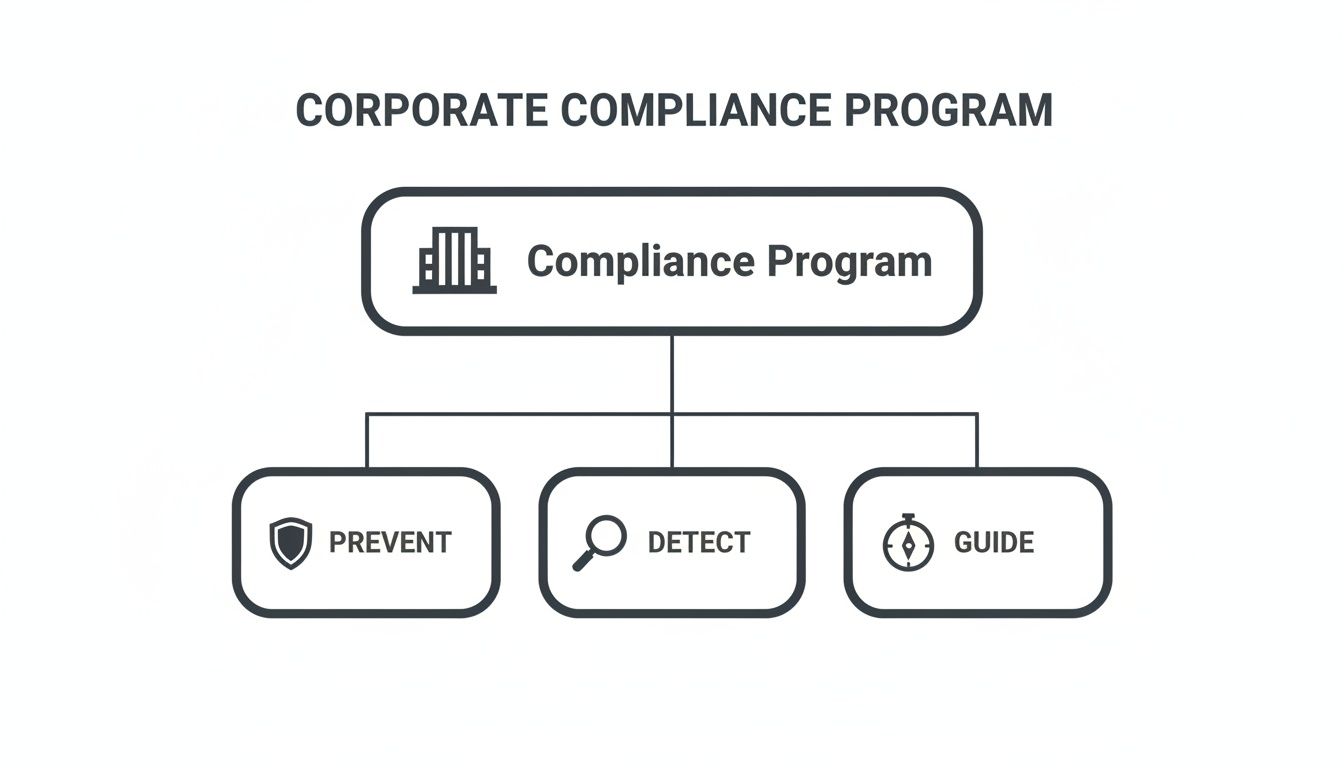
As this shows, the goal isn't just to react to problems after they happen. A well-built program is always working to safeguard your company.
Core Components of Compliance
Building a program that will stand up to scrutiny requires a methodical approach that addresses each of these foundational elements. Every pillar supports the others, creating a system that is both comprehensive and resilient. You can also explore the 7 Elements Effective Compliance Program for another helpful perspective on these core components.
Here are the seven pillars every business should put in place:
Standards and Procedures: This is your company's rulebook. It starts with a clear code of conduct and includes written policies that translate complex laws into easy-to-understand guidelines for your employees. These documents must be accessible and directly address your company’s unique risks.
Leadership Oversight: Compliance has to start at the top. Your company's leadership and board must visibly champion the program, dedicate enough resources to it, and appoint a qualified person—like a Chief Compliance Officer—to oversee it. Their buy-in is absolutely non-negotiable.
Employee Education and Training: You can't expect people to follow rules they don't know exist. Regular, practical training is crucial to ensure every team member understands the company's standards, their specific obligations, and the legal environment they're working in.
Monitoring and Auditing: A program is only as good as its results. This pillar involves continuously monitoring day-to-day activities to spot misconduct and periodically auditing the entire system to find weak spots. This proactive work lets you fix small issues before they become major liabilities.
Secure Reporting Mechanisms: Your employees need a safe way to report potential problems without fearing retaliation. This usually means setting up anonymous channels, like a hotline. A reporting system that people trust is one of the best tools for discovering issues early.
Consistent Enforcement and Discipline: For your program to have any credibility, it needs to have teeth. This means applying disciplinary standards fairly and consistently across the entire organization, no matter who is involved. This consistency is a cornerstone of good corporate governance and sends the clear message that no one is above the rules.
Proactive Response and Prevention: When misconduct is found, you have to respond quickly and effectively. This involves investigating the issue, taking the right remedial action, and, most importantly, updating your program to prevent the same thing from happening again.
If you want to discuss your business law matter, contact Kons Law at (860) 920-5181.
Why Modern Regulations Make Compliance Essential
In today’s business world, the web of regulations feels more tangled than ever. For any company, especially small and mid-sized businesses right here in Connecticut, trying to navigate this landscape without a formal compliance program is like sailing into a storm without a compass. It’s no longer about dodging one big fine; it's about managing a constant stream of overlapping local, state, and federal rules that all demand your attention.
This growing complexity makes a formal compliance program an absolute necessity. The simple truth is that regulations are always in motion, and what was perfectly legal yesterday might be a violation today. This isn't just a hunch—it's a measurable trend. According to PwC's 2025 Global Compliance Survey, a staggering 85% of business leaders reported that compliance requirements have become more complex over the last three years. A full 44% pointed to rapid regulatory changes as the main reason. You can explore more of these compliance statistics over on Secureframe.com.
The High Stakes of Non-Compliance
Choosing to ignore this complexity is a risky bet, with consequences that go far beyond a financial slap on the wrist. While a hefty fine from a government agency can certainly sting, the fallout is often far more damaging in the long run.
A single compliance failure can trigger a cascade of problems:
- Lasting Reputational Harm: News of a violation travels fast. Whether it's a data breach or an environmental issue, the customer trust you spent years building can vanish in an instant.
- Increased Scrutiny: Once you’re on a regulator's radar, expect them to stay there. This means more frequent and more intense audits, which can become a major drain on your time and resources.
- Operational Disruption: A government investigation or a drawn-out legal battle can bring your daily operations to a grinding halt, pulling your team’s focus away from what they do best—running the business.
Shifting from Reactive to Proactive
This is where understanding what is a corporate compliance program gives you a real strategic advantage. A proactive compliance strategy shifts your business from constantly putting out legal fires to navigating challenges before they ever escalate. It gives you the foresight to anticipate changes in critical areas like cybersecurity, employment law, and data privacy. For a deeper dive, check out our guide on what is regulatory compliance.
A well-structured program provides the framework to identify potential threats, train your team on current laws, and implement controls to prevent violations. It turns your commitment to doing things right into a tangible, defensible asset.
This proactive stance doesn't just reduce risk; it builds a more resilient and trustworthy organization. It sends a clear message to your customers, partners, and employees that your business is built on a solid foundation of integrity. If you want to discuss your business law matter, contact Kons Law at (860) 920-5181.
How to Build Your Compliance Program Step by Step
Alright, let's get practical. The idea of a "corporate compliance program" can sound intimidating, especially for a small or mid-sized business. It brings to mind thick binders of rules nobody reads. But it doesn't have to be that way.
Building a strong compliance framework is about creating a smart, manageable system that protects your company and grows with you. Think of it as a roadmap. The journey starts with two simple things: knowing where your risks are and getting your leadership team on board. Without support from the top, even the best plans fall flat.

Phase 1: Laying the Groundwork
The first phase is all about discovery and commitment. Before you write a single policy, you need to understand your business's unique weak spots and get everyone in leadership pulling in the same direction.
Perform a Thorough Risk Assessment: This is the most important first step. You can't guard against threats you don't know exist. Look closely at your operations to find specific legal, regulatory, and ethical risks. Do you handle sensitive customer data? Are you in an industry with strict environmental rules? A clear picture of your risks will shape every decision that follows.
Gain Leadership Buy-In: Compliance has to be a top-down initiative. Take your risk assessment findings to the leadership team and show them exactly why this program is necessary. You need their vocal support and a real commitment to provide the resources—whether that’s time, budget, or staff.
Designate a Compliance Leader: Somebody needs to own this. Assign a specific person to be in charge of the program. In a smaller company, this might be a senior manager wearing multiple hats, but their responsibility for compliance needs to be crystal clear. This person will be the champion who implements the program and makes sure it's working.
Phase 2: Building the Program Components
Once your foundation is solid, it's time to start building the core elements of the program. This is where you document your standards and figure out how to communicate them.
Write Clear Policies and a Code of Conduct: Turn your risk assessment into simple, easy-to-understand policies. Your Code of Conduct is your company's ethical North Star—it should spell out expected behaviors in plain English, not legalese. For a great starting point, check out this small business compliance checklist to make sure you're covering the essentials.
Create a Training and Communication Plan: Policies are worthless if they're just sitting in a drawer. You need a plan to train every employee on the Code of Conduct and any policies that affect their job. This can't be a one-and-done event; plan for regular refreshers to keep compliance front and center. For more detailed steps, this guide on how to build an HR compliance program is an excellent resource.
Phase 3: Implementation and Maintenance
The final phase is about putting your program into action and keeping it alive. This means creating systems for reporting issues and committing to ongoing improvement.
A compliance program is not a "set it and forget it" project. It must be a living system that adapts to new regulations, evolving business operations, and emerging risks. Regular audits are your program's health checkups.
Schedule regular program audits and updates to ensure your framework stays current and effective. This cycle of continuous improvement is what turns your program into a resilient and valuable business asset.
If you want to discuss your business law matter, contact Kons Law at (860) 920-5181.
The Strategic Business Benefits of Strong Compliance
It’s easy to think of a corporate compliance program as just a defense mechanism—a necessary evil to keep legal trouble at bay. But that’s like seeing a high-performance engine as only a way to avoid speeding tickets. A truly robust program does far more than just keep you out of court. It becomes a powerful strategic asset that actively drives business growth and strengthens your entire organization.
The most immediate benefit is, of course, risk reduction. The costs of non-compliance can be devastating, from crippling fines and expensive litigation to increased government oversight. A well-designed program dramatically lowers this risk, creating a more stable and predictable operational environment.
More Than Just Avoiding Fines
Beyond the obvious legal protections, a commitment to compliance builds something far more valuable: trust. When customers, partners, and the community see your company operating with integrity, they are more likely to remain loyal. This strong reputation also makes you a magnet for top-tier talent, because skilled professionals want to work for ethical, well-run organizations.
According to one survey, an astonishing 95% of employees at a top-ranked company agreed that “management is honest and ethical in its business practices,” directly linking a culture of compliance to high employee morale and satisfaction.
This positive reputation extends to investors, too. A business that can demonstrate a solid compliance framework is often seen as a safer, more reliable investment, which can unlock more favorable terms and open doors to new opportunities.

Building a Stronger, More Efficient Business
Compliance also brings significant operational advantages. By creating clear, consistent processes and policies, you streamline day-to-day activities and improve overall efficiency. Employees know exactly what is expected of them, which reduces ambiguity and empowers them to make confident, correct decisions. This internal clarity fosters a more accountable and productive workplace.
Ultimately, understanding what is a corporate compliance program is about recognizing its dual role. It is both a shield that protects your company from harm and a strategic tool that enhances its value. By shifting from a reactive, cost-center mindset to a proactive investment in ethical operations, you build a resilient foundation for long-term success.
If you want to discuss your business law matter, contact Kons Law at (860) 920-5181.
When to Partner With a Business Law Expert
You can absolutely lay the groundwork for a compliance program on your own, but knowing when to call in a legal expert is one of the smartest decisions you can make. Even the most well-designed DIY program can have blind spots, and those are exactly what can leave your business exposed.
Certain milestones and situations are clear signals that you need professional legal guidance. For instance, if you operate in a highly regulated field like healthcare or finance, the complexity is just on another level. A simple misstep isn't just a mistake—it can bring on severe penalties.
Key Moments for Legal Consultation
Think of an attorney as a strategic partner. Bringing one in at the right time transforms compliance from a source of stress into a source of confidence.
You should seriously consider partnering with an expert when you are:
- Facing a Government Inquiry: Responding to a regulator's questions without legal advice is a massive gamble. Don't take that risk.
- Conducting an Internal Investigation: An attorney ensures the investigation is handled correctly, protecting its integrity and preserving legal privilege.
- Experiencing Rapid Growth: As your business scales, it outgrows its original compliance framework. New people, new processes, new risks.
- Entering New Markets: Expanding across state lines or internationally means you’re playing by a whole new rulebook.
A business law expert helps you build a defensible program from the start, saving you from incredibly costly mistakes down the road. To get a better feel for how these legal advisors fit into the bigger picture, you can learn more about what is corporate counsel and the value they bring.
If you want to discuss your business law matter, contact Kons Law at (860) 920-5181.
Common Questions About Corporate Compliance
Diving into corporate compliance can feel overwhelming, especially for small and mid-sized business owners here in Connecticut. Let's clear up a few of the most common questions we hear from clients to give you a solid starting point.
Do I Really Need a Compliance Program if I’m a Small Business?
Absolutely. It's a common misconception that compliance is a "big company" problem. While a global corporation’s program will look very different from a local shop's, the fundamental expectation from regulators is the same: businesses of all sizes must make a good-faith effort to follow the law.
Think of it as scalable. For you, it might start with a straightforward employee handbook and some basic training. The goal isn't complexity for its own sake; it’s about protecting your business from avoidable legal trouble, safeguarding your reputation, and showing you’re committed to doing things the right way.
What’s This Going to Cost Me?
There’s no one-size-fits-all price tag. The cost of building a compliance program depends entirely on your company's size, your industry, and the specific risks you face. A small startup might just need to invest time in drafting a clear code of conduct, while a mid-sized manufacturer may need more specialized training and software.
The key takeaway is that an investment in proactive compliance is almost always a fraction of the cost of non-compliance. A single regulatory fine, lawsuit, or hit to your reputation can be financially devastating in a way that far outweighs the cost of prevention.
Where Is the Best Place to Start?
Your first step, without a doubt, should be a risk assessment. You can't build effective defenses against threats you haven't even identified.
This just means sitting down and pinpointing the specific legal and regulatory risks tied to your business in Connecticut. Are you handling sensitive customer data? Are you up-to-date on state employment laws? Do you have industry-specific regulations to follow? The answers to these questions will become the foundation for your entire program, making sure you focus your time and money where it matters most.
If you want to discuss your business law matter, contact Kons Law at (860) 920-5181.
