
You're doing solid work, building client relationships, and seeing real momentum. Then the growth stalls for a reason that has nothing to do with investment skill. A client moves across state lines. Your firm wants you selling a broader set of products. Compliance tells you your registration profile doesn't support what you're trying to do.
That's where a lot of advisors get tripped up on the Series 63 vs Series 7 question.
The mistake is treating these as two exam-prep boxes to check. They're not. They define what you're allowed to sell, where you're allowed to do business, and which regulator gets interested when something goes wrong. If you're a financial advisor, these licenses shape your earning power, your mobility, and your exposure when a complaint, Form U5, or investigation lands on your desk.
Navigating Your Financial Advisory Career Path
A common version of this problem looks like this. An advisor starts at a broker-dealer, passes the basic entry requirements, begins building a book, and then finds out that serving a household in another state or handling a broader securities recommendation isn't just a business decision. It's a licensing question.
That's why the Series 63 vs Series 7 issue matters so much. One license expands your product authority. The other gives you legal permission to operate at the state level. If you're missing either one, your practice can hit a hard stop.

Advisors who are planning a transition to independence run into this even faster. The licensing path for a broker at a traditional firm isn't always the same path for someone evaluating whether to start an RIA. If you misunderstand that distinction, you can waste time chasing the wrong registration sequence or, worse, create a compliance problem before your new platform is even operational.
The real issue isn't the exam
The exam itself is temporary. Your registration footprint is what stays with you.
Series 7 affects what securities business you can conduct. Series 63 affects whether you can legally do that business in a state. Advisors who blur that line often assume one license is “bigger” and the other is “smaller.” That's the wrong frame. They do different jobs.
Practical rule: If your career plan involves both selling securities and working with clients across state lines, you usually need both authorities working together.
Career strategy beats exam trivia
If you're early in your career, this is about getting properly positioned from the start. If you're established, it's about avoiding preventable limitations and disciplinary risk. And if your record already involves a disclosure event, a termination, or a pending inquiry, the licensing distinction becomes even more important because regulators don't care that you were confused. They care whether you acted within the scope of your registration.
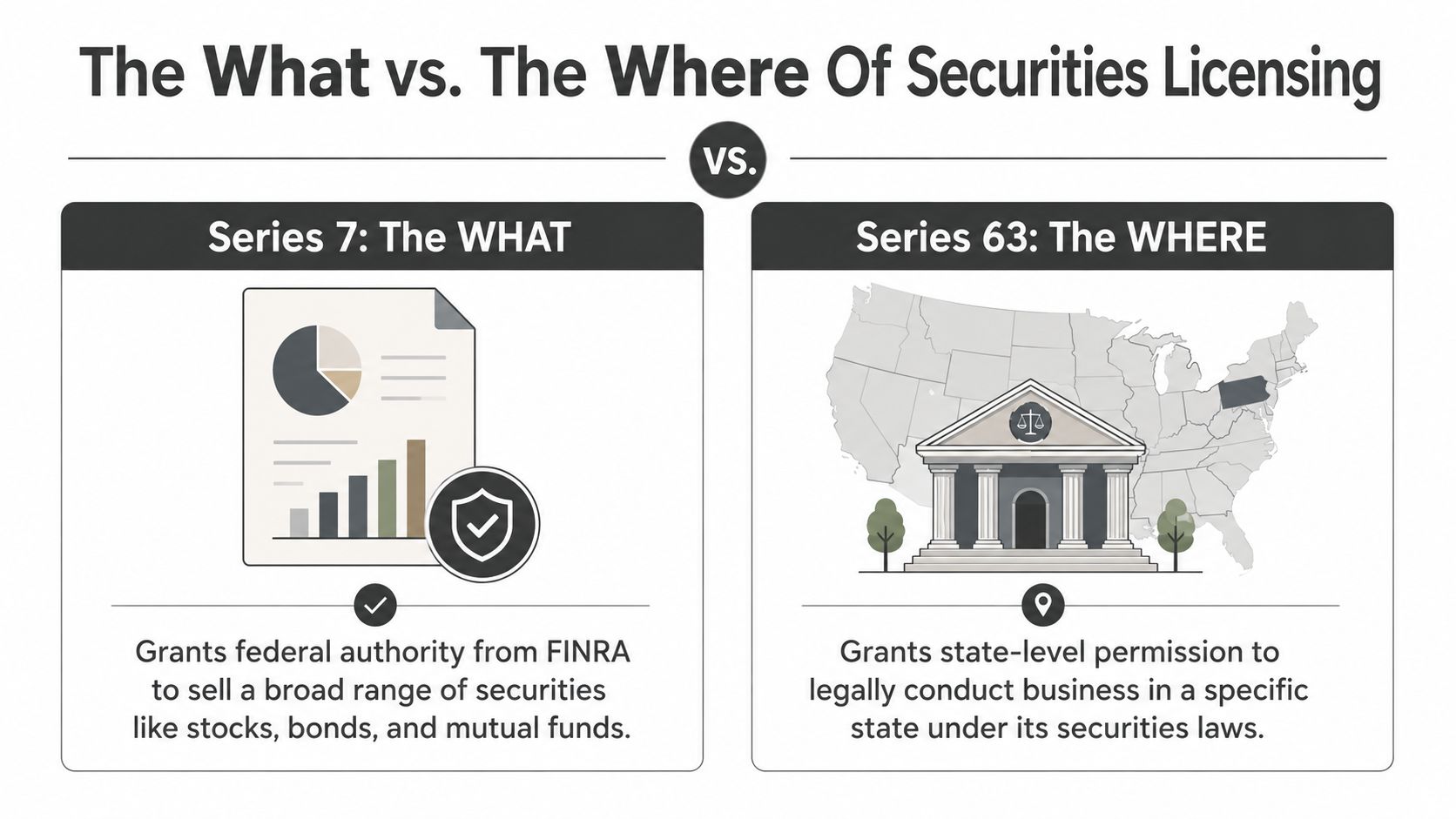
The What vs The Where Of Securities Licensing
The cleanest way to understand Series 63 vs Series 7 is this. Series 7 is the what. Series 63 is the where.
The Series 7 (General Securities Representative Exam) grants federal-level authority to sell a broad set of securities products, including corporate stocks, municipal bonds, mutual funds, options, and direct participation programs, while the Series 63 (Uniform Securities Agent Exam) is a state-level compliance license focused on state securities laws, ethics, and fiduciary duties and does not authorize the sale of any product, as described in the Sacramento Bee comparison of Series 63 and Series 7.
That distinction sounds simple. In practice, it controls your daily work.
Series 7 gives you product authority
If you hold the Series 7, you're authorized for a broad range of securities activity from the product side. That's why firms view it as the core representative license for many traditional brokerage roles. It's the credential that opens the door to selling more than the narrower menu associated with limited registrations.
A lot of professionals compare career tracks before deciding whether to stay in securities, move toward insurance, or even become a mortgage loan originator. That comparison is worth making because each path has different licensing, compensation, and enforcement risk. But if you plan to operate as a securities representative, the Series 7 remains the central product license.
Series 63 gives you state-level legal permission
Series 63 doesn't let you sell a security. It lets you lawfully function as an agent under state law where that registration is required. That means your conduct, solicitations, and client-facing activities can trigger state regulatory consequences even if your product knowledge is excellent.
This becomes especially important in messy fact patterns. Outside business activities, referral arrangements, and private securities transactions often create problems because advisors focus on the product side and ignore the state-law side. That's a mistake. State regulators care about how the business was conducted, how it was disclosed, and whether it was properly supervised.
Holding a Series 7 without the necessary state registration can leave you authorized to sell a product in theory but unable to lawfully conduct the business in practice.
They aren't substitutes
Advisors often ask which one is “better.” Neither. They are complementary. One doesn't replace the other.
If you only have Series 63, you don't have product-selling authority. If you only have Series 7, you may still be blocked from doing business where the client relationship sits. For most advisors working through a broker-dealer with clients in multiple jurisdictions, the practical answer isn't choosing one. It's understanding why operating without the paired authority creates career risk.
Comparing The Series 7 and Series 63 Exams
A new advisor passes the Series 7, starts speaking with clients, and assumes the hard part is over. Then a state registration issue surfaces, supervision questions follow, and what looked like an exam problem turns into a disclosure problem. That is why you should compare these exams by function, burden, and downstream risk, not by difficulty alone.
Series 63 vs Series 7 exam at a glance
| Attribute | Series 7 (General Securities Representative) | Series 63 (Uniform Securities Agent State Law) |
|---|---|---|
| Primary function | Broad securities product authority | State law compliance registration |
| Prerequisites | Requires the SIE exam and firm sponsorship | No prerequisites |
| Question format | 125 scored multiple-choice questions, plus 10 experimental questions | 60 scored questions, plus 5 pretest questions |
| Exam time | 3 hours and 45 minutes | 1 hour and 15 minutes |
| Passing score | 72% | 70% |
| Cost | $300 | $147 |
| Typical study time | 80 to 100 hours | Approximately 40 hours |
| Administrative context | FINRA-administered | NASAA-administered |
The exam mechanics matter, but the business consequence matters more. Series 7 is the heavier lift because it qualifies you for a much broader product set and requires sponsorship. Series 63 is narrower, faster, and cheaper, but it sits closer to the conduct rules that can trigger state scrutiny if you get sloppy.
What the exam differences actually mean
Series 7 tests whether you can function as a general securities representative across a broad range of products and transactions. In practice, firms treat it as proof that you can be placed into a revenue-producing role with wider client exposure, tighter supervision, and more chances to create a record that follows you on your Form U4 and, later, your Form U5 if the relationship ends badly.
Series 63 tests something different. It focuses on state law, prohibited practices, fiduciary concepts under state standards, and the rules that govern how business is solicited and conducted. That makes it more than a short state add-on. It is often the exam tied most directly to the kind of conduct allegations that draw a state regulator's attention.
That distinction matters once a client complaint, internal review, or branch audit starts asking who said what, where the client lived, which registration applied, and whether the activity was properly supervised.
Prep time is the least important difference
Advisors obsess over study hours because that is the immediate pain point. Career risk comes later.
Yes, Series 7 usually demands a longer prep cycle and more operational planning with your firm. You need sponsorship, time blocked off, and a realistic onboarding schedule. Series 63 usually takes less time, but that shorter prep window fools candidates into treating it like a minor exam. It is not minor if your future issue involves unapproved activity, unsuitable recommendations, poor disclosures, or client interactions across state lines.
A short exam can still create a long disciplinary file.
How to compare them like a practicing advisor
Use this framework:
- Series 7 answers: what products and transactions am I qualified to handle through the firm?
- Series 63 answers: where and under what state-law conditions can I lawfully function as an agent?
- Series 7 risk: broader product authority creates broader supervision and suitability exposure.
- Series 63 risk: state-law violations often surface in complaints about how the business was conducted, not just what was sold.
That is why exam comparison should include supervision. A representative who studies products and ignores conduct rules is setting up avoidable problems. Client onboarding, account approvals, and suitability reviews all sit inside supervisory systems that matter once regulators or counsel start reconstructing a file. The same is true of FINRA Rule 2090 and know your customer obligations, which become real exposure points after the exams are over.
The practical takeaway
If you are deciding which exam deserves more respect, the answer is both, for different reasons. Treat Series 7 as the gate to broader securities work. Treat Series 63 as the exam that often sits closer to the conduct and registration failures that damage careers.
Passing either one is not the end of the analysis. It is the start of your regulatory footprint.
Strategic Licensing Pathways For Your Career
You join a firm, pass the exams the branch expects, start building a book, and then a better opportunity appears. The new role involves advisory accounts, clients in several states, or a broader product menu. If your licensing path was built around speed instead of fit, you now have a registration problem, a compensation problem, and possibly a disclosure problem if the transition goes badly.
Choose the license path that matches the business you intend to run.
The standard broker-dealer path
For a representative who plans to sell a broad range of securities through a broker-dealer, the sequence is simple. Pass the SIE, get sponsored, take the Series 7, and add the Series 63 if your role requires state agent registration.
That order is practical because it tracks how the business is supervised. Series 7 gives you the product-side authority the firm needs. Series 63 addresses whether you can lawfully act as an agent under state law. If your goal is full brokerage capacity, delaying the state-law piece creates avoidable friction with onboarding, client coverage, and branch supervision.
It also creates career drag. Firms hire for usable registrations, not partial progress.
When a narrower license is a bad long-term bet
A limited registration can make sense if your role is confined to a narrow product set. The problem is that many advisors accept a narrow license based on their first job, then discover that the firm, the market, or their own production goals require broader authority within a year or two.
That is usually a planning failure.
If you expect to change firms, expand product scope, or work with higher-value households, start with the path that supports that future. Re-papering your registration profile later is not just inconvenient. It can delay transitions, restrict compensation options, and invite closer review of what you were doing before your licenses matched your actual activity.
Advisors shifting toward advisory work
Series 63 is often misunderstood by advisors who want to build a fee-based practice. It is not a substitute for adviser-focused licensing. If your long-term model centers on advisory accounts, portfolio management, or an RIA platform, you should be evaluating the Series 65 or Series 66 instead of treating the 63 as the final step.
Career strategy and regulatory exposure converge. Advisors who collect registrations without a clear business model often create messy records. The mismatch shows up during internal reviews, branch exams, and departures from a firm. If a transition ends badly, the language a firm uses on termination paperwork can affect your next move. Review these Form U5 reporting issues and FINRA implications before you assume a license change is just an operations task.
A practical licensing framework
Use a stricter test than “Which exam can I pass fastest?”
- You want broad brokerage authority. Get the Series 7, then complete the state registration required for the jurisdictions where you will act as an agent.
- You are in a limited product role. Confirm that the limitation is likely to last, and that your compensation and promotion path do not depend on broader authority.
- You plan to build a fee-based advisory practice. Evaluate the adviser-representative path based on the platform, compensation model, and services you will provide.
- You expect multi-state activity or mobility between firms. Plan for state registration issues early. They tend to surface during expansion, not at the moment you first choose an exam.
Experienced advisors ask a better question than “What should I take next?” They ask, “What registration structure will still make sense after my business grows, my firm changes, or my file gets reviewed?”
Regulatory Consequences And Your Professional Record
Licenses don't just define authority. They define jurisdiction. That matters the moment a complaint, sales practice issue, or termination hits your file.
If your conduct involves product recommendations, supervisory questions, or suitability concerns, FINRA may take interest because of the federal product side of your registration. If the issue involves state-law compliance, solicitation activity, registration status, or local securities rules, state regulators may have their own angle. Sometimes those tracks run separately. Sometimes they overlap.

Your licenses connect to different enforcement lanes
This is the long-term consequence most exam guides miss. Series 7 and Series 63 are not just educational milestones. They connect your conduct to different regulatory frameworks and different disclosure consequences.
That distinction becomes visible on records that follow you from firm to firm. Form U4 disclosures, amendments, and Form U5 separation language can alter hiring prospects, advantage in career changes, and your defense posture if a future employer or regulator reviews your history. Advisors dealing with termination language should understand how Form U5 issues can affect a FINRA-registered professional record.
U4 and U5 problems don't stay small
A bad disclosure often starts with a sentence. Then it becomes an explanation. Then it becomes a background issue every recruiter, branch manager, and regulator reads through a suspicious lens.
Here are the situations where the Series 63 vs Series 7 distinction often matters in the background:
- Customer complaints tied to recommendations: product authority and supervision questions often sit front and center.
- State registration issues: a state regulator may care less about your product expertise and more about whether the business activity was lawfully conducted in that jurisdiction.
- Termination disputes: firms frequently draft U5 language with an eye toward their own risk, not your future employability.
- Outside activity and selling-away accusations: these can trigger both firm-level concerns and state-law scrutiny.
Hard truth: By the time a firm says “this is just a routine compliance matter,” your record may already be at risk.
The 2025 exam update matters less for testing than for strategy
One under-discussed issue is the October 27, 2025 FINRA exam structure change reducing unscored questions from 10 to 5, which the Acadio article identifies as a gap in existing preparation content in its update on FINRA exam changes. For a practicing advisor, the larger point isn't test pacing. It's that licensing rules and exam structures change while online guidance often lags behind.
That has a compliance lesson. Don't rely on stale internet summaries when your registration, compensation, and disciplinary exposure are on the line.
When the legal issue begins
You need legal judgment when the problem shifts from “what license do I need?” to “what can this disclosure or investigation do to my career?” That line arrives faster than most advisors expect.
If the issue involves a written complaint, a request for information, a separation event, or a proposed disclosure, you're no longer in self-study territory. You're in record-protection territory.
Practical Next Steps And When To Seek Legal Counsel
You accept an offer, give notice, and expect to start producing in a few weeks. Then important questions hit. Does the role require broad brokerage authority under Series 7, state registration through Series 63, or both? Is your firm ready to sponsor the application, or are they assuming you already know how the registration sequence works? Those details decide whether you can lawfully do the job, get paid for the business, and avoid preventable trouble on your CRD record.
Start with your actual function, not the exam syllabus. If your role involves recommending and selling a broad range of securities through a broker-dealer, build your plan around Series 7 first and confirm the state-law registration that must accompany it. If your work is narrower, test that assumption against the products you will handle, the states where clients sit, and how your firm supervises the activity. Advisors get into avoidable trouble when they treat licensing as an HR checklist instead of a regulatory permission structure.
Then confirm the operational facts in writing. Ask who is sponsoring the filing, what registrations the firm expects you to hold by start date, which jurisdictions matter, and what happens if licensing is delayed. A vague answer today becomes a compensation dispute or a U5 problem later.
Know when the issue stops being administrative
Studying, scheduling, and filing are ordinary licensing tasks. A matter becomes legal once it can affect your disclosures, your ability to transfer firms, or the language attached to your professional record.
Get counsel early if any of these appear:
- A FINRA Rule 8210 request. Your first response can define the scope and tone of the investigation.
- A proposed or filed Form U4 amendment involving customer complaints, tax liens, terminations, or investigations. Disclosure wording matters.
- A disputed Form U5. Firms often draft termination language to protect themselves, not your future mobility.
- A state securities division inquiry. State regulators are not just enforcing exam requirements. They are building a record that can follow you across registrations.
- A customer complaint that may become arbitration. Even a weak claim can trigger disclosure consequences and internal supervision issues.
- A resignation, termination, or branch move tied to outside business activities, private securities transactions, or selling-away allegations. These facts create parallel exposure with the firm, FINRA, and state regulators.
- A promissory note, bonus repayment, or clawback dispute after departure. Those cases often arrive at the same time as registration and disclosure problems.
My recommendation
Treat Series 7 as your product authority license. Treat Series 63 as your state-law permission to act where the business occurs. If your role needs both, get both lined up early and document every step with the firm.
Do not wait for a final U5 filing, a regulator interview request, or a statement of claim before calling a lawyer. By then, the record is already taking shape. The better time to get advice is when the firm starts asking questions, proposes disclosure language, or hints that your departure will be coded as a compliance issue.
If you want to discuss your business law matter, contact Kons Law at (860) 920-5181.
Frequently Asked Questions About Securities Licensing
Can I take the Series 63 before I have sponsorship for the Series 7
Yes. The Series 63 has no prerequisite sponsorship requirement, unlike the Series 7. But that doesn't mean it should be your main focus if your job depends on broad securities sales authority. Passing the state-law exam first won't solve the product-authority problem.
What is the Series 66 and do I need it if I have a 63
Series 66 is commonly used in adviser-related licensing pathways and is often considered alongside Series 65 questions. Whether you need it depends on your role, compensation model, and firm structure. If you already hold the Series 63, don't assume that ends the analysis. It may not.
What happens to my licenses if I leave my firm or leave the industry
That depends on the registration status tied to your employment and filings. The bigger practical concern is often what gets reported when you leave. A clean departure is one thing. A U5 with damaging language is another. If separation is tense, protect the record, not just the transition package.
Is Series 7 harder than Series 63
Yes, in substance and scope. It covers a broader range of products and requires more intensive preparation. But difficulty isn't the main issue. Relevance is. The better question is which license aligns with the business you're legally permitted to conduct.
If you need guidance on a securities licensing dispute, a FINRA inquiry, a Form U5 problem, a compensation fight, or another business law matter affecting your practice, contact Kons Law. If you want to discuss your business law matter, contact Kons Law at (860) 920-5181.
