
A deal often feels done before it's done.
A founder shakes hands with a new customer on price. A practice owner agrees with a vendor on timing. A financial professional receives a draft employment or transition agreement and thinks, "Most of this looks standard." Then the paper arrives, and the differences show up. Payment is tied to milestones no one defined. Liability is one-sided. The termination section gives one party an easy exit and the other party a mess.
That gap is where contract negotiation lives.
In business, negotiation isn't just a debate about who gets the better bargain. It's the work of turning a general commercial understanding into language that a court, arbitrator, lender, investor, auditor, or successor can rely on. If the parties stop at "we basically agreed," they may have a relationship. They may even have momentum. What they don't have is the same thing as a clear, enforceable contract.
That matters more than many teams realize. A business lawyer's day-to-day work often involves fixing deals that looked settled in conversation but were never aligned in writing on scope, payment, risk, or remedies.
Introduction to Contract Negotiation in Business
A simple example makes this easier to see.
A software vendor tells a client, "We'll onboard you next month, integrate with your systems, and bill half up front and half at launch." The client says yes. Everyone is pleased. Sales marks the deal as closed.
Then the draft agreement starts moving. The client expects custom integration. The vendor meant standard setup only. The client assumes launch means full deployment across all users. The vendor meant a pilot. The client wants a refund right if the timeline slips. The vendor wants delays excused if the client doesn't provide data on time. Nobody is acting in bad faith. They just attached different meanings to the same commercial conversation.
Where the handshake stops helping
That is why contract negotiation exists. It closes the space between what the parties meant and what they can enforce.
A useful way to think about it is this. The business team creates the deal thesis. The negotiation process tests that thesis against reality. Can the work be described? Can the payment terms be administered? Can the risk allocation survive a dispute? Can both parties perform what the paper requires?
Practical rule: If two smart people can read the same clause and reach different conclusions about who must do what, the deal isn't finished.
Negotiation also protects relationships. Clear terms reduce the chance that one side feels tricked later. In many commercial disputes, the problem isn't that no one talked. The problem is that the parties talked at a high level and never converted those conversations into operational language.
Why this matters financially
This isn't only a legal housekeeping exercise. A 2024 survey reported by Icertis found that 90% of CEOs and over 80% of CFOs said they were leaving money on the table during contract negotiations, and businesses lost an average of 9% of a contract's overall value after signature. That is a strong reminder that wording choices affect margin, not just form.
When people ask what is contract negotiation, the best answer isn't "it's where lawyers redline documents." It's where a business decides what promises it will make, what risks it will carry, and what economics it will accept.
What Contract Negotiation Really Means
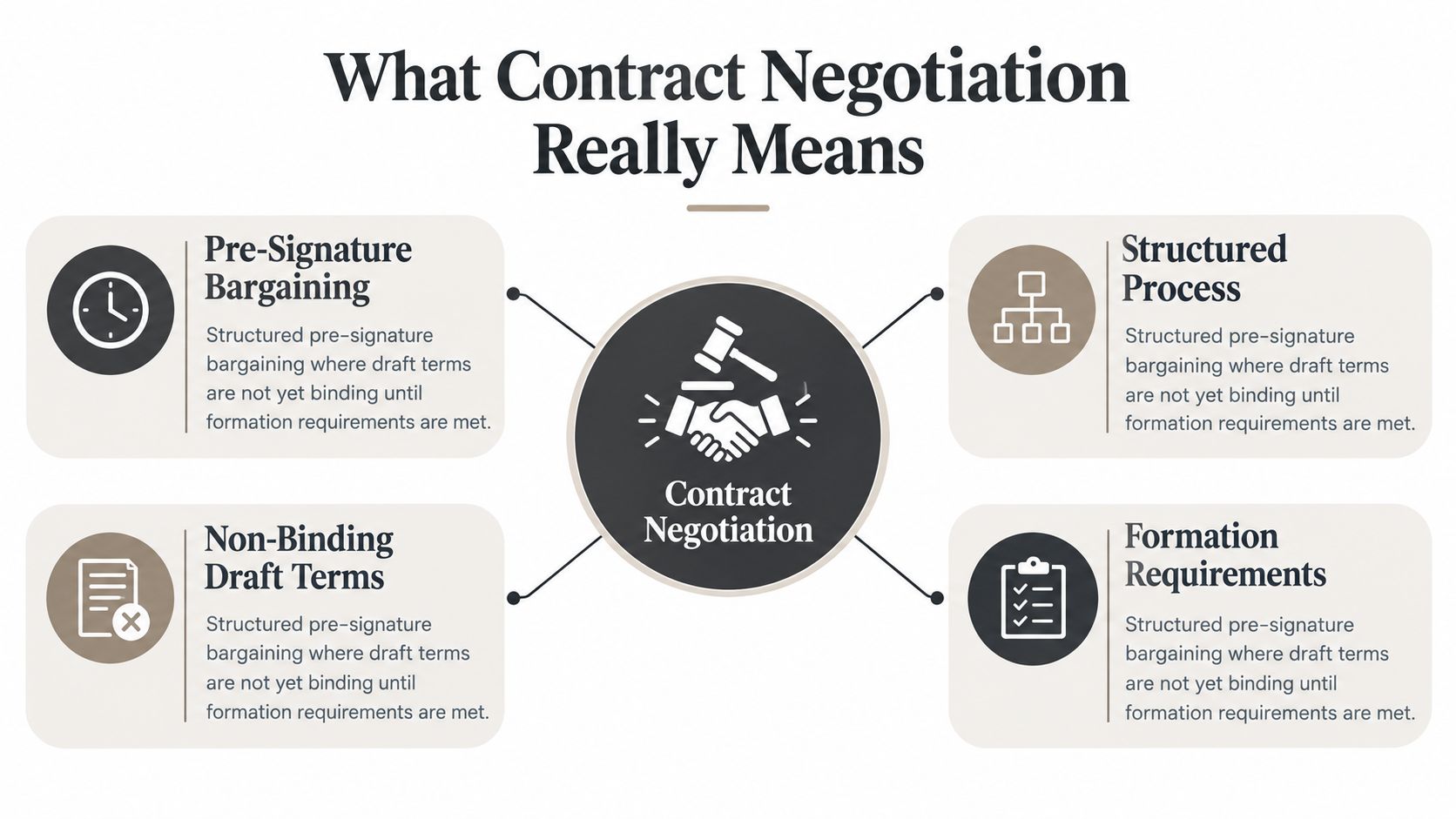
Contract negotiation is the structured process of bargaining over draft terms before signature. That's the practical boundary that matters most.
Under the basic legal view reflected in Cornell's overview of negotiation, pre-signature terms are generally not binding until the parties execute a contract that satisfies formation requirements. In ordinary business language, that means a draft, a redline, and a friendly email saying "looks good in principle" usually aren't the finish line.
Think blueprint, not building
A good analogy is a construction blueprint.
The blueprint shows intent. It tells you what the parties expect the finished structure to be. But you can't move into a blueprint. In the same way, a negotiation draft shows direction, but it doesn't yet give the parties a final, enforceable allocation of duties and risk.
That distinction is where readers often get confused. They assume the business agreement happened in the meeting, and the contract merely "memorializes" it. Sometimes that's partly true. But if the paper changes payment mechanics, acceptance standards, termination rights, liability exposure, or dispute procedure, the writing isn't administrative. It's substantive.
Essential terms and secondary terms
Not every clause carries the same weight.
Legal analysis discussed in the Oxford University Press article on essential terms and formation recognizes that many systems treat agreement on the essential elements as sufficient for contract formation even if some secondary terms remain open. In practice, that means teams should settle the points that define the deal first.
Those essentials often include:
- Scope: What exactly is being sold, built, licensed, or delivered.
- Price and payment: How money moves, when it's due, and what triggers an invoice.
- Timing: Deadlines, milestones, dependencies, and what counts as delay.
- Risk allocation: Liability limits, indemnity obligations, and insurance expectations.
If those items remain fuzzy, the deal may never close. If they are resolved early, later drafting becomes much easier.
A commercial understanding without execution can leave both sides in an ambiguous middle ground. The relationship moves forward, but enforceability doesn't.
What negotiation is really doing
When lawyers and deal teams negotiate, they're answering a set of practical questions:
- What must happen for each side to get paid?
- What happens if performance goes wrong?
- Which promises are firm, and which are only targets?
- Who bears which category of loss?
- Where will a dispute be handled if the relationship breaks down?
That is why "what is contract negotiation" can't be answered with "it's just reaching agreement." It is the process that converts business intent into enforceable obligations.
The Five Stages That Move a Deal Forward
A deal team agrees on price in a meeting, then loses two weeks arguing about payment timing, security language, and who approves a service change. Nothing has gone wrong in a dramatic sense. The problem is that business intent has not yet been turned into instructions, and instructions have not yet been turned into enforceable text.
That is why a five-stage process matters. As DiliTrust's overview of contract negotiation explains, the work usually moves through preparation, opening, bargaining, drafting and review, and closing. Those stages function less like a debate and more like a financial control system. Each one converts assumptions into decisions, then decisions into contract language the business can operate.
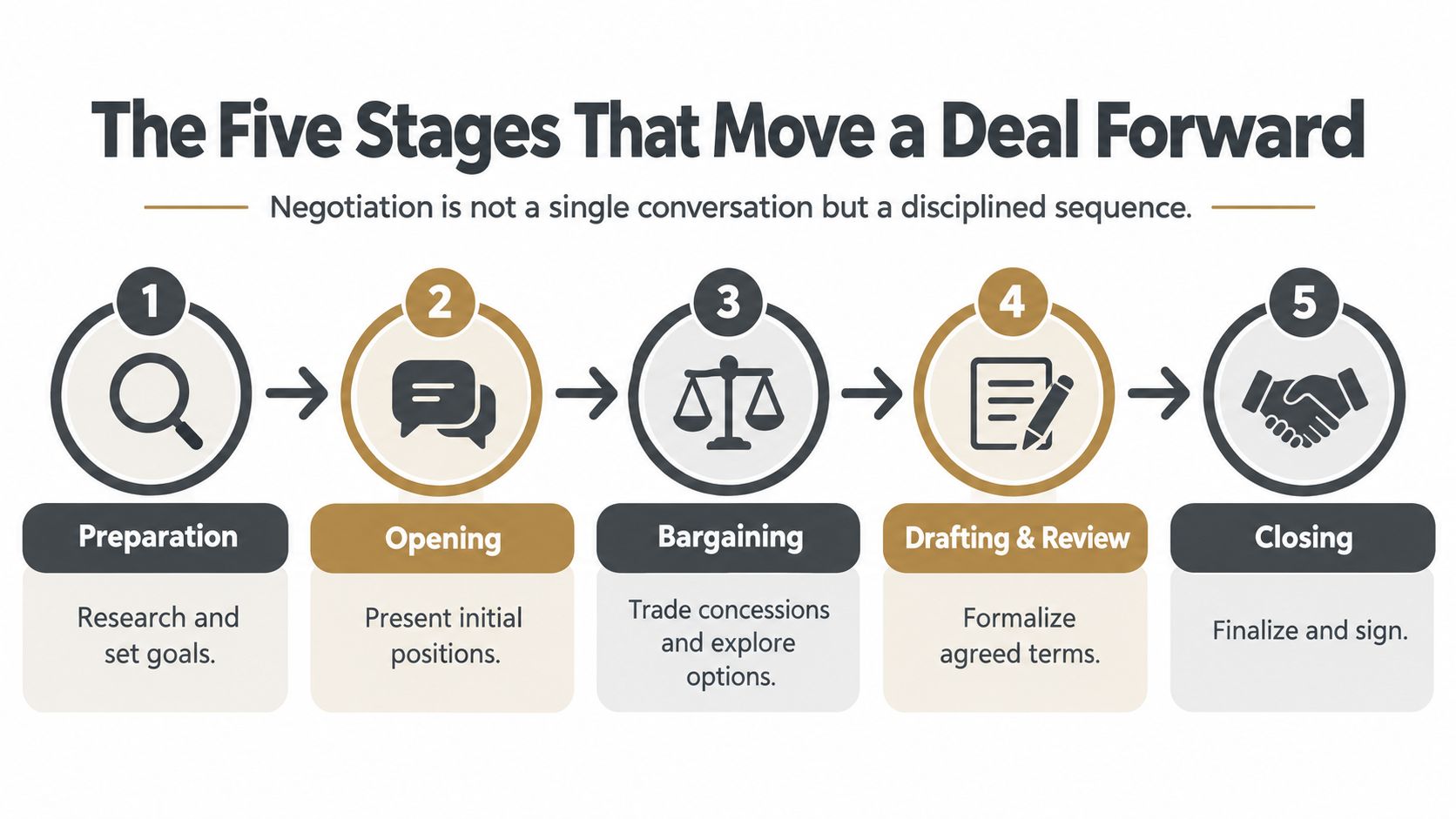
Preparation
Preparation should produce four things before the first markup: target terms, approval limits, known business dependencies, and clear walkaway points.
That sounds simple, but it is where many teams lose control. Sales may want speed, finance may care about cash timing, operations may see staffing risk, and legal may spot a clause that creates uncapped exposure. If those views are not reconciled early, the negotiator becomes a messenger instead of a decision-maker.
A disciplined record also matters. For teams that want a review trail, the AI citation audit methodology offers a useful model for checking whether edits and assumptions are supported. In contract work, that habit reduces casual redlines based on memory, pressure, or guesswork.
A preliminary term sheet can help at this stage. A letter of intent in business deals can confirm whether the parties agree on the commercial outline before they spend time on full-form drafting.
Opening
The opening stage sets the operating rules for the negotiation.
A good opening does not try to solve every issue at once. It identifies the subjects that will decide whether the deal works, such as payment mechanics, service levels, data use rights, or termination triggers. It also assigns owners, sequencing, and turnaround expectations so the process does not stall in version confusion.
This stage often reveals a point teams miss. Friction rarely comes from every modern clause. It usually comes from a smaller group of clauses tied to security reviews, privacy addenda, AI use restrictions, audit rights, and approval chains for subcontractors or scope changes. Those provisions affect workflow after signature, so they deserve early attention.
Bargaining
Bargaining is the exchange stage. One side asks, the other side responds, and movement should happen for a reason.
The practical question is not "Who won this point?" The better question is "What did this change buy us, cost us, or shift onto operations?" A cap on liability, for example, is not abstract legal wording. It prices downside risk. A longer cure period is not courtesy. It changes how quickly a payment dispute or service failure can become a termination event.
Human judgment matters most here. AI can compare drafts, spot deviations from playbooks, and flag unusual language, but it cannot reliably decide whether conceding on an audit right is acceptable because the account is strategically important, the customer has strong alternatives, or the delivery model makes the risk manageable. That decision requires context, not just pattern matching.
Drafting and review
Drafting and review turns negotiated tradeoffs into language that behaves the way the business expects.
Contracts work like wiring behind a wall. The switch may look simple from the outside, but one change affects several connected points. A refund commitment can conflict with a limitation of liability. A revised implementation schedule can break the invoicing section. A customer approval right over AI outputs can clash with service levels or acceptance criteria if nobody aligns the clauses.
This is also the stage where data becomes useful in a controlled way. Clause libraries, fallback language, and redline comparison tools can speed review, but the team still needs a person to test whether the text matches actual operations, revenue recognition, compliance requirements, and dispute posture.
Closing
Closing confirms that the final package says what the parties decided, and includes everything needed to perform.
Signatures are only part of that job. Teams also need the correct exhibits, statement of work, order form, data processing terms, pricing schedules, and final version control. If any of those pieces are outdated or inconsistent, the business may sign one deal and operate another.
A clean closing is less about ceremony than control. The contract should leave the file as reliable business data: who owes what, when approval is needed, which risks were accepted, and what happens if performance breaks down.
Core Techniques That Strengthen Your Bargaining Position
A sales lead shakes hands on price, the operations manager promises a launch date, and legal receives a redline that shifts payment timing, acceptance rights, and liability. The deal still looks profitable on the surface. On paper, though, the controls have changed.
That is why strong negotiation is not about sounding tough. It is about protecting margin, cash flow, and operational capacity by turning business intent into enforceable terms the team can track.
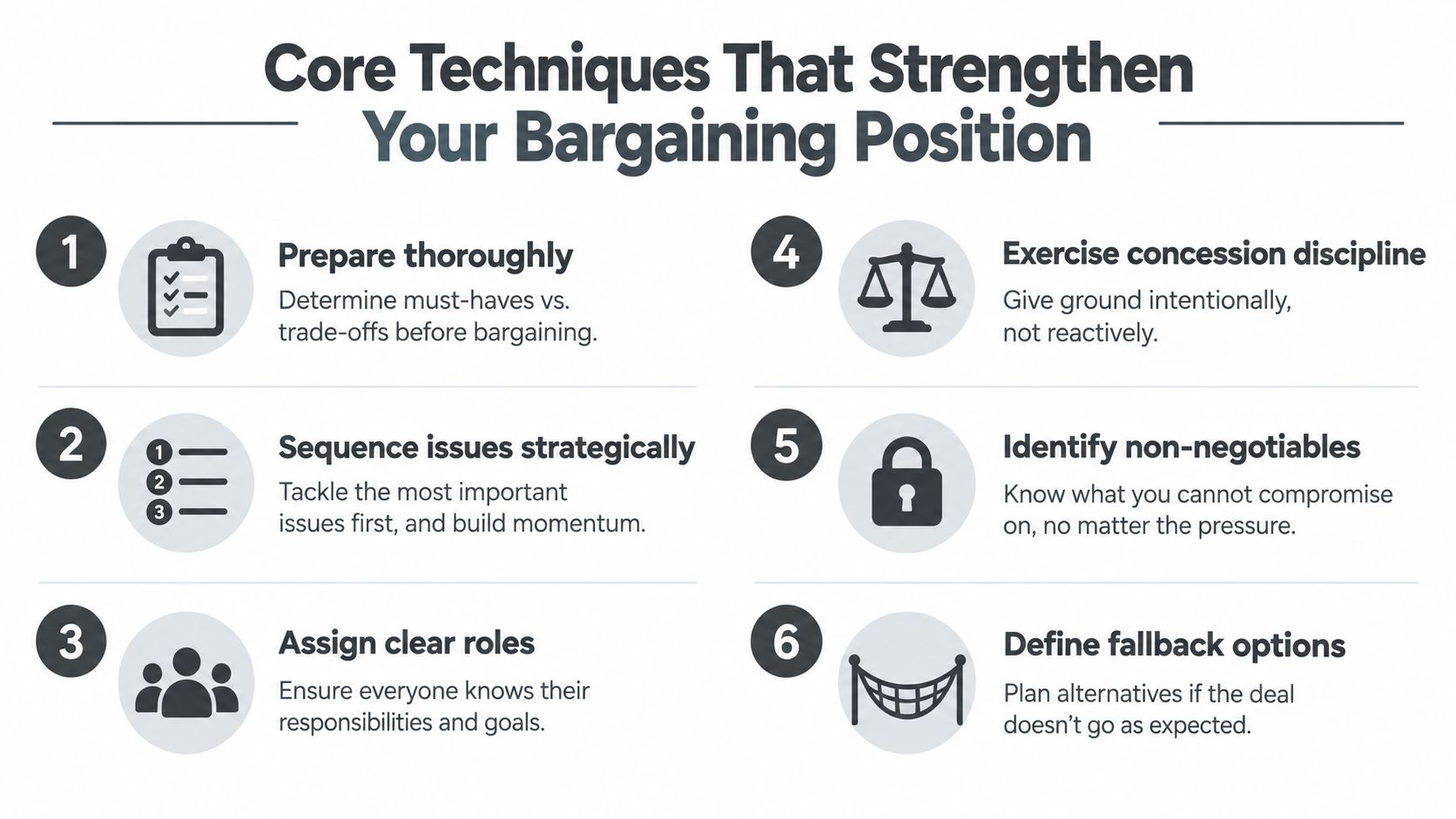
Prepare like you are setting financial controls
Preparation matters because every contract term acts like a switch in a control panel. Change one setting, and money, risk, or workflow moves somewhere else.
Before a call or markup, the team should translate preferences into instructions that a negotiator can use in real time:
- Required positions: Terms that would break economics, compliance, security, or delivery if accepted.
- Acceptable fallbacks: Positions that are workable, even if they are not ideal.
- Tradeable points: Terms the other side values more than you do.
- Approval lines: Who can approve movement on price, timing, legal risk, or exceptions.
Clear instructions prevent a common mistake. Teams often spend energy arguing over wording that feels important while conceding the clauses that control cash collection, scope creep, or remedy exposure. If your team wants a practical framework for that kind of discipline, this guide on how to improve negotiation skills is a useful starting point.
Sequence issues in the order the deal actually works
Negotiation goes better when the discussion follows the business model instead of the redline order.
A contract works like plumbing. If the parties argue about pressure at the far end of the pipe before they agree on what is flowing through it, where it starts, and who maintains the line, the conversation gets heated fast and resolves little. In contract terms, that means scope, timing, and payment mechanics usually deserve attention before the hardest risk clauses.
A practical sequence often looks like this:
- Commercial core: Scope, pricing, invoicing, payment timing.
- Operational mechanics: Implementation steps, dependencies, acceptance, change control, service levels.
- Risk allocation: Liability caps, indemnity, warranties, termination rights.
- Process terms: Notice rules, amendment mechanics, dispute procedure, exhibits.
That order does not eliminate disagreement. It gives disagreement context. A liability cap discussion is easier when both sides already know the contract value, delivery model, and likely failure points.
Trade concessions for measurable value
Concessions should buy something.
If you extend payment terms, ask for a larger upfront payment, a shorter acceptance window, stronger suspension rights, or a narrower dispute process for invoices. If you accept broader service commitments, tighten customer dependencies or approval deadlines. Good negotiators treat concessions like entries in a ledger, not gestures of goodwill that disappear in the meeting notes.
This is also one place where human judgment still beats AI. Software can show which fallback clause the company used in similar deals. It cannot reliably tell you whether giving on audit rights is harmless in one transaction and dangerous in another because of revenue recognition, customer concentration, or a fragile implementation schedule.
Keep one team voice and one decision map
A scattered internal team weakens bargaining position quickly.
One person should carry the commercial story. One person should control legal language. Finance should weigh in where terms affect collections, pricing structure, credits, or exposure. Security, privacy, or operations should speak when their area is at issue, not on every point.
The goal is consistency. Counterparties notice when legal says one thing, sales says another, and finance corrects both later. They start pressing the gap.
That discipline helps in vendor deals too. A company reviewing service contracts, software renewals, or facilities spend may pair negotiation with cost review so it knows where flexibility exists before bargaining starts. In that setting, a practical budgeting resource like reduce monthly bills 2026 can help teams identify which recurring charges deserve harder scrutiny before anyone marks up the contract.
Put the real agreement into the document
Unwritten assurances are not controls. They are memories.
If someone says, "We would never enforce it that way," the clause should be revised until the text matches that statement. Modern contracts create friction most often where language is vague about approvals, usage rights, data handling, implementation dependencies, or who pays when performance slips. Those are not drafting details. They are operating rules.
For companies that need formal support with drafting, review, and negotiation of commercial agreements, Kons Law handles that work as part of its business law practice. The value is practical. Someone has to convert a business compromise into contract language that finance can invoice against, operations can perform under, and leadership can defend if the deal goes sideways.
Key Contract Clauses You Will Actually Negotiate
Price gets the attention. Clauses create the friction.
In modern commercial contracts, the hardest disagreements often come from terms that sit outside the pricing box. Scope can expand. Payment rights can become hard to administer. Liability can be asymmetric. And a clause that seems boilerplate, such as governing law, can carry real weight if it places one party at a procedural disadvantage.
Sirion's clause-focused overview of contract negotiations notes that teams commonly flag payment terms, liability caps, timelines, and intellectual property rights during review because those provisions are often changed before approval and signature.
Commercial clauses most often negotiated
| Clause | What It Controls | Common Negotiation Point |
|---|---|---|
| Scope | What work, goods, or services must be delivered | Whether deliverables are specific enough to prevent scope creep |
| Payment terms | When invoices issue and when money is due | Upfront payment, milestone billing, holdbacks, late fees |
| Timelines | Delivery dates, milestones, dependencies | Which delays are excused and what happens if dates slip |
| Liability cap | Maximum financial exposure for certain claims | Whether the cap ties to fees paid, excludes certain claims, or is mutual |
| Intellectual property | Ownership and use rights in work product, software, data, or materials | Whether ownership transfers, licenses are limited, or background IP stays with creator |
| Indemnification | Who must defend or reimburse for third-party claims | Whether indemnity is mutual, one-way, narrow, or broad |
| Confidentiality | Protection of sensitive business information | How long obligations last and what exceptions apply |
| Termination | How and when the deal can end | Termination for convenience, cure periods, post-termination duties |
| Governing law and venue | Which law applies and where disputes must be filed | Whether the forum is neutral and practical for both sides |
Two clauses people underestimate
Indemnification causes repeated confusion because people use the word loosely. It can mean defense obligations, reimbursement obligations, third-party claim handling, or all three depending on how the clause is written. A more detailed explanation of indemnification clauses in contracts is helpful because this is one of the places where business expectations and legal effect often diverge.
Governing law and venue also deserve more attention than they usually get. A guide from Legally Spoken on legal clauses notes a practical red flag: choosing a state where neither party operates, especially when the choice appears driven mainly by law that favors the drafter. That doesn't automatically make the clause invalid, but it should prompt questions about convenience, fairness, and strategic advantage.
If a clause changes who bears the cost of failure, who controls the remedy, or where a fight must happen, it isn't boilerplate for the party exposed to it.
Clauses don't live alone
One more practical point. Clauses interact.
A strong termination right means less if prepaid amounts are nonrefundable. A customer-friendly service level commitment may matter little if the sole remedy is a modest credit. An IP ownership clause can conflict with a vendor's background tools unless the draft distinguishes new work product from preexisting materials.
For teams that regularly manage post-signature changes, a practical contract modifications overview can help frame how amendments, change orders, and evolving obligations affect the original bargain.
How Modern Teams Use Data and AI Without Losing Control
Contract negotiation used to be explained almost entirely as a conversation skill. That is no longer enough for many businesses.
Modern teams increasingly treat negotiated terms as structured business data. The question isn't only "Did we get the clause we wanted?" It's also "Can we see that clause across all agreements, forecast its impact, and manage the risk over time?"
Where AI helps reliably
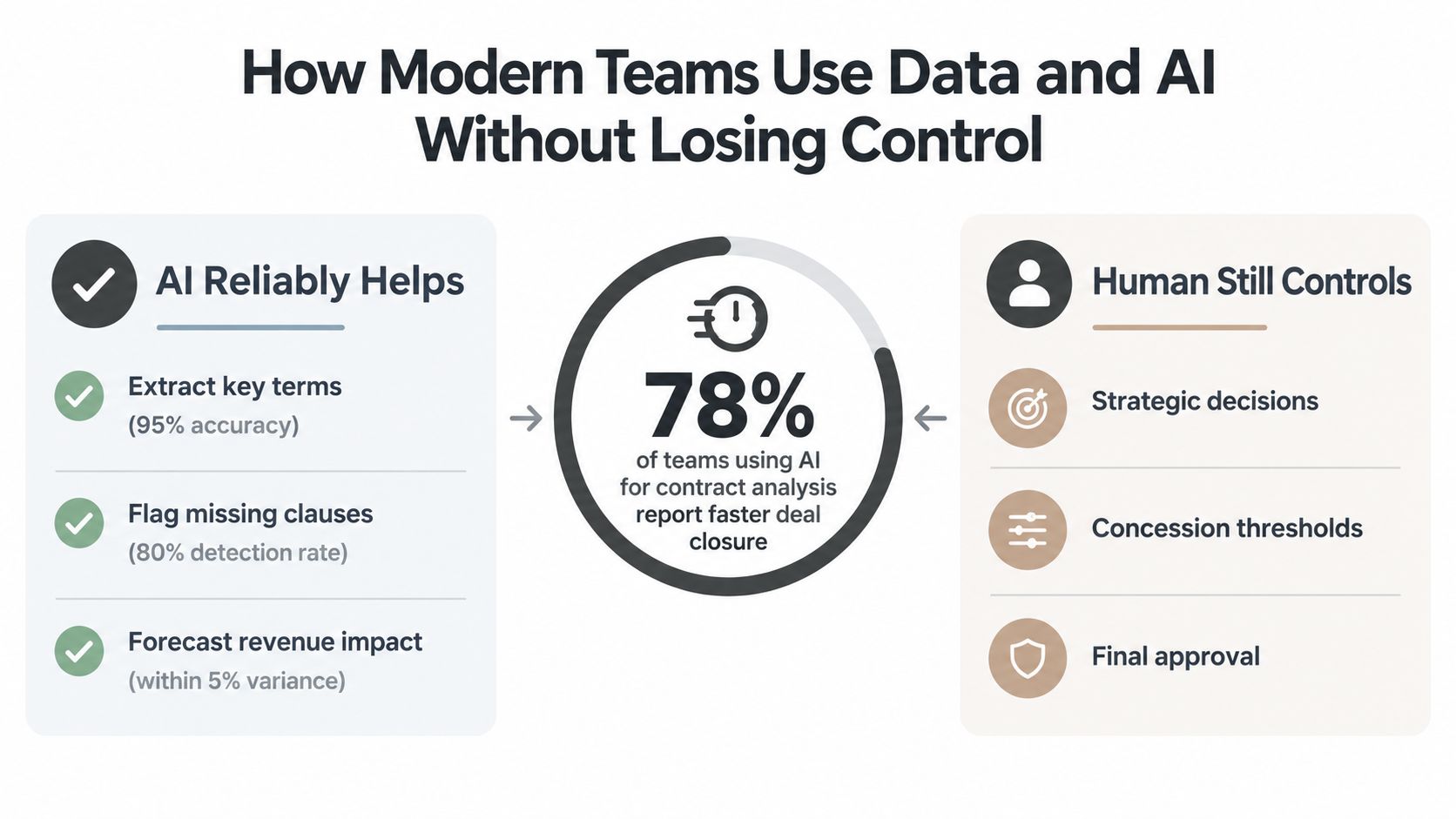
Recent Gartner contract analytics market coverage describes how AI can extract provisions, flag missing clauses, score risk, and recommend process changes. That is a major operational shift. Negotiated language is becoming machine-readable inventory, not just archived paper.
In practical use, AI is most helpful when the task is structured:
- Extraction: Pulling payment terms, renewal dates, liability caps, and venue provisions from large contract sets.
- Comparison: Spotting deviations from approved templates or fallback language.
- Triage: Identifying which agreements need human attention first.
- First-pass redlining: Marking obvious departures from standard positions.
These uses save time because they reduce manual hunting.
Where humans still decide
The harder judgment calls still belong to people.
Industry reporting summarized in the Gartner coverage and in the 2026 State of Contracts report from Spellbook suggests AI use in first-pass review and redlining is growing, but fully autonomous negotiation remains experimental, especially in complex agreements that require strategic concessions and relationship judgment. The same Spellbook report notes that AI-use clauses appeared in 18% of SaaS agreements, and that 62% of respondents worried about unknown exposure in older contracts while 34.5% prioritized stronger templates and fallback terms.
That combination tells an important story. Faster review does not mean simpler risk. Teams are moving faster while also facing more clause variation, more legacy exposure, and more pressure to standardize.
The practical operating model
The most sensible model for many businesses is a blended one:
- Use AI for pattern recognition.
- Use templates for repeatability.
- Use human judgment for exceptions, tradeoffs, and approvals.
That is especially true when clauses involve disputed facts, unusual liability structures, evolving technology terms, or a counterparty relationship that matters beyond this quarter.
Putting Negotiation Knowledge Into Practice
A sound negotiation doesn't try to win every line. It tries to produce a contract the business can perform, defend, and understand.
That means asking a short set of disciplined questions before the next draft goes out:
A practical deal-team checklist
- Are the essentials settled: Do both sides share the same understanding of scope, price, payment triggers, and timing?
- Have we priced the risk: If a clause shifts liability, refund exposure, or performance burden, has someone measured the business impact?
- Are concessions documented: Does the draft reflect what was agreed, or are key points still living in emails and phone calls?
- Will the team be able to administer this contract: Can operations, finance, and compliance carry out what the language requires?
- Do unusual clauses need closer review: One-sided indemnity, broad IP transfer, awkward venue selection, and vague acceptance criteria often deserve extra attention.
A useful historical reminder comes from labor and commercial bargaining research. In U.S. labor contracts from 1970 to 1995, only 7% were renegotiated before planned expiration, only 1.9% of early settlements in major negotiations occurred at least 30 days before expiration, and in a separate sample of 5,002 large-unit wage negotiations from 1970 to 1989, bargaining disputes occurred in 57% of cases, according to research available through EconStor. Negotiation has never been just a quick exchange of drafts. It has long involved timing, pressure, and conflict management.
When the stakes are meaningful, careful negotiation saves more than legal cleanup later. It preserves economics, clarifies accountability, and gives both sides a deal they can run. If you want to discuss your business law matter, contact Kons Law at (860) 920-5181.
Kons Law advises businesses and financial professionals on the contracts, negotiations, disputes, and commercial decisions that shape real-world risk. If you're reviewing a draft agreement, negotiating terms, or trying to resolve uncertainty before you sign, visit Kons Law to discuss how the firm can help.
