
A lot of advisory firms reach the same point in their growth curve. The founding team built the business around client relationships, portfolio management, and trust. Then the firm adds staff, takes on more accounts, adopts new technology, and starts marketing more actively. Suddenly, compliance for RIA operations stops feeling like a background task and starts shaping daily decisions.
That shift catches many firms off guard. A policy manual may exist. Form ADV may be on file. Someone may hold the CCO title. But when the firm steps back and asks whether its compliance program matches how people work, the answer is often uncomfortable.
Introduction Navigating the Regulatory Landscape
One common scenario looks like this. An advisory firm has grown steadily, advisors are communicating with clients across email, text, and collaboration tools, and marketing now includes a website, social media, and third-party content support. The principals know they have obligations, but the written procedures still reflect an older version of the business. That gap is where trouble starts.

The stakes aren't theoretical. The SEC reported 21,669 investment advisers in 2024, a 1.4% year-over-year increase from 2023, and those advisers managed about $146 trillion in assets, according to the SEC's investment adviser statistics. That scale explains why regulators expect firms to maintain programs that work in practice, not just on paper.
Why growth makes compliance harder
Early-stage firms often treat compliance as a filing exercise. Growing firms learn that it's an operating system. Every new service, employee, vendor, communication channel, or compensation structure can create a new disclosure issue, a supervisory issue, or both.
That's why firms benefit from thinking about compliance as infrastructure. It supports fiduciary performance, client trust, and exam readiness at the same time. If you want a broader sense of how businesses approach this issue across industries, Kons Law's discussion of regulatory compliance topics is a useful starting point.
Practical rule: If your procedures don't match what your people actually do each day, you don't have a functioning compliance program. You have a document problem waiting to become a regulatory problem.
What a defensible program really means
A defensible program isn't perfect. It is current, customized, supervised, documented, and revised when the firm identifies a weakness. Regulators understand that firms evolve. What they scrutinize is whether management identifies risk, assigns responsibility, and follows through.
That practical mindset matters more than checklists alone. The firms that fare best under scrutiny usually aren't the firms with the thickest manuals. They're the firms that can show how policy translates into action.
The Legal Foundation of RIA Compliance
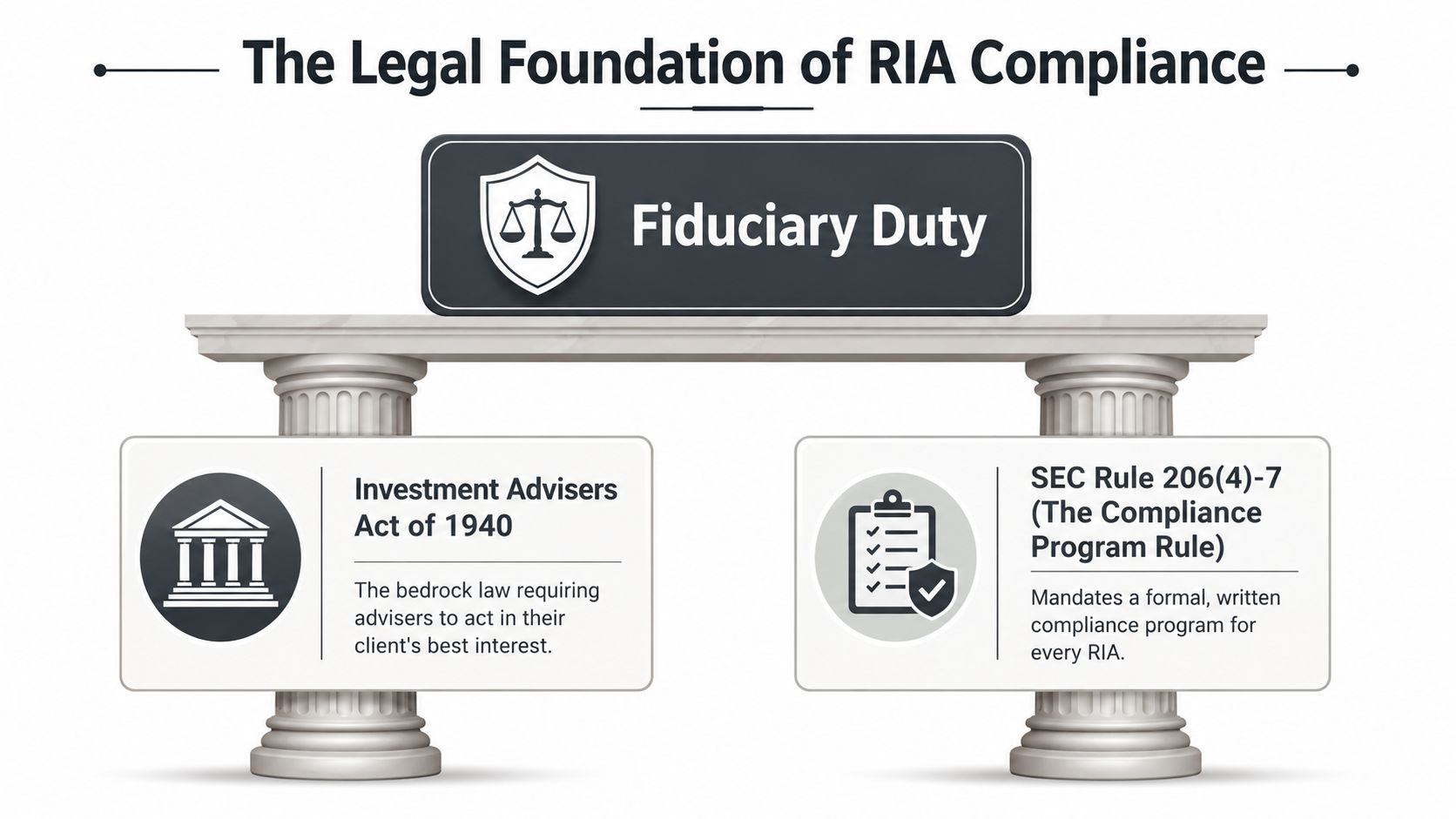
The legal backbone of compliance for RIA firms is the Investment Advisers Act of 1940. At a practical level, that statute frames the adviser-client relationship around fiduciary duty. Advisers do not merely sell a product. They're expected to act in the client's best interest and address conflicts with candor and care.
For a new or growing firm, that means compliance should never be treated as separate from business operations. The law doesn't ask whether the firm has a polished compliance binder. It asks whether the firm's conduct, disclosures, supervision, and recordkeeping satisfy the obligations that come with advisory status.
Rule 206(4)-7 is the operating mandate
The modern structure turns on Rule 206(4)-7. That rule requires each adviser to adopt and implement written policies and procedures reasonably designed to prevent violations, and to designate a chief compliance officer. It also requires an annual review of the adequacy of those policies and the effectiveness of their implementation.
This is the point many firms miss. Rule 206(4)-7 doesn't reward generic language. It requires a system. If your firm trades in a certain way, bills a certain way, markets in a certain way, and communicates across certain channels, the compliance program has to address those actual workflows.
A related development raises the stakes further. The SEC's 2024 amendment to Regulation S-P requires RIAs to implement written incident-response programs and provide customer breach notifications within 30 days of a data incident, as discussed in Sidley's analysis of the 2024 update for investment advisers.
Fiduciary duty shows up in ordinary decisions
Most compliance failures don't begin with obvious fraud. They start with routine decisions that no one escalated. A fee practice changes but disclosures don't. A marketing vendor posts content no one reviewed. An employee uses a personal device for client messages because it's convenient. A cybersecurity plan exists, but no one has mapped who does what after an incident.
Those failures matter because the Advisers Act is built to police real conduct. Firms that want a clearer picture of how regulators and litigants assess misconduct should understand the broader context of securities fraud issues, even when the firm's own issue is framed as a compliance deficiency rather than an enforcement fraud case.
Written policies matter. Operational reality matters more.
The legal minimum is not the practical minimum
A firm can satisfy the formal requirement to have written policies and still create exam risk if those policies are stale, copied from another business model, or ignored by staff. The law sets the floor. A defensible program goes beyond that floor by making responsibilities clear, documenting review, and revising procedures when the business changes.
That is how the legal foundation should be understood. Not as a stack of rules to memorize, but as a framework that forces the firm to align fiduciary duty, supervision, disclosure, and documentation.
Structuring a Defensible Compliance Program
The strongest compliance programs are built around authority, specificity, and evidence. Authority means the right people can enforce standards. Specificity means procedures reflect the firm's actual activities. Evidence means the firm can prove that review and remediation occurred.
The CCO must have real authority
The first structural question is simple. Who owns compliance in practice?
If the CCO cannot obtain information, stop problematic conduct, escalate issues to leadership, or require remediation, the title doesn't mean much. In smaller firms, the CCO often wears multiple hats. That can work, but only if the firm is honest about conflicts, workload, and reporting lines.
A functioning CCO role usually includes responsibility for:
- Policy ownership: Maintaining written supervisory and compliance procedures that fit the firm's business model.
- Testing and review: Confirming that controls operate as described, not just that policies say they should.
- Escalation authority: Bringing material issues to firm leadership quickly and documenting the response.
- Training and follow-up: Making sure personnel understand requirements tied to their roles.
A manual should read like your business
A compliance manual shouldn't sound impressive. It should sound familiar to the people using it.
If your firm outsources portfolio management, uses model portfolios, participates in wrap programs, permits remote work, or relies on specific software platforms, the manual should say so. If it contains pages on practices the firm doesn't use, or says nothing about practices the firm does use, examiners will notice.
A useful way to test a manual is to compare it against the firm's real workflow map. For each area, ask whether the policy identifies the risk, the control, the responsible person, and the evidence that the control occurred.
| Business activity | What the policy should address | What examiners often ask for |
|---|---|---|
| Trading | Allocation, errors, approvals, monitoring | Blotters, reviews, exception handling |
| Fee billing | Calculation method, adjustments, oversight | Bills, backup, reconciliation records |
| Marketing | Review process, approvals, disclosures | Final ads, review logs, support files |
| Personal trading | Pre-clearance, reporting, restricted activity | Reports, certifications, escalations |
Under Rule 206(4)-7, the program must be mapped to actual workflows like trading and marketing, and exam risk rises when policies exist on paper but don't match operating reality, as described in SmartAsset's overview of RIA compliance requirements.
The annual review is where firms prove seriousness
Many firms treat the annual review as a dated memo plus a checklist. That's not enough. The annual review should function as a disciplined look back at the past year's operations, incidents, complaints, vendor changes, marketing activity, employee conduct, and any issues uncovered through testing.
What works:
- Define the review scope clearly. Cover the business lines, risks, and control owners that matter to the firm's current operations.
- Test actual activity. Pull samples. Review approvals. Compare disclosures against practice. Check whether prior remediation stayed fixed.
- Write down findings candidly. A review that identifies nothing often looks less credible than one that identifies manageable issues and addresses them.
- Track remediation to completion. Assign owners and keep evidence that the corrective action happened.
A good annual review doesn't prove the firm had no issues. It proves the firm knows how to find issues and fix them.
Off-the-shelf programs often fail in predictable ways
Template compliance packages can be a useful starting point. They're rarely enough on their own. The most common failure points are familiar: borrowed language that doesn't match the firm, controls assigned to people who no longer work there, and no documentation showing whether any testing occurred.
That is why firms should think of compliance design as a legal and operational exercise, not a purchase. A strong overview of how companies build this type of infrastructure appears in Kons Law's discussion of a corporate compliance program.
Mastering Key Filings and Client Disclosures
Filings and disclosures are where many compliance weaknesses become visible. A firm may operate in good faith and still create avoidable risk if its public statements are inaccurate, stale, or incomplete. For most RIAs, the center of gravity is Form ADV and the brochure materials that clients receive.
Treat Form ADV as a live disclosure document
A surprising number of firms still act as if Form ADV is a registration event rather than an ongoing disclosure obligation. That mindset causes trouble. The form should reflect the business as it exists now, not as it existed when the firm first registered.
Part 1A speaks primarily to regulators. It covers structure, ownership, services, disciplinary disclosures, and other core facts. Part 2A is different in tone and function. It tells clients, in plain language, what the firm does, how it gets paid, and where conflicts may arise.
When firms run into avoidable exam issues, the underlying problem is often inconsistency. The ADV says one thing, client agreements say another, invoices reflect a third practice, and employees describe the service model in a fourth way.
Brochures should prevent misunderstandings
The Part 2A brochure and Part 2B brochure supplements are often treated as mandatory handouts. They should be treated as risk-control documents. Good disclosures help set expectations before a misunderstanding becomes a complaint.
Focus on clarity in areas such as:
- Fees and billing practices: Explain plainly how the firm charges, when it deducts fees, and how clients can verify calculations.
- Services and limitations: Describe what the firm does, and what it does not do.
- Conflicts of interest: Address incentives, referrals, compensation structures, and outside business activities transparently.
- Personnel information: Make sure brochure supplements are current for the professionals who service accounts.
What good disclosure work looks like
Strong firms usually build a simple internal comparison process. Before filing or updating disclosure documents, they compare them against:
- client agreements,
- website and social media content,
- fee practices,
- investment committee materials,
- vendor and solicitor arrangements,
- and current personnel roles.
That process catches inconsistencies before an examiner or client does.
Disclosure should answer the question a skeptical client would ask after reading your website, signing your contract, and reviewing the first invoice.
Where firms usually stumble
They overdescribe capabilities, underdescribe conflicts, or forget to update documents after operational changes. None of those issues requires bad intent. But all of them can undermine credibility quickly.
For compliance for RIA firms, the practical lesson is straightforward. Your filings and client-facing documents should match the business line by line. If they don't, the firm is creating risk in public.
Managing Common High-Risk Compliance Areas
High-risk areas aren't always the most complicated legal topics. They're the areas where daily business pressure collides with disclosure, supervision, and documentation. In practice, that usually means marketing, custody-related issues, trading oversight, conflicts management, cybersecurity, and electronic communications.
Marketing problems usually start with ordinary content
The SEC's Marketing Rule creates risk because firms now market through many channels and often with help from vendors, consultants, or affiliated personnel. The firm may view a website update, a LinkedIn post, or a client quote as routine. Regulators may view it as an advertisement that required review, disclosures, substantiation, and retention.
What works is a pre-use review process that captures every public-facing communication tied to advisory services. That process should apply whether content is drafted by an employee, an agency, or a third-party promoter. It should also cover edits made after initial approval.
What doesn't work is informal review by whoever happens to be available that day.
Custody and fee practices require precision
Custody issues often arise when firms don't recognize that a seemingly convenient client arrangement can trigger additional obligations. The same is true for fee deduction practices. If billing authority, standing letters of instruction, or access to client accounts aren't analyzed carefully, the firm can wander into a more regulated posture than it intended.
The right response is not guesswork. It is a documented legal and operational assessment of what authority the firm has and what disclosures, controls, and third-party arrangements follow from that structure.
Best execution and conflicts need evidence
Every advisory firm understands the concept of best execution. Fewer firms build a record that shows how they monitor it. The same problem appears in conflict management. A firm may verbally acknowledge a conflict but fail to document how it discloses, supervises, and mitigates the issue over time.
A practical control framework often includes:
| Risk area | Weak approach | Defensible approach |
|---|---|---|
| Best execution | Relying on broker relationships alone | Periodic review with documented factors and follow-up |
| Soft dollars | General disclosure without monitoring | Inventory of benefits, disclosure review, oversight |
| Wrap programs | Standard language copied from forms | Product-specific conflict analysis and training |
| Proprietary products | Disclosure only at onboarding | Ongoing suitability and conflict review |
Electronic communications are now a core exam issue
This area has changed compliance for RIA firms more than many leaders initially expected. Business communications don't live only in email anymore. They move through text messages, collaboration tools, social platforms, and personal devices.
Rule 204-2 recordkeeping expectations extend to business-related electronic communications, including texts and social media, with a general five-year retention period, and regulators evaluate not just whether records are kept but whether the firm can demonstrate continuous supervision and prompt retrieval, as explained in Smarsh's discussion of RIA communications compliance requirements.
That has several direct consequences:
- Approved channels must be explicit: Employees need clear guidance on what they may use for client business.
- Archiving must be thorough: If the firm allows a channel, it must capture and retain those communications.
- Supervision must be documented: A policy without review logs, escalation records, and follow-up isn't enough.
- Personal devices can't be ignored: If business happens there, the compliance program must address it.
Firms don't get into trouble only because someone sent a text. They get into trouble because the firm allowed business to move into a channel it couldn't supervise or produce.
Cybersecurity is now operational compliance
Cyber risk used to sit at the edge of many advisory compliance programs. It no longer does. If a firm stores sensitive client information, uses cloud platforms, depends on vendors, and communicates electronically, cyber preparedness is part of ordinary compliance governance.
The firms that handle this well map legal obligations to actual incident response steps. They know who investigates, who preserves evidence, who decides whether notice is required, and who communicates with clients. The firms that struggle usually have policies drafted in broad language but no tested process behind them.
Surviving an SEC Exam and Enforcement Action
When an SEC exam begins, the firms that struggle most are usually the firms that haven't practiced how to respond. The first document request arrives. People scramble to find records. Different employees answer similar questions differently. Old versions of policies surface. Tension rises because no one is sure whether the issue is routine or serious.

The first response sets the tone
The opening stage matters. Firms should gather a small response team, preserve relevant materials, identify one coordinator for examiner communications, and create a clear production plan. A rushed, inconsistent response can create more concern than the underlying issue.
Good exam management usually includes:
- Centralized coordination: One person tracks requests, deadlines, and productions.
- Consistency review: Policies, agreements, disclosures, and actual practices are compared before interviews begin.
- Privilege awareness: Legal review should be considered early when sensitive issues appear.
- Interview preparation: Employees should understand the scope of questions and answer accurately without speculation.
For firms facing deeper scrutiny, it helps to understand how regulators approach SEC investigations and how that process can differ from a routine examination.
During the exam, credibility matters
Examiners are evaluating more than documents. They are assessing whether the firm appears organized, transparent, and in control of its own compliance function.
That means the right posture is cooperative but disciplined. If the firm doesn't know an answer, it should say so and follow up after checking. If a document is missing, the firm should address that candidly and explain what it is doing to locate or reconstruct the record where appropriate.
The worst exam responses are improvisation and overconfidence. The best are accurate, organized, and documented.
Deficiency letters are not the same as enforcement
Many exams end with comments, requests for clarification, or a deficiency letter. That is serious, but it is not the same as an enforcement action. A deficiency letter usually means the staff identified issues requiring correction. The quality of the firm's response matters a great deal.
A solid response generally does three things:
- Addresses each point directly: No vague assurances.
- Explains remediation concretely: Revised policy, training, testing, new system, or supervisory change.
- Includes support where appropriate: Updated documents, logs, attestations, or implementation evidence.
Enforcement risk rises when the issue involves material misstatements, repeated failures, obstructive conduct, missing records that should exist, or facts suggesting deeper misconduct. At that stage, strategy changes. The firm is no longer just fixing a process problem. It may be defending its conduct before the agency.
Preparation should happen before the letter arrives
The firms that handle exams best usually do the work long before any notice comes in. They organize records, rehearse retrieval, test disclosures against practice, and identify weak spots internally.
That kind of preparation reduces stress because it turns the exam from a panic event into a controlled response. No firm enjoys being examined. But firms with disciplined programs usually find the process far more manageable than firms that are trying to invent their controls after the request list arrives.
Conclusion Proactive Compliance and When to Seek Counsel
The most useful way to think about compliance for RIA firms is this. Compliance isn't a side obligation that competes with growth. It is part of how a mature advisory business protects clients, protects its reputation, and protects enterprise value.
Firms that treat compliance as a one-time drafting project usually end up with stale documents and recurring fire drills. Firms that treat it as a living management function tend to make better operational decisions. They identify conflicts sooner, update disclosures faster, respond to incidents more coherently, and face exams with less disruption.
A practical remediation checklist
If a firm has concerns about its current program, the first steps are usually straightforward:
- Compare policy to practice: Identify where actual workflows no longer match written procedures.
- Review disclosure consistency: Reconcile Form ADV, brochures, agreements, invoices, and website language.
- Test communications capture: Confirm the firm can retain and retrieve business communications across approved channels.
- Assess the CCO function: Determine whether the role has the time, authority, and institutional support it needs.
- Document remediation: Keep evidence of findings, decisions, deadlines, and follow-through.
That work often reveals whether the issue is manageable internally or whether the firm is facing a more sensitive situation that needs legal guidance.
When counsel should be involved
Outside counsel isn't only for subpoenas, Wells notices, or enforcement litigation. In many situations, legal review is most valuable before a crisis. That includes new service lines, compensation arrangements, marketing initiatives, custody questions, cyber incidents, difficult disclosure judgments, and exam responses involving potential misstatements or recordkeeping gaps.
Counsel can also help firms separate ordinary compliance cleanup from matters that may carry broader exposure. That distinction matters. A weak policy can often be fixed. A weak policy combined with inaccurate disclosures, missing records, or a misleading exam response is a different category of problem.
The firms that hold up best under scrutiny
They are not necessarily the largest firms or the firms with the most expensive software stack. They are the firms that do the basics well and can prove it. Their disclosures match their business. Their supervision reaches the channels their employees use. Their annual reviews produce action. Their leadership treats compliance findings as management issues, not annoyances.
That is what makes a program defensible. It is built for reality, not appearance.
If you want to discuss your business law matter, contact Kons Law at (860) 920-5181.
