
Amending your Articles of Organization isn't just about shuffling paperwork; it's a formal legal step to update your LLC's public record. The process involves getting your members or managers to sign off, drafting the exact language for the changes, and then filing a Certificate of Amendment with the Connecticut Secretary of State. It’s how you keep your business compliant and ensure its public filings match reality.

Why and When to Amend Your Articles of Organization
Think of your Articles of Organization as your company's birth certificate on public display. When the core facts about your business change, this document absolutely must be updated.
Ignoring this can create a huge gap between your legal paperwork and how you actually operate. This can lead to compliance headaches, rejected contracts, or even trouble getting a business loan. This isn't just bureaucratic red tape; it's a fundamental part of good corporate governance that keeps your LLC in good standing with the state.
Common Triggers for an Amendment
Business is never static. Growth, rebranding, and strategic pivots are all signs of a healthy, evolving company. But these milestones often trigger the need for a formal amendment.
Recognizing these triggers is the first step. Here's what I see most often in my practice:
- Changing Your Business Name: You're rebranding for a new market, or maybe the original name just doesn't fit anymore. To make it official with the state, banks, and the IRS, you have to file an amendment.
- Updating Your Principal Office Address: If your LLC moves its main hub of operations, the state needs to know. This ensures official mail and legal notices don't get lost.
- Modifying Your Management Structure: Switching from a member-managed to a manager-managed LLC (or the other way around) is a huge operational shift. It changes who has the authority to run the company, and your articles must reflect that.
- Changing Your Registered Agent: While this is often handled with a dedicated "Change of Agent" form, sometimes it's part of a broader amendment. Your registered agent is your official point of contact for lawsuits, so this information is critical.
Let's look at why this is so important in practice.
Common Triggers for Amending Articles of Organization
To really understand the impact, it helps to see how these triggers play out and what happens if you ignore them. I've put together a quick table outlining the most frequent scenarios I encounter with clients.
| Reason for Amendment | Example Scenario | Risk of Inaction |
|---|---|---|
| Business Name Change | Your LLC, "Dave's Web Design," rebrands to "Quantum Digital Solutions" to attract larger corporate clients. | Banks may reject loan or account applications under the new name. The state has no record of "Quantum Digital Solutions," creating legal identity confusion. |
| Address Update | You move your home-based business into a commercial office space downtown. | A crucial legal notice (like a lawsuit summons) is sent to your old address, you never receive it, and a default judgment is entered against your LLC. |
| Management Structure Shift | Your LLC grows, and the members decide to appoint a non-member CEO to run daily operations, shifting from member-managed to manager-managed. | Without an amendment, the new CEO may lack the official authority to sign contracts, which could be deemed invalid later. |
| Adding or Removing Members | One of the founding members exits the business, and their ownership interest is bought out by the remaining members. | Public records are inaccurate, which can cause major problems during due diligence if you try to sell the company or bring on investors. |
Failing to file an amendment can turn a simple operational change into a significant legal and financial liability. It’s a foundational piece of corporate maintenance.
The Real-World Impact of Inaction
So, can you just "let it slide?" Honestly, the consequences range from minor administrative annoyances to serious legal vulnerabilities.
Imagine walking into a bank to open an account under your slick new brand, only to be told that, as far as the state is concerned, your company doesn't exist under that name. It's an embarrassing and completely avoidable roadblock.
An amendment serves as the official, legally recognized record of your company's evolution. It synchronizes your public-facing legal identity with your day-to-day business operations, preventing legal and financial disconnects down the road.
The business world moves fast. Changes within your company or shifting regulatory compliance changes are often what drive the need to amend your articles. For new companies, these updates can come up sooner than you'd think. In the U.S., over 4.7 million new businesses were started in 2023 alone. My experience aligns with industry estimates suggesting that 15-20% of them will need to file an amendment within their first three years for common reasons like a name or address change.
Getting the foundation right from the start is key. That's why I always recommend new entrepreneurs review a solid guide on LLC formation in Connecticut to understand their initial and ongoing obligations.
If you want to discuss your business law matter, contact Kons Law at (860) 920-5181.
Getting Your Ducks in a Row: The Internal Approval Process
Before you even think about filling out a state form, you have to handle business on the inside. Filing an amendment with the state without getting the proper internal green light is a classic "cart before the horse" scenario. It’s a move that can completely invalidate the change you’re trying to make.
Skipping this step can cause serious internal strife, even if the state initially accepts your paperwork. Imagine one of your partners finding out you changed the company’s name or management structure on your own. This procedural misstep could spark legal challenges that unravel the very amendment you worked to file.
Your Operating Agreement or Bylaws Are Your Rulebook
First things first: pull out your company’s governing document. This is your internal constitution, and it spells out exactly how major decisions—like amending the Articles of Organization—get made.
For an LLC, this all-important document is your Operating Agreement. For a corporation, you'll be looking at the Bylaws.
These documents will tell you everything you need to know, including:
- Who can propose a change: Is it any member, or only a manager? For corporations, is it a director or a specific officer?
- What kind of notice you have to give: How much advance warning do members or shareholders need before a meeting to vote?
- What it takes to pass a vote: Does the decision need a simple majority (over 50%), a supermajority (like two-thirds), or everyone’s unanimous consent?
Ignoring what these documents say is a common and expensive mistake. If your Operating Agreement demands a 75% vote to approve a change and you only got 60%, that amendment isn't legally valid internally, no matter what the state filing says. To get a better handle on this foundational document, check out our guide on what an operating agreement is and why it’s so critical for your LLC.
Making it Official: Proposing and Voting on the Amendment
Once you know the rules from your operating agreement or bylaws, it's time to formally propose the change and hold a vote. This isn’t a casual chat over lunch; it's a formal procedure that has to be documented from start to finish.
Typically, this involves drafting a formal resolution that clearly outlines the proposed amendment. For example, the resolution might read: "RESOLVED, that the members of XYZ Innovations, LLC hereby approve amending Article I of the Articles of Organization to change the name of the company from 'XYZ Innovations, LLC' to 'Quantum Growth Partners, LLC'."
This resolution is then put before the decision-makers—the members of an LLC or the board of directors (and sometimes shareholders) of a corporation—during a properly scheduled meeting.
Documentation is everything here. Every single step—the meeting notice, the exact wording of the resolution, the final vote count, and the decision—must be recorded in the official meeting minutes. These minutes become a permanent part of your company records and serve as your proof that you followed the proper procedure.
Key Differences Between LLCs and Corporations
This internal approval process really shines a light on one of the biggest differences between LLCs and corporations. LLCs are known for their flexibility, with the operating agreement setting most of the rules. Corporations, on the other hand, have to follow much stricter, more formal state laws.
In fact, corporations often have a heavier compliance burden. An analysis from Wolters Kluwer notes that the corporate process often involves notifying shareholders 10-30 days before a vote, where a majority or two-thirds approval is often required by statute.
This means a corporation trying to authorize more shares has a rigid path of board resolutions and shareholder votes to navigate. An LLC adding a new member might just need to follow the simpler rules it created for itself in its operating agreement.
Ultimately, whether you run an LLC or a corporation, the principle is the same. The internal approval process is a non-negotiable step that gives your amendment its legal power and shields your business from damaging internal disputes down the road.
If you want to discuss your business law matter, contact Kons Law at (860) 920-5181.
Filing Your Amendment with the Connecticut Secretary of State
Once you have your internal approvals squared away, it's time to make it official with the state. This is the moment your proposed change goes from an internal decision to a legal reality. The process in Connecticut is fairly straightforward, but it's one of those things where the details really matter.
Your first move is to head over to the Connecticut Secretary of State's website. You're looking for a specific document called the Certificate of Amendment, which is the official form LLCs use to put their changes on the public record.
Locating and Completing the Correct Form
You can usually find the Certificate of Amendment in the business services or forms section of the Secretary of State's site. When you open it up, you'll see it asks for standard information about your LLC—its official name, business ID number, and so on.
The most important part of the form, and where people often slip up, is the section where you actually describe the amendment. You can't be vague here. The state needs to know exactly what's changing.
For a clean filing, you have to state both the old provision and the new one.
- For a Name Change: A good example would be, "Article I of the Articles of Organization is amended to change the name of the limited liability company. The name is changed from 'Old Company Name, LLC' to 'New Company Name, LLC'."
- For a Management Change: You might write, "Article III of the Articles of Organization is amended to reflect a change in management structure. The management of the limited liability company is now vested in a manager or managers."
Here's a pro tip for name changes: before you even fill out the form, use the state's online business registry search to make sure your desired new name is actually available. Submitting an amendment with a name that’s already taken is a surefire way to get rejected, costing you both time and the filing fee.
Getting your internal approval process right before you file is non-negotiable. It’s a simple but critical sequence of review, proposal, and voting.
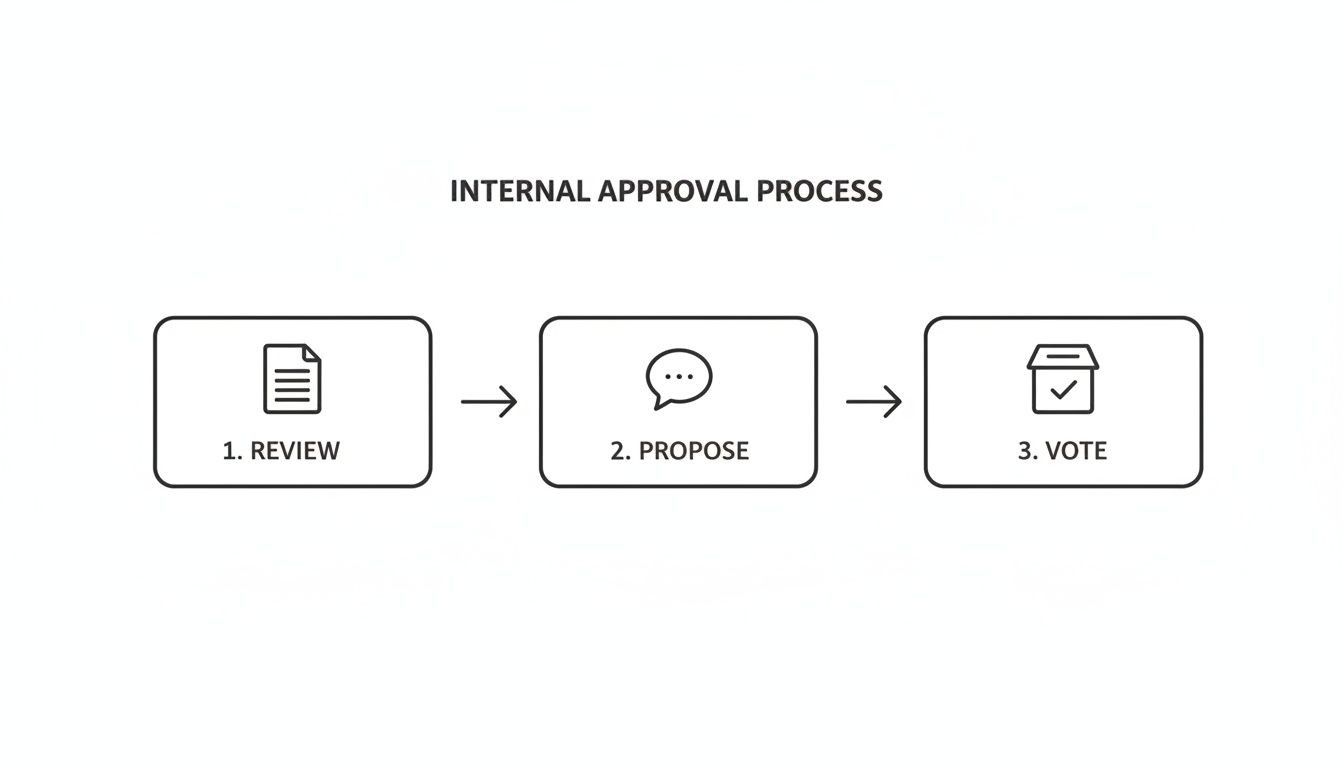
This just goes to show that the state filing is the final piece of the puzzle, not the first. Proper internal governance always comes first.
To help you stay organized, here's a quick checklist to gather what you need before filing with the Connecticut Secretary of State.
| Connecticut Amendment Filing Checklist | ||
|---|---|---|
| Step | Key Action Required | Helpful Tip |
| 1. Internal Approval | Confirm and document the member/manager vote authorizing the amendment. | Have a signed copy of the resolution or consent form ready for your records. |
| 2. Check Name Availability | If changing the LLC name, use the state's online search tool to confirm it's available. | Try a few variations in case your first choice is taken. |
| 3. Draft Amendment Language | Write the exact text for the amendment, clearly stating the old and new provisions. | Model your language on the examples provided to avoid ambiguity. |
| 4. Gather LLC Info | Have your LLC’s full legal name and Connecticut Business ID number handy. | This ID number is on your original formation documents and state correspondence. |
| 5. Choose Filing Method | Decide whether to file online for speed or by mail for a paper trail. | Online is almost always faster and provides immediate confirmation. |
| 6. Prepare Payment | Have a credit card ready for online filing or a check for the correct fee if mailing. | Double-check the current fee on the Secretary of State's website before sending. |
Following this checklist can help you avoid common errors and ensure a much smoother filing experience.
Filing Options: Online vs. Mail
Connecticut gives you a choice on how to submit your Certificate of Amendment. You can file online through the state's portal, or you can go the traditional route and send a physical copy by mail.
Online filing is almost always the faster option. You get an instant receipt confirmation, and the state usually processes it much quicker. On the other hand, mail-in filing works well for business owners who prefer a paper trail and want to pay by check. Just be prepared for a longer wait due to mail transit and manual processing.
The filing fee for a Certificate of Amendment in Connecticut is currently $120. It’s always a good idea to check the Secretary of State’s website for the most current fee schedule right before you file, as these things can change. To keep errors to a minimum, some businesses find that using legal document automation software can help streamline the drafting and submission process.
Timelines and Expedited Services
After you hit "submit" or drop the envelope in the mail, you'll need a bit of patience. Standard processing times can range from several business days to a couple of weeks, especially for mailed documents.
Keep in mind, the amendment is legally effective on the date the Secretary of State's office accepts it—not the date you sent it. That's the day your change officially takes effect.
If you’re in a time crunch for a loan closing or a new contract, Connecticut offers expedited processing for an additional fee. This can cut the turnaround time down to just a few business days. You'll have to weigh the extra cost against how urgently you need the approved documents.
Finally, make absolutely sure the person signing the form is authorized to do so. This is typically a member, a manager, or another person specifically authorized in your operating agreement. An unauthorized signature is a critical mistake that could invalidate your entire filing.
Common Filing Mistakes and How to Avoid Them
Filing an amendment to your Articles of Organization should be the easy part, right? Unfortunately, this is where a surprising number of businesses get tripped up. A simple mistake on the form can get your filing bounced by the Secretary of State, leading to frustrating delays and forcing you to start all over again.
Getting it right the first time isn't just about saving yourself a headache. It's about making sure your business changes become legally effective without a hitch. The best way to do that is to know the common pitfalls so you can steer clear of them.
The Problem of Incomplete or Vague Information
One of the most common reasons a filing gets rejected is shockingly simple: blank fields or unclear information. The clerks at the state office aren't going to guess what you mean. If the form asks for your Connecticut Business ID and you leave it blank, it’s an automatic rejection. No questions asked.
The same goes for the amendment language itself. Writing something vague like "changing business purpose" just won't cut it. You have to be specific. Spell out exactly which article you're changing and provide the precise new wording.
- How to Avoid It: Before you even touch the form, get your information in order. Have your LLC's full legal name, its Connecticut Business ID number, and the exact address on file ready to go. When you draft the amendment language, write with absolute clarity—as if the person reading it has zero context about your business.
Overlooking Signature and Authority Requirements
A missing or unauthorized signature is a fatal flaw. The person signing the Certificate of Amendment has to have the legal authority to do so on behalf of the LLC. This is usually a member or a manager, but it could also be another person who is specifically authorized in your operating agreement.
While 92% of amendments sail through when filed correctly, a good chunk of failures come from basic procedural errors. National data shows that about 7% of rejections are due to missing signatures or filings made without proof of an internal vote. Here in Connecticut, LLCs accounted for 62% of the 15,400 amendments filed in 2024, which shows just how routine this process is—and how critical it is to get the details right. You can find more details on making changes to an LLC on LegalZoom.com.
A rejected filing is more than just a piece of paper. It’s a delay that can stall your business plans. A bank might put a loan on hold until your new name is official, or a critical contract could be stuck in limbo until your public records are updated.
Failing to Get Internal Approval First
Here’s a classic mistake: filing with the state before getting the green light from your own team. As we covered earlier, your operating agreement sets the rules for making big changes. If you file an amendment without holding the proper member vote and documenting it, the change isn't legally sound—even if the state happens to accept the paperwork.
This can create a real mess down the road. A member who never approved the change could legally challenge its validity, potentially forcing you to undo the amendment and creating serious internal conflict.
Common Errors at a Glance
To keep your filing on the right track, be on the lookout for these all-too-common (and easily avoidable) mistakes:
| Mistake | Why It's a Problem | Solution |
|---|---|---|
| Incorrect Filing Fee | The state won’t process filings with the wrong payment amount. Simple as that. | Always double-check the current fee on the CT Secretary of State's website right before you file. |
| Name Not Available | Submitting a name change for a name that’s already taken is an instant "no." | Use the state's online business search tool to confirm your desired name is available before you file. |
| Wrong Form Used | You can’t use a "Change of Agent" form to change your business name. | Make sure you’re using the specific "Certificate of Amendment" form for your change. |
At the end of the day, a successful filing comes down to precision and preparation. Treat the form not as a formality, but as the important legal document it is. That’s how you’ll avoid these common errors and get your amendment approved without a hitch.
If you want to discuss your business law matter, contact Kons Law at (860) 920-5181.
So, Your Amendment Is Approved. Now What?
Getting that confirmation from the Connecticut Secretary of State feels great, but hold the celebration for just a moment. Your work isn’t quite finished. Think of the state's approval as the starting pistol for the next, equally important phase: updating everyone and everything connected to your LLC.
Filing the amendment makes the change official with the state, but it doesn't magically update your internal company records or notify the outside world. To avoid a mess down the road and keep everything consistent, you need a solid post-approval game plan.
First, Get Your Internal House in Order
Your first move should be to look inward. Your company’s internal governance documents are the foundation of your business, and they must perfectly mirror the changes you just made in your public filing. This isn't just about being tidy; it's critical for maintaining a clean and accurate corporate history, which you'll need for any future financing, audits, or even a potential sale of the company.
Here’s your immediate to-do list for internal updates:
- Your Operating Agreement: This is the rulebook for your LLC. If you amended your Articles to change from member-managed to manager-managed, for instance, your operating agreement absolutely has to be updated to reflect that new power structure.
- Member Ledgers: If your amendment involved a change in ownership—adding a new member or documenting a buyout—you must update your ledgers immediately. These records need to show the correct members and their exact ownership percentages.
- Meeting Minutes: Create a new entry in your corporate minute book that includes a copy of the approved Certificate of Amendment. This officially closes the loop on the internal resolution that authorized the change in the first place, creating a complete paper trail.
These internal updates make sure that all your company's foundational documents are singing from the same sheet of music. It’s more than just good housekeeping; it's the bedrock of proper corporate governance.
An approved amendment is only as powerful as its implementation. Failing to sync up your internal and external records creates a legal and operational disconnect that can undermine the very reason you filed the amendment.
Next, Tell the Outside World

With your internal records aligned, it's time to broadcast the news. Government agencies, banks, and business partners are all relying on your company information being correct.
A name change, for example, sends ripples across your entire business ecosystem. You’ll need to formally notify the Internal Revenue Service (IRS). The exact process depends on your entity type, but it often involves sending a formal letter to the same IRS service center where you filed your last tax return.
Your bank is another crucial stop. Walk into your local branch with a copy of the approved amendment and update your business bank accounts, company checks, and any debit or credit cards. If you skip this, you could find yourself dealing with rejected payments or bounced deposits under your new name.
Don’t forget these other key notifications:
- State Licensing Boards: If your business holds any professional licenses, they must be updated to reflect the new company name or address.
- Vendors and Suppliers: Let your key partners know about the change so invoices and contracts are issued correctly from day one.
- Clients and Customers: Update your website, marketing materials, and client contracts to show your new legal name.
Consistency is everything. This is also a perfect time to double-check that your other state filings are up to date. You can get a refresher on those obligations in our guide to the Connecticut annual report filing.
And if you operate in more than one state, you have an extra assignment. If your LLC is registered as a "foreign" entity elsewhere, you must also file to update your qualification in those states. This ensures your legal identity is consistent everywhere you do business. Tackling these post-filing tasks systematically is what makes your amendment truly complete.
If you want to discuss your business law matter, contact Kons Law at (860) 920-5181.
When You Should Call a Business Law Attorney
Look, a lot of amendments feel like simple paperwork, and sometimes they are. But certain changes carry serious legal weight, and that’s when getting professional guidance becomes a smart investment, not an expense. Trying to navigate complex legal territory on your own can lead to costly mistakes, ugly internal disputes, or even an amendment that gets invalidated down the road.
Knowing when to pick up the phone and call for backup is just savvy business leadership.
Identifying High-Stakes Scenarios
You should strongly consider talking to an attorney when the amendment involves any of the following:
- Changes in Ownership: Any time you’re adjusting member ownership percentages, bringing on a new partner, or documenting someone's exit, you need precise legal language. This is all about protecting everyone involved.
- Shifting Management Structures: Moving from a member-managed LLC to a manager-managed structure (or the other way around) is a big deal. It fundamentally changes who has authority and what their fiduciary duties are.
- Mergers and Acquisitions: If your amendment is just one piece of a much larger transaction like a merger or a sale, legal oversight is non-negotiable. It’s the only way to ensure compliance and protect your interests.
- Complex Capital Changes: For corporations, this is critical. Any changes involving authorized shares, different stock classes, or shareholder rights come with a tangled web of legal and tax implications.
An attorney makes sure your amendment’s wording is legally airtight and that you’ve followed all your own internal procedures correctly. Their real value, though, is in their experience—they can anticipate potential conflicts before they ever happen, shielding your business from future liabilities. To get a better sense of their role, you can learn more about what a business lawyer does in our detailed guide.
An experienced business attorney does more than just fill out a form; they provide strategic counsel to ensure the amendment aligns with your long-term business goals and protects your legal interests.
If you want to discuss your business law matter, contact Kons Law at (860) 920-5181.
Common Questions About Amending Your Articles of Organization
When you’re running a business, things change. As you navigate the process of amending your LLC's Articles of Organization, a few common questions always seem to pop up. Here are some straightforward answers from what I've seen in my practice.
How Much Does It Cost to File an Amendment in Connecticut?
Right now, the filing fee for a Certificate of Amendment for a Connecticut LLC is $120.
That said, state fees can and do change. It's always a smart move to double-check the current fee on the Connecticut Secretary of State's website right before you send in your paperwork. You don't want a simple administrative oversight to cause a rejection.
Can I Change My LLC to a Corporation with an Amendment?
No, an amendment won't work for that. An LLC and a corporation are fundamentally different legal animals, and you can't just switch from one to the other by filing a simple update.
Changing your business entity type is a much bigger deal known as a statutory conversion. This is a more complex legal process that requires filing entirely different conversion documents with the state.
An amendment is for tweaking the details of your current business structure. A full conversion changes the structure itself, a move that comes with significant legal and tax implications you’ll want to review carefully.
What Happens If I Don't File a Required Amendment?
Putting off a required amendment might seem like a small thing, but it can lead to some serious headaches down the road.
For instance, if you start operating under a new business name without officially filing the change, any contracts you sign under that new name could be challenged—or even deemed invalid. What if you move and forget to update your principal office address? You could miss crucial legal notices, which might lead to a default judgment against your company in a lawsuit you didn't even know about.
In short, failing to file creates a legal disconnect. It can jeopardize your LLC's good standing with the state, make it harder to get a business loan, and expose your company to legal risks you could have easily avoided.
If you want to discuss your business law matter, contact Kons Law at (860) 920-5181.
