If you run a business in Connecticut, the CT annual report filing is one of those non-negotiable, yearly tasks you simply can’t ignore. It's a mandatory check-in with the state to keep your company in good standing, and it applies to pretty much everyone, from LLCs to corporations and nonprofits.
Think of it less like a financial report and more like a simple confirmation of your business's vital signs. The state just wants to know you're still active and that your core details—like your registered agent and principal office address—are up to date. This ensures the public record is accurate, which is crucial for anyone looking to do business with you.
Why Is This So Important?
Honestly, skipping this filing can create a world of headaches. When an annual report isn't filed, the state assumes the business might be inactive or non-compliant. If this happens, your company loses its "good standing," a status that is far more important than it sounds.
Without it, you could find yourself unable to:
- Secure a business loan or line of credit.
- Renew essential professional licenses.
- Enter into new contracts.
- Sell or even dissolve the business properly.
Let it slide for too long, and the state can administratively dissolve your company. That’s the business equivalent of a death sentence. Bringing a company back from dissolution is a far bigger, more expensive ordeal than just filing the report on time. I’ve seen it halt major deals in their tracks.
Getting the fundamentals right from the start is key. If you're just getting started, our guide on the basics of starting a business in CT is a great resource.
CT Annual Report Deadlines and Fees at a Glance
Meeting the deadline is half the battle, and the exact date depends on when your company was officially formed. It’s a good idea to put this on your calendar as a recurring event so it never catches you by surprise.
Here’s a quick breakdown of what to expect for the most common business types.
| Business Entity Type | Filing Deadline | Standard Filing Fee |
|---|---|---|
| Limited Liability Company (LLC) | Annually, by the last day of your formation anniversary month. | $80 |
| Corporation (Stock & Nonstock) | Annually, by the last day of your formation anniversary month. | $150 |
| Limited Liability Partnership (LLP) | Annually, by the last day of your registration anniversary month. | $80 |
Staying on top of your CT annual report filing is one of the easiest ways to protect your business. If you’re feeling overwhelmed or need help with any compliance matter, give the team at Kons Law a call at (860) 920-5181.
A Practical Walkthrough of the Online Filing Portal
Every Connecticut business owner eventually finds their way to the state’s online portal, CONCORD. It’s the only way to file your annual report, and while it's fairly straightforward, knowing the lay of the land before you dive in can prevent a lot of headaches.
Let's walk through the process screen by screen. First, you'll need to pull up your business record. The easiest way is with your 7-digit Connecticut Business ID, but don't worry if you can't find it. The portal has a search function that lets you look up your company by name. Once you’ve located and selected your business, the filing process officially begins.
Verifying and Updating Core Information
The first few screens are all about verification. CONCORD will show you the information the Secretary of the State has on file for your business. Your job is to be the final editor, carefully reviewing each detail to confirm it's still accurate.
Think of this as your annual compliance check-up. It’s the designated time to update critical information that might have changed over the last year. Pay close attention to these fields:
- Principal Office Address: This has to be a physical street address, not a P.O. Box. If you’ve moved your operations, this is the place to make it official.
- Business Email Address: Make sure this is an email inbox you actually check. The state uses this address for all official notices, so a dead or ignored email means you’ll miss important reminders.
- Registered Agent Information: Is your registered agent still the right person or company at the right address? An outdated agent is a serious risk—it could mean you never receive a legal summons.
Updating these details right in the annual report is the correct and most efficient way to do it. You won't have to submit separate change forms later, which keeps your public record clean and current in one go.
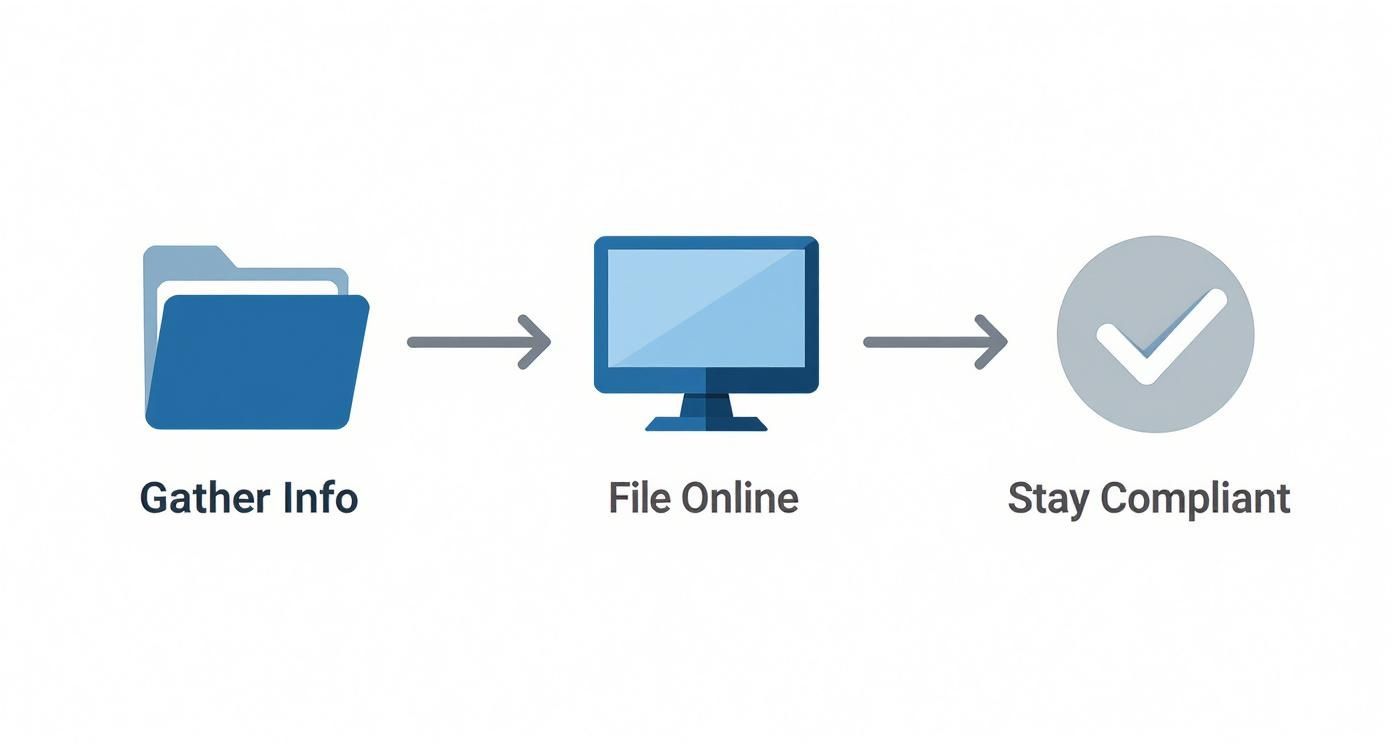
As the graphic shows, it’s really a simple flow: get your info ready, file online, and stay in good standing.
Listing Principals and Finalizing Your Report
After the addresses and agent details are squared away, the portal asks you to confirm the key people in your business. The terminology changes based on your entity type—LLCs will see "members" or "managers," while corporations will list "officers" or "directors."
You are required to list at least one person here. This is a common sticking point for some filers, but the rule is simple. For each principal, you’ll need to provide their name along with their business and residence addresses.
It’s important to know that this information becomes public. However, while a home address is required for the filing, Connecticut law allows the business address to be displayed publicly on the record, offering a layer of privacy.
With all the principals listed, you’re on the home stretch. The system will present a final review screen summarizing everything you’ve entered. Take a minute and read it over one last time. It’s your last chance to catch a typo before it becomes part of the official record.
Once you confirm everything is correct, you’ll be routed to the payment gateway to cover the filing fee with a credit or debit card. After the payment goes through, a confirmation receipt will appear. Always download and save a copy of this receipt. It’s your official proof that you've met your annual reporting obligation for the year.
If you hit a snag or have questions about your business's legal compliance, feel free to call Kons Law at (860) 920-5181.
Common Filing Mistakes and How to Avoid Them
Even the most careful business owners can hit a snag when filing their CT annual report. What looks like a tiny oversight can get your submission rejected, trigger late fees, or even put your company's good standing at risk. In my experience, most rejections come from a handful of recurring—and completely avoidable—mistakes.
Knowing what these common pitfalls are ahead of time is the best way to make sure your filing is a smooth, one-and-done process. It’s all about taking a few extra moments to double-check the details that people most often get wrong.

The Registered Agent Information Error
One of the most critical pieces of information on your annual report is the registered agent, and it's also one of the most frequently messed up. This is your business's official point of contact for legal notices, so getting it right is non-negotiable.
We see two major errors here all the time. First, a business changes its registered agent but forgets to officially update the Secretary of the State. The annual report is the perfect time to fix this, but many owners just click through the screens without verifying.
Second, the agent’s address is out of date. If your agent moves and you don't update their address on record, any legal papers sent to that old address are still considered legally served. That’s a huge risk you can easily avoid just by confirming the current street address during your filing.
Forgetting to Update Principals
Businesses are dynamic. People come and go. The annual report is how the state keeps track of who is running the show. Filing a report with an outdated list of principals, members, or directors is a common mistake that can cause real legal and operational headaches later.
Before you file, make sure your list is accurate.
- Did any members leave your LLC? Take them off the list.
- Did your corporation bring on a new director? Add them.
- Has someone legally changed their name? Update it.
This isn't just about checking a compliance box; it's about clarity. An accurate list of principals ensures the public record correctly shows who has the authority to act on behalf of your business.
Using Incorrect Addresses
This one seems simple, but it can cause an instant rejection. The state has specific rules for the types of addresses you can use in different fields, and mixing them up is a frequent error.
Here’s what to look out for:
- Principal Office Address: This must be a physical street address. A P.O. Box is not going to fly here and will get your filing flagged. If you run a remote business, a home address is fine, but a post office box is out.
- Mailing Address: This is where you can use a P.O. Box if that's what you prefer. The state sends general mail and reminders to this address.
- Principal Addresses: The CONCORD system requires both a business and a home address for every principal listed. Forgetting to provide a complete address for each person is a classic reason for an incomplete filing.
Taking a few minutes to review these key areas—your agent, your principals, and all your addresses—can save you time, money, and the headache of a rejected filing. Accuracy is everything when it comes to compliance.
A great way to stay on top of all your obligations is to use a detailed checklist. You can find more practical tips in our guide to the small business compliance checklist for Connecticut companies.
If you've run into problems with past filings or want to talk through any other business law questions, give us a call at Kons Law at (860) 920-5181.
Understanding Deadlines, Fees, and Late Penalties
For any Connecticut business, staying on top of your annual report timeline and costs is one of the most fundamental parts of good standing. This isn't a surprise obligation; it's a predictable, recurring task. When you know your specific deadline, the fee, and what happens if you're late, it turns what could be a source of stress into a simple administrative box to check off each year.
The CT annual report filing deadline isn’t a one-size-fits-all date. It’s tied directly to your company's anniversary. For almost every entity type—LLCs, corporations, and LLPs included—the report is due by the last day of the month your business was originally formed or registered. So, if you formed your LLC on October 15th, your deadline is October 31st. Every single year.

A Breakdown of Filing Fees
Along with the deadline, the filing fee is the other half of the equation. These costs are standardized by business type and you’ll need to pay them when you submit your report online through the CONCORD portal. The system takes all major credit and debit cards, making payment straightforward.
Here's the current fee structure:
- Limited Liability Companies (LLCs): $80
- Stock and Nonstock Corporations: $150
- Limited Liability Partnerships (LLPs): $80
A quick word of caution: these fees are non-refundable. If you rush through the filing, submit incorrect information, and have it rejected, you don’t get your money back. That’s another great reason to slow down and double-check every single detail before hitting that final submit button.
The Real Cost of Missing Your Deadline
Failing to file your annual report on time is far more than a simple paperwork mistake. It triggers direct and escalating consequences, both financial and legal. The state’s system is automated, and once your deadline passes, the penalties are applied without exception.
First, you'll be hit with an immediate late fee on top of the regular filing fee you already owe. It's an unnecessary expense that instantly makes the process more costly.
But the most severe penalty isn't about money.
If a business completely fails to file its annual report, the Secretary of the State has the full authority to administratively dissolve the company. This action effectively strips the business of its legal standing and its right to operate in Connecticut.
This isn't an idle threat; it's a standard procedure for businesses that appear to be non-compliant. Missing a simple deadline can put the very existence of your company in jeopardy.
Missing a deadline can lead to a cascade of problems that are much harder and more expensive to fix than simply filing on time. The table below outlines just how quickly the consequences can escalate.
Risks of Late or Missed Annual Report Filings
| Issue | Immediate Consequence | Long-Term Risk |
|---|---|---|
| Late Fee | A statutory late penalty is immediately added to the standard filing fee. | The cost of compliance increases, impacting cash flow. |
| Loss of Good Standing | Your business loses its "good standing" status with the state, which can be seen on public records. | Inability to secure financing, renew licenses, or enter into certain contracts. |
| Administrative Dissolution | The Secretary of the State can dissolve your business entity, revoking its legal status. | You lose your liability shield, personal assets can be at risk, and you can no longer legally conduct business. |
| Reinstatement Complexity | To get back in good standing, you must file all missed reports, pay all back fees and penalties, and submit a formal reinstatement application. | Reinstatement can be costly and time-consuming, causing significant operational disruption. |
Ultimately, a consistent approach to this task is a cornerstone of maintaining strong regulatory compliance and protecting everything you’ve built.
Navigating compliance issues, especially if you've missed a deadline and are facing dissolution, can be complicated. If you want to discuss your business law matter, contact Kons Law at (860) 920-5181.
While filing your CT annual report is usually a pretty straightforward process, some situations can turn this simple compliance task into a real headache with serious legal risks. What looks like a basic form can quickly become a minefield. Knowing when to handle it yourself versus when to call in a legal professional is a critical judgment call for any business owner.
Trying to muddle through complex issues alone can lead to incorrect filings, future legal fights, or even jeopardize the liability protection your company structure provides. An attorney doesn't just make sure the form is filled out correctly; they ensure it aligns with your business's legal and structural reality, especially when big changes or past compliance hiccups are in the mix.
Reinstating an Administratively Dissolved Business
One of the most pressing reasons to get legal help is if the state has administratively dissolved your business. This usually happens after you’ve failed to file annual reports for a prolonged period. When this occurs, your company loses its good standing and its legal right to operate. Simply filing the late report won't fix it.
The reinstatement process is much more involved than a standard filing. You'll need to:
- File all of the delinquent annual reports you've missed.
- Pay all the back fees and late penalties, which can add up fast.
- Submit a formal Application for Reinstatement to the Secretary of the State.
- Check that your business name is still available—it’s possible another company claimed it while yours was dissolved.
An experienced business attorney can manage this entire process from start to finish. They'll make sure every step is handled correctly to get your company's legal status restored as quickly as possible and can advise you on any liabilities that might have cropped up while the business was dissolved.
Managing Major Structural or Ownership Changes
Your annual report is a public record of your company's current structure and ownership. If your business just went through a significant change, getting this filing right is absolutely critical. This is no time for guesswork.
You should seriously consider consulting an attorney if you're dealing with situations like:
- Conversion of Entity Type: Switching from an LLC to a corporation (or vice versa) is a complex legal maneuver. Your annual report has to reflect this new structure perfectly, as a mistake could undermine the entire conversion.
- Mergers and Acquisitions: After a merger or acquisition, the ownership and management structure is often completely new. An attorney will make sure the annual report accurately lists the new principals and lines up with the terms of the deal.
- Complex Ownership Disputes: If owners are disagreeing about who should be listed as a member, manager, or director, filing an incorrect report will only pour fuel on the fire. Legal counsel can help mediate the dispute before an inaccurate public record is created.
In these scenarios, the annual report is far more than a compliance form—it's a public declaration of your company's legal identity. Getting it right is essential to protect the business and its owners from future challenges.
Navigating Internal Disputes and Information Discrepancies
Sometimes the problem isn't with the state, but from within your own company. What happens when partners can't agree on the information to put in the annual report? Maybe there's a dispute over someone's title, their status as a director, or even the principal office address.
Filing a report with information that one or more owners contest is a recipe for serious internal legal battles. A business lawyer can act as a neutral party to help resolve the disagreement or provide guidance based on what's in your company's operating agreement or bylaws. Understanding what a business lawyer does can make it clear how they can help you stay compliant while navigating these sensitive issues. Getting legal advice before you file can prevent a simple report from becoming Exhibit A in a future lawsuit between partners.
If you find yourself in a complex situation and want to discuss your business law matter, contact Kons Law at (860) 920-5181.
Questions We Hear All the Time About CT Annual Reports
Filing your Connecticut annual report can feel like a routine task, but it’s one that often trips up even seasoned business owners. We get a lot of questions about the specifics, so I’ve put together some straightforward answers to the most common ones we see.
What Happens If I Blow Past My Filing Deadline?
Missing your annual report deadline isn't just a minor oversight—it has immediate consequences. Right off the bat, the state hits you with a $50 late fee.
More importantly, your business loses its "good standing" status. This can be a real problem, as it can stop you from securing a business loan, renewing professional licenses, or even bidding on certain contracts. If you continue to ignore it, the Secretary of the State can administratively dissolve your company, which effectively pulls the plug on your legal right to operate in Connecticut. Getting reinstated from that point is a much bigger, more expensive headache than just filing on time.
Can I Just Mail My Annual Report In?
Nope. Connecticut has gone fully digital for this. All annual reports must be filed through the state's official CONCORD portal.
This isn't just to make things difficult; the online system is designed to be faster and far more accurate. You get instant confirmation that your report was received, and the guided process helps prevent the common mistakes that used to happen with paper forms. There is no mail-in option anymore, so you’ll need to get comfortable with the online portal.
The state's move to an online-only system really streamlines things. By making CONCORD the single point of entry, they’ve cut down on the manual processing errors that were so common with paper filings and ensured everyone's information is standardized and up-to-date.
Do I Still Have to File If My Business Did Nothing All Year?
Yes, you absolutely do. This is a big one that catches people off guard. Your duty to file is tied to your company’s legal existence, not its financial performance or activity level.
Even if your LLC or corporation was completely dormant, had zero revenue, and made no changes, you are still required to file that report. Think of it as your annual check-in with the state to confirm your business still exists and its contact information is current. Skipping it will lead to the same late fees and potential dissolution as any other company.
Where Can I Find My Connecticut Business ID Number?
To even start your filing on the CONCORD portal, you'll need your Connecticut Business ID. This is a unique, seven-digit number the state assigned to your company when it was first formed.
If you don't have it written down, no worries. The easiest way to find it is by using the "Business Search" feature on the Secretary of the State’s website. Just type in your business name, and your company’s record—including your Business ID—will pop right up. It’s a good idea to jot that number down and keep it with your permanent business records so you have it ready for next year.
If you find yourself facing a complex compliance issue or want to discuss your business law matter, contact Kons Law at (860) 920-5181.
