
An operating agreement is the rulebook for your Limited Liability Company (LLC). It’s the single most important internal document you'll create, defining exactly how your business will run, who owns what, and how the money flows.
Think of it this way: if your LLC is a team, the operating agreement is your official playbook. It makes sure every player knows their position, the rules of the game, and what happens when things don't go as planned.
The Blueprint for Your Business
Every successful venture starts with a solid plan. Your operating agreement is that plan—a legally binding contract between the members that maps out the internal structure and procedures of your company. Without one, your LLC falls back on Connecticut's default state laws, which are often a poor fit for your specific vision and partnership dynamics. A well-crafted agreement lets you write your own rules and stay in control.
This document is where you turn handshake deals and verbal understandings into a concrete, enforceable roadmap. It provides a clear path for handling everything from day-to-day operations to major business decisions, which is absolutely essential for preventing costly misunderstandings and disputes between partners down the line.
The Core Purpose of an Agreement
At its heart, an operating agreement serves a few critical functions that protect both the business itself and you, the owner. Its most important job is to solidify the legal separation between your personal assets and the company's debts—the very reason you formed an LLC in the first place. This distinction is what shields your personal wealth from business lawsuits and creditors.
An operating agreement isn't just paperwork; it's a shield. It serves as powerful proof that your LLC is a legitimate, separate entity—a key factor courts look at. Without one, you risk "piercing the corporate veil," exposing your personal assets if the business runs into legal trouble.
It also sets crystal-clear expectations for everyone involved by spelling out:
- Ownership Stakes: The exact percentage of the company each member owns.
- Member Roles: Who is responsible for what, and what authority each member or manager holds.
- Decision-Making Processes: How votes are handled and what it takes to approve important business choices.
- Financial Protocols: The specific details on how profits are distributed and how losses are allocated.
Why This Document Is So Essential
It’s hard to overstate the importance of a well-drafted operating agreement. Even the U.S. Small Business Administration highlights it as the document that “outlines the business’ financial and functional decisions” and is crucial for protecting an LLC's limited liability status. By formally documenting that your business is a distinct legal entity, you reinforce the "veil" that protects you personally.
To help you see the bigger picture, here’s a quick breakdown of its main functions:
Key Functions of an LLC Operating Agreement
| Function | Why It Matters for Your Business |
|---|---|
| Preserves Limited Liability | Reinforces the legal separation between your personal assets and business debts, which is the primary benefit of an LLC. |
| Defines Member Roles | Clarifies responsibilities and authority, preventing confusion over who does what and minimizing internal conflicts. |
| Customizes State Rules | Allows you to override generic state laws and create rules that are tailored to your specific business needs and goals. |
| Outlines Financial Structure | Specifies how profits are distributed and how capital contributions are handled, ensuring financial transparency. |
| Provides a Succession Plan | Establishes a clear process for when a member leaves, dies, or becomes disabled, ensuring business continuity. |
| Establishes Dispute Resolution | Creates a pre-agreed framework for resolving conflicts, saving you significant time, money, and stress later on. |
Ultimately, a strong operating agreement is your best proactive strategy for long-term stability. It anticipates future challenges and provides a clear, agreed-upon path for navigating tough situations, like a partner's exit or a major disagreement.
If you want to discuss your business law matter, contact Kons Law at (860) 920-5181.
The Must-Have Clauses for a Rock-Solid Operating Agreement
Alright, we’ve covered the “why.” Now, let’s get into the “what.” A strong operating agreement is built on a handful of essential clauses. These aren't just legal boilerplate; they're the actual rules of the road for your business, dictating how things will run day-to-day.
Think of these clauses as the detailed schematics for your business. Without them, you’re trying to build something complex with a vague sketch—it's almost guaranteed to cause problems when things get tough. Each section addresses a specific, critical aspect of your company, making sure every owner is on the same page from the start.
Let's break down the non-negotiable clauses that form the backbone of any good agreement.
This diagram illustrates how an LLC’s key functions—its operations, members, and finances—are all governed by the rules you set in the operating agreement. It's the central hub that connects everything.
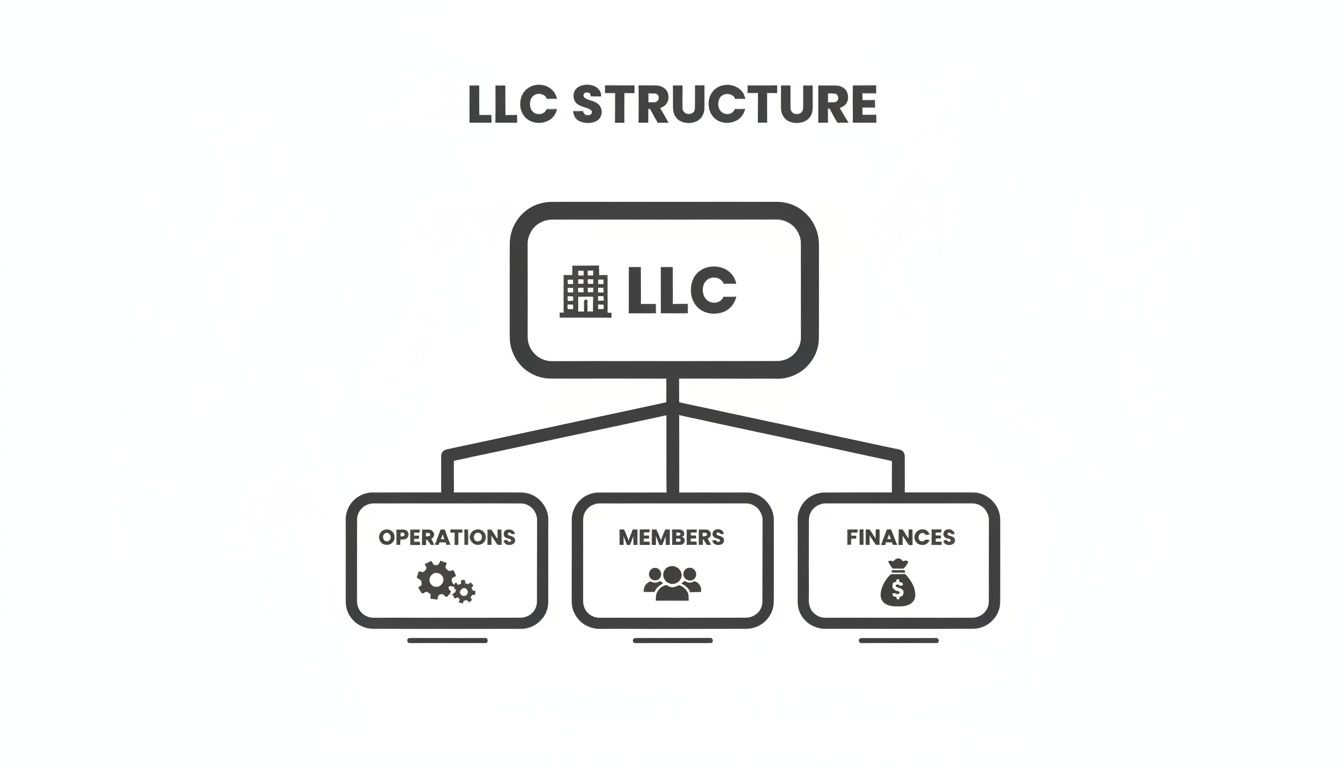
As you can see, every piece of your LLC depends on the foundation laid by this single document.
Ownership and Membership Interests
First and foremost, who owns the company? The section on ownership percentages, or membership interests, puts this in black and white. It lists every member by name and clearly states the slice of the company each one holds. There can be no ambiguity here.
For instance, if you and a partner start a company together, this clause might state that Member A owns 60% and Member B owns 40%. That simple percentage dictates everything from how profits are split to who has more say in big decisions. It’s the cornerstone of the entire agreement.
This part also typically spells out the rights and responsibilities that come with being a member, preventing future arguments over control and equity.
Capital Contributions
So, where does the startup money come from? The capital contributions clause answers that question by documenting exactly what each member is putting in to get the business off the ground. It's a detailed ledger of initial investments.
And it's not always cash. Contributions can take a few different forms:
- Cash: A direct monetary investment.
- Property: Things like real estate, vehicles, or expensive equipment.
- Services: Pledging your professional time and skills, often called "sweat equity."
A smart agreement will also address whether members might be required to chip in more money down the line and what the consequences are if someone fails to deliver on their initial promise. This little bit of foresight can prevent one partner from having to shoulder the entire financial burden later on.
Management Structure and Voting Rights
How will your LLC actually be run? This is one of the biggest decisions you'll make, and it needs to be clearly defined in your operating agreement. You have two main options:
- Member-Managed: This is the default for most small LLCs. All the members (owners) have a direct hand in running the business and making daily decisions. It’s simple and works well when everyone wants to be actively involved.
- Manager-Managed: In this setup, the members appoint a manager (or a few) to handle operations. The manager can be one of the members or an outside professional hired for the job. This is a great structure when some members are just passive investors.
Tied directly to management are voting rights. This clause sets the rules for decision-making. Will a simple majority vote be enough? Or will major decisions, like selling the company or taking on a huge loan, require a unanimous or supermajority vote? Nailing down these thresholds from day one is the best way to prevent gridlock. You can learn more about these roles in our guide to limited liability company officers.
By explicitly defining the management structure and voting protocols, you create a clear chain of command and a fair process for making critical business decisions. This proactive step can prevent a simple disagreement from escalating into a full-blown partnership dispute.
Profit and Loss Distributions
Let's talk about the money. The profit and loss distribution clause explains how, when, and to whom the company’s profits are paid out. It’s the financial roadmap for the members.
While distributions are often based on ownership percentages, they don’t have to be. That's one of the great things about an LLC—you have flexibility. Your agreement can create a different split if, for example, one member is doing most of the work but put in less capital.
This section should also clarify the timing. Will profits be paid out quarterly? Annually? Or only when the managers decide it's right? Clear, transparent rules on money are absolutely vital for keeping trust and harmony between partners.
By carefully crafting these essential clauses, you're building a robust framework that not only guides your company today but protects it for years to come. If you want to discuss your business law matter, contact Kons Law at (860) 920-5181.
How Your Agreement Protects Your Business Future
A truly great operating agreement does more than just manage your business today—it’s a roadmap for the future. While the day-to-day rules are important, the real value comes from the forward-thinking clauses that protect your company through change, challenges, and even crises. These are the provisions that bring stability when everything else feels uncertain.
Think of it as a contingency plan for your company's toughest moments. A ship's captain doesn't just steer for clear skies; they plot a course that accounts for potential storms. Your operating agreement needs to do the same, laying out clear steps for navigating difficult transitions. Without this foresight, a single event—like a co-founder's sudden departure—can throw the entire business into chaos.

This kind of proactive planning is what separates a resilient business from one that crumbles under pressure.
Navigating Member Exits with Buy-Sell Provisions
One of the most critical future-proofing tools you can have is the buy-sell provision. This section clearly defines what happens when a member wants—or is forced—to leave the company. It's an exit strategy everyone agrees on while you're all still on the same team, which prevents expensive and emotionally draining disputes down the road.
A solid buy-sell provision anticipates several key "triggering events," including:
- Voluntary Exit: A member retires, starts a new venture, or simply wants to cash out.
- Involuntary Exit: A member has to be removed for breaching their duties or other serious reasons.
- Death or Disability: An owner passes away or becomes unable to work in the business.
- Divorce: A member's ownership stake gets tangled up in a divorce settlement.
Without a buy-sell clause, any of these situations could spell disaster. Imagine a co-founder dies, and their shares automatically pass to a spouse who knows nothing about the business but now has a say in how it's run. A well-written provision stops this by giving the company or the remaining members the first right to buy back the interest, using a price or valuation formula you've already agreed on.
A buy-sell agreement is like a prenuptial agreement for your business partners. It sets clear, fair rules for separation before emotions and conflicts can cloud judgment, protecting the company’s continuity and the remaining owners' interests.
Establishing a Clear Path with Dissolution Procedures
Nobody goes into business planning for it to end, but outlining dissolution procedures is a sign of smart, responsible ownership. This clause provides a clean, legal, and fair roadmap for winding down the company if and when the time comes. Think of it as the final chapter in your business playbook.
This section should detail the exact conditions that would trigger dissolution, like a majority vote or achieving the company's original goal. More importantly, it lays out the step-by-step process for an orderly shutdown. This usually includes:
- Paying off all company debts and liabilities to creditors first.
- Selling off company assets in a fair and transparent way.
- Distributing any leftover funds or assets to the members based on their ownership stakes.
Having this process defined in your operating agreement ensures the end of your business journey is handled professionally and fairly. It prevents ugly fights over who gets what and helps shield members from being held personally liable for company debts. These provisions can also be critical when dealing with creditor claims. To learn more about how creditors might pursue LLC assets, check out our guide that explains what a charging order is and its impact on members.
Proactive planning in these areas gives you the stability and clarity to navigate your business's most challenging moments. If you want to discuss your business law matter, contact Kons Law at (860) 920-5181.
Your Operating Agreement vs. Other Key Business Documents
When you form an LLC, it's easy to get lost in a sea of paperwork. But of all the documents you'll sign, the operating agreement is in a class of its own. While other filings announce your company’s existence to the state, your operating agreement is the private, internal rulebook that dictates how your business will actually run.
Getting these documents confused is a common mistake that can lead to serious governance problems and legal headaches down the road. Let’s clear things up by comparing your operating agreement to the two other legal documents you'll encounter most often: the Articles of Organization and corporate bylaws.
Operating Agreement vs. Articles of Organization
For new LLC owners, the most frequent point of confusion is the difference between an operating agreement and the Articles of Organization. They're both foundational, but they serve completely different functions.
Think of it this way: your Articles of Organization are like your LLC’s birth certificate, while the operating agreement is its detailed life plan.
The Articles of Organization is a simple, public-facing form you file with the Connecticut Secretary of the State to officially create your LLC. It contains just the bare essentials:
- The legal name of your LLC
- The address of your main office
- The name and address of your registered agent
This document simply makes your business a legal entity. That’s its only job. It says nothing about who owns what percentage, how you’ll split profits, or what happens when a member wants out. All of that critical detail belongs in your private operating agreement, which is almost never filed with the state.
The Articles of Organization tell the world that your LLC exists. The operating agreement tells your members how it will exist, operate, and ultimately succeed.
Operating Agreement vs. Corporate Bylaws
Another important distinction is between an LLC’s operating agreement and a corporation’s Corporate Bylaws. They serve a similar purpose—acting as an internal guide—but they are built for entirely different business structures. If you run an LLC, you use an operating agreement. If you run a corporation, you have bylaws.
Corporate Bylaws are far more formal and rigid. That’s because corporations are bound by stricter state laws that mandate specific governance structures, like holding annual shareholder meetings and keeping meticulous corporate minutes.
Your operating agreement, on the other hand, gives you incredible flexibility. It empowers LLC members to design a custom management structure that truly fits their needs, free from the strict procedural chains that bind corporations. This freedom is one of the biggest reasons entrepreneurs choose the LLC model in the first place.
This table breaks down the key differences, giving you a clear, at-a-glance comparison.
Operating Agreement vs Articles of Organization vs Corporate Bylaws
Understanding where each document fits into your business's legal framework is essential for maintaining compliance and smooth operations.
| Attribute | Operating Agreement (LLC) | Articles of Organization (LLC) | Corporate Bylaws (Corporation) |
|---|---|---|---|
| Purpose | To define the internal rules, ownership, and operational procedures for an LLC. | To legally form the LLC as a distinct entity with the state. | To establish the internal governance rules for a corporation. |
| Audience | Internal document for members and managers. | Public document filed with the state. | Internal document for shareholders, directors, and officers. |
| Content | Highly detailed (ownership, profits, management, voting, exit plans). | Basic information (company name, address, registered agent). | Formal rules (shareholder meetings, board duties, officer roles). |
| Requirement | Strongly recommended; required in some states but not Connecticut. | Mandatory for LLC formation in all states. | Mandatory for corporations in most states. |
| Flexibility | Very high; allows for customized rules and structures. | Very low; a standardized form with limited information. | Moderate; must comply with strict corporate statutes. |
Grasping these distinctions helps you appreciate the unique and vital role your operating agreement plays. It's not just another piece of paper; it is the indispensable private guide for managing your LLC, totally separate from its public formation filings.
If you want to discuss your business law matter, contact Kons Law at (860) 920-5181.
Your Connecticut LLC Operating Agreement: Why State Law Isn't Enough
While the idea of an operating agreement is pretty standard across the country, the devil is always in the details—specifically, your state’s laws. For anyone starting an LLC here in Connecticut, getting a handle on these local rules is the key to protecting your business and making sure it actually runs the way you and your partners intended.
Surprisingly, Connecticut does not legally require you to have a written operating agreement. It’s tempting to see this as a shortcut, a way to save a little time and money upfront. But going without one is a massive gamble. When you don't write your own rulebook, you’re letting the state do it for you.
What Happens When You Rely on Connecticut's Default Rules?
If your LLC doesn’t have an operating agreement, its fate is decided by the Connecticut Uniform Limited Liability Company Act. Think of these as "off-the-shelf" rules. They’re designed to cover every possible business, which means they rarely fit any single business well. Letting these default statutes govern your company can lead to some seriously unwelcome surprises.
Take money, for example. It’s one of the biggest sticking points. Under state law, if your agreement doesn't say otherwise, profits and losses get split equally among all members. This rule applies no matter how much cash each person put into the business.
Imagine this: one partner puts in $90,000 to get things off the ground, while another contributes $10,000. Without an operating agreement, Connecticut law says they both get a 50/50 split of the profits. It’s an outcome almost no one would agree to, and it's a perfect recipe for conflict down the road.
Best Practices for Connecticut LLCs
To steer clear of these default traps, every Connecticut business owner needs a solid game plan. The first step, and the most critical, is to draft a detailed, written operating agreement right from the start. This is your chance to set your own terms for how the company is run, how profits are divided, and who is responsible for what.
Beyond that, keep a few Connecticut-specific points in mind:
- It’s an Internal Document: Your operating agreement is for your eyes only. You do not file it with the Connecticut Secretary of the State. It stays with your internal company records.
- A Must-Have for Solo Owners: Even if you’re a single-member LLC, you need one. A solid operating agreement helps prove that your business is a separate entity from you personally, which is vital for protecting your personal assets if the business ever gets sued.
- Formation Comes First: You create the operating agreement after the LLC is officially formed. The first move is always filing your Articles of Organization with the state. For a full walkthrough, check out our guide on the steps for LLC formation in CT.
Taking the time to get this document right isn't just paperwork—it's one of the smartest investments you can make in your company's future. If you want to discuss your business law matter, contact Kons Law at (860) 920-5181.
Bringing Your Operating Agreement to Life
An operating agreement is more than just a piece of paper you file away and forget. Think of it as the living constitution for your business—its real value comes from how you create, maintain, and ultimately, enforce it. This is where the plan on paper becomes a powerful, dynamic tool that actively protects and steers your LLC.
The process kicks off with drafting. It’s tempting to grab a generic template off the internet, but that’s often a recipe for disaster. These one-size-fits-all documents are filled with vague language and clauses that probably don’t match your business reality, which can lead to major confusion and disputes down the road. Getting professional legal help from the start ensures your agreement is clear, comprehensive, and built for your specific situation.

Treating Your Agreement as a Living Document
Your business is going to change, grow, and pivot. Your operating agreement needs to do the same. It's a living document designed to evolve right alongside your company, so any time you hit a significant milestone, it’s time for a review and a potential amendment.
What kind of events trigger an update? A few common ones include:
- Adding or Removing Members: When ownership shifts, the agreement has to be updated to reflect the new lineup.
- Securing a Major Loan: Lenders often have their own requirements and may demand specific terms be included in your agreement before they’ll sign off.
- Changing Your Management Structure: Switching from a member-managed setup to a manager-managed one (or vice versa) is a fundamental shift that absolutely needs to be documented.
- Significant Capital Contributions: If members are putting more money into the business, you need to update the document to reflect that.
Making an amendment isn’t just a handshake deal. It usually requires a formal vote, following the exact procedures laid out in the agreement itself. This makes sure every change is officially agreed upon and legally binding.
Enforcement When Disputes Arise
In a perfect world, your operating agreement prevents most arguments by making sure everyone is on the same page. But when disagreements do happen, this document becomes your first line of defense. It's the official rulebook that all members have already agreed to live by, providing a clear path to resolving the issue.
If things escalate, courts will look directly to the operating agreement to understand the members' original intentions and enforce its terms. A well-drafted agreement gives a judge a clear roadmap of how you intended to run the business, making it an incredibly powerful tool in any legal proceeding. Before you start from scratch, it can be helpful to review an operating agreement template for an LLC just to see how these documents are typically structured.
By actively drafting, amending, and enforcing your agreement, you ensure it stays relevant and effective. If you want to discuss your business law matter, contact Kons Law at (860) 920-5181.
Frequently Asked Questions About Operating Agreements
Even after a deep dive, a few specific questions always seem to come up when business owners are working through their operating agreements. Let's tackle some of the most common ones to clear up any lingering confusion and get you moving forward.
Do I Need an Operating Agreement for a Single-Member LLC?
Yes, absolutely. It might feel a bit strange creating a formal agreement with yourself, but for a single-member LLC, this document is critical for two big reasons.
First, it’s the single best piece of proof you have that your business is a truly separate legal entity. This separation is what creates the "corporate veil," the legal shield that protects your personal assets—your house, car, and savings account—if the business ever gets sued. Without it, that line can get blurry.
Second, it acts as a contingency plan. Your operating agreement can designate a successor to manage or dissolve the company if you become incapacitated. This simple step can save your family from a legal and logistical nightmare down the road.
What Happens if My LLC Doesn't Have an Operating Agreement?
If you don't have an operating agreement, your LLC is automatically governed by the default rules set by the state—specifically, the Connecticut Uniform Limited Liability Company Act. This is a massive gamble because these one-size-fits-all statutes rarely align with what you actually want for your business.
Relying on state law can cause some serious headaches:
- Equal Profit Splits: The law might require profits to be split equally among all members, even if one person invested 90% of the capital and the others invested 10%.
- Management Mayhem: Without defined roles, every member could have an equal say in all decisions. This is a classic recipe for gridlock and conflict.
- No Clear Exit Strategy: State laws have rigid, often unappealing, processes for when a member wants to leave or sell their share of the business.
An operating agreement lets you write your own rulebook instead of being forced to play by the state's.
How Often Should We Update Our Operating Agreement?
Think of your operating agreement as a living document, not something you sign once and file away forever. You should be reviewing and potentially amending it anytime your business goes through a major change. A good rule of thumb is to give it a fresh look every two to three years, but certain milestones demand an immediate update.
An operating agreement is like a business plan for your internal governance. As your company grows and changes, your foundational rules need to evolve right along with it.
Key events that should trigger a review include adding or removing a member, securing a major loan, changing how the LLC is managed, or when members contribute significant new capital. Keeping it current ensures it always reflects the reality of your business.
If you want to discuss your business law matter, contact Kons Law at (860) 920-5181.
