When you're starting a business in Connecticut, you're faced with a flood of decisions. But none is more foundational than choosing the right legal structure for your company. For most entrepreneurs I work with, the Limited Liability Company (LLC) hits the sweet spot, offering a powerful blend of personal asset protection and operational flexibility.
Think of it as a legal shield between your personal finances and your business's obligations. It's a popular choice for a reason.
Why an LLC Is a Smart Move in Connecticut
Picking a business structure isn't just paperwork; it shapes everything from your daily operations and tax filings to how much personal risk you're taking on. Here in Connecticut, the LLC has become the go-to entity because it neatly combines the liability shield of a corporation with the straightforwardness of a sole proprietorship.
This hybrid approach is its real superpower. Let's say your business gets sued or takes on debt it can't pay. With a properly maintained LLC, your personal assets—your house, car, and savings account—are generally off-limits. Creditors can typically only pursue the business's assets, which provides some much-needed peace of mind for any founder.
The Real-World Impact of LLCs in Connecticut
Forming an LLC isn't just a smart move for you; it plugs you into a vital part of our state's economy. Small businesses are the engine of Connecticut's growth, and LLCs are a huge piece of that puzzle.
The numbers don't lie. Back in 2022, Connecticut's small businesses employed roughly 726,097 people, which accounts for 48.1% of the entire state workforce. And the financial upside of formalizing your business is just as clear. The median income for self-employed individuals with incorporated businesses (like LLCs) was $60,584. That's nearly double the $31,786 earned by those running unincorporated businesses. You can see more data on Connecticut's small business landscape at BoostSuite.com.
The takeaway here is that creating a formal business entity like an LLC doesn't just protect you—it often correlates with a significant boost in earning potential.
Simplicity and Credibility, All in One
Beyond the asset protection, an LLC offers an operational simplicity that's perfect for new entrepreneurs. It's a world away from the rigid formalities of a C-Corporation, which demands a board of directors, shareholder meetings, and meticulous corporate minutes. An LLC gives you the professional credibility of an official business entity without all the administrative baggage.
This credibility is huge. Showing up as "Your Company LLC" instead of just your personal name sends a powerful signal to customers, vendors, and banks. It tells them you're serious and established, which can make it far easier to get a business loan, open a bank account, and build lasting professional relationships. For a deeper dive, check out our guide on starting a business in CT.
Ultimately, the Connecticut LLC formation process is designed to support your journey, not complicate it. If you want to discuss your business law matter, contact Kons Law at (860) 920-5181.
The Core Steps of Connecticut LLC Formation
Getting your Connecticut LLC off the ground isn't just a pile of paperwork; it's about building a solid legal foundation for your business. When you get these initial steps right, you save yourself a world of trouble down the road. Let's walk through the critical tasks, from picking the perfect name to filing the right documents with the state.
Choosing and Securing Your Business Name
The first move is always the name. It’s not just about branding—it’s a legal requirement. Your LLC’s name has to be unique and clearly distinguishable from every other business registered with the Connecticut Secretary of the State.
It also must end with a designator like "Limited Liability Company," "LLC," or "L.L.C." This little tag signals your company's legal structure to the world. Before you order business cards, do a quick search on the state’s online business registry, Concord, to see if your name is available.
Found the perfect name but not quite ready to file? No problem. Connecticut lets you reserve it for up to 120 days by filing an Application for Reservation of Name. It's a smart move that costs a small fee but gives you peace of mind.
Filing the Articles of Organization
This is the big one. The Articles of Organization is the official document that legally creates your LLC. You’ll file this with the Secretary of the State, and it requires some key pieces of information:
- Your LLC’s full name and address.
- The name and address of your Registered Agent (more on that in a minute).
- The names and addresses of the LLC's members or managers.
You can file online through the Concord business portal, which I almost always recommend. It’s faster, and you'll typically see it processed within a few business days. Filing by mail is an option, but be prepared to wait.
This initial $120 filing is your ticket into Connecticut's thriving business scene. The state has seen incredible growth, with net business formations jumping from 13,847 in 2010 to 44,146 in 2024. Clear processes like this are a big reason why.
Appointing a Registered Agent
Every single LLC in Connecticut is required to have a Registered Agent. Think of this person or company as your business's official point of contact for legal documents and state mail. They must have a physical street address in Connecticut—P.O. boxes don't cut it.
Key Takeaway: Your Registered Agent is your lifeline for official notices. If they miss a court summons, you could face a default judgment without ever knowing you were sued. Choosing a reliable agent is absolutely non-negotiable.
You can be your own agent, but that means your home address becomes public record, and you have to be available during all business hours. Many entrepreneurs opt for a professional registered agent service to maintain privacy and ensure nothing ever slips through the cracks. This decision is a core part of your company's risk management, a topic we cover often in corporate and business law.
The infographic below breaks down why so many entrepreneurs choose the LLC structure in Connecticut. The benefits—from asset protection to tax simplicity—are significant.
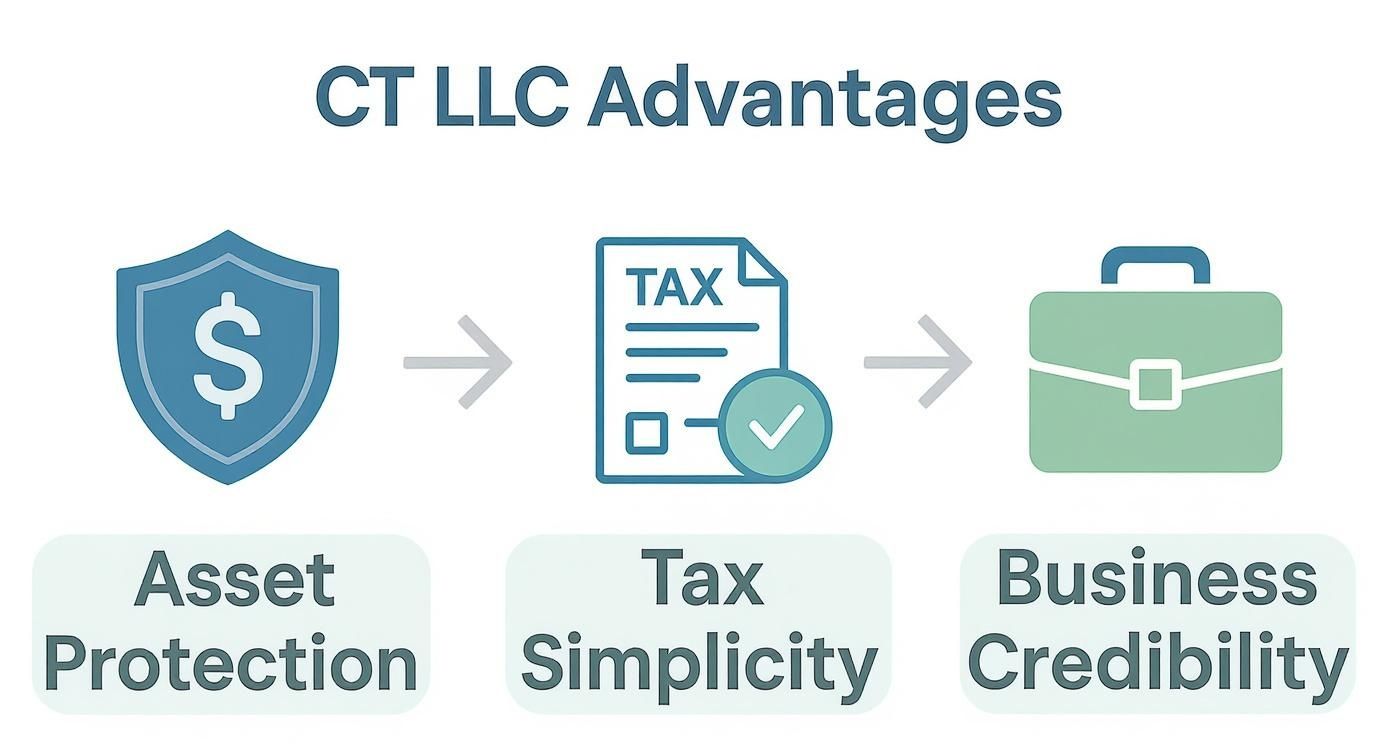
These structural advantages give your business the stability and credibility it needs to grow. If you want to discuss your business law matter, contact Kons Law at (860) 920-5181.
Crafting Your LLC's Internal Playbook
Your LLC is officially recognized by the state once the Connecticut Secretary of the State gives your Articles of Organization the green light. That's the public-facing milestone, but your work isn't done. The next, and arguably more critical, step is building the internal framework that dictates how your business will actually run.
This is where the Operating Agreement comes into play.
Think of it as the constitution for your company. It's a private, internal legal document that clearly lays out the rights, duties, and operational rules for the members (the owners). While Connecticut law doesn't technically force you to have one, trying to run a business without it is like setting sail without a rudder—especially if you have partners.

Why Every LLC Needs This Document
Even for a single-member LLC, a well-drafted Operating Agreement is vital. It reinforces your limited liability protection by drawing a clear, legal line between you and the business.
For multi-member LLCs, it's completely non-negotiable. This document is your chance to answer all the tough "what if" questions before they can blow up a partnership.
It defines the absolute essentials of your business relationship, including:
- Ownership Percentages: Who owns what slice of the company.
- Profit Distribution: The nuts and bolts of how and when profits (and losses) are paid out.
- Management Structure: Is the LLC run by its owners (member-managed) or by appointed managers (manager-managed)?
- Voting Rights: How major decisions get made and who has the final say.
- Exit Strategies: The exact process for a member leaving the LLC, whether they sell, pass away, or have a falling out.
If you skip this, your LLC will automatically be governed by Connecticut's generic state laws, which are a one-size-fits-all solution that probably won't fit your specific goals.
Building a Strong Foundation
The LLC has become the go-to business structure in Connecticut for a reason. Its popularity has exploded—between 2000 and 2015, LLCs grew to account for a staggering 93.3% of all new business formations in the state. This incredible growth, tracked by the Connecticut Department of Labor, underscores just how important solid internal governance is for modern businesses.
A strong Operating Agreement prevents future disputes by creating a clear roadmap. Imagine a scenario where one of two partners wants to sell their stake. Without a buyout clause in your agreement, you could find yourself in business with a complete stranger, leading to potential conflict and instability.
Taking the time to create this document forces you and your partners to have the essential conversations upfront. A great place to start is by looking over an operating agreement template for an LLC to get a feel for the key clauses and overall structure.
While a template is a helpful launchpad, getting a legal professional to customize it for your unique situation is the only way to ensure it truly protects your interests.
If you want to discuss your business law matter, contact Kons Law at (860) 920-5181.
Handling Your Federal and State Obligations
Once the state gives your Articles of Organization the green light and you've got a solid Operating Agreement in place, your LLC is officially born. But don't pop the champagne just yet. This is where the real compliance work begins. Before you can open a business bank account or even think about hiring your first employee, you need to get your federal and state credentials in order.
First up is the big one: getting a federal Employer Identification Number (EIN) from the IRS. You can think of an EIN as a Social Security Number for your business. It's the unique nine-digit number the feds will use to identify your company for all things tax-related.
Thankfully, applying for an EIN is a straightforward and free process you can do right on the IRS website. It’s absolutely essential for a few key reasons.
- Opening a Business Bank Account: No bank will let you open an account in your LLC's name without an EIN. This is non-negotiable for keeping your personal and business finances separate.
- Hiring Employees: If you plan to build a team, an EIN is mandatory for handling payroll taxes.
- Filing Federal Taxes: This is the number you'll use when filing your LLC's federal income tax returns.
Navigating Connecticut State Requirements
With your federal EIN secured, it's time to turn your attention to Hartford. Your main task is registering your new LLC with the Connecticut Department of Revenue Services (DRS). This is a critical step for managing any state taxes your business might need to collect or pay.
The specific taxes you'll register for are tied directly to what your business actually does. For instance, if you're selling products or certain services, you'll need to register for sales and use tax. If you have employees, you’ll be dealing with withholding tax. You can handle the registration online through the DRS portal, myconneCT.
It’s a classic rookie mistake to assume that filing with the Secretary of the State automatically registers you for taxes. They are two completely separate processes with two different agencies. Missing your DRS registration can lead to some nasty surprises with penalties and back taxes down the line.
Don't Forget Local Licenses and Permits
After you've checked the federal and state boxes, there's one more layer: local rules. Many towns and cities in Connecticut require businesses to get specific licenses or permits to operate legally. These can be anything from a general business license to highly specialized permits for industries like restaurants, construction, or professional services.
Figuring out exactly what you need means getting in touch with your local town clerk's office or digging through the municipal website. A coffee shop in Hartford will have a completely different set of local permit requirements than a consulting firm based in Stamford. This final piece of due diligence ensures your LLC formation in CT is fully compliant from day one. Getting a handle on these multi-layered rules is a huge part of staying in good standing. You can learn more about the wider world of business regulations in our article on what is regulatory compliance.
If you want to discuss your business law matter, contact Kons Law at (860) 920-5181.
Keeping Your Connecticut LLC in Good Standing
Getting your LLC formed is a huge win, but it’s really just the starting line. The real work is in keeping it that way. To make sure the liability protection you worked to create actually holds up, you have to keep your LLC in “good standing” with the state. This just means you’re keeping up with the ongoing compliance tasks that prove your business is active and playing by the rules.

The biggest piece of this puzzle is filing your Annual Report with the Connecticut Secretary of the State. It’s a yearly filing that either confirms or updates your LLC's core information—things like your business address and registered agent details.
The Annual Report Requirement
Think of the Annual Report as a simple yearly check-in with the state. It isn't a complex financial document, but don't let its simplicity fool you; failing to file it on time can cause serious problems.
The state charges an $80 filing fee, and the report is due every year by the last day of the month you originally formed your LLC. So, if you formed your business on June 15th, your report is due by June 30th of the next year, and every year after that. Missing that deadline can rack up penalties and, if ignored long enough, lead to the state administratively dissolving your LLC. That completely wipes out your liability shield.
Your personal liability protection is only as strong as your LLC's compliance. If your LLC is dissolved by the state for failing to file an annual report, you could be held personally responsible for business debts and lawsuits.
Beyond the Annual Filing
Maintaining good standing is about more than just one yearly report. It’s about building consistent habits that reinforce the idea that your LLC is a separate legal entity, not just a piggy bank for your personal finances.
A few key maintenance habits are non-negotiable:
- Clean Financial Records: This is critical. Keep your business money completely separate from your personal accounts. That means a dedicated business bank account and credit card, no exceptions.
- Connecticut PE Tax: You need to get familiar with state-specific rules, like the Pass-Through Entity (PE) Tax. This is a mandatory tax for a lot of LLCs in Connecticut, and staying on top of it is essential for state compliance.
- Documenting Major Decisions: While you don't have the same formal requirements as a corporation, it's a smart practice to document significant business decisions. This is especially true for multi-member LLCs where disagreements can arise later.
These aren't just bureaucratic hoops to jump through. They are the very foundation of your asset protection strategy. They ensure that if your business ever faces a legal challenge, the "corporate veil" remains strong and your personal assets stay protected.
If you want to discuss your business law matter, contact Kons Law at (860) 920-5181.
Connecticut LLC Formation and Maintenance Costs Overview
To give you a clearer picture, here’s a breakdown of the typical costs and timelines you’ll encounter when forming and maintaining your LLC in Connecticut. These are the state-mandated fees and average processing times, which can help you budget both time and money.
| Filing Type | State Fee | Typical Processing Time (Online) | Typical Processing Time (Mail) |
|---|---|---|---|
| LLC Articles of Organization | $120 | 2-3 business days | 3-5 weeks |
| Name Reservation (Optional) | $60 | 2-3 business days | 3-5 weeks |
| Annual Report | $80 | 1 business day | 3-5 weeks |
As you can see, filing online is significantly faster and is the recommended route for most entrepreneurs. Planning for these fees and timelines from the start helps ensure a smooth process and keeps your business compliant from day one.
When Should You Call a Business Lawyer?
Look, the state gives you the tools to form a Connecticut LLC on your own, and for a simple, single-owner setup, that might be all you need. But thinking a lawyer is just an extra expense is a mistake. It’s actually a strategic investment to get things right from day one and avoid expensive, headache-inducing problems down the road.
An experienced attorney really earns their keep when things get even slightly complicated. For instance, if you have partners, you absolutely need a custom Operating Agreement. You're not just friends starting a business; you're defining how profits are split, who is responsible for what, and—critically—what happens when someone wants out.
A generic template you download online won't help you navigate tricky situations like bringing on an investor, planning to pass the business to your kids, or figuring out a buyout. Getting professional legal advice ensures your LLC’s internal rules are solid, compliant, and actually match what you want to achieve with your business. It's about building on a rock-solid foundation.
If you want to discuss your business law matter, contact Kons Law at (860) 920-5181.
Got Questions About Forming a CT LLC?
As you get ready to launch, it's completely normal to have a few last-minute questions about the LLC formation process in Connecticut. Getting clear, straightforward answers is key to moving forward with confidence and sidestepping common mistakes that can trip up new business owners.
Do I Really Need a Lawyer to Form My LLC?
While Connecticut law doesn't force you to hire an attorney to form an LLC, it's something we strongly recommend, especially if you have multiple partners or a complex business model. Why? Because a lawyer can draft a custom Operating Agreement built specifically for your business, heading off future conflicts over management, profits, and exit strategies.
This kind of professional guidance ensures every legal box is checked correctly right from the start.
What’s the Real Cost to Start an LLC in Connecticut?
The main state fee you can't avoid is the $120 for filing your Articles of Organization. Beyond that, you'll need to budget for the $80 Annual Report fee, which is due every single year to keep your LLC in good standing with the state.
A few other costs might pop up, including:
- An optional $60 fee if you want to reserve your business name ahead of time.
- Fees for a professional registered agent service, if you decide not to handle it yourself.
- The cost of any local business licenses or permits your specific industry requires.
What's the Difference Between Articles of Organization and an Operating Agreement?
This is a big one, and many new entrepreneurs mix them up. The Articles of Organization is the official document you file with the Connecticut Secretary of the State to legally create your LLC. Think of it as your company's birth certificate—it's a public record.
The Operating Agreement, on the other hand, is a private, internal document. It's the rulebook for your LLC, detailing ownership structure, member duties, and how you'll run things day-to-day. While the state doesn't require you to have one, a well-drafted Operating Agreement is absolutely essential for good governance and preventing internal disputes down the road.
If you want to discuss your business law matter, contact Kons Law at (860) 920-5181.
