
So, what exactly does a business lawyer do? It’s a common question, and the answer goes way beyond just showing up when there’s a problem. A great business lawyer is a strategic partner—part of your core team, helping architect your company's legal framework from the ground up.
Think of them as the co-pilot for your business journey. Their main job isn't just reacting to trouble; it's to proactively manage risk, protect your most valuable assets, and clear the runway for you to grow.
Trying to run a business without this kind of guidance is like sailing a ship in stormy seas without a map. You're completely exposed to hidden dangers that can sink you before you even see them coming. Many entrepreneurs make the mistake of waiting until a lawsuit lands on their desk, but that's always the most expensive and stressful way to handle things.
Building a Business That Lasts
A business lawyer helps you build a company that's legally solid, preventing the kinds of internal disputes or compliance issues that cause so many promising startups to implode. They focus on three core pillars to support your operations and your vision for the future.
This infographic gives a great visual breakdown of those key areas of support.
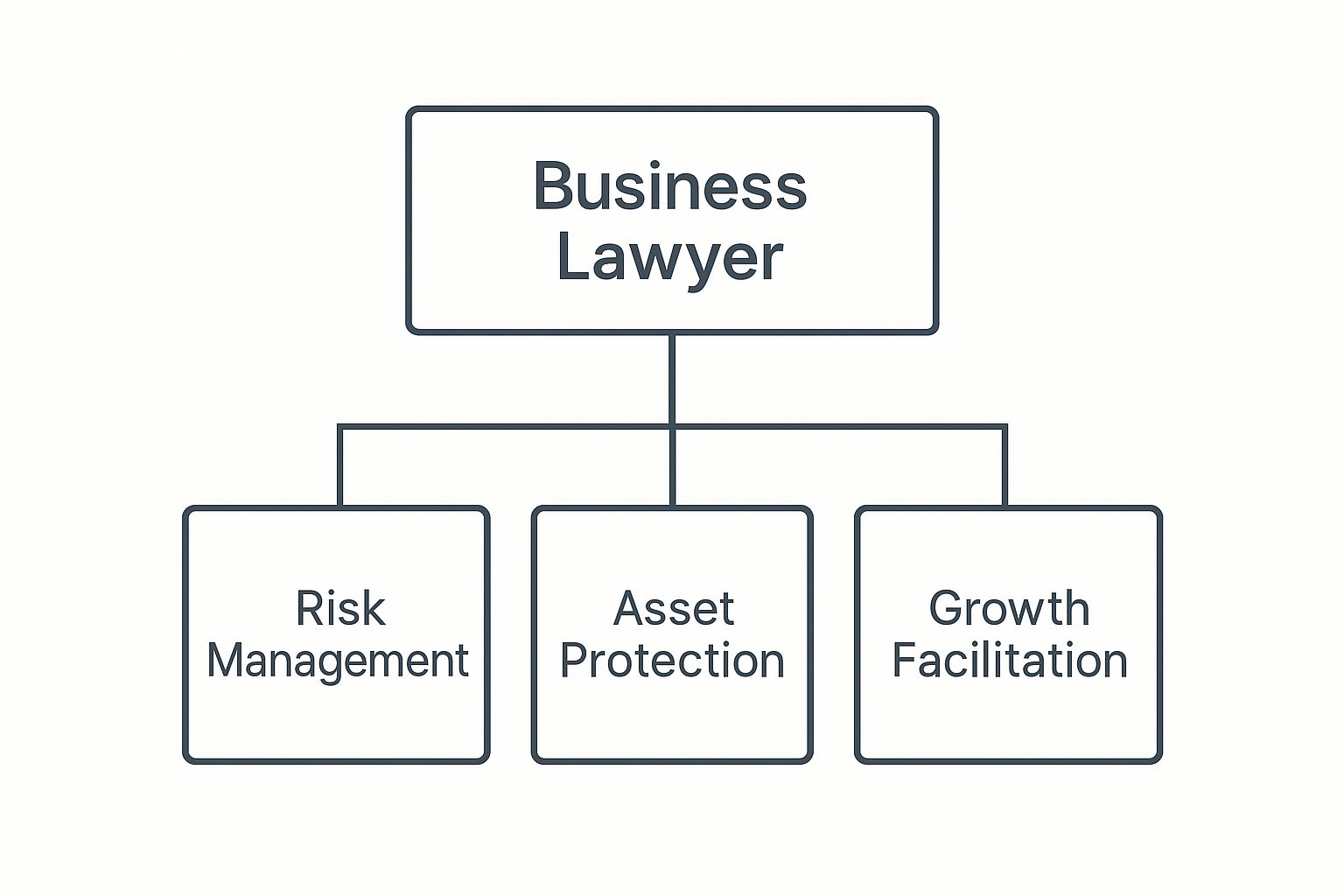
As you can see, their role is incredibly multifaceted. It covers everything from day-one risk assessment all the way to navigating complex deals that fuel long-term growth. This kind of comprehensive support is what gives you, the business owner, the confidence to focus on innovation and running your company.
These functions cover a huge range of legal needs, making sure your business is protected at every stage. You can explore the specific practice areas that a dedicated business law firm handles to see just how they align with what your company needs.
A Business Lawyer's Core Responsibilities
To make it even clearer, this table breaks down the essential functions of a business lawyer. It shows how they provide both proactive guidance and reactive solutions across the most critical areas of your business.
| Area of Focus | Key Actions | Strategic Outcome |
|---|---|---|
| Risk Management | Compliance checks, contract reviews, and dispute resolution. | Minimized legal liability and operational disruptions. |
| Asset Protection | Trademark registration, IP strategy, and corporate structuring. | Secured brand value and protected intellectual property. |
| Growth Facilitation | M&A guidance, capital raising support, and transaction negotiation. | Smooth, legally sound expansion and strategic deals. |
Ultimately, a business lawyer’s job is to create a secure legal environment where your company can not only survive but thrive.
If you want to discuss your business law matter, contact Kons Law at (860) 920-5181.
Building a Solid Legal Foundation for Your Business

Think of a business lawyer as the architect and general contractor for your company's legal framework. Just like a building needs a solid foundation to withstand storms, your business needs a strong legal structure to handle future challenges. This work is most critical right at the beginning, where the decisions you make can echo for years to come.
Lots of entrepreneurs fall into the trap of thinking they can just pick an LLC or an S-Corp from a dropdown menu on some website and call it a day. But that’s missing the point entirely. A good business lawyer doesn’t just file paperwork. They dig into your vision, your industry, your plans for raising money, and even your personal financial situation to choose the structure that truly protects you and sets you up for tax efficiency from day one.
Crafting Your Company’s Rulebook
Once that structure is in place, the next step is drafting the documents that will serve as your company’s internal constitution. These aren't just boilerplate templates you can download; they are custom-built to fit your specific operation and a multi-owner relationship.
These are the absolute essentials:
- Operating Agreements: For an LLC, this is the master document. It spells out who owns what percentage, what each member's duties are, and how you’ll handle big decisions or, just as importantly, disagreements.
- Bylaws: If you’re a corporation, these are the official rules of the road. They govern how the company is managed and clarify the roles and responsibilities of directors and officers.
A well-drafted operating agreement or set of bylaws is one of the most effective tools for preventing the kind of internal disputes that sink many promising startups. It provides a clear roadmap for navigating disagreements before they become destructive.
These documents are about more than just legal formalities. They define how your business actually runs, how profits get divided, and what the exit plan is if a partner wants to leave. Getting this right is a huge part of any small business compliance checklist because it establishes clear, predictable governance from the very start. By setting these rules early, you're not just avoiding future headaches—you're securing your company's stability and potential for growth.
Drafting and Negotiating Bulletproof Contracts

Contracts are the lifeblood of your business. They’re the formal handshakes that define your relationships with vendors, partners, clients, and employees. This is one of the most fundamental areas a business lawyer handles, and it goes far beyond downloading a generic template from the internet. Their job is to craft and negotiate agreements that truly shield your company from risk.
A lawyer’s trained eye can spot hidden dangers you might easily miss. When a vendor sends over their standard agreement, a lawyer immediately looks for one-sided liability clauses, vague language, or unfavorable terms that could mushroom into expensive problems later. They then get to work negotiating a more balanced and protective agreement on your behalf.
This is just as crucial for client and employment agreements. A good lawyer builds in safeguards that clarify everyone's expectations, protect your valuable intellectual property, and ensure every document complies with all relevant state and federal laws.
From Risk Identification to Strategic Advantage
A sharp business lawyer doesn't just play defense by eliminating risks; they turn your contracts into a strategic advantage. It helps to stop thinking of a contract as a mere formality and start seeing it as the official rulebook for a successful business relationship.
Here's how they add tangible value:
- Clarity and Precision: They swap out ambiguous terms for specific, measurable obligations. This leaves no room for misinterpretation if a disagreement pops up.
- Dispute Resolution Clauses: They strategically include clauses that dictate exactly how a disagreement will be handled, often recommending mediation or arbitration to keep you out of a costly and time-consuming courtroom battle.
- Liability Limitation: They work to cap your financial exposure, protecting your business from potentially catastrophic damages if something goes wrong.
The way lawyers manage contracts is also changing. A 2025 survey noted that while many attorneys are comfortable using AI for routine tasks like drafting emails (used by 54% of legal professionals), a much smaller number—only 21% of law firms—have formally adopted generative AI tools. This shows a cautious but steady embrace of technology. You can learn more about these trends in the 2025 legal industry report.
If you want to discuss your business law matter, contact Kons Law at (860) 920-5181.
Protecting Your Most Valuable Intellectual Property

For most companies, the most valuable assets aren't the ones you can see or touch. They’re the ideas, brand identity, and unique creations that set you apart from the competition. This is your intellectual property (IP), and a business lawyer’s job is to be its dedicated guardian.
They’re the ones who know how to transform your intangible concepts into powerful, legally defensible assets that build real value. It’s a strategic process that involves identifying what makes your business special and then building a legal shield around it.
Securing Your Brand and Creative Works
For many businesses, protecting the brand itself is the first line of defense. A business lawyer is essential in this process, helping you secure legal ownership over the core elements of your brand so no one else can water down your presence in the market.
Their key IP functions include:
- Trademarks: This is all about your brand identity—the business name, logo, and slogans that customers recognize. A lawyer navigates the complex trademark registration process to lock in your exclusive rights.
- Copyrights: Any original creative work you produce, from the code behind your software to your website content and marketing brochures, can be protected. A lawyer handles filing for copyright protection to make sure it stays yours.
- Trade Secrets: Some IP, like a secret family recipe or a one-of-a-kind manufacturing process, is best kept confidential. An attorney drafts rock-solid non-disclosure agreements (NDAs) that legally bind employees and partners to secrecy.
Proactive IP protection builds a competitive moat around your business. It transforms your ideas from mere concepts into tangible assets that can be licensed, sold, and defended against infringement, directly contributing to your bottom line.
By securing your IP, a business lawyer ensures that the value you create stays with you. It stops competitors from cashing in on your innovation and hard work, keeping your unique advantage right where it belongs.
If you want to discuss your business law matter, contact Kons Law at (860) 920-5181.
Guiding Your Business Through Growth and Transactions
As your business grows up, you’ll hit major milestones that define its future—raising a round of funding, merging with another company, or buying out a competitor. These moments are exciting, but they’re also incredibly high-stakes.
A business lawyer is your guide through these complex situations. They make sure your growth is built on a solid legal foundation, not on hidden risks that could come back to haunt you. They're not just paper-pushers; they're your strategic counsel, helping structure sophisticated agreements and negotiating terms that put your interests first.
Take a merger or acquisition (M&A) for example. Before any deal is signed, a lawyer’s first job is due diligence. Think of them as a private investigator for your business, meticulously sifting through the target company’s legal and financial health. They dig into contracts, corporate records, and compliance history to uncover any red flags or hidden liabilities. This is the work that prevents a great deal from turning into a nightmare later on.
Structuring Deals for Success
Once the due diligence is done and the coast is clear, your lawyer's role shifts to being the architect of the deal itself. They are the ones drafting and negotiating the mountain of paperwork—purchase agreements, financing documents, and all the other critical contracts.
Their expertise ensures the deal isn't just legally compliant, but that it actually lines up with your strategic goals. These are complex commercial transactions that require absolute precision to protect your company’s future.
And this isn't a niche activity. Globally, M&A deal values hit roughly $3.5 trillion in 2024, which shows just how much legal heavy lifting is happening behind the scenes in corporate growth. You can dive deeper into the data with the 2025 state of the U.S. legal market report.
If you want to discuss your business law matter, contact Kons Law at (860) 920-5181.
Resolving Disputes and Managing Litigation Risk
No matter how carefully you plan or how airtight your contracts are, business disputes are almost inevitable. A simple disagreement with a supplier, a falling-out with a partner, or a complaint from a customer can escalate quickly. This is where a business lawyer steps in, not just as your advocate, but as a strategic problem-solver to manage conflicts before they derail your business.
The first move isn't always to race to the courthouse. In fact, a seasoned business lawyer knows that the best victory is often the one achieved outside of a courtroom. They can frequently diffuse a tense situation with a professionally drafted demand letter—a formal notice that clearly states your position and the legal consequences if the other party doesn't act. This alone can often bring people to the negotiating table.
Seeking Resolution Outside of Court
Let's be honest: most business owners want to avoid the time, money, and sheer stress of a lawsuit. That’s why lawyers often first turn to Alternative Dispute Resolution (ADR), which offers structured ways to solve conflicts without getting bogged down in formal litigation.
These methods are highly effective and include:
- Negotiation: Your lawyer will engage directly with the other side’s attorney to hammer out a compromise that protects what’s most important to your business.
- Mediation: A neutral third-party mediator steps in to facilitate a structured conversation, guiding both parties toward a voluntary agreement they can both live with.
The real goal is to find the smartest, most cost-effective path forward. A business lawyer's job is to champion your company’s interests, whether that's at a negotiating table or, only when necessary, in a courtroom.
When a dispute simply can’t be resolved amicably, your attorney is fully prepared to fight for you. They’ll manage every stage of the legal battle, from filing the initial motions to representing you at trial. To get a better sense of what that involves, you can learn more about the firm's approach to commercial litigation.
If you want to discuss your business law matter, contact Kons Law at (860) 920-5181.
Common Questions About Working with a Business Lawyer
It's natural to have questions when you're thinking about the legal side of your business. Let's clear up a few of the most common ones to demystify the process and help you feel more confident about getting the right guidance.
When Is the Right Time for a Startup to Hire a Lawyer?
Ideally, you should talk to a lawyer before you even officially form your business. It might seem early, but getting professional advice on your business structure, hammering out a solid founder agreement, and reviewing your first contracts is one of the smartest early investments you can make.
Think of it this way: proactive legal counsel helps you build a strong foundation, preventing problems that can be far more expensive and stressful to fix down the road.
What Is the Main Difference Between a Business Lawyer and a Litigator?
This is a great question. A general business lawyer usually focuses on what we call "transactional" work—they're the architects. Their job is to build things and prevent problems by drafting contracts, making sure you're compliant with regulations, and structuring deals to protect you.
A litigator, on the other hand, is a trial attorney. They're the ones you call when a conflict has already boiled over and you need someone to represent you in a lawsuit or court proceeding. While some firms do both, they are very different specializations.
Having clear, upfront conversations about legal services is essential for building a strong, trusting relationship with your attorney. It ensures everyone is on the same page and you can focus on growing your business.
What Are the Typical Fee Structures for Business Lawyers?
Legal fees can be structured in a few different ways, and it’s really important to understand these before you sign anything. The most common models you'll see are:
- Hourly Rates: This is the traditional model where you're billed for the actual time the attorney spends working on your legal matters.
- Flat Fees: For a specific, well-defined project—like forming an LLC or reviewing a single lease agreement—you'll pay a single, fixed price.
- Monthly Retainers: If you need ongoing advice and general counsel, you might pay a consistent monthly fee to have an attorney on call.
No matter the structure, always ask for a written engagement letter. It should clearly spell out the costs and exactly what work will be done.
If you want to discuss your business law matter, contact Kons Law at (860) 920-5181.
