A customer who used to pay on time stops responding. Your accounting team has sent reminders. Sales wants to preserve the relationship. Operations wants to cut them off. Meanwhile, the unpaid balance is no longer a nuisance. It’s affecting payroll planning, vendor payments, and your own borrowing base.
That’s where creditor rights law stops being an abstract legal topic and becomes a business discipline. In Connecticut, the businesses that recover more money usually aren’t the ones that threaten the loudest. They’re the ones that document the deal properly, move at the right time, and use the correct remedy for the debtor and the asset.
If you extend credit, ship goods before payment, lend against collateral, or carry receivables for any meaningful period, you need a working understanding of what the law lets you do and what it forbids. That includes contract formation, pre-suit demands, litigation strategy, judgment enforcement, lien rights, secured transactions, and the hard stop that comes with a bankruptcy filing.
Why Creditor Rights Law Matters to Your Business
Most business owners first think about collections when an invoice ages badly. By then, the legal issues usually started much earlier. The key question isn’t only whether someone owes you money. It’s whether your paperwork, internal process, and timing put you in a position to enforce that obligation efficiently.
In practical terms, creditor rights law is the body of rules that lets a business pursue payment, protect collateral, obtain judgments, and enforce those judgments against available assets. It also includes the compliance rules that keep collection efforts lawful. If you ignore either side of that equation, recovery gets harder and risk goes up.
A strong collection file usually begins with a strong deal file. If your team wants a useful refresher on the elements of enforceable contracts, start there. In commercial collections, small drafting failures become expensive litigation arguments.
Cash flow protection starts before default
A credit sale, promissory note, guaranty, or services agreement should answer basic enforcement questions before there’s a problem:
- Who owes the debt: The exact legal entity matters. A trade name isn’t enough.
- What triggered payment: Delivery, milestone completion, monthly billing, or demand terms should be clear.
- What happens on default: Late charges, attorney’s fees if permitted, acceleration language, collateral rights, and venue provisions can define the creditor's position.
- Who else is liable: A personal guarantor, parent company, or co-obligor can change the value of the claim.
When these basics are missing, debtors gain room to delay. They dispute the amount, challenge acceptance of goods or services, or force you to prove terms that should have been obvious on the face of the documents.
Practical rule: Collection success often turns on records, not outrage.
Risk management, not just dispute management
Businesses often treat debt collection as a last-stage emergency. That’s backwards. Creditor rights law is part of ordinary risk management, just like insurance review or contract approval.
That’s why internal controls matter. A business that uses consistent account documentation, approval workflows, and compliance practices usually enters collection with a stronger position than a business that relies on scattered emails and oral modifications. A useful internal starting point is a small business compliance checklist that helps identify where documentation and process are thin.
The payoff isn’t theoretical. Better legal positioning narrows disputes, improves settlement pressure, and gives your lawyer more than one path to recovery.
The Creditor's Toolkit Key Remedies in Connecticut
Different debts call for different tools. A creditor with signed loan documents, perfected collateral, and a solvent guarantor has a very different case from a trade creditor chasing an old invoice against a company that’s already fading. Connecticut collections work best when you match the remedy to the asset.

The money judgment
For many unsecured claims, the money judgment is the master key. Until a court enters judgment, you usually have a claim. After judgment, you have an enforceable court order.
That distinction matters. A debtor may ignore invoices and demand letters for months, but a judgment opens the door to post-judgment remedies that can reach bank accounts, wages in the right context, and certain property interests. It also changes the conversation in settlement. Debtors who were content to argue about billing often become more serious when they face actual enforcement.
A judgment, however, isn’t the finish line. It’s a tool. If you don’t investigate assets and move on enforcement, the paper can sit while the debtor restructures, moves funds, or closes.
Property liens and judgment pressure
A lien is useful when the debtor owns real property or when real estate pressure can force a business resolution. A creditor who records appropriately can turn a passive debt into an encumbrance that interferes with sale, refinance, or transfer.
That’s often where business realities do the work. Some debtors won’t write a check because you sued. They pay when the debt starts affecting a closing, a lender relationship, or another transaction.
Use liens carefully. They’re effective when title issues create urgency, but they’re less useful against debtors with no real estate, over-encumbered property, or assets held in unrelated entities.
Bank executions and wage garnishment
If the debtor has reachable cash flow, garnishment-style remedies become important. For some cases, the most direct route is intercepting funds before the debtor spends them. Bank executions target deposits. Wage-related remedies may apply where the law allows and where the debtor is an individual with steady earnings.
The strategic advantage is speed and focus. A debtor can hide behind excuses for a long time, but it’s harder to ignore a levy aimed at existing funds.
That said, these tools depend on information. If you don’t know where the debtor banks, who pays them, or how they hold income, your enforcement rights exist in theory more than in practice. Asset investigation is what converts judgment rights into money.
A creditor with incomplete asset information often spends more time than money obtaining a judgment, then the opposite trying to collect it.
UCC remedies for secured creditors
If you lent against equipment, inventory, accounts, or other personal property, your strongest remedy may arise under secured transaction law rather than from a standard collection suit alone. A properly documented and perfected security interest can let a creditor seize or dispose of collateral through commercially reasonable procedures after default.
That’s where secured lending separates itself from open-account credit. The law gives value to lenders who identified collateral, documented the grant of security, and perfected their interest correctly. If your credit team uses collateral-based lending or supplier financing, review the mechanics of how to file a UCC lien before default happens. Perfection mistakes are usually discovered too late.
A secured creditor still needs judgment about when to act. Taking collateral is sometimes the best move. In other cases, collateral is depreciating, hard to liquidate, or operationally tangled with the debtor’s ongoing business. Repossession can create value, but it can also convert a payment problem into a logistics problem.
Rights are strongest when courts can enforce them
Legal rights matter, but enforcement capacity matters just as much. Research from the World Bank Enterprise Surveys found that a unit increase in the creditor rights index increased the share of bank loans in firm investment by about 27 percent in countries with weak court enforcement, but only 7 percent in countries with strong enforcement, showing that rights and enforcement work as complements rather than substitutes, according to the World Bank Enterprise Surveys research on when creditor rights work.
That principle applies at the ground level in Connecticut too. Contract rights, judgment rights, and lien rights only matter if you can execute them in a disciplined way. The toolkit is only as useful as the creditor’s willingness to use it promptly and correctly.
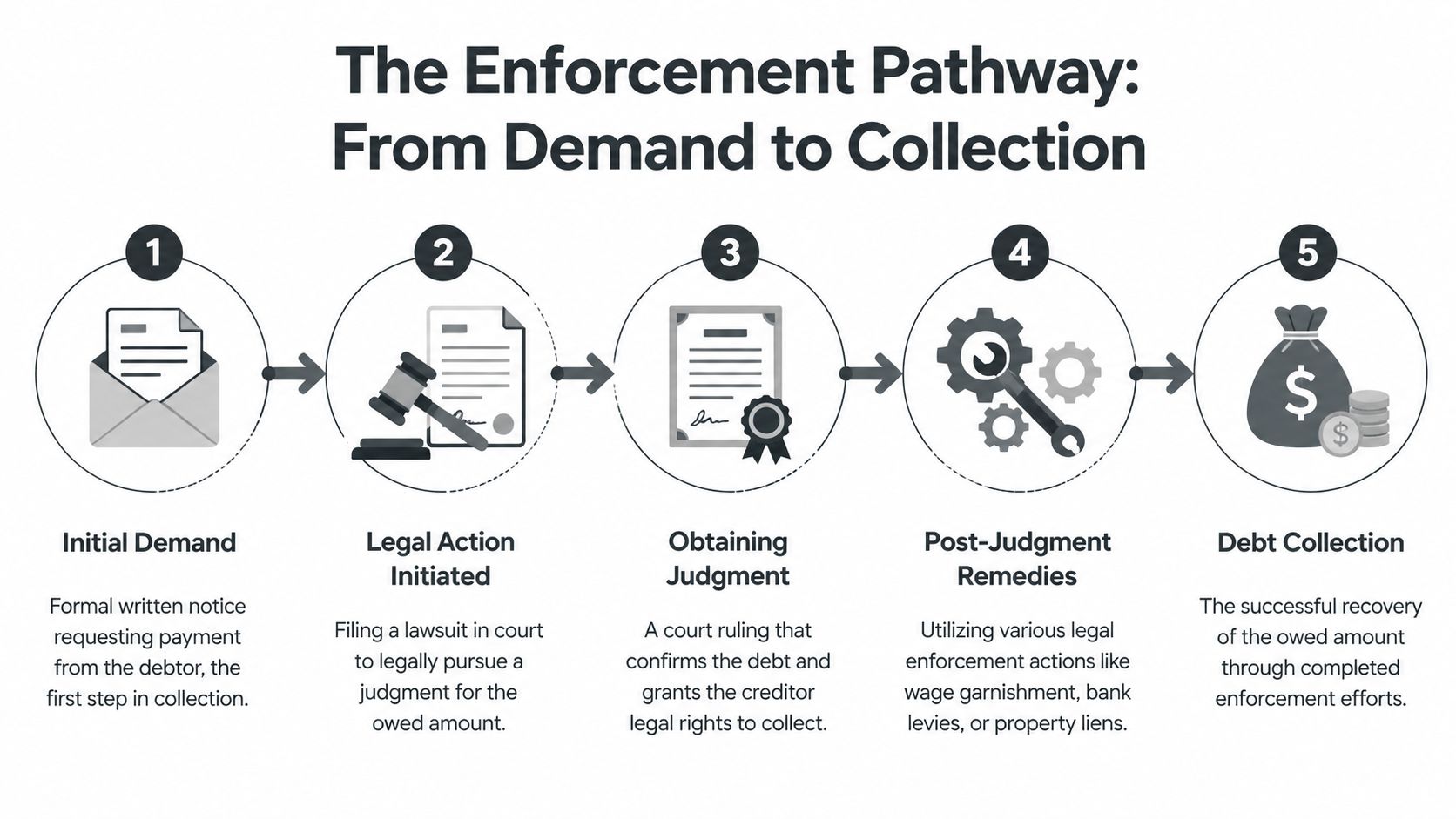
The Enforcement Pathway From Demand to Collection
Most recoveries follow a sequence. Not every file goes all the way through it, and many should settle earlier, but disciplined collection work moves in stages. Skipping steps can weaken the case. Delaying too long can do the same.
Start with a demand that helps, not hurts
A demand letter should do more than demand money. It should identify the contract or account, state the amount claimed in a way your documents can support, set a clear deadline, and avoid loose statements that create defenses.
Before sending that letter, confirm the file. If your team needs a plain-English checklist on basic formation issues, this guide on the elements of a legal agreement is a useful companion. Demand letters are much stronger when they rest on clean contract formation and clean records.
A good demand letter also asks a business question: do you want payment, collateral turnover, a workout, or positioning for suit? Those goals aren’t always the same.
File suit when leverage has peaked outside court
Some debtors respond to structured pressure. Others use every pre-suit communication to buy time. If the debtor is evasive, raising recycled disputes, or showing signs of asset movement, filing may be the more economical choice.
Once litigation begins, focus matters. Plead the right claim. Attach the right documents where appropriate. Name the right defendants. If a guaranty exists, don’t treat it as an afterthought.
Common commercial collection files often turn on a short list of proof points:
- The agreement: Signed contract, credit application, note, guaranty, or accepted terms.
- The performance: Invoices, delivery records, statements of account, or evidence of completed services.
- The default: Past-due status, missed installments, dishonored payments, or unmet cure demands.
- The amount due: A calculation that matches the documents and doesn’t overreach.
Judgment is the pivot point
Many cases resolve before trial through payment plans, stipulated judgments, or negotiated reductions tied to speed of payment. If the debtor doesn’t appear or can’t raise a genuine defense, a default or other dispositive ruling may put the creditor in position to enforce.
The hard part often starts there. Businesses unfamiliar with collections assume judgment means payment follows automatically. It doesn’t. You still need an enforcement plan.
That plan usually begins with asset discovery. Where does the debtor bank? What receivables are coming in? Does the business own equipment free and clear? Is there real estate? Are there related entities receiving diverted revenue? The more quickly those questions get answered, the more useful the judgment becomes.
The file that gets collected fastest is often the one where asset investigation started before judgment entered.
Tailor the strategy to the debtor, not the paperwork alone
Strong rights don’t always produce the same economic result in every market. Research discussed by the University of Rochester notes that stronger creditor rights can have a more nuanced effect in markets with low lender competition, and can sometimes reduce business investment rather than uniformly improving outcomes, as explained in the University of Rochester discussion of creditor rights and market conditions.
The practical lesson for Connecticut creditors is straightforward. Don’t apply one script to every file. A distressed contractor, a closely held distributor, and a repeat commercial borrower present different points of negotiation. A rigid approach can destroy settlement value. A strategic one can preserve it while still moving firmly.
For businesses that already have judgment in hand and need to turn that judgment into recoveries, the procedural side of how to enforce a judgment is often where momentum is won or lost.
Understanding Deadlines and Debtor Protections
Collections law has two sets of boundaries. One limits how long you have to sue. The other limits how you may pursue payment. Serious creditors respect both because missing either can damage an otherwise valid claim.
Deadlines control leverage
In Connecticut practice, timing questions should be raised early. Different claims can carry different limitation periods, and businesses often make the mistake of using the invoice date, last payment date, charge-off date, and demand date interchangeably. They’re not interchangeable.
That’s why a collections review should identify the legal theory before the file goes stale. Is the claim based on a written contract, an oral agreement, an account stated theory, goods sold, or a guaranty? The answer affects not only pleading but also the deadline analysis. A practical Connecticut-specific starting point is this overview of the statute of limitations on debt in CT.
If your team waits until the debtor has completely gone dark, key dates may already be under pressure. That doesn’t mean the claim is lost, but it does mean strategy becomes narrower and more expensive.
The FDCPA changed the compliance baseline
Debtor protection laws are not side issues. They shape the lawful perimeter of collection conduct. The most important federal baseline is the Fair Debt Collection Practices Act, which was enacted in 1977 and became effective in 1978, establishing the first extensive federal protections against abusive collection practices and creating clear boundaries for third-party debt collectors, as described in the National Consumer Law Center history of the FDCPA.
The practical point for a business client is this: collection pressure must be disciplined. The law restricts how and when certain debt collectors may contact debtors and was designed to stop abusive tactics that had flourished before federal oversight existed.
That history still matters because many collection mistakes are old mistakes in modern form.
Professional collections require restraint
Businesses hurt themselves when they treat aggressive conduct as effective conduct. It usually isn’t. The better approach is controlled pressure supported by documents and procedure.
Keep these guardrails in view:
- Know who is collecting: Rules can differ depending on whether the creditor is collecting its own debt or using a third party.
- Control communications: Repeated, emotional, or improvised outreach creates unnecessary risk.
- Document disputes carefully: A billing disagreement may be genuine, tactical, or mixed. Treat it as an evidentiary issue, not a personal insult.
- Escalate through legal process: Court orders, liens, and executions carry more weight than angry emails.
Businesses collect better when they act like records custodians and litigators, not like offended counterparties.
When Bankruptcy Halts Collection The Automatic Stay
Nothing changes a collection file faster than a bankruptcy filing. The moment the petition is filed, the legal environment shifts. What looked like a straightforward state-court enforcement matter can become a bankruptcy-controlled process overnight.
The automatic stay is a hard stop
The automatic stay under 11 U.S.C. § 362 stops creditor collection activity when bankruptcy begins. Lawsuits, garnishments, repossessions, and collection communications are halted. Once notice is received, the safest working assumption is that all active collection steps must stop unless the bankruptcy court grants relief.
That isn’t a technicality. It’s one of the most heavily enforced rules in debtor-creditor practice. If your staff, lender, servicer, or outside collector doesn’t have a process for recognizing bankruptcy notice and freezing activity, the exposure can be serious.
Why secured status changes the outcome
Bankruptcy doesn’t treat all creditors equally. Priority matters. Perfection matters. Collateral matters.
In Chapter 7 liquidations, secured creditors with perfected security interests often recover 70 to 90 percent of their claims, while unsecured creditors typically recover 10 to 30 percent, because the Bankruptcy Code’s priority system rewards creditors who legally secured their debt against specific collateral before the filing, as discussed in this explanation of understanding creditors' rights in business law.
That difference explains a lot of pre-bankruptcy strategy. If you wait to think about collateral until the debtor is already failing, you’re late. The creditor who documented and perfected earlier often enters bankruptcy with options. The unsecured trade creditor often enters with a proof of claim and a significantly weaker position.
The first moves after notice matters
When a business customer files bankruptcy, slow reaction creates avoidable losses. Quick, organized review matters more than dramatic action.
Use a short internal checklist:
- Stop collection activity immediately: Freeze calls, emails, auto-drafts, legal process, and vendor-side collection scripts.
- Review the debt structure: Determine whether the claim is secured, guaranteed, disputed, or tied to executory contracts.
- Gather the collateral file: Security agreement, financing statements, account histories, default notices, and correspondence should be assembled fast.
- Assess bankruptcy counsel needs: If stay relief, adequate protection, or claim objections may be involved, the file has already moved beyond ordinary collections.
The legal system gives secured creditors meaningful tools in bankruptcy, but only if the groundwork was laid before the petition date.
Practical Checklists for Connecticut Creditors
Most collection problems get worse because businesses wait too long, preserve too little, or pursue the wrong target. A short checklist fixes none of that by itself, but it does keep a file usable.
Pre-litigation preparation
Before sending the file out, gather the documents that will prove both liability and amount due.
- Verify the debtor identity: Confirm the exact legal name of the customer, borrower, or guarantor.
- Pull the core contract file: Collect the signed agreement, credit application, guaranty, purchase order, change orders, and amendments.
- Match invoices to performance: Pair each invoice with delivery records, acceptance evidence, or service completion support.
- Review communications: Save emails, text messages, and payment promises in a format that can be produced later.
- Check for dispute material: Is the debtor claiming defective work, offset, return rights, or unauthorized charges?
- Look for collateral and insurance: Identify equipment, receivables, inventory, or policy proceeds that may matter.
Post-judgment enforcement
Once judgment enters, speed and sequencing count.
- Docket and record appropriately: Make sure the judgment is positioned for enforcement.
- Investigate assets quickly: Bank relationships, real property, receivables, equipment, and related entities should be identified.
- Use discovery with purpose: Ask for the information you need to enforce, not every document imaginable.
- Choose the pressure point: A bank execution, lien, turnover effort, or negotiated payment plan may each be right in different files.
- Monitor compliance: Debtors who agree to payment terms need active follow-up.
- Escalate if the debtor stalls: Delay after judgment usually signals either inability, concealment, or a test of your resolve.
Creditor Action Checklists
| Phase | Action Item | Purpose |
|---|---|---|
| Pre-litigation | Confirm debtor and guarantor names | Prevent suing the wrong party |
| Pre-litigation | Assemble contracts, invoices, and account statements | Prove liability and damages |
| Pre-litigation | Review communications and disputes | Anticipate defenses |
| Pre-litigation | Identify collateral or other security | Evaluate leverage before suit |
| Post-judgment | Locate bank accounts and property | Target enforcement efficiently |
| Post-judgment | Serve focused post-judgment discovery | Obtain actionable asset information |
| Post-judgment | Select the remedy that fits the asset | Improve recovery chances |
| Post-judgment | Track payment promises and defaults | Support fast follow-up action |
For businesses that need outside help implementing this process, a collections and creditors’ rights practice such as Kons Law can handle demand work, litigation, and judgment enforcement in a structured sequence rather than as disconnected events.
When to Hire a Creditor Rights Attorney
Some collection matters can be handled internally at first. Many shouldn’t be.
If the debt is large, the paperwork is messy, a guarantor may be liable, collateral is involved, or the debtor is signaling insolvency, legal counsel should enter early. The same is true when the debtor raises technical defenses, threatens bankruptcy, shifts assets, or forces you into post-judgment enforcement. Those are the points where ordinary accounts receivable efforts stop being cost-effective.
A creditor rights attorney does more than file suit. Counsel helps frame the right claim, protect their advantage, avoid collection misconduct, evaluate settlement structure, and decide whether judgment, lien rights, UCC remedies, or bankruptcy strategy offers the best path.
The businesses that recover most consistently usually make one practical decision: they stop treating serious delinquent accounts as bookkeeping issues and start treating them as legal enforcement matters.
If you want to discuss your business law matter, contact Kons Law at (860) 920-5181.
Frequently Asked Questions About Creditor Rights
Can I seize a customer’s assets without a court order
Usually, not as an unsecured creditor. If you sold goods or provided services and were never granted a valid security interest, you generally need to proceed through lawful collection channels, often starting with suit and then judgment enforcement.
A secured creditor may have stronger rights in collateral if the documents were drafted correctly and the interest was perfected. Even then, self-help has legal limits and should be planned carefully.
What’s the difference between a trade creditor and a secured lender
A trade creditor often relies on contract rights, invoices, and later judgment enforcement. A secured lender starts with a claim against specific collateral. That difference can shape bargaining power from the first default and can become decisive if the debtor collapses financially.
The practical lesson is simple. If your business regularly extends substantial credit, evaluate whether some accounts should be documented with security, guaranties, or both.
What if the customer says the bill is disputed
Don’t treat every dispute as bad faith, but don’t assume every dispute is real either. Pull the contract, delivery records, approvals, and prior communications. Then separate quality or scope complaints from pure delay tactics.
A documented dispute should change your approach, not end it. Sometimes the right move is negotiation. Sometimes it’s a suit that frames the issue cleanly for the court.
Can I keep calling or emailing after a bankruptcy filing
No. Once you receive notice of bankruptcy, collection activity must stop unless the bankruptcy court permits otherwise. The automatic stay is powerful enough that knowing violations can lead to significant sanctions. In In re McLean v. Green Point Credit, a court awarded $500,000 in damages for stay violations, as noted by the Eastern District of New York bankruptcy court guidance on creditor rights and responsibilities.
That’s why every business that collects internally should have a bankruptcy notice protocol.
Is it worth suing if I’m not sure the debtor has assets
Sometimes yes, sometimes no. The answer depends on more than current liquidity. A debtor may lack cash today but have receivables, equipment, real estate exposure, insurance proceeds, or a guarantor. In other files, judgment only confirms what you already know, that recovery is unlikely.
The better question is whether a pre-suit asset review suggests a realistic collection path. If the answer is unclear, a short legal assessment can save substantial time and cost.
Should I accept a payment plan
Often, yes, if the plan is structured correctly. The key is documentation, default provisions, and clarity about what happens if the debtor misses a payment. Informal plans create repeat problems. Formal plans can create an advantage and preserve remedies.
If you need help evaluating collateral, enforcing a contract, pursuing a Connecticut judgment, or responding to a debtor bankruptcy, contact Kons Law. If you want to discuss your business law matter, call (860) 920-5181.
