
You’ve won your lawsuit. That big sigh of relief, the feeling that it’s all over… it’s a great moment. But the hard truth is, winning the case is often just halftime. Now, the real game begins: actually collecting the money you're owed.
A court judgment confirms the debt, but it doesn't magically transfer funds into your bank account. To turn that piece of paper into cash, you, the creditor, have to take active steps after the trial is over. This means hunting down the debtor's assets and using the right legal tools—like wage garnishments, bank levies, or property liens—to seize them.
From Courtroom Win to Cash in Hand
That judgment from the judge is a powerful thing, but it’s not a self-executing order. The legal system puts the ball squarely in your court. As the judgment creditor—the person the money is owed to—you are responsible for spearheading the entire collection process. The court isn't going to chase down the debtor for you. This is a surprise for many people who think a judge’s ruling is the end of the story.
Think of it this way: the judgment is the key, but it's up to you to find the right lockbox and open it. This next phase is less about legal arguments and more about strategic investigation. It's about taking that theoretical win from the courtroom and making it a practical, financial reality.
The Creditor’s Active Role
Your role officially shifts from plaintiff to investigator and collector. It’s a transition that comes with a new set of responsibilities, and understanding them is crucial before you can pick the right collection method.
Here’s what’s now on your plate:
- Asset Discovery: You need to figure out what the debtor owns and where they keep it. This could be anything from bank accounts and real estate to cars and regular paychecks.
- Taking Legal Action: It's on you to file the right paperwork with the court. This means preparing documents like writs of garnishment to intercept wages or abstracts of judgment to place a lien on property.
- Staying Compliant: You must follow all state and federal debt collection laws to the letter. Get it wrong, and you could end up in legal trouble yourself. For instance, the specific rules for judgment enforcement in Connecticut are very clear about the proper process and its limits.
A judgment is really just a license to collect. If you don't do anything with it, it's just a piece of paper validating a debt—it has no real-world value. The actions you take next are what determine whether your legal victory actually puts money back in your pocket.
This guide will break down these steps, starting with the all-important first phase: uncovering the debtor's assets.
If you want to discuss your business law matter, contact Kons Law at (860) 920-5181.
Finding the Money: Uncovering Debtor Assets
Winning a judgment is a huge step, but it's not the finish line. That court order is your legal right to get paid, but it doesn't come with a map to the debtor's wallet. Before you can start using powerful tools like bank levies or wage garnishments, you have to put on your investigator hat.
This is the intelligence-gathering phase of enforcing your judgment. You need to find out what the debtor owns and where they're keeping it. Honestly, this discovery process is often what separates creditors who get paid from those left holding a worthless piece of paper. You can't seize funds from a bank account you don't know exists, and you can't put a lien on a property you haven't identified.
Formal Discovery Tools
The legal system gives you a few potent tools to force a debtor to reveal their financial situation. These aren't just polite requests—they are legally binding demands, and there are penalties for ignoring them.
Two of the most effective methods I use for my clients are:
- Post-Judgment Interrogatories: Think of these as a list of written questions you send directly to the debtor. They are required to answer them truthfully and under oath. You can ask about everything from bank accounts and employment details to real estate holdings and vehicle ownership.
- Subpoenas Duces Tecum: This is a court order that doesn't go to the debtor, but to a third party, like a bank or an employer. It compels them to turn over documents. For example, you can subpoena the debtor's bank for account statements or their employer for payroll records.
These tools are so effective because they go around the debtor's resistance. A bank has to comply with a valid subpoena, no matter what its customer—the debtor—wants.
This decision tree gives you a great visual of the path from winning your case to actually collecting the money.
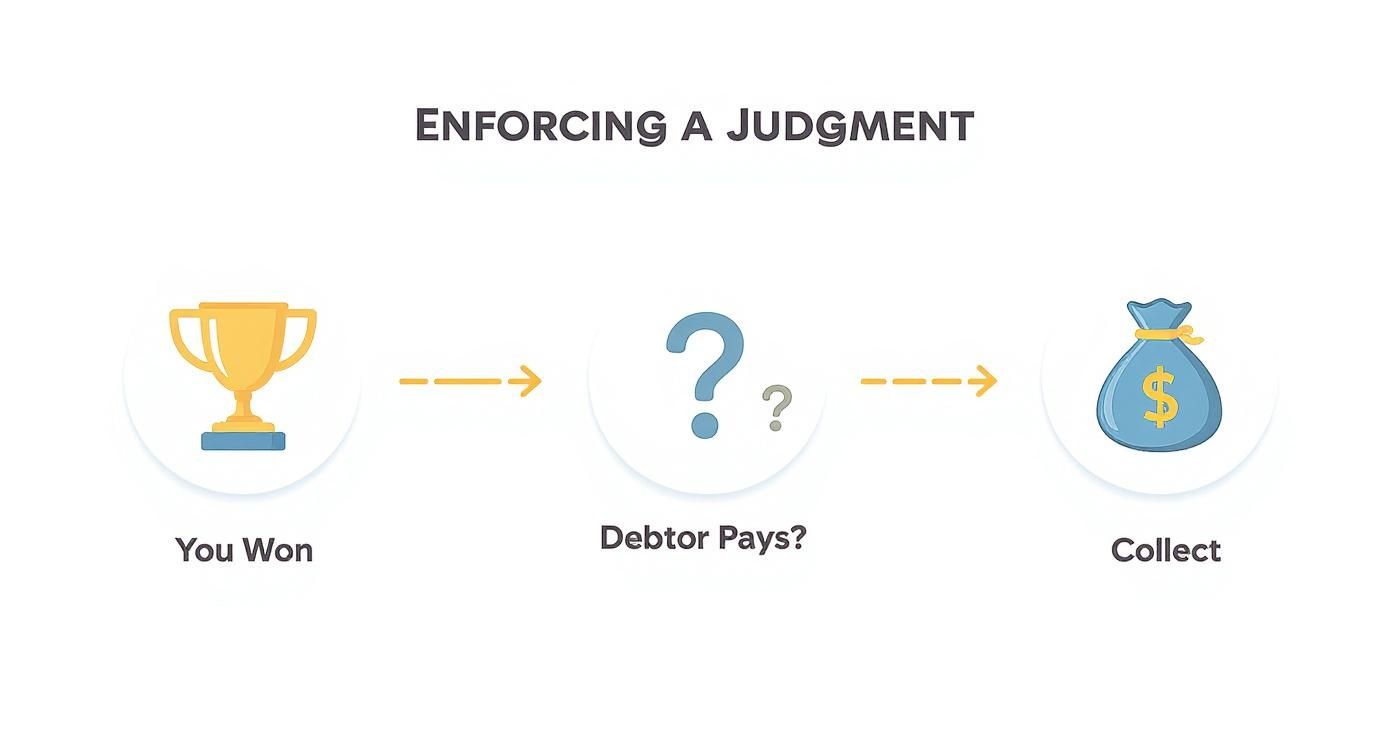
As you can see, winning is just the first part. The real work begins when you have to actively collect on that judgment.
Informal Asset Searching
While you're waiting on the formal discovery process, you can do some digging on your own using publicly available information. You'd be surprised how effective these informal searches can be, and they often get you quick results without the cost of court filings.
A great place to start is with public records databases, many of which are online.
- Property Records: Check the county recorder or assessor's website to see if the debtor owns any real estate.
- Vehicle Registrations: State DMV records can tell you if the debtor has cars, boats, or other vehicles registered in their name.
- Business Filings: The Secretary of State's office is a good source for records of any businesses the debtor might own.
Doing this kind of groundwork helps build a more complete financial picture. It also makes your formal discovery requests much more targeted. For example, if you find a business listing, you can then subpoena that business's bank for its financial records.
The biggest mistake I see creditors make is assuming the debtor will cooperate. You have to build your strategy on the opposite assumption—that you will need to legally compel them to disclose information before you can find their assets and get paid.
The Challenge of Modern Assets
Your ability to collect is only as good as your ability to find the assets. While we have a high success rate with traditional assets, the rise of digital currency is a new wrinkle. In the United States, enforcement actions against identifiable bank accounts or real estate are successful 70–80% of the time.
But cryptocurrencies and other digital assets can be moved across the globe in seconds, making collection a whole lot more complicated. You can find more details on judgment enforcement trends in this insightful guide.
Building Your Collection Strategy
Once your investigation is done, you'll have a list of the debtor's assets. This is the blueprint for your collection strategy.
- Found cash in a bank account? A bank levy is the most direct way to get it.
- Know they have a steady job? Wage garnishment is a reliable, long-term option.
- Discovered they own real estate? A property lien is perfect for securing your debt against that asset.
Every piece of information you uncover points you toward the right enforcement tool. The work you put in during this discovery phase has a direct impact on your ability to collect what you're owed. For creditors in Connecticut, it's crucial to understand the state's specific laws. You can learn more about navigating debt collection in Connecticut to protect your rights.
If you want to discuss your business law matter, contact Kons Law at (860) 920-5181.
Using Bank Levies and Wage Garnishments
You’ve done the hard work of locating the debtor's assets, and now it's time to take direct action. When it comes to enforcing a judgment, two of the most powerful tools in your arsenal are bank levies and wage garnishments.
Think of these as the legal equivalent of a direct intercept. They allow you to legally grab money before the debtor has a chance to move or spend it, making them a cornerstone of any serious collection strategy.
A bank levy is exactly what it sounds like: a court-authorized seizure of funds straight from the debtor’s bank account. This isn't a request; it's an order. The bank is legally required to freeze the account and hand over any available funds to you, up to the total judgment amount. It’s a fast, powerful, one-time hit that works wonders if you know the debtor has cash sitting in an account.
Then there's the wage garnishment, which targets the debtor’s income at the source. This is a continuous court order sent directly to their employer. Each payday, the employer is required to withhold a specific portion of the debtor's paycheck and send it to you. If the debtor has a steady job, this method creates a reliable, ongoing payment stream that keeps chipping away at the debt until it's paid in full.

Executing a Bank Levy
Let's be clear: you can’t just call up the debtor’s bank and ask for your money. Executing a bank levy is a formal legal process. After you've confirmed where the debtor banks, your first move is to get a writ of execution from the same court that issued your judgment.
This writ is your golden ticket. It's the official document that authorizes a sheriff or marshal to enforce the judgment on your behalf. You'll give the officer the writ along with precise instructions—the name of the bank and the account information. The officer then serves the writ on the bank, which must immediately freeze the account.
It’s a powerful move. One day the debtor goes to use their debit card, and it's declined. That immediate financial shock is often enough to bring them to the negotiating table.
But the process isn’t quite over. The debtor gets a chance to argue that some of the money is legally protected, or exempt, from seizure. Both federal and state laws shield certain types of funds, like Social Security benefits, disability payments, and child support. If the debtor files a claim of exemption, you might end up in a court hearing to determine what portion of the frozen funds you're actually entitled to.
Setting Up a Wage Garnishment
If your asset search uncovered where the debtor works, a wage garnishment is an excellent long-term play. The process starts just like a bank levy, with a writ of execution. This time, however, the legal order is served on the debtor's employer.
The employer is now what's known as a garnishee—a neutral third party legally obligated to follow the court's order. They have to calculate the non-exempt portion of the debtor’s wages each pay period and send the money directly to you or the sheriff.
It’s critical to know that you can’t take their whole paycheck. There are strict legal limits on how much you can garnish.
- Federal Limits: Under the Consumer Credit Protection Act (CCPA), garnishments are generally capped at 25% of the debtor’s disposable earnings (or the amount their earnings exceed 30 times the federal minimum wage, whichever is less).
- State Limits: Many states have their own laws that are even more protective of debtors. You have to follow whichever law is more favorable to the debtor.
So, while you won't get the debt paid off in one lump sum, you'll establish a consistent flow of payments. It’s a fantastic "set it and forget it" method that works for as long as the debtor stays at their job. For more on the broader strategies involved, you can explore our other articles on debt collection.
A wage garnishment effectively turns the debtor's employer into an unwilling collection agent. The administrative hassle and potential embarrassment at work can be a huge motivator for the debtor to finally settle the judgment.
Comparing Common Enforcement Methods
So, which one do you choose? The right tool really depends on the debtor's financial situation. A bank levy is your go-to for a quick cash grab, while a wage garnishment is perfect for creating a steady payment plan.
To make it easier, let's break down the key differences. This table compares the top enforcement methods to help you decide which strategy best fits your situation.
Comparing Common Enforcement Methods
| Enforcement Method | Best For | Typical Speed | Key Challenge |
|---|---|---|---|
| Bank Levy | Debtors with known cash reserves in a bank account. | Fast, often freezing funds within days of serving the writ. | The account might have a low balance or contain exempt funds. |
| Wage Garnishment | Debtors with consistent employment and a regular paycheck. | Slower to start but provides ongoing payments. | The debtor could change jobs, requiring you to locate the new employer. |
| Property Lien | Debtors who own real estate or valuable personal property. | Very slow; payment often occurs only when the property is sold or refinanced. | The property may have other liens on it with higher priority. |
Ultimately, both bank levies and wage garnishments highlight just how crucial that initial asset search is. Knowing whether the debtor has a flush bank account or a stable job is the key to picking the right tool to finally get paid.
If you want to discuss your business law matter, contact Kons Law at (860) 920-5181.
Securing Your Claim with a Property Lien
While grabbing cash directly through bank levies or wage garnishments feels like a quick win, those methods aren't always a good fit. What happens when the debtor is self-employed, gets paid in cash, or is a pro at keeping their bank balance near zero?
This is where a property lien becomes your most powerful long-term play, especially if you've discovered the debtor owns real estate.
Think of a judgment lien as a legal "dibs" you place on the debtor’s property. It won't put cash in your pocket tomorrow, but it gives you incredible leverage by attaching your claim to their most valuable asset. It's about playing the long game and making sure you’re first in line to get paid when that property is eventually sold or refinanced.

Attaching the Lien to Real Estate
The actual process of putting a lien on a property is surprisingly straightforward, but you have to be precise. The critical document you need is an Abstract of Judgment. This is a simple, one-page summary of the court’s decision, officially certified by the court clerk.
With that abstract in hand, you’ll file it with the county recorder’s office in every county where you have reason to believe the debtor owns property. This part is absolutely crucial. Just getting the judgment isn't enough; recording the abstract is what officially creates the public lien on the property’s title.
Once recorded, your judgment is tethered to that land. This means the debtor is stuck. They cannot:
- Sell the property without first paying off your lien to clear the title for the new buyer.
- Refinance the property because no lender will issue a new loan against a property with your judgment clouding the title.
The lien effectively freezes the debtor's ability to pull any equity out of their property until you’ve been paid.
The Power of a Lien
Unlike a one-and-done bank levy that might only capture a small amount, a property lien secures your debt against an asset that will likely appreciate over time. It’s a patient strategy, but it’s incredibly effective.
Even if the debtor swears they'll never sell, life happens. A new job in another state, a divorce, or a growing family could force a sale down the road. When that day comes, your lien guarantees you get paid out of the proceeds.
What's more, a judgment lien in Connecticut will often automatically attach to any future real estate the debtor buys in that same county. So, if you record your abstract in Hartford County, it latches onto the house they own today and any condo they might buy there five years from now, for as long as the judgment is valid.
The real strength of a judgment lien is that it forces the debtor to deal with you on your terms. It turns an unsecured debt into a secured one, giving you a powerful negotiating position you didn't have before.
Extending Liens to Personal Property
Real estate isn't the only asset you can target. Liens can also be placed on valuable personal property—think vehicles, expensive business equipment, or even high-end collectibles. The process here is a bit different, typically involving a filing with a state agency like the Secretary of State or the Department of Motor Vehicles (DMV).
For instance, filing a lien with the DMV on a debtor's car title stops them from selling it without paying you. For a business, a filing with the Secretary of State can attach to nearly all of its assets, including inventory and accounts receivable. This is a fantastic way to enforce a judgment against a business that doesn't own buildings but has other valuable assets.
Whether you're targeting real estate or personal property, a lien is a strategic move that secures your claim for the long haul. It transforms your judgment from a piece of paper into a powerful encumbrance the debtor simply cannot ignore.
If you want to discuss your business law matter, contact Kons Law at (860) 920-5181.
When Assets Cross State Lines or Borders
It’s a common scenario: you win a judgment, only to discover the debtor’s money or property is sitting in another state. In today’s economy, people and businesses have financial footprints that stretch all over the country. So, what do you do when the only real asset you can find—a bank account, a vacation home—is across state lines?
Don’t worry, your judgment isn't worthless. You just need to take an extra step to make it legally binding in that new jurisdiction. This process is often called "domesticating" a judgment.
Instead of filing a whole new lawsuit from scratch, you can use a well-established legal framework to transfer your court order. Doing this gives your out-of-state judgment the same teeth as a local one, unlocking all the enforcement tools available in that state, from property liens to bank levies.
The Uniform Enforcement of Foreign Judgments Act
Thankfully, this isn't as complicated as it sounds. Most states have adopted the Uniform Enforcement of Foreign Judgments Act (UEFJA) or a very similar law to make the process straightforward. The UEFJA lets a creditor enforce a judgment in a new state simply by filing a certified copy of the original judgment with the local court.
The process generally looks like this:
- Get a Certified Copy: First, you’ll need to request an authenticated or "exemplified" copy of your judgment from the clerk of the court where you originally won.
- File It in the New State: You then take that certified judgment, along with an affidavit spelling out the key details, and file it in the court where the assets are.
- Let the Debtor Know: Finally, you have to formally notify the debtor that you’ve registered the judgment in the new state.
Once you’ve completed these steps and a short waiting period has passed, your "foreign" judgment is treated just like it was issued by a local court. You can then immediately start using that state’s procedures to go after the debtor's assets.
Tackling International Enforcement Hurdles
Domesticating a judgment is one thing; trying to enforce it across international borders is a whole different ballgame. If the debtor’s assets are stashed in another country, you can’t just file your U.S. judgment and expect results. The entire process becomes far more complex, expensive, and frankly, uncertain.
You'll almost certainly need to hire local lawyers in the foreign country to guide you through their specific laws for recognizing U.S. court orders. This can mean dealing with language barriers, completely different legal systems, and significant upfront costs.
Despite global efforts to standardize things, international enforcement is still hit-or-miss. The New York Convention, which has been ratified by 170 countries, helps with enforcing foreign arbitration awards, but even then, success isn’t guaranteed. Enforcement in major financial hubs like London or Singapore often exceeds a 90% success rate, but that can plummet to 40–50% in other economies bogged down by local legal roadblocks. You can discover more insights about the evolving standards for enforcing awards on Wolters Kluwer's legal blog.
When you're looking at cross-border enforcement, a frank cost-benefit analysis is a must. The legal fees and time involved can easily swallow the entire value of the judgment, making it a strategic gamble, not a guaranteed win.
Before you jump into an international collection effort, take a hard look at the potential recovery versus the guaranteed costs and the real-world odds of success in that specific country.
If you want to discuss your business law matter, contact Kons Law at (860) 920-5181.
Hitting Roadblocks and Knowing When to Call for Backup
Winning your case is one thing; getting paid is another battle entirely. You can count on debtors to throw up roadblocks. They might try to hide assets, shuffle property over to a family member, or claim that certain funds are legally off-limits. Getting past these hurdles takes persistence and a solid game plan for whatever moves the debtor makes.
One of the most common tactics you'll see is the exemption claim. Debtors have a right to protect certain assets and income, like Social Security benefits, disability payments, and a chunk of their wages. If you go for a bank levy, they can file a claim of exemption. This often triggers a court hearing to sort it out, putting your collection efforts on pause.
Then there's the debtor who goes into hiding mode with their assets. They might bounce money between different bank accounts, use shell companies, or put a valuable car in their cousin's name. This is where your basic asset searches hit a wall and you need to bring in more advanced investigative firepower.
When You Absolutely Need a Professional
You can definitely handle some of the enforcement steps yourself, but certain situations are a flashing red light telling you it's time to bring in a legal pro. Knowing when to escalate can save you a mountain of time, money, and frustration. More importantly, it dramatically increases your odds of actually getting paid.
It’s probably time to get help if:
- The Debtor is Hiding Assets: A seasoned collections attorney has access to sophisticated asset-tracing tools that go way beyond a simple public records search. They know where to look and how to uncover what the debtor is trying to keep hidden.
- Things Get Legally Complicated: If the debtor files for bankruptcy, starts claiming multiple exemptions, or has assets tangled up in complex trusts, you're now in deep water. An expert is your best bet for navigating these legal minefields.
- The Debtor is in Another State: As we've covered, domesticating a judgment is a very precise legal dance. One wrong step and you're back at square one.
The wider legal environment can also throw a wrench in the works. The strength of our judicial system is everything, and a recent trend is frankly a bit concerning. According to the World Justice Project, the rule of law deteriorated in 68% of countries this year—the steepest decline they've ever recorded. This can make enforcing court orders trickier, even in places you wouldn't expect. You can dig into the global rule of law trends on their website for more details.
Bringing in a professional isn't admitting defeat; it’s a strategic pivot. An attorney can often get done in weeks what might take you months or even years, simply because they have the experience and tools to shut down common debtor games.
At the end of the day, a good attorney can size up the situation, map out the most cost-effective path forward, and handle all the legal heavy lifting needed to get your money. If you want to talk through your own business law matter, give Kons Law a call at (860) 920-5181.
A Few Common Questions About Enforcing Judgments
Even with a solid plan, trying to enforce a judgment can throw a few curveballs your way. It’s natural to have questions pop up. Here are some of the most common ones I hear from clients, along with straightforward answers.
How Long Do I Have to Collect on a Judgment?
A judgment isn't a blank check you can cash anytime you want; it has an expiration date. Here in Connecticut, a judgment is generally good for 20 years. That might sound like a long time, but you can't just set it and forget it.
Often, you'll need to take specific steps to renew the judgment before it expires. If you don't, your legal right to collect the money owed to you simply vanishes. Forgetting to track this deadline is a surprisingly common and costly mistake.
Are There Any Assets I Can't Touch?
Yes, absolutely. Both federal and state laws protect certain assets from being seized. The idea is to leave the debtor with enough to cover basic living expenses, so they aren't left destitute. These are often called exempt assets.
You'll run into a few common categories of protected property and income:
- A slice of the debtor's wages, based on federal and state limits.
- Government benefits like Social Security, disability, and unemployment.
- A certain amount of equity in their home (this is the "homestead exemption").
- Money received from child support or alimony.
What Happens if the Debtor Declares Bankruptcy?
This is a big one. The moment a debtor files for bankruptcy, something called an automatic stay kicks in. Think of it as a legal brick wall that immediately stops all your collection efforts—no more bank levies, wage garnishments, or anything else.
Trying to collect while the stay is active is a serious violation and can lead to penalties. From there, your ability to get paid depends entirely on the type of bankruptcy they filed and whether your specific debt gets wiped clean (discharged) by the court.
For more detailed answers to your legal questions, you might find helpful information in our firm's comprehensive FAQs.
If you want to discuss your business law matter, contact Kons Law at (860) 920-5181.
