A supplier sends over a “standard” agreement on Tuesday afternoon. Your sales team wants it signed by Thursday so the order can ship this month. The pricing looks fine. The term looks manageable. Then you get to the parts most business owners skim: auto-renewal, indemnity, limitation of liability, setoff rights, venue, attorney’s fees, and a payment clause that doesn’t clearly say when money is due.
That’s the moment many companies realize a contract isn’t paperwork. It’s operations, cash flow, strategic advantage, and risk written down.
For Connecticut businesses, that problem shows up everywhere. It appears in vendor agreements, customer contracts, lease documents, employment and contractor arrangements, software subscriptions, distribution deals, and settlement terms. And because contracts sit under so much of modern commerce, they deserve more attention than they usually get. In the United States, 60-80% of all B2B deals are governed by contracts, Fortune 1000 companies often manage 20,000 to 40,000 active contracts simultaneously, and contract management can consume up to 50% of a legal department’s time according to Juro’s contract management statistics.
Your Business's First Line of Defense
A commercial contract lawyer is often most valuable before anyone signs anything.

Small and mid-sized business owners usually don’t call counsel because a contract is interesting. They call because a deal matters. A new customer wants your company to accept broad warranty obligations. A vendor wants to cap liability at the last month’s fees even though it will handle sensitive company data. A partner wants a quick joint venture agreement because “we all trust each other.”
Those are business decisions, but they’re also legal design choices. If the contract is drafted well, it supports the relationship and gives each side a clear path when performance slips. If it’s drafted poorly, it turns an ordinary disagreement into an expensive fight about what the parties thought they meant.
Contracts aren’t just for disputes
Commercial contract lawyers do more than clean up language. They allocate risk, set expectations, define remedies, and make obligations measurable. Good contracts answer practical questions before anyone has to argue about them. Who pays, when, and under what conditions? What happens if delivery is late? Who owns work product? Can either side walk away, and if so, how?
If you want a simple refresher on the legal building blocks that make agreements enforceable, this overview of the fundamental elements of contract is a useful starting point.
A strong contract should let your operations team know what to do next, not force your lawyer to explain what the document might mean.
For many Connecticut companies, the right lawyer isn’t a last resort. The right lawyer is the person who helps keep a promising deal from becoming a preventable problem.
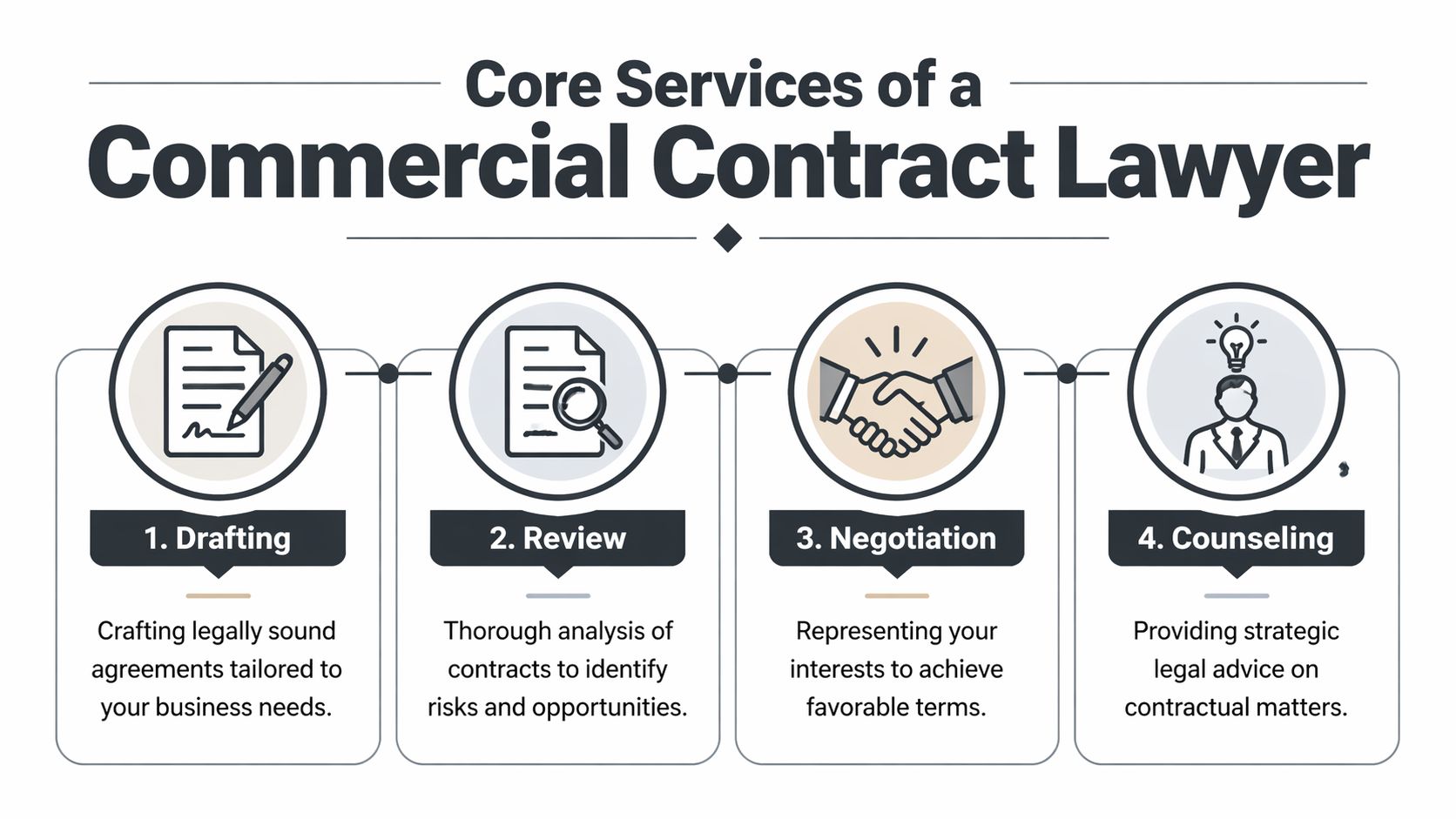
The Core Services of a Commercial Contract Lawyer
Commercial contract lawyers work like business architects. They don’t just look at one clause in isolation. They look at how the whole structure holds together when money is on the line, performance slips, or a relationship ends badly.
Drafting agreements that work in the real world
Drafting isn’t about making a contract longer. It’s about making it usable.
A well-drafted agreement reflects the actual deal the business team intends to perform. That means matching legal terms to operational reality. If your company invoices on milestones, the payment section should track milestones. If your customer expects exclusivity, the exclusivity language needs boundaries. If late payment is a recurring issue in your industry, your remedies need to be clear and enforceable.
Lawyers who draft commercial agreements well usually focus on plain definitions, workable timelines, and a remedy structure that makes sense if something goes wrong. Boilerplate still matters, but custom terms usually drive the business result.
If you want to compare legal review with business-side drafting habits, Kons Law’s guide on how to write a business contract gives a practical overview of the basics.
Reviewing third-party paper before it becomes your problem
Most businesses don’t start with a blank page. They receive someone else’s form.
That’s where contract review becomes critical. Vendor paper often shifts cyber risk downstream. Customer forms may expand warranties far beyond what your team discussed. Landlord leases can load up default triggers, pass-through costs, and one-sided renewal rights. A review should identify the clauses that move risk, not just mark up commas.
In practice, useful review means spotting issues like these:
- Payment friction: The invoice trigger is vague, acceptance criteria are subjective, or the other side can delay payment through broad dispute rights.
- Uneven liability: Your company carries broad indemnity exposure while the other side’s obligations are heavily capped.
- Weak exit rights: The contract is easy for them to terminate and hard for you to leave.
- Forum problems: The dispute clause puts your Connecticut business in a distant venue or an expensive procedure that doesn’t fit the deal.
Negotiating terms that preserve leverage
Negotiation is where legal judgment and business judgment have to work together.
Some terms are worth a fight. Some aren’t. A seasoned lawyer helps the client distinguish between cosmetic edits and clauses that affect revenue, control, or recovery. In many deals, the right approach isn’t “win every point.” It’s preserving your advantage on the points that matter if the relationship sours.
Practical rule: Negotiate the provisions you’ll care about when the other side stops performing, not the ones that simply look aggressive on paper.
Resolving disputes and protecting collection rights
This is the part many articles miss. A contract is also your collections document.
When a customer doesn’t pay, your ability to recover often depends on what the agreement says about due dates, notice, default, acceleration, personal guaranties, attorney’s fees, security interests, offsets, venue, and dispute procedures. That connection matters because 25% of U.S. business disputes involve unpaid contracts, contributing to $1.2 trillion in B2B bad debt globally, as noted in Silverman Thompson’s discussion of contract litigation.
A contract lawyer who understands creditors’ rights will often draft with enforcement in mind. That doesn’t make the document hostile. It makes the document useful. If payment trouble starts, the contract should help your business act quickly and from a position of clarity.
Key Moments When Your Business Needs a Contract Lawyer
Some legal work is routine. Some arrives at moments that shape the next few years of a business. Commercial contract lawyers are most valuable when the stakes rise faster than the paperwork.

Growth points that deserve legal review
A company usually needs contract counsel when it’s doing one of the following:
- Starting a business with another person: Early ownership documents shape decision-making, exits, deadlock resolution, and who can bind the company.
- Hiring key employees or contractors: The issue isn’t just compensation. It’s confidentiality, ownership of work product, restrictive covenants where permitted, and what happens after separation.
- Signing a commercial lease: Rent is only part of the deal. Use restrictions, maintenance obligations, assignment rights, defaults, and personal guaranties often carry more long-term risk.
- Entering a major customer or supplier relationship: Revenue concentration and supply dependence both increase the cost of sloppy language.
- Buying or selling a business: Asset purchase terms, reps and warranties, indemnification, and post-closing obligations can create liability long after the closing date.
These moments have one thing in common. They blend optimism with exposure. Business owners are focused on momentum. The contract needs to protect that momentum without inadvertently creating obligations the company can’t carry.
Trouble signs inside an existing relationship
Sometimes the right time to call a lawyer isn’t before the relationship starts. It’s when the relationship starts drifting.
If the other side is repeatedly paying late, sending inconsistent purchase orders, changing scope informally, or disputing invoices that used to be routine, the contract may need attention before a full dispute develops. That might mean a targeted amendment, a formal notice strategy, or a decision about whether negotiation, arbitration, or litigation makes more sense. If you’re weighing those options, this summary of alternative dispute resolution vs litigation helps frame the differences.
The costliest contract issues often start as “small” operational workarounds. A missed signature, an emailed scope change, or a tolerated late-payment pattern can become the center of the case later.
The smartest time to involve counsel is usually before your team says, “We’ll fix it later.”
How to Evaluate and Hire the Right Legal Partner
Many business owners wait too long to hire counsel because they assume the process will be opaque, expensive, or overly formal. That hesitation is understandable. 68% of SMBs cite cost as the top barrier to using legal services, and only 22% use lawyers for contracts because of perceived expense, according to MPL Law’s discussion of commercial contracts.
Still, the answer isn’t to skip legal help. The answer is to evaluate lawyers the same way you evaluate any other professional service provider. Ask how they work, what they handle often, how they price matters, and whether they understand businesses of your size.
Start with fit, not prestige
For a Connecticut SMB, the right legal partner is often a lawyer or boutique firm that regularly handles owner-managed businesses, growing companies, lenders, trade creditors, and in-house overflow work. Big-firm experience can be useful, but it isn’t the same thing as day-to-day fit.
Look for signs that the lawyer understands practical constraints:
- They ask about your business model: Not just the immediate contract.
- They talk about turnaround time: Because deal timing matters.
- They explain trade-offs clearly: They don’t pretend every clause is equally important.
- They can scale service: From one-off review to repeat template work.
Operational discipline matters too. Law firms that invest in intake, document tracking, and follow-up generally communicate better. If you’re curious how firms organize client pipelines and matter management, this overview of CRM software tailored for law firms gives a good sense of the systems that support responsiveness.
One practical option for Connecticut companies that need transaction, litigation, or collections support is Kons Law’s small business contract lawyer page, which outlines the kinds of business contract matters boutique counsel can handle.
Questions worth asking in the first consultation
Don’t waste a consultation on broad questions like “Are you experienced?” Ask about workflow, judgment, and billing.
| Category | Question | Why It Matters |
|---|---|---|
| Experience | What kinds of commercial agreements do you review or draft most often? | You want someone familiar with your deal type, not just business law in the abstract. |
| Industry fit | Have you worked with companies my size and stage before? | A lawyer used to enterprise clients may structure work very differently from one who serves SMBs. |
| Scope | What would you focus on first in this contract? | This shows whether the lawyer can identify the issues that actually move risk. |
| Negotiation style | How do you decide which clauses are worth pushing hard on? | Good counsel knows when to press, when to compromise, and why. |
| Timing | What turnaround can you usually offer for contract review? | A sound legal process still has to work with deal deadlines. |
| Fees | Do you offer flat fees, hourly billing, or hybrid arrangements for contract work? | Pricing structure affects predictability and the total cost of the engagement. |
| Communication | Who will do the work and how will updates be delivered? | You need to know whether the person you meet is the person managing the matter. |
| Disputes | If this agreement breaks down later, how does your firm handle enforcement or defense? | Drafting and enforcement are connected. Collection and dispute planning should be part of the conversation. |
Red flags that deserve attention
Some warning signs show up quickly.
A lawyer may not be the right fit if they can’t explain risk in business terms, won’t discuss fees with any clarity, seem irritated by practical questions, or promise a result instead of explaining a process. Another red flag is over-lawyering a routine matter. If every simple contract gets treated like a major acquisition, your legal bill will reflect that approach.
Ask whether the lawyer can help you create repeatable templates and fallback positions. Good commercial counsel doesn’t just solve today’s issue. They make the next contract easier.
The best hiring decision usually comes from a short list, a focused consultation, and a realistic discussion about budget, urgency, and expected volume.
Understanding Legal Fees and Pricing Structures
Legal fees make business owners uneasy mostly because they’re often discussed too late. The right time to talk about pricing is before the work begins, when scope and expectations can still be shaped.

Hourly billing
Hourly billing is common for work where the path isn’t predictable. That includes complex negotiations, fast-moving disputes, emergency injunction work, and heavily revised contracts where the other side keeps changing business terms.
The advantage is flexibility. The drawback is uncertainty. If your matter depends on the other side’s conduct, an hourly model may be realistic, but you should still ask for budget ranges, staffing expectations, and notice if the scope changes.
Flat fees
Flat fees work well for discrete tasks with a definable scope. Think first-draft agreements, standard reviews, routine amendments, or a package of related business documents.
Clients usually like flat fees because they create predictability. Lawyers like them when the matter can be scoped clearly. The catch is that flat-fee work needs boundaries. If the engagement includes unlimited negotiation rounds, the “predictable” number may stop making sense for either side.
Retainers and hybrid models
A retainer can mean different things depending on the firm. Sometimes it’s an advance deposit against future hourly work. Sometimes it supports ongoing availability for a business with recurring needs. Hybrid models combine approaches, such as a flat fee for initial drafting and hourly billing if negotiations become prolonged or contentious.
For businesses that sign contracts regularly, a hybrid arrangement often makes practical sense. It aligns routine work with a stable price while preserving flexibility if the matter turns disputed.
What to ask before agreeing to a fee structure
A fee quote only helps if you understand the assumptions behind it. Ask:
- What’s included: Drafting only, or negotiation too?
- What triggers extra charges: Additional parties, major redrafts, urgent turnaround?
- Who does the work: Partner, associate, paralegal, or a mix?
- How will billing updates be handled: Especially on hourly matters.
The best pricing structure is the one that fits the deal, the likely workflow, and your tolerance for uncertainty. For many companies, transparency matters more than the model itself.
Navigating Contract Law in Connecticut
Connecticut businesses benefit from local counsel for one simple reason. Commercial disputes don’t unfold in a vacuum. They unfold in specific courts, before specific judges or arbitrators, under procedures that affect timing, cost, and strategic advantage.
Why local knowledge matters
A contract might look strong on paper and still create practical problems if the dispute clause points to a forum that doesn’t fit the case. Venue, service provisions, arbitration language, temporary relief rights, and state-law choices can all shape what enforcement looks like in real life.
For Connecticut companies, that often means thinking carefully about whether a dispute belongs in state court, federal court, or arbitration. It also means understanding how local judges tend to handle commercial matters, what documentation will matter early, and how quickly the business needs a remedy.
That judgment is hard to outsource to generic contract templates.
Connecticut forums and procedural realities
Commercial disputes in Connecticut can land in the Connecticut Superior Court, including the Complex Litigation Docket for appropriate matters, or in private arbitration through forums such as AAA or JAMS when the contract requires it. Each setting has strategic consequences.
Court can provide stronger procedural tools in some cases. Arbitration can offer privacy, flexibility, and a more customized process in others. But either route depends heavily on what the contract says about notice, venue, governing law, emergency relief, discovery, and fee shifting.
A Connecticut-focused commercial lawyer should be thinking about those downstream effects while the contract is still being negotiated.
Technology in modern contract disputes
Contract litigation has changed. The old model of manually reviewing every document is slower and often more expensive than it needs to be.
In commercial litigation, AI-enhanced e-discovery and contract analytics can resolve disputes 30-50% faster by identifying key clauses with over 90% accuracy, according to Reed Smith’s discussion of technology and data litigation. In practical terms, that means faster identification of the provisions that usually control the dispute, such as limitation of liability, termination rights, notice requirements, and force majeure language.
For a Connecticut business, that can change early case strategy. Faster review can help counsel assess whether to seek an injunction, press for early settlement, move quickly in arbitration, or pursue targeted collections remedies. It can also reduce the burden of assembling a record when the dispute turns on a chain of amendments, purchase orders, emails, and side letters rather than a single clean contract.
Local knowledge still matters even when technology improves speed. The software can organize the documents. Counsel still has to make sound strategic calls in the forum where your case will actually be decided.
The best commercial contract lawyers combine both. They know the local terrain, and they know how to use modern tools without losing sight of business objectives.
Common Contract Risks and Mitigation Strategies
Bad outcomes usually don’t come from exotic legal theories. They come from familiar clauses that nobody pushed hard enough to fix.
Unclear payment terms
A business delivers on time, sends an invoice, and expects to be paid under the net terms everyone discussed. Then the customer points to “acceptance” language that never defines what acceptance means. Payment drifts. The account becomes a negotiation instead of a receivable.
A lawyer usually rewrites this by tying payment to objective triggers. Delivery date, milestone approval, or a short deemed-acceptance period. If there’s a dispute right, it should apply only to the specific contested amount, not the entire invoice.
Overbroad indemnification
This clause often gets skimmed because it sounds standard. It isn’t.
If your company agrees to indemnify the other side for broad categories of loss without clear limits, you may be taking on claims that don’t match the economics of the deal. A better draft narrows the indemnity to defined third-party claims, excludes the other side’s own misconduct where appropriate, and coordinates with any liability cap rather than letting indemnity swallow the cap.
The question isn’t whether indemnity belongs in the contract. It’s whether the indemnity matches the deal you actually made.
One-sided limitation of liability and termination rights
A limitation of liability clause can protect both sides when it’s balanced. It can also function as a trap when only one party gets meaningful protection.
A common problem appears when your business bears broad performance obligations, but the other side limits its exposure to a minimal amount while preserving broad termination rights. That combination can leave you with sunk costs, disrupted operations, and little practical remedy. A commercial contract lawyer will often push to align caps with the actual risk, carve out the most serious misconduct thoughtfully, and make termination rights mutual or at least more workable.
Data rights and cyber risk in tech contracts
Technology contracts create a different class of exposure. Data use, security obligations, subcontractor access, and breach response terms can matter more than price.
In technology contracts, lawyers often focus on data rights and cyber risk, using standardized playbooks to reduce legal review time by up to 40% while addressing liability tied to data breaches that average $4.45 million per incident, as discussed by Holland & Knight’s technology and cyber team. That usually means defining who owns what data, requiring practical security commitments, adding audit or verification rights where needed, and making sure vendor promises don’t dissolve into vague “commercially reasonable efforts” language with no meaningful remedy.
For businesses managing recurring agreements, disciplined internal process matters too. This guide to best practices for contract management is useful if your team is trying to tighten intake, review, and renewal controls.
Most contract risk is manageable when it’s identified early. It becomes expensive when the business treats legal language as administrative cleanup instead of deal structure.
Your Questions Answered and How Kons Law Can Help
What should I gather before calling a contract lawyer
Bring the draft agreement, any exhibits or attachments, prior versions, related emails that reflect the business deal, and a short summary of what matters most to you. If the issue involves nonpayment or a dispute, gather invoices, notices, amendments, and communications about performance.
Can a lawyer help with a contract I already signed
Yes. The options depend on the document and the current facts. A lawyer may be able to interpret the contract, prepare a notice, negotiate an amendment, preserve claims, or evaluate enforcement and defense strategies before the situation gets worse.
Do I need a lawyer for every business contract
Not every document requires the same level of review. Routine, low-risk agreements may justify a lighter process. But contracts involving meaningful money, key vendors, sensitive data, exclusivity, guaranties, long terms, or difficult exit rights usually deserve legal attention.
Can contract counsel also help if the account goes into collections
Yes, and that’s often where integrated business counsel has real value. The contract, the notice strategy, and the recovery path should work together. If they don’t, your position weakens quickly.
Commercial contract lawyers do their best work when they support the business before a signature and when they enforce the business’s rights after a breach. That includes clear drafting, practical negotiation, dispute planning, and when necessary, collections and litigation strategy tied to the actual economics of the deal.
If you want to discuss your business law matter, contact Kons Law at (860) 920-5181.
