Starting and running a small business is a monumental achievement, but the excitement of growth can quickly be overshadowed by the complex web of legal and regulatory requirements. From federal tax laws and state employment regulations to local zoning ordinances, the compliance landscape can feel like a minefield of potential penalties, fines, and legal disputes. Many entrepreneurs, driven by passion and innovation, inadvertently overlook critical obligations, putting their hard-earned success at risk. This oversight isn't due to negligence but rather the sheer volume of rules that govern modern commerce.
This is where a strategic, proactive approach becomes essential. A comprehensive small business compliance checklist isn't just a bureaucratic hurdle; it's a strategic roadmap that protects your assets, builds trust with customers and employees, and creates a stable foundation for sustainable growth. Ignoring these rules can lead to significant financial repercussions and reputational damage that can be difficult, if not impossible, to recover from. Proactive compliance management, on the other hand, safeguards your venture and signals to partners, investors, and clients that your business is built on a solid, professional framework.
This guide breaks down the most critical compliance areas into a manageable, actionable checklist. We will cover everything from business registration and tax reporting to employment law and data security. Our goal is to help you transform legal obligations from a source of anxiety into a competitive advantage, allowing you to focus on what you do best: running your business. By methodically addressing each point, you can ensure your company operates on firm legal ground, ready for whatever challenges and opportunities lie ahead.
1. Business Registration and Licensing
Proper business registration and licensing are the foundational steps of your small business compliance checklist, establishing your company as a legitimate, legally recognized entity. This process involves formally registering your business structure with the appropriate state authorities, obtaining a federal tax ID, and securing all necessary operational permits at the federal, state, and local levels. Neglecting this crucial first step can lead to significant penalties, fines, and even forced closure, making it a non-negotiable priority for any entrepreneur.
Why It's a Compliance Priority
Choosing and registering a business entity, such as an LLC or a corporation, provides crucial liability protection, separating your personal assets from business debts. After state registration, you must obtain an Employer Identification Number (EIN) from the IRS if you plan to hire employees, operate as a corporation or partnership, or file certain tax returns. Finally, your specific industry and location dictate the licenses and permits you'll need. This multi-layered process ensures you operate legally, pay the correct taxes, and meet public safety standards.
For instance, a new restaurant in Connecticut not only needs to register as an LLC with the Secretary of State and get an EIN but must also secure local health permits, food handler licenses for staff, and a state liquor license. Similarly, a home-based consulting firm might need to register its trade name and obtain a local home occupation permit to comply with zoning regulations. Each layer of authorization is critical for uninterrupted and lawful operation.
A Step-by-Step Registration Workflow
Navigating the registration and licensing requirements can seem complex, but it follows a logical sequence. The process generally starts at the state level, moves to the federal, and then drills down into local and industry-specific mandates.
The infographic below illustrates the three core stages of the business registration compliance process.
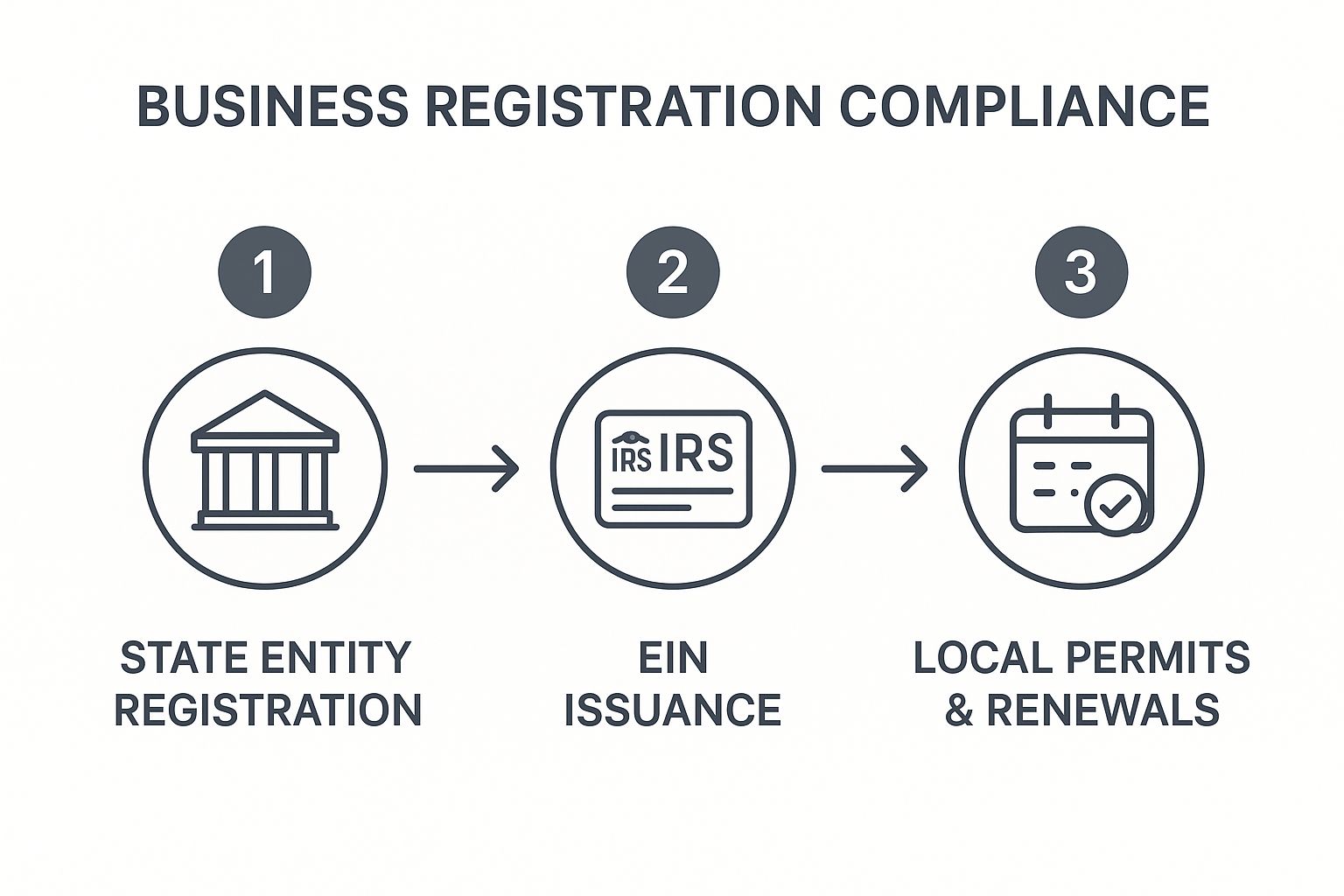
This visual process flow highlights that compliance is not a single action but a sequence of dependent steps, with each stage unlocking the next and requiring ongoing attention.
Actionable Tips for Success
- Start with Your State: Visit your state's Secretary of State website first. It is the primary resource for understanding business entity types and registration requirements.
- Leverage Local Resources: Your local chamber of commerce or Small Business Development Center (SBDC) can provide checklists of required city and county permits.
- Create a Compliance Calendar: Immediately log all license renewal dates in a digital calendar with multiple reminders to prevent costly lapses in authorization.
- Consult Trade Associations: Organizations specific to your industry are invaluable resources for uncovering niche licensing requirements that are easy to miss.
Navigating the complexities of entity formation and ongoing licensing is fundamental to protecting your venture. For guidance tailored to your specific needs, explore our resources on business law.
To ensure your new venture is set up for success and to navigate the complexities of state and local licensing, contact the attorneys at Kons Law at (860) 920-5181 to discuss your business law matter.
2. Tax Compliance and Reporting
Tax compliance encompasses all obligations related to collecting, reporting, and paying federal, state, and local taxes, making it a critical part of any small business compliance checklist. This area requires meticulous handling of income, self-employment, employment, and sales taxes. For small businesses, this means maintaining pristine records, filing accurate returns on time, and ensuring proper tax withholding and remittance to avoid steep penalties, audits, and interest charges from agencies like the IRS.

Why It's a Compliance Priority
Effective tax management is essential for financial stability and legal operation. Small businesses must navigate multiple layers of tax law, from making quarterly estimated tax payments to avoid underpayment penalties to processing bi-weekly payroll taxes if they have employees. Furthermore, sales tax has become increasingly complex since the 2018 Wayfair decision, which established "economic nexus" and requires many online businesses to collect and remit sales tax in states where they have no physical presence.
For example, a freelance graphic designer must proactively calculate and pay quarterly estimated taxes on their income to cover both income and self-employment taxes. Likewise, an e-commerce business selling nationwide may need to register for sales tax permits in over 40 states and stay current with varying tax rates and rules. Failing to manage these duties correctly can lead to significant financial and legal repercussions that jeopardize the business's future.
Actionable Tips for Success
- Use Accounting Software: Implement software like QuickBooks or Xero from day one to accurately track all income and expenses, simplifying tax preparation.
- Segregate Tax Funds: Open a separate business savings account and regularly set aside 25-30% of your gross income to cover future tax liabilities.
- Consult a Professional: Work with a CPA or enrolled agent, especially during your first year or if your business structure is complex. Their expertise can prevent costly errors.
- Maintain Meticulous Records: Keep all receipts and documentation for business expenses organized and accessible for at least seven years, as required by the IRS.
- Master Sales Tax Nexus: Proactively register for sales tax permits in all states where your sales volume or transaction count creates economic nexus.
- File and Pay Electronically: Use the IRS Electronic Federal Tax Payment System (EFTPS) for federal tax payments to ensure timely processing and reliable records.
Properly managing your tax obligations is key to maintaining your business's financial health and ensuring compliant commercial transactions.
If you are facing challenges with tax compliance or need legal guidance on other financial aspects of your business, call the attorneys at Kons Law at (860) 920-5181 to discuss your business law matter.
3. Employment Law Compliance
Employment law compliance involves adhering to the vast web of federal, state, and local regulations that govern the employer-employee relationship. This area of your small business compliance checklist covers everything from fair hiring practices and wage-and-hour laws to workplace safety and proper termination procedures. For small businesses, navigating laws like the Fair Labor Standards Act (FLSA), Americans with Disabilities Act (ADA), and state-specific mandates is crucial, as non-compliance can result in costly lawsuits, audits, and significant penalties.

Why It's a Compliance Priority
From the moment you post a job opening, employment laws apply. These regulations are designed to protect workers from discrimination, ensure fair pay, and provide a safe work environment. Misclassifying an employee as an independent contractor, for example, can lead to back taxes, fines, and benefit-related liabilities. Similarly, failing to pay overtime correctly is a common and expensive mistake. As your business grows and crosses certain employee thresholds (like 50 employees for FMLA coverage), new legal obligations are triggered, making constant vigilance essential.
For instance, a tech startup must correctly classify its developers as either employees or contractors to avoid severe IRS penalties. A retail store in Connecticut must not only adhere to the federal minimum wage but also the state's higher standard, and it must use accurate time-tracking to comply with FLSA overtime rules. These aren't just best practices; they are legal requirements that protect your business from devastating financial and reputational damage.
A Step-by-Step Employment Compliance Workflow
Managing employment law is an ongoing process that begins before an employee is hired and continues long after they leave. It requires a systematic approach to documentation, policy creation, and training to minimize risk at every stage of the employment lifecycle. This structured approach helps ensure fairness, consistency, and legal defensibility.
A proactive workflow includes developing clear job descriptions, conducting fair interviews, properly onboarding new hires with all necessary paperwork (like I-9 forms), implementing clear and consistent policies, and following a documented, legal process for termination. Each step is a critical link in the compliance chain.
Actionable Tips for Success
- Properly Classify Workers: Use the IRS guidelines and your state's "ABC test" to correctly distinguish between employees and independent contractors.
- Display Required Posters: Post all mandatory federal and state labor law posters in a conspicuous area frequented by employees, such as a break room.
- Create a Handbook: Develop a clear, written employee handbook that outlines policies on attendance, conduct, anti-harassment, and discipline, and have it reviewed by legal counsel.
- Document Everything: Maintain meticulous records of performance reviews, disciplinary actions, and any employee complaints. Thorough documentation is your best defense.
- Train Your Managers: Ensure anyone with supervisory duties is trained on anti-harassment, anti-discrimination, and proper disciplinary procedures to prevent costly mistakes.
The complexities of employment law can expose your business to significant litigation risks. For a deeper understanding of how to protect your company, explore our resources on commercial litigation.
To ensure your hiring practices, policies, and workplace procedures are fully compliant, contact the attorneys at Kons Law at (860) 920-5181 to discuss your business law matter.
4. Data Privacy and Security Compliance
Data privacy and security compliance is no longer just a concern for big tech; it's a critical component of every small business compliance checklist. This area involves legally and ethically handling the sensitive customer, employee, and business information you collect. It requires implementing robust cybersecurity measures, being transparent about data collection, respecting consumer rights to their data, and having a plan to respond to breaches as required by a growing web of regulations. Failure to comply can result in steep fines, reputational damage, and loss of customer trust.
Why It's a Compliance Priority
In today's digital economy, data is a valuable asset, and protecting it is a legal mandate. Regulations like the EU's GDPR, California's CCPA/CPRA, and industry-specific rules like HIPAA for healthcare, dictate how you must manage personal information. These laws grant consumers rights over their data, including the right to access, correct, and delete it. Compliance ensures you avoid penalties and demonstrates to customers that you take their privacy seriously, which is a significant competitive advantage.
For example, an e-commerce shop selling to European customers must implement a GDPR-compliant cookie consent banner and have data processing agreements with its vendors. A small medical practice must use HIPAA-compliant software and encrypted communications to safeguard patient health information. Ignoring these obligations can be costly; a local business could face tens of thousands of dollars in fines for failing to honor customer data deletion requests within the legally required timeframes.
A Step-by-Step Data Protection Workflow
Implementing a data privacy program can feel daunting, but it can be broken down into manageable, strategic phases. The process begins with understanding your data landscape, moves to establishing protective controls, and culminates in ongoing monitoring and response planning. This systematic approach transforms compliance from a vague goal into an achievable business process.
A solid workflow ensures that you identify risks, deploy appropriate safeguards, and are prepared to handle incidents, building a resilient data protection framework from the ground up.
Actionable Tips for Success
- Start with a Data Inventory: You can't protect what you don't know you have. Map out all the personal information you collect, where it's stored, how it's used, and who has access.
- Use Privacy Policy Generators: Tools like Termly or TermsFeed provide excellent starting templates for your website's privacy policy. Be sure to customize them to reflect your specific data practices.
- Implement Strong Access Controls: Enforce two-factor authentication (2FA) across all business systems and mandate strong, unique passwords for all employees to prevent unauthorized access.
- Create an Incident Response Plan: Don't wait for a breach to happen. Develop a clear, written plan outlining the steps to take in the event of a data security incident.
- Train Your Team: Conduct annual security awareness training for all employees to educate them on phishing, social engineering, and proper data handling procedures.
Navigating the complexities of data privacy laws is crucial for protecting your business and your customers. To develop a compliant data security strategy and protect your business from liability, call the attorneys at Kons Law at (860) 920-5181 to discuss your business law matter.
5. Occupational Safety and Health (OSHA) Compliance
Ensuring compliance with the Occupational Safety and Health Administration (OSHA) is a core part of any small business compliance checklist, as it involves the legal duty to provide a safe and healthy workplace. This means employers must proactively identify and mitigate workplace hazards, establish safety protocols, provide training, and maintain meticulous records. Failing to meet OSHA standards can result in severe penalties, work stoppages, and reputational damage, making it an essential focus area for businesses across all industries.
Why It's a Compliance Priority
OSHA's primary goal is to prevent workplace injuries, illnesses, and fatalities. To achieve this, the agency sets and enforces standards that require employers to provide a work environment free from recognized serious hazards. This includes everything from ensuring proper machine guarding in a manufacturing plant to providing ergonomic workstations in an office. Compliance also involves critical record-keeping, like maintaining the OSHA 300 Log of work-related injuries and illnesses, and mandatory reporting of severe incidents.
For example, a small construction company in Connecticut must implement robust fall protection systems and provide OSHA-10 training for all workers. Similarly, a dental office must establish strict bloodborne pathogen protocols and conduct annual training for staff. Even a seemingly low-risk warehouse operation could face fines exceeding $150,000 for repeated forklift safety violations and inadequate training, demonstrating that no business is exempt from these crucial safety mandates.
A Step-by-Step OSHA Compliance Workflow
Achieving and maintaining OSHA compliance is an ongoing process of assessment, implementation, and review. It requires a systematic approach to identifying risks specific to your business and putting protective measures in place. This cycle ensures that safety remains a continuous priority rather than a one-time task.
The process involves identifying potential hazards, creating and documenting safety programs, training employees on these procedures, and regularly reviewing their effectiveness. This workflow helps businesses move from a reactive to a proactive safety culture, protecting both employees and the company itself.
Actionable Tips for Success
- Conduct a Hazard Assessment: Use OSHA's free On-Site Consultation Program for small businesses to identify specific workplace hazards without fear of penalties.
- Establish a Safety Committee: Create a committee with employee representatives to help identify and resolve safety concerns, fostering a culture of shared responsibility.
- Document Everything: Keep detailed records of all safety training sessions, equipment inspections, incident investigations, and near-miss reports.
- Maintain OSHA Logs: Diligently keep your OSHA 300 logs updated and remember to post the annual summary (Form 300A) from February 1 to April 30.
- Keep SDS Accessible: Ensure Safety Data Sheets (SDS) for all chemicals used on-site are readily available to all employees.
Managing the complexities of OSHA regulations is critical to protecting your employees and your business from significant liability. For guidance specific to your industry, explore our resources on business law.
To ensure your workplace safety programs meet all legal requirements and to protect your business from potential fines, call the attorneys at Kons Law at (860) 920-5181 to discuss your business law matter.
6. Environmental Compliance
Environmental compliance involves adhering to regulations designed to protect air, water, and land from pollution. For a small business, this means managing waste disposal, emissions, water discharge, and chemical handling according to federal Environmental Protection Agency (EPA) standards and specific state laws. These rules are a critical part of any small business compliance checklist, as non-compliance can result in severe fines, mandated cleanup costs, and operational shutdowns, especially for industries like manufacturing, automotive services, and dry cleaning.
Why It's a Compliance Priority
Environmental regulations are in place to prevent harm to the ecosystem and public health. For a business, compliance is not just about environmental stewardship; it is a fundamental risk management issue. The EPA and state agencies have the authority to levy substantial penalties for violations, even unintentional ones. Proper management of hazardous materials, from chemical storage to waste disposal, protects your business from costly liabilities and reputational damage while ensuring a safe workplace for your employees.
For example, an auto repair shop must meticulously manage and dispose of used oil, antifreeze, and solvents through certified waste haulers. A small manufacturer using spray painting equipment may need an air permit to control emissions. Failure to comply can be disastrous; a printing company that improperly disposes of ink solvents in its regular trash could face over $100,000 in cleanup costs and fines, a financial blow that could easily cripple a small operation.
A Step-by-Step Compliance Workflow
Achieving environmental compliance requires a systematic approach to identifying, managing, and monitoring regulated materials and processes. This workflow moves from initial assessment to ongoing management and training, ensuring that your business operations remain within legal environmental limits. It is a continuous cycle of evaluation and improvement.
A typical workflow involves first identifying all potential pollutants and regulated activities at your facility. The next step is to implement control measures and proper disposal procedures. Finally, ongoing employee training and meticulous record-keeping ensure that compliance is maintained day-to-day, protecting your business from unforeseen violations and liabilities.
Actionable Tips for Success
- Identify Your Waste: Start by determining if your business generates any materials on the EPA's list of common hazardous wastes to understand your obligations.
- Obtain an EPA ID: If you generate any amount of hazardous waste, you must obtain an EPA identification number before you transport, treat, store, or dispose of it.
- Use Licensed Haulers: Always contract with licensed, reputable waste management companies for disposal and keep all manifests and records for at least three years.
- Label and Store Properly: Ensure all hazardous waste containers are clearly labeled, dated, and stored according to federal and state requirements to prevent leaks and fines.
- Train Your Team: Conduct regular training for all employees who handle chemicals or waste, ensuring they understand proper procedures and safety protocols.
- Audit Your Operations: Use resources like the EPA's Small Business Gateway to perform a self-audit and identify potential areas of non-compliance before they become a problem.
Navigating the complexities of federal and state environmental laws is essential to protect your business from significant financial and legal risk. For guidance tailored to your specific operational needs, explore our resources on business law.
If you need assistance understanding your environmental obligations or developing a compliant waste management plan, call the attorneys at Kons Law at (860) 920-5181 to discuss your business law matter.
7. Industry-Specific Regulatory Compliance
Beyond foundational business laws, industry-specific compliance involves a layer of specialized regulations tailored to your particular sector. These rules are designed by government agencies and professional boards to protect consumers, ensure safety and quality, and maintain market integrity. Failing to adhere to these targeted mandates can result in severe consequences, including hefty fines, loss of professional licensure, and business shutdown, making this a critical component of any small business compliance checklist.
Why It's a Compliance Priority
General business compliance ensures your company operates legally, but industry regulations govern how you conduct your core business activities. These rules are non-negotiable and often dictate everything from your operational procedures and employee qualifications to your marketing claims and data handling practices. This level of oversight is most common in sectors with high public impact, such as healthcare, finance, food service, and transportation, where non-compliance poses a direct risk to public health, safety, or financial well-being.
For example, a financial advisory firm in Connecticut must comply with SEC and FINRA regulations, including fiduciary standards and disclosure requirements, to protect investors. Likewise, a local craft brewery must navigate complex federal (TTB) and state laws for formula approvals, labeling, and distribution. A childcare center must adhere to strict state licensing rules for staff-to-child ratios, background checks, and facility safety. Each of these businesses faces a unique set of rules essential for its legal operation.
A Step-by-Step Compliance Workflow
Successfully managing industry regulations requires a proactive, systematic approach. The process starts with identifying all applicable agencies, understanding their specific rules, implementing compliant procedures, and maintaining rigorous documentation for audits and inspections. This is an ongoing cycle, not a one-time task, as regulations frequently evolve.
The compliance journey involves identifying your sector’s governing bodies, implementing required operational controls, and committing to continuous monitoring and training to stay current with any changes.
Actionable Tips for Success
- Join Industry Associations: Trade associations are invaluable resources that provide compliance updates, checklists, and training specific to your sector.
- Subscribe to Agency Newsletters: Sign up for email updates from key regulatory bodies like the FDA, SEC, or your state’s professional licensing board to receive direct information on rule changes.
- Conduct a Compliance Audit: Before launching or when acquiring a business, perform a thorough audit to identify all applicable industry regulations and assess your current level of compliance.
- Create a Documentation System: Maintain organized digital and physical records for permits, licenses, training certifications, and inspection reports to ensure you are always ready for an audit.
Navigating the dense web of industry-specific regulations is crucial for long-term viability and risk management. For guidance tailored to your specific sector, professional legal counsel is indispensable.
To ensure your business fully complies with the unique regulations of your industry, call the attorneys at Kons Law at (860) 920-5181 to discuss your business law matter.
8. Insurance and Risk Management Compliance
Securing and maintaining the right insurance is a critical component of your small business compliance checklist, serving as a financial shield against unforeseen liabilities and operational risks. This involves obtaining legally mandated coverage, such as workers' compensation, and strategically acquiring policies that protect against industry-specific threats. Failing to comply with insurance requirements can result in severe financial penalties, lawsuits, and even business closure, making it an essential safeguard for your company's longevity.
Why It's a Compliance Priority
Insurance compliance is not just about following rules; it's about robust risk management that protects your business, employees, and customers. States legally require businesses with employees to carry workers' compensation insurance, and commercial auto insurance is mandatory for any vehicles used for business purposes. Furthermore, many client contracts and commercial leases will explicitly demand that you maintain specific types and levels of general liability insurance.
For example, a Connecticut-based construction company must carry workers' compensation for its crew, commercial auto insurance for its trucks, and general liability coverage often exceeding $2 million to meet contractual obligations. Similarly, a marketing consultant must have professional liability (or errors and omissions) insurance to protect against claims of negligent advice that causes a client financial harm. These policies ensure that a single accident, mistake, or lawsuit doesn't bankrupt an otherwise healthy business.
A Step-by-Step Risk Management Workflow
Implementing a compliant insurance program is a systematic process that aligns legal requirements with your specific business risks. The approach involves identifying mandatory coverage first, then assessing operational vulnerabilities to layer on additional protections, and finally establishing a system for ongoing policy management and review.
This process ensures you are not only compliant but also adequately protected as your business evolves. It moves from foundational, legally required policies to strategic coverages that support long-term stability and growth.
Actionable Tips for Success
- Verify State Mandates: Start by confirming your state’s specific workers' compensation laws, as thresholds for required coverage vary significantly.
- Review Your Contracts: Scrutinize all client agreements and commercial leases to identify the minimum insurance coverages and limits you are contractually obligated to maintain.
- Conduct Annual Reviews: As your business grows, so do your risks. Schedule an annual review with an insurance broker to ensure your coverage levels keep pace with new services, increased revenue, and larger staff.
- Understand Policy Exclusions: Be aware of what your policies do not cover. A standard general liability policy, for instance, will not protect you from a professional error or a data breach.
- Document Everything: Keep detailed records of your safety programs and employee training, as a strong safety record can help lower your insurance premiums over time.
Properly managing insurance and other liabilities is key to financial health, especially when dealing with commercial agreements and potential disputes. For more information on managing financial obligations, explore our resources on creditors' rights.
To ensure your business has the right insurance coverage and a comprehensive risk management strategy in place, call the attorneys at Kons Law at (860) 920-5181 to discuss your business law matter.
Small Business Compliance Checklist Comparison
| Compliance Area | Implementation Complexity | Resource Requirements | Expected Outcomes | Ideal Use Cases | Key Advantages |
|---|---|---|---|---|---|
| Business Registration and Licensing | Moderate (varies by jurisdiction and industry) | Fees for registration, licenses; legal and administrative time | Legal business operation authorization; liability protection; access to banking and hiring | New businesses; industries needing permits and licenses | Establishes legal identity; enables hiring; builds credibility |
| Tax Compliance and Reporting | High (complex, ongoing deadlines) | Accounting software; possible CPA fees; time for recordkeeping | Avoidance of penalties; accurate tax filing; financial credibility | All businesses with tax obligations | Avoids fines; maximizes deductions; builds financial trust |
| Employment Law Compliance | High (complex laws varying by state) | HR support or outsourced services; training time; documentation | Legal workforce management; reduced litigation risk; improved morale | Businesses with employees | Reduces lawsuits; ensures fair treatment; boosts reputation |
| Data Privacy and Security Compliance | High (technical and regulatory complexity) | Investment in IT security; training; legal consultation | Protection of sensitive data; regulatory compliance; enhanced customer trust | Businesses handling personal or sensitive data | Prevents breaches; avoids fines; builds customer confidence |
| Occupational Safety and Health (OSHA) Compliance | Moderate to high (industry specific) | Safety equipment; training; recordkeeping time | Safer workplace; reduced injuries; compliance with law | Workplaces with physical risks or hazards | Lowers injury costs; boosts morale; avoids citations |
| Environmental Compliance | Moderate to high (industry and activity dependent) | Permitting costs; waste disposal; training | Environmental protection; compliance with EPA/state laws; risk reduction | Businesses with emissions, waste, or chemical use | Protects environment; avoids fines; enhances reputation |
| Industry-Specific Regulatory Compliance | Very high (specialized, varies widely) | Specialized expertise; licensing; audits; legal fees | Compliance with sector rules; maintained licenses; consumer protection | Heavily regulated sectors (healthcare, finance, food) | Ensures quality and safety; protects consumers; limits competition |
| Insurance and Risk Management Compliance | Moderate (varies by coverage needs) | Insurance premiums; broker fees; annual reviews | Financial protection against risks; legal compliance; business continuity | Businesses with employees, vehicles, or professional liability | Protects assets; required by law/contracts; peace of mind |
Turn Your Checklist into Action with Expert Legal Guidance
Navigating the complexities of business compliance can feel like a monumental task. This comprehensive small business compliance checklist has provided a structured roadmap, breaking down your obligations across critical areas from initial business registration and tax reporting to nuanced employment laws and industry-specific regulations. We've explored the foundational pillars necessary for a legally sound operation, covering everything from OSHA and data privacy to essential insurance and risk management protocols.
The key takeaway is that compliance is not a one-time event; it is an ongoing, dynamic process. It requires vigilant monitoring, proactive management, and a deep understanding of how local, state, and federal laws apply to your unique business context. Simply having a checklist is the first step; the real value lies in its consistent and correct implementation.
From Checklist to Confident Compliance
The transition from a passive list to an active strategy is where many businesses falter. The regulations discussed, such as those governed by FINRA for financial advisors or specific environmental statutes for manufacturing firms, are not static. They evolve with new legislation, court rulings, and administrative guidance. This constant change underscores the immense value of transforming your compliance checklist from a document into a living, breathing part of your business operations.
Mastering these concepts is not just about avoiding fines or penalties. It is about building a sustainable, resilient, and reputable enterprise. A strong compliance posture enhances your brand, builds trust with customers and partners, and protects your assets from unforeseen liabilities. For lenders, trade creditors, and investors, a company’s dedication to compliance is a direct indicator of its operational integrity and long-term viability. It's the bedrock upon which stable growth is built.
Your Actionable Next Steps
To truly secure your company's future, consider the following immediate actions:
- Conduct a Self-Audit: Use the sections of this article as a guide. Go through each category, from tax filings to data security policies, and honestly assess where your business stands. Identify potential gaps or areas of uncertainty.
- Assign Responsibility: Compliance cannot be an afterthought. Designate a specific person or team, even within a small organization, to own the compliance function. This ensures accountability and consistent oversight.
- Document Everything: Create a central repository for all compliance-related documentation. This includes licenses, permits, employee records, safety logs, and tax filings. Proper documentation is your first line of defense in an audit or legal dispute.
- Seek Professional Guidance: The most crucial step is recognizing when you need expert help. The legal landscape is too intricate for a one-size-fits-all approach. Consulting with a seasoned business attorney can help you interpret regulations correctly, customize your compliance framework, and address specific challenges before they escalate.
Don't let compliance ambiguities leave your business vulnerable. A proactive legal strategy is one of the smartest investments you can make in your company's long-term success and security. Whether you are forming a new entity, navigating a commercial dispute, seeking to enforce a judgment, or require specialized counsel for FINRA arbitration, having an expert in your corner is indispensable.
To ensure your business is built on a solid legal foundation and to translate this small business compliance checklist into a robust, actionable plan, call the experienced attorneys at Kons Law at (860) 920-5181 to discuss your business law matter today.
