
A senior vice president at a registered investment adviser writes a $5,000 personal check to a state treasurer campaigning for governor. Within weeks, the firm starts bidding on a $400 million state pension mandate. The executive may view the contribution as ordinary political participation, and nobody may have discussed the pension contract. The pay to play rule can still create a serious business problem.
For advisers and broker-dealers, the immediate issue isn't whether the contribution looked corrupt. It's whether the firm has controls that identify covered people, stop prohibited activity, preserve reliable records, and prevent compensation during a restriction period. That remains the practical reality even after the SEC proposed rescinding its federal investment adviser rule in September 2026.
What the Pay to Play Rule Actually Stops
The rule works mechanically
SEC Rule 206(4)-5 is a prophylactic restriction, not a bribery test. Under the current rule, an investment adviser generally cannot provide compensated advisory services to a government client for two years after a covered political contribution. The SEC adopted the rule on June 30, 2010, and announced it in September 2010 to address contributions used to influence public pension and other government investment mandates, as described in the SEC's adoption release for Rule 206(4)-5.
The firm does not need to win the mandate for the issue to arise. A contribution can restrict compensation from the relevant government entity even if the executive intended no influence, the official had no role in selecting the adviser, or the firm loses the bid. The rule interrupts the revenue stream without requiring enforcement staff to prove a bribe or an agreed exchange.
That makes the rule different from traditional antifraud provisions, which generally address misleading conduct, material omissions, deceptive schemes, or improper exchanges. Rule 206(4)-5 focuses earlier on incentive and appearance risk. A lawful contribution can still prevent the adviser from receiving compensation.
Practical rule: Treat every political contribution by a potentially covered person as a business event until compliance clears it, not as a private matter outside the firm's risk system.
What the two-year restriction means
The restriction concerns compensated advisory services for the government entity connected to the covered official. Depending on the facts and the government's role, it may affect an existing mandate, a proposed engagement, or the firm's ability to keep collecting fees. The analysis requires more than checking whether the contribution was personal. Compliance must identify the contributor, the official, the government entity, and the relevant advisory relationship.
The SEC proposed rescinding Rule 206(4)-5 and related recordkeeping provisions on September 3, 2026. The proposal does not remove current obligations. The SEC states that the rule remains applicable unless and until a final rescission is adopted and becomes effective, as explained in its September 2026 proposal announcement. Until then, the existing two-year restriction governs conduct.
Keep pre-clearance, contribution logs, covered-associate reviews, and solicitation controls active this quarter. A pending proposal does not provide a safe harbor, particularly while advisers prepare for a potential repeal ahead of the 2026 midterms.
How the Rule Evolved From MSRB G-37 to Rule 206(4)-5
The modern investment adviser rule grew from an earlier municipal finance response. MSRB Rule G-37 took effect in 1994, targeting pay to play in the municipal securities industry. Its structure used a bright-line $250 de minimis contribution threshold and could impose a two-year underwriting ban on covered firms after contributions above the threshold, according to the historical account summarized in Reuters' review of the SEC pay to play rule.
That history explains why Rule 206(4)-5 feels stricter than an ordinary conflict policy. Municipal underwriting and public pension mandates are recurring government relationships. Regulators were concerned that elected officials could steer those mandates toward contributors instead of pursuing value for taxpayers, beneficiaries, or public employees. The SEC carried that logic into investment advisory services after earlier scandals involving public investment business and political influence.
One regulatory idea, several industry settings
The SEC adopted Rule 206(4)-5 in 2010 under the Investment Advisers Act framework. The rule translated the municipal market's time-out concept into a system for advisers seeking government clients, including public pension funds and other public entities. Its compliance dates were phased. Adoption occurred in mid-2010, the rule became effective September 13, 2010, and major restrictions took effect March 14, 2011, giving firms time to redesign controls.
The framework also expanded beyond a personal check delivered directly to an officeholder. Third-party solicitors and placement agents became part of the risk analysis, and broker-dealer obligations developed alongside the adviser regime. FINRA and MSRB rules address related fundraising and solicitation concerns in the securities markets.
For firms handling a SEC investigation involving securities activity, the institutional history matters because it shows why regulators may view weak controls as more than an isolated administrative error. The pay to play rule was built as an anti-corruption safeguard, and its mechanics remain binding while the 2026 rescission proposal is pending.
The September 2026 proposal places that history in uncertainty, but uncertainty doesn't suspend the rule. Firms should manage today's obligations while preparing for a possible change in the federal framework.
Who the Rule Covers and What Triggers the Two-Year Ban
Coverage starts with the people who can influence government business
The rule applies to registered investment advisers and exempt reporting advisers that solicit government clients. It can also reach general partners, managing members, executives, and other covered associates who solicit government entities, supervise those activities, or have a role that can influence the engagement.
A triggering contribution isn't limited to a campaign check. The SEC's FAQ describes contribution-related restrictions involving gifts, loans, advances, deposits, or anything of value made to influence an election. The rule can also reach payments made through third parties for an official's benefit. The SEC's pay to play FAQ explains the regulated-person structure for third-party solicitation.
A small personal contribution can therefore matter. The compliance question isn't only how much was given. It also includes who gave it, which official received it, which government entity the official can affect, when the contribution occurred, and whether the firm is receiving compensation from that entity.
Third-party channels create separate control problems
An adviser generally can't pay a person to solicit a government entity for advisory business unless that person is a regulated person. The category includes an SEC-registered investment adviser, a registered broker-dealer subject to comparable restrictions, or a registered municipal adviser subject to MSRB pay to play rules.
Placement agents and solicitors should be reviewed before they contact a public pension or other government client. A firm that outsources the conversation hasn't outsourced the regulatory exposure. Contract language, certification procedures, contribution representations, and ongoing monitoring should match the actual work the intermediary performs.
| Covered Person | Triggering Conduct | Resulting Bar |
|---|---|---|
| Covered associate | Political contribution to a covered official or candidate | Two-year restriction on compensated advisory services to the affected government entity |
| Solicitor or placement agent | Soliciting government advisory business without qualifying as a regulated person | Adviser can't pay the person for that solicitation |
| Adviser personnel with government-client responsibilities | Contribution or other item of value connected to an election | Compliance review, possible time-out, and related disclosure obligations |
| Broker-dealer personnel involved in fundraising or solicitation | Political activity handled without adequate supervision | Separate supervisory and pay to play exposure under applicable FINRA rules |
The rule's practical effect is simple. A contribution can impair the firm's relationship with the government entity even without proof that anyone intended to trade political support for business. Firms building or revising their RIA compliance program should map the rule to actual reporting lines, sales responsibilities, and third-party arrangements.
Exemptions and Edge Cases Worth Knowing
The exemptions don't eliminate the need for review. They narrow specific situations, and a firm that applies them casually can turn a defensible exception into an incomplete file.
Small contributions still need a decision
The rule includes a de minimis exception commonly discussed at $350 for a person who can vote for the candidate and $1,000 when the person can't vote for the candidate, subject to the rule's conditions. The contribution must stay within the applicable limit. Once the covered associate exceeds the relevant cap, the exception disappears and the firm must assess the resulting restriction.
Other exceptions can apply when the contributor is the only candidate on the ballot or when the person contributes to their own campaign. The regulated-person exception also matters for certain solicitation arrangements involving other investment advisers. Those provisions are fact-dependent, so the approval record should identify the precise exception and the facts supporting it.
Volunteer activity deserves separate treatment. Rule 206(4)-5(b)(3) contains a carve-out for certain uncompensated volunteer services. That doesn't mean every campaign activity is harmless. A volunteer who also solicits government advisory business, coordinates fundraising, or uses firm resources may create a different analysis.
Indirect support is where files often become thin
A direct check is easy to spot. PAC donations, party committee activity, bundled fundraising, trade association payments, and third-party solicitation require more investigation. A payment to an organization may carry risk if the organization passes money to officials or uses the funds in a way that effectively supports a covered candidate.
Joint accounts and spousal contributions also deserve a written position. The firm should determine who made the contribution, whose funds were used, whether the contributor is a covered associate, and whether the recipient can influence the government relationship. An official outside the person's immediate jurisdiction can still matter if that official has authority or practical influence over the public fund.
| Exemption / Edge Case | What It Permits | Where Risk Hides |
|---|---|---|
| De minimis contribution | A contribution within the applicable voting and amount conditions | The cap can be exceeded through multiple contributions or combined activity |
| Only candidate on the ballot | A contribution in the limited circumstance covered by the rule | Election status and ballot facts must be verified when the contribution occurs |
| Personal candidacy | Certain contributions made on the contributor's own behalf | The exception doesn't excuse unrelated contributions or solicitation conduct |
| Volunteer service | Certain uncompensated campaign work | Solicitation, reimbursement, or use of firm resources can change the analysis |
| Regulated-person solicitation | Payment to a qualifying regulated solicitor | The intermediary's registration and comparable restrictions must be confirmed |
| PAC or bundled activity | Political support routed through an organization | Indirect influence, coordination, and inadequate tracing can create exposure |
| Joint or spousal account | Contribution may be attributable to a particular account holder | Ownership, authorization, and covered-associate status can be unclear |
For broker-dealers, the adviser rule is only one part of the assessment. FINRA's related framework, including Notice to Members 07-50, can still govern fundraising and supervisory issues even where a particular adviser-rule exception appears available.
Recordkeeping Disclosure and Day-to-Day Compliance
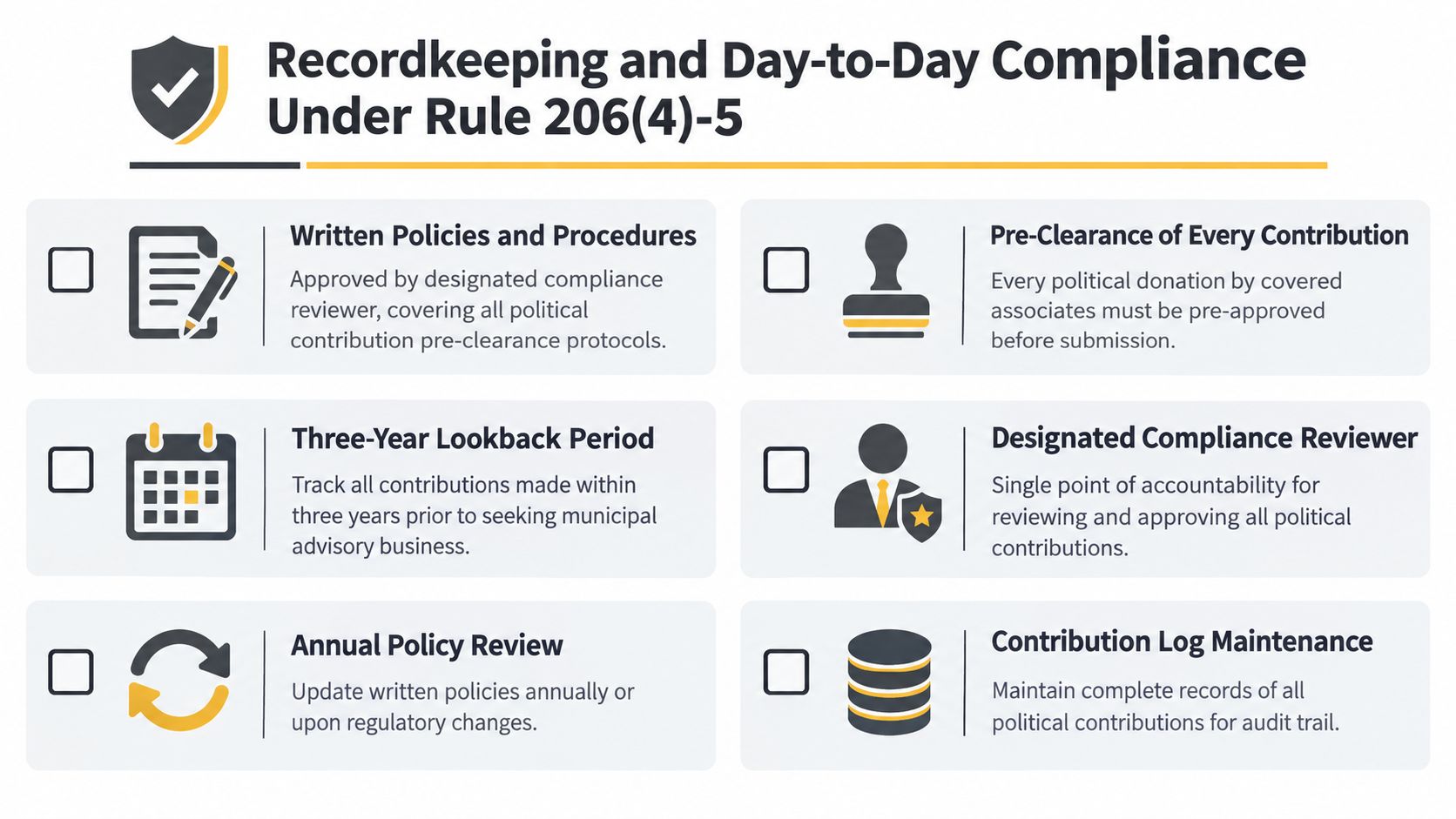
A policy that says “obtain approval before contributing” isn't a functioning program unless employees can use it quickly and compliance can reconstruct the decision later. The strongest programs centralize the request, identify the recipient and office, check the government-client map, and preserve the approval before the contribution is made.
Build a workflow that creates evidence
Use a single request system rather than email chains and informal messages. The request should capture:
- Contributor identity: Record the person's title, covered-associate status, business unit, and reporting line.
- Recipient details: Identify the official or candidate, office sought, government entity, jurisdiction, and campaign committee.
- Contribution facts: Preserve the amount, date, funding source, and whether the payment is direct or routed through another organization.
- Business connection: Note current government clients, pending solicitations, public pension opportunities, and the contributor's role in those relationships.
- Approval record: Identify the reviewer, decision, exception relied on, conditions imposed, and date of approval.
A centralized contribution log should allow compliance to search by contributor, official, entity, jurisdiction, and lookback period. It should also reconcile against expense reports, PAC records, political activity disclosures, and solicitor certifications. A log that captures only checks sent from the firm's account won't identify personal, spousal, bundled, or third-party activity.
The record-retention framework under Rule 204-2 requires retention for five years, with the first two years maintained in an appropriate office, as reflected in record retention guidance for regulated businesses. Form ADV disclosure also matters. Item 5 of Schedule 1 requires relevant disclosure updates within 90 days of fiscal-year end, so compliance should assign ownership rather than treating the filing as an afterthought.
Give broker-dealers a parallel control path
Broker-dealers should connect pay to play reviews to FINRA Rule 3110 supervisory systems. Separate tracking may be needed for solicitation activity, political fundraising, solicitation letters, placement-agent contacts, and related approvals. The system should identify who approved the activity and what information the reviewer considered.
For advisers and broker-dealers, a workable monthly rhythm looks like this:
- Pre-clear proposed contributions and covered political activity.
- Log approved and rejected requests, including exceptions.
- Attest through partners, officers, and supervised persons.
- Reconcile the log against financial and political activity records.
- Test a sample of files and remediate gaps promptly.
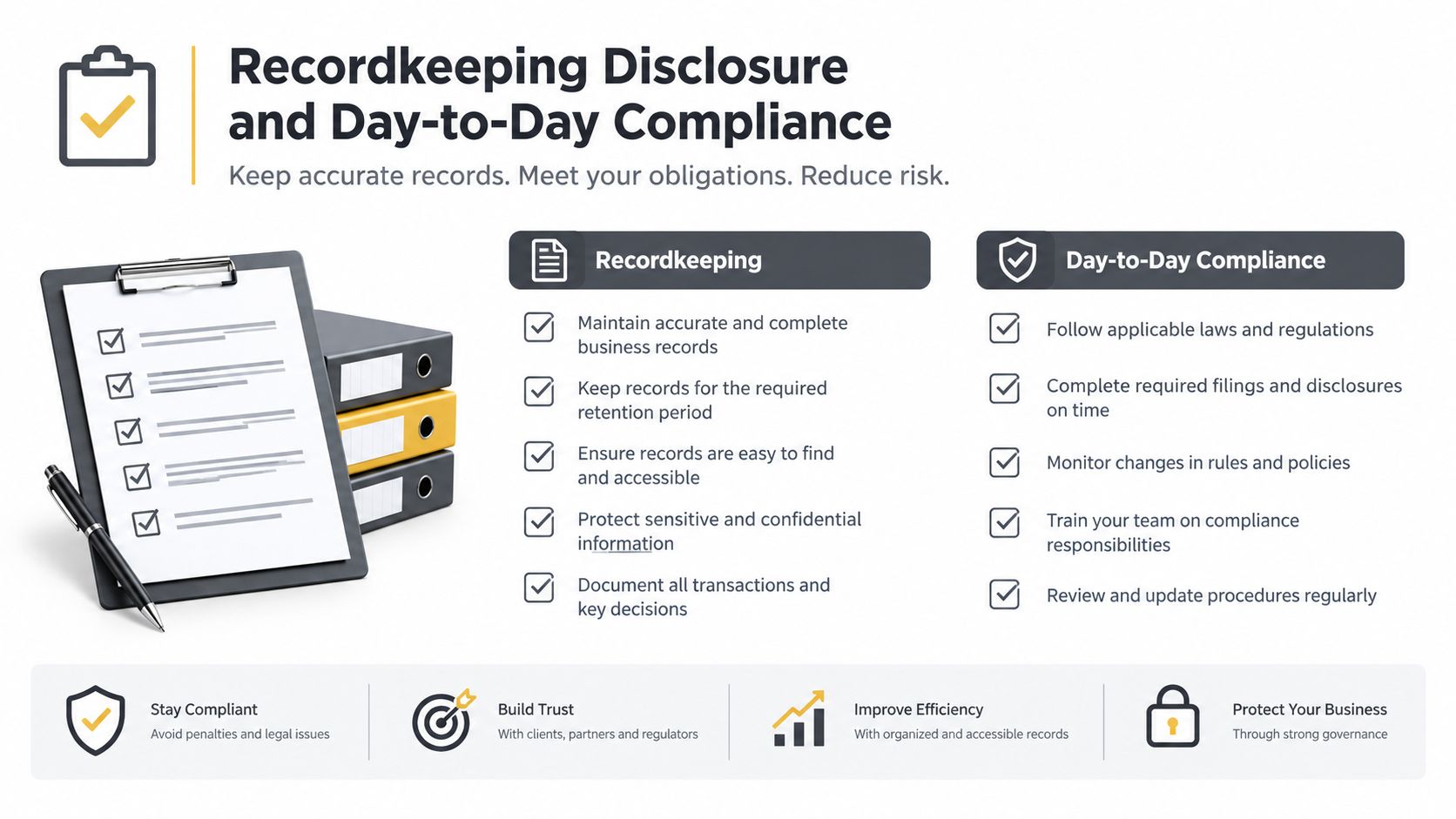
The objective isn't paperwork for its own sake. It's proof that the firm had a functioning process before an examiner asks why a contribution reached a covered official.
Enforcement Trends and the Cost of Getting It Wrong
A contribution can become an enforcement matter when the firm receives compensation during a restriction period or cannot show a credible review process. An inquiry may start with one political payment, then expand into covered-associate classifications, client relationships, third-party solicitors, records, supervision, and compliance certifications.
The SEC has pursued advisers that failed to pre-clear contributions or accepted advisory fees during a two-year time-out. A firm can also face direct exposure when a placement agent or another intermediary connects political activity to government business. Outsourcing the contact does not automatically transfer responsibility.
The financial remedy is only one part of the problem
SEC resolutions may include civil penalties, disgorgement of advisory fees received during a prohibited period, and consequences for individuals. Some firm penalties have reached seven figures, as reflected in SEC enforcement actions involving pay-to-play matters. The practical damage may exceed the payment itself if a public pension relationship is lost, a mandate is rebid, or a government client questions the adviser's integrity.
Broker-dealers face a parallel concern under FINRA supervision rules and related notices. FINRA may examine whether the firm maintained reasonable supervisory systems for political fundraising, solicitation letters, and employee activity. A written policy without testing, escalation, or documented review offers little protection against a supervisory-failure theory.
A regulator rarely sees the isolated check first. The regulator sees the check, the missing approval, the stale policy, the unexplained fee, and the manager who can't identify who reviewed the transaction.
Early response affects the shape of the matter
The SEC often uses a charge-and-settle posture in administrative matters. After receiving an inquiry, the firm should preserve records, stop informal discussion of the issue, identify potentially affected government relationships, and coordinate its response before producing inconsistent accounts. The Wells process can create further demands, particularly when staff identifies recurring control failures instead of one isolated mistake.
Chief compliance officer certifications can create additional pressure under Rule 206(4)-7. A certification or annual review based on stale procedures, incomplete testing, or an inaccurate covered-associate list may become part of the enforcement record. A contemporaneous file should show what the firm knew, what it checked, what it escalated, and why it reached its decision.
That file also matters while the SEC's proposed rescission remains unresolved. Until a final rescission becomes effective, advisers and broker-dealers should preserve current controls, document exceptions, and prepare for scrutiny during the transition. A potential repeal may change the future rulebook, but it does not erase today's evidence.
Why the 2026 Rescission Proposal Changes Your Playbook
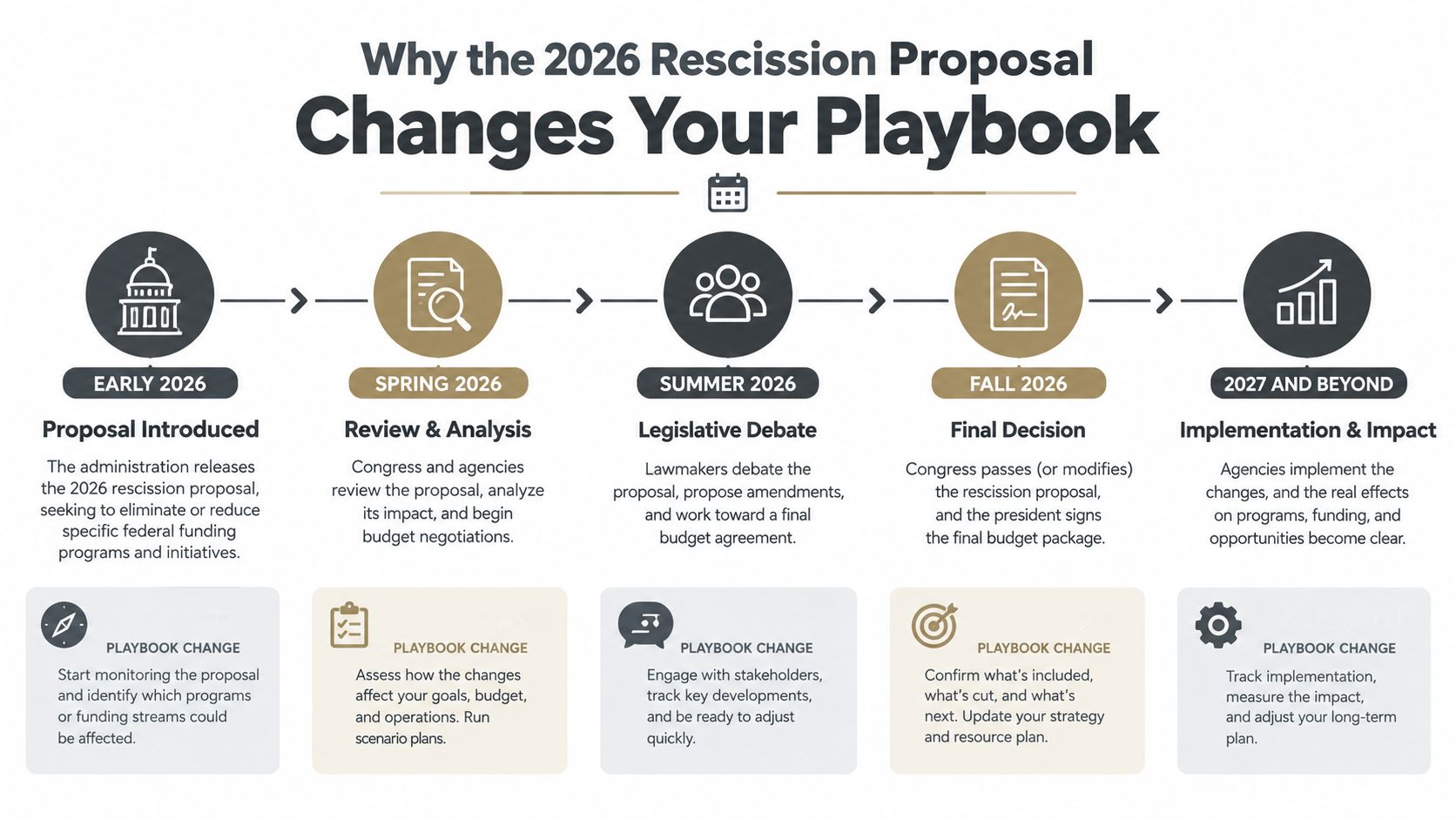
The SEC's September 2026 proposal would rescind Rule 206(4)-5 in its entirety, along with related recordkeeping provisions. It is a proposal, not an effective repeal. The rule remains enforceable unless the SEC adopts a final rescission and that rescission becomes effective, a point reinforced in the SEC Chair's statement on the proposal.
A proposal doesn't change today's controls
An investment adviser shouldn't stop pre-clearance because a proposed rule may disappear. It shouldn't delete contribution logs, loosen solicitor certifications, or tell employees that political activity is no longer relevant. One legal update notes that advisers should expect the current rule to remain in force through the November 2026 midterm elections if the proposal hasn't been finalized, as explained in WilmerHale's analysis of the rescission proposal.
The timing creates a dual-track program:
- Operate under current law: Maintain Rule 206(4)-5 controls, MSRB G-37 procedures where applicable, and broker-dealer supervision.
- Monitor the rulemaking: Track SEC releases, comments, final action, effective dates, and any litigation or court challenge.
- Prepare for divergence: Review state and local restrictions, contractual representations, client procurement rules, and independent industry obligations.
- Preserve the record: Keep existing records long enough to address examination questions and pending matters.
The SEC's stated rationale is that the rule may be overly prescriptive and difficult to administer. That doesn't mean the underlying risk disappears. Antifraud duties, fiduciary duties, codes of ethics, procurement rules, and state pay to play laws can continue to constrain political activity even if the federal adviser rule is rescinded.
The election calendar increases the pressure
The 2026 midterms create a practical deadline for firms that serve public clients. Fundraising requests may arrive through executives, government affairs personnel, public-sector sales teams, PACs, party committees, and placement agents. The closer a contribution is to a government decision, the more important it becomes to document the business context and the approval path, even when the federal rule's future is uncertain.
A final rescission would change the federal adviser rule's status only after the required rulemaking process is complete and effective. It wouldn't automatically repeal state statutes, local ordinances, FINRA requirements, MSRB restrictions, or the firm's own contractual commitments. The sensible playbook is to preserve controls that protect against those overlapping risks while removing or redesigning federal-only requirements only after the legal change is final.
Practical Next Steps and When to Call Counsel
A contribution request arrives from a senior employee while a public client is considering a contract. The employee wants to respond immediately. Your process should make the answer clear: pause, obtain pre-clearance, check the covered-person and government-entity connection, and preserve a record that an examiner can understand without interviewing everyone involved.
A 30-60-90 day plan
During the first 30 days, confirm the foundation. Locate the current written policy, identify the compliance reviewer, map covered associates, and list government clients and pending solicitations. Test whether the pre-clearance form asks about personal contributions, joint accounts, spouses, PACs, bundling, and third-party activity. The process should also state what happens when the SEC's proposed September 2026 rescission remains pending.
During the next 60 days, test the data. Compare the contribution log with expense records, PAC activity, political disclosures, and solicitor certifications. Confirm that the firm can identify the recipient's office, jurisdiction, government-entity connection, date, amount, and approval. Refresh training for partners, officers, public-sector sales personnel, government affairs staff, and supervisors involved in solicitation.
By 90 days, reconcile overlapping law. Compare the federal program with state and local requirements in California, New York, New Jersey, and Texas. Those jurisdictions may use different restrictions, disclosure rules, covered persons, lookback periods, or procurement consequences. A federal repeal would not resolve those obligations.
Escalate before the file becomes an investigation
Call outside counsel promptly if a contribution to a covered official is flagged, required pre-clearance was missed, or a fee may have been received during a restriction period. Consider engaging a regulatory compliance attorney to preserve evidence and assess disclosure. Escalate the same way after an SEC or FINRA document request, a state attorney general subpoena, or a message suggesting that a placement agent or solicitor crossed a line.
Counsel can preserve evidence, direct an internal investigation, evaluate a voluntary self-report, answer a deficiency letter, and defend an inquiry involving SEC investment adviser staff, an FCPA unit, or FINRA. Early decisions about scope, privilege, interviews, remediation, and disclosure can affect penalty exposure more than the contribution itself.
For financial advisers, an improvised response creates avoidable risk. Employees may delete messages, business teams may give inconsistent explanations, and compliance may discover that the written policy never matched the approval process. Keep facts separate from assumptions, maintain the controls that protect against overlapping law, and revisit federal-only procedures only if a rescission becomes final.
If you want to discuss your business law matter, contact Kons Law at (860) 920-5181. The firm advises financial professionals and businesses on regulatory inquiries, internal investigations, compliance programs, and securities disputes. Visit Kons Law before a contribution, document request, or public-client issue becomes harder to contain.
