Your former firm has sent a repayment demand, and you disagree with the explanation it placed on your Form U5. You're trying to move your practice forward while counsel asks for agreements, compensation records, and termination correspondence. Before either side commits to broad discovery, early neutral evaluation may help answer a more useful question than whether everyone is ready to settle: which parts of this dispute deserve the time and expense of litigation?
When an Advisor First Meets Early Neutral Evaluation
Consider a hypothetical advisor who leaves a broker-dealer after a disputed termination. The firm demands repayment of an upfront loan. The advisor believes the firm withheld earned compensation and described the departure inaccurately. Each side sees a straightforward case, but they're relying on different documents and different assumptions.
The firm focuses on the signed note. The advisor focuses on the circumstances of termination, compensation promises, and the disputed Form U5 narrative. Before discussing settlement, counsel needs to separate those issues rather than treat the entire relationship as a single grievance.
ENE enters the conversation when an independent assessment could change a litigation decision. Counsel might propose that a neutral examine the repayment language, the evidence supporting the termination explanation, and the compensation calculation. The objective is to identify what can be assessed now and what requires additional evidence.
Recognize the decision point
The right question isn't whether the dispute feels serious enough for ENE. It's whether counsel can identify a concrete question for the evaluator:
- Form U5 language: Which specific statement is disputed, and what contemporaneous evidence supports or contradicts it?
- Loan repayment: Does the proposed defense address the actual contractual obligation, or merely explain why the advisor considers repayment unfair?
- Compensation: Are the parties disagreeing about entitlement, the calculation, or both?
- Termination: Which facts connect the employment decision to the advisor's asserted legal claim?
A neutral shouldn't be asked to reconstruct an entire career from an unorganized document dump. Counsel should define the disputed decisions before selecting the process.
For an advisor in Connecticut, that means considering the employment dispute, contractual forum provisions, and any parallel regulatory matter together. An ENE proposal shouldn't assume that a broker-dealer, FINRA, or the CFP Board will treat every issue as part of the same proceeding.
Keep the scope manageable
A broader business dispute resolution strategy can help counsel decide whether evaluation belongs before negotiation, after a targeted document exchange, or alongside an existing case.
Practical rule: Don't commission an evaluation of everything. Identify the uncertainty that could change what you do next.
ENE is less useful if the advisor wants vindication without confronting adverse documents, or the firm wants a neutral to repeat its demand. Both sides need a question worth answering, not another occasion to deliver opening statements.
What Early Neutral Evaluation Actually Is
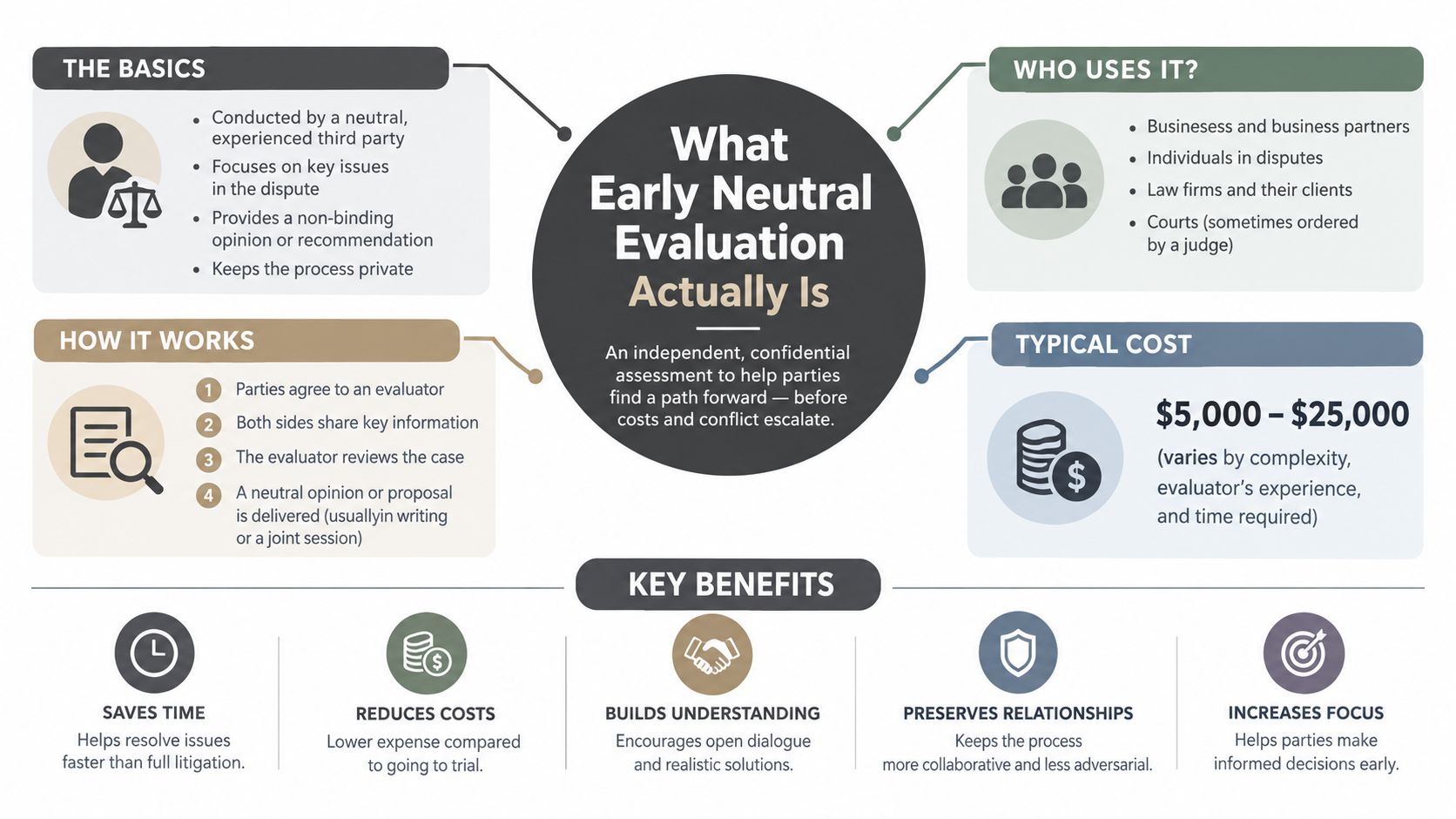
Early neutral evaluation is a structured, nonbinding assessment of a dispute by an experienced neutral. Its defining contribution is a reasoned appraisal of the parties' positions, rather than a decision imposed on them or a demand that they negotiate immediately.
Its origins matter. During the early 1980s, Chief Judge Robert Peckham commissioned a task force of approximately 20 lawyers in the United States District Court for the Northern District of California to address civil-litigation expense and crowded calendars. The court introduced ENE experimentally in 1985, expanded it to 100 cases in 1986, and made it permanent in 1988, according to the historical account of ENE's development.
The design was deliberately diagnostic. Parties would receive candid feedback before they spent heavily developing positions that an experienced outsider might find incomplete or unpersuasive.
Understand the design choices
The foundational model combines several features:
- Early timing: The evaluation should inform litigation choices while counsel can still adjust them.
- Neutral expertise: The evaluator examines legal and evidentiary strengths, rather than transmitting offers.
- Confidentiality: Counsel must understand the protections supplied by the applicable program and agreement.
- Nonbinding recommendations: The assessment informs the parties' decisions without deciding the underlying dispute.
For an advisor, the distinction is consequential. An unfavorable assessment isn't a judgment. It is a reason to examine whether the submission omitted critical evidence, whether the evaluator misunderstood an issue, or whether the case is weaker than counsel and client initially believed.
Read settlement statistics carefully
Published accounts report a 75% settlement rate during Hennepin County's initial two years of ENE, later Minnesota statewide rates ranging from 60% to 100%, and manual-reported averages of 74% for Social Early Neutral Evaluation and 68% for Financial Early Neutral Evaluation, as summarized in the academic discussion of ENE outcomes.
Those figures describe different programs, not a universal probability of success. The same academic discussion emphasizes the absence of a single rigorous, standardized evaluation across jurisdictions.
Family-law results don't establish how a contested broker-dealer note will resolve. Referral practices, available evidence, case complexity, and the definition of settlement all matter. For securities-related disputes, the more defensible conceptual model is early reality-testing, with settlement as a possible consequence rather than a promised product.
How an ENE Session Runs Step by Step
ENE begins with the governing procedure, not the presentation. Counsel should determine who selects the evaluator, what must be submitted, who must attend, and which deadlines apply. Federal programs illustrate why an advisor shouldn't assume there is unlimited preparation time.
Confirm the schedule and evaluator
ENE Scheduling Windows Across Federal Court Programs
| Court Program | Key Deadline | Trigger Event |
|---|---|---|
| Western District of Michigan | Joint evaluator selection within 14 days, followed by evaluator consultation within 14 days | Case-management order for selection; referral order for consultation, under the Michigan ENE program description |
| Eastern District of North Carolina | Session generally within 30 days | Evaluator designation, as described in the federal ENE procedural overview |
| Western District of Pennsylvania | Session ordinarily within 60 days, subject to extension for good cause | Initial scheduling conference, under the Pennsylvania ADR policies |
| Northern District of California | Session presumptively within 90 days, unless the court directs otherwise | Referral, under the Northern District's dispute-resolution procedures |
Subject-matter fit deserves as much attention as availability. An evaluator assessing a financial advisor's departure should be able to distinguish contractual repayment issues from compensation calculations and reputational concerns. Counsel should also investigate conflicts before sharing sensitive materials.
Present the case without staging a trial
The sequence ordinarily moves from concise submissions to presentations, evaluator questions, issue identification, and assessment. A useful submission explains the requested decision, identifies the supporting documents, and acknowledges the evidence that cuts against the client.
In the Northern District of California, parties present evidence and arguments without formal rules of evidence or direct and cross-examination. The evaluator identifies agreement, narrows disputed issues, and encourages stipulations under the court's official ENE process description.
The same procedure calls for a private written evaluation estimating the likelihood of liability and, where feasible, a damages range, with reasons addressing each side's strengths and weaknesses. An oral presentation must be provided if a party requests it; parties may instead postpone the presentation while pursuing settlement discussions, focused discovery, or additional disclosures.
That distinction matters: the assessment isn't merely an optional conversation in every program. Counsel must follow the applicable procedure.
Turning off evidentiary formalities doesn't make unreliable material persuasive. It lets the evaluator diagnose the dispute without conducting a second trial.
A disputed email may help the neutral identify an issue even when its eventual admissibility needs further work. Counsel should still distinguish authenticated records, client recollections, and assumptions.
The session should end with an identifiable next action. That might be exchanging the compensation ledger, stipulating to an undisputed contract provision, preparing a targeted motion, or opening negotiations. A neutral's opinion without an implementation plan leaves much of the potential value unused.
ENE Compared to Mediation Arbitration and Settlement Conferences
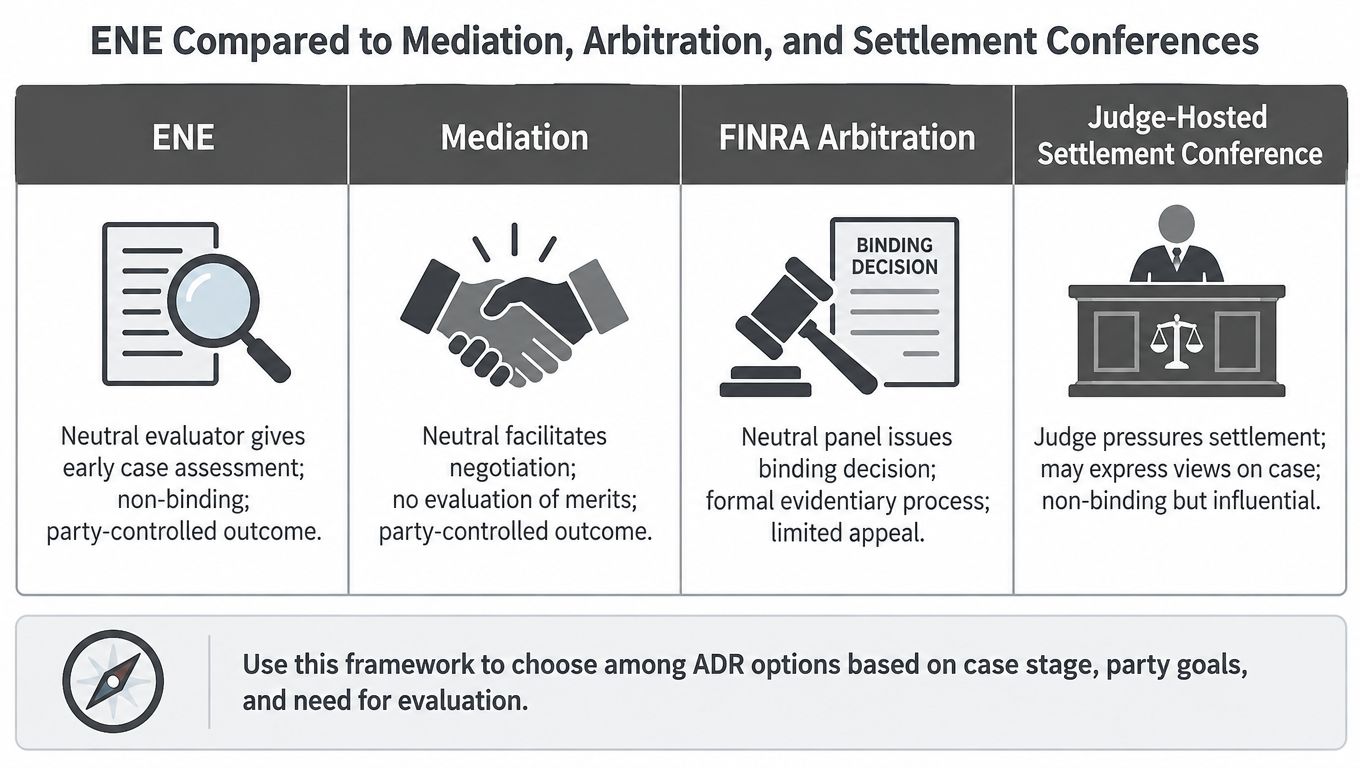
Choose the process by the task. An advisor who needs a candid merits assessment has a different problem from an advisor who understands the risks but needs help negotiating payment terms and departure language.
ENE and mediation can overlap in practice. A mediator may offer evaluative feedback, and an ENE evaluator may facilitate negotiations. The useful distinction is what the parties are asking the neutral to deliver: an assessment or an agreement.
Match the process to the unresolved problem
| Process | Best-fit task | Outcome control | Preparation concern |
|---|---|---|---|
| ENE | Test disputed merits or valuation assumptions | Parties decide how to use the assessment | Assemble enough evidence for a credible diagnosis |
| Mediation | Negotiate a workable resolution | Parties decide whether to agree | Establish priorities, authority, and acceptable terms |
| FINRA arbitration | Obtain an adjudicated resolution in the applicable forum | Arbitrators decide submitted claims | Prepare proof and defenses for determination |
| Settlement conference | Pursue agreement with judicial assistance | Parties decide whether to settle | Understand the judge's procedures and attendance requirements |
Confidentiality shouldn't be reduced to a checkmark in a comparison chart. Counsel should identify what protects submissions and discussions, who receives them, and whether underlying documents remain subject to production elsewhere. Don't treat arbitration as interchangeable with a confidential settlement discussion.
Timing and cost also depend on purpose. If the parties already agree about the evidence and disagree only about acceptable terms, adding an evaluation may duplicate preparation. If they're negotiating from incompatible readings of the same contract, a focused assessment may be more useful than another exchange of offers.
Preserve the adjudication strategy
For an advisor defending a note claim and considering related employment or compensation claims, ENE should complement the forum analysis, not substitute for it. Counsel should review arbitration agreements, claim scope, filing obligations, and deadlines before suggesting a parallel process. A proposal to evaluate the case doesn't itself protect procedural rights.
An overview of securities arbitration provides context for that distinction. Where the applicable agreement requires arbitration, evaluation should be planned around the adjudication path rather than treated as an alternative that automatically displaces it.
Appeal posture is another dividing line. An ENE opinion isn't an award to appeal; an adjudicated outcome raises different review questions that counsel must address under the governing law.
For readers comparing negotiation approaches outside financial services, Bryan Fagan trust dispute advice from Law Office of Bryan Fagan, PLLC offers a separate resource on trust disputes and mediation options. That context shouldn't be confused with securities procedure.
Use ENE when an assessment could change the strategy. Use negotiation-focused processes when the remaining task is reaching acceptable terms.
Preparing an Advisor-Specific ENE Submission
A persuasive ENE submission is a decision document, not a shortened litigation brief. Counsel should tell the evaluator what must be assessed, show the evidence that matters, and distinguish present proof from facts the client hopes discovery will establish.
Start with the controlling facts, the damages model, vulnerabilities to a potentially dispositive motion, and a discovery request tied to the unresolved issue. Avoid attaching every document just because it concerns the advisor's employment.
Build the submission around the actual claim
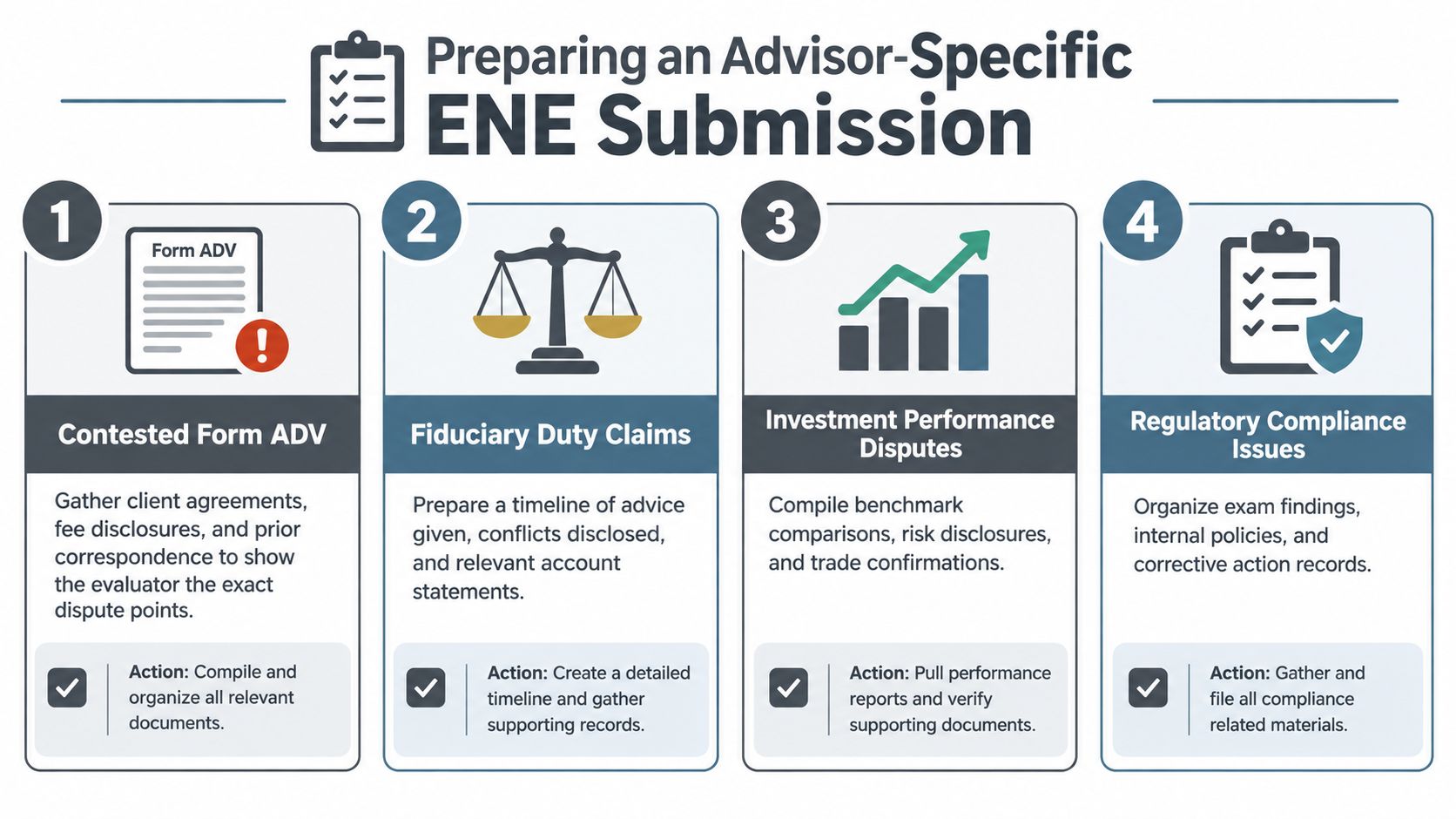
For a contested Form U5 narrative, reproduce the disputed language accurately and identify the proposed correction. Pair each challenged statement with termination correspondence, investigation materials available to the client, or other contemporaneous records. Don't substitute a general account of good performance for evidence addressing the particular statement.
For wrongful termination or employment discrimination, separate the asserted legal theory from the client's understandable frustration. Present the sequence of events, the stated reason for termination, contrary evidence, and any available comparator or decision-maker evidence. Counsel should identify gaps rather than imply that missing records support the claim.
Withheld bonus and deferred compensation disputes need a reproducible calculation. Include governing plan language, award communications, production records, vesting conditions, and the firm's stated basis for withholding payment. Distinguish earned amounts from contingent expectations and identify any overlap with other requested damages.
A promissory-note defense should begin with the executed note and related agreements. Map the repayment trigger, claimed balance, credits, and proposed defenses to specific language and documents. Counsel should test whether an employment grievance supplies a defense, a counterclaim, or neither, instead of assuming those categories are interchangeable.
Address procedural boundaries before disclosure
For a Connecticut matter, counsel should verify the applicable Connecticut Practice Book provisions, referral order, and confidentiality agreement before describing court-connected ADR materials as protected. Federal program protections shouldn't be assumed to govern a state proceeding or a privately arranged evaluation.
Use a short readiness checklist:
- Venue and claims: Confirm where the employment and contractual claims belong before proposing a combined evaluation.
- Parallel proceedings: Review consistency with FINRA responses, CFP Board submissions, and any Department of Labor matter.
- Information handling: Identify client information and personnel records requiring redaction or agreed protection.
- Missing proof: Request the smallest useful exchange that would let the evaluator assess the disputed issue.
The discipline used in preparing for mediation also helps with document organization and client preparation, although ENE demands particular attention to evidentiary weaknesses.
Submission test: Could the evaluator explain the opposing side's strongest argument from your materials? If not, the presentation probably needs more candor.
Measuring Outcomes and Planning Follow-Up
Settlement rate is an incomplete measure of ENE. It doesn't tell an advisor whether the process clarified the disputed language, exposed a weak defense, or prevented counsel from pursuing irrelevant discovery.
Vermont's 2016 reporting recorded 1,982 of 4,030 eligible cases, or 49%, resolving through settlement or dismissal before an evaluation session; 40 of 78 sessions produced full settlement and 38 did not, as discussed in the review of neutral-evaluation outcomes. Those figures don't establish causation, particularly without a randomized comparison group.
Cost claims deserve the same skepticism. A World Bank review reported that approximately 40% of participants believed ENE saved money, while 38% of attorneys and parties believed it added about US$4,000 in litigation costs, illustrating the varied effects described in its review of court-connected dispute resolution.
Record what changed
Evaluate the session against the uncertainty counsel identified beforehand:
- Issue definition: Did the parties isolate the disputed Form U5 statement or contractual provision?
- Discovery discipline: Which requests became unnecessary, and which missing records now justify focused production?
- Economic judgment: Did counsel revise valuation, reserves, settlement authority, or the anticipated cost of pursuing the case?
- Concrete commitments: Did the parties agree to stipulations, disclosures, or a follow-up timetable?
Compare evaluator fees and preparation time with actual work avoided, not hypothetical savings. An unsuccessful negotiation can still produce a useful diagnostic result, but counsel shouldn't use that possibility to excuse an unfocused session.
Choose the next step deliberately
Proceed with ENE when a credible assessment can materially affect a pending decision. Defer it when essential documents are unavailable, the scope remains undefined, or participants won't engage with adverse evidence.
Afterward, counsel may pursue focused discovery under an appropriate protective order, recalibrate motion practice, arrange mediation, or prepare for adjudication. If the parties reach terms, understanding what a settlement agreement should address helps convert agreement in principle into clear obligations.
The useful outcome is a better-supported decision about what to pursue, what to concede, and what evidence to obtain next.
Kons Law represents financial professionals in securities disputes, Form U5 matters, and business litigation, and can help assess whether early neutral evaluation fits your case. Visit Kons Law to discuss the disputed documents, forum, and next procedural decision. If you want to discuss your business law matter, contact Kons Law at (860) 920-5181.
