The email arrives while you're between client meetings. It asks for records related to a customer complaint, and your firm's compliance team wants to discuss a Form U5 amendment. Until now, the issue seemed routine. Now you're wondering what the regulator already knows, what your records show, and whether a rushed response could make matters worse.
That shift is familiar to advisors and brokerage professionals. Regulatory compliance in finance becomes personal when someone must explain a recommendation, a supervisory decision, or a disclosure under scrutiny. The defense often turns not only on what happened, but on what the firm documented, when it escalated concerns, and whether its controls were followed.
Financial regulation also reaches beyond securities rules. For example, businesses tracking regulatory obligations across different industries may find this regulatory update on PAGCOR fees useful as a reminder that compliance requirements vary by jurisdiction and activity. For financial professionals, the practical challenge is navigating overlapping SEC, FINRA, CFP Board, and state-level obligations while preserving a clear record of decisions.
Why Regulatory Compliance in Finance Matters Now
A routine customer complaint can become a serious matter when the firm's records don't line up. The complaint may prompt an internal review, trigger questions about supervision, and require the firm to assess whether a regulatory filing needs to be updated. If the advisor's account differs from the contemporaneous notes, emails, or branch records, the firm may have to explain that gap as well as the underlying conduct.
That's why regulators look beyond written policies. A policy can describe the right process, but it doesn't prove that anyone followed it. Examiners and investigators may ask who reviewed the account, what information was available at the time, how exceptions were handled, and whether the firm retained evidence of its decisions.
The enforcement environment makes this more than a paperwork concern. The SEC reported 583 enforcement actions in fiscal year 2024 and 456 in fiscal year 2025, and reported $17.9 billion in monetary-relief orders for fiscal 2025, including disgorgement and prejudgment interest and civil penalties (SEC enforcement results). The SEC also cautioned that the fiscal 2025 aggregate included large amounts connected to long-running litigation, so the total shouldn't be treated as a typical outcome for every firm.
Why an individual advisor should care
A firm's compliance department may handle the initial response, but an advisor's own statements and records can shape what happens next. A late or incomplete response, an unexplained discrepancy, or a disclosure filing that doesn't reflect the relevant facts can create a separate problem alongside the customer complaint.
That exposure can follow an advisor across proceedings. A FINRA inquiry, an employment dispute involving a Form U5, and a CFP Board complaint may involve overlapping facts but different processes and consequences. Advisors need to understand who is asking questions, preserve records early, and avoid informal explanations that haven't been checked against the file.
Practical rule: Treat the first request for information as a preservation and escalation point, not as an invitation to answer from memory.
Strong compliance is not a promise that no complaint or examination will occur. It's a way to show what the firm and professional knew, what action they took, and whether they followed a defensible process.
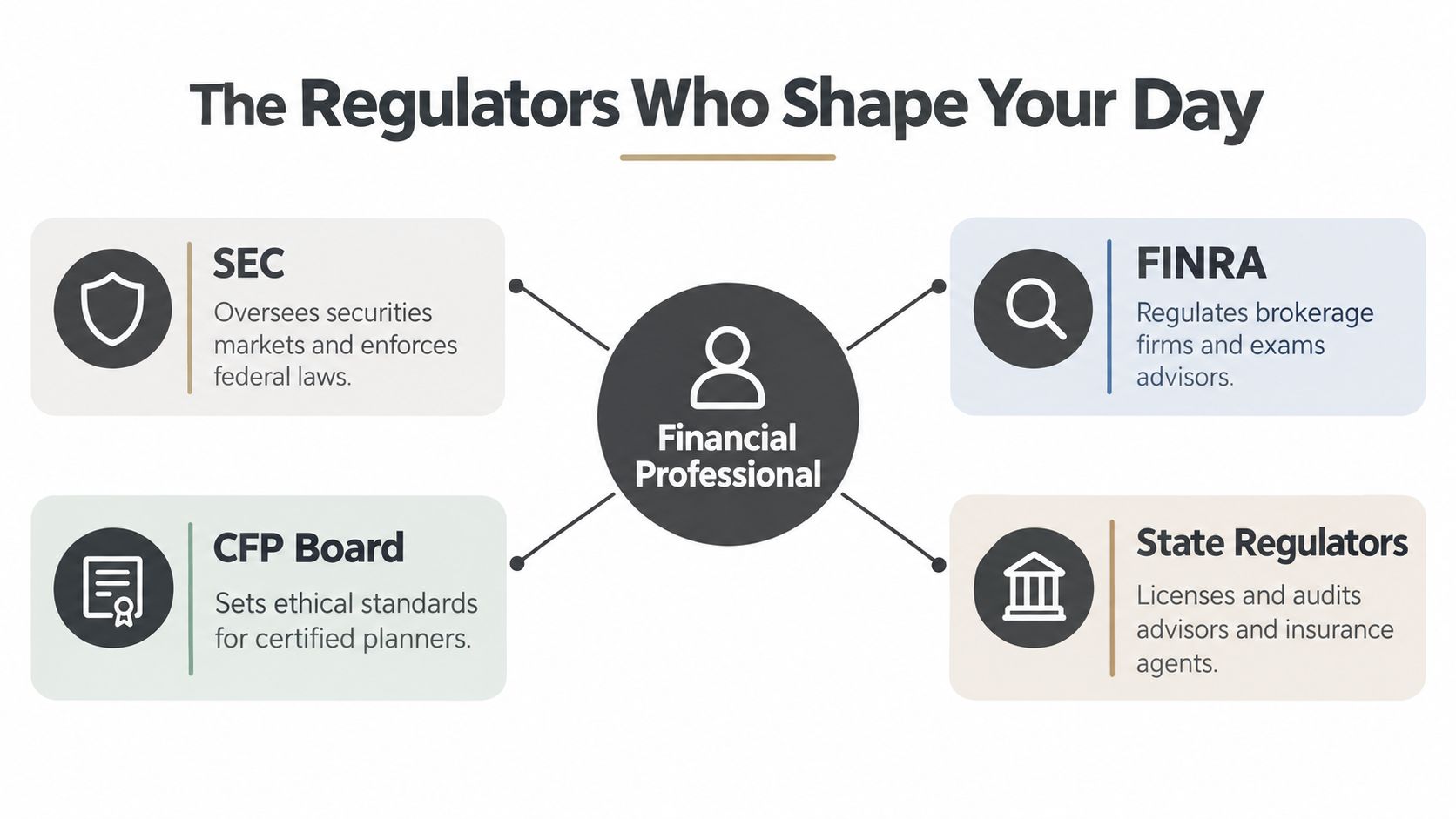
The Regulators Who Shape Your Day
The regulator's name on a letter tells you where the request comes from, but not necessarily who else may care about the same facts. Start by identifying the authority involved, the subject of the inquiry, and whether the request concerns the firm, an individual, or both.
SEC and FINRA
The SEC oversees federal securities laws and securities markets. Its work can affect investment advisers, broker-dealers, public companies, and individuals, depending on the conduct and registration involved. For an individual advisor, the practical point is that SEC authority reaches both the firm and the associated person, so a single inquiry can create obligations at both levels.
FINRA regulates member brokerage firms and associated persons. Its examination and enforcement work can reach an individual's professional record, and a formal information request under Rule 8210 can require documents, written answers, or on-the-record testimony. When FINRA raises a question, the firm and the individual may both have obligations to respond, and those obligations run on separate tracks. An advisor who assumes the firm's compliance department will cover everything is often surprised to learn that personal exposure survives the firm's response.
CFP Board and state regulators
The CFP Board sets and enforces standards for professionals who use CFP certification marks. Its disciplinary process is distinct from FINRA's, so a CFP professional named in a FINRA matter may face a separate Board review of the same conduct. Available sanctions include censure, suspension or revocation of the right to use CFP marks, and a temporary or permanent bar from certification (CFP Board enforcement process).
State securities and insurance regulators may oversee state registration, licensing, examinations, and insurance-related activities. Their reach depends on the professional's role and the business being conducted. A state inquiry shouldn't be treated as a duplicate of a federal or self-regulatory inquiry without first checking the request's scope and legal basis.
Each authority keeps its own deadlines and disclosure obligations, and the records produced in one matter may be examined in another. Advisors who answer a FINRA letter as though it were the only pending issue sometimes learn otherwise when a state regulator or the CFP Board opens a file on the same facts. Identify every authority with jurisdiction over the conduct and coordinate responses, because a resolution with one regulator does not close a related matter with another.
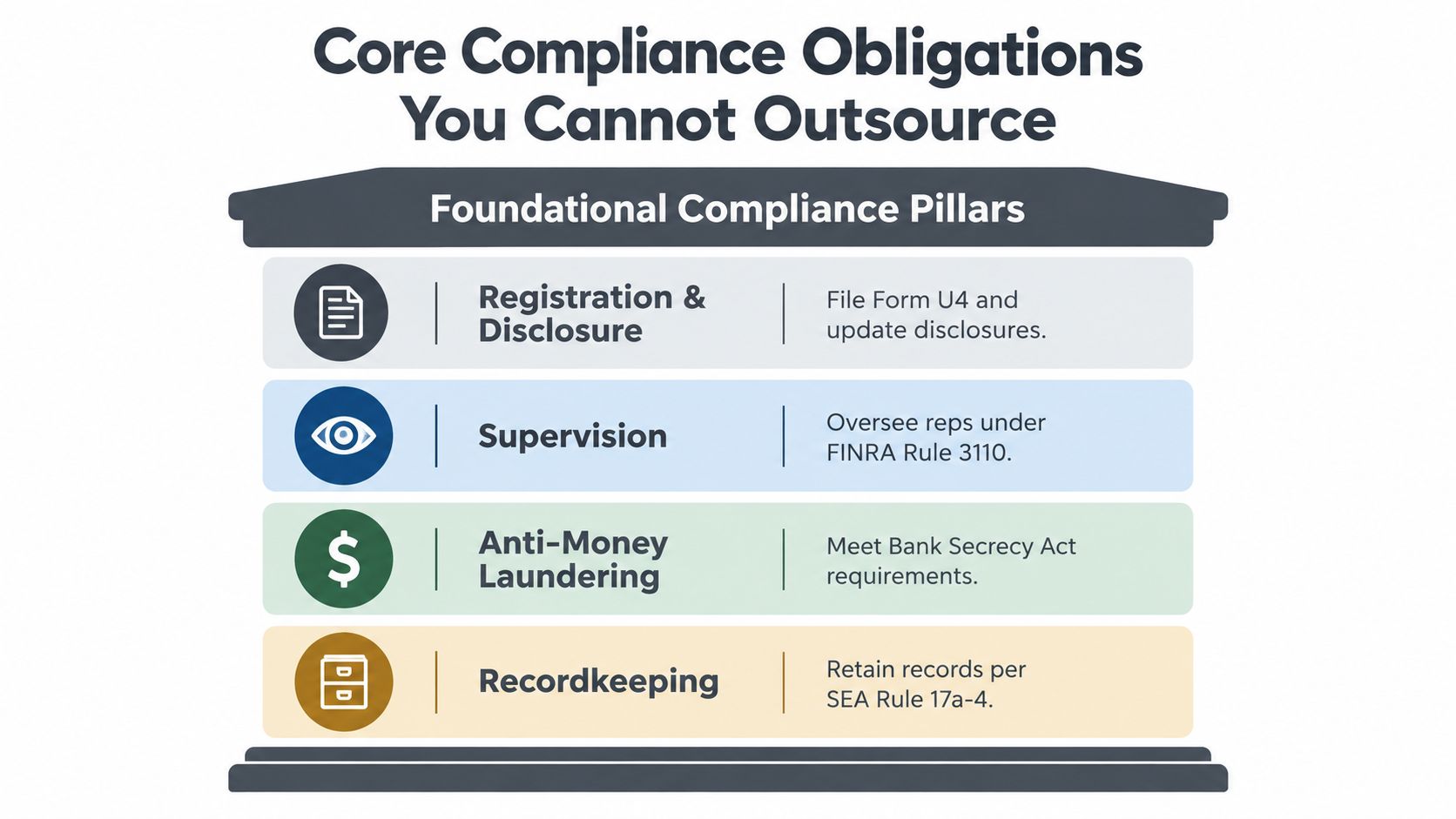
Core Compliance Obligations You Cannot Outsource
A compliance program works only when responsibility reaches the people making recommendations, supervising accounts, updating registrations, and maintaining records. A vendor can support those tasks, but the firm and its associated persons still need to know what their obligations require and retain evidence that the work was done.
Filings, supervision, and records
Registration and disclosure begin with accurate filings, including Form U4 information and required updates. A filing isn't a one-time task. Firms and registered individuals need a process for identifying events that may require amendment and confirming that the submitted information matches the supporting record.
Supervision must be operational, not merely described in written supervisory procedures. Firms should be able to show who reviewed activity, which exceptions were identified, how they were resolved, and whether the supervisor followed up when the initial review raised concerns.
Anti-money laundering controls require a firm to apply its obligations under the Bank Secrecy Act to the business it conducts. That includes having a clear path for handling alerts and documenting decisions. For firms comparing approaches in another jurisdiction, this practical resource on Dubai business AML compliance help provides a point of comparison, but it doesn't replace advice on U.S. requirements.
Recordkeeping is what lets a firm demonstrate what happened. Retention controls should cover required business records and make them retrievable for examination or investigation. An archive that exists but can't be searched, or a record that's missing from a relevant custodian, won't help explain a supervisory decision.
Regulation Best Interest in a client interaction
Regulation Best Interest applies when a broker-dealer or associated person recommends a securities transaction or investment strategy to a retail customer, including an account recommendation. Adopted by the SEC on June 5, 2019, it has four obligations: disclosure, care, conflict of interest, and compliance (SEC's Reg BI guide).
In practice, those obligations meet in a single conversation. The firm must provide written disclosure of material facts about the relationship and conflicts before or at the time of the recommendation. The recommendation must reflect reasonable diligence, care, and skill. The firm must maintain written policies addressing conflicts and policies reasonably designed to achieve compliance with Reg BI.
For each recommendation, ask: What did the client need? What alternatives were considered? Were material conflicts disclosed? Can the file show how the recommendation met the customer's interest? Firms reviewing identity-related procedures can also consult their discussion of FINRA Rule 2090 as part of a broader account-opening and customer-information review.
How Compliance Failure Become Real Things
Consider a hypothetical branch where an AML alert is flagged but not clearly assigned. A supervisor assumes another employee will review it. During a later inspection, the firm finds incomplete notes and no clear record of the final decision. The original alert may have an innocent explanation, but the firm now has to account for the alert, the review process, and the missing documentation.
A customer complaint then arrives. The advisor tells the branch manager that the issue is resolved, but the complaint file doesn't explain what the customer alleged or what the firm did in response. The firm's internal review identifies a possible registration update, yet the Form U4 amendment is delayed while employees debate whether the event is reportable.
How one file can expose several weaknesses
By the time a regulator asks questions, each gap affects how the others are assessed. The incomplete AML record raises questions about supervision. The branch inspection record may not establish that the supervisor tested the relevant control. The delayed filing creates a separate concern about disclosure timing, even if the underlying customer dispute is defensible.
This is how a matter grows beyond its starting point. Investigators may compare the complaint, internal emails, account records, inspection materials, and registration history. If those records tell different stories, the firm has to explain why. A clear chronology can help distinguish a correctable process failure from an attempt to obscure what happened.
A regulator doesn't need to agree with every internal decision to ask whether the firm made it promptly, consistently, and with adequate information.
The useful response is to connect each event to an owner and a record: who received the alert, who reviewed it, when the complaint was escalated, what filing decision was made, and why. Don't backfill notes as though they were contemporaneous. If a record is incomplete, preserve what exists and document the later review accurately.
Understanding how regulators describe disciplinary matters can help firms recognize recurring control themes. Kons Law's overview of FINRA disciplinary actions offers relevant context, but each matter still turns on its own facts and documentation.
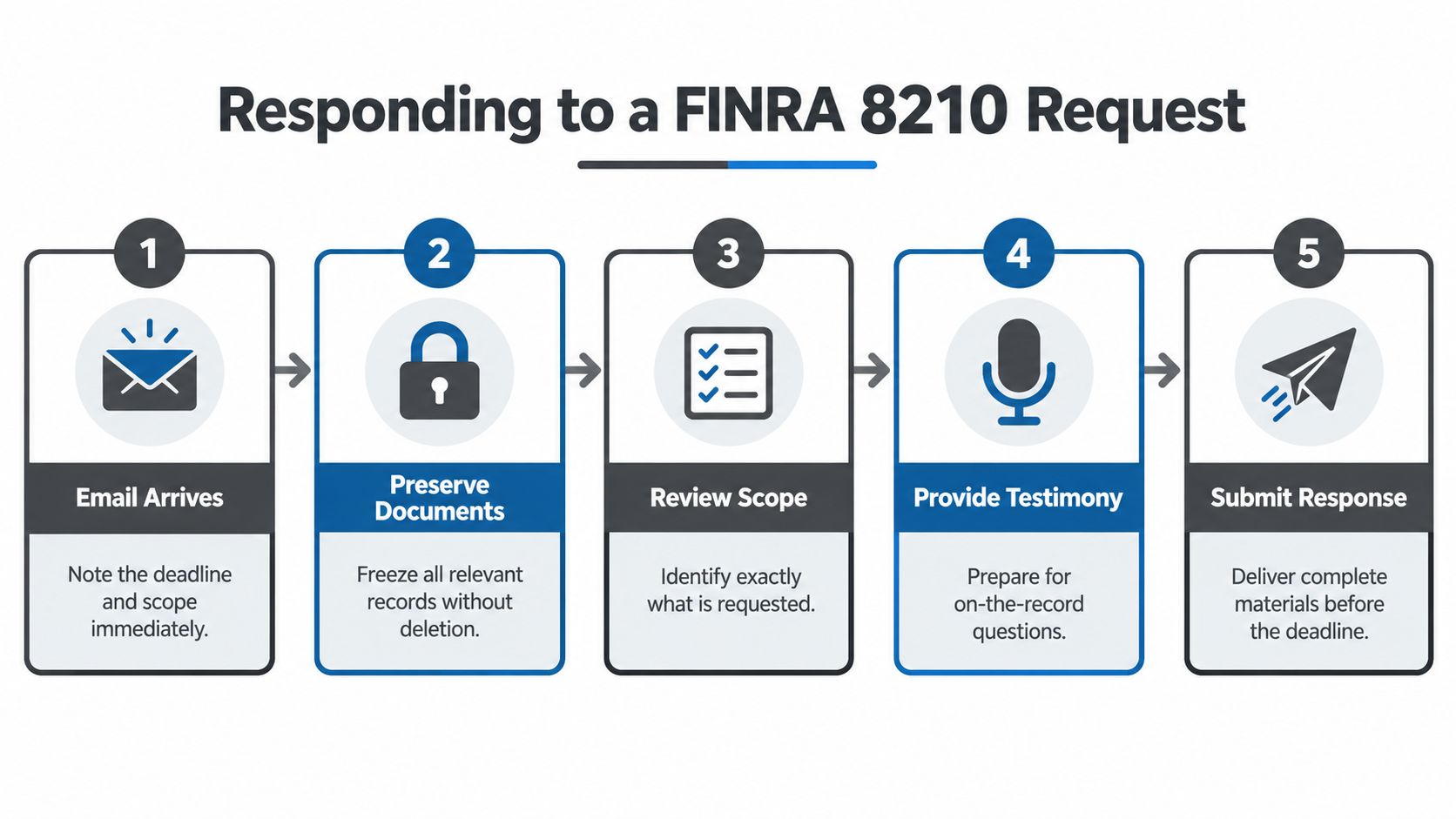
Responding to a FINRA 8210 Request
An 8210 request arrives, and the first temptation is to answer quickly to show cooperation. Resist the urge to improvise. FINRA Rule 8210 gives FINRA staff and adjudicators broad authority to require information orally, in writing, or electronically, compel testimony under oath or affirmation, and inspect and copy books, records, and accounts. Failure to respond, or an incomplete or untruthful response, can expose a firm to sanctions up to expulsion from FINRA membership and an associated person to a bar (FINRA Rule 8210 information requests).
Start with preservation and scope
Read the request carefully and calendar the deadline. Identify each requested category, date range, person, account, and format. Then preserve potentially relevant materials across firm email, messaging platforms, branch files, personal devices used for business, and other custodians. Don't delete, alter, or selectively export records while the request is being reviewed.
The firm and associated person should coordinate, but they don't necessarily have identical interests. The firm may be responding as a member while an individual faces questions about personal conduct or statements. Counsel can help identify conflicts, protect privileged communications, and determine whether a scope discussion is appropriate. A request for clarification isn't permission to ignore the deadline.
Prepare testimony from the record
If FINRA requests testimony, don't rely on memory alone. Build a timeline from the documents, identify gaps, and distinguish what you personally observed from what someone else told you. Review relevant records before answering, but don't rehearse a polished version that goes beyond what you know.
A common trap is giving an absolute answer when the records show uncertainty. Another is providing a partial document set without explaining that a category remains under collection. Track what was searched, which custodians were included, what was produced, and any limitations communicated to FINRA.
A defensible response is complete, accurate, and delivered by the deadline. If a real obstacle prevents timely production, raise it early through the appropriate channel and keep a record of the request and response. Silence and guesswork create avoidable risk.
Common Pitfalls in Form U4, U5, and Disclosure
Form U4 and Form U5 problems often arise during stressful transitions. An advisor may believe a customer complaint is meritless, a termination is unfair, or a dispute is merely employment-related. Those beliefs don't answer whether a disclosure is required or whether the filing must be amended. The firm and advisor should evaluate the applicable reporting questions against the actual facts and filing duties.

Timing and accuracy matter
A frequent mistake is treating a disputed complaint as though it can be ignored until the merits are resolved. Another is assuming that an employer's decision controls what the advisor must disclose. A filing should reflect the relevant facts and required updates, not a preferred characterization of the dispute.
Form U5 issues can become especially complicated after a contested termination. The wording may affect a professional's record and future employment, while the underlying disagreement may also involve wrongful termination, discrimination, compensation, or a promissory note. Those matters may proceed in different forums, so communications and factual positions should be coordinated rather than drafted in isolation.
A late amendment can create scrutiny even when the advisor contests the underlying allegation. An inaccurate or incomplete filing may be examined as a separate issue, which is why the chronology matters: when the firm learned of the event, who assessed reportability, what information was available, and when the filing decision was made.
Build a clean record before taking a position
Preserve the complaint, internal communications, termination documents, and relevant customer records. Compare proposed filing language with the underlying record. If the advisor disputes the employer's account, keep the disagreement specific and supported rather than relying on broad accusations or conclusory denials.
Don't assume that a civil claim automatically resolves a disclosure issue, or that a disclosure filing resolves the employment dispute. Each question needs its own analysis, with attention to the relevant deadline and forum. Early coordination can prevent inconsistent accounts from appearing in a FINRA response, an arbitration claim, and a registration filing.
Building and Auditing a Compliance Program
The first request in many routine exams is the written supervisory procedures, and examiners compare them against what the staff does. That gap is where findings come from. A 2025 financial-services survey found that 44% of respondents considered regulatory compliance challenging or very challenging, with data privacy, consumer protection, and financial reporting among the frequently cited difficult areas (financial-services compliance survey). For a smaller firm with limited compliance staff, the practical answer is a program sized to the firm's real business, built so every control produces evidence.
Make controls testable
Map each activity the firm performs to the risk it creates. For every control, record who owns it, what evidence it generates, where that evidence sits, and who reviews exceptions. Written supervisory procedures should describe the workflow as it exists today. When the manual and the practice diverge, fix one or the other quickly, because in an investigation the discrepancy becomes the exhibit.
I have watched examiners treat a stale procedure manual as a separate violation even when the underlying conduct was defensible. Training logs should name the attendees and the subjects covered. Exception logs should capture the issue, the reviewer, the resolution, and any follow-up. Supervisory reviews need enough detail that a third party can tell what was checked and what happened next.
Firms comparing obligations in a different licensing regime can review these 8 essential AFSL controls, while keeping their U.S. duties distinct. For a closer look at what examiners expect from procedure documentation, see Kons Law's explanation of written supervisory procedures.
Use a risk-based review cycle
A program earns its keep on the review schedule, where you test whether controls operate rather than whether policies exist. A workable cycle covers:
- Risk review: Reassess business lines, products, vendors, and complaint patterns.
- Control testing: Sample records and trace exceptions through to resolution.
- Training review: Confirm staff understand escalation duties and filing triggers.
- Remediation tracking: Assign owners and confirm corrective actions close.
- Management reporting: Put unresolved issues and weak controls in front of leadership.
When a regulator changes a filing trigger, a computation method, or a supervisory standard, run it through the same cycle: name an owner, test the revised process, and keep proof it happened. That discipline pays off later. If an 8210 request or exam letter arrives, the chronology of who fixed what, and when, separates a program that holds up from one that reads as paperwork.
When to Engage Counsel and How to Choose
Timing drives the outcome. Bring securities counsel in when an 8210 request arrives, when the firm proposes a Form U5 amendment, or when the CFP Board opens an investigation. CFP Board discipline can affect the right to use the marks or seek certification, not just financial exposure, so treat that first letter as a deadline. Early advice also pays when you are moving firms while a termination, compensation, or promissory note dispute remains unresolved.
Choose counsel who handles regulatory defense and the employment and arbitration disputes that come with it. I have seen advisors hurt their cases by answering an 8210 request alone because the questions looked routine. Come to the first meeting with the request, the relevant correspondence, a chronology, and the records you believe matter. A regulatory compliance attorney can coordinate your response across parallel proceedings, so a statement in one forum does not undercut you in another.
