
You may be weighing an acquisition to grow, considering a sale as part of a succession plan, or trying to decide whether a business unit still belongs in your portfolio. The headlines can make a transaction look like a simple choice between buying, combining, or selling. In practice, each option changes more than ownership. It can reshape contracts, responsibilities, customer relationships, and the way the remaining business operates.
Mergers, acquisitions, and divestitures are best understood as connected tools for changing a company's direction. A deal creates value only when its business purpose, legal structure, operational boundaries, and post-closing responsibilities fit together. The transaction documents matter, but they can't make an unclear strategy successful or untangle shared operations on their own.
Why Transaction Strategy Comes First
An owner considering a deal should start with the business problem, not the paperwork. Is growth limited by a missing product or market? Does an acquisition provide a sensible route to customers, capabilities, or intellectual property? Is a sale the right way to address succession, release capital, or let a business unit operate under a more suitable owner?
These questions help distinguish a strategic transformation from an opportunistic transaction. A potential target may look attractive, but that doesn't mean it solves the buyer's actual problem. A business unit may be available to sell, but the seller still needs to ask what the sale will mean for the company that remains.
The scale of the global M&A market offers context, not an answer for an individual company. Worldwide announced transaction value grew from approximately $240 billion in 1985 to more than $5.6 trillion in 2021, while transaction value increased at an estimated 7.3% compound annual growth rate from 1985 through 2025, according to the American Bar Association's review of M&A market trends. Those figures reflect the market's long-term expansion. They don't tell an owner whether a particular deal is affordable, properly priced, or operationally manageable.
Think of a deal like remodeling a building. Before hiring a contractor, you decide which rooms need to change, who will use them, and what the budget can support. The construction plan follows the purpose. A transaction needs the same discipline: define the intended outcome before choosing the legal route.
A short strategic brief can anchor that work. It should state the business objective, the expected source of value, the people affected, the risks the parties can accept, and how they'll recognize success. That brief can guide valuation, diligence, negotiations, regulatory review, and integration planning. Without it, deal teams may negotiate terms efficiently while losing sight of what the transaction was meant to accomplish.
Understanding the Three Transaction Types
A useful way to understand transaction types is to picture an assembly line. Different routes can deliver a similar business result, but each route handles ownership, assets, liabilities, and control differently.
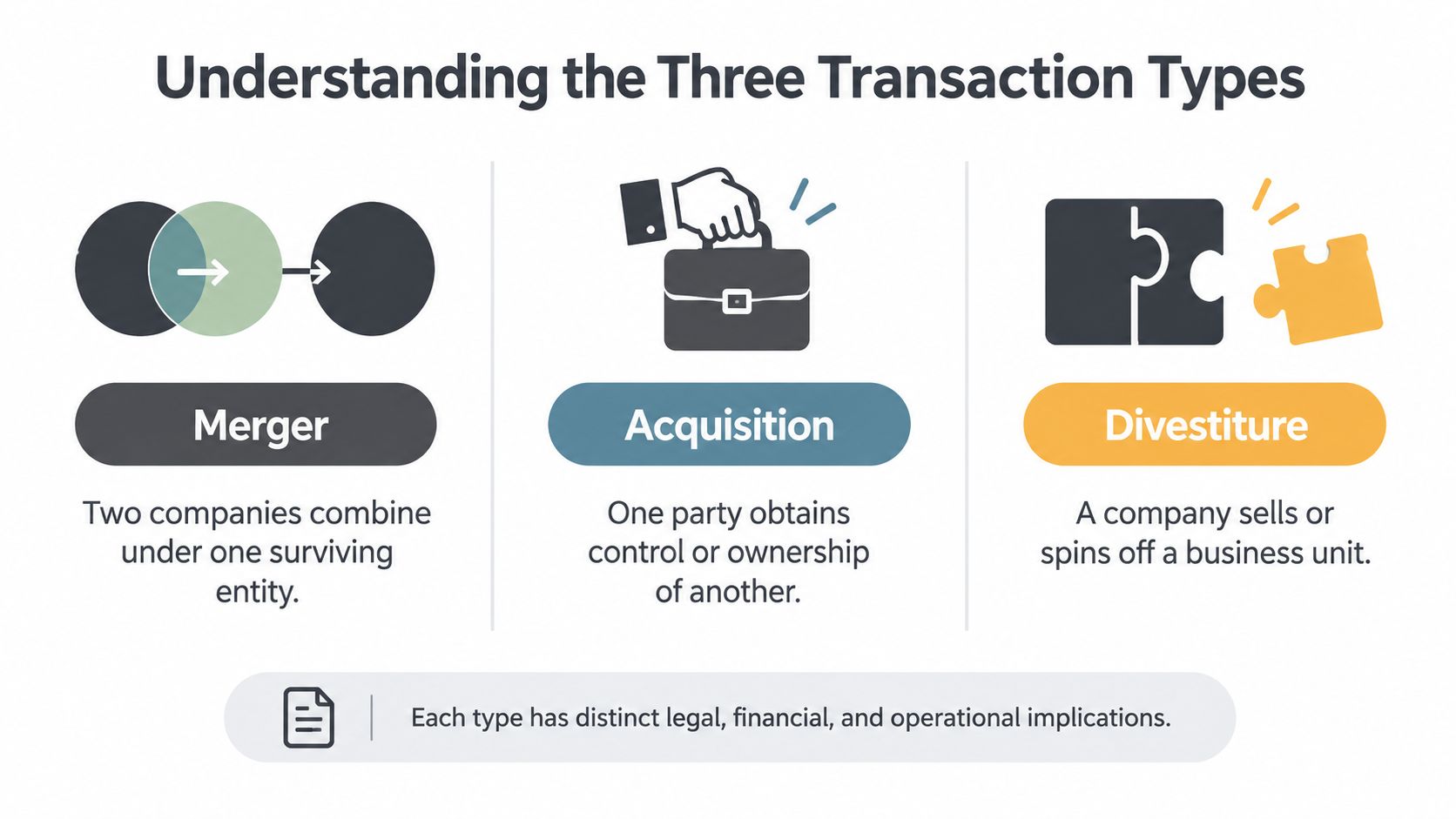
A merger combines businesses under a surviving legal entity. An acquisition occurs when one party obtains ownership or control of another business. A divestiture separates a business, asset group, or ownership interest from its current owner, often through a sale or spin-off.
The legal structure determines how the transaction moves through that assembly line. In an asset purchase, a buyer acquires specified assets and may agree to take on specified liabilities. In an equity purchase, the buyer acquires ownership interests in the entity that holds the business, so the entity continues to own its assets and remains responsible for its obligations. A merger can also use a parent or subsidiary structure, sometimes called a triangular merger, in which a subsidiary participates in combining the target with the buyer's corporate group.
The labels don't settle the important questions. A transaction called an asset sale can still involve complex contracts, employee arrangements, permits, and liabilities. An equity purchase may provide continuity for some operations, but it can also leave the buyer with exposure tied to the acquired entity. Parties should consider both the legal route and the practical result, including how an asset purchase differs from a stock purchase.
| Transaction type | Typical objective | Control after closing | Questions to resolve |
|---|---|---|---|
| Merger | Combine businesses under a surviving entity | Rests with the resulting ownership and governance structure | Which entity survives, and how are ownership and management arranged? |
| Acquisition | Obtain control, assets, or ownership interests | Usually shifts to the buyer, subject to the deal structure | What is included, what consideration is paid, and which liabilities are assumed? |
| Divestiture | Sell or separate a business or asset group | Moves to the buyer or a newly independent entity | What leaves, what stays behind, and how will the separated business operate? |
Each structure has trade-offs involving approvals, consideration, liability allocation, and successor responsibilities. A buyer may prefer an asset deal to define what it is acquiring, while a seller may favor a sale of ownership interests. The parties' preferences won't always align, so structure should follow the commercial objective, the diligence findings, and the risks each side is prepared to accept.
Reading the Market Beyond the Headlines
A rising market can create opportunity, but aggregate deal value doesn't show how accessible that opportunity is to an ordinary business. Financing conditions, corporate profits, valuations, and uncertainty all affect buyers' willingness and ability to transact. They may support dealmaking in one period and constrain it in another.
The difference between transaction value and transaction volume matters. Global M&A value reached approximately $4.7 trillion in 2025, up 43% year over year, while transaction volume remained broadly flat because deals valued at $10 billion or more drove much of the increase, according to PwC's analysis of global deals trends. A sharp rise in total value can therefore reflect a small number of very large transactions, rather than better conditions for every potential buyer or seller.
Landmark deals help show the scale possible when companies pursue a transformational transaction. Vodafone AirTouch announced its takeover of Mannesmann in November 1999, and the deal closed in February 2000 after Mannesmann accepted an offer valued at approximately $180.95 billion. The same period included AOL's approximately $165 billion merger with Time Warner. Later landmarks included Verizon's approximately $130.2 billion purchase of Vodafone's stake in Verizon Wireless and Anheuser-Busch InBev's approximately $101.5 billion acquisition of SABMiller, as described in M&A statistics and transaction benchmarks.
These deals are not templates for a private company sale or a modest strategic acquisition. They're reminders that a few major transactions can shape headlines while smaller businesses face different financing, valuation, and buyer-access conditions.
| Market signal | What it suggests | Question for the business |
|---|---|---|
| Rising announced deal value | Large or transformational deals may be lifting totals | Are buyers for this business actually active and capable of closing? |
| Broadly flat transaction volume | Higher totals don't necessarily mean more businesses are transacting | Is there realistic buyer competition for this particular asset? |
| Large deals dominate the news | Headlines may reflect unusual size, scale, or financing | Does the valuation expectation fit this company's results and risk profile? |
Treat market statistics as context, not proof that the timing is right. A business should test its own readiness, likely counterparties, financing needs, and regulatory exposure before relying on a broad narrative about a strong market.
Moving From Diligence to Closing
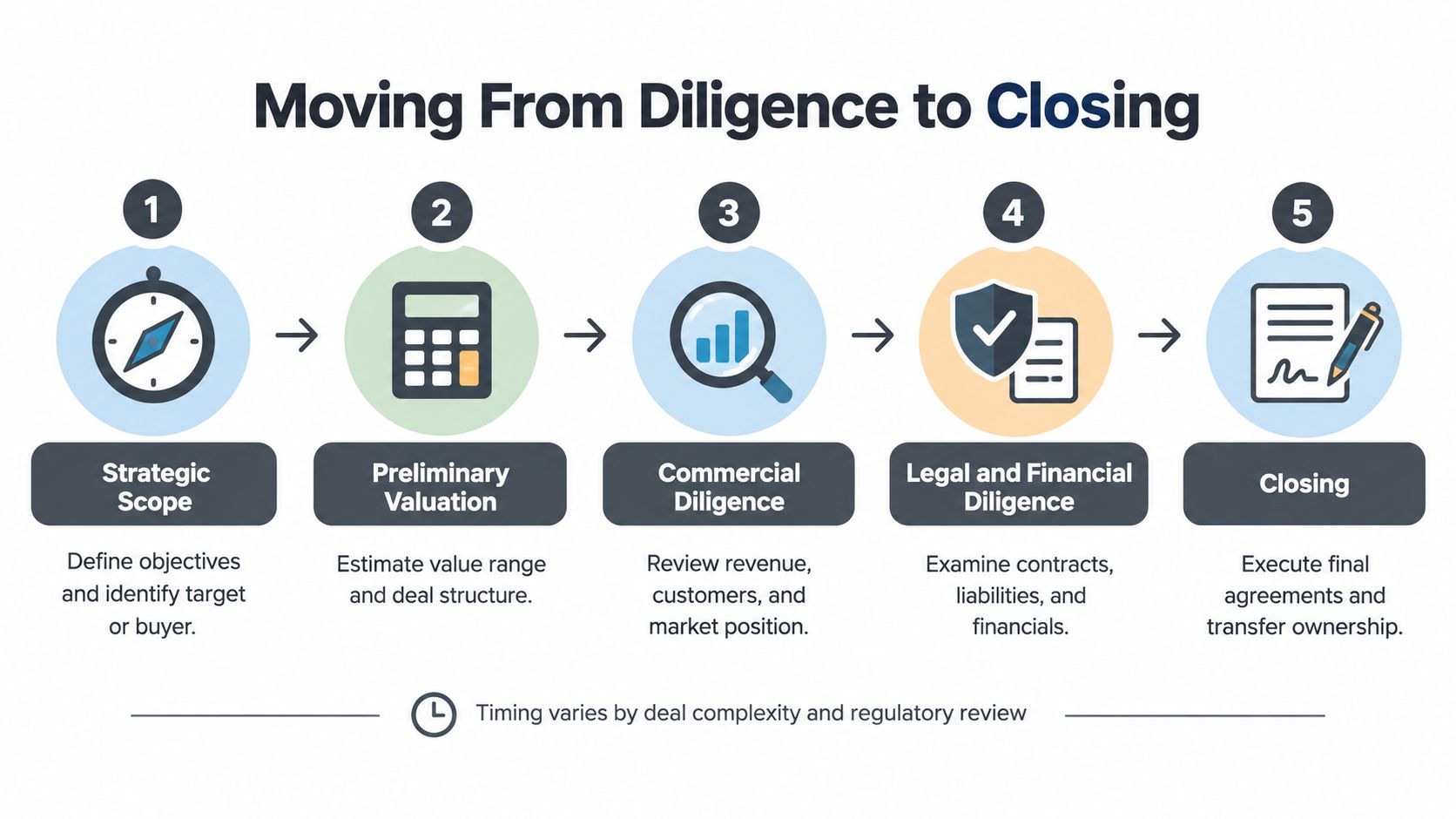
A transaction usually moves through a series of decisions, but there's no universal timetable. The work begins by defining what the parties intend to buy or sell, then testing whether the proposed price and structure can account for the business's risks.
Start with scope and value
First, the buyer and seller identify the transaction perimeter: the entity, assets, operations, contracts, employees, and liabilities included in the deal. A preliminary valuation can then provide a working range. That range is not just a number. It depends on the business's financial performance, forecasts, capital needs, risk profile, and expected value after the transaction.
Investigate what sits behind the price
Due diligence tests the assumptions. Commercial diligence examines customers, revenue sources, competition, and market position. Financial and tax diligence reviews the records, accounting practices, cash needs, and relevant tax exposures. Legal and operational diligence looks at contracts, ownership, employees, systems, licenses, disputes, and the company's ability to operate as proposed.
A buyer can think of this work as inspecting a used aircraft before accepting the keys. A promising flight plan doesn't replace the inspection. The point is to identify what the purchase price, the agreement, or the closing plan must account for. For a structured way to organize financial review, Jumpstart Partners' diligence checklist can help teams identify records and questions to prepare. A legal review can also use a focused mergers and acquisitions due diligence checklist.
The findings can change the deal. A gap in financial records might prompt more diligence or revised price terms. A contract that requires consent before assignment may affect closing conditions. An identified liability might lead the parties to negotiate an indemnity, a covenant, or a different allocation of responsibility.
Negotiate, sign, and satisfy closing conditions
After the parties understand the material issues, they negotiate the purchase agreement and related documents. These terms address consideration, representations, indemnities, covenants, financing conditions, and the steps required before closing. The agreements should reflect what diligence uncovered, not merely restate the initial deal thesis.
For SEC reporting purposes, an acquisition or disposition of assets is generally significant when the registrant's equity in the assets' net book value, or the amount paid or received, exceeds 10% of the consolidated group's total assets, under the SEC's Form 8-K. This is a reporting test, not a general measure of whether a private transaction is important to the parties.
Signing and closing can occur at different points. Between them, the parties may need to obtain approvals, satisfy contractual conditions, secure financing, or complete other agreed steps. The practical question is whether unresolved diligence issues are manageable conditions or fundamental obstacles to completing the transaction.
Handling Regulation Tax Financing and Liability
Regulatory review, tax planning, financing, disclosure, and liability allocation can shape a deal from the beginning. They shouldn't be treated as final document checks. A sound business rationale won't resolve a competition concern, guarantee financing, or make an unsuitable structure appropriate for tax purposes.
Competition review is one area where simple screening tools help identify issues but don't decide the outcome. The Herfindahl-Hirschman Index (HHI) measures market concentration by summing the squares of firms' market shares. Under the 2023 U.S. Merger Guidelines, a merger may create a structural presumption of competitive concern when post-merger HHI is above 1,800 and the merger increases HHI by more than 100 points. A separate screen applies when a transaction creates a firm with more than 30% market share and increases HHI by more than 100 points, as explained by the Congressional Research Service's discussion of the guidelines. These are screening thresholds, not automatic conclusions about every transaction.
Public-company disclosures also matter. Under the SEC's Form 8-K rules, a public company generally must describe material terms of a business-combination agreement, including the nature and amount of consideration, exchange ratio or valuation formula, committed or required financing, and material changes to ownership or management. Whether consideration is cash, stock, or a combination can affect both the agreement and the required disclosure.
| Issue | Decision question | Where risk may be addressed |
|---|---|---|
| Competition review | Could the combination raise concentration concerns? | Regulatory filings, closing conditions, and covenants |
| Industry permissions | Are licenses, consents, or regulatory approvals needed? | Conditions to closing and post-closing obligations |
| Public-company rules | What must be disclosed, and which approvals are required? | Disclosure documents, governance terms, and shareholder processes |
| Tax and financing | Does the structure support the intended tax and funding outcomes? | Transaction structure, financing documents, and purchase agreement |
| Liability allocation | Which obligations remain with the seller, transfer, or are assumed? | Assumption clauses, representations, indemnities, and covenants |
An asset purchase may allow the parties to specify which assets and liabilities transfer, but it can require attention to individual contracts, permits, and consents. An equity purchase may preserve the target entity and its relationships, while keeping obligations within the entity the buyer acquires. Neither structure eliminates the need to investigate tax consequences, financing conditions, or successor exposure.
Financing deserves its own practical review: the source of funds, commitments, conditions, and ability to close must match the deal's structure and timetable. For readers comparing financing options, this overview of how hard money loans can speed up deals offers context on one possible route, though the suitability of any financing depends on the transaction. If part of the consideration depends on future performance, the parties also need to define measurement and payment mechanics clearly; what an earn-out agreement involves is one related issue to address.
Turning Acquisition Integration Into Value
An acquisition can close as planned and still fail to deliver the buyer's expected results. Consider a buyer that acquires a company to broaden its customer base and combine overlapping operations. The agreement transfers control, but customers still need reliable service, employees need clear reporting lines, and the two companies' systems may not exchange information cleanly.
Integration planning should start before signing because the deal team needs to know whether its assumptions can be implemented. If the business case depends on consolidating functions, leaders should identify who will make those decisions, what systems must change, what implementation costs arise, and how the company will protect customers during the transition.
McKinsey's review found that 79% of companies outperforming their market index 18 months after close continued to outperform three years later, while strong performers captured at least 50% of their publicly announced synergy target during the first year, according to its review of merger integration success. The lesson is not that a particular target guarantees success. It's that early execution and consistent measurement help teams distinguish progress from the original promise.
Practical rule: Treat each synergy as an operating commitment with an owner, a baseline, a cost, and a way to verify the resulting value.
The buyer and seller should build a measurement system that separates different effects instead of bundling them together. Recurring EBITDA savings, one-time implementation costs, revenue assumptions, and cash realization are not interchangeable. Reporting them separately helps the board see whether the combined business is producing durable value or recording activity.
A useful plan connects operational decisions to customer and employee outcomes:
- Customer retention: Track service continuity and customer response to changes in products, contracts, and support.
- Leadership and accountability: Clarify who can approve changes and who owns each value-creation commitment.
- Systems and controls: Sequence data migration and finance-control changes so the company can report reliable results.
- People decisions: Address overlapping roles and communications directly, rather than letting uncertainty drive avoidable departures.
- Board oversight: Review performance against the agreed baseline and revise assumptions when the evidence changes.
Legal completion transfers rights and responsibilities. It doesn't establish that the combined company is ready to operate as one business. A measurement architecture gives the buyer, board, and integration team a shared basis for making decisions and correcting course.
Planning Divestitures and Complex Carve-Outs
A divestiture isn't finished when the sale agreement is signed or the buyer receives control. The seller still needs to understand which services, costs, systems, people, records, and obligations remain connected to the business being sold.
Deloitte reports that one-time divestiture costs most commonly fall in the 3%–5% range of transaction value, while only 11% of sellers fully address identified stranded costs, in its global divestiture survey. These findings underline a practical risk: the seller may receive proceeds but still carry costs that no longer fit the retained business.
A carve-out plan should map the separation perimeter before signing. That means identifying shared legal entities, employees, technology, procurement, data, intellectual property, customer contracts, licenses, and regulatory obligations. The parties can then assign each item to the retained company, the divested business, or a transition-services agreement.

Transition-services terms need operational detail. They should specify which services the seller will provide, how service levels and pricing work, who handles remediation, and what milestones will end the arrangement. A buyer may need temporary access to the seller's systems, while the seller needs a credible exit path that prevents temporary support from becoming an indefinite dependency. A corporate carve out advisor handbook can help deal teams think through separation planning alongside the legal agreement.
Sellers should also test whether the retained business can absorb overhead that was previously shared. If it can't, the apparent value of a sale may shrink as stranded costs and operating gaps surface. These findings can inform purchase-price adjustments, indemnities, covenants, closing conditions, and the company's plan for what remains after the transaction. A business separation agreement can document responsibilities, but it won't replace an operational separation plan.
Financial-services businesses have additional continuity concerns. A carve-out may require careful handling of client-account transfers, supervisory responsibilities, regulatory records, and ongoing service. A clean purchase agreement alone doesn't ensure that customers remain served, records are accessible, or each party knows who is responsible after closing.
Managing Transaction Risk and Taking Action
A transaction's risk doesn't sit in one document or one phase. Some issues need an answer before signing; others belong in closing conditions or contractual protections; still others require clear ownership after the deal closes. A practical review should connect the strategic objective to the realities of execution.
Before approaching a counterparty, answer three questions:
- What business problem should the transaction solve? State the objective and how the business will judge whether the deal achieved it.
- What is included, and what could prevent closing? Identify the proposed perimeter, material diligence gaps, approvals, financing needs, and the liabilities each party expects to allocate.
- Who will own the work after signing and closing? Name the people responsible for integration or separation, reporting, customer continuity, and verifying results.
Then test decision rights, tax treatment, regulatory analysis, closing conditions, and post-close accountability. For a divestiture, ask what stays behind, which services will continue temporarily, and how the remaining business will absorb shared costs. For an acquisition, distinguish expected revenue or cost benefits from the steps and spending needed to achieve them.
The 2023 Merger Guidelines also identify a concentration screen when a transaction creates a firm with more than 30% market share and increases market HHI by more than 100 points, as described in the earlier discussion. A potential competition issue is a reason to evaluate the transaction carefully, not to assume that a deal will be approved or rejected.
Signing isn't the end of risk management. It begins the work of measuring whether the strategic thesis, legal perimeter, and operating plan hold together. If you want to discuss your business law matter, contact Kons Law at (860) 920-5181.
Kons Law advises businesses on transaction structuring, due diligence, purchase-agreement negotiation, and post-closing governance. If you're considering an acquisition, merger, business sale, or separation, contact Kons Law to discuss the legal issues and practical steps involved.
