
A Hartford supplier has shipped the product, sent the invoices, and chased payment for ninety days. Now the customer is dodging calls. The balance may be valid, but that alone won't put money in the bank. The next move depends on what the debtor owns, whether you have collateral or other contractual rights, and whether the debtor may file for bankruptcy.
For Connecticut businesses, creditors rights and remedies work best as a sequence, not a list. First protect the evidence and assess the debtor. Then decide whether a demand, negotiated workout, pre-judgment remedy, lawsuit, or bankruptcy strategy gives you the strongest path to payment. At every stage, weigh the likely recovery against the time, expense, and risk of making the wrong move.
When a Connecticut Business Is Owed Money and Cannot Wait
A missed invoice can turn into a collection problem quickly. Before filing suit, confirm who owes the debt, what the contract requires, whether the invoice is disputed, and where the debtor's money and property are. A signed contract and clean account records help, but they don't tell you whether the defendant has assets worth pursuing.
Start with the amount at stake and the debtor's ability to pay. A large balance supported by valuable collateral calls for a different approach from a smaller unsecured invoice against a business with no obvious assets. If you have a security interest, check the documents and perfection records before relying on the collateral. If you don't, early investigation matters because a judgment is useful only if there's something available to collect.
The central decision: Choose whether to sue or settle, pursue the debtor or specific collateral, and act now or preserve leverage for a better window.
A direct demand can resolve a genuine accounting dispute or prompt payment without the expense of litigation. Make it precise: identify the debt, attach the supporting records, state the amount claimed, and set out what you expect next. A demand should be firm, not theatrical. If the debtor raises a real dispute, investigate it; if the debtor avoids engagement, do not let repeated unanswered calls substitute for a plan. For a practical overview of the initial collection process, see how to collect unpaid invoices.
The route from delinquent account to recovery isn't always a straight line. Bankruptcy risk can change what you're permitted to do, while the debtor's asset picture can make a negotiated payment plan more sensible than a costly fight. The right sequence preserves options and keeps you from spending more to enforce a claim than the claim is likely to return.
What Creditors Rights and Remedies Actually Mean
Think of a creditor's legal options as a contractor's toolbox. A contractor doesn't reach for every tool on the job. The right tool depends on the task, and using it in the wrong order can waste time or damage the work. Creditors face the same choice: some tools protect the relationship or property early, some preserve assets before judgment, and others help collect once a court has decided the claim.
Preventive tools include a well-drafted security agreement, clearly written default and remedies provisions, and any lawful setoff rights. Before judgment, a creditor may consider remedies such as an attachment, replevin, or, in an appropriate case, a receivership. After judgment, execution, garnishment, a bank levy, or a debtor examination may help turn the legal result into an actual recovery.
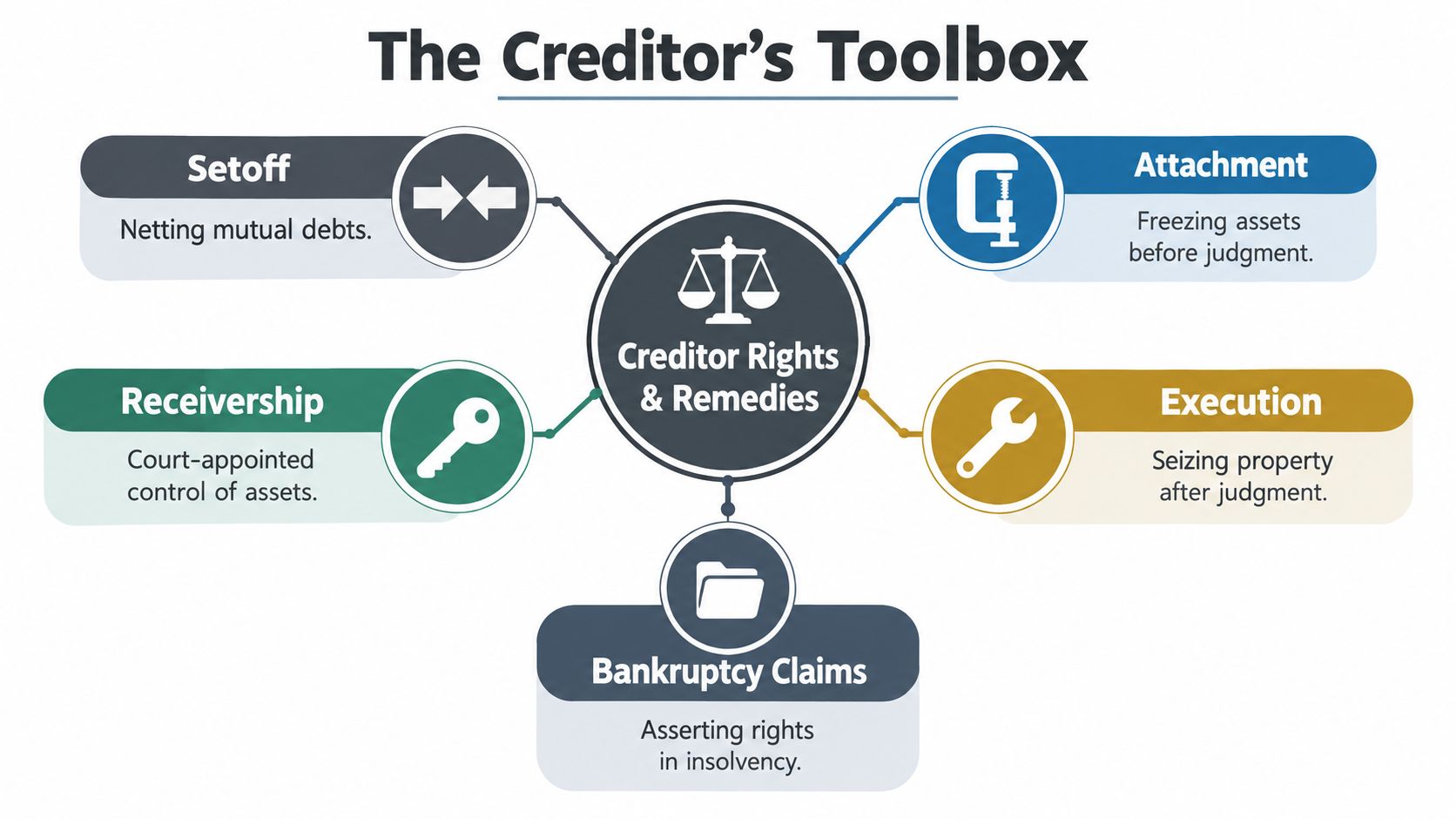
Connecticut's statutory framework gives creditors important anchors. General Statutes Chapter 903 addresses money judgments and related procedures, while Article 9 of the Uniform Commercial Code governs many secured transactions and the enforcement of security interests in personal property. Which rule applies depends on the claim, the contract, the asset, and the procedural stage. Don't assume that a right written into an agreement automatically authorizes every collection step.
The practical point is sequencing. A creditor that checks its contract, verifies its security, and investigates the debtor before acting is better positioned to select an efficient remedy. A creditor that files first and investigates later may end up with a judgment that is expensive to enforce or collateral that has already moved.
The World Bank's cross-country insolvency analysis supports a broader lesson about creditor protections: a one-percentage-point increase in a country's creditor-rights score was associated with a 1.9-point increase in the recovery rate, after controlling for income per capita (World Bank analysis of creditor protections and recoveries). The takeaway for a business owner is practical: information rights, the ability to object, and influence over asset dispositions can matter to recovery, not just to paperwork.
Pre-Judgment Tools That Stop the Money from Disappearing
Before judgment, the main question is whether the debtor may move, hide, or consume assets before you can collect. Connecticut pre-judgment remedies can preserve a target while the case proceeds, but they require proper legal grounds and cost money to pursue. They're not a substitute for investigating the claim and identifying the property first.
Attachment can secure property while a lawsuit is pending. Under Chapter 903, the creditor must apply for the remedy and establish probable cause through the required court process. Depending on the facts, the target might be real estate or funds in a bank account. A bank attachment may be the better fit when the concern is liquid money that could quickly be transferred; a real-estate attachment may make sense when the debtor owns property and an interest can be recorded.
Replevin is aimed at recovering specific personal property, instead of merely securing a general money claim. It may be relevant where the creditor has rights in identifiable goods or equipment, but the documents and the debtor's possession of the property matter. This overview of a prejudgment claim to a right of possession can help frame the issue.
A supplier discovers that a buyer has been wiring cash to a new LLC. If the supplier can establish the necessary legal basis, moving promptly for a bank attachment may preserve funds before they move again. Waiting for ordinary litigation to finish could defeat the point. But speed has a price: an application, supporting evidence, court review, and a hearing all require preparation, and a mistaken or overbroad move can create a dispute of its own.
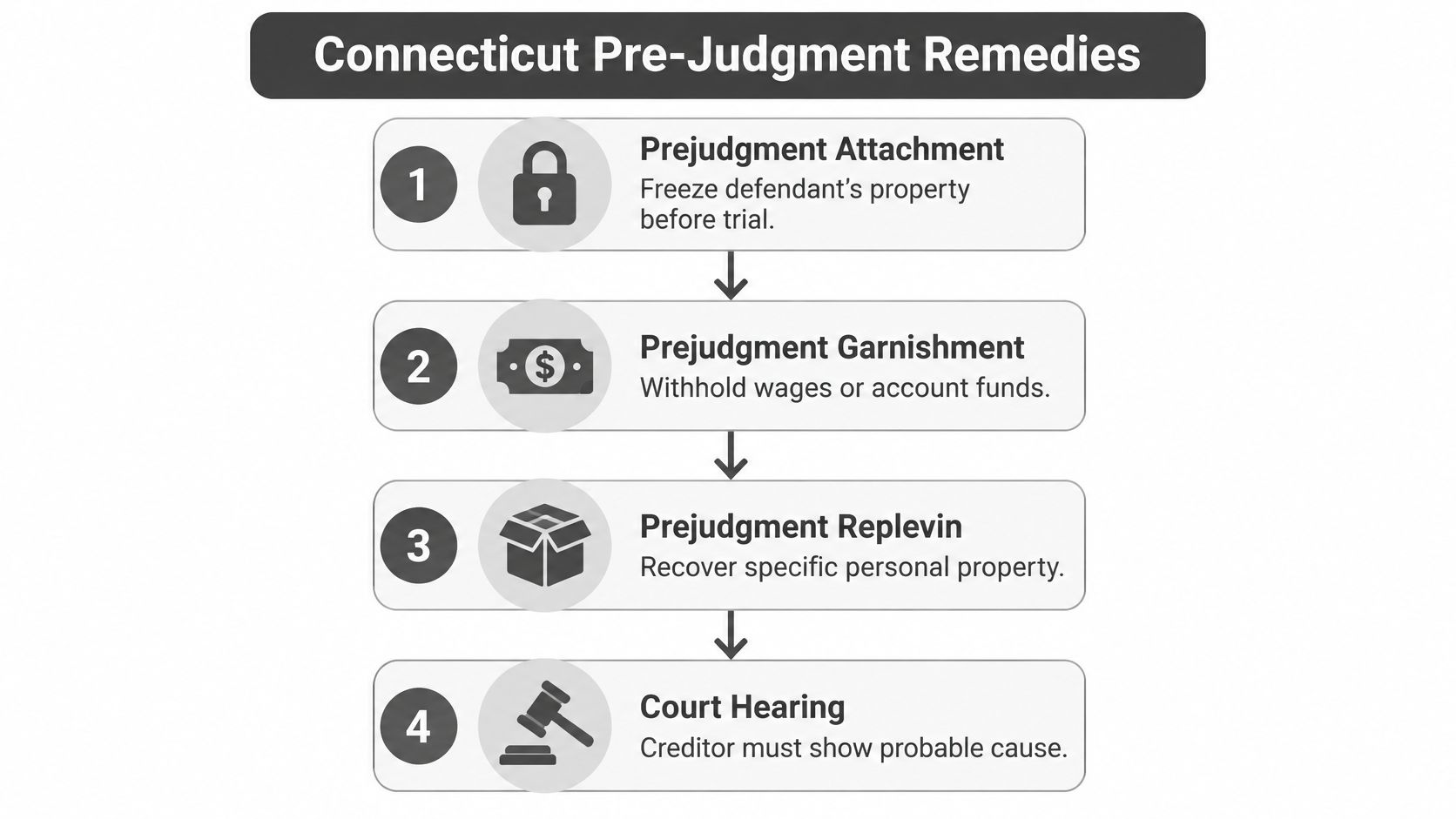
A pre-judgment receivership is a more intrusive option. It may be worth evaluating when the facts justify court-supervised control to protect property or operations, but it isn't a routine substitute for attachment or a well-supported claim. Match the remedy to the asset at risk, and compare the cost of moving quickly with the potential loss from waiting.
Post-Judgment Collection Where the Real Money Lives
Winning a judgment is not the same as getting paid. Treat it as authority to investigate and pursue available assets, not as a check in the mail. The sensible next move is to identify what the debtor owns, where it is held, and whether exemptions or other claims affect its availability.
Connecticut post-judgment procedures can reach different asset classes through different methods. An execution may target eligible property. A bank levy can be useful when you can identify an account, while wage execution under Chapter 906 may apply when the debtor has wages subject to collection. Supplemental process, including a debtor examination, can help uncover information about assets and income. Each route depends on the facts and applicable procedure.
| Remedy | Stage | Best For | Key Trade-Off |
|---|---|---|---|
| Pre-judgment attachment | Before judgment | Preserving identified property at risk | Requires advance court process and supporting evidence |
| Replevin | Before or during litigation, as applicable | Recovering specific personal property | Depends on a right to possession and identifiable goods |
| Execution or bank levy | After judgment | Reaching eligible property or known account funds | Requires asset information and compliance with procedure |
| Wage execution | After judgment | Collecting from eligible wages | Recovery depends on wages and applicable limits |
| Charging order | After judgment | Reaching a debtor's economic interest in an LLC or partnership | Doesn't automatically give control of the entity's property or operations |
Some assets are easier to pursue than others. A known bank account may offer a direct target, while business interests and intellectual property can require more investigation and careful analysis of ownership. Property protected by applicable exemptions, including qualifying retirement assets or a homestead, may be unavailable or limited. Don't budget around an asset until counsel has checked title, exemptions, liens, and any competing claims.
For an LLC interest, distinguish the debtor's personal economic rights from property owned by the LLC. A creditor should not assume that a judgment against an owner permits seizure of the company's equipment or real estate. Charging orders and other remedies depend on the governing law and the debtor's actual interest.
A disciplined post-judgment plan starts with asset discovery and then selects the remedy that fits the asset. Judgment enforcement is often where careful investigation matters more than another round of correspondence.
How Bankruptcy Changes Every Other Remedy
When a debtor files for bankruptcy, ordinary collection strategy stops being ordinary. The automatic stay under 11 U.S.C. § 362 generally takes effect upon filing and halts covered collection activity, including lawsuits, foreclosures, garnishments, and efforts to obtain or control property of the bankruptcy estate. The purpose is to preserve the estate and prevent creditors from racing to seize assets (overview of the automatic stay).
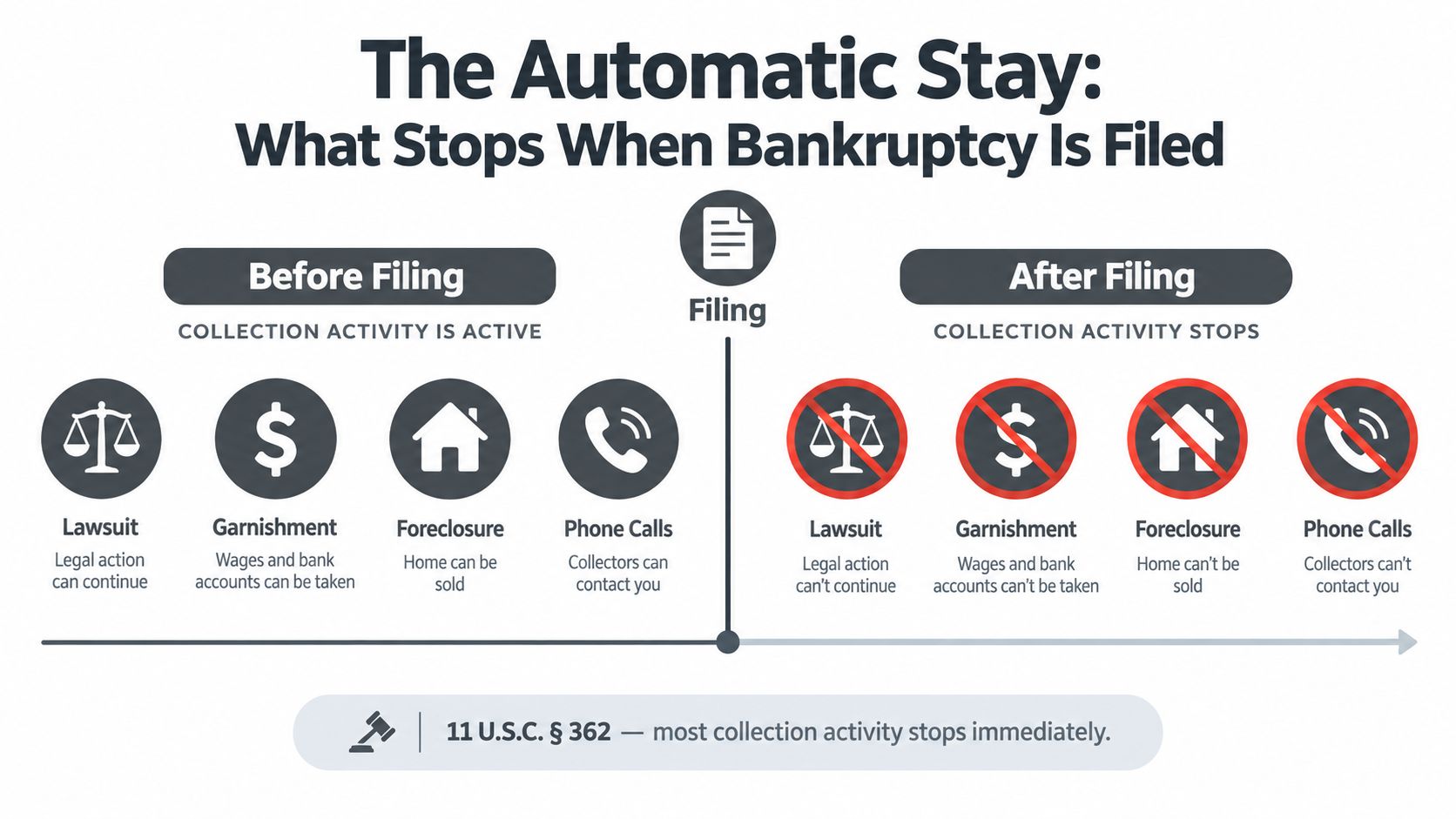
A valid debt or properly perfected lien doesn't authorize self-help after filing. A creditor that wants to continue enforcing its rights generally must seek relief from the stay and receive court authorization. In a secured-creditor dispute, the motion needs to connect the creditor's enforceable interest to an appropriate legal ground, such as inadequate protection or a lack of equity in the collateral (federal court guidance on the automatic stay). Filing a motion alone doesn't lift the stay; until the court grants relief or an approved stipulation applies, collection remains restricted (court guidance for creditors seeking stay relief).
Consider a lender with a properly perfected UCC lien on equipment whose borrower files Chapter 11. The lender should preserve its loan and perfection records, assess the equipment's value and protection, and decide whether to seek stay relief, negotiate adequate protection, or file a bankruptcy claim while monitoring the case. A focused strategy is better than continuing routine collection activity and risking a stay violation.
Repeat filings can change the timeline. When a prior case was pending and dismissed within the preceding year, the stay in a later case generally terminates after 30 days unless a timely extension is obtained under the statutory process. The extension request must meet the statute's timing and good-faith requirements (11 U.S.C. § 362). Creditors should verify the filing history promptly rather than assume the stay will last indefinitely.
Out-of-court options also deserve attention before a bankruptcy filing closes them off. Fitch reported that 2024 distressed-debt exchanges produced average recoveries of 78.5%–92.6%, compared with approximately 39.5% for weighted first-lien bankruptcy recoveries (Fitch analysis of distressed-debt exchanges). Those figures don't predict the result in an individual case, but they reinforce a sound question: will enforcement preserve value, or destroy the business value that could support repayment?
Setoff, Receivership, and the Out-of-Court Leverage Most Creditors Ignore
A lawsuit is not always the fastest route to cash. If you hold funds belonging to the debtor, check whether a lawful contractual or other setoff right applies before you send another demand. Setoff depends on the relationship between the obligations and the documents, and bankruptcy can restrict its use. Don't treat a balance on your books as permission to take money without confirming the right.
The same discipline applies to acceleration and termination clauses. Review the agreement for notice requirements, cure rights, collateral provisions, and conditions that must be met before you exercise a remedy. A contract that clearly defines default and enforcement rights can put a creditor in a stronger negotiating position. A contract with gaps may leave the creditor spending time litigating over the right to act.
A receiver may be appropriate when a debtor's business or property needs court-supervised management to protect value. But receivership is disruptive and expensive compared with a focused workout, so tie the request to a concrete risk such as asset dissipation or mismanagement. Explain why a less intrusive remedy won't protect the creditor's interest.
Forbearance offers another route when the debtor has a credible path to performance. A written agreement can pause enforcement temporarily in exchange for new commitments, such as scheduled payments, reporting, additional collateral, or guarantees. It should state the duration, the conditions for continued forbearance, what happens on a new default, and which existing rights are preserved. A temporary pause without enforceable terms is just delay.
The decision isn't whether you can sue. Ask which lever offers the best expected recovery after cost, delay, and risk. If a negotiated payoff or secured workout preserves more value than immediate enforcement, consider it. But act while there's still a realistic choice. Once the debtor is in distress or has filed for bankruptcy, the available routes can narrow sharply.
Common Mistakes and What Recovery Really Costs in Time and Money
The first mistake is waiting too long to investigate. A debtor's finances can change while a creditor sends repeated reminders, and asset information becomes less useful when the business has already shifted property or stopped operating. The second is pursuing the wrong entity. Confirm the contracting party, any guarantor, and who owns the relevant assets before you spend money suing.
Other errors are preventable. A creditor may rely on a security agreement without confirming that the lien was properly perfected, overlook notice or cure requirements, or assume every asset is available despite exemptions. A remedy that looks aggressive on paper can create delay if the creditor can't show a valid legal basis.
Practical rule: Match the budget to the likely asset and the remedy, not just the size of the invoice.
Costs vary with the dispute and the steps needed. A straightforward demand and negotiation usually involve less work than litigation with contested motions, discovery, attachment proceedings, and post-judgment asset investigation. Filing and service expenses are only part of the picture; professional fees depend on the complexity of the claim, the debtor's response, and how much enforcement work follows a judgment. Ask counsel to identify likely stages and decision points so you can reassess the budget as the case develops.
Bankruptcy timing also makes a single recovery timetable unreliable. In consumer bankruptcy cases closed in the year ending December 31, 2025, the mean filing-to-closing interval was 499 days, while the median was 127 days; U.S. courts also reported 557,376 bankruptcy petitions in 2025, 53,264 more than in 2024 (U.S. Courts' 2025 bankruptcy statistics). Those consumer-case figures aren't a timetable for a particular commercial matter, but the spread shows why creditors should plan for different durations rather than rely on one estimate.
A missed deadline can be more costly than a measured legal strategy. Review the applicable statute of limitations on debt in Connecticut early, and don't wait until the deadline is near to learn what documents or claims matter.
A Practical Checklist and What to Do Next
A controller, owner, or general counsel can use this checklist to turn an overdue account into an organized recovery plan:
- Confirm the claim: Gather the contract, invoices, delivery records, account statements, payment history, and relevant correspondence.
- Identify the debtor: Verify the correct entity and any guarantors before naming defendants.
- Check the security: Review the security agreement, collateral description, and perfection records.
- Investigate the assets: Identify property, accounts, receivables, and business interests, then consider ownership and exemptions.
- Send a documented demand: State the balance, the basis for it, and the next expected step.
- Choose the right remedy: Consider whether attachment, replevin, a negotiated workout, or litigation best protects the likely recovery.
- Plan for bankruptcy: Monitor for a filing and stop covered collection activity if a petition triggers the automatic stay.
- Set a realistic budget: Include the cost of investigation and enforcement, not just filing suit.
Can a Connecticut creditor pursue a debtor out of state? Potentially, but enforcing a judgment against property or income elsewhere may require steps in that jurisdiction. Identify where the assets are and get advice on the applicable process before assuming a Connecticut judgment reaches them automatically.
When should a creditor consider a receiver? Consider one when there's a specific reason court-supervised control may protect value, such as a serious risk of asset dissipation or business mismanagement. A receiver is an intrusive tool; explain why a narrower remedy won't do the job.
How long does a Connecticut judgment last? Don't assume it remains enforceable indefinitely. The applicable rules can depend on the kind of judgment and the required steps to maintain or enforce it, so confirm the deadline and any renewal requirements with counsel.
What if the debtor files bankruptcy during collection? Stop collection activity covered by the automatic stay, preserve your records, and evaluate the bankruptcy claim and any request for stay relief with counsel. Don't continue a levy, lawsuit, foreclosure, or repossession without confirming that the stay permits it.
If you want to discuss your business law matter, contact Kons Law at (860) 920-5181. The firm advises businesses and creditors on demand strategies, negotiated resolutions, collection litigation, and judgment enforcement. Visit Kons Law to discuss the facts, assets, and next step in your matter.
