
A recommendation can look ordinary when it's made and consequential only much later. An advisor answers a retired teacher's question about income, sends an email describing a complex product, and records the transaction through the firm's normal workflow. Eighteen months later, a FINRA examiner asks whether the broker-dealer acted in the customer's best interest, what alternatives were considered, and which supervisor reviewed the recommendation.
That's the practical reality of the best interest standard. The hard question usually isn't whether the rule exists. It's whether the firm can reconstruct the decision through emails, account records, supervisory notes, disclosures, exception reports, and evidence showing that the customer's interests came first. Compliance failures rarely look dramatic when they occur. They often look like a routine product conversation with an incomplete file.
The Moment a Recommendation Changed Everything
The advisor in this composite scenario didn't necessarily intend to put compensation ahead of the customer. The product appeared to address a legitimate concern, the customer had asked about generating income, and the transaction passed through the firm's ordinary approval process. The email thread contained a product description and a recommendation, but not a clear comparison of costs, risks, liquidity, or available alternatives.
That missing reasoning became important later. An examiner wasn't reviewing only the product's characteristics. The examiner was asking what the advisor knew about the customer, what the advisor understood about the product, how the recommendation was formed, whether conflicts affected the analysis, and what the firm's supervisory system did before the transaction was completed.
Practical rule: A defensible recommendation is a documented decision, not merely a suitable transaction.
Regulation Best Interest attaches at the recommendation moment. The SEC describes the rule as applying when a broker-dealer or associated person recommends a securities transaction or investment strategy involving securities to a retail customer for personal, family, or household use. That includes certain account recommendations, while general education and other non-recommendation communications may fall outside the rule's scope. The SEC's staff bulletin on account recommendations is useful because it focuses on the boundary practitioners typically face.
The customer's later complaint may focus on performance, but an investigation often focuses on process. Was the recommendation reviewed? Did the representative understand the product? Did the firm identify a compensation incentive? Did a principal ask why this product was preferable for this customer? The answer must come from contemporaneous evidence, not a polished explanation prepared after the inquiry begins.
What the Best Interest Standard Actually Requires
The modern U.S. securities best interest standard was formally adopted by the SEC on June 5, 2019, through Regulation Best Interest. The rule became effective on September 10, 2019, with a compliance deadline of June 30, 2020, as described in the SEC's Regulation Best Interest compliance guide.
In plain terms, Reg BI requires a broker-dealer and its associated persons to act in the retail customer's best interest when making a covered recommendation. They can't place the firm's financial or other interests ahead of the customer's interests. The obligation applies both to the firm's program and to the representative's conduct, which is why a compliance manual alone won't protect an individual who can't explain the recommendation.
The rule has two practical dimensions. First, the representative must exercise objective care, including a reasonable understanding of the security or strategy, its risks and rewards, its costs, and its fit with the customer's investment profile. Second, the firm and representative must meet the conduct standard. A recommendation cannot be defended only because it was technically suitable if a conflict caused the firm's interest to take priority.
The four obligations
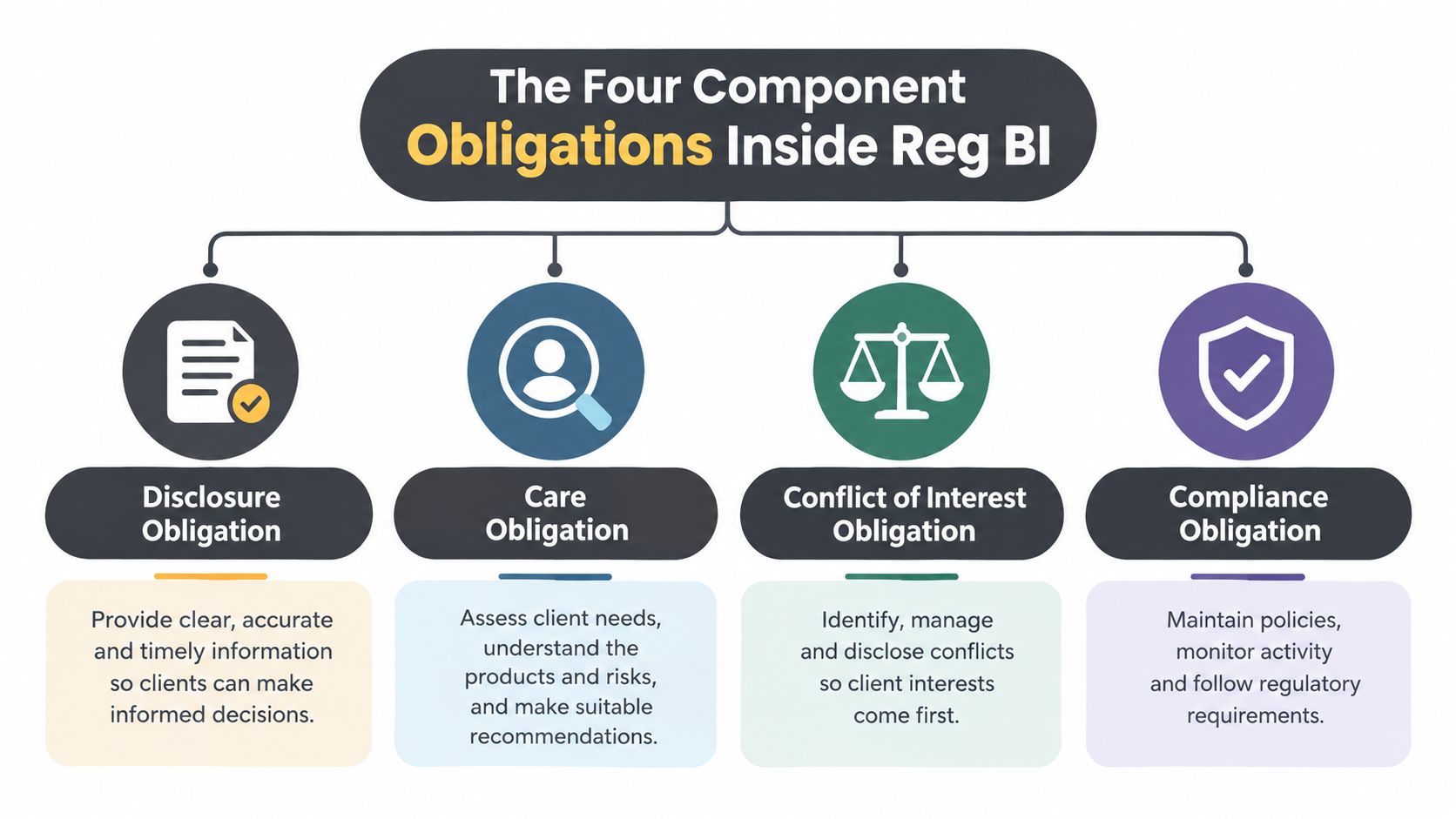
The FINRA overview of Reg BI describes a general obligation implemented through four component obligations:
- Disclosure Obligation: Provide material information about the relationship, services, fees, costs, conflicts, and standard of conduct.
- Care Obligation: Use reasonable diligence, care, and skill to understand the recommendation and its effect on the customer.
- Conflict of Interest Obligation: Identify, mitigate, eliminate, or disclose conflicts through a workable framework.
- Compliance Obligation: Maintain written policies and procedures reasonably designed to achieve compliance.
The four obligations overlap. A disclosure won't cure a recommendation that the representative didn't understand, and a care analysis won't excuse a compensation structure that systematically encourages conflicted recommendations. The program must connect product review, customer information, conflict controls, supervision, and remediation.
Reg BI emerged from a policy shift that the SEC was pursuing by April 18, 2018, when it issued the proposal that led to the final rule and enhanced disclosure through Form CRS and related interpretations, as explained in the Congressional Research Service analysis. That history matters because the rule's purpose is broader than adding another suitability form. It imposes an express best-interest obligation at the point of a retail recommendation.
From Suitability to Reg BI and the CFP Board Standard
Suitability remains part of the practical analysis, but it no longer marks the end of the inquiry. Under the traditional framework associated with FINRA Rule 2111, the core question was whether the recommendation had a reasonable basis for the particular customer, considering information such as investment objectives, financial circumstances, and risk tolerance.
Reg BI added a separate conduct obligation. A firm must still understand the customer and the product, but it must also manage conflicts and avoid placing its interests ahead of the retail customer's. The SEC's adoption in 2019 and the June 30, 2020 compliance deadline marked the point at which broker-dealers had to operationalize that broader obligation. The rule didn't erase suitability analysis. It made suitability an incomplete answer.
The same period produced a different but related development for CFP certificants. The CFP Board's Standard of Conduct established fiduciary obligations for certificants, and its requirements are discussed in this guide to the CFP Board Code of Ethics. A CFP professional may face duties arising from the designation, the engagement, state law, and the firm's business model in addition to any applicable securities standard.
Why overlapping standards matter
Practitioners often make a mistake by treating the governing label as dispositive. “Broker” doesn't mean only suitability, “investment adviser” doesn't answer every question about a particular transaction, and a CFP designation can create obligations that exceed the firm's baseline securities framework.
The more useful approach is to identify the conduct first. What was recommended? To whom? In what capacity? What information did the professional use? What conflicts existed? What did the customer understand? The SEC and FINRA materials on Reg BI frame the broker-dealer obligation through care, disclosure, conflicts, and compliance. Those requirements often produce practical convergence with fiduciary expectations, but satisfying a narrower standard doesn't automatically satisfy a broader one.
An advisor who builds a customer-centered process will usually be better positioned across overlapping regimes. The reverse isn't always true. A file that demonstrates technical suitability may still leave unanswered why the firm recommended a higher-cost or more profitable option when another reasonable alternative was available.
Best Interest vs Fiduciary vs Suitability
The three standards overlap, but they don't ask exactly the same question. Suitability asks whether the recommendation fits the customer. Reg BI asks whether the broker-dealer acted in the customer's best interest and avoided placing its interests first. Fiduciary duty generally imposes a broader obligation of loyalty and prudence across an advisory relationship.
| Standard | Scope | Trigger | Ongoing Duty | Conflict Handling |
|---|---|---|---|---|
| Best Interest | Covered securities recommendations by broker-dealers to retail customers | A recommendation of a securities transaction, strategy, or covered account | Not a general continuous fiduciary duty, though related supervision and relationship obligations continue | Conflicts must be addressed through identification, mitigation, elimination, or disclosure as required |
| Fiduciary | Investment advisory relationships and other relationships imposing fiduciary duties | Advice and conduct within the fiduciary relationship | Broader ongoing duties of loyalty and prudence | The adviser must manage conflicts consistently with fiduciary principles |
| Suitability | Customer-specific suitability of a recommended transaction or strategy | A recommendation evaluated against the customer and product | Generally narrower than fiduciary or Reg BI obligations | No express general requirement to prefer the customer's interest over the firm's |
A broker-dealer can therefore face a duty gap even when the transaction appears suitable. A proprietary product may fit the customer's stated objective, yet the firm must still address whether its incentives affected the recommendation and whether the representative considered reasonably available alternatives.
The label isn't enough
The discussion of financial planner fiduciary duty captures the practical concern: the customer's interest must come first and conflicts must be handled in good faith. That principle helps explain why a title or registration category doesn't settle the analysis.
The trigger and duration differ. Reg BI applies at the point of a covered recommendation, while fiduciary analysis can extend across the advisory relationship. Suitability is narrower still, although its customer and product analysis remains essential. Firms should train representatives to identify all potentially applicable duties instead of asking which label permits the least restrictive process.
A strong file answers three separate questions: Was the recommendation suitable? Was it in the retail customer's best interest? Did the professional owe a broader fiduciary or professional duty? Treating those questions as interchangeable creates avoidable exposure.
The Four Component Obligations Inside Reg BI
Reg BI's general obligation operates through four connected duties: the Disclosure, Care, Conflict of Interest, and Compliance Obligations. A disclosure document alone cannot satisfy the rule. FINRA's Reg BI notice on the four obligations sets out that framework.
Disclosure: record the relationship and the recommendation
Before or when making a recommendation, the broker-dealer must provide full and fair written disclosure of material facts about the relationship's scope and terms, together with material conflicts connected to the recommendation. SEC guidance on conflicts disclosures also emphasizes written policies and procedures reasonably designed to support compliance.
The operational question is whether the file shows delivery, timing, receipt, and updates. A disclosure buried in an onboarding packet may describe the relationship generally while failing to show that the customer received and understood a specific conflict when the recommendation occurred.
Care: what the representative must understand about the product
The representative must understand the product well enough to assess its risks, rewards, costs, liquidity, complexity, and likely effect on the customer. The required analysis depends on the recommendation. A structured product, variable annuity, or concentrated strategy calls for more than a notation that the customer has moderate risk tolerance.
Training should use actual products and decision points. A supervisor should be able to ask why the product was chosen, which reasonably available alternatives were considered, and how the recommendation addressed the customer's stated objectives. Those answers often matter more in an investigation than a generic suitability form.
Conflict of Interest: controls that operate at the point of sale
Consider a recommendation involving a proprietary product that pays more compensation than an available alternative. The firm must address the incentive, not merely state that conflicts should be avoided. The obligation reaches compensation arrangements, proprietary products, revenue sharing, sales contests, and other incentives that could affect recommendations.
Effective controls include product-level review, escalation rules, supervisory testing, and remediation when patterns emerge. A policy has little value if it does not change conduct or create a reviewable record.
Compliance makes the obligations operational
The Compliance Obligation links procedures, training, supervision, surveillance, testing, and corrective action. Exception reports should prompt documented review rather than automatic closure. If repeated recommendations involve the same higher-compensation product, the firm should determine whether customer need, representative preference, an incentive, or inadequate supervision explains the pattern.
An advisor who builds a customer-centered process will usually be better positioned across overlapping regimes.
A policy becomes credible when a supervisor can show what the firm reviewed, what questions were asked, and what changed after the answers.
Documentation, Supervision, and Disclosures That Hold Up
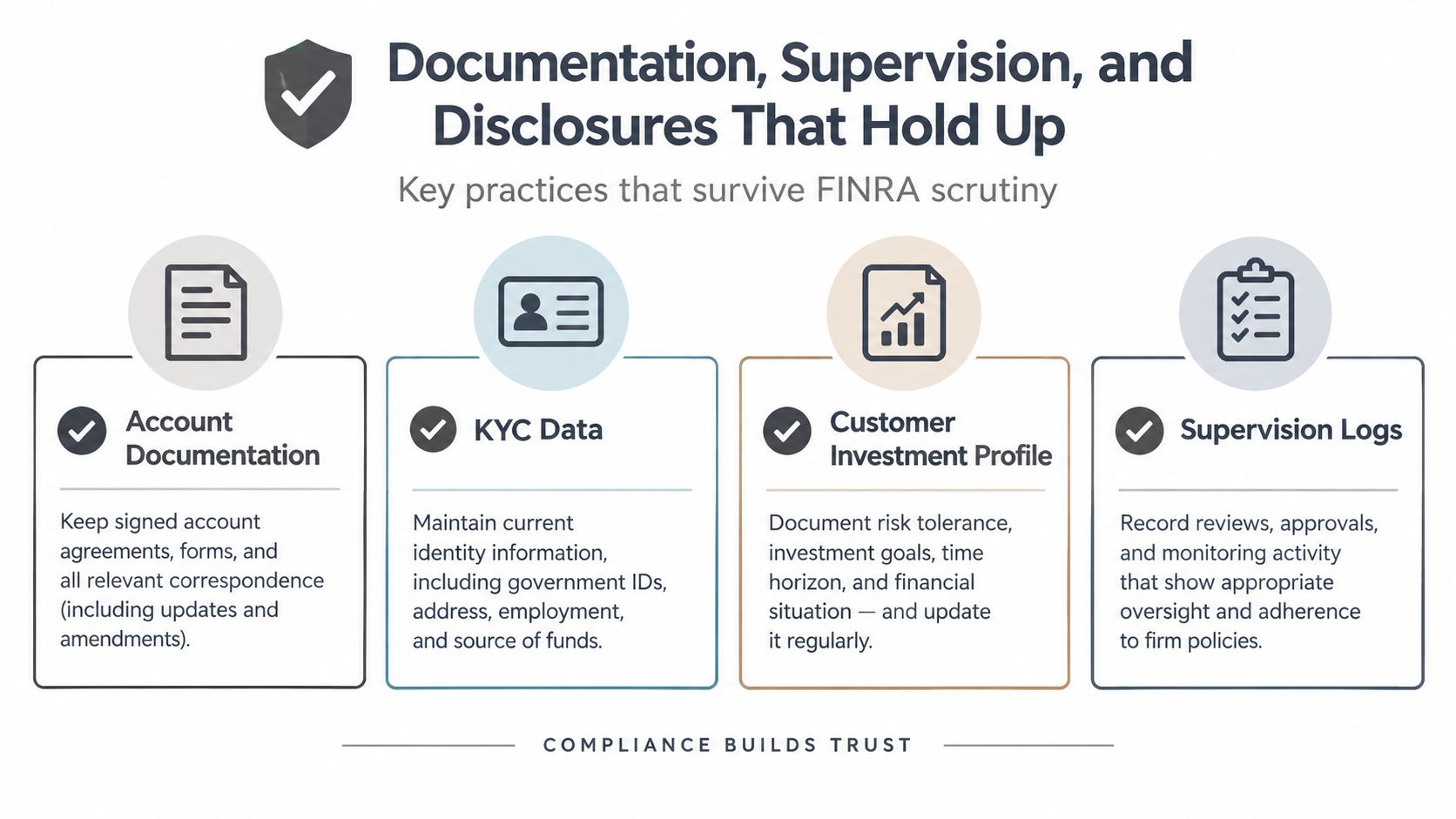
A firm under examination should be able to tell the recommendation's story without reconstructing it from memory. The file should connect the customer's information, the product analysis, the recommendation rationale, the disclosures, and the supervisor's response.
Build the file around the decision
At minimum, the record should make it possible to identify:
- Customer profile: Financial circumstances, investment objectives, experience, time horizon, liquidity needs, tax considerations, and risk tolerance.
- Product analysis: Principal risks, costs, complexity, liquidity limits, alternatives, and the representative's basis for understanding the product.
- Recommendation rationale: Why this strategy or security addressed the customer's stated needs at that time.
- Conflict record: Compensation, proprietary status, revenue sharing, incentives, and the control applied to each material conflict.
- Approval trail: The principal or supervisory system that reviewed the recommendation, including questions, responses, and any escalation.
- Follow-up evidence: Account review notes, customer communications, exception reports, and remediation records.
A risk questionnaire can support the analysis, but it can't replace judgment. “Moderate risk” doesn't explain why a complex, illiquid, or concentrated product was preferable. A short contemporaneous note that identifies the customer's objective, the relevant product features, the material trade-off, and the supervisor's conclusion is usually more useful than a long templated form.
Supervision should test behavior
A practical workflow might require principal review of new-account documentation, surveillance for product concentration, and escalation of transactions that involve heightened complexity or compensation. The firm should also review outside activity reports, revenue-sharing arrangements, and proprietary product placements through a defined procedure:
- Identify the activity, product, or compensation arrangement.
- Compare the recommendation pattern with the customer profiles involved.
- Confirm that required disclosures were delivered and recorded.
- Review whether the representative considered alternatives.
- Escalate unexplained patterns to compliance or a supervisory principal.
- Document the conclusion, remediation, and follow-up testing.
Form CRS is separate from recommendation activity. Firms that offer services to retail investors must provide the prescribed relationship summary covering services, fees, conflicts, and legal or disciplinary history, whether or not the firm makes recommendations, as FINRA explains in its 2025 annual regulatory oversight report.
For retention and retrieval practices, firms should align the workflow with applicable record retention requirements. Examiners commonly request customer profiles, recommendation notes, surveillance exceptions, branch inspection materials, disclosure records, and remediation evidence. If the firm can't find the record, it may be unable to prove the control worked.
When a Conversation Becomes a Recommendation
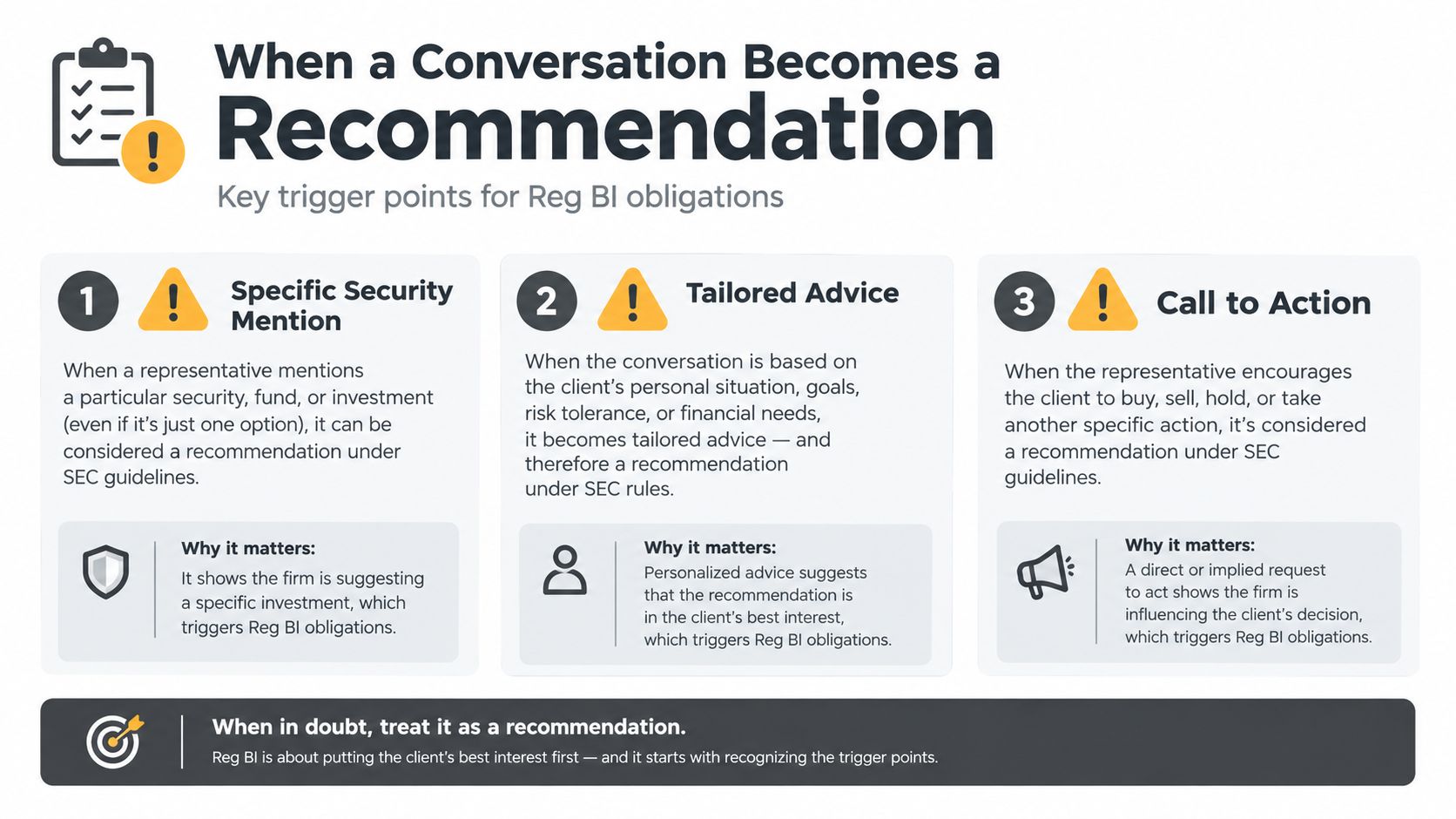
The most dangerous assumption is that Reg BI begins only when a customer signs an order. The obligation chain begins earlier, when a communication becomes a recommendation.
The SEC's framework asks whether the communication reasonably could be viewed as a suggestion, whether the customer reasonably could act on it, whether it concerns a specific security or strategy, and whether it arises from individualized investor interaction. No single factor decides every case. Context matters.
Informal channels create formal exposure
An advisor may mention a preferred complex product during a portfolio review. A wholesaler may join a client call and explain why a particular strategy could address the customer's income concern. An educational email may start with general information and end with a sentence telling the customer what to buy or change.
Each communication deserves classification review. A screenshot sent by text, a message in a collaboration platform, a social media direct message, or a recorded line can become evidence of a recommendation. The communication doesn't need to resemble a formal research report. A conversational suggestion can be enough if the customer could reasonably view it as a course of action suited to the customer's situation.
Audit the gray areas before an examiner does
Firms should sample communications that include:
- Specific securities: A product name, ticker, strategy, or account type.
- Individualized facts: References to the customer's age, holdings, income needs, losses, or objectives.
- Action language: Suggestions to buy, sell, exchange, roll over, allocate, or change an account.
- Third-party participation: Wholesaler or product sponsor involvement in a customer-facing conversation.
- Educational drift: General content that moves into a personalized conclusion.
Classification is fact-intensive. General education, marketing, and non-recommendation activity may fall outside Reg BI, but a firm shouldn't rely on a communication label if the substance points the other way. Once an examiner frames the exchange as a recommendation, ambiguity rarely helps the firm, particularly when there's no record of customer information, product analysis, or conflict review.
Responding to FINRA Inquiries and Form U5 Issues
A FINRA inquiry may begin as a routine cycle examination and become a targeted Reg BI review. The request often narrows to particular representatives, products, customer profiles, supervisor attestations, recommendation notes, account review records, branch inspection reports, and exception reports.
The response should start with preservation, not advocacy. Suspend ordinary deletion for relevant communications, identify all systems used by the representative, collect emails and messages, and map the recommendation from initial contact through approval, execution, review, complaint, and remediation. A templated file is especially problematic because it may show that a form was completed without showing that anyone exercised judgment.
Build a chronology before drafting explanations
A defensible chronology identifies the customer, the communication that may have triggered Reg BI, the product or strategy, the representative's information, the conflict, the supervisor, the disclosure delivery, and the firm's response. Then organize the evidence under the four obligations rather than preparing a generalized statement that the transaction was suitable.
Form U5 issues add an employment and reputation dimension. A firm may expand the reason-for-leaving narrative when it believes the circumstances involve a Reg BI concern, customer complaint, supervision issue, or other reportable event. The departing representative should review the proposed narrative carefully, preserve supporting records, and understand the available responding process under FINRA's rules and the CRD/U5 amendment mechanism. The FINRA Form U5 resource provides context for the issues that can arise when a separation record becomes part of a regulatory dispute.
Under the framework described in FINRA Rule 8310 and the underlying U5 process, a representative may have rebuttal rights under Rule 8310(d). The response should address accuracy, completeness, chronology, and the distinction between an allegation, a disputed conclusion, and an established finding.
| Trigger | Where It Surfaces | Documentation Defense |
|---|---|---|
| Product-specific recommendation | FINRA request for transaction and customer files | Customer profile, product review, rationale, disclosure, and approval record |
| Concentration or repeated use of a product | Surveillance exception report or branch examination | Exception review, escalation notes, customer-specific analysis, and remediation |
| Compensation or proprietary-product concern | Conflict review or targeted inquiry | Conflict inventory, mitigation control, compensation disclosure, and testing |
| Missing supervisory evidence | Principal attestations and inspection materials | Dated supervisory notes showing questions, responses, and conclusions |
| Expanded Form U5 narrative | CRD record and departing representative response | Communications, employment chronology, rebuttal, and supporting documents |
The quality of the supervisory record often decides the case. Rule interpretation matters, but investigators first look for what the firm knew, what it did, and whether the file supports the explanation now being offered.
Kons Law represents financial professionals and firms in Reg BI inquiries, FINRA investigations, securities arbitration, and Form U5 disputes. If you want to discuss your business law matter, contact Kons Law at (860) 920-5181 or visit Kons Law.
