
A complaint notice from the CFP Board can arrive on an otherwise ordinary workday. The advisor may believe the recommendation was reasonable, the client may have received the required paperwork, and the firm's compliance department may have approved the process. None of that makes the notice inconsequential. A CFP Board inquiry can create reputational exposure, threaten the advisor's certification, and trigger related questions from a broker-dealer, FINRA, an employer, or a prospective firm.
The CFP Board Code of Ethics and Standards of Conduct is therefore more than a statement of professional ideals. It's an operating standard for financial advice, client communications, conflicts, confidentiality, and professional behavior. Advisors who understand how the Code works can make better decisions before a complaint arrives, preserve evidence when one does, and avoid treating a CFP Board matter as an isolated credential issue.
Why the CFP Board Code of Ethics Matters for Your Practice
The first mistake many advisors make is assuming that a complaint must involve an obviously harmful investment recommendation. The CFP Board's Code applies whenever a CFP professional provides financial advice or serves clients, so the issue might instead involve a compensation explanation, an outside business activity, a client communication, confidential information, or the way a conflict was handled. The Code reaches beyond portfolio construction.
A complaint creates several risks at once
Suppose a client alleges that an advisor recommended a product because it generated compensation. The advisor may respond that the product was suitable, the client signed the paperwork, and the firm approved the transaction. Those facts may matter, but they don't answer the separate question of whether the advisor met the CFP Board's fiduciary and disclosure obligations.
The advisor now has to consider several parallel concerns:
- Certification risk: The CFP Board can investigate and impose discipline affecting the advisor's ability to use the CFP marks.
- Employment risk: The employer may review the allegation under internal policies, supervisory procedures, and employment agreements.
- Broker-dealer risk: A registered representative may face related questions from the firm or FINRA.
- Disclosure risk: A termination or regulatory event may create issues involving future registration and Form U5 reporting.
- Litigation risk: The client, employer, partner, or recruiting firm may assert separate contractual or business claims.
Practical rule: Treat the first complaint notice as a preservation event. Save the relevant client file, emails, texts, meeting notes, presentations, disclosures, and supervisory records before anyone edits or deletes them.
A defensive response also requires discipline. Do not send an emotional explanation to the client, speculate about motive, or provide a broad narrative before identifying the allegation and the governing standard. The better approach is to map each allegation to the applicable Code provision, identify the documents that support your position, and assess the effect on every related regulatory or employment relationship.
The Code matters because it gives the CFP Board a framework for evaluating conduct, while the surrounding institutions may apply different standards and procedures. A decision that seems acceptable under a firm's ordinary process may still create CFP Board concerns. Conversely, a CFP Board complaint may be defensible even when an employer or FINRA investigation creates independent exposure. Advisors need a coordinated strategy, not separate explanations prepared in isolation.
The Evolution of CFP Board Ethical Standards
A complaint involving conduct from several years ago can turn on the version of the CFP Board standards in force at the time. That timeline matters when the same conduct is later reviewed by CFP Board, FINRA, an employer, or a court handling an employment dispute.
The predecessor organization introduced its first Code of Ethics in 1985, and CFP Board adopted a Code of Ethics and Standards of Professional Conduct in 1986. CFP Board revised the standards again in 1988 and 1993, reflecting changes in advisory practice. CFP Board's history of its fiduciary standard documents that development.
From general ethics to defined obligations
A major revision was adopted in May 2007. It took effect on July 1, 2008, with enforcement beginning January 1, 2009. The three dates represent different legal and compliance events: adoption, effectiveness, and enforcement. That distinction can affect how an advisor responds to an allegation involving a transition between standards.
In March 2018, CFP Board adopted a new Code of Ethics and Standards of Conduct. The Code became effective on October 1, 2019, and enforcement began on June 30, 2020. The current Code of Ethics and Standards of Conduct sets out the more formal framework.
Earlier codes could be read as broad professional commitments. The modern framework imposes defined duties, disclosure expectations, procedural requirements, and potential sanctions. Good faith alone may not answer the question. CFP Board will examine whether the advisor's process, communications, and records satisfy the applicable obligation.
That analysis also matters outside CFP Board. A firm may review the same conduct under supervisory policies, FINRA may examine registration or customer-related issues, and an employer may rely on the record when preparing a Form U5 or defending a termination. The operative standard and procedure may differ across each forum, so an advisor should not assume that one explanation will resolve every exposure.
Why the timeline affects defense preparation
Start with the date of each relevant event. Identify the Code version that applied, then separate the conduct date from the complaint date, investigation date, and any employment action. A later policy or current template does not automatically answer a historical allegation.
Ethical expectations have become more operational. Maintain a written compliance history, update templates when standards change, train staff on revised procedures, and record implementation dates. A manual without evidence of use carries limited weight. Training records, dated revisions, supervisory reviews, and audit results provide a clearer defense record when CFP Board, FINRA, or an employer asks what the practice did.
Core Principles Every CFP Professional Must Uphold
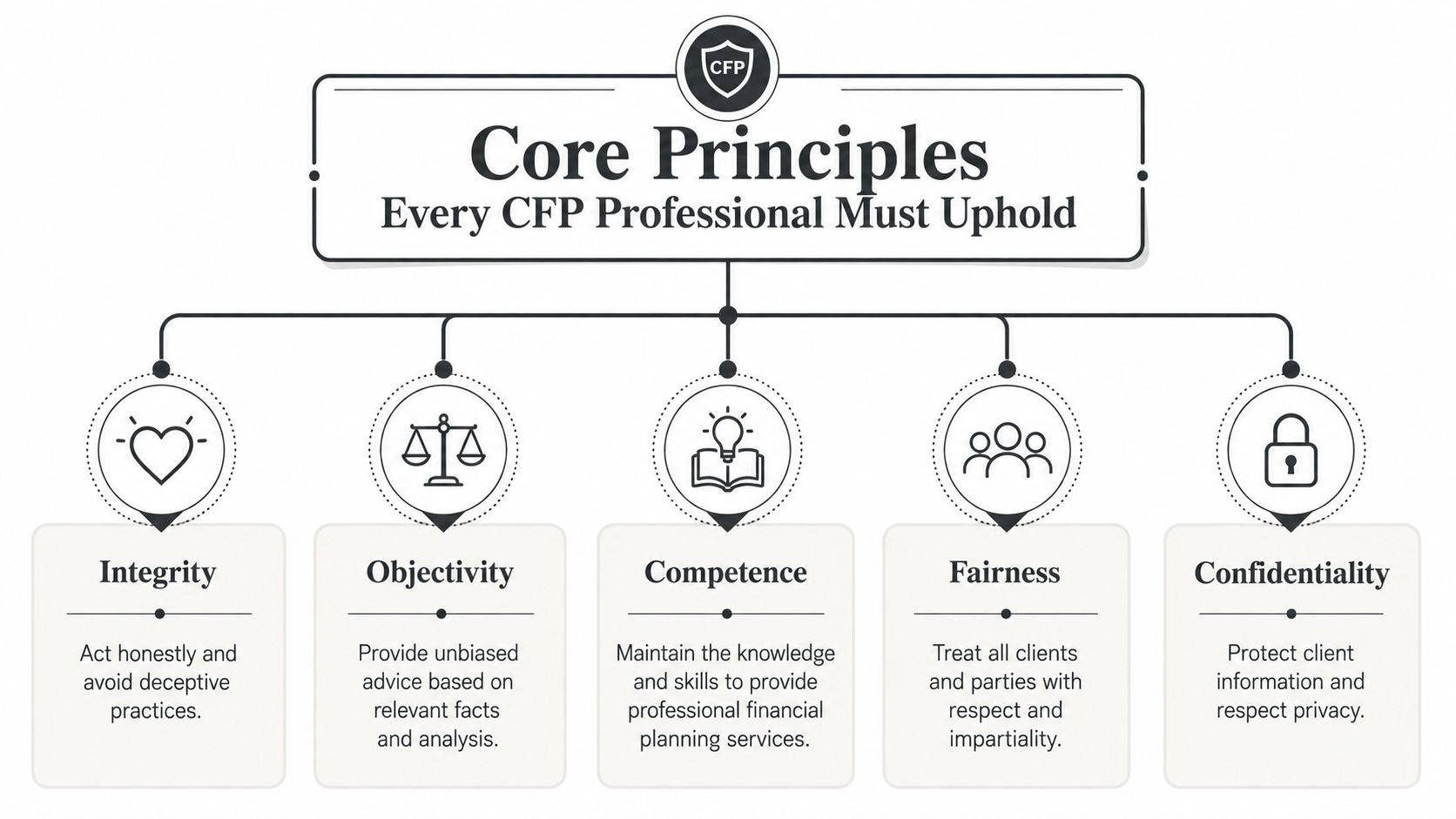
A client complaint can begin with an unsuitable recommendation, then expand into a firm investigation, a FINRA inquiry, or an employment dispute. The same facts may later appear in a Form U5 disclosure. For that reason, the five core principles, integrity, objectivity, competence, fairness, and confidentiality, should guide both client service and the records supporting it.
Integrity and objectivity
Integrity requires honest professional dealings at every stage. Misleading marketing, incomplete explanations, inaccurate questionnaires, and evasive responses during a firm investigation can create regulatory and employment problems even when no client reports a financial loss. Anyone responding to a complaint should examine the recommendation and every statement about compensation, expertise, services, and results.
Objectivity requires impartial professional judgment. Personal incentives cannot determine a recommendation. A useful compliance file identifies the client's objectives, explains why the recommendation fit those objectives, records reasonable alternatives, and shows how the advisor addressed incentives that could affect the advice. Those records may also help an advisor challenge an inaccurate account of events in a FINRA investigation or employment proceeding.
Competence, fairness, and confidentiality
Competence means maintaining the knowledge and skill needed for the engagement. It also requires recognizing limits. A sound process may involve explaining those limits, consulting a qualified professional, or declining work outside the engagement's scope.
Fairness requires consistent procedures and equitable treatment. Comparable clients may receive different recommendations because their circumstances differ, but the advisor should be able to explain differences in fees, service levels, product access, or communications. That explanation matters if a former employer later characterizes a client dispute as misconduct in a Form U5.
Confidentiality covers client information in internal discussions, vendor systems, shared devices, email, messaging platforms, and dispute materials. A departing employee or partner should not copy or use client data outside authorized business purposes. Preserving relevant records while restricting unauthorized access is the practical balance.
Conflicts require more than a signed form
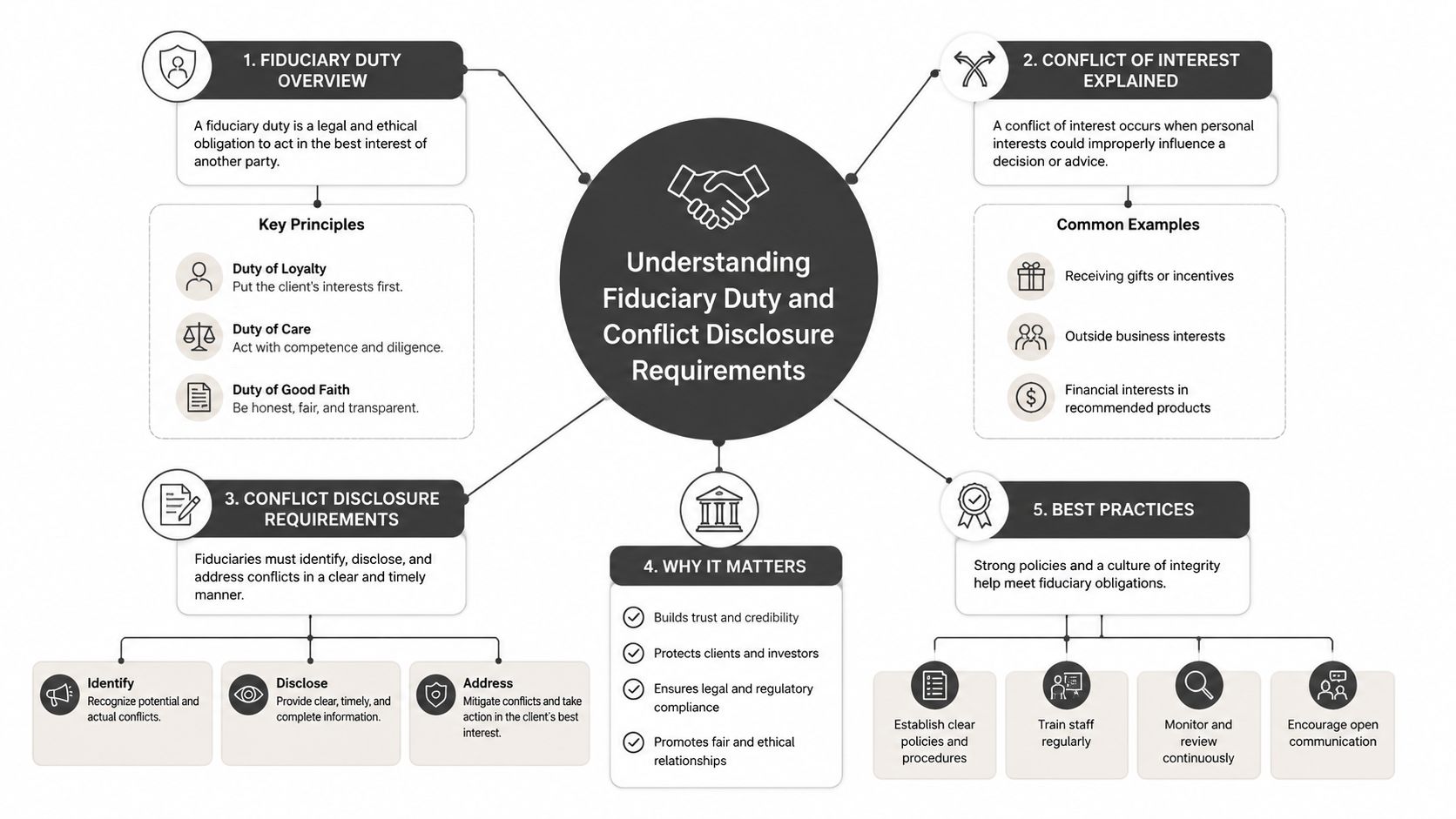
CFP professionals should avoid conflicts when possible and disclose and manage them when avoidance is not possible. A statement that an advisor “may have conflicts” does not explain the business practice creating the risk. The client should understand the conflict, its possible effect on the recommendation, and the controls used to manage it.
Compliance insight: A signed disclosure proves delivery. It does not prove understanding, specificity, or informed consent.
Suspected investment misconduct calls for prompt preservation of transaction records and careful consideration of client recovery options. This investment fraud recovery guide offers context for evaluating potential claims after an investment loss. The same records may become relevant to CFP Board, FINRA, or an employment dispute, so deletion or selective preservation can create a separate defense problem.
Understanding Fiduciary Duty and Conflict Disclosure Requirements
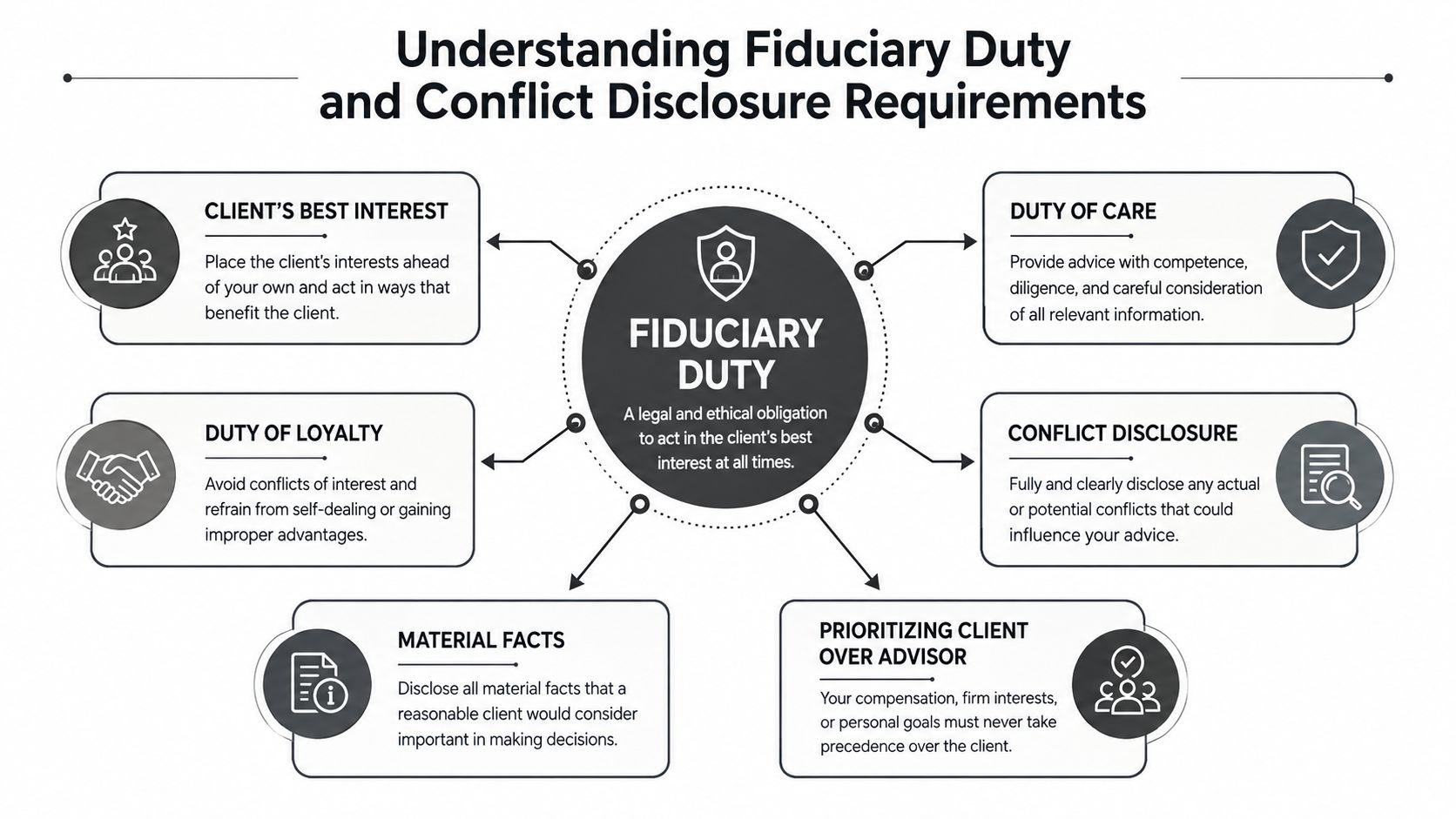
A CFP professional owes a fiduciary duty when providing financial advice. That duty requires acting in the client's best interests, avoiding conflicts when possible, and fully disclosing and managing material conflicts when avoidance isn't possible. CFP Board's guidance on the duty to disclose material conflicts explains that a conflict is material when a reasonable client or prospective client would consider it important in making a decision.
What makes a disclosure adequate
A material conflict can arise from compensation, product access, referral arrangements, ownership interests, business relationships, or incentives connected to retaining client assets. The existence of a conflict isn't automatically misconduct. The risk increases when the advisor minimizes it, discloses it in vague language, or fails to explain the business practice that creates it.
CFP Board guidance requires sufficiently specific facts so a reasonable client can understand both the conflict and the business practices behind it. A useful disclosure should answer practical questions:
- What is the relationship? Identify the advisor, firm, affiliate, product provider, or other participant.
- What benefit may result? Explain the compensation, referral value, ownership interest, or other incentive.
- How could it affect the advice? Describe the decision or recommendation that may be influenced.
- How will the conflict be managed? State the review, approval, monitoring, or client-choice process.
- What should the client consider? Explain meaningful alternatives or limitations.
The difference between a usable disclosure and a defensive form is often factual detail. “We may receive compensation” leaves the client guessing. A more useful explanation identifies the type of compensation, the service or product connected to it, and the steps taken to prevent the incentive from controlling the recommendation.
Scope and recordkeeping matter
An advisor who provides budgeting and cash-flow work should define whether that service is standalone, part of a broader planning engagement, or connected to investment advice. Resources on budgeting and cash-flow planning can help advisors and clients distinguish planning functions from implementation decisions, but the engagement letter must still describe the actual relationship.
A fiduciary analysis also benefits from a clear written scope. Advisors should identify the client, services, assumptions, responsibilities, limitations, compensation, conflicts, and monitoring obligations. Keep the scope consistent across the agreement, Form ADV disclosures where applicable, marketing language, and meeting notes.
For a focused discussion of the applicable professional obligation, advisors can review this financial planner fiduciary duty analysis. The practical point is simple: a disclosure should help a reasonable client decide, not merely help an advisor point to a signed page after a complaint.
CFP Board Enforcement Process and Potential Sanctions
A CFP Board matter generally begins with a complaint or information suggesting possible misconduct. The Board may seek documents, communications, explanations, and other records. The respondent should read the notice closely, calendar every deadline, preserve relevant materials, and avoid contacting potential witnesses in a way that could appear coercive or coordinated.
The procedural path can include investigation, a formal response, hearing procedures, and a final disciplinary outcome. The respondent has an interest in understanding the allegations, identifying factual disputes, presenting supporting evidence, and preserving procedural objections. A rushed response often creates unnecessary admissions or inconsistent explanations that later affect FINRA, employment, or litigation matters.
Sanctions have different meanings
CFP Board's disciplinary system includes private censure, public censure, suspension, revocation of CFP certification and the trademark license, and temporary or permanent bars on obtaining CFP certification. The procedural rules explain that suspension leaves the respondent subject to certification terms while prohibiting use of the CFP marks. Revocation terminates certification and the trademark license. These distinctions appear in CFP Board's procedural rules.
| Sanction Type | Definition | Career Impact |
|---|---|---|
| Private censure | A private disciplinary reprimand | May limit public visibility of the matter, but can still affect future responses and professional standing |
| Public censure | A disciplinary reprimand made public | Can affect reputation, client confidence, recruiting, and firm supervision |
| Suspension | Certification continues subject to terms, but CFP marks can't be used during the suspension | Interrupts use of the designation and may require employment and marketing changes |
| Revocation | Certification and the trademark license end | Prevents continued use of the CFP marks and can materially change the advisor's professional profile |
| Temporary or permanent bar | The individual is barred from obtaining CFP certification for the specified period or permanently | Can prevent future certification and restrict long-term career options |
Discipline can protect the profession, not just clients
CFP Board's revised sanction guidelines became effective January 1, 2024, and its current sanction schedule is effective July 1, 2024 through May 30, 2026, as stated in the revised sanction guidelines. The guidelines address conduct that reflects adversely on a professional's integrity or on the profession. That means direct financial harm isn't the only concern. Conduct that undermines confidence in CFP professionals can also influence the disciplinary analysis.
Advisors should assess settlement and hearing decisions with that broader impact in mind. A quick resolution may reduce cost and uncertainty, but an agreement can create public disclosure, employment consequences, or admissions that affect another proceeding. Contesting the matter may preserve important defenses, but it requires organized evidence and a realistic assessment of credibility, records, and potential sanctions. Counsel familiar with securities investigations can help coordinate the CFP Board response with related regulatory exposure.
How CFP Board Complaints Intersect with FINRA and Employment Issues
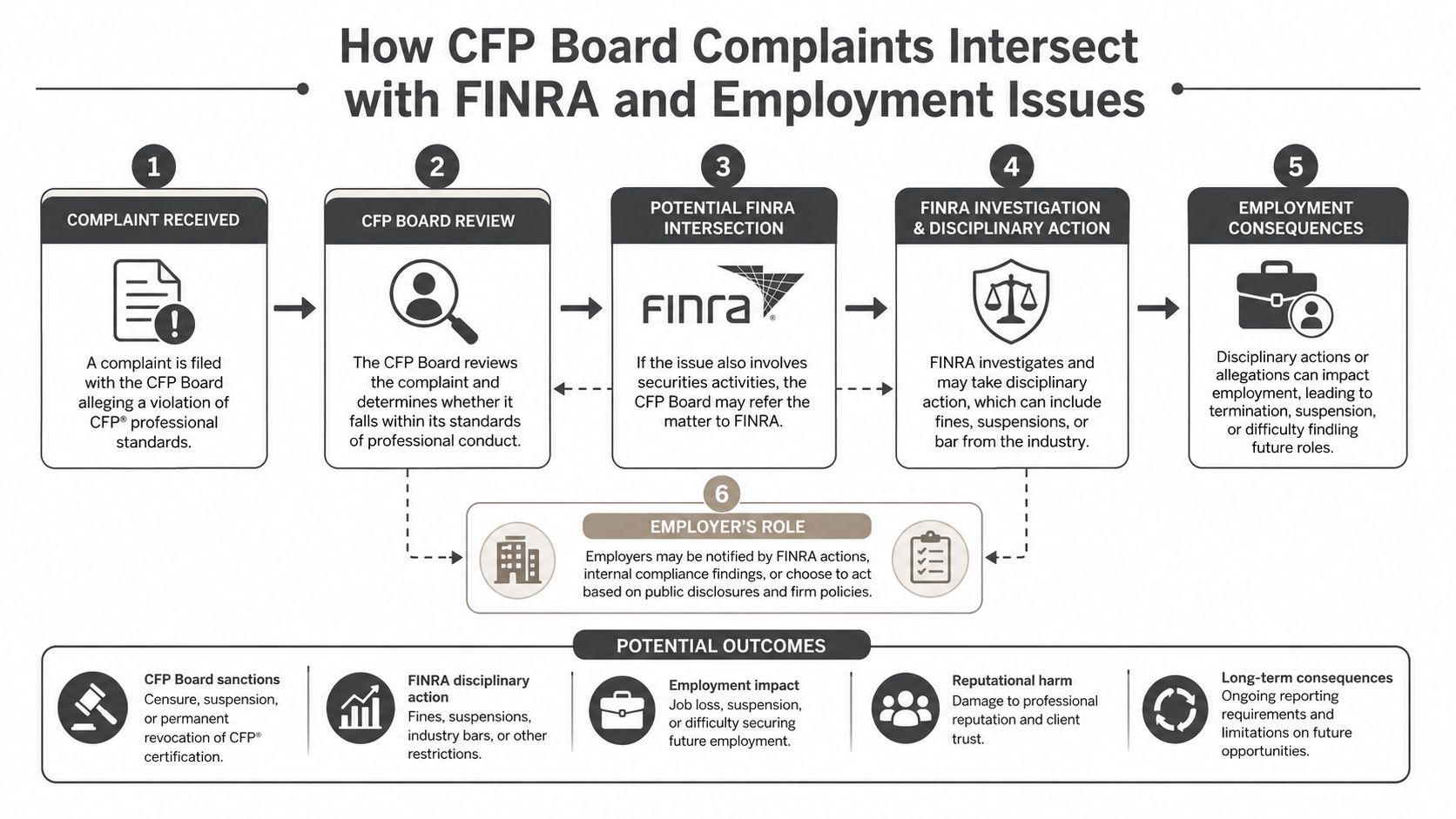
A CFP Board complaint rarely stays confined to the designation. An advisor who is also a registered representative may receive a FINRA inquiry, including a request for information under Rule 8210, while the broker-dealer conducts its own supervisory review. The CFP Board and FINRA are separate organizations with different authorities, procedures, and objectives. A response prepared for one may create admissions or inconsistencies in the other.
Form U5 requires careful attention
If an employment relationship ends, the broker-dealer's Form U5 disclosure may become central to the advisor's next job search. The wording can affect how recruiting firms evaluate the departure, whether a successor firm requests clarification, and whether the advisor must defend the accuracy or completeness of the disclosure. A CFP Board complaint, investigation, sanction, or related termination may create Form U5 questions depending on the facts and the employer's reporting analysis.
Advisors should not assume that a CFP Board matter will automatically appear on Form U5, or that it can never be relevant. The correct approach is to examine the specific allegation, the employment event, the stated reason for termination, the firm's reporting obligations, and the factual support for each proposed description. Review the record before signing a statement or accepting language that is materially misleading.
This Form U5 and FINRA guidance is relevant when an advisor needs to evaluate reporting language, respond to a disputed disclosure, or prepare for a related employment dispute.
Employment disputes often develop alongside regulatory matters
A firm may terminate an advisor after receiving a complaint, withhold a bonus or deferred compensation, demand repayment under a promissory note, or restrict access to firm and client systems. The advisor may contend that the termination was wrongful, discriminatory, retaliatory, or inconsistent with the employment agreement. A departing partner may also face a partnership breakup involving ownership, client relationships, restrictive covenants, or confidential information.
The defense must account for these overlapping interests. The advisor may need to challenge an inaccurate Form U5 while cooperating with FINRA, defend a CFP Board allegation while preserving employment claims, and protect client confidentiality while collecting evidence. Separate counsel teams can work efficiently, but they need a coordinated factual record and a clear privilege strategy.
A regulatory response can become evidence in an employment case. An employment email can become evidence in a regulatory inquiry.
Document chronology is especially important. Preserve the complaint notice, supervisory communications, termination documents, compensation plan, partnership agreement, recruiting materials, client transition records, and all versions of proposed disclosures. Don't copy client files casually or remove data that belongs to the firm. Obtain legal advice before taking records, contacting clients, or making public statements.
Practical Compliance and Defense Strategies for CFP Professionals
The strongest defense usually begins before the complaint. Advisors should build a file that allows another person to understand what happened, why the recommendation was made, what the client knew, and how the advisor addressed competing incentives.
Build a defensible operating record
Use a repeatable process:
- Document client decisions: Record goals, relevant facts, assumptions, alternatives, recommendations, client questions, and follow-up instructions.
- Make conflicts specific: Identify the relationship or incentive, explain its potential effect, and document how the conflict was avoided or managed.
- Audit the practice: Review marketing, compensation descriptions, engagement letters, CRM notes, email templates, and outside business activity disclosures.
- Control communications: Use approved systems, preserve text and messaging records, and avoid informal explanations that contradict formal disclosures.
- Track changes: Record when policies, templates, training, and supervisory procedures were updated.
If a complaint arrives, stop treating it as a routine client-service issue. Preserve evidence, identify every related institution, review deadlines, and avoid contacting the complainant or witnesses without a strategy. Experienced counsel should evaluate the CFP Board allegations alongside possible FINRA requests, Form U5 language, termination claims, compensation disputes, partnership issues, and promissory note exposure.
A regulatory compliance attorney can help an advisor assess the governing standards, prepare a factual response, and coordinate the defense across regulatory and employment forums. The right strategy may involve cooperation on undisputed facts, a focused challenge to unsupported allegations, negotiation over sanction language, or preparation for a contested proceeding. The answer depends on the record, not on a generic response template.
If you want to discuss your business law matter, contact Kons Law at (860) 920-5181. Kons Law advises financial professionals on CFP Board complaints, FINRA investigations, Form U5 disputes, employment claims, compensation issues, and related business litigation. Visit Kons Law to discuss how counsel can help protect your certification, professional record, and broader career interests.
