
When you're starting a business with someone, one of the first and most important conversations you'll have is about how to structure it legally. This isn't just paperwork—it's the foundation of your entire venture. The legal entity you choose will define everything from personal liability and management roles to how the business is taxed.
Getting this wrong can have serious consequences. A poorly chosen structure could put your personal assets, like your home and savings, on the line for business debts. On the other hand, the right structure acts as a vital shield, creating a clear separation between your personal finances and the company's obligations.
Let's break down the most common partnership structures to help you figure out which one fits your situation.
General Partnership (GP)
A General Partnership is the most straightforward way to structure a business. In fact, you can form one without filing any official paperwork. If you and a partner simply start a business together, you've likely created a GP by default.
But this simplicity comes with a major risk: unlimited personal liability. In a GP, every partner is 100% personally responsible for all business debts, even those incurred by another partner. If your partner racks up a huge bill or gets sued, creditors can come after your personal assets to cover it. Because of this, a GP is really only suitable for low-risk ventures where the partners have an immense amount of trust in one another.
Limited Partnership (LP)
A Limited Partnership introduces a bit more complexity but also more protection for certain partners. An LP has two distinct types of partners:
- General Partners: They are the ones running the show—managing the daily operations of the business. Just like in a GP, they have unlimited personal liability for the business's debts.
- Limited Partners: These are typically passive investors. They contribute capital to the business but don't get involved in management. In exchange for this hands-off role, their liability is limited to the amount of money they invested.
This structure is a great fit for businesses that need to raise money from investors who want a stake in the company without the risk of managing it.
Limited Liability Partnership (LLP)
For professional service firms—think law firms, accounting practices, or architectural groups—the Limited Liability Partnership is often the go-to choice. An LLP provides a critical layer of protection for all its partners.
The main benefit here is that partners are shielded from liability for the professional malpractice or negligence of their other partners.
In an LLP, you're protected from the financial fallout of your partner's professional mistakes. This is a huge advantage over a General Partnership. However, it's important to remember you are still personally liable for your own misconduct and for the general debts of the business.
This decision tree can help you visualize which structure aligns best with your primary goals.
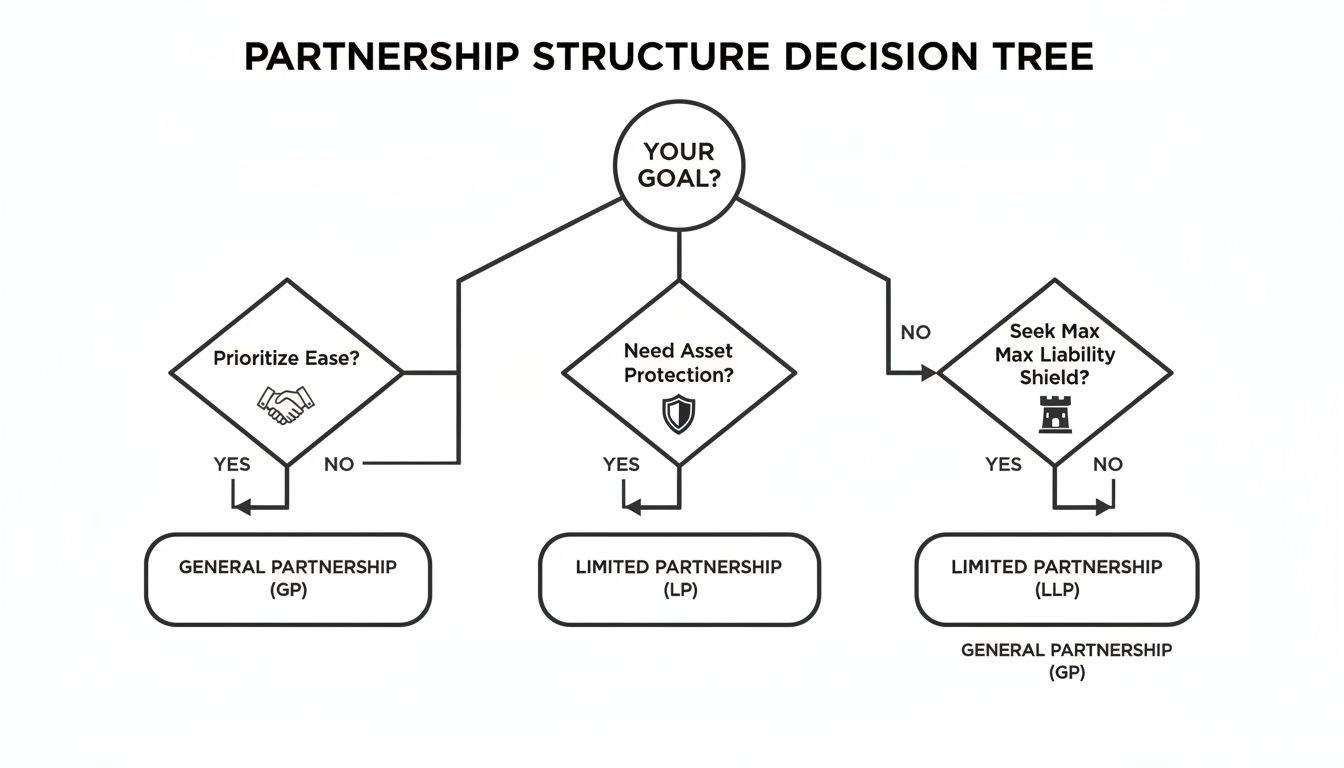
As the graphic shows, whether you prioritize simplicity, asset protection, or a robust liability shield will point you toward the right entity. To help clarify these distinctions further, here's a side-by-side comparison.
Comparing Core Business Partnership Structures
| Feature | General Partnership (GP) | Limited Partnership (LP) | Limited Liability Partnership (LLP) |
|---|---|---|---|
| Personal Liability | Unlimited for all partners. Personal assets are at risk for all business debts. | Unlimited for general partners; limited to investment for limited partners. | Limited. Partners are not liable for each other's professional negligence. |
| Management Control | All partners typically have equal management rights, unless agreed otherwise. | General partners manage the business; limited partners have no management role. | All partners can participate in management. |
| Best For | Low-risk ventures, high-trust relationships, simple setups. | Businesses seeking investment from passive partners (e.g., real estate). | Professional service firms (attorneys, accountants, architects). |
No matter which structure you land on, a comprehensive internal agreement is non-negotiable. For LLCs, which offer similar protections to LLPs, this governing document is crucial. You can learn more by reading our detailed guide that explains what is an operating agreement. This document, much like a partnership agreement, is where you'll spell out all the rules of the road for your business.
Crafting Your Partnership Agreement
Think of your partnership agreement as the constitution for your business. When you're just starting, a handshake and verbal promises can feel like enough. But when the pressure is on, those unwritten understandings often crumble, leaving you in a mess of ambiguity and conflict.
This legally binding document is your single best defense against future disputes. It’s not just a formality; it’s a custom-built road map that lays out exactly how your business will operate, make decisions, and handle challenges. Without one, you’re flying blind and putting your investment and livelihood at risk.

Defining Capital Contributions
One of the first things you need to nail down is capital contributions. It's rarely as simple as everyone writing a check for the same amount. Contributions come in all shapes and sizes, and your agreement must spell out their value and the ownership stake they buy.
- Cash Investments: The most straightforward. Your agreement must state the exact dollar amount each partner is putting in and by what date.
- Property or Equipment: Is someone contributing a building, a company vehicle, or critical machinery? You'll need a professional appraisal to assign a fair market value, which then gets documented as their contribution.
- Intellectual Property: When a partner brings a patent, trademark, or proprietary code to the table, its value has to be properly assessed and credited.
- Sweat Equity: This is for the partner contributing their time and skills instead of cash. Quantifying this can be tricky but is absolutely essential. We often structure this as an ownership stake that vests over time, tied to hitting specific performance milestones.
Getting this wrong can ignite major fights over ownership percentages later on. Be precise.
Establishing Profit and Loss Distribution
So, how does everyone get paid? The default isn't always a 50/50 split, and frankly, that's often not fair. Your agreement needs to detail the exact formula for allocating profits and losses.
You might tie distributions directly to the percentage of initial capital contributed. Or, you could use a tiered approach where one partner who handles the day-to-day grind receives a guaranteed payment (like a salary) before the remaining profits are divided.
It's just as important to define when distributions happen. Will it be quarterly? Annually? At the discretion of a managing partner? This clarity prevents arguments over reinvesting profits versus taking money out of the business.
Setting Rules for Governance and Decision-Making
Every partnership has to make decisions, from the small stuff to the company-altering moves. Who has the final say? Your agreement needs a clear governance structure.
For everyday operational choices, you can empower individual partners to act on their own. But for the big-ticket items, you need a formal voting process. Major decisions should require a majority, or in some cases, a unanimous vote.
Examples of Major Decisions Requiring a Vote:
- Taking on significant debt, like a loan over $25,000.
- Bringing in a new partner or buying out an existing one.
- Making a capital purchase that blows past the agreed-upon budget.
- Pivoting the core mission or direction of the business.
- Signing a contract with a value that exceeds a set threshold.
This structure functions much like corporate bylaws. For a closer look at how these governing documents work in a corporate setting, our guide on what is a shareholders' agreement provides some great parallels. A clear process ensures no single partner can make a huge decision that affects everyone else without getting proper buy-in.
If you want to discuss your business law matter, contact Kons Law at (860) 920-5181.
Building a Modern Partner Ecosystem for Growth
When you think about how to structure a business partnership today, the conversation has moved far beyond a simple one-to-one agreement. The most successful ventures I see are built on interconnected networks—or ecosystems—where multiple partners all contribute to mutual growth. This strategy transforms a single partnership into a powerful, scalable engine for expanding your market and generating serious revenue.
Instead of operating in a silo, modern partnerships thrive by strategically aligning with a variety of players. This could mean collaborating with technology partners who integrate your product, distributors who broaden your reach, or even affiliate marketers who drive new leads. The real goal is to create a web of relationships where everyone benefits from the collective momentum.

Designing Your Ecosystem Framework
Your first step is to map out what this ideal ecosystem actually looks like. Who are the key players that can help you reach your target customers more effectively? This requires a fundamental shift in mindset from direct sales to enabling others to sell for you or with you.
This kind of strategic expansion is becoming absolutely critical for business-to-business success. In the evolving B2B world, structuring your partnership around an expanding ecosystem is key. Forrester's 2025 Partner Ecosystem Marketing Survey confirms this, showing that most decision-makers anticipate growth in all partner types, especially technology and distribution partners.
What’s really telling is that 67% of the organizations surveyed expect their indirect revenue—the money generated through partners—to grow by over 30% compared to last year. You can dig deeper and discover insights from the Forrester partner ecosystem survey to see where the market is headed.
To manage these different relationships effectively, I often advise clients to create partnership tiers. This lets you offer varying levels of support, resources, and incentives based on a partner's performance and commitment.
Example of a Tiered Partner Structure:
- Bronze Tier: Your entry-level partners. They receive basic marketing materials and a standard commission. This is a great, low-overhead way to get new affiliates on board.
- Silver Tier: For partners who hit specific sales targets. They get access to co-marketing funds, dedicated support, and higher commission rates.
- Gold Tier: These are your top-performing strategic partners. They receive exclusive benefits like joint business planning, early access to new products, and the highest level of support.
A tiered approach like this doesn't just organize your network. It creates a clear path for partners to grow within your ecosystem, giving them a real incentive to invest more in the relationship.
Crafting Agreements That Incentivize Performance
Once you have a framework, your partnership agreements need to drive the right behaviors. Generic, one-size-fits-all contracts just won't cut it in a dynamic ecosystem. Your agreements should include clauses that directly reward performance and align with your core business goals.
A well-structured partner agreement is more than a legal safeguard; it's a strategic tool. It should clearly define success metrics and link them to tangible rewards, transforming your partners from passive resellers into proactive growth drivers.
Think about including specific, measurable incentives that go beyond a simple revenue share.
Effective Incentive Clauses to Include:
- Milestone-Based Bonuses: Offer a one-time bonus when a partner hits a key milestone—like closing their first ten deals, completing an advanced certification on your product, or generating a set number of qualified leads.
- Performance Accelerators: Implement clauses where commission rates increase as sales volumes climb. For example, a partner might earn 15% on their first $50,000 in sales and jump to 20% on everything after that.
- Marketing Development Funds (MDF): Allocate funds that partners can use for co-branded marketing campaigns. The agreement should be very specific about how these funds are earned (e.g., based on the previous quarter's sales) and what activities they can be used for, ensuring the investment drives real results.
By building these performance-based elements directly into your legal structure, you create a system that is both fair and highly motivating. It ensures that as your partners succeed, your business grows right alongside them.
If you want to discuss your business law matter, contact Kons Law at (860) 920-5181.
Aligning Your Mission with Strong Governance
A great product or service is just the starting point. What really holds a lasting partnership together is a foundation of shared values and a common mission. When you're structuring your business, weaving that core mission directly into your legal and operational framework is crucial. It stops being a vague idea and becomes a powerful, practical tool for making decisions. This alignment ensures that as your business grows, it’s always growing in the right direction.
Think of your mission as the first filter for every major decision, starting with who you bring on as a partner. You need to look beyond the balance sheet or a fancy resume. Does this person genuinely buy into the "why" behind your business? That shared purpose is the glue that will hold you together when things inevitably get tough.
Embedding Your Mission into Operations
A mission statement hanging on a wall is nothing more than decoration. To give it teeth, you have to embed it directly into your governance structure. This means creating clear protocols that guide how you operate, especially when you’re facing decisions that could impact your reputation or your community.
Strong governance isn't just about avoiding legal trouble; it’s a proven driver of performance, particularly for businesses with a purpose beyond pure profit. According to Momentum's 2025 partnership trends report, 55% of CSR leaders now rank support for local communities as a top benefit of their work. Similarly, KPMG’s Global Family Business Report 2025 found that 67% of high-performing family businesses have formal boards—a full 10% higher than average. This tells us that structured, mission-driven oversight gets results. You can read the full research on partnership trends to see how these strategies are shaping modern business.
For a closer look at the mechanics, our article explaining what is corporate governance provides a great foundation that applies to partnerships of all sizes.
Creating a Mission-Alignment Matrix
So how do you translate your values into measurable action? One practical tool is to build a mission-alignment matrix right into your partnership agreement. It’s a simple framework for evaluating opportunities and tracking progress against both your financial and social goals. More importantly, it keeps everyone accountable to your purpose.
This doesn't have to be complicated. A simple table that lists your core values and assigns metrics to them is all you need to get started.
Sample Mission-Alignment Matrix:
| Core Value | Key Performance Indicator (KPI) | Decision-Making Guideline |
|---|---|---|
| Community Impact | Percentage of profits donated locally; employee volunteer hours. | Does this new venture create local jobs or support community initiatives? |
| Sustainability | Reduction in carbon footprint; use of recycled materials. | Will this supplier partnership align with our environmental standards? |
| Ethical Sourcing | Percentage of suppliers who meet fair trade certification. | Have we vetted this vendor's labor practices before signing a contract? |
By formalizing these criteria, you create an objective lens to view every business decision. It shifts conversations away from subjective opinions and toward a structured evaluation based on what truly matters to your partnership.
This approach helps you build a business that is not only profitable but also purposeful—creating a legacy that all partners can be proud of. It’s the strategic way to ensure your financial success never comes at the cost of your core principles.
If you want to discuss your business law matter, contact Kons Law at (860) 920-5181.
Future-Proofing Your Partnership with AI
In today's market, where every ounce of efficiency counts, technology isn't just a nice-to-have anymore. It's a foundational piece of a smart business partnership. Bringing artificial intelligence into your operations isn't about chasing trends; it's about carving out a real competitive advantage that helps you scale faster and smarter than the competition.
Many partners, especially those just starting out, assume advanced tech is out of their league. But AI is quickly becoming the great equalizer. It gives businesses of all sizes the power to automate mundane tasks, analyze market shifts, and connect with customers in ways that used to be reserved for massive corporations. This is how you close the resource gap and grow without your overhead costs ballooning.
Crafting AI Governance Clauses
If you’re going to use AI in your partnership, you absolutely must address it head-on in your partnership agreement. Leaving this to chance is a surefire recipe for disputes down the road over data ownership, intellectual property, and who’s really in control. Your agreement needs clear, specific clauses that spell out the rules of engagement.
Here are the key areas you need to define:
- Data Sharing Protocols: Get granular. What specific data will be fed into AI systems? Who owns that data, and what are the protections? This covers everything from customer lists and financial records to your unique operational data.
- Intellectual Property Rights: What happens if you and your partners create a new AI-driven tool or process together? Who owns the IP? Your agreement has to lay out ownership, usage rights, and how any money generated from these new assets will be shared.
- Decision-Making Authority: Define where the buck stops. How much autonomy can an AI have? Set firm limits on actions that demand human review and partner sign-off, like major financial commitments or strategic shifts based on AI recommendations.
By hammering out these rules from the start, you build a secure and transparent framework for using AI. This not only insulates the partnership from internal conflict but ensures your tech stack is built on a rock-solid legal foundation.
Structuring Differentiated Support for Tech Adoption
Just handing your partners a new tool isn’t enough. You have to give them a reason to use it. This is where you get strategic with support systems like Marketing Development Funds (MDF). A well-designed framework motivates partners of all sizes to invest in and actually use the technology you provide.
The move toward deeper tech integration is already happening. The Channel Company's 2025 State of Partner Marketing Report found that partners are shifting from just piloting AI to putting it into full production. The survey—which included 44% Managed Service Providers and 30% Value Added Resellers—also uncovered a major funding gap. Larger partners get over 50% of their marketing budget from MDF, while smaller partners are often left footing the bill themselves.
To close that gap and encourage everyone to get on board, think about a tiered MDF structure that rewards AI adoption:
- Base-Level Funding: Start by offering all partners a standard MDF amount for their general marketing efforts.
- Tech Adoption Bonus: Offer an extra layer of funding for partners who complete AI training or integrate specific AI tools into their sales or marketing workflow.
- Performance-Based Grants: Set aside a larger pool of funds for partners who can prove a direct ROI from their AI use, like a jump in lead generation or better conversion rates.
This kind of tiered approach gives partners a clear path to getting more support as they become more tech-savvy, directly tying their growth to your own.
If you want to discuss your business law matter, contact Kons Law at (860) 920-5181.
Planning for Disagreements and Exits
Thinking about the end at the beginning isn’t pessimistic; it’s just smart business. It’s one of the hallmarks of a mature, well-structured partnership. No matter how solid your relationship is today, life happens and circumstances change.
Building dispute resolution clauses and clear exit strategies directly into your partnership agreement is the single best way to sidestep costly, emotionally draining conflicts down the road. This kind of proactive planning gives everyone a clear, mutually agreed-upon roadmap for navigating the tough stuff. It replaces panicked, emotional reactions with a calm, professional process.

The Critical Role of a Buy-Sell Agreement
A buy-sell agreement is an absolutely essential piece of your partnership’s legal foundation. Think of it as a prenup for your business. This is a legally binding contract that dictates exactly what happens if a partner wants—or is forced—to leave. It pre-negotiates the terms of an exit, protecting the remaining owners and making sure the business can keep its doors open.
Without one, a partner's departure can trigger a full-blown crisis. It could potentially force the company to be liquidated or lead to a messy and incredibly expensive court battle over the value of their share. This isn't just a document; it's a critical risk management tool for any partnership.
We get into the nitty-gritty of what is a buy-sell agreement in our detailed guide, which I highly recommend reading. It outlines the key events that should always trigger the agreement.
Common Buy-Sell Triggering Events:
- Voluntary Departure: A partner decides to retire, resign, or chase another dream.
- Death or Disability: The agreement spells out how a deceased partner's share is handled or what happens if a partner can no longer fulfill their duties due to a serious illness or injury.
- Involuntary Termination: This covers messy situations like a breach of fiduciary duty, a personal bankruptcy filing, or a divorce settlement that could threaten business ownership.
Setting Fair Valuation and Buyout Terms
Once a trigger event happens, the next big question is: what’s the departing partner’s share actually worth? A solid buy-sell agreement removes the guesswork—and the potential for a fight—by defining how the business will be valued ahead of time.
There are several ways to do this, and the best method really depends on your business and industry. You might agree to a fixed price, use a formula based on annual revenue or earnings, or require a formal appraisal from a neutral third-party expert when the exit occurs.
Defining the valuation method upfront is non-negotiable. It prevents a departing partner from demanding an inflated price or the remaining partners from low-balling the value—two of the most common reasons partnerships end up in litigation.
Just as important are the buyout terms. Your agreement needs to specify whether the buyout will be a lump-sum payment or structured in installments over time. Often, these buyouts are funded by a key-person life insurance policy or financed through a promissory note. This planning ensures the buyout doesn't cripple the company's cash flow.
A Tiered Approach to Dispute Resolution
Not every disagreement has to end in a courtroom showdown. A well-drafted partnership agreement includes a tiered dispute resolution clause. This creates a structured process for handling conflicts internally before they explode. This approach saves an incredible amount of time, money, and often, the business relationship itself.
- Informal Negotiation: The first step is always a good-faith discussion between the partners to find common ground and work it out yourselves.
- Formal Mediation: If you can't get there on your own, the next step involves bringing in a neutral, third-party mediator to help facilitate a resolution. Mediation is non-binding but is highly effective at finding a middle ground.
- Binding Arbitration or Litigation: This is the last resort. If mediation fails, the dispute moves to binding arbitration or, if necessary, a lawsuit. This clause should specify which method you've chosen to avoid yet another argument over process.
If you want to discuss your business law matter, contact Kons Law at (860) 920-5181.
What's Next? Putting Your Partnership on Solid Ground
We've walked through the entire lifecycle of structuring a business partnership, from picking the right legal entity to planning your eventual exit. It’s a lot to take in. But remember, this process isn’t a race—it’s about laying a solid foundation through deliberate thought, honest conversations, and smart planning.
The best money you'll ever spend on your business is getting the legal framework right from day one. A generic template you find online or a handshake agreement just won't cut it. They can't possibly account for your unique business model, your specific goals, or the real-world risks you'll face down the road.
A Final Sanity Check
Before you pop the champagne and announce your launch, pause and run through one last check. This is your chance to catch any small oversights that could snowball into major headaches later.
- Is the Entity Filed? Have you actually filed the official paperwork for your chosen entity, like an LLP or LLC, with the state?
- Is the Agreement Signed? Is your partnership agreement or operating agreement finalized and signed by every single partner?
- Are Capital Contributions Recorded? Is every initial contribution—whether it’s cash, property, or sweat equity—spelled out and documented in writing?
- Is the Buy-Sell Plan Done? Do you have a clear, pre-agreed plan for what happens if a partner wants out, passes away, or needs to be removed?
This isn’t just about CYA legal protection. It's about creating a predictable, stable environment where your business can actually grow.
A well-crafted partnership agreement does more than just minimize risk. It creates a clear roadmap that lets everyone focus their energy on building the business, not on second-guessing each other or worrying about what-if scenarios.
Knowing When to Call a Pro
While this guide gives you the map, every journey is different. You're going to run into unique challenges and opportunities specific to your industry and your team. Trying to untangle state-specific regulations, complex tax implications, or the nuances of contract law on your own is a recipe for trouble.
An experienced business attorney is trained to spot the issues you can't see. They can help you craft custom solutions that truly protect everyone’s stake in the venture.
Thinking through these things now is how you prevent expensive, relationship-destroying disputes later. Your investment, your partnerships, and your business's future are worth protecting.
If you’re ready to make sure your partnership is built to last, contact Kons Law at (860) 920-5181 to discuss how we can help.
