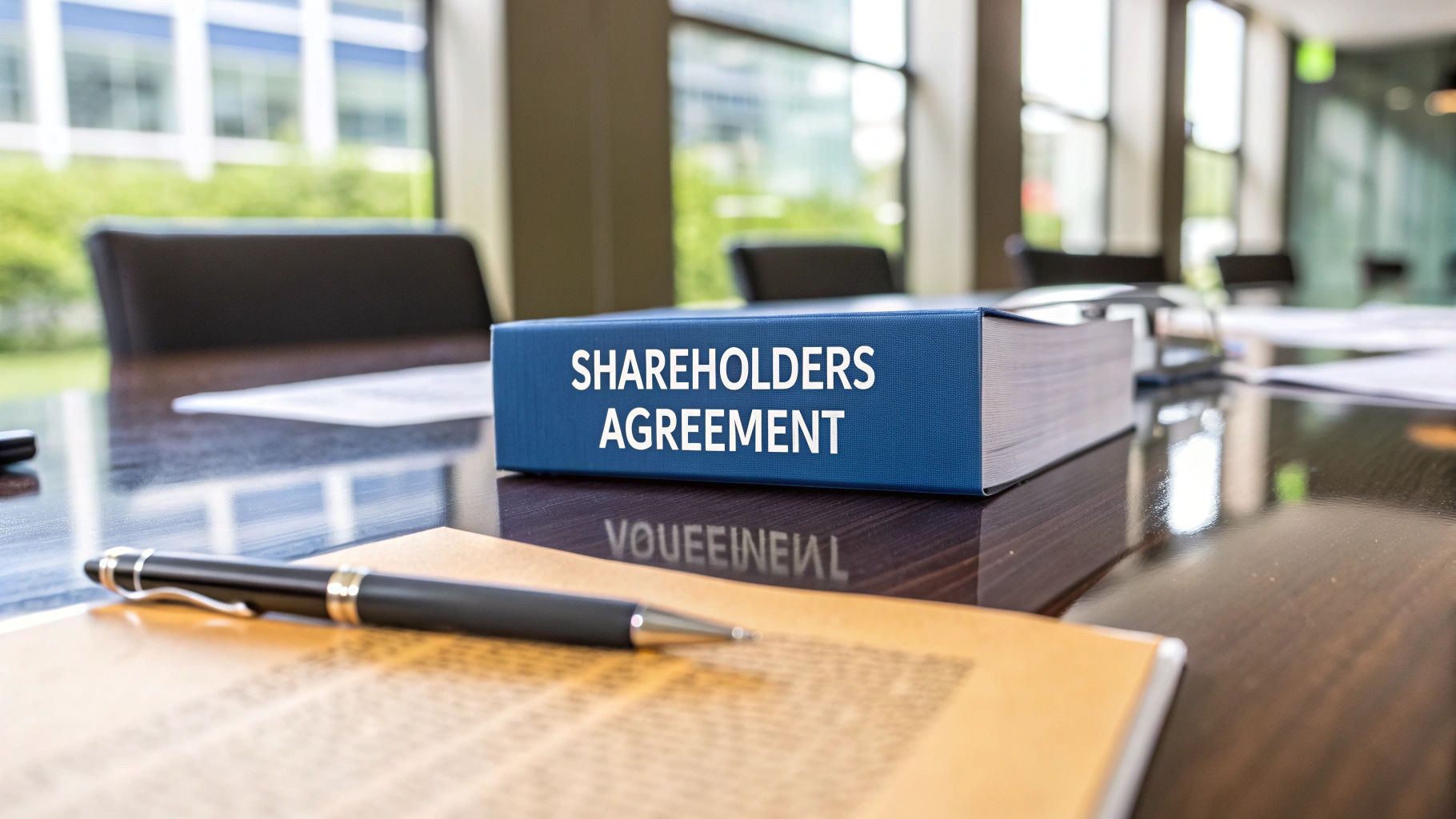
Think of a shareholders agreement as the essential 'pre-nup' for your business partners. It’s a private, legally binding contract that lays down the rules of the game for everyone who owns a piece of the company. This document digs much deeper than your standard corporate bylaws, tackling the specific rights, responsibilities, and "what-if" scenarios that will inevitably come up.
Decoding the Business Pre-Nup
A shareholders agreement is a foundational tool for protecting not just the interests of individual shareholders but the long-term health of the entire business. Its main job is to head off messy disputes down the line by setting clear expectations from day one—on everything from how major decisions get made to what happens when someone wants to sell their shares.
Unlike public corporate filings, this agreement stays confidential among the people who sign it. This privacy is key, as it allows for honest, custom-fit rules that truly reflect the unique dynamics between the owners of your company.
Why It’s More Than Just a Formality
This document acts as a detailed roadmap for how your company's ownership works. By spelling out specific procedures, it makes sure every shareholder is on the same page and understands their role.
Some of the most critical areas it covers include:
- Protecting Minority Shareholders: It gives smaller stakeholders a real voice in big decisions that a majority owner might otherwise dominate.
- Ensuring Business Continuity: The agreement provides a clear, pre-agreed plan for disruptive events, like the death, disability, or sudden departure of a key shareholder.
- Controlling Share Ownership: It puts guardrails in place to prevent shares from being sold to strangers or unwelcome third parties, protecting the company’s internal culture and strategic vision.
The infographic below really drives home the idea of a shareholders agreement as a protective shield for business partnerships.

This visual reinforces that the agreement isn't about mistrust; it's a smart, proactive step to secure the relationship between business owners before any conflicts have a chance to ignite.
To give you a clearer picture, let's break down the core functions of a shareholders agreement into a simple table.
Core Functions of a Shareholders Agreement
| Function | Description |
|---|---|
| Dispute Resolution | Provides a pre-defined process for resolving disagreements, preventing costly litigation. |
| Share Transfer Control | Governs how, when, and to whom shares can be sold or transferred. |
| Exit Strategy Planning | Outlines clear procedures for shareholder exits, whether planned or unexpected. |
| Decision-Making Authority | Defines which decisions require a simple majority versus a unanimous vote. |
| Minority Shareholder Protection | Includes provisions like tag-along rights to protect smaller investors. |
| Business Valuation Method | Establishes an agreed-upon formula for valuing shares to avoid future disputes. |
Ultimately, having this framework in place allows everyone to focus on growing the business, knowing the foundational rules are already set in stone.
This legally binding contract outlines the rights and obligations of each party on ownership, management, and decision-making. Historically, these agreements became much more common in the late 20th century as companies realized they needed to clarify shareholder roles beyond what was covered in standard corporate bylaws. Just like this document, there are other critical business agreements that help define operational rules and prevent future conflicts.
The Must-Have Clauses in Your Agreement
A strong shareholders agreement is built on a foundation of critical clauses designed to tackle friction points before they escalate into full-blown crises. Think of these provisions as the legal armor for your company. They make sure every shareholder is on the same page about the rules for major events. Without them, you're leaving your company's future to chance.
The real meat of any shareholders agreement is dedicated to one thing: what happens when someone's ownership status changes. We're not just talking about a co-founder deciding to leave. It covers difficult scenarios like death, disability, or even a forced departure. These clauses lay out a clear, predictable roadmap for managing how shares move from one hand to another.
Share Transfer Restrictions and Rights
One of the most important jobs of your agreement is controlling who gets to be a shareholder. You don't want a key partner suddenly selling their stake to a competitor or a complete stranger. This is where share transfer restrictions are absolutely essential.
A classic tool for this is the Right of First Refusal (ROFR). If a shareholder gets an offer for their shares from an outsider, the ROFR clause forces them to offer those shares to the existing shareholders first, under the exact same terms. This simple mechanism gives the current owners the power to keep the business within the trusted circle.

On top of that, two other powerful clauses govern what happens when a third-party buyer comes knocking:
- Tag-Along Rights: This is a crucial protection for minority shareholders. If a majority owner finds a buyer for their large stake, this clause lets the smaller owners "tag along" and sell their shares to the same buyer at the same price. It keeps them from being stuck in a company with a new, unknown majority owner calling the shots.
- Drag-Along Rights: This one protects the majority shareholder. If a majority owner lines up a deal to sell the entire company, this provision allows them to "drag" the minority shareholders into the sale, forcing them to sell their shares too. It's vital for getting a deal done, as most buyers want 100% of the company, not just a piece of it.
Deadlock Resolution and Financial Policies
What happens when you have an even number of partners who are fundamentally at odds over a critical business decision? Without a plan, the company can grind to a halt. A deadlock resolution clause provides a clear path forward, outlining steps like mediation, arbitration, or even a "shotgun" buyout provision to break the stalemate. This pre-agreed process can save the business from being paralyzed by a single dispute.
Similarly, a well-defined dividend policy can head off major disagreements about money. This clause sets clear expectations for how and when profits will be paid out to shareholders, so it’s not left to a heated debate every year. By establishing a formula or a clear set of principles, you ensure fairness and transparency in how everyone shares in the company's success. As you formalize these kinds of arrangements, it's also helpful to understand what is a letter of intent and its role in the early stages of a major business transaction.
Shaping Company Governance and Key Decisions
A shareholders agreement is more than just a document that protects individual owners—it’s the blueprint for how your company is actually run. It lays out a clear roadmap for making the big decisions, preventing the business from being steered by a simple majority vote when the stakes are incredibly high.
This is where the concept of ‘reserved matters’ comes into play. Think of these as the game-changing decisions: selling the company, taking on a mountain of debt, or bringing in new investors by issuing more shares. Your agreement can stipulate that these actions can't be pushed through by a single majority owner. Instead, they require a much broader consensus.
Establishing Voting Thresholds
Instead of relying on a simple 51% to pass a motion, the agreement can demand a supermajority—say, 75% approval or even a unanimous vote. This is a game-changer for minority shareholders. It gives them a real voice and a seat at the table, preventing their interests from being railroaded.
These rules create stability and stop power struggles before they even start. By defining the voting requirements for major decisions ahead of time, everyone is aligned on the company’s long-term direction. This is a fundamental piece of good corporate governance best practices.
A well-crafted agreement turns governance from a potential battleground into a predictable, collaborative framework. It acts as a crucial safeguard, protecting the business from impulsive decisions by forcing thoughtful discussion on the issues that truly define its future.
From a practical standpoint, these agreements are essential for protecting every shareholder's rights during annual meetings and other critical votes. As business changes, these documents have even adapted to modern trends. A recent OECD report noted the rise of virtual shareholder meetings, which allow for broader participation from owners around the globe. You can read the full report on shareholder meetings and governance across 50 economies to see how these trends are shaping corporate life.
Ultimately, these governance clauses ensure your company is managed with foresight and stability. If you want to discuss your business law matter, contact Kons Law at (860) 920-5181.
Keeping Control and Preventing Unwanted Influence
In any business, keeping control is fundamental to seeing a long-term vision through. A shareholders agreement is your first line of defense against unwanted influence, whether that comes from internal power struggles or outside pressures like hostile takeovers and shareholder activism. Think of it as a protective barrier around your company’s ownership.
This agreement ensures that the founders and key investors can stay in the driver's seat. By setting clear rules from the beginning, it helps prevent unexpected challenges to the company's direction down the road.
Safeguarding Your Ownership Structure
One of the most powerful tools in a shareholders agreement is the ability to restrict how shares are transferred. These clauses are specifically designed to stop shares from ending up in the wrong hands—like a direct competitor or an activist investor trying to shake things up for a quick profit.
A well-crafted agreement makes sure any change in ownership is orderly and requires approval, protecting the original mission of the business.
By proactively defining the rules of engagement, a shareholders agreement transforms potential chaos into a predictable process, ensuring the company’s stability remains intact even when ownership changes hands.
This is more relevant than ever as shareholder activism continues to rise. A recent report showed that a huge number of global activism campaigns were concentrated in major markets like the USA, Japan, and the UK. In these markets, agreements are widely used to manage exactly these kinds of situations.

Activist investors often push for changes to the board, force mergers, or demand operational overhauls, which makes having protective clauses in your shareholders agreement all the more critical. You can get more insights on how these trends are shaping corporate strategy in the 2025 Cooley report.
Ultimately, a shareholders agreement is a strategic tool for maintaining control. If you want to discuss your business law matter, contact Kons Law at (860) 920-5181.
When Do You ActuallyNeed a Shareholders Agreement?
It’s a question I hear all the time: does my company really need one of these? If you’ve brought anyone else into your private corporation as a shareholder, the answer is an emphatic yes. The absolute best time to put an agreement in place is right at the beginning, when everyone is on the same page and excited about the future.
Trying to hammer out an agreement after a problem pops up is like trying to buy insurance for a house that's already on fire. It's too late. At certain key moments in a business's life, a shareholders agreement goes from a "nice-to-have" to a must-have. These are the times when the dynamics shift and the financial stakes get higher, making a clear rulebook essential for keeping things stable. Getting ahead of this with a legal professional is one of the smartest things you can do; you can learn more about what a business lawyer does to guide businesses through these exact stages.
Critical Moments for an Agreement
Some events just naturally raise the stakes and put a spotlight on the need for a formal agreement. If your business is heading toward any of these milestones, it’s time to make this a priority:
- Bringing on a Co-Founder: The moment you're no longer the sole owner, you need a blueprint for making decisions, handling disagreements, and figuring out what happens if one of you wants to leave.
- Accepting Outside Investment: Angel investors and venture capital firms won't just ask for a shareholders agreement—they’ll demand it. It's non-negotiable for them to protect their investment.
- Offering Equity to Employees: Giving a key team member shares is a powerful incentive. An agreement makes sure everyone understands the rules governing that equity.
- Family Business Succession: In a family-run company, this document is what keeps business decisions from turning into messy personal feuds, especially during generational handovers.
If you want to discuss your business law matter, contact Kons Law at (860) 920-5181.
Laying the Foundation for Long-Term Success
In the end, a shareholders agreement isn't just another piece of legal paperwork. It's the strategic framework that holds your business together, especially as it grows and faces new challenges. Think of it less as planning for the worst-case scenario and more as building a solid foundation that allows for confident, sustainable growth.
By sorting out the rules for governance, ownership changes, and potential disagreements from the start, you create a stable, predictable environment. This is the kind of setting where a business can truly hit its stride.
An agreement like this is a sign of smart, forward-thinking leadership. It shows you’re prioritizing the long-term health of the company over short-term convenience. To make sure your business is truly protected, the next step is to create an agreement that fits your unique goals and structure.
If you’re ready to discuss your business law matter, contact Kons Law at (860) 920-5181. Taking this step is one of the most important things you can do to protect the future you're working so hard to build.
Common Questions About Shareholders Agreements
When you're sorting out the legal side of your business, a few questions always seem to pop up. Let's clear up some of the most common ones about shareholders agreements and how they fit into your company's structure.
What Is the Difference Between a Shareholders Agreement and Company Bylaws?
Think of your company bylaws as the public rulebook for how your corporation operates, covering the basics like board meetings and director duties as required by law. A shareholders agreement, on the other hand, is a private, confidential contract just between the shareholders. It gets into the nitty-gritty of their specific rights and obligations—things like how shares can be sold, what happens if someone leaves, and how to solve disputes. It’s a much more detailed and customized layer of protection.
Can a Shareholders Agreement Be Changed or Updated?
Yes, absolutely. But it’s not something that can be done on a whim. Changing the agreement almost always requires the unanimous written consent of every single shareholder who signed it. This high standard is there for a reason: it protects everyone’s interests by making sure that the core rules of ownership can't be changed unless everyone is on board.
What Happens If We Don't Have a Shareholders Agreement?
Flying without a shareholders agreement means you're leaving everything up to state corporate laws. These laws are generic, one-size-fits-all rules that probably don't match what your specific business needs. This can quickly lead to expensive, draining legal battles over things like selling shares, breaking decision-making deadlocks, or handling a founder's unexpected death. Without an agreement, the business you've poured everything into is left vulnerable.
If you want to discuss your business law matter, contact Kons Law at (860) 920-5181.
