
Whistleblower retaliation is an employer taking an adverse action because a worker made a protected disclosure or helped with an investigation. In finance, that often means 60% of private-sector whistleblowers who report misconduct face retaliation, and 30% lose their jobs after speaking up, while 76% of federal employees who report misconduct face retaliation too (worldmetrics review).
You can feel the shift before anyone says a word. A broker raises concerns about unsuitable recommendations, churning, or a compliance gap, and management thanks them for “looking out for the firm.” Then the account assignments shrink, the performance review turns cold, compliance scrutiny suddenly gets sharper, and a Form U5 warning starts hovering in the background.
That pattern is what makes retaliation so dangerous in brokerage and advisory firms. The harm usually starts before the final termination, and it can show up as demotion, reduced responsibilities, harassment, pay pressure, isolation, or a reassignment that drains a producer's book of business (DOL whistleblower overview, AIC summary).
When Reporting Misconduct Backfires
A registered representative spots a pattern that doesn't sit right. Maybe the recommendations look unsuitable, maybe accounts are being churned for commission, or maybe the firm is brushing off compliance failures that should have been escalated long ago. The rep reports it internally, and at first the firm responds the way firms usually do, with polite acknowledgment and a promise to “look into it.”
Then the tone changes. The rep starts getting skipped for meetings, key clients are reassigned, and a once-clean personnel file fills up with criticism that doesn't match the earlier record. By the time the firm moves to a suspension, a demotion, or a termination, the career damage has already been set in motion.
What retaliation looks like in real life
Whistleblower retaliation is broader than firing. It can include poor performance reviews, demotions, suspensions, terminations, revocations, and reassignment when those actions are tied to a protected disclosure (EEOC OIG guidance). In securities cases, the SEC says employers also can't discharge, demote, suspend, harass, threaten, or otherwise discriminate against an employee for reporting possible federal securities-law violations (SEC whistleblower protections).
The key question isn't whether the firm dislikes the employee. It's whether the adverse action followed the protected report and was tied to it.
The risk is that financial firms can make retaliation look administrative. A reassignment can be framed as staffing. A bad review can be framed as coaching. A Form U5 entry can be framed as disclosure. In practice, the legal fight usually turns on whether those steps were triggered by the disclosure itself or by a legitimate issue that would have surfaced anyway.
A separate research summary found that when employees who observed misconduct reported it, 22% perceived retaliation, and planned departures rose from 11% to 23% after retaliation (worldmetrics review). That matters in brokerage and advisory firms because retaliation doesn't just end a job, it can drive a producer out of the business entirely.
The Legal Elements of Whistleblower Retaliation
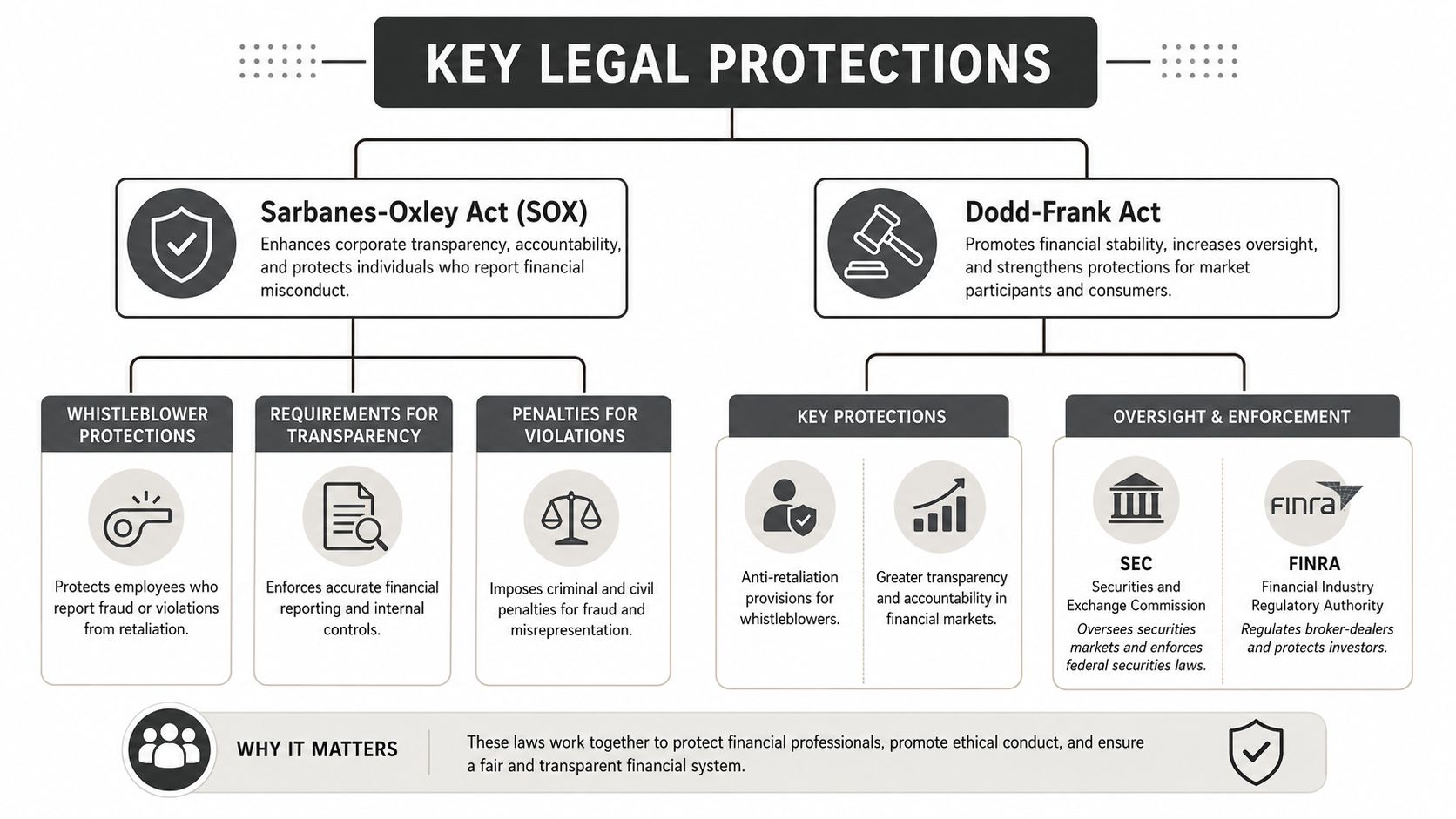
Protected activity comes first
The first element is protected activity. For federal employees, protected disclosures include reports made with a reasonable belief that there was a violation of law, gross mismanagement, gross waste of funds, abuse of authority, or a substantial and specific danger to public health or safety (Whistleblower Protection Act fact sheet). In private financial services, the same core issue applies when an advisor, trader, or compliance professional reports possible securities-law violations or cooperates with an SEC investigation.
Internal complaints matter too. SEC anti-retaliation rules cover reports made through internal whistleblower, legal, or compliance channels before the worker goes to the Commission (17 C.F.R. § 165.20). If the employee reasonably believed misconduct was occurring, the law may still protect the disclosure even if every detail later proves inaccurate.
Adverse action is wider than a firing
The second element is adverse action. In labor and securities enforcement, that means an employer takes action that would dissuade a reasonable employee from reporting misconduct, which can include firing, demotion, denied promotion, reduced pay or hours, harassment, suspension, or similar conduct (DOL whistleblower overview). For federal executive-branch employees, agency guidance also lists poor performance reviews, demotions, suspensions, terminations, revocations, and reassignment as examples of potentially unlawful action when they are tied to a protected disclosure (EEOC OIG guidance).
In brokerage and advisory firms, the harm often shows up in ways that are easy to dress up as routine management. A desk move can be described as staffing. A compensation change can be framed as a business decision. A Form U5 entry can be presented as a compliance record. The legal question is whether the action would have happened anyway, or whether the disclosure set it in motion.
Causation is the fight that usually matters
The third element is the causal link. In practice, the protected disclosure usually only needs to be a contributing factor in the adverse action, which is a lower bar than proving retaliation was the only reason (DOL whistleblower overview). That is why timing matters so much in these cases.
If the complaint comes first and the discipline comes soon after, the paper trail starts to tell a story the firm may not like.
A strong retaliation case often has little to do with a dramatic firing memo. It usually turns on sequence, shifting explanations, and whether the employer's paperwork matches the treatment the employee received. In a financial-services setting, that same analysis often extends to supervision notes, branch communications, and the language used in a Form U5.
Federal and Regulatory Protections for Financial Professionals
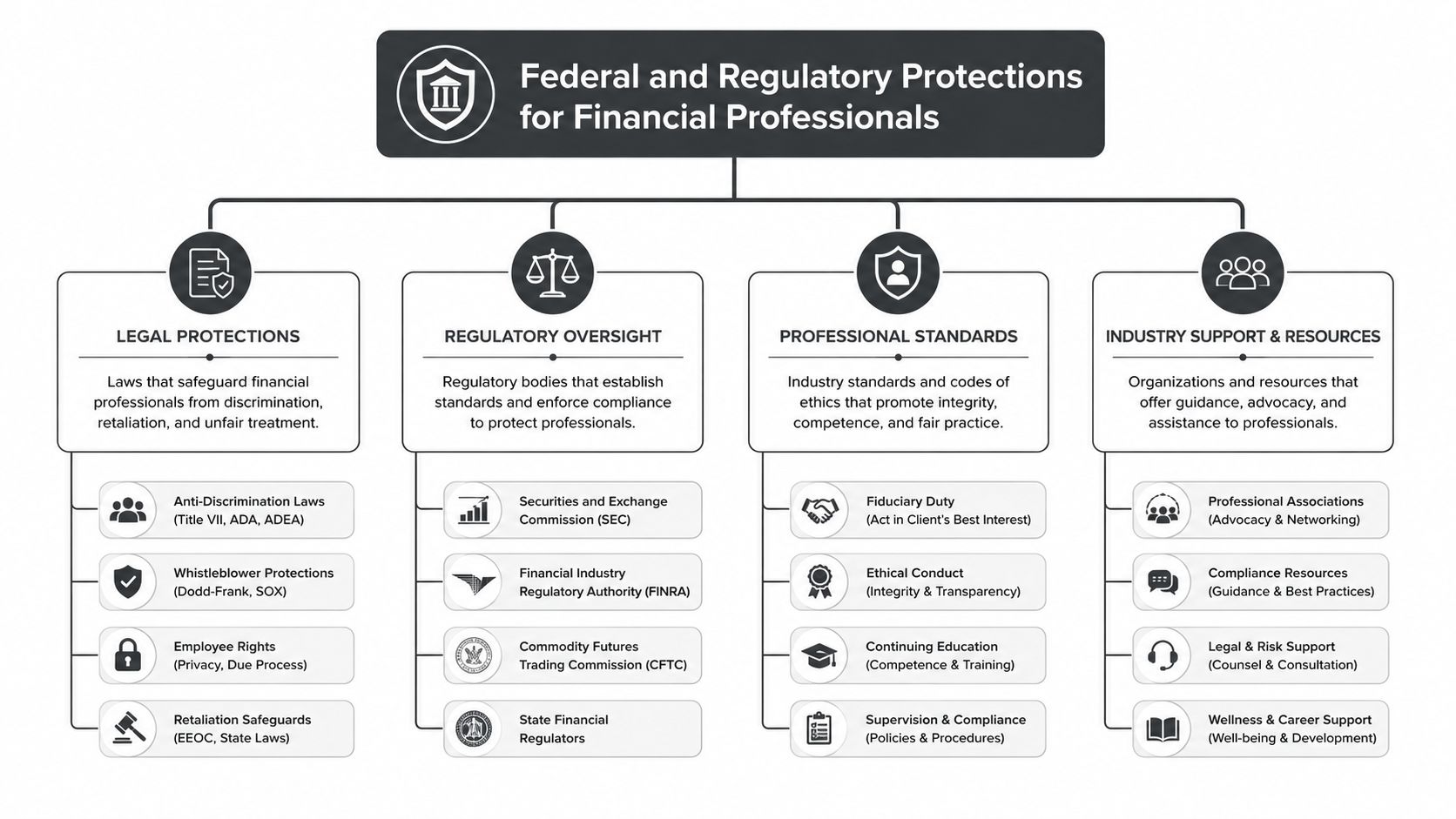
Dodd-Frank and SEC retaliation claims
For brokerage and advisory professionals, Dodd-Frank matters because it gives whistleblowers a direct path to challenge retaliation when they report possible federal securities-law violations (SEC whistleblower protections). The SEC's position is direct. Employers may not retaliate by discharging, demoting, suspending, harassing, threatening, or otherwise discriminating against a worker for reporting securities-law concerns.
That protection matters because retaliation in a brokerage shop often hides inside ordinary personnel moves. The label on the action does not control the legal analysis. What matters is whether the report triggered the response.
The remedies can also be meaningful. Dodd-Frank can allow reinstatement, double back pay, litigation costs, expert witness fees, and attorneys' fees. That level of exposure is one reason firms often defend these matters hard, especially when the record starts to show a connection between the report and the discipline.
Sarbanes-Oxley still matters
Sarbanes-Oxley still has a place in financial services because many brokers, advisors, and compliance staff work around public companies, vendors, or contractors tied to publicly traded issuers. A practical overview appears in Sarbanes-Oxley whistleblower protections, which is useful background when the issue involves accounting, fraud, or company-level misconduct rather than a pure brokerage dispute.
That distinction matters in real cases. A registered rep may raise a concern about books and records, supervision, or issuer conduct at the same time, and the legal framework can shift depending on which conduct is at issue and who is involved.
FINRA, Form U5, and the industry angle
FINRA does not replace whistleblower law, but it changes how retaliation shows up on the ground. A Rule 8210 request, an internal review, or a Form U5 filing can become part of the retaliation story if the firm uses those tools to pressure the rep after a report. For that reason, counsel who understand securities defense and registration issues matter, especially when a Form U5 entry could follow the advisor into the next job search.
The SEC side can matter at the same time. If a firm starts an investigation after a report, the process can move quickly from an employment dispute to a regulatory problem, and the practical steps are different. A close look at SEC investigations guidance helps show how compliance concerns can spill into formal scrutiny.
Common Retaliation Tactics in Brokerage and Advisory Firms
Retaliation in a brokerage office rarely starts with someone saying, “You're being punished for reporting.” It usually shows up as friction. A strong producer gets moved off a good household, a veteran advisor is left out of morning meetings, or a compliance officer starts getting copied on every email only after raising a concern.
The quiet tactics matter most
The subtle moves are often the most damaging:
- Negative reviews after a clean record: a sudden “performance issue” memo lands after years of strong production and no similar criticism.
- Book-of-business pressure: key accounts get reassigned, split, or “temporarily” moved to another rep.
- Selective compliance scrutiny: one advisor gets audited, coached, or investigated in a way that others in the office never see.
- Isolation: the employee stops being invited to client strategy calls, team meetings, or compensation discussions.
These tactics don't always look like retaliation to management. They often look like papered-up business decisions. In a brokerage environment, that's exactly why they're so effective, because they can weaken a rep's standing without creating one single dramatic event.
The louder tactics are easier to spot
Eventually, some firms escalate. Compensation gets reduced, a PIP appears with impossible targets, or a rep is suspended while an investigation is “pending.” A Form U5 threat can be especially coercive because it can affect future licensing and mobility in the industry.
In this business, a Form U5 can do more damage than a termination notice if it's drafted to stain the record.
That's also why line-by-line review matters. A vague description in the U5, or an internal memo that suddenly paints ordinary business disagreements as misconduct, can become evidence that the employer was building a retaliation file. For advisors and registered reps, the question isn't just whether the action was unfair. It's whether the firm tied the action to the disclosure and then used the industry's reporting system to amplify the harm.
How to Document Retaliation and Preserve Your Evidence
The strongest retaliation files usually start with a clean chronology. When a rep can line up the protected complaint, the emails that followed, the revised reviews, and the changed account treatment, the firm has a harder time recasting the story later. If the sequence is vague, management gets more room to call the action routine or unrelated.
A Form U5 dispute, a sudden compliance review, or a client reassignment often makes sense only when the paper trail is organized from day one. That is especially true in brokerage and advisory firms, where the public record and the internal record can diverge fast.
Build the record immediately
Start a contemporaneous log and keep it narrow. Record the date, who was involved, what was said, what changed, and whether anyone else saw it. Save the original complaint, the acknowledgment, the follow-up emails, and any performance review or compliance note that looks different after the disclosure.
Use this checklist:
- Preserve written proof: emails, texts, memoranda, review forms, and compliance correspondence.
- Track treatment changes: client assignments, pay credits, supervision, meeting access, and travel or office privileges.
- Capture timing: write down when the report was made and when discipline, scrutiny, or reassignment began.
- Keep copies off the firm system: if policy allows, store lawful copies somewhere you control.
Document the parts a firm usually tries to explain away later. That includes who got moved off a revenue book, who started receiving extra supervision, and who suddenly had problems that never showed up before the complaint. If you later need to show retaliation, those details help connect the protected activity to the adverse action in the way a court or regulator can evaluate.
Choose the reporting channel with care
Internal reporting can still be the right move when the issue can be fixed quickly and the firm has a real compliance culture. If the internal process becomes the source of the retaliation, external reporting may be the safer path. SEC reporting can also affect a potential award analysis, while internal reporting can still support anti-retaliation protection under SEC rules (17 C.F.R. § 165.20).
For the evidence side of a claim, a practical reference on how to prove wrongful termination can help frame what to preserve when the employer keeps shifting its explanation. In this industry, that often means keeping the emails, the branch-level notes, the supervisory feedback, and the public-facing filings in one place before anyone has a chance to edit the story. A separate resource on top financial analyst interview questions can also help professionals think through how employers test judgment and credibility, which matters when a firm later claims the reported conduct was the problem.
Remedies and Timelines for Retaliation Claims
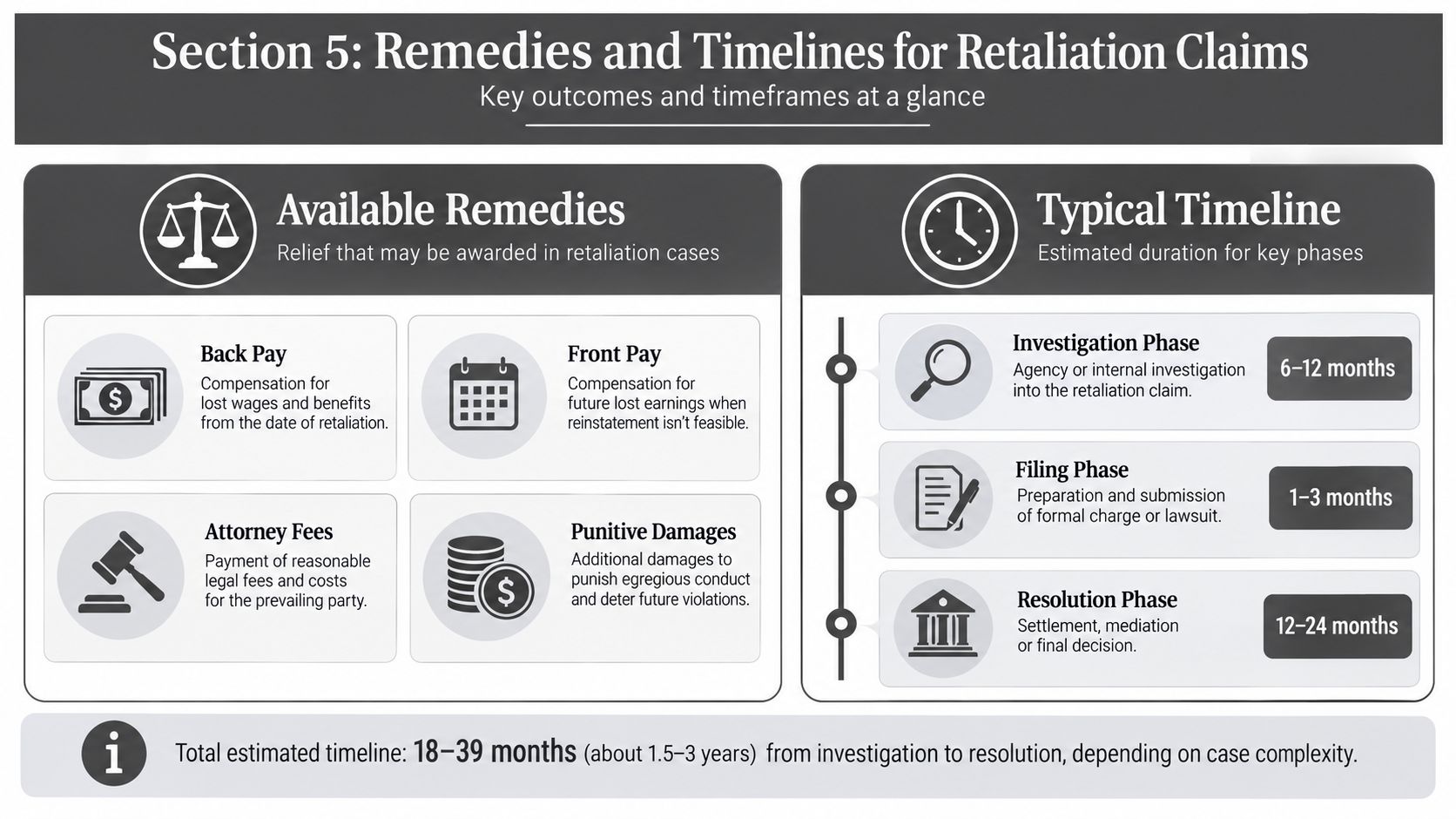
When a retaliation claim succeeds, the remedies can be meaningful. Under Dodd-Frank, relief can include reinstatement, double back pay with interest, reasonable attorneys' fees, expert witness fees, and certain litigation costs (SEC whistleblower protections, DOL whistleblower overview). In practice, that can matter as much as the underlying pay issue, especially for brokers and advisers whose next role can be affected by what appears in a termination record or on a Form U5.
What recovery can look like
Sarbanes-Oxley can also provide reinstatement and back pay, along with related damages in the appropriate case. For financial professionals, that relief is often only part of the story. Career harm can continue after the pay stops if a firm leaves behind a bad U5 narrative, an internal compliance label, or a regulatory explanation that follows the rep to the next employer.
The money is only part of the remedy. In this industry, the record can matter as much as the paycheck.
Timing is a real strategic issue
These cases are rarely fast. Firms defend hard, regulators move at their own pace, and the record usually has to be built document by document. The historical research shows retaliation claims are often difficult to prove even when they have merit, so the filing strategy needs to be deliberate rather than reactive (worldmetrics review, AIC summary).
A useful comparison point is constructive discharge claim guidance, because some retaliation matters end with working conditions that make continued employment untenable rather than with a clean firing. That changes how counsel frames the claim and what evidence matters most, especially in brokerage and advisory settings where pressure, reassignment, and supervision changes can be used to push a person out without saying so outright.
When to Consult Counsel and Protect Your Career
The earlier a financial professional gets counsel involved, the more options stay open. A lawyer who knows securities disputes can help structure the report, preserve the record, and avoid statements that accidentally weaken the retaliation claim later. That matters when the firm is already thinking about Form U5 language, FINRA exposure, or a regulatory response.
Why financial-services experience matters
Brokerage and advisory cases aren't generic employment disputes. They often touch FINRA arbitration, AAA, JAMS, internal compliance reviews, and registration fallout at the same time. A lawyer who understands those layers can help evaluate whether the right move is internal escalation, SEC reporting, negotiation, or litigation.
That's also where practical career planning comes in. If you're preparing for interviews, the top financial analyst interview questions are a reminder that next-step opportunities often depend on how a former employer will describe your departure. In regulated finance, that description can matter as much as the dispute itself.
For Form U5 problems specifically, the right starting point is Form U-5 and FINRA guidance, because a bad filing can create a second injury even after the original retaliation.
If you want to discuss your business law matter, contact Kons Law at (860) 920-5181. The firm handles securities arbitration, regulatory defense, and business litigation for financial professionals who need a clear strategy before a personnel issue becomes a career problem.
If you're dealing with reporting fallout, a Form U5 issue, or retaliation after raising a securities concern, Kons Law can help you assess the legal and regulatory exposure fast. Visit Kons Law to connect with counsel that works on business disputes and financial-services matters with the documentation, timing, and forum strategy these cases demand.
