
You've just been fired. The explanation was vague, the timing feels suspicious, and in a financial services role the damage can spread fast. Your compensation may stop immediately, your team may be told a story about “performance,” and if a Form U5 is involved, the consequences can follow you into your next opportunity.
That's the point where many smart professionals make the same mistake. They focus on whether the termination felt unfair, instead of whether they can prove it was illegal. Those are not the same thing. If you want an advantage, whether in a negotiated exit, a settlement, or arbitration or litigation, you need evidence, a legal theory, and a disciplined record of what happened.
Understanding Wrongful Termination vs Unfair Termination
A sudden firing often feels personal, especially if you were producing, managing client relationships, or raising compliance concerns shortly before the decision. In practice, the law asks a narrower question. It doesn't ask whether your employer acted harshly. It asks whether the employer fired you for a reason the law forbids.

Most employees work in an at-will system. That means an employer can terminate employment for a bad reason, a mistaken reason, or no stated reason at all, so long as the actual reason isn't illegal. That legal line matters. If you were fired because the firm wanted a cheaper replacement, that may be unfair but not necessarily unlawful. If you were fired because you reported misconduct, took protected leave, objected to discriminatory treatment, or refused to do something illegal, the analysis changes.
The practical reality is sobering. Over 90% of all wrongful termination disputes are settled out of court. However, for the small fraction that go to trial, employees only win approximately 10% to 20% of cases, according to Mundaca Law's discussion of wrongful termination outcomes. That doesn't mean claims are hopeless. It means the strongest cases are usually built for negotiation first, not courtroom theatrics later.
What turns a bad firing into a legal claim
Look for facts that connect the termination to a protected reason:
- Protected activity such as reporting harassment, complaining about discrimination, raising compliance concerns, or requesting protected leave
- Protected status such as age, race, sex, disability, religion, or other legally protected categories
- Contractual rights created by an agreement, compensation plan, or enforceable policy
- Public policy violations such as termination for refusing to break the law
Practical rule: Don't ask only, “Was this unfair?” Ask, “What illegal motive can I prove with documents, timing, witnesses, or inconsistent treatment?”
For professionals trying to assess whether they were fired unfairly in Mississippi or in another state, the same distinction applies. “Unfair” is a workplace description. “Wrongful” is a legal conclusion supported by facts.
If your termination happened in Connecticut, it also helps to review a state-specific overview of wrongful termination laws in Connecticut because local procedure and claims often shape early strategy.
Identifying Your Specific Legal Claim
The fastest way to weaken a case is to describe everything that happened without identifying the actual claim. A termination dispute becomes actionable when you can tie the firing to a specific legal wrong. For financial advisors and brokerage professionals, that often means separating ordinary business conflict from discrimination, retaliation, contract breach, public policy claims, or defamation issues tied to a Form U5.
Start with the legal category
A strong claim usually falls into one or more of these buckets:
| Claim Type | What You Must Prove |
|---|---|
| Discrimination | You were in a protected class, qualified for the role, suffered termination or another adverse action, and the surrounding facts suggest discrimination motivated the decision |
| Retaliation | You engaged in protected activity, the employer knew about it, you were terminated, and the facts support a causal link between the two |
| Breach of contract | A written or implied agreement limited the employer's ability to terminate you or required certain compensation, and the employer broke that agreement |
| Public policy violation | You were fired for refusing illegal conduct, reporting unlawful conduct, or engaging in conduct the law protects |
| Form U5 related dispute | The firm used a false or misleading explanation tied to your departure, harming your reputation or future employment prospects |
For California claims, courts use a burden-shifting framework in which the employee first must show membership in a protected class or protected activity, qualification and adequate performance, an adverse action, and surrounding circumstances suggesting discrimination or retaliation, as explained in King & Siegel's summary of proving wrongful termination in California.
Retaliation is often the core claim
In many professional terminations, retaliation is the primary engine of the case. In 2021, retaliation was the basis for nearly 60% of all discrimination charges filed with the EEOC, making it the most frequently alleged form of wrongful termination, according to Rekhi & Wolk's employment law statistics summary.
For a financial professional, protected activity can include reporting supervisory failures, objecting to questionable sales practices, raising concerns about unsuitable recommendations, flagging books-and-records issues, or complaining about discriminatory treatment. The key isn't whether the firm labels the issue “disruption” or “fit.” The key is whether your complaint came first and your firing followed.
What sophisticated professionals often miss
Many high earners assume a strong production history automatically proves the case. It doesn't. Strong performance helps, but it isn't a substitute for legal theory. A firm can argue that you were profitable and still claim it terminated you for policy violations, management style, or alleged documentation failures.
That's why “constructive discharge” also deserves attention in some cases. If the firm made conditions intolerable to force your resignation, that may matter as much as a direct firing. A closer look at a constructive discharge claim can help when the employer pressured you to resign before entering a termination on its own terms.
Most bad cases sound compelling in conversation. Good cases survive after you remove opinions, assumptions, and outrage, and keep only provable facts.
Form U5 disputes require separate analysis
For registered representatives, the termination itself may be only half the problem. A U5 explanation can damage recruiting, client portability, and future registration. If the stated reason on the U5 doesn't match the actual events, or if the firm cloaks a competitive dispute as a compliance problem, the evidence strategy has to account for both the firing and the publication of the reason for it.
In those cases, proving wrongful termination often depends on showing that “poor performance,” “policy concerns,” or “regulatory issues” were pretext, not the actual reason. That moves the case from narrative to proof.
Building Your Case With Critical Evidence
Wrongful termination cases are won on records. Memory helps. Documents move cases.

As ElDessouky Law explains in its discussion of how to prove wrongful termination, an employee must gather physical evidence such as contracts, emails, and performance reviews, create a detailed chronological timeline, document witness statements, and file a formal complaint with the appropriate agency before pursuing litigation. That framework is right. The difference in stronger cases is execution.
Build the file before you build the argument
Start with the items that usually matter most:
- Compensation records. Offer letters, bonus plans, deferred compensation documents, forgivable note materials, territory assignments, and production credit records.
- Performance history. Annual reviews, interim feedback, sales rankings, awards, coaching notes, and any praise that conflicts with a later “poor performance” explanation.
- Termination documents. Separation notices, HR letters, compliance notices, severance proposals, and any draft language describing the reason for departure.
- Communications. Emails, texts, calendar invites, Teams or Slack messages, and meeting notes tied to complaints, discipline, or sudden scrutiny.
- Policies and handbooks. Discipline procedures, escalation rules, complaint procedures, supervisory manuals, leave policies, and any policy the firm ignored when dealing with you.
Financial professionals should also preserve anything related to account transitions, internal compliance reviews, desk audits, branch supervision, and U5 drafting. If the firm says the issue was regulatory, the timeline of who said what, and when, often matters more than the label itself.
Your timeline is the spine of the case
A useful timeline doesn't just list events. It shows sequence, escalation, and contradiction.
Create a chronology that includes:
- The protected activity or triggering event
- Who knew about it
- What changed afterward
- When discipline began
- What explanation the firm gave at each stage
- What happened at termination
- What the firm later said on paper, in recruiting channels, or on a U5
Often, many “poor performance” cases begin to unravel. If your reviews were solid until you complained, then your first negative write-up appeared right after the complaint, and termination followed soon after, the issue isn't just performance. The issue is whether performance became the firm's cover story.
A timeline should let a stranger understand the case without hearing your opinion about it.
Witnesses matter, but not all witnesses help equally
Coworkers often want to help but hesitate once they realize their names may surface. Focus on witnesses who can testify to one concrete point:
- A supervisor who praised your work before the complaint
- A colleague who saw inconsistent enforcement of the same rule
- An HR participant who knew about your complaint
- A compliance employee who can place key events in order
- A recruiter or manager who later heard a different explanation for your termination
Witnesses are most useful when they confirm a fact, not when they provide a blanket agreement that you were treated badly.
Preserve evidence the right way
Don't alter documents. Don't forward privileged firm material to yourself indiscriminately. Don't edit screenshots. Don't annotate originals. Preserve what you already lawfully possess, keep copies in original format where possible, and maintain context.
If you expect a deposition or arbitration hearing, reviewing practical guidance on how to prepare for deposition can help you avoid avoidable inconsistencies later.
What usually doesn't work
Some evidence sounds persuasive but often adds little value:
- General statements that management disliked you
- Long personal narratives without dates
- Rumors about other departures
- Selective screenshots with no surrounding context
- Social media posts about being wronged
A shrewd employer usually won't admit illegal motive directly. That's why proving wrongful termination often depends on disciplined assembly of ordinary business records that, taken together, show the stated reason doesn't hold up.
Proving Causation In At-Will Employment States
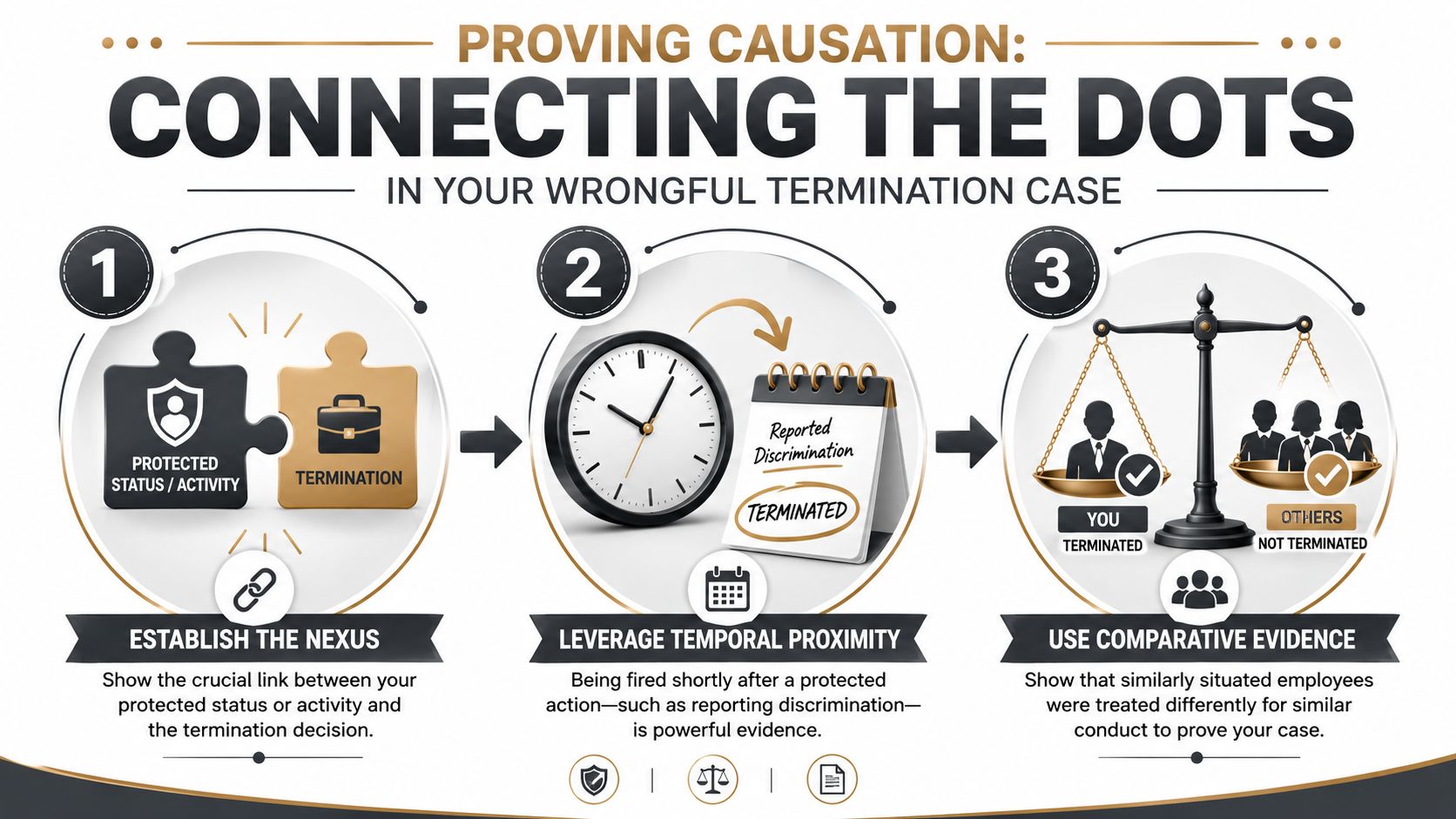
At-will employment gives employers broad room to terminate. It doesn't give them permission to fire someone for an illegal reason. The hard part is proving the link between your protected conduct or status and the decision to terminate. That link is causation, sometimes called the nexus.
In real cases, the employer rarely says, “We fired you because you complained.” Instead, it says “performance slipped,” “leadership had concerns,” or “the relationship wasn't working.” Your task is to show that the stated reason is pretext and that the actual motive was unlawful.
Circumstantial evidence often carries the case
In at-will states, direct evidence is rare. Circumstantial evidence does most of the work. In at-will states, 42% of successful wrongful termination cases rely on circumstantial evidence of inconsistent rule enforcement, such as an employer failing to follow its own disciplinary procedures in the handbook, according to Noble Law's discussion of the evidence needed to prove wrongful termination.
That matters for financial professionals because firms tend to have extensive written processes. They usually have compliance escalation paths, branch management procedures, documentation expectations, and HR protocols. When the firm skips its own steps for you but not for others, that inconsistency can become a causation tool.
Three ways to prove the nexus
Temporal proximity
If discipline began right after you made a complaint, requested protected leave, refused questionable conduct, or challenged a false compliance narrative, timing can be powerful. Timing alone won't always carry the case, but it can frame the entire dispute.
Comparative evidence
Compare yourself to similarly situated employees. Did another advisor commit a similar documentation error and receive coaching instead of termination? Did a non-complaining employee keep their book despite similar production issues? Comparative evidence can expose selective enforcement.
Implied contract and past practice
Even without a written termination agreement, a handbook, compensation structure, oral commitments, or consistent internal practices may matter. If the firm promised progressive discipline, mandatory review steps, or specific bonus treatment and ignored those commitments only when your protected activity became inconvenient, that inconsistency can support both pretext and contract-based arguments.
If the employer's reason changes over time, treat every version as evidence. Shifting explanations often reveal the weak point in the defense.
Pretext in financial industry cases
“Poor performance” is one of the most common pretext labels in this space because it sounds businesslike and non-retaliatory. But it's often vulnerable to records. A producer with recent praise, stable client relationships, and no meaningful prior discipline doesn't suddenly become unfit overnight without a paper trail.
The same is true when a firm claims “regulatory concerns” while the surrounding facts point to a business breakup, a disputed client transition, or a desire to control the narrative before a U5 filing. In those cases, proving wrongful termination means testing the firm's explanation against its own documents, its own procedures, and how it treated other people.
Navigating The Legal And Administrative Process
Strong facts can still be lost by procedural mistakes. Employment claims often require you to take a specific administrative step before you can sue, and financial industry disputes may move in arbitration rather than court.
Before an employee can file a lawsuit for wrongful termination based on discrimination, federal law requires them to first file a formal administrative complaint with the Equal Employment Opportunity Commission or a state equivalent, adhering to strict deadlines to preserve their rights, as summarized by Oasis Center for Interpersonal Abuse & Sexual Violence.
The administrative track
For discrimination and many retaliation claims, the first move is often an agency filing, not a lawsuit. That filing defines issues, preserves claims, and sets timing in motion. If you miss the filing deadline, the strength of your documents may no longer matter.
The practical takeaway is simple. Don't wait to “see how things settle down” while deadlines run. If your claim involves protected class discrimination or protected activity, assume timing is urgent until counsel confirms otherwise.
The arbitration track for financial professionals
Financial services cases add another layer. Some claims may proceed through FINRA arbitration, especially when compensation disputes, promissory notes, transition issues, or industry-related defamation overlap with the termination. That forum has its own pleadings, discovery limits, and evidentiary rhythms.
A well-developed strategy often requires deciding early whether the case is primarily:
- an employment discrimination or retaliation matter,
- a compensation or contract dispute,
- a Form U5 defamation case,
- or a combined dispute requiring careful coordination.
That distinction shapes where the case belongs, what discovery you can obtain, and how you frame damages.
Early process decisions that affect leverage
Procedure also affects negotiation. A well-drafted agency charge, arbitration claim, or pre-suit demand can lock in the narrative before the employer fully shapes the record. A sloppy filing can do the opposite.
Before that filing goes out, many professionals benefit from understanding the role of a demand letter because early written positioning can influence settlement discussions, preservation obligations, and the scope of the dispute.
The first formal filing is not paperwork to get through. It's often the first document the other side reads as if it may become an exhibit.
If your case includes a U5 issue, procedure becomes even more strategic. The timing of amendment requests, arbitration allegations, and related employment claims can affect both settlement posture and future registration consequences. That's why process should be treated as part of proof, not as an afterthought after the facts are collected.
Calculating Damages And When To Engage Counsel
A wrongful termination case isn't just about proving you were right. It's about quantifying what the firing cost you and protecting the claim before avoidable mistakes reduce its value.
What damages usually include
In practice, damages may involve lost wages, lost bonuses, deferred compensation, lost benefits, and future income disruption. For financial professionals, the analysis can be more complicated because compensation may include trailing commissions, production-based pay, transition incentives, forgivable loans, equity-linked incentives, or compensation tied to a client book.
A U5-related dispute can also widen the harm. If a false or misleading termination narrative affects future employment, recruiting terms, or client movement, the damage may extend well beyond the final paycheck.
Why counsel should be involved early
Early legal involvement changes the quality of the case. Counsel can help preserve documents, frame the legal theory correctly, prevent harmful communications, and keep you from turning a strong facts pattern into a credibility problem.
The most common self-inflicted damage happens early:
- talking too freely with former coworkers,
- posting online about the dispute,
- signing separation documents without analysis,
- accepting the employer's label for the termination,
- or failing to preserve the records that expose pretext.
The strongest approach is usually immediate and disciplined. Preserve the record. Stop casual discussion. Get the timeline into shape. Test every suspected claim against the actual evidence.
If you want to discuss your business law matter, contact Kons Law at (860) 920-5181.
If you want to discuss your business law matter, contact Kons Law at (860) 920-5181.
