
You can pass the exams, get the sponsorship, and still run into trouble the first time you change firms or cross a state line. That's the part most advisors underestimate. Series 6 and Series 63 licenses are not just credentials you file away after testing, they define what you're allowed to sell, where you can sell it, and how clean your record looks when a new employer pulls your registration history.
An advisor who thinks the paperwork is over the moment the score report comes in often learns otherwise during a job move. The old firm's records may show a gap, a state registration may have lapsed, or a future sponsor may ask questions about why activity continued before the new filings were in place. Those are the kinds of issues that make licensing feel less like exam prep and more like career risk management.
For firms trying to move business into the pipeline, appointment-setting discipline matters too, which is why practitioners often look at resources like fueling your sales funnel as part of a broader growth process. In regulated financial services, though, the funnel only works if the producer's permissions are current.
Why Your Licenses Matter More Than You Think
An advisor I've seen in practice may think the worst part of a career move is the compensation negotiation. Then the compliance review starts, and someone notices that the Series 63 registration never got updated in a state where the advisor had been servicing clients. That's when the problem stops being administrative and starts affecting the next sponsor, the client file, and the Form U5 narrative that follows the person to the next firm.
Licensing is a boundary, not a trophy
The Series 6 is a narrow product license for packaged investment products, and the Series 63 is the state-law registration that permits business in the relevant jurisdiction. If the permissions on your record don't match the work you're doing, the mismatch can create employment friction long before any regulator opens a file. FINRA's registration framework ties those permissions to the activities a professional is approved to perform, not just to the fact that they once passed an exam. See FINRA's qualification-exam framework for the regulatory context around registration and permissions in practice. FINRA qualification exams
Gaps show up when you move, not when you study
The danger is that a registration gap often stays invisible until a transition. A new firm may see that you were active at the old firm, but it will also see whether your filings, state authority, and approval history line up. If they don't, the firm may delay onboarding or narrow what you're permitted to do while the issue gets cleaned up.
Practical rule: Treat licensing as part of your employment record, not just your test record.
That mindset changes how you handle resignations, transfers, and state servicing. It also makes it easier to explain why a clean record matters when you're building referral relationships or working on your next move. In regulated channels, reputation doesn't just come from client service, it comes from the accuracy of your registration trail.
What Series 6 and 63 Licenses Actually Authorize
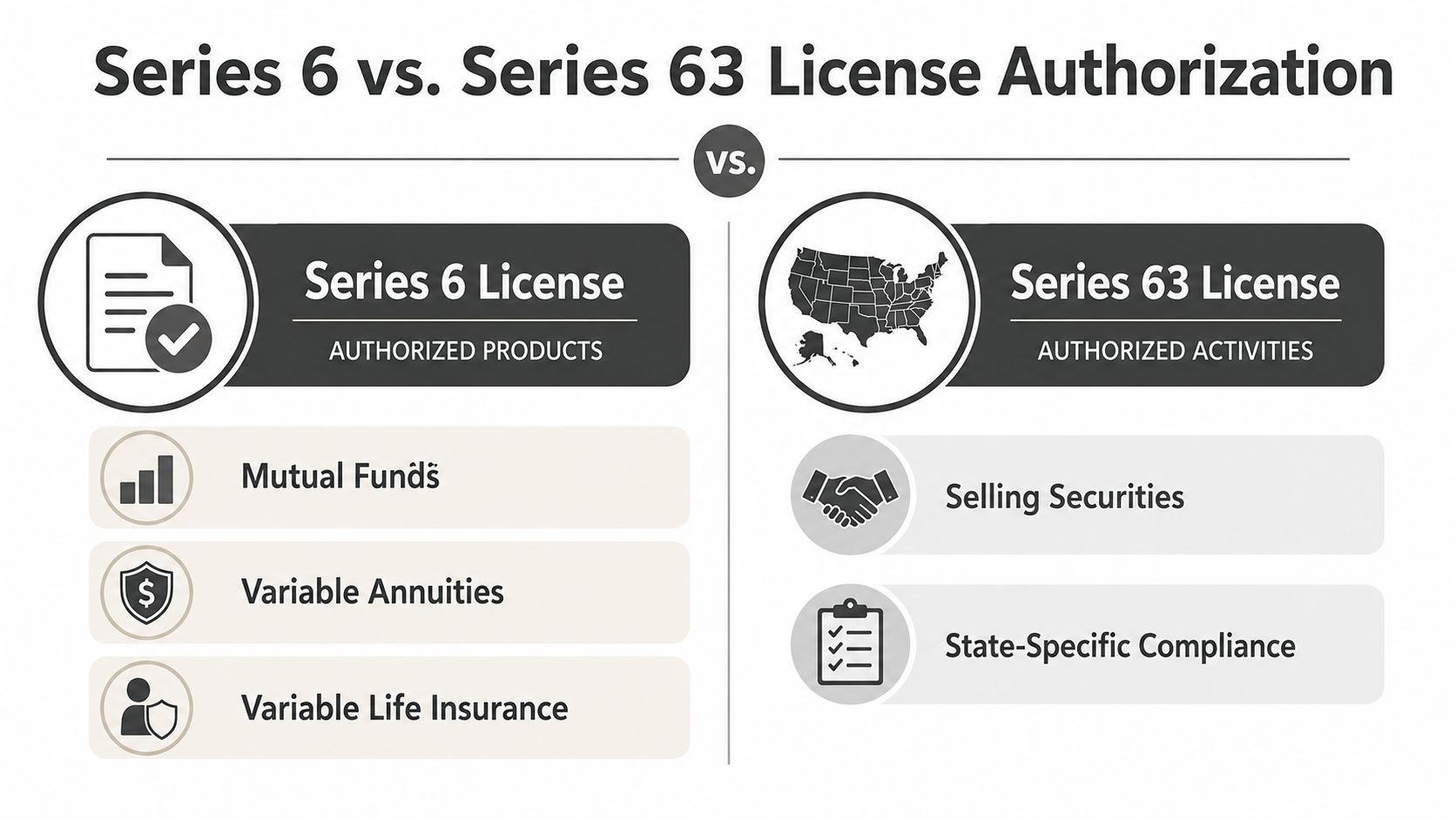
The biggest misconception I hear is that passing the exams somehow creates a general right to sell securities. It doesn't. Series 6 is product-specific, and Series 63 is jurisdiction-specific, so you have to read them together instead of assuming one fills every gap in the other.
Series 6 covers packaged products, not the whole market
The Series 6 qualification exam is built around selling mutual funds, variable annuities, variable life insurance, unit investment trusts, and 529 plans, and it excludes individual stocks, bonds, options, and direct participation programs. That means a rep with Series 6 can handle certain pooled or insurance-linked products, but not the broader universe of individual securities. For that broader scope, firms usually look to registrations such as Series 7.
Series 63 is about the state law layer
The Series 63 does not expand product authority by itself. Instead, it helps a broker-dealer representative satisfy the state-law registration piece in the jurisdictions where the person is doing business. In practice, that means an advisor can't point to Series 63 as a substitute for product authority, and can't point to Series 6 as a substitute for state registration.
A clean way to think about it is this:
- Series 6 authorizes product access, but only for the limited products in that registration.
- Series 63 authorizes state-law compliance, but only within the applicable jurisdictions.
- Neither license should be treated as a catch-all, because the firm's supervision and the state's registration rules still control what happens next.
| License | What It Authorizes | What It Does Not Authorize |
|---|---|---|
| Series 6 | Packaged products such as mutual funds, variable annuities, unit investment trusts, and variable life insurance | Individual stocks, bonds, options, and direct participation programs |
| Series 63 | State-law registration and permission to conduct business in the relevant jurisdiction | Broader product authority by itself |
Misreading the license leads to bad client conversations
One common mistake is promising a client a product the rep is not registered to discuss or sell. Another is assuming that a state registration means the rep can service every account type equally. If you're unsure where your scope ends, check the product and jurisdiction together, not separately.
For a practical discussion of how the limited representative role differs from broader registration paths, the training overview at Series 6 pass-rate and exam context can help frame the exam within a larger career track.
Exam Structure and State Requirements Explained
The exam mechanics matter because they shape your timing, your study plan, and your job search. Series 6 has 50 scored questions, a 90-minute limit, a 70% passing score, and a $75 fee, while Series 63 has 60 questions, a 75-minute limit, a 72% passing score, and a commonly cited $147 fee. Those numbers are useful, but only because they point to how different the two tests really are. Series 6 exam structure and Series 63 exam details
The tests measure different kinds of competence
The Series 6 is narrower and product-driven. The Series 63 is shorter, but it demands comfort with state securities law and ethics obligations. That matters for planning because a candidate can be strong on product knowledge and still get tripped up by the state-law side, especially if they treat the Series 63 as a formality after passing the Series 6.
Jurisdiction matters more than most candidates expect
Kaplan notes that the Series 63 is not required in Colorado, Florida, Louisiana, Maryland, the District of Columbia, and Puerto Rico. That exception matters if you're relocating, joining a firm with a regional footprint, or splitting servicing across multiple jurisdictions. You need to know where your client activity will occur, not just where your home office sits. Series 63 jurisdictional exception
Plan the sequence around your actual role
Some advisors chase the license first and think the firm part comes later. In practice, the firm's business model drives the registration path. If the role is limited to packaged products, Series 6 and Series 63 may be the right combination. If the job expands into broader securities or advisory work, the firm may require additional registrations.
| Exam Feature | Series 6 | Series 63 |
|---|---|---|
| Administered by | FINRA | FINRA, developed by NASAA |
| Question count | 50 scored questions | 60 questions |
| Time limit | 90 minutes | 75 minutes |
| Passing score | 70% | 72% |
| Fee | $75 | $147 |
| Main focus | Packaged investment products | State securities law and ethics |
| State exception | Not a state-law exam | Not required in the listed jurisdictions |
Passing an exam is only one step in the process. The core compliance question is whether the registration supports the work you've been hired to do.
Registration and Sponsorship Requirements
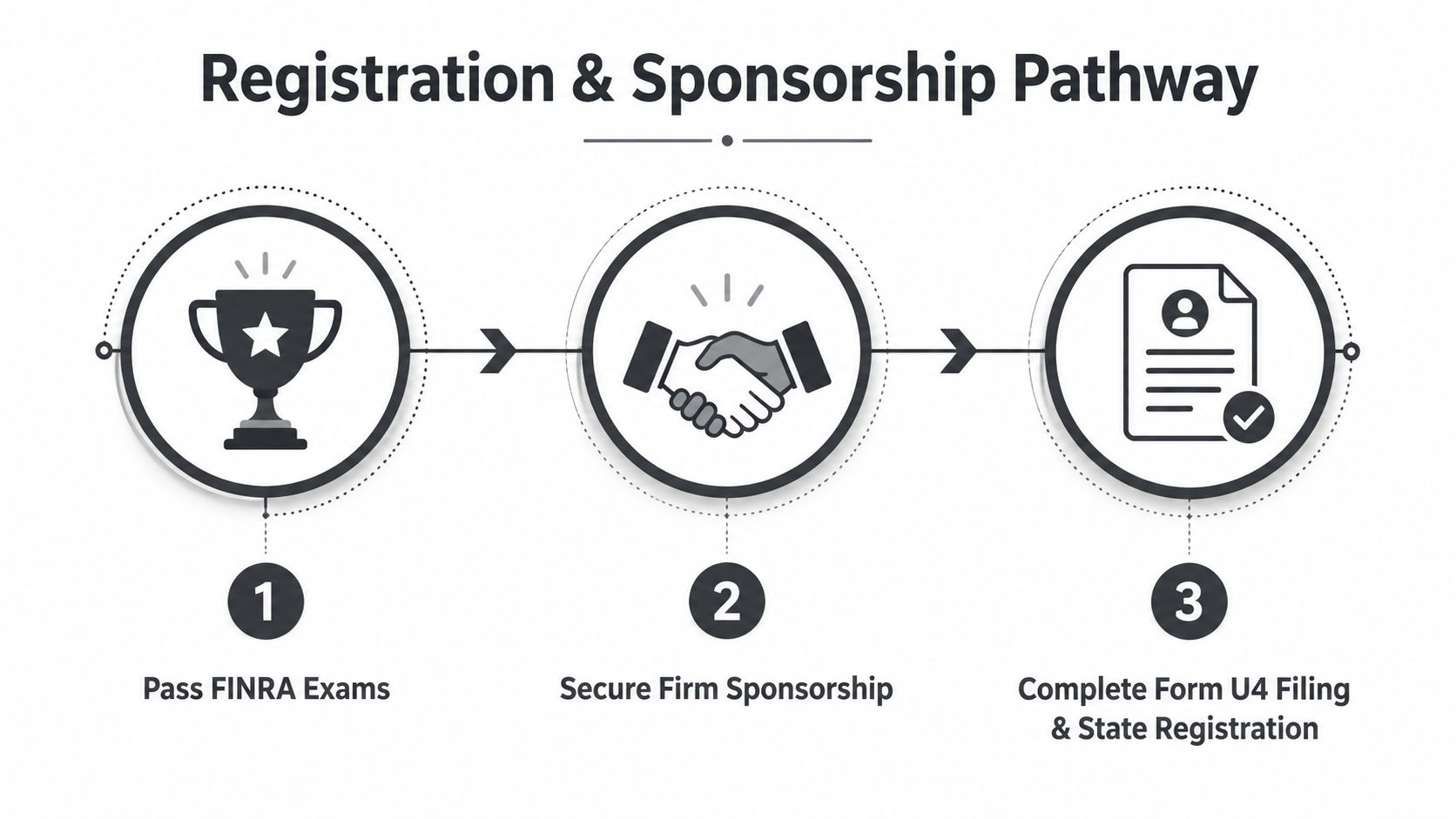
Passing a securities exam does not, by itself, make you operational. You still need the right sponsor, the right filings, and the right state permissions in place. Without that, you may have a passing score and still be blocked from doing the work that generated the score in the first place.
Sponsorship and Form U4 drive the actual authority
For most broker-dealer roles, a Form U4 filing is what ties the individual to the firm and the approved registrations. The form is not a formality. It is the document that tells regulators and the CRD system what exams you've passed, what jurisdictions you're approved in, and what type of activity the firm is asking permission to supervise.
Timing mistakes create downstream problems
The most common error is waiting too long after passing the exam to get the sponsorship and filings lined up. Another is assuming that a verbal job offer is enough to keep the registration trail clean. It isn't. If the paperwork lags behind the actual move, the record can look as though there was a gap in authority, even if the transition itself was handled in good faith.
Registration is an ongoing control, not a one-time milestone.
That's why firms track continuing education, approval history, and jurisdictional changes together. If the registration is inactive or incomplete, the advisor may not be allowed to perform the same functions while the compliance department sorts out the gap.
CE keeps the license alive in practice
Continuing education has two practical sides, the Regulatory Element and the Firm Element. Fail to stay current, and the problem is no longer just a stale file, it can become an inactive status issue that changes what you're allowed to do on a day-to-day basis. A clean registration record depends on staying current, not just passing once and moving on.
For a plain-language overview of the broker registration path, the guide at how to become a stock broker is a useful reference point for the filing sequence and the sponsorship step.
Hidden Risks During Firm Transitions and Terminations
The licensing problem that gets people in trouble is often not the exam itself. It's the transition. A rep resigns, a firm changes supervision, a move across state lines gets rushed, and suddenly the registration record no longer matches the work that was performed. That is where Form U5, registration lapses, and state servicing issues start to matter.
A U5 can define the next chapter of your career
A Form U5 is the Uniform Termination Notice, and the language used on it can follow an advisor far beyond the final day at the old firm. If the termination reason is vague, overstated, or inaccurate, the next sponsor may hesitate, or regulators may ask why the record looks the way it does. That's especially dangerous when the advisor is trying to move quickly into a new role and needs uninterrupted approval.
Mismatched state activity creates a separate exposure
Another recurring problem is service in a state where the advisor's registration lapsed or never got filed correctly. The rep may have been talking to clients in good faith, but the registration record tells a different story. That mismatch can trigger client complaints, internal discipline, or a regulatory review because the activity and the permission set no longer line up.
Audit before you move
Before a transition, review the CRD record, the active jurisdictions, the termination language, and any pending disclosures. If you know a former firm may file a problematic U5, don't wait until the next sponsor flags it. That's the time to get ahead of the issue, preserve evidence, and decide whether the language needs to be challenged.
For advisors who want a disciplined way to evaluate a brokerage relationship before problems surface, the checklist at questions to ask a broker is a practical starting point.
Practical rule: If your activity changed before your paperwork did, assume someone will eventually ask about the gap.
That's not paranoia, it's how the system works. The employment issue and the licensing issue often become the same issue once a recruiter, compliance officer, or regulator reviews the file. In that moment, the best protection is a clean timeline and a record that supports it.

Defending Your Record During Investigations and Disputes
Once an inquiry starts, time moves fast and mistakes compound. A licensing issue can sit for years, then become urgent when a regulator, firm, or opposing counsel asks for records that were never kept in a way that can withstand scrutiny. The best defense is a paper trail that shows you stayed within your permissions and responded promptly when something changed.
Documentation is the first line of defense
Keep your registration history, CE confirmations, and correspondence with compliance in one place. If you ever need to show that a registration was requested, approved, corrected, or withdrawn, you do not want to be reconstructing the sequence from old email threads at the last minute. Good records also make it easier to challenge inaccurate statements later, because you can point to dates, filings, and approvals instead of relying on memory.
Legal counsel belongs in the process early
When the dispute involves a Form U5 issue, a licensing lapse, or a registration dispute tied to employment, a securities lawyer can help frame the response before it hardens into a bigger problem. In many cases, the fastest path is not a public argument, it's a focused review of the filing history, the supervisory record, and the statements that got submitted. That approach matters for advisors who also hold CFP credentials or face overlapping compliance reviews, because the employment and regulatory tracks can move at the same time.
Use the inquiry to clean up the record
A serious response does more than deny a problem. It identifies the filing error, the missing approval, or the inaccurate description and then corrects the record where possible. That's especially important if the issue could affect future sponsorship or arbitration posture. For a more detailed discussion of how termination notices affect advisors, the resource on Form U-5 issues at FINRA is worth reading before the dispute gets worse.
The professionals who do best in these disputes usually share one habit, they don't wait until the problem is public to start organizing the file. They collect the facts early, preserve the timeline, and involve counsel before the record gets rewritten by someone else.
Protecting Your Career with Proactive Compliance
The cleanest way to protect a securities career is to treat registration like an active asset. Review your CRD record, confirm the jurisdictions where you're approved, and make sure your firm's compliance team knows where you serve clients. That's not busywork, it's how you avoid the kind of mismatch that can turn a routine transition into a disciplinary headache.
Build a routine before something goes wrong
A simple monthly or quarterly check can catch the issues that cause the biggest problems later. Look at state approvals, CE status, supervision notes, and any pending filing changes before they become a client-facing issue. If you work across multiple jurisdictions, keep a state-by-state list of where you're active so you can spot a lapse quickly.
Use tools, but don't outsource judgment
Monitoring software can help you track disclosures and deadlines, especially in a multi-state practice. A platform like the Intelligent Contacts compliance platform may help teams centralize alerts and documentation, but it still has to be paired with human review and a real understanding of what your license allows. Technology can flag the problem, but it can't decide how to respond to a U5 dispute or a registration mismatch.
Know when the issue needs legal help
If your registration history, state permissions, or termination paperwork no longer lines up with the work you performed, get advice early. That's especially true if you're moving firms, facing a disclosure review, or worried that a former employer may characterize your departure in a way that hurts future sponsorship. The sooner those facts are reviewed, the easier it is to protect the record.
For advisors and firms dealing with licensing, registration, or employment consequences tied to Series 6 and Series 63 licenses, Kons Law handles securities disputes, regulatory inquiries, and Form U5 matters with a focus on the practical consequences of the paperwork. If you want to discuss your business law matter, contact Kons Law at (860) 920-5181 or visit Kons Law to speak about your situation and the next step.
