
You may be sitting in a meeting where someone says, “We're looking at a DST,” and nobody bothers to explain whether they mean a time change or a real-estate structure. If you're an advisor, sponsor, or investor hearing that phrase in a 1031 conversation, the safest starting point is to assume the acronym is overloaded until the context tells you otherwise. In business-law and tax-planning discussions, DST usually means a Delaware Statutory Trust, not Daylight Saving Time.
That distinction matters because the two meanings lead in completely different directions. One is about clocks, schedules, and the annual one-hour shift in local time, while the other is a legal wrapper that can hold title to real estate for multiple investors. If you're trying to understand whether a DST is a replacement property, a trust, or just a scheduling shorthand, the answer depends on the room you're in and the documents on the table.
Why the Acronym DST Confuses People
A lot of people first search “what is a DST” after hearing the term in a 1031 exchange conversation. That's where the confusion starts, because the most common public meaning is still Daylight Saving Time, the practice of moving clocks forward by one hour for part of the year so evenings stay lighter later on the clock. In the U.S., that time change begins at 2:00 a.m. on the second Sunday in March and ends at 2:00 a.m. on the first Sunday in November; in 2026, that means DST runs from March 8 to November 1 (NIST daylight saving time rules).
Start with the context, not the acronym
If the conversation is about bedtime routines, payroll, airline schedules, or systems that must handle the spring-forward and fall-back transition, the clock meaning is probably the right one. At the spring change, local time jumps from 1:59 a.m. to 3:00 a.m.. At the fall change, the 1:00 a.m. hour repeats, which is why that day is longer on the clock (Timeanddate DST overview).
If the conversation is about property, exchange deadlines, fractional ownership, or passive replacement property, the acronym usually points somewhere else entirely. In those settings, DST most often means Delaware Statutory Trust, a trust vehicle used in real-estate planning and 1031 structures. General references tend to privilege the timekeeping meaning first, so readers who need the legal meaning often have to dig past the obvious result (Dictionary.com DST entry).
Practical rule: if the words 1031, replacement property, trust agreement, or qualified intermediary show up nearby, you're probably not dealing with clocks.
That's why this acronym trips people up. The same three letters can describe a scheduling rule, a tax-planning vehicle, or several other technical abbreviations. In legal and advisory work, the safest move is to force the speaker to define the term in context before you rely on it.
The Legal Structure of a Delaware Statutory Trust
A Delaware Statutory Trust is a legal entity formed under Delaware law, and it works much like a container. Think of the trust as the bucket that holds the deed, while the investors stand outside the bucket holding beneficial interests that track the economics inside it. The legal title sits with the trust, not with each investor individually, which is what lets a group own a property without every owner taking direct title (DST legal structure overview).
Who owns what inside the trust
The trustee is the lawful holder of title. Investors do not hold the deed directly, they hold undivided fractional interests in the trust's holdings, which is the economic interest that gives them a share of the returns. In plain English, the trust owns the property, and the investors own slices of the trust's cash flow and value, not a direct parcel deed in their own names (fractional interest description).
That structure matters when comparing a DST with an LLC, a tenancy-in-common, or a limited partnership. An LLC usually gives members governance rights through operating agreements and management structures. A tenancy-in-common puts co-owners on title directly. A DST, by contrast, centralizes legal ownership and pushes the investor into a more passive position.
The trust wrapper is doing the heavy lifting. The investor is buying economics, not management control.
That's why sponsors and advisors often describe a DST as a passive replacement property. The phrase sounds like marketing, but it really means the investor gets exposure to the property without taking on the day-to-day operational role that direct ownership usually demands. For a financial advisor, the simplest mental model is this. The sponsor brings the asset, the trustee holds legal title, and the investors sit inside the trust as fractional beneficial owners.
For a deeper look at how investors sign onto an offering like this, a useful companion is what a subscription agreement does in a private offering. The DST itself is the legal container, but the subscription documents are what bring a particular investor into that container.
How a DST Fits Inside a 1031 Exchange
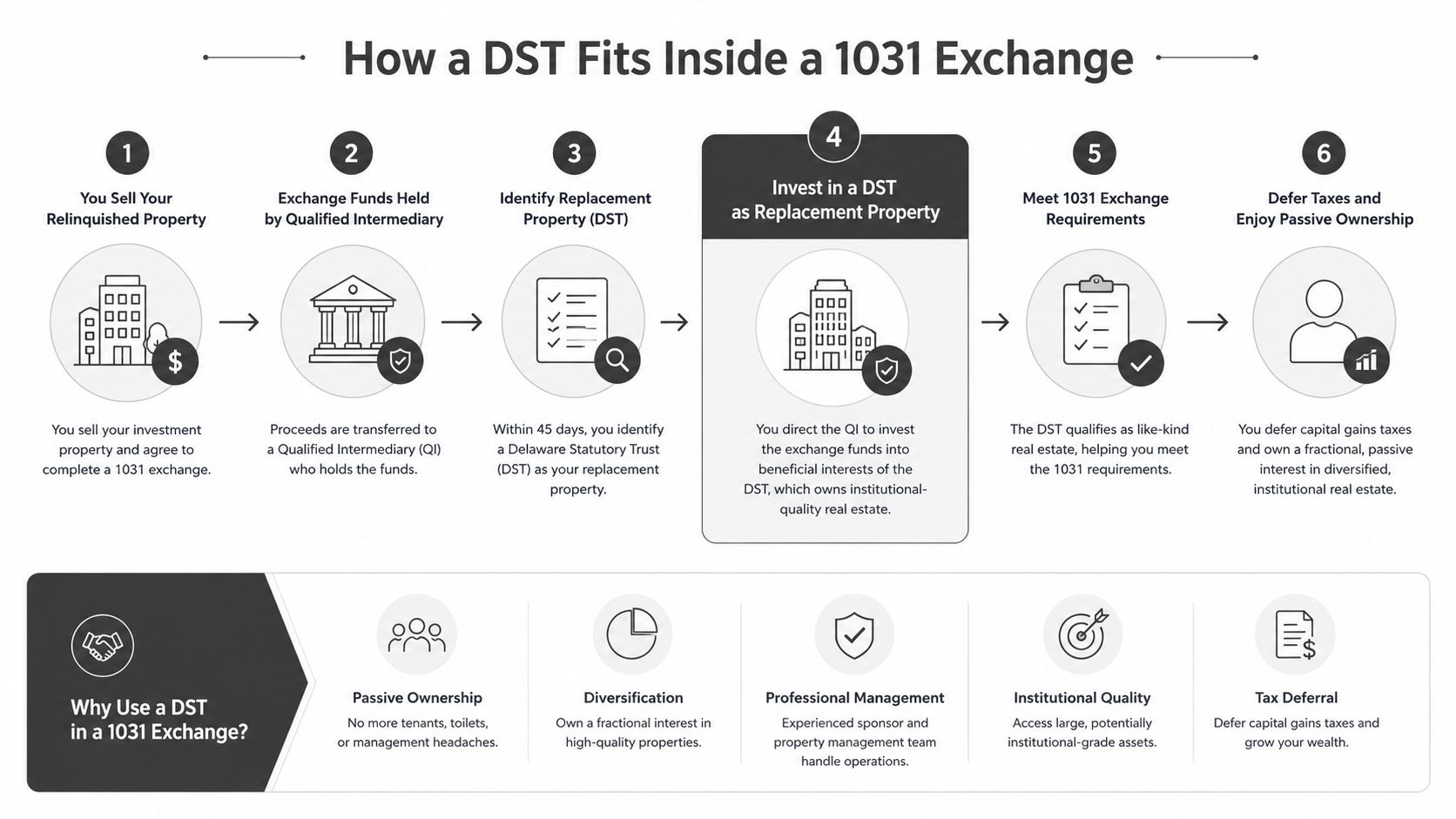
A DST becomes relevant in a 1031 context because it can serve as replacement property. Under Section 1031 of the Internal Revenue Code, an exchanger can defer gain by moving equity from the relinquished property into qualifying replacement property rather than cashing out. In practice, that is why advisors talk about a DST as a way to pivot from active ownership into a more passive asset while still staying inside the exchange framework.
Why the IRS cares about the structure
The comfort comes from Revenue Procedure 2004-86, which sets the operating framework for a DST to be treated as a pass-through vehicle for federal tax purposes. The point of that guidance is not to make the investment flexible. It does the opposite. It gives sponsors a narrow lane to stay in, and the trust has to keep its decisions at the trust level rather than turning into a member-managed arrangement.
That is why investors usually can't start negotiating lease terms on their own, directing renovations, or managing the asset the way they might in an LLC or active partnership. The trust has to behave like a trust, not a loose group project. If individual investors start driving asset-level decisions, the structure starts to look less like the IRS-safe model and more like direct ownership with extra paperwork.
For readers who want a practical refresher on exchange mechanics, like-kind property swap tips from Edinhart Realty and Property Management are a useful companion resource. The core takeaway is simple, though. A DST is not a tax strategy by itself. It is a structure that can fit inside a 1031 strategy when the rest of the exchange is handled correctly.
What makes it useful in practice
The appeal is that a relinquished-property seller can move into a fractional interest rather than hunting for a whole new building on a tight deadline. That helps when the seller wants to defer gain, preserve real-estate exposure, and reduce operational burden at the same time. Advisors often call that a passive replacement property because the investor is replacing one real asset with another, but without signing up to run the property personally.
If you already follow DST discussions, the 1031 exchange resource hub can help you connect this structure to the broader exchange rules. The key point is that the DST sits inside the exchange, it doesn't replace the exchange rules themselves.
Benefits and Trade-Offs Investors Should Weigh
A DST has a clear attraction for investors who want to step out of active management. No tenants. No toilets. No midnight repair calls. Instead of running the property, the investor participates in the economics of the real estate through the trust, which is why advisors often use the passive ownership label.
What investors usually like
The first benefit is access. A DST can open the door to institutional-grade property without requiring an investor to buy and manage an entire building alone. The second is the planning angle. A properly structured DST can support tax deferral inside a 1031 exchange, which is the main reason many investors even ask about it in the first place. The third is financing flexibility, because offerings are often built with non-recourse loan structures at the trust level.
That said, every convenience comes with a constraint. The investor is not buying control. Beneficial owners usually have very limited ability to vote, direct operations, or influence major decisions, because the trust has to remain inside its narrow operating lane. If a client wants hands-on control, the DST format can feel frustrating fast.
A useful way to think about it is like buying an airline seat instead of flying the plane. You get to the destination, but you don't pick the route or touch the controls.
Where the friction shows up
Liquidity is another trade-off. Many DST programs are designed around a longer capital commitment, and investors should expect to be tied to the structure for years rather than months. Major changes are restricted, too. The trustee generally can't freely renegotiate leases, launch large renovations, or improvise the business plan without staying inside the trust documents and sponsor framework.
Trade-off to surface early: the more passive the investment, the less freedom the investor has to respond to changing conditions.
Fees also stack up across the structure. Sponsors, trustees, and property managers may each have their own compensation layers, so the economic burden is not always obvious from the headline yield story. For that reason, it helps to look at DSTs the same way you'd look at any other income property, with a disciplined eye on cash flow, operating assumptions, and the exit path. A broader way to compare yield expectations against property economics is to review a resource like Global rental property analysis from Global, then map those ideas onto the DST's actual structure.
Deal Documents and Governance Roles
The paperwork stack is where the DST stops being a concept and starts being a live transaction. The trust agreement is the vehicle's core charter, the private placement memorandum is the disclosure package, and the 1031 exchange cooperation agreement helps tie the trust investment to the exchanger's qualified intermediary. If acquisition financing is part of the deal, the loan documents sit in the same stack and affect how the trust can operate.
The documents do different jobs
The trust agreement tells you who has authority, what the trustee can do, and how the property can be managed or disposed of. The private placement memorandum explains the offering, the risks, and the business assumptions behind the investment. The exchange cooperation agreement helps make sure the 1031 timeline and mechanics line up with the money flow through the intermediary.
Those documents are not duplicates. They speak to different audiences and different legal issues. A sponsor might focus on the economics, but an advisor should care just as much about the governance language, because that is where the primary constraints hide.
The people in the room
The sponsor originates and manages the deal. The independent trustee holds legal title and signs for the trust. The beneficial owners receive pro rata economic interests and distributions. The qualified intermediary shepherds the exchange funds so the seller doesn't accidentally touch money that could break the 1031 treatment.
That split of roles is what makes the DST workable. It also makes the structure fragile if the documents are sloppy. When the trustee, sponsor, and investor rights are not clearly allocated, the offering starts to look less like a disciplined trust and more like a bundle of promises with no operating map.
For a parallel discussion of another transaction document that often appears in business-law work, what a due diligence review is in commercial deals helps frame how these papers should be read. In a DST, the documents are the operating system. If you don't read them carefully, you won't know who can act, who can block, or who bears the economic risk.
A Due Diligence Checklist for Advisors and Investors
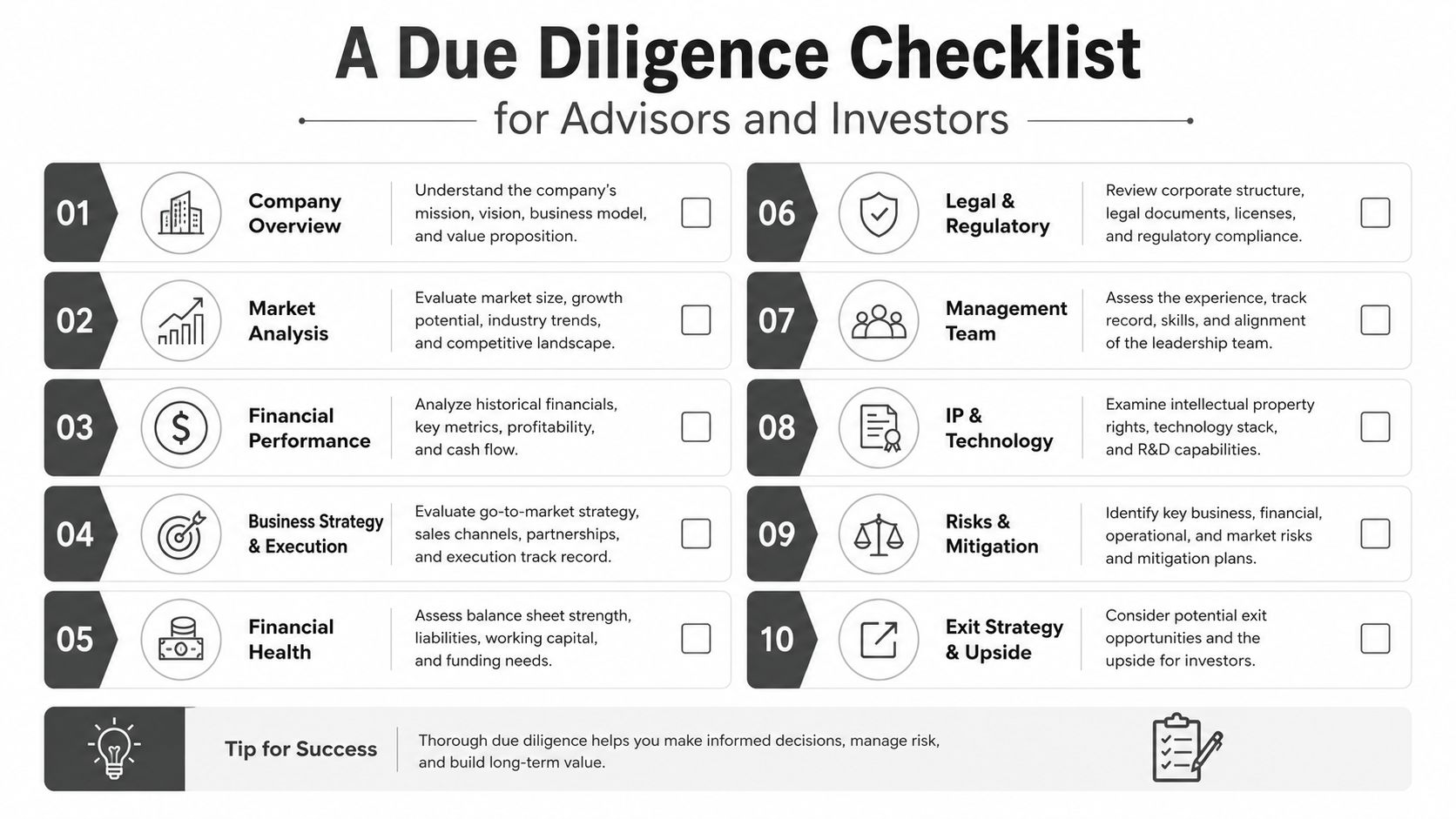
A good DST review starts with the sponsor, not the glossy summary. Ask what the sponsor has done before, how prior programs were structured, and whether the current offering matches the sponsor's track record. If the sponsor can't explain the economics, the exit options, and the limitations in plain English, that's a warning sign before you ever get to the signature page.
Start with the documents, then test the deal
Read the private placement memorandum from front to back, especially the risk factors. Then review the trust agreement for the financing terms, leasing limits, replacement rules, and exit mechanics. If the offering uses debt, check whether the loan documents are consistent with the sponsor's distribution story.
A few verification points matter more than the rest:
- Sponsor history: confirm the sponsor has prior DST programs you can review, not just a polished pitch deck.
- Trustee independence: make sure the trustee is independent, not just independent in name.
- Lease and debt fit: stress-test projected distributions against the lease terms and debt service.
- Control limits: verify how little voting power the beneficial owners really have.
- Exit provisions: identify who can sell, when they can sell, and what happens if the business plan changes.
Check the exchange clock before anything else
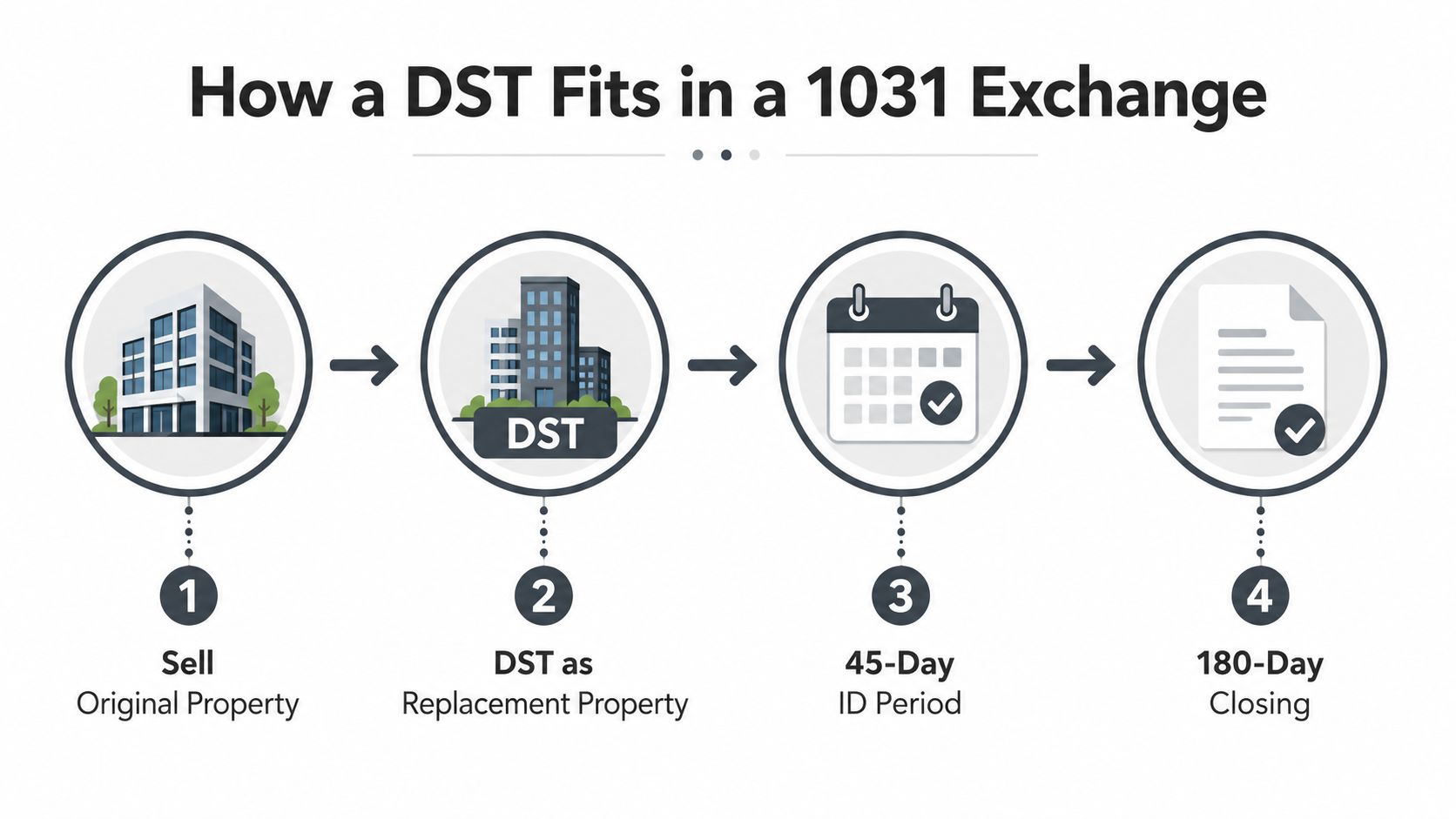
The 1031 timeline is unforgiving. The identification period is 45 days, and the exchange closing window is 180 days. If the DST won't fit inside that timing, the structure may be a poor match no matter how attractive the property looks on paper (IRS exchange timeline resource).
If the timeline is tight, start there. A good property that misses the exchange window is still a failed exchange.
Advisors should also read the offering the way a lender would. What supports the cash flow? What happens if the lease underperforms? What protections are in writing? That's the level of scrutiny that separates a thoughtful DST review from a sales call.
Compliance and Regulatory Considerations
A DST offering sits at the intersection of securities law, trust law, and tax reporting. That's why the compliance analysis needs to start early. If the interests are offered to investors, the offering is typically a securities transaction, which means the sponsor must either register the offering or rely on a valid exemption such as Rule 506(b) or Rule 506(c) under Regulation D. After the first sale, a Form D filing is generally part of the federal compliance picture.
The regulatory stack is layered
Delaware law adds another layer because the trustee owes fiduciary duties under the trust framework. State-level notice filings may also be required when the trust interests are offered in multiple jurisdictions, and broker-dealer involvement can trigger FINRA issues if a registered firm is selling the DST interests. If the sponsor or selling group is regulated as a broker-dealer, the offering needs to fit not just the tax story but the sales-practice story as well.
For a broader legal overview, regulatory compliance guidance for business transactions is a useful companion piece. The key point here is that compliance isn't a back-office formality. It shapes how the trust is offered, sold, and administered.
What happens on the tax side
The exchange itself is designed to avoid a taxable event at the time of the swap, but that does not mean tax issues disappear. Investors may receive K-1s during the operating years, and the basis has to be tracked carefully if they later do a 1031 out of the DST. The paper trail matters because the trust's tax treatment depends on the structure staying clean from entry through exit.
If you want a practical market-facing point of reference, high-yield investment property articles from Dream Destin Realty can help you compare how DST income properties are often discussed in investor materials. The compliance question, though, is simpler than the marketing question. Can the offering be sold, operated, and exited without breaking the legal promises that made it viable in the first place?
| Phase | Filing or Rule | Purpose |
|---|---|---|
| Offering | Regulation D exemption | Allows the trust interests to be offered as securities without full registration when the exemption is valid |
| First sale | Form D filing | Notifies regulators that the exempt offering has begun |
| Operation | Delaware fiduciary duties | Defines the trustee's obligations under the trust |
| Sale process | FINRA-related oversight | Applies when broker-dealer channels are used to sell the DST interests |
Putting the Pieces Together With Kons Law
A DST is not just a tax wrapper. It is a legal entity, a securities offering, and a governance structure that has to work together from the first investor conversation through the final exit. If you are an advisor presenting a DST to a client, a sponsor building a new program, or an investor reviewing a private placement memorandum, the documents should line up before anyone signs.
That is where careful legal review earns its keep. The trust agreement, the offering documents, the exchange paperwork, and the regulatory filings all have to point in the same direction. If they don't, the deal may still look polished while hiding friction that shows up later in operations, reporting, or exit planning.
If you want to discuss your business law matter, contact Kons Law at (860) 920-5181.
If you're evaluating a DST offering, building one, or reviewing the legal documents behind a 1031 exchange, Kons Law can help you spot the issues that matter before they become expensive problems. Visit Kons Law to discuss your matter and get practical guidance for your transaction.
