
Most people think great negotiators are born, not made. They picture charismatic, fast-talking dealmakers who win through sheer force of will. But after years of handling high-stakes business deals, I can tell you the real secret isn't personality—it's preparation.
What you do before you ever sit down at the table determines whether you walk away with a win or a disappointment. Amateurs wing it. Professionals prepare.
Prepare to Win Before You Even Start
Success in negotiation is built on a foundation of solid groundwork. Skipping this step is like walking into a courtroom without having read the case file. It leaves you exposed, reactive, and likely to leave value on the table.
Differentiate Interests from Positions
First, you have to get clear on the difference between what you say you want and what you actually need.
A position is your stated demand: "I need a 10% discount on this order." An interest is the reason behind it: "I need to get my total cost under $50,000 to stay within my quarterly budget."
Focusing on interests opens up a world of possibilities. If the other side can't give you that 10% discount, maybe they can offer free shipping or extended payment terms. These alternative solutions can still satisfy your underlying interest—meeting your budget—without getting stuck on a single, inflexible number.
Establish Your BATNA and Map Theirs
Your single greatest source of power in any negotiation is your Best Alternative to a Negotiated Agreement (BATNA). This isn't your rock-bottom price; it's your plan B. It's what you will do if the negotiation fails and you have to walk away.
Knowing your BATNA is what gives you the confidence to say "no" to a bad deal.
A strong BATNA is the ultimate safety net. It transforms your mindset from desperation to confidence, allowing you to negotiate from a position of strength, not need.
It's just as critical to put in the time to figure out your counterpart's BATNA. What are their other options? Who else could they make this deal with? Understanding their walk-away point shows you the true bargaining zone—the space where an agreement is better for both of you than your respective alternatives.
This simple flowchart shows how this prep work flows directly into making a strong opening move.
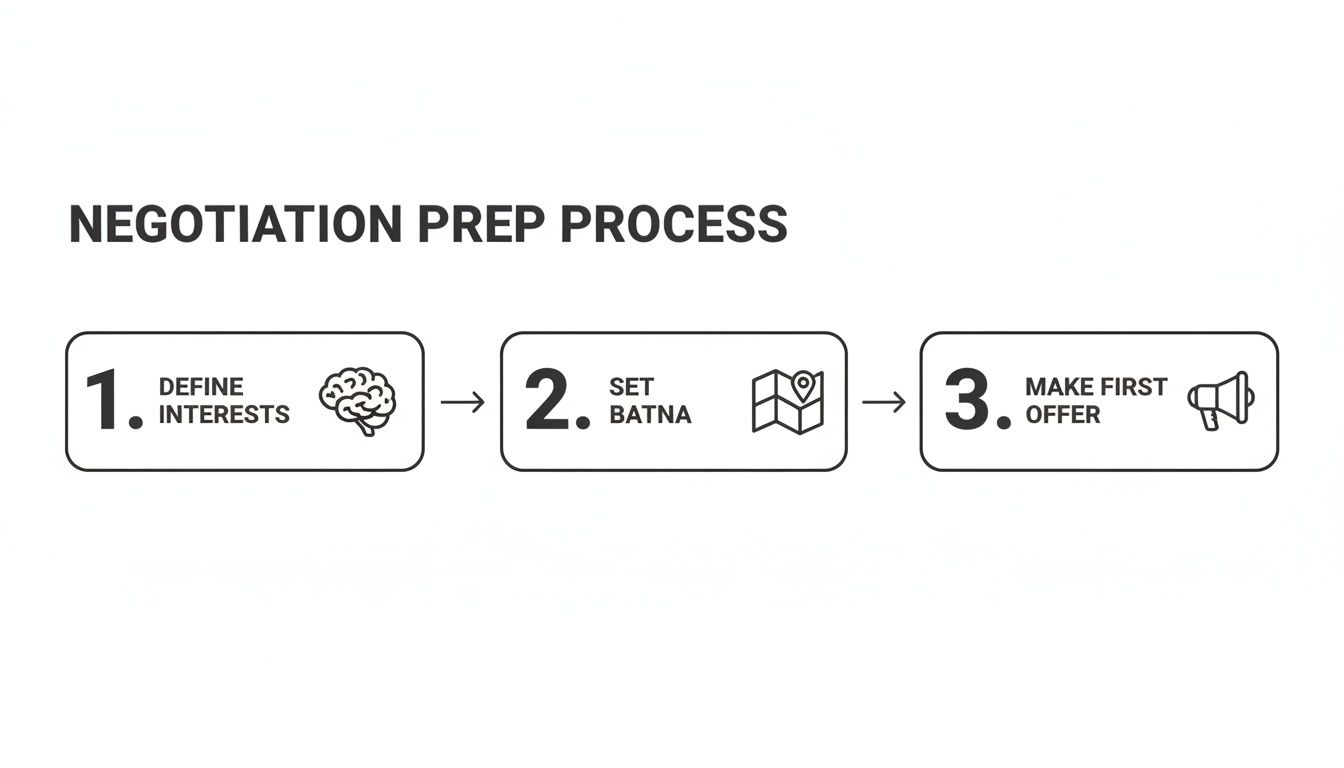
As you can see, the first offer isn't a random guess. It's the logical result of careful strategic analysis.
The Power of the First Offer and Anchoring
Once your homework is done, you're in the perfect position to make the first offer. This move, known as anchoring, sets the psychological starting point for the entire discussion. The first number put on the table has a powerful, often subconscious, pull on the final agreement.
Don't just take my word for it. An EY report that reviewed 1,900 vendor contracts found that negotiators who used anchoring tactics achieved 23% better terms in 78% of cases. When you make the first move, you frame the entire conversation around your desired outcome.
Develop a Smart Concession Strategy
You can't expect the other party to accept your first offer without a counter. A smart negotiator goes in with a concession plan already mapped out. Don't just give things away; trade them strategically.
Your plan should include:
- Prioritized Trade-offs: Know what’s a must-have for you and what’s a nice-to-have. This tells you what you can afford to concede.
- Valuable but Low-Cost Concessions: Identify items that are highly valuable to the other party but don't cost you much to give. Think extended warranties or flexible delivery dates.
- Reciprocity: Never make a concession without asking for something in return. Always frame it as, "If I can do X for you, then I'll need you to do Y for me."
This level of preparation also ensures the final deal is solid. For a closer look at turning your negotiated points into an enforceable agreement, you can review our guide on how to write a business contract.
Ultimately, negotiation isn't an improvised art form; it’s a structured process. By defining your interests, knowing your BATNA, planning your anchor, and mapping your concessions, you build a strategic framework that dramatically shifts the odds in your favor.
Master Communication That Persuades and Influences
All the preparation in the world won't close a deal if your communication fails once you're at the table. When the negotiation begins, your success hinges less on the data you’ve gathered and more on how you interact. Your verbal and non-verbal cues are what ultimately build trust or create roadblocks.
This is where skilled communicators separate themselves. They don't just present facts; they guide the conversation, uncover the other party's real motivations, and frame their position in a way that naturally leads to agreement.

Listen More Than You Speak
The single biggest mistake I see in negotiations is people talking too much. They are so fixated on delivering their own arguments that they completely miss the intelligence being offered by the other side. The key to unlocking a negotiation isn't a perfect speech; it's active listening.
This isn't about just being quiet until it's your turn to talk. It's a deliberate effort to hear what's being said—and what isn't.
- Paraphrase and Confirm: Regularly restate what you believe you've heard. Something as simple as, "So, to be clear, your primary concern is the delivery timeline, more so than the unit price?" shows you're paying attention and gives them a chance to clarify.
- Acknowledge Their Position: If the other party shows frustration, don't ignore it. Acknowledging it with, "I understand this is a sticking point for you," can de-escalate tension. It’s not an agreement, but a signal that you're listening.
- Observe the Non-Verbal: Body language often tells the real story. Did they lean forward when you mentioned a specific clause? Did their tone change when discussing payment terms? These cues are gold.
The most powerful negotiation tool isn't your voice; it's your ears. By truly listening, you gain the intelligence needed to solve their problems and, in turn, achieve your own goals.
Guide the Conversation with Strategic Questions
The person asking the questions is the one in control. Instead of making declarations that can be easily shot down, ask open-ended questions that force a detailed response and reveal crucial information.
For example, don't just ask a closed question like, "Can you offer a lower price?" It invites a simple "no."
Instead, try an open-ended approach: "Could you walk me through how you arrived at this pricing?" This prompts them to discuss their costs, margins, and constraints, which gives you the ammunition you need to find a creative, workable solution.
Frame Proposals for Mutual Gain
The way an offer is presented is just as critical as the offer itself. Most people respond better to proposals framed around shared benefits or avoiding a potential loss.
Instead of demanding, "I need a 15% discount," reframe it to highlight their gain. "We are looking to establish a long-term supply agreement. If we can get this initial order to the right price point, it solidifies our ability to commit to a much higher volume of recurring business with you."
This simple shift changes the dynamic. A concession is no longer a loss for them but an investment in a profitable future relationship.
Project Confidence Through Body Language
Your non-verbal communication can either amplify or completely sabotage your words. Even if you're nervous, you can project confidence and authority.
- Maintain Eye Contact: It conveys sincerity and engagement.
- Use an Open Posture: Crossing your arms often reads as defensive or closed-off. Keep your posture open and relaxed.
- Leverage Silence: This is a classic but powerful tactic. After you make an offer or ask a difficult question, stop talking. Most people rush to fill the silence, and in doing so, they often volunteer key information or a concession.
Mastering these techniques turns a negotiation from an adversarial fight into a collaborative exercise. This is how you build not just better deals, but stronger, more durable business relationships. If you want to discuss your business law matter, contact Kons Law at (860) 920-5181.
Empathy: Your Strategic Advantage in Negotiation
It’s a common mistake to view high-stakes business and legal negotiations as a zero-sum battle. This adversarial approach, however, is a major misstep. The most skilled negotiators know that empathy and emotional intelligence aren’t just “soft skills”—they are powerful strategic tools for forging stronger, more durable agreements.
When you genuinely understand the other party's perspective—their pressures, their goals, their underlying motivations—you unlock the door to creative solutions. The dynamic shifts from a tense standoff to a collaborative problem-solving session. This is absolutely essential in sensitive matters like partnership disputes or contract negotiations, where preserving the relationship is often just as important as the bottom line.
See the Negotiation Through Their Eyes
Before you can persuade anyone, you have to understand them. In a negotiation, empathy isn’t about being “nice” or simply giving in. It’s about accurately identifying the other side's core interests and constraints. This insight allows you to frame your own proposals in a way that solves their problems while achieving your objectives.
Think about a small business negotiating with a key supplier who just announced a significant price hike. The standard, unempathetic response is to dig in your heels and demand they honor the old price. An empathetic negotiator, on the other hand, starts by asking why.
- Are their raw material costs going up?
- Are they facing new regulatory burdens?
- Is a competitor putting the squeeze on them, forcing them to find margin elsewhere?
By asking the right questions, you might uncover an opportunity. Perhaps you can offer a longer-term contract to give them stability, or even make an upfront payment to ease their cash flow—all in exchange for a better price. This approach builds trust and can turn a potential adversary into a partner.
Master Your Own Emotions to Control the Room
Just as you need to understand their emotions, you must be in complete control of your own. High-stakes negotiations are stressful. It's perfectly natural to feel pressure, frustration, or even anger, but letting those feelings drive your decisions is a recipe for a bad outcome.
When things get heated, a skilled negotiator stays calm and collected. Having a firm grasp on the four components of emotional intelligence is critical for making smart decisions under pressure. If the other party gets hostile or makes an aggressive demand, pause before you react. Sometimes, just acknowledging their frustration—without agreeing with their position—is a powerful way to de-escalate.
"I can see this issue is incredibly important to you, and I understand your frustration. Let's take a step back and make sure we're both focused on finding a workable path forward."
This simple act of emotional recognition can diffuse a tense moment and bring the focus back to a productive discussion. It demonstrates that you're listening, which is vital for maintaining a constructive atmosphere. The data confirms this. An Accenture study of 2,700 tech partnerships revealed that empathy training improved deal closure rates by 37%. An INSEAD survey also found that cross-cultural empathy training cut negotiation impasses by an impressive 41%—a huge benefit for anyone dealing with diverse arbitration forums like FINRA or AAA. You can explore more about how empathy drives results by reviewing the data on negotiation statistics.
Ultimately, empathy gives you a distinct advantage. It gives you the insight to craft more compelling offers, the emotional discipline to navigate difficult conversations, and the ability to build the trust needed for a lasting agreement.
If you want to discuss your business law matter, contact Kons Law at (860) 920-5181.
Advanced Tactics for High-Stakes Negotiations
When the stakes are high, your negotiation strategy has to evolve. General principles are a great start, but they won’t cut it when you’re dealing with complex legal agreements or major financial disputes. This is where the rubber meets the road—where core skills are applied under the intense pressure of contract law, litigation, and finance.
In these environments, every single clause carries weight. A seemingly minor detail buried in an indemnification clause or a poorly calculated settlement offer can create long-term headaches and financial damage for your business.
Navigating Complex Contract Negotiations
When you're at the table for a complex commercial agreement, the conversation quickly moves beyond the price tag. The real value—and the hidden risks—is almost always tucked away in the legal boilerplate. To get better at these types of negotiations, you have to master the clauses that truly matter.
Here are three areas that demand your full attention:
- Liability and Indemnification: These clauses dictate who pays when things go wrong. A smart tactic is to negotiate not just the financial cap on liability, but also the specific “carve-outs” (or exceptions) for issues like gross negligence or intellectual property infringement.
- Dispute Resolution: Don’t just gloss over this section. You need to negotiate the exact process for handling future conflicts. Will you use mediation, binding arbitration, or go straight to court? Specifying the jurisdiction and venue—the "where"—can give you a massive home-field advantage down the line.
- Termination and Exit: How does this partnership end? You need to negotiate clear conditions for termination for convenience (ending the deal without cause) versus termination for cause (ending it due to a breach). A well-defined exit ramp is an essential safety net.
For business owners, getting these details right is crucial. For instance, when dealing with property, you can find more targeted advice in our guide on how to negotiate a commercial lease.
Strategies for Commercial Litigation and Settlements
Settlement talks during active litigation are a different beast entirely. Emotions often run high, and the mounting legal costs become a bargaining chip in themselves. The real goal is to strike a balance between the potential reward of a win in court and the certainty and cost savings of a settlement.
A critical first step is to accurately value your case, and that involves more than just adding up potential damages. You have to objectively assess your probability of winning, the estimated legal fees to see it through, and the business disruption that comes with a long, drawn-out fight. This analysis gives you a data-driven foundation for any offer you make or receive.
A common mistake we see in litigation is when a client "falls in love with their case." An effective negotiator has to stay objective, constantly weighing the evolving costs and risks against the upside of fighting versus settling now.
As you can see, the right approach depends entirely on the situation. The table below outlines how your focus should shift across different business contexts.
Negotiation Focus Areas by Business Context
| Scenario | Primary Goal | Key Tactic | Critical Clause/Term |
|---|---|---|---|
| New Vendor Agreement | Secure favorable terms and mitigate future risk. | Frame requests around partnership and mutual benefit. | Liability Cap & Indemnification |
| Commercial Lease | Lock in a predictable cost structure with operational flexibility. | Anchor the rent negotiation early; focus on concessions later. | CAM Charges & Termination Options |
| Litigation Settlement | Minimize financial loss and business disruption. | Use a detailed risk/cost analysis to justify your offer. | Release of All Claims |
| Creditor Collection | Maximize recovery while avoiding debtor bankruptcy. | Offer structured payment plans instead of demanding a lump sum. | Consent Judgment |
Each scenario demands a unique playbook, shifting from broad partnership goals in a vendor deal to pure risk mitigation in a lawsuit.
Techniques for Creditor Collections
When you’re trying to collect from a debtor, the objective is to get back as much as you can without spending a fortune on legal fees. Taking a hard, non-negotiable stance can easily backfire—it might push a debtor with few assets into bankruptcy, leaving you with nothing.
A more strategic approach often involves creating structured solutions.
- Negotiating Payment Plans: Offer a realistic payment schedule that works with the debtor's cash flow. This strategy frequently yields a higher total recovery than a one-time, deeply discounted settlement.
- Securing Consent Judgments: Here, the debtor agrees to let a court enter a judgment against them, while you agree not to act on it as long as they follow a payment plan. This gives you immediate legal leverage if they default, saving you the time and expense of a full-blown lawsuit.
The Unique Dynamics of Securities Arbitration
For financial professionals, negotiations frequently happen within the structured world of securities arbitration, such as through the Financial Industry Regulatory Authority (FINRA). This process is a hybrid, blending formal litigation with behind-the-scenes negotiation.
Preparation is everything. You have to know the forum's specific rules, what arbitrators have awarded in similar cases, and the opposing counsel’s reputation. The negotiation isn't about open-ended brainstorming; it’s about presenting a meticulously documented case to a panel while simultaneously engaging in settlement talks. Success often comes down to building a case file so credible that it signals to the other side you are fully prepared to see it through to a final hearing.
If you want to discuss your business law matter, contact Kons Law at (860) 920-5181.
From Theory to Action: Turning Knowledge Into Skill Through Practice
Knowing the theory behind negotiation is one thing. Performing under pressure when a deal is on the line? That’s something else entirely. Reading about tactics like anchoring or active listening is the easy part. The real work is embedding that knowledge so you can use it instinctively in the heat of a high-stakes meeting.
This is where deliberate practice comes in. It’s the bridge that takes you from simply knowing the playbook to executing the plays flawlessly. Top professionals know negotiation is a perishable skill. It demands constant sharpening, much like an athlete’s muscle memory. Without it, you’ll revert to old, less effective habits when the pressure is on.
Why Structured Training Delivers Real Returns
The proof is in the numbers. Businesses are investing heavily in structured negotiation training because the returns are undeniable. The global market is set to hit $14.85 billion by 2025, with 10.75% annual growth.
Why the boom? The ROI is compelling. Research shows that training can:
- Yield as much as $7 for every $1 spent.
- Boost employee confidence by 65%.
- Increase retention of key negotiation methods by 75% through realistic simulations.
You can find a more detailed breakdown in these findings on the negotiation training market. This investment works because it creates a safe environment to fail, get feedback, and improve without putting a real contract or relationship on the line.
Negotiation isn't a spectator sport. You can't get better just by reading the playbook. You have to get on the field, run the plays, and even get tackled a few times to build real strength and resilience.
Create Your Own Practice Plan
Hoping to get better isn't a strategy. You need a clear, actionable plan focused on creating practice opportunities, seeking out feedback, and analyzing your own performance.
Start by integrating practice into your daily work. Don't wait for a major contract renewal to try a new technique. Instead, practice in lower-stakes situations. Negotiate a project deadline with a colleague or discuss a change in scope with your manager. These small, everyday interactions are your training ground.
Next, find a trusted colleague and run role-play scenarios. If you have a big supplier negotiation coming up, have your partner play the part of a tough procurement officer. This lets you practice your opening, test your concession strategy, and get a feel for the emotional dynamics before you walk into the real meeting.
Finally, make a habit of asking for constructive feedback. Don’t just ask, "How did I do?" Go deeper. Ask specific questions like, "Was my first offer credible?" or "Did my argument seem weak when I addressed your concerns about delivery?"
Debrief and Analyze Your Performance
After every significant negotiation, take 15 minutes for a personal debrief. This self-analysis is where the lessons truly sink in and become part of your skillset.
Ask yourself a few critical questions:
- Preparation: Was my BATNA solid? Did I correctly identify their core interests, or was I caught off guard?
- Execution: Did I anchor the conversation where I wanted? Did I ask enough open-ended questions to uncover new information?
- Outcome: Did I achieve my main objectives? More importantly, where might I have left value on the table?
- Emotional Control: How did I handle the pressure? Did I get flustered or stay centered?
In high-stakes deals, your conflict management skills are just as important as your negotiation tactics. They help you de-escalate tension and keep the conversation productive, even when disagreements arise. By consistently practicing, seeking feedback, and reviewing your performance, you can transform negotiation from a stressful event into a manageable—and improvable—process.
If you want to discuss your business law matter, contact Kons Law at (860) 920-5181.
Putting It All Together: Your Path to Mastery
We’ve covered the core pillars of effective negotiation, from the hard work of preparation to the finer points of communication. You now have a practical framework for building your skills, deal by deal. The journey to becoming a truly great negotiator is a marathon, not a sprint, and it’s built on these fundamental elements.
The most important thing to remember is that masterful negotiation isn't some gift you're born with. It’s a skill, plain and simple—one that anyone can learn, practice, and perfect over time with enough discipline.
Integrating the Key Skills
Your real progress will come from weaving these different skills into a single, seamless approach.
- Make Preparation Your Bedrock: Before any discussion, get serious about defining your interests, figuring out your BATNA, and doing your homework on the other party. This is non-negotiable.
- Use Communication as Your Crowbar: Practice genuine active listening. Ask the smart, strategic questions that get you the information you need. And always frame your proposals to show how everyone wins.
- See Empathy as Your Edge: You have to look past what they say they want to understand what they truly need. Their underlying pressures and motivations are where the real deal gets made.
- Treat Practice as Your Fuel: Actively look for low-stakes opportunities to negotiate. Role-play the tough conversations before they happen. Always debrief yourself afterward to lock in the lessons.
When you consistently apply these skills, you won't just get better outcomes—you'll build stronger, more valuable business relationships. Part of this process also means getting comfortable with the legal side of agreements. For a closer look, you can read our guide on critical contract negotiation points.
The best negotiators don't just close deals; they build partnerships. They have a knack for turning a tense standoff into a collaborative exercise, transforming a one-off transaction into a long-term asset. Mastering that shift in mindset is the final piece of the puzzle.
When your most important business matters are on the line, having an expert in your corner can change the outcome. If you need to discuss a business law issue, contact Kons Law at (860) 920-5181 for a consultation.
Your Negotiation Questions, Answered
Even seasoned professionals run into tricky situations at the negotiation table. Here are my thoughts on some of the questions I hear most often from clients navigating high-stakes business and legal discussions.
What’s the Biggest Mistake People Make in Negotiations?
The most damaging and frequent mistake is simply failing to prepare. Too many people walk into a critical meeting with just a vague goal and hope for the best.
They haven't clearly defined their BATNA (Best Alternative to a Negotiated Agreement), they don't have a prioritized list of their interests, and they certainly haven't spent time understanding the other party's perspective. This lack of preparation forces them into a reactive position, leading to poor decisions, rushed concessions, and leaving a lot of value on the table.
What if the Other Side Holds All the Cards?
When you’re facing a significant power imbalance, your best defense is always a good offense—and that means meticulous preparation and strategy. Your BATNA is your lifeline here; the stronger your alternative is, the more power you have to negotiate confidently or even walk away.
Information is your other great equalizer. Do your homework. Dig into their business, their market position, their reputation, and what really drives their decisions. You can use this knowledge to craft creative, interest-based proposals that solve a problem for them in a way they hadn't considered. It shifts the dynamic from a power play to a collaborative session.
Even when you feel you have less leverage, you always have the power of your own choices. A strong BATNA and deep knowledge of the other side's needs can level the playing field far more than you might think.
Is It Better to Make the First Offer?
If you've done your homework, then yes, in most situations, you should make the first offer. This is a tactic called "anchoring," and it’s incredibly powerful.
By making the first offer, you set the psychological starting point for the entire discussion. The negotiation will now revolve around your number, which often results in a final agreement much closer to your target. The only time to hold back is if you have almost no information about what a reasonable range might be. In that case, letting them go first can be a smart way to gather intel before you put a number out there.
How Should I Handle a "Take It or Leave It" Offer?
First, you need to gently test how firm that ultimatum really is. You can do this without being aggressive. Acknowledge their position, then pivot to understanding the "why" behind it.
Try saying something like, "I understand that's your position. Can you help me understand the constraints that led to this offer?" This can often reopen a dialogue that seemed closed.
If the offer is truly non-negotiable, you simply have to compare it to your BATNA. If their offer is better than your best alternative, accepting it might be the right move. If your BATNA is stronger, you can walk away with confidence. Navigating these moments is a critical skill, and you can learn more about different approaches to conflict by understanding the differences between alternative dispute resolution vs litigation.
If you want to discuss your business law matter, contact Kons Law at (860) 920-5181.
