You open the USPTO record and see a mark that looks uncomfortably close to yours. Maybe the words overlap. Maybe the products sit on the same shelf, target the same buyers, or show up in the same search results. Your first reaction is usually the right one. This could become a real brand problem if you let it pass.
For a business owner, that moment is rarely just legal. It affects naming strategy, marketing spend, distributor relationships, and the value you've built into the brand itself. A federal registration can strengthen the other side's position, make enforcement harder later, and create avoidable friction in the market. If you haven't already reviewed your broader intellectual property protection strategy, this is usually the point when that work becomes urgent.
Your Brand Is at Risk What Happens Now
A trademark opposition is the formal process for objecting to a pending trademark application before it registers. In practical terms, it is your chance to stop a problem before it becomes a registered right that the other party will rely on.
Most business owners don't deal with TTAB procedure every day, and that's why the process feels more intimidating than it should. The concern is understandable. You are being asked to make a fast decision, under deadline, about a brand asset that may be central to your company's growth.
Why timing matters immediately
A trademark opposition isn't something to put in the stack for next quarter. Once the mark is published for opposition, the window to act is short. Delay can take a manageable dispute and turn it into a more expensive one.
The first strategic question isn't just "Can we oppose?" It's broader:
- How important is the mark to your business? A flagship brand deserves a different response than a secondary product line.
- How close is the conflict? Similar words alone don't decide the issue. The goods, services, customers, and marketplace context matter.
- What result do you want? Sometimes the right outcome is blocking the application. Sometimes it's narrowing the other side's description or negotiating distance between the brands.
Practical rule: Treat an opposition review like a business risk assessment, not just a legal filing exercise.
Why business owners call counsel at this stage
At this point, most owners want three things. They want a clear read on risk, a realistic budget, and a strategy that doesn't waste money chasing a result that doesn't improve the business.
That's where a trademark opposition attorney adds value early. The attorney's role is to sort the emotional reaction from the legal and commercial realities. Some matters should be pressed hard. Others should be resolved through a targeted agreement before the process expands.
Understanding Trademark Oppositions
A trademark opposition starts before the other party gets a registration. That timing matters. If your concern is preventing a conflicting mark from gaining the advantages of federal registration, the TTAB is often the right forum to consider first.
The TTAB, short for the Trademark Trial and Appeal Board, decides disputes about whether a mark should register. For a business owner, the practical point is simple. This process is about stopping or limiting a registration before it becomes a stronger asset in someone else's hands.
Who can file and what the case is really about
An opposition is not open to the general public. The party filing it must have a real stake in the outcome, usually because it believes the applied-for mark threatens its own rights or will cause commercial harm.
Likelihood of confusion is the ground that comes up most often, but the analysis is more specific than many owners expect. Similar names matter. So do the products or services, the buyers, the sales channels, and the overall context in which customers encounter the brands. Companies often review what trademark infringement involves as a starting point, then assess whether the registration dispute is strong enough to justify the time and cost of an opposition.
A close call on similarity does not always justify a fight. If the other side sells in a narrow channel, uses a limited description, or appears open to narrowing its application, a negotiated result may protect the brand at a lower cost.
What the TTAB can decide
The TTAB decides registration rights. It can refuse registration, sustain an opposition, or allow the application to proceed. It does not award money damages, and it does not enter the kind of broad injunction a court may issue in an infringement case.
That limit is not a weakness. It is part of the cost-benefit analysis.
For many small and mid-sized businesses, the immediate objective is to keep a problematic mark off the federal register without paying for full federal court litigation. In the right case, that is a disciplined business decision. In the wrong case, it can become an expensive sideshow if the primary problem is already happening in the market and court relief is what the company truly needs.
Why this section matters strategically
Business owners sometimes treat an opposition like a paperwork dispute inside the USPTO. That is a mistake. The process is formal, the record matters, and the claims you choose should match the result you want.
A sound early assessment usually turns on three questions. Is the other mark a real threat to revenue or brand clarity. Is the likely outcome worth the cost of pressing the case. Is there a narrower solution, such as a consent agreement or amended description, that protects the business without prolonged litigation.
Those are legal questions, but they are also budget questions. The strongest opposition strategy usually starts with a clear business objective, not a reflex to fight.
The TTAB Opposition Process Step by Step
A business owner often learns about a trademark opposition at the worst time. The application has already published, the window to act is short, and the team wants to know whether this is a contained USPTO dispute or the start of expensive litigation. The answer usually depends on how the case is handled in the first few weeks.
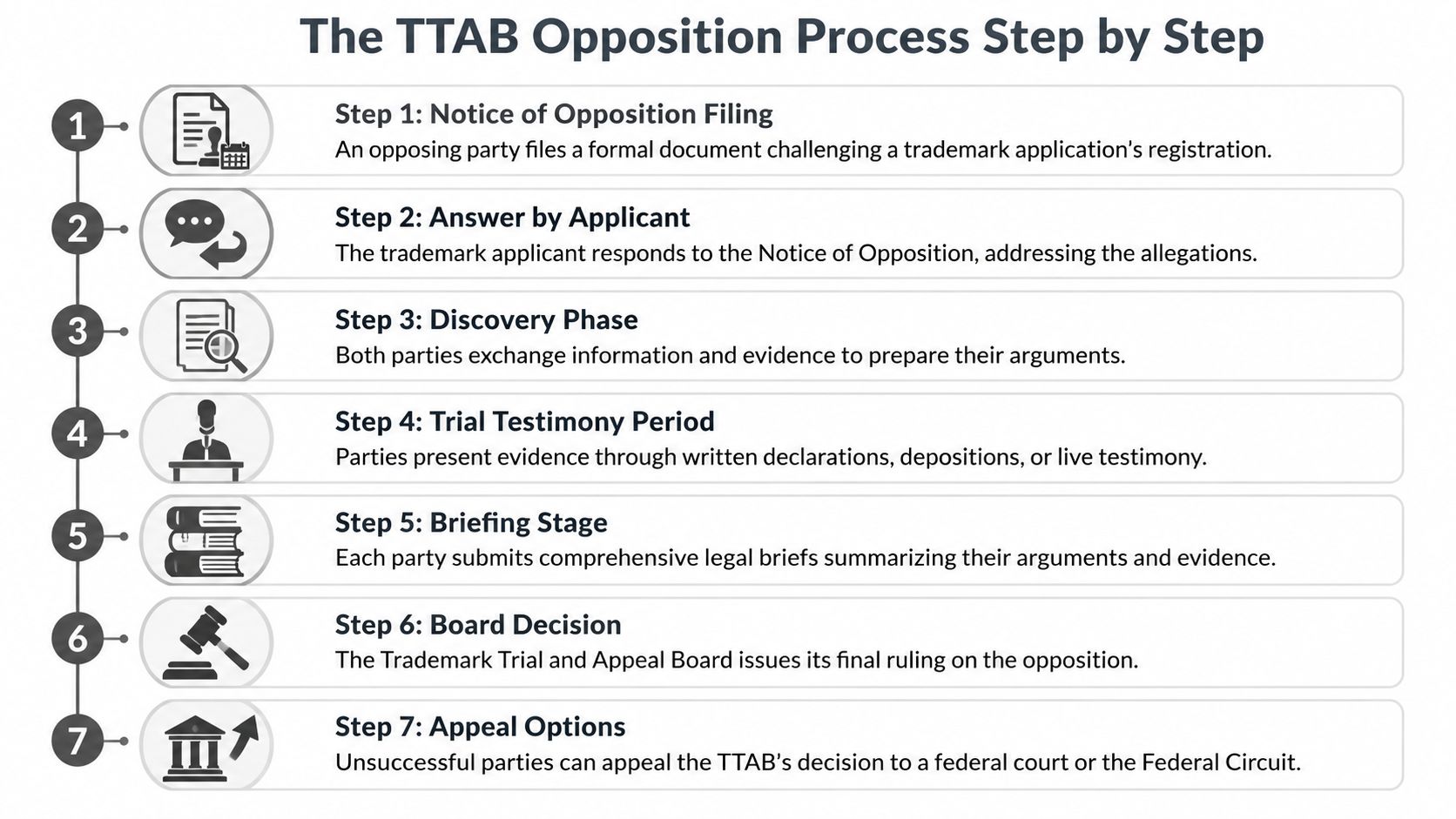
The process follows a set schedule, but smart parties do not treat it as a checklist. Each phase creates a decision point about risk, proof, settlement value, and budget.
Filing and the answer
The first deadline is the publication window. If the opposition is not filed on time, the opportunity can be lost, and the business may be pushed into a harder and more expensive forum later.
The notice of opposition does more than start the case. It sets the theory, defines the facts that matter, and shapes the other side's response. An overbroad pleading can waste money. An underspecified one can leave out claims that should have been preserved from the start.
After service, the applicant must answer or face the risk of default. That sounds simple, but this stage often presents the first real business choice. Press the case immediately, discuss a coexistence solution, or ask whether a negotiated amendment would solve the problem at lower cost.
Discovery and motion practice
Once the pleadings close, the opposition begins to feel like litigation. The parties exchange written discovery, request documents, and take testimony through the TTAB's procedures. Disputes over objections, confidentiality, and the scope of requests can become expensive if no one is managing them with a clear theory of the case.
Smaller companies can lose control of cost in these situations.
A disciplined discovery plan focuses on the facts that move the result. Priority. Overlap in the goods or services. Channels of trade. Evidence of marketplace use. Proof of confusion, if it exists. Fishing expeditions usually increase fees without improving the record.
Motions can also change the value of the case. Some motions narrow issues and create settlement pressure. Others consume time and money without changing the outcome. The right call depends on what the client is trying to protect and whether the likely gain justifies the spend.
Testimony, briefing, and decision
The TTAB trial phase is usually a paper record, not a courtroom hearing with live witnesses in front of a judge. Evidence must be introduced in the proper form during the assigned testimony periods. If a party assumes that documents produced in discovery automatically count as evidence, that mistake can damage an otherwise strong case.
After the record closes, the parties file briefs and the Board issues its decision. By that point, the outcome often turns less on who feels more wronged and more on who built a usable evidentiary record and kept the case aligned with the governing legal factors.
A practical process map looks like this:
| Phase | What happens | Strategic focus |
|---|---|---|
| Publication and filing | Opposer files the notice | Choose claims that match the business goal |
| Answer | Applicant responds | Evaluate defenses and early settlement options |
| Discovery | Parties exchange evidence | Gather proof that supports the strongest issues |
| Testimony period | Evidence is formally submitted | Make the record admissible and complete |
| Briefing and decision | Legal arguments go to the Board | Connect the proof to the TTAB standards |
Where businesses make avoidable mistakes
The most common errors are not dramatic. They are procedural and strategic.
- Missing or miscalculating deadlines. TTAB scheduling orders are strict, and extensions should be handled deliberately, not casually.
- Spending money on every possible issue. A narrower case is often cheaper to prove and easier to settle.
- Treating discovery as routine paperwork. Discovery should test the merits and improve negotiating position.
- Failing to budget by phase. Filing is only the opening cost. Discovery and testimony usually drive the larger spend.
- Waiting too long to discuss resolution. Many cases become easier to settle after each side sees the strengths and weaknesses of the record.
Handled well, the TTAB process gives a business several off-ramps before final decision. Handled poorly, it becomes an expensive exercise in procedure.
The Value of a Trademark Opposition Attorney
You get notice that another party has opposed your application, or you discover a published mark that is too close to yours. At that point, the question is not whether you are upset. The question is whether the dispute justifies the cost, risk, and management time of a TTAB fight.

A good trademark opposition attorney helps a business answer that question early. That starts with an honest case assessment. Similar names alone do not decide an opposition. The real analysis turns on priority, the relatedness of the goods or services, the strength of the mark, available proof, and whether a business objective can be met through settlement instead of full litigation.
For small and mid-sized companies, that judgment matters as much as legal skill. Owners often come in wanting to either fight on principle or make the problem disappear as cheaply as possible. Both instincts can lead to bad outcomes. Some disputes threaten a core brand and deserve immediate investment. Others can be resolved with coexistence terms, amendments, or a narrower agreement that protects the business without funding every phase of a Board case.
Experienced counsel adds value by setting the right objective before fees start stacking up. In one matter, the right answer may be aggressive opposition because rebranding later would cost far more than the proceeding. In another, the better answer is to press hard enough to gain favorable settlement terms, then stop before discovery costs outweigh the practical benefit.
That strategic role shows up in several places:
- Early case valuation. Counsel should tell you whether the claim is strong, marginal, or better used as settlement pressure.
- Issue selection. A narrower, provable case often serves the client better than a long list of weak claims.
- Record building. Businesses usually have helpful documents, but those materials need to be organized and introduced in a form the TTAB will consider.
- Settlement timing. The right proposal at the right stage can save substantial cost while still protecting the mark.
- Witness preparation. If testimony or depositions are likely, preparation affects both cost and credibility. Businesses facing that stage should understand how to prepare for a deposition before avoidable mistakes get locked into the record.
Self-representation usually breaks down on judgment, not effort. A business owner may work hard and still spend money proving points that do not change the result. An attorney should keep the case tied to business reality: what needs to be protected, what can be negotiated, and what outcome is worth paying for.
That is the primary value. A trademark opposition attorney is not there just to file papers. Counsel should help you decide when to fight, when to narrow the dispute, and when a practical resolution puts the company in a better position than a win after months of expense.
Key Strategies and Evidence That Win Cases
A TTAB opposition usually turns on discipline. The side that wins is often the side that chose a clear theory early, gathered proof that fits that theory, and avoided spending money on facts that do not change the result.
For a small or mid-sized business, that matters as much as the legal standard. Every hour spent collecting documents, answering discovery, or preparing witnesses has a cost. The question is not just whether you can prove confusion, priority, or descriptiveness. The question is whether you can prove the right point with evidence the Board will credit, at a cost that makes business sense.
What evidence usually carries the case
The strongest records are usually the least glamorous. Dates of first use. Product packaging. website screenshots. sales materials. invoices. catalogs. advertising. channel-of-trade evidence. customer communications. If priority or likelihood of confusion is the issue, those ordinary business records often matter more than broad statements about how hard you worked on the brand.
Survey evidence can help, but it is not automatic. A well-designed survey may support confusion or perception. A weak survey can become an expensive distraction and give the other side something to attack. Many smaller businesses are better served by tight documentary proof and a witness who can explain consistent marketplace use.
As noted earlier in the article, reported opposition outcomes vary widely depending on case strength, mark similarity, and whether counsel is involved. That is the practical takeaway. Strong facts and admissible proof improve your odds. Weak records force harder settlement choices.
Strategy decisions that affect the result
Good TTAB strategy is usually narrower than business owners expect. A shorter case with provable points often performs better than a broad complaint that mixes strong claims with weak ones.
These choices often make the difference:
- Lead with the best claim. If priority and likelihood of confusion are your strongest grounds, build around them instead of adding every possible theory.
- Match evidence to each element. Do not assume the Board will connect the dots for you. If you claim overlapping customers or channels, prove those overlaps directly.
- Use discovery with a purpose. Ask for documents and admissions that test use dates, geographic scope, product overlap, and claimed market conditions.
- Protect witness credibility. A careless declaration or poorly handled deposition can damage an otherwise solid case. If testimony is likely, review the practical steps for how to prepare for a deposition before the record is set.
- Treat settlement as part of the strategy. Strong evidence does more than support trial papers. It also improves your position in coexistence talks, consent discussions, and amendment proposals.
Common mistakes that weaken otherwise good cases
The Board decides trademark disputes on proof in the record, not on how unreasonable the other side seems. Businesses lose ground when they file an emotionally satisfying case instead of a focused one.
| Weak approach | Why it hurts the case |
|---|---|
| Arguing that the other side acted unfairly, without tying it to a legal claim | The TTAB is looking for proof that matches the pleaded grounds |
| Pleading too many theories | Extra claims add cost, create inconsistencies, and distract from the strongest path to relief |
| Saving document collection for late in the case | Important records get lost, custodians forget details, and deadlines become expensive |
| Using discovery to ask for everything | Broad requests increase cost without always producing evidence that changes leverage |
One practical point deserves emphasis. The best opposition record usually starts before formal testimony. Businesses that collect dated examples of use, organize sales and marketing records, and identify one or two credible witnesses early are in a better position to either win or settle on acceptable terms.
That is what winning preparation looks like in TTAB practice. It is focused, documented, and tied to a business objective.
Budgeting for an Opposition and Exploring Alternatives
For many small and mid-sized businesses, cost is the first practical question. It should be. Trademark protection is important, but the spending has to make sense in relation to the mark, the business objective, and the risk of confusion if the other side registers.

What the cost picture looks like
Verified data shows average attorney fees for opposition defense can range from $15,000 to $50,000, and that oppositions filed with attorney representation succeed at a 65% rate versus 42% for pro se filings, according to Miller Johnson's summary of the cost-benefit analysis.
That doesn't mean every case should hire counsel or spend aggressively. It means owners should make the decision with open eyes. Representation improves the odds in the reported data, but the economics still depend on the value of the brand and the commercial significance of the dispute.
The verified data also notes that fixed-fee pricing for early stages such as the Notice of Opposition and Discovery Conference can range from $2,500 to $8,500, covering work like consultation, research, drafting, filing, government fees, and initial correspondence, as summarized in the earlier cited discussion of TTAB practice.
A practical decision framework
Instead of asking only "How much will this cost?" ask four more useful questions:
- How valuable is the mark to the business? If the brand anchors a core product or service, the spend may be justified.
- How avoidable is confusion? Some disputes can be solved by narrowing goods, changing presentation, or agreeing on boundaries.
- What is the likely path? A matter positioned for early resolution has a different budget profile than one headed into hard-fought discovery.
- What happens if you do nothing? Sometimes the biggest cost comes later, after the other side has a registration.
Litigation versus negotiated outcomes
Full TTAB litigation isn't the only path, and it often isn't the best one.
A side-by-side comparison helps:
| Option | Best use case | Main advantage | Main trade-off |
|---|---|---|---|
| Full opposition fight | High-value mark and serious conflict | Preserves the strongest formal challenge | Highest cost and management burden |
| Settlement | Both sides want predictability | Can resolve quickly and reduce spend | Usually requires compromise |
| Consent or coexistence agreement | Marks can live apart without confusion | Protects business operations while reducing risk | Needs careful drafting and monitoring |
| Voluntary amendment or narrowing | The problem is scope more than the mark itself | Targets the issue directly | May not solve deeper marketplace overlap |
In practice, many owners benefit from an early assessment that asks whether the business needs a ruling, or a durable solution. Those are not always the same thing.
A good budget isn't just a number. It's a plan matched to the value of the mark and the most realistic route to resolution.
Choosing Your Attorney and Taking the Next Step
Not every business lawyer handles TTAB cases well. A trademark opposition has enough procedural nuance that you should look for counsel with actual opposition experience, not just general familiarity with trademarks.
What to look for in counsel
A useful screening list includes:
- TTAB-specific experience. Ask whether the lawyer has handled oppositions and defenses before the Board.
- Comfort with evidence and procedure. This is not only about trademark law. It also involves litigation habits, deadlines, discovery management, and briefing.
- Business judgment. You want someone who can explain when to fight, when to negotiate, and when to stop spending.
- Clear communication about cost. Good counsel should discuss likely phases, not just provide a vague opening estimate.
- Commercial perspective. A strong advisor understands how trademark disputes fit into the broader role of a business lawyer advising companies.
Questions worth asking on the first call
Don't waste the initial consultation on abstract legal theory. Ask direct questions.
- What is your preliminary view of the confusion risk?
- Do you see a path to early resolution?
- What evidence should we collect now?
- What deadlines matter first?
- How will you help us decide whether the economics justify the fight?
A capable trademark opposition attorney should be able to answer those questions in practical terms. If the response is all jargon and no strategy, keep looking.
The right attorney won't promise outcomes. What good counsel can do is reduce avoidable mistakes, sharpen your strategic position, and align the legal process with your business goals. That is usually what matters most.
If you want to discuss your business law matter, contact Kons Law at (860) 920-5181.
