A lot of Connecticut business owners first call a lawyer after the problem already has a shape. A demand letter lands in the inbox. A customer refuses to pay. A co-owner starts moving money or records. A former employee threatens suit. A regulator asks for documents that were never meant for public review.
At that point, you don't need abstract legal theory. You need a plan that protects cash flow, preserves evidence, controls what gets said, and keeps a business dispute from turning into an operational crisis. That's where a business defense attorney matters.
What a Business Defense Attorney Does for You

A business defense attorney does more than appear in court. Their primary work begins much earlier. Counsel identifies the legal and commercial risk, determines which facts are significant, and chooses the response that protects the company rather than feeding the conflict.
That can mean pushing back on a weak claim. It can mean negotiating a fast business resolution before fees spiral. It can also mean preparing for arbitration or trial when the other side won't act reasonably.
The need is constant, not niche. The business law sector generated $191.8 billion in revenue in 2024, which reflects how often companies need counsel for disputes, compliance issues, and transactional risk management, according to IBISWorld's business lawyers and attorneys industry data.
More than courtroom defense
Most clients initially think "defense" means responding to a lawsuit. In practice, the work is broader:
- Early risk control: Reviewing the demand, the contract, the emails, and the internal decision trail before anyone says too much.
- Positioning the record: Making sure your business doesn't accidentally admit liability in a rushed reply.
- Protecting operations: Containing the dispute so employees, vendors, and customers aren't dragged into unnecessary disruption.
- Forum strategy: Deciding whether the matter belongs in court, arbitration, or a negotiated settlement track.
A useful starting point is understanding the broader role of counsel in day-to-day operations, not just crises. This overview of what a business lawyer does helps frame why dispute defense and proactive business advice are so closely connected.
Practical rule: The first response to a legal threat shouldn't be the fastest response. It should be the most controlled one.
What clients usually get wrong
Businesses often hurt themselves in the first week of a dispute. They forward the claim around the office, argue by email, suspend payment without checking contract terms, or try to "explain everything" before documents are organized.
Effective strategies are more disciplined. Preserve records. Limit internal discussion to the individuals who need to know. Gather the governing documents, amendments, invoices, communications, and payment history. Then build a response around facts, strategic advantages, and business goals.
That approach often saves more than money. It protects credibility.
Common Disputes a Business Defense Attorney Handles
Most commercial disputes don't start with dramatic facts. They start with ordinary business friction that hardens into legal exposure.
A supplier misses deadlines and your company withholds payment. A customer claims the work was defective after using the deliverables. Two partners agree verbally on one thing and write something else in the operating agreement. A competitor hires away staff and walks off with client relationships. These are the cases that fill business dockets.
Contract disputes and payment fights
Breach of contract claims are the most familiar version. One side says the other didn't perform. The other side says performance was excused, accepted, waived, modified, or never clearly required in the first place.
In these matters, details carry the case. Delivery terms. Approval language. Notice provisions. Cure rights. Integration clauses. Damages limitations. Businesses often learn too late that the sentence they skimmed at signing becomes the sentence everyone fights about later.
Experienced counsel can often narrow these cases before they metastasize. In contract litigation, attorneys can use data-driven strategies to reach settlement rates exceeding 85% before trial, reducing cost and disruption, according to Tilem & Associates' business law discussion.
If the dispute starts with nonpayment, a clear pre-suit strategy matters. Business owners who want a plain-English overview of how these notices work may find this legal demand letter for payment guide useful, especially before escalating a collections matter into litigation.
Internal business fights
Some of the hardest cases involve people who once trusted each other.
A member stops sharing financial information. A shareholder claims self-dealing. A founder exits and solicits customers. A manager opens a competing entity while still inside the company. These disputes are emotionally charged because they combine money, control, and reputation.
Common examples include:
- Owner deadlock: The business can't make decisions because the people in control no longer agree on spending, hiring, or strategy.
- Fiduciary breach claims: One side alleges misuse of company assets, concealment, or unfair self-benefit.
- Exit disputes: A departing principal challenges buyout terms, restrictive covenants, or ownership records.
When clients ask whether a wrong is "just unfair" or legally actionable, the answer often turns on whether it qualifies as a business tort. This explanation of what is a business tort is a good primer.
A business dispute rarely stays limited to the claim named in the first letter. Payment fights become fraud allegations. Partnership disputes become injunction requests. Early framing matters.
Business torts and operational claims
Not every case is strictly contractual. Some involve conduct that damages the business itself. That can include unfair competition, interference with customer relationships, misuse of confidential information, or false statements that harm a company's market position.
Employment-related disputes can also overlap with commercial defense. A wage claim, a restrictive covenant issue, or a trade secrets allegation can put company records, policies, and leadership decisions under scrutiny very quickly.
The practical point is simple. Small and mid-sized businesses face the same categories of exposure as larger companies. The difference is that they usually have less room for error.
Choosing Your Arena Litigation vs Arbitration
A dispute doesn't just turn on who is right. It also turns on where the fight happens. Forum choice affects cost, speed, privacy, strategic advantage, and settlement pressure.
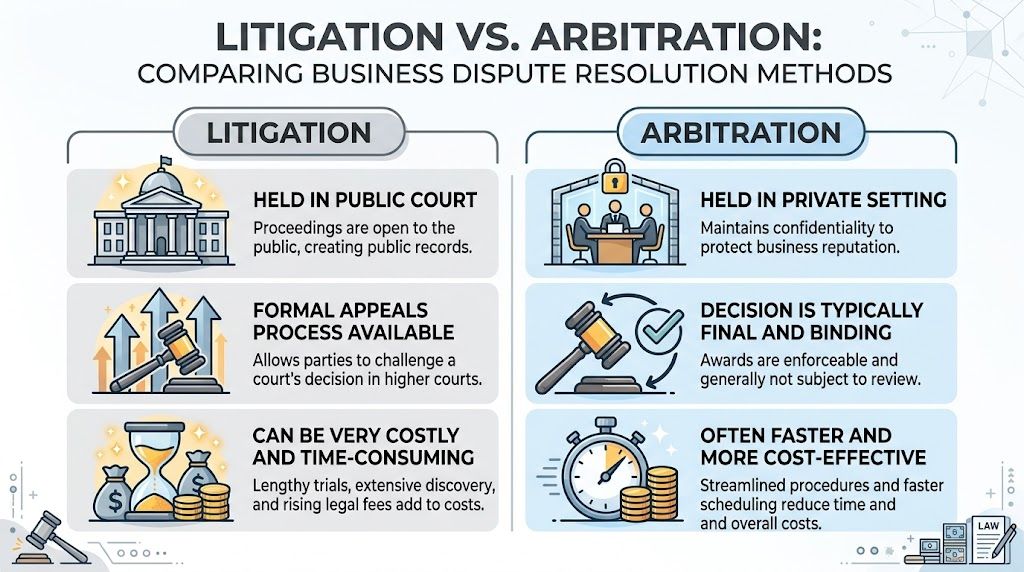
For many businesses, the key question isn't whether litigation or arbitration is better in the abstract. It's which one fits the contract, the facts, and the business objective.
Side by side comparison
| Factor | Litigation | Arbitration |
|---|---|---|
| Publicity | Usually public court filings and hearings | Usually private, which can help protect reputation |
| Procedure | More formal rules and broader motion practice | More streamlined, but procedure depends on the forum and clause |
| Appeals | Formal appellate review may be available | Awards are often final with limited review |
| Speed | Can take longer, especially with crowded dockets | Often moves faster |
| Cost | Costs can escalate with discovery and motion practice | Often more cost-effective, though forum fees matter |
Cost is often the first real decision point. Mid-sized commercial litigation can average $150,000 to $500,000 in costs, while negotiated settlements or arbitration may cost a fraction of that, as described in the earlier-cited Tilem source. That doesn't mean arbitration is always cheap. It means unmanaged court litigation can become very expensive very fast.
For a more focused breakdown of the trade-offs, this article on the difference between arbitration and litigation is worth reviewing before a strategy call.
What works in practice
If confidentiality matters, arbitration often has an edge. That's especially important when the dispute involves investor relations, customer trust, proprietary systems, or allegations that could damage a firm's standing even if they never prove true.
Litigation can still be the better forum when you need immediate court remedies, broader third-party discovery, or a clearer path to appellate review. Some businesses also prefer a judge-made record when the issue may recur in future disputes.
Decision lens: Choose the forum that best serves the business outcome you actually want, not the one that sounds tougher.
Common mistake
Companies often sign arbitration clauses without reading the mechanics. The clause may decide venue, governing rules, arbitrator selection, and available remedies long before any dispute appears. By the time conflict starts, your strategic advantage may already be partly written into the contract.
That is why dispute planning belongs at the drafting stage, not only after relations collapse.
Navigating Specialized Regulatory and FINRA Defense
Some business disputes are about invoices, performance, or ownership. Others threaten a professional license, a public disclosure record, or the ability to stay in the industry at all.
That second category is where many general commercial discussions stop short. For financial advisors, brokerage professionals, and firms operating in regulated channels, a business defense attorney may also need to handle regulatory defense and FINRA arbitration. Those matters move on a different track, use different rules, and carry a different kind of reputational risk.

Why Form U5 issues are serious
A Form U5 disclosure issue isn't just an administrative annoyance. It can affect future employment, trigger follow-up scrutiny, and shape how counterparties, employers, and regulators view the advisor's record.
Timing matters. So does wording. So does the evidentiary record behind the disclosure.
For financial advisors, specialized counsel can achieve dismissal or expungement of customer claims in 70 to 85 percent of FINRA arbitration cases, according to Justia's business law attorney resource. That matters because a bad regulatory record can outlast the underlying dispute.
Regulatory defense is not ordinary commercial litigation
The wrong instinct here is to treat a FINRA inquiry like a standard demand letter. It isn't. Responses must account for disclosure obligations, internal records, supervisory structures, communications with firms, and the way statements may be used in a later arbitration or disciplinary setting.
That usually means doing several things at once:
- Preserving the factual record: Emails, notes, policies, supervisory communications, and customer files need to be collected carefully.
- Managing parallel exposure: One issue can involve the firm, the advisor, a customer complaint, and a regulatory inquiry at the same time.
- Controlling narrative risk: Loose explanations made early often become exhibits later.
- Aligning business and licensing goals: The immediate dispute may be money. The long-term issue may be continued registration and employability.
Businesses in regulated environments also benefit from stronger governance and compliance infrastructure before a dispute appears. For teams reviewing broader resilience and compliance frameworks, especially in cross-border or regulated operations, this overview of operational GRC for DORA and NIS2 is a practical reference.
In regulatory matters, "we'll explain it later" is usually a losing strategy. The first written response often shapes the entire case.
A Connecticut angle with national reach
Local business defense and specialized securities defense intersect in these cases. A Connecticut business may have an affiliated advisory practice, a financial principal facing allegations, or investors involved in an arbitration forum outside state court. The legal strategy has to account for both the company's commercial interests and the individual's regulatory exposure.
Kons Law handles commercial disputes, collections, creditors' rights, and securities arbitration matters, including representation before FINRA, AAA, and JAMS. For the right client, that combination can matter because a contract dispute and a regulatory issue sometimes grow from the same set of facts.
Red Flags Signs Your Business Needs to Retain Counsel
Businesses rarely get surprised by a lawsuit out of nowhere. More often, the warning signs were there and no one treated them as legal signals.
The dangerous assumption is that you should wait until you are formally sued. In most cases, that's too late. By then, emails have been sent, documents may be scattered, deadlines may be running, and the other side has already shaped the narrative.
Warning signs you shouldn't ignore
- A demand letter arrives: Even if the claim sounds exaggerated, silence or a casual reply can make things worse.
- A subpoena or records request appears: Someone else's case can still expose your business to cost, disclosure, and risk.
- A partner or shareholder starts acting outside normal channels: Missing records, unilateral spending, or refusal to share information are serious signs.
- An employee threatens legal action: Preserve records immediately and stop informal off-the-record discussions.
- A government agency or regulator contacts the business: Don't assume a routine inquiry will stay routine.
- A major customer or vendor stops performing and starts blaming your company: Contract disputes often become reputation disputes.
What waiting usually costs
Delay creates practical problems before it creates legal ones.
Witness memories fade. Internal messages multiply. People try to "fix" files. Payment disputes become entrenched. The business keeps operating under a contract no one has re-read carefully. Then counsel has to reconstruct events that could have been organized on day one.
Early move: Once a serious dispute appears, gather the contract set, the payment history, and the key communications before anyone starts rewriting the story in email.
When the issue feels small but isn't
Some owners hesitate because the amount at issue doesn't seem large enough yet. That can be a mistake. A modest receivables dispute can expose offset claims. A founder disagreement can freeze access to records or accounts. A personnel complaint can widen into claims about classification, pay practices, or retaliation.
The legal problem isn't always the headline allegation. It's the chain reaction that follows if no one contains it.
Retaining counsel early doesn't mean declaring war. Often it means preserving options so the business can still choose a measured resolution later.
The Engagement Process What to Expect from Your Attorney
Many clients are less worried about hiring counsel than they are about not knowing what happens after they do. The process is more manageable when you know what your attorney needs and what you should expect in return.
The first meeting
Bring the documents that define the dispute, not every paper your business has created in the last five years.
Usually that means:
- Core agreements such as contracts, amendments, guarantees, operating documents, or employment agreements.
- Key communications including the emails, letters, texts, or notices that moved the dispute from ordinary friction to formal conflict.
- Business context so counsel understands what result matters. Fast payment, confidentiality, preserving a customer relationship, stopping a competitor, or protecting a license.
A good first consultation should identify the legal posture, the immediate risks, the information gaps, and the likely next move.
Engagement and case planning
After conflicts are cleared and the engagement is formalized, counsel will usually map the matter around a few practical questions:
- What facts can be proven?
- Which documents control?
- Is the case headed to court, arbitration, or pre-suit negotiation?
- What deadlines or preservation issues exist right now?
- What business outcome justifies the spend?
This stage also sets communication expectations. Clients should know who will handle day-to-day work, when updates will come, and what decisions require direct approval.
Fees, staffing, and timelines
Fee structure depends on the matter. Some tasks are suited to hourly billing. Others can be handled on a flat-fee basis, especially where the scope is defined, such as a contract review, demand response, or early-stage collections work. Some recovery matters may involve different arrangements depending on the claim and forum.
Ask direct questions about staffing. Who drafts. Who appears. Who reviews strategy. Businesses sometimes assume every task must be performed by a senior attorney, but that's not always efficient. In the right setting, support from experienced litigation staff and paralegals can improve organization and reduce avoidable cost.
Good legal service isn't just about arguing well. It's about building a process that keeps the client informed and the case moving.
What clients can do to help
The best client contribution is clarity. Keep facts separate from assumptions. Send complete document sets. Flag business sensitivities early. Don't edit chains or forward privileged communications broadly inside the company.
That discipline gives your attorney room to make better strategic calls, whether the right move is settlement, motion practice, arbitration, or aggressive defense.
Finding the Right Connecticut Attorney for Your Business
Selecting a business defense attorney should not depend on who returns the initial call. A more effective approach is to determine if the lawyer aligns with the specific risks your business faces.
If the issue is a partner dispute, you need someone comfortable with ownership records, fiduciary allegations, injunction risk, and negotiated exits. If the issue is collections or contract enforcement, you need counsel who understands strategic advantage, not just pleadings. If the matter touches FINRA, Form U5, or securities arbitration, industry-specific experience matters.
Questions worth asking
Ask direct, practical questions in the first conversation:
- Have you handled this type of dispute before?
- Do you regularly work in Connecticut courts, arbitration forums, or both?
- How do you approach early settlement versus formal litigation?
- What documents do you want first?
- Who will manage the matter day to day?
- What business risks do you see besides the legal claim itself?
The right attorney should answer plainly. Not every dispute belongs in a scorched-earth process. Not every claim should settle quickly either. Good counsel should be able to explain the trade-offs without turning every answer into a lecture.
For businesses comparing options, this guide on finding a commercial litigation attorney near me can help narrow what to look for.
In Connecticut, businesses often need one advisor who can connect contracts, disputes, collections, governance, and regulatory pressure into a single strategy. That's particularly true for companies that operate across state lines or sit close to the financial services industry.
If you want to discuss your business law matter, contact Kons Law at (860) 920-5181.
If you want to discuss your business law matter, contact Kons Law at (860) 920-5181.
