Trademark infringement is the unauthorized use of a brand identifier—like a name, logo, or slogan—in a way that's likely to confuse consumers about where a product or service comes from.
Think of your brand as a unique signpost in a crowded marketplace. Infringement happens when someone else puts up a similar sign that points your customers in the wrong direction, whether they meant to or not.
What is Trademark Infringement and Why Does It Matter?
Your trademark is so much more than just a name or a cool logo; it's the commercial identity of your business and a direct symbol of your reputation. When another company uses a mark that is confusingly similar to yours on related goods or services, they are committing trademark infringement. This act doesn’t just create a little confusion—it actively undermines your brand’s integrity and can lead to serious financial harm.
The entire point of trademark law is to prevent that kind of consumer confusion. If customers mistake a competitor’s product for yours because of a look-alike name or design, your business can suffer in a few critical ways:
- Lost Revenue: Potential customers might unknowingly buy from the infringing party, thinking they're buying from you.
- Brand Dilution: Your unique brand identity gets weaker and less distinct in the marketplace, making it harder to stand out.
- Reputation Damage: If the infringer offers lower-quality goods or services, your brand’s hard-earned reputation can be unfairly tarnished by association.
The High Stakes of Infringement
Protecting your trademark isn't just a legal formality; it's a critical business function. Ignoring potential infringement can quickly erode the value you've worked so hard to build. For businesses here in Connecticut, staying vigilant is absolutely essential.
This isn't a small-time issue. Trademark disputes represent a massive risk for businesses everywhere, with litigation growing right alongside global e-commerce and counterfeiting. In the United States alone, a staggering 11,941 trademark infringement lawsuits were filed in 2020. That number alone shows just how aggressively companies are willing to fight to protect their brands from copycats.
At its heart, trademark infringement is about fairness. It ensures that the goodwill and reputation a business earns through quality and service are not unfairly co-opted by another. Protecting your mark is about protecting your connection with your customers.
While trademarks protect your brand identifiers, it's also important to understand how to handle other forms of intellectual property. You can learn more by checking out our guide on protecting trade secrets.
Ultimately, a strong grasp of these principles is your first line of defense in building a legally secure and valuable brand. If you want to discuss your business law matter, contact Kons Law at (860) 920-5181.
The Core Legal Test: Likelihood of Confusion
At the heart of every trademark infringement claim is one critical question: is there a likelihood of confusion between the two marks? This isn't a simple "yes" or "no." It's a deep-dive legal analysis that courts use to figure out if an average consumer would likely be confused, mistaken, or even deceived about where a product or service is coming from.
Think about it this way. Imagine a beloved, long-standing pizzeria in New Haven with an iconic logo. If a new pizza shop suddenly opens in Mystic using a strikingly similar logo and name, the court’s entire job is to decide if customers might think the Mystic spot is just a new location for the New Haven original. The whole case lives or dies on that answer.
When that kind of confusion happens, the damage to a brand can be significant, hitting everything from revenue to reputation.
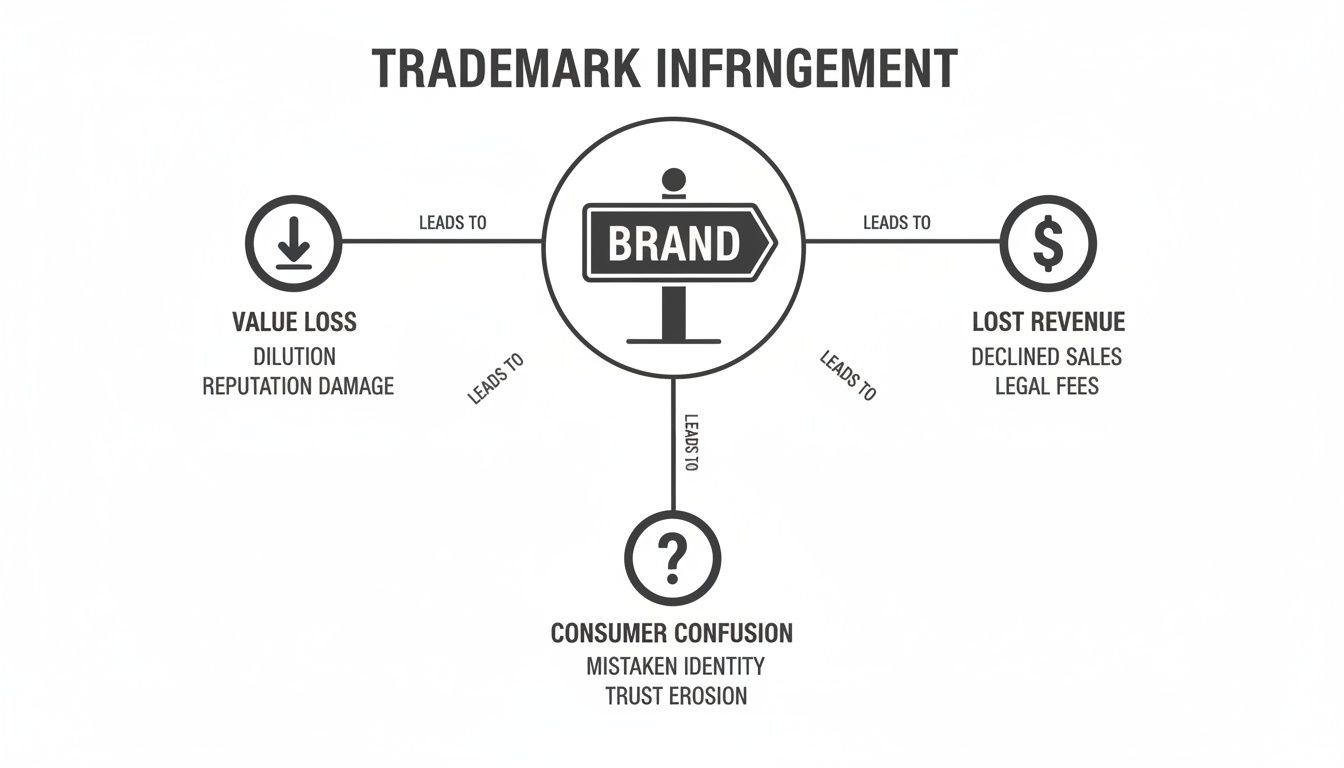
As you can see, letting consumer confusion go unchecked directly chips away at a brand’s value and market clarity—it's a serious threat that needs to be managed.
The Multi-Factor Analysis
Courts don't just guess whether confusion is likely. They rely on a structured set of factors to guide their decision. While the exact list might vary slightly depending on the court, the core ideas are consistent nationwide. Getting a handle on these factors gives you a framework to spot potential infringement risks before they blow up.
These factors help a judge get the full picture of how two brands actually interact in the marketplace from a customer's point of view. No single factor decides the case; they're all weighed together to get to the bottom of what is trademark infringement.
Key factors a court will almost always look at include:
- Similarity of the Marks: How alike do the two trademarks look, sound, and feel from a commercial standpoint?
- Similarity of the Goods or Services: Are the products or services related enough that consumers would assume they come from the same company?
- Strength of the Original Mark: Is the first user's trademark really well-known and distinctive in its field, or is it more of a generic term?
Applying the Factors in a Practical Scenario
Let's go back to our Connecticut pizzeria example. The New Haven pizzeria has a strong, distinctive name and logo that it has used for decades. The new Mystic shop uses a name that rhymes and a logo with a similar font and color scheme.
A court would break it down like this:
- Mark Similarity: The names sound alike, and the logos give off a very similar vibe. This factor points strongly toward infringement.
- Product Similarity: They both sell pizza and Italian food. This direct overlap makes confusion almost a given.
- Marketing Channels: Both advertise on local Connecticut radio and social media, going after the exact same customers.
- Consumer Sophistication: The average person buying a pizza isn't doing deep research before ordering dinner, making them much more likely to be confused.
- Defendant’s Intent: Did the Mystic shop owner pick that name and logo on purpose to ride the coattails of the New Haven pizzeria’s good reputation? Evidence of bad faith is a very powerful factor.
By weighing these elements, a court can systematically determine whether the new pizzeria's branding crosses the line from fair competition into illegal trademark infringement. This methodical approach ensures decisions are based on evidence, not just a gut feeling.
Understanding this test is the first step in both protecting your own brand and avoiding the costly mistake of infringing on someone else's. If you want to discuss your business law matter, contact Kons Law at (860) 920-5181.
Common Types of Trademark Infringement
Trademark infringement isn't always a blatant copy-and-paste job. It comes in all shapes and sizes, from the obvious to the surprisingly subtle. For a business owner, learning to spot these different forms is the first line of defense in protecting your brand’s hard-earned reputation.
Infringement has moved far beyond physical knockoffs into the digital world, and sometimes it even works in reverse. Recognizing these scenarios is key to stopping a threat before it does real damage to your Connecticut business.
Direct Infringement and Counterfeiting
This is the one most people picture. Direct infringement is the classic copycat scenario where someone uses a mark that’s identical—or just confusingly similar—to yours on related products or services.
Counterfeiting takes this a step further. It's not just about similarity; it's about fraud. Counterfeit goods are deliberate fakes, designed to trick customers into thinking they're buying the real deal, right down to the logo and packaging.
Think of a Hartford-based artisan who has built a brand around her unique, trademarked leather bags. If a factory starts churning out cheap imitations with her exact logo and selling them online, she’s dealing with both direct infringement and counterfeiting.
Cybersquatting
In today’s market, your domain name is your digital storefront. Cybersquatting is the act of registering a domain name that mirrors a well-known trademark with the bad-faith intent to profit from it.
Often, the cybersquatter’s goal is to hold the domain hostage and sell it back to the rightful owner for a huge markup. Other times, they use it to pull traffic to a competing website or, even worse, a site loaded with malware.
- Example Scenario: A popular Stamford tech startup, "InnovateCT," learns that someone has registered
InnovateCT.netandInnovateCT.org. The squatter puts up a bare-bones page on each site offering to sell the domains for $10,000. They know the startup needs those domains to protect its brand. That's cybersquatting.
You can think of cybersquatting as digital real estate extortion. The Anticybersquatting Consumer Protection Act (ACPA) was created for this very reason—to give trademark owners a legal weapon against these bad-faith domain grabs.
Reverse Confusion
This is a trickier, more nuanced form of infringement, but it can be devastating. In a typical infringement case, a small company copies a big, famous one. With reverse confusion, the tables are turned: a large, deep-pocketed company adopts a mark that’s confusingly similar to one already being used by a smaller, established business.
The bigger company then blankets the market with advertising, effectively drowning out the original brand. Before long, customers start to think the small, original business is the copycat or a franchisee of the big newcomer. The senior user's brand identity gets completely washed away.
Imagine a small coffee roaster in Bridgeport that has been operating as "Coastal Grind" for a decade. Out of nowhere, a massive beverage corporation launches a new coffee line called "Coastal Grindz," backed by a Super Bowl commercial.
Soon, the Bridgeport shop's regulars are asking if they're affiliated with the new national brand. That's reverse confusion in action. The small business is now stuck with the uphill battle of proving it was there first and re-educating a marketplace that has already been misled. If you want to discuss your business law matter, contact Kons Law at (860) 920-5181.
How to Enforce Your Trademark Rights
Finding out another business is using your trademark is more than just frustrating—it feels like someone is cashing in on your hard work and reputation. The good news is that there’s a clear, methodical path to enforcing your rights, and it doesn't always have to end in a courtroom battle.
The primary goal is to shut down the infringement as quickly and efficiently as possible. Understanding your options at each stage gives you the power to protect your brand, your market share, and the intellectual property you've worked so hard to build.
Start by Playing Detective
Before you fire off any warnings, your first move is to gather solid proof. You need to build a case file that documents exactly what’s happening, where, and when. Rushing this step is a mistake; strong evidence is the foundation for everything that follows.
This isn’t about finding just one example. You need a comprehensive collection showing the scope of the problem.
Your evidence-gathering checklist should include things like:
- Screenshots: Grab images of their website, social media ads, or online product listings where they're using the mark.
- Photographs: If the infringement is on physical goods or a brick-and-mortar store, snap clear photos.
- Purchase Samples: Buying the product is one of the best ways to compare it directly to your own.
- Timestamps and Dates: Keep a running log of when and where you found everything. This timeline is crucial.
The Power of the Cease and Desist Letter
With your evidence in hand, the standard first step is sending a cease and desist letter. This isn't just an angry email; it's a formal legal document that puts the other party on official notice. It clearly states that you own the trademark, explains how they are infringing, and demands they stop.
You'd be surprised how many trademark disputes end right here. Sometimes, the other party is genuinely unaware of the issue, and a sharp, professional letter from an attorney is all it takes to get them to comply. It’s a cost-effective and powerful first move.
A cease and desist letter does more than just warn someone. It creates a paper trail showing you're actively defending your brand and gave the infringer a chance to do the right thing—a fact that can be very helpful if you end up in court.
A proper letter should be firm but professional, and it will typically outline:
- A clear statement of your trademark ownership, including federal registration numbers.
- A detailed description of their infringing use, supported by the evidence you gathered.
- A direct demand that they stop all use of the mark immediately.
- A deadline to respond before you explore further legal action.
Of course, being on the receiving end of one of these letters requires its own careful strategy. If that's the situation you're in, you can learn more from our guide on how to respond to a demand letter.
Escalating to Litigation When Necessary
What if they ignore your letter or refuse to stop? Your next move may be filing a lawsuit. In the U.S., these cases are typically heard in federal court and are governed by a federal law known as the Lanham Act. This is the cornerstone of trademark protection and sets the rules for resolving these conflicts.
Going to court is a serious step. It’s a formal process that can be expensive and time-consuming, but it’s also the strongest tool you have to force an infringer’s hand and recover damages for the harm done to your business. The Lanham Act gives trademark owners the ability to get injunctions (court orders to stop the behavior) and seek financial compensation for lost profits.
This decision should never be made lightly. It’s critical to work with an experienced business law attorney who can weigh the strength of your case against the potential costs and rewards.
If you believe your trademark rights are being violated and want to discuss your business law matter, contact Kons Law at (860) 920-5181.
The Powerful Remedies for Trademark Infringement
When you win a trademark infringement lawsuit, it’s about more than just being proven right. The law gives you a powerful set of tools—called remedies—to stop the infringement cold, compensate you for the harm, and discourage others from trying the same thing.
Think of enforcement as more than just defense. It's a strategic move to reclaim lost value and reinforce your brand’s position as a critical business asset.
Courts typically grant two kinds of relief. The first is equitable relief, which is all about stopping the bad behavior. The second is monetary relief, which focuses on the financial hit you took. A judge can award one or both, depending on the facts of your case.
Stopping the Damage with Injunctive Relief
Often, the most urgent remedy is an injunction. This is a direct court order forcing the other party to stop using your trademark—immediately. An injunction isn't a friendly request; it's a command with serious legal weight behind it.
Injunctions come in two main forms:
- Preliminary Injunction: This is a temporary order put in place early in the lawsuit. Its job is to prevent any more damage to your brand while the case is ongoing.
- Permanent Injunction: If you win, the court makes the order permanent. This is the final word, forever barring the infringer from using your mark.
For most businesses, getting an injunction is the top priority. It cuts off the source of confusion for your customers and lets your brand start to heal.
Financial Recovery and Damages
On top of stopping the infringement, the law provides ways to recover financially. While getting a monetary award can be tricky, these remedies are designed to make your business whole and prove that infringement doesn't pay.
Here are the main types of financial recovery:
- Disgorgement of Profits: You may have a right to the profits the infringer made from using your trademark. The logic is simple: no one should get to keep money they made by breaking the law.
- Actual Damages: This covers the real financial losses your business suffered. We're talking lost sales, hits to your brand’s reputation, or the money you had to spend on advertising to clear up the confusion they caused.
- Attorney’s Fees: In “exceptional” cases—like when the infringement was deliberate, malicious, or outright fraudulent—a court can order the infringer to pay your legal bills.
The world is seeing an explosion in trademark filings, which means these kinds of disputes are becoming more common. A WIPO report shows global trademark filings are soaring, with the USPTO alone hitting 12.7 million cumulative applications by March. This crowded marketplace guarantees more clashes over similar marks, making infringement a daily battle for businesses in Connecticut and beyond.
Winning a judgment for financial damages is a huge step, but it’s not the last one. The next challenge is actually collecting that money. This process, known as judgment enforcement, requires its own legal strategy to turn a court order into cash in hand.
Proving your case for these remedies requires sharp legal arguments and detailed documentation. Our team can also help you with what comes next. You can learn more by reading our guide on how to enforce a judgment.
If you want to discuss your business law matter, contact Kons Law at (860) 920-5181.
Proactive Steps to Protect Your Brand
The best legal strategy is almost always the one you put in place before a problem arises. While knowing how to handle trademark infringement is essential, the real win is building a brand so legally sound that you sidestep the risk from the very beginning. It’s about shifting from a reactive panic to a proactive posture.
For any Connecticut business, these preventative steps aren't just legal busywork. They're fundamental investments in your brand's long-term value and stability. Get this right early on, and you can save yourself from incredibly expensive and stressful fights down the road.

Conduct a Thorough Trademark Search Before Launch
Before you spend a single dime on printing labels, building a website, or launching that marketing campaign, you absolutely must conduct a comprehensive trademark search. This is the single most important thing you can do to prevent being on the receiving end of an infringement claim. The goal is simple: make sure your chosen name or logo isn't already being used by someone else in a related field.
A quick Google search is a good first step, but it’s nowhere near enough. A professional, in-depth search is non-negotiable.
This deep dive should cover several key databases:
- The USPTO's TESS Database: This is the official federal registry of all registered and pending trademarks.
- State Trademark Registries: Many states, including Connecticut, have their own databases for marks used just within their borders.
- Common Law Searches: This involves digging for unregistered trademarks already in use. Just because a mark isn't on a government list doesn't mean it has no rights.
Skipping a proper search is like building a house without checking the land records. You could pour years of work into it, only to find out someone else owns the property and you have to walk away from everything.
The Power of Federal Trademark Registration
Once your search confirms the coast is clear, your next move is to file for federal registration with the U.S. Patent and Trademark Office (USPTO). Yes, you gain some limited "common law" rights just by using your mark, but federal registration gives you a whole arsenal of legal advantages that are indispensable for any serious business.
Registering your trademark gives you nationwide protection and creates a legal presumption that you are the rightful owner. Suddenly, the burden of proof shifts to anyone who dares to challenge you. It puts the whole country on notice that the mark is yours.
The benefits are huge:
- Nationwide Priority: Your rights aren’t just local; they extend across the entire United States.
- Legal Deterrent: That little ® symbol sends a powerful message to competitors: this mark is federally protected, and we will defend it.
- Access to Federal Courts: Registration is your ticket to filing a trademark infringement lawsuit in federal court.
- A Valuable Asset: A registered trademark is property. You can sell it, license it, or even use it as collateral for a loan.
Police Your Mark Diligently
Getting your trademark registered isn't the finish line—it's the starting gun. As the owner, you have a legal duty to "police" your mark. That means you have to actively monitor the marketplace to make sure no one else is using a confusingly similar mark for related products or services.
If you let others use similar marks without a challenge, you risk diluting your brand's distinctiveness. In a worst-case scenario, a court could rule that you've abandoned your rights by failing to act.
Your ongoing monitoring should include:
- Regularly searching for your mark online and on social media.
- Setting up Google Alerts for your brand name and key phrases.
- Keeping an eye on new trademark applications filed with the USPTO that might be too close for comfort.
Use Your Trademark Correctly
Finally, how you use your trademark matters. To keep it strong, always use it as an adjective that describes a generic noun, not as a noun or verb itself. For example, it’s "Kleenex® brand tissues," not "a Kleenex."
This simple habit helps prevent your mark from becoming generic—a process called "genericide," where a brand name becomes so common it loses its trademark status (think of aspirin or escalator). You should also use the right symbol: ™ for an unregistered mark and ® for a federally registered one. It's also critical to protect the confidentiality of your brand strategy. Understanding how to use tools like a non-disclosure agreement for employees can be a vital part of your overall brand protection plan.
By taking these proactive steps—searching, registering, policing, and using your mark correctly—you build a powerful legal foundation for your brand, turning it from just a name into a defensible and valuable asset.
Navigating the complexities of trademark law requires careful planning and strategic action. If you want to discuss your business law matter, contact Kons Law at (860) 920-5181.
