
You're likely in one of two positions right now. Either you've landed, or are chasing, an investment banking role and discovered that the Series 79 license is the gatekeeper. Or you already work around deals, capital raises, or M&A and need to know where the licensing line sits before a compliance issue lands on your desk.
That moment catches many professionals off guard. They assume the hard part is learning valuation, due diligence, and transaction mechanics. In practice, the first barrier is often regulatory. You can be strong on modeling and client work and still find your path blocked because the role requires registration, firm sponsorship, and a clean understanding of what your license lets you do.
A lot of online content treats Series 79 as an exam-prep problem. That's too narrow. The key issue is career control. You need to know what the license covers, how sponsorship works, what mistakes create exposure after you're registered, and why termination language or a FINRA inquiry can matter as much as the exam itself. If you're trying to enter the field, it also helps to streamline your job search with AI while you target firms that can sponsor the registration process.
For readers weighing this path against other securities careers, it also helps to understand the broader licensing ladder in finance, including how to become a stock broker. Investment banking registration sits in a different regulatory lane, and that distinction has real consequences for your role, your supervision, and your risk.
Your Path to Investment Banking
A common scenario looks like this. A candidate has the education, technical ability, and interview traction for a boutique advisory firm or broker-dealer affiliate. The team likes the candidate. The work is real. The problem is that the candidate cannot begin handling covered investment banking functions without the right registration path in place.
That's where the Series 79 license stops being a line item on a job posting and becomes a professional threshold. In real practice, firms care less about whether you've read a study guide cover to cover and more about whether you understand the regulated scope of the role you're stepping into. If your work touches capital raising, M&A execution, fairness-related analysis, or restructuring activity, registration isn't cosmetic. It's part of the legal infrastructure of the job.
Practical rule: Treat the Series 79 license as both a hiring requirement and a risk-management issue. Passing the exam matters. Understanding the boundaries of licensed activity matters just as much.
Professionals often make two mistakes early. First, they assume they can solve the problem independently, then circle back to firms later. Second, they think the license is the finish line. It isn't. Registration opens the door, but it also places you inside a system of supervision, disclosures, and employment consequences that follow you from firm to firm.
That's why a practitioner's view matters. The exam is only one piece. Sponsorship, Form U4 filings, permissible activity, firm policies, investigations, and Form U5 language can shape your career long after the exam date is forgotten.
What the Series 79 License Is and Who Needs It

A candidate joins an investment banking group, starts helping with a sell-side process, comments on diligence materials, and weighs in on offering documents. If the person is associated with a FINRA member firm, the licensing question is already live.
The Series 79 license is the investment banking representative qualification. It applies to professionals whose work falls within defined investment banking activities, rather than the broader securities functions covered by other registrations.
According to Kaplan's overview of how to get your Series 79 license, the Series 79, officially the Investment Banking Representative Examination, qualifies professionals to advise on or facilitate debt and equity offerings, mergers and acquisitions, tender offers, financial restructuring, asset sales, divestitures, and corporate reorganizations. Kaplan also notes that it works with the SIE exam as part of the registration path.
Titles do not control the analysis. Functions do.
A first-year analyst, associate, or vice president may need the Series 79 if the role includes covered advisory or execution work through a broker-dealer. That usually includes:
- M&A advisory assignments involving transaction analysis or execution support
- Debt or equity offerings in public or private transactions
- Tender offer work connected to acquisition or control transactions
- Financial restructuring engagements involving covered banking functions
- Asset sales, divestitures, and reorganizations handled through a FINRA-member firm
The practical mistake I see most often is overreliance on the job description. Firms sometimes describe roles broadly, but FINRA and the firm's compliance staff will look at what the person does. If your work includes preparing deal materials, participating in valuation or diligence tied to a securities transaction, advising on structure, or helping execute a covered deal, registration analysis should happen before the work starts, not after questions arise.
Confusion usually shows up at the border between Series 79 and broader representative licenses. A useful point of comparison is the difference between Series 63 and Series 7 registrations. Each license serves a different regulatory function. Series 79 is narrower than Series 7, but narrow does not mean minor. It authorizes a specific category of high-risk, closely supervised activity.
That distinction matters for career protection, not just compliance. A person who performs covered functions without the right registration can create problems for the firm, the supervisor, and the individual. Those problems can surface later in internal reviews, FINRA examinations, investigations, or Form U5 language after a departure.
Who may not need it
Not everyone touching a transaction needs a Series 79 license. Lawyers, accountants, valuation consultants, and employees at the issuer often work on the same deal without registering as representatives. The question is whether the person is acting through a FINRA-member firm in a role that constitutes covered securities activity.
That is why firms should analyze responsibilities function by function. It is also why professionals should ask licensing questions early. Once a matter turns into a supervisory issue, the discussion is no longer about exam timing. It is about whether the firm permitted unregistered activity and how that decision will be documented if the relationship ends badly.
Navigating the Series 79 Exam Structure and Content
A candidate can know the deal process cold, walk into the testing center overconfident, and still fail because the exam does not reward broad familiarity. It rewards disciplined coverage of the functions FINRA tests and the ability to apply them under time pressure. That distinction matters later. A failed exam attempt is usually manageable. A pattern of weak preparation, delayed registration, or pressure to perform licensed work before qualification can create employment problems that surface in supervision discussions and, in the worst cases, in Form U5 disclosures and FINRA reporting issues.
The Series 79 is a targeted exam. Its content is built around the actual work of an investment banking representative, with the heaviest emphasis on collecting, analyzing, and evaluating information. The remaining tested areas cover underwriting and new financing transactions, plus mergers, tender offers, and restructuring work. Candidates who study as if each topic deserves equal time usually misallocate effort.
What the weighting tells you
The weighting reflects how firms expect junior bankers and registered representatives to function. Analysis carries the largest share because bankers spend much of their time reviewing issuer information, transaction materials, valuation inputs, disclosures, and deal terms before a transaction reaches execution.
That has a direct study consequence. Candidates who spend too much time memorizing isolated definitions often miss the point of the exam. The test is narrower than a broad retail securities exam, but the questions still expect judgment inside real transaction settings.
Series 79 Exam Content Breakdown
| Exam Section (Function) | Number of Questions | Percentage of Exam |
|---|---|---|
| Collection, Analysis, and Evaluation of Data | 37 | 49% |
| Underwriting/New Financing Transaction, Types of Offerings, and Registration of Securities | 20 | 27% |
| Mergers and Acquisitions, Tender Offers, and Financial Restructuring Transactions | 18 | 24% |
The exam mechanics that matter
Candidates also need to respect the mechanics. The exam uses scored multiple-choice questions, a fixed time limit, a passing standard, an exam fee, and a waiting period after certain failed attempts. Those details shape pacing and retake planning as much as substantive knowledge shapes performance.
I have seen candidates underestimate the timing because the subject matter feels familiar from work experience. Familiarity helps, but only if the candidate can read fact patterns cleanly, eliminate wrong answers quickly, and avoid getting trapped in technical wording.
How to allocate your effort
A sound study plan follows the tested functions, not personal preference.
- Give first priority to analytical questions. That category carries the most weight and exposes weak command of transaction logic quickly.
- Study underwriting and registration issues as process questions. Candidates score better when they understand how an offering moves from structure to execution, rather than treating rules as disconnected flashcards.
- Use M&A and restructuring review to practice application. These questions often turn on identifying the right framework from a short deal scenario.
One practical rule helps. If a topic feels easy because you see it at work every day, test it under timed conditions before assuming it is secure.
Common preparation mistakes
The first mistake is equal-time studying. Organized does not mean effective. A candidate who splits hours evenly across all topics ignores the exam blueprint and usually leaves points on the table in the largest category.
The second mistake is passive review. Reading summaries and highlighting terms can create false confidence. The Series 79 is better handled through timed question sets, error logs, and repeat exposure to transaction-style scenarios.
The third mistake is treating the exam as separate from the candidate's compliance record. Firms notice repeated failures, delayed qualification, and confusion about what a candidate may do before registration is active. Those issues do not always stay academic. In a strained employment situation, they can become part of a broader conversation about supervision, judgment, and documentation.
Candidates who prepare for the actual exam, rather than the version they assume it will be, put themselves in a much stronger position.
The Sponsorship Bottleneck and Enrollment Process
The largest practical obstacle isn't usually the exam content. It's getting in the door. Many candidates assume they can decide to pursue the Series 79 license, register, and then market themselves as licensed talent. In real life, that's backwards.
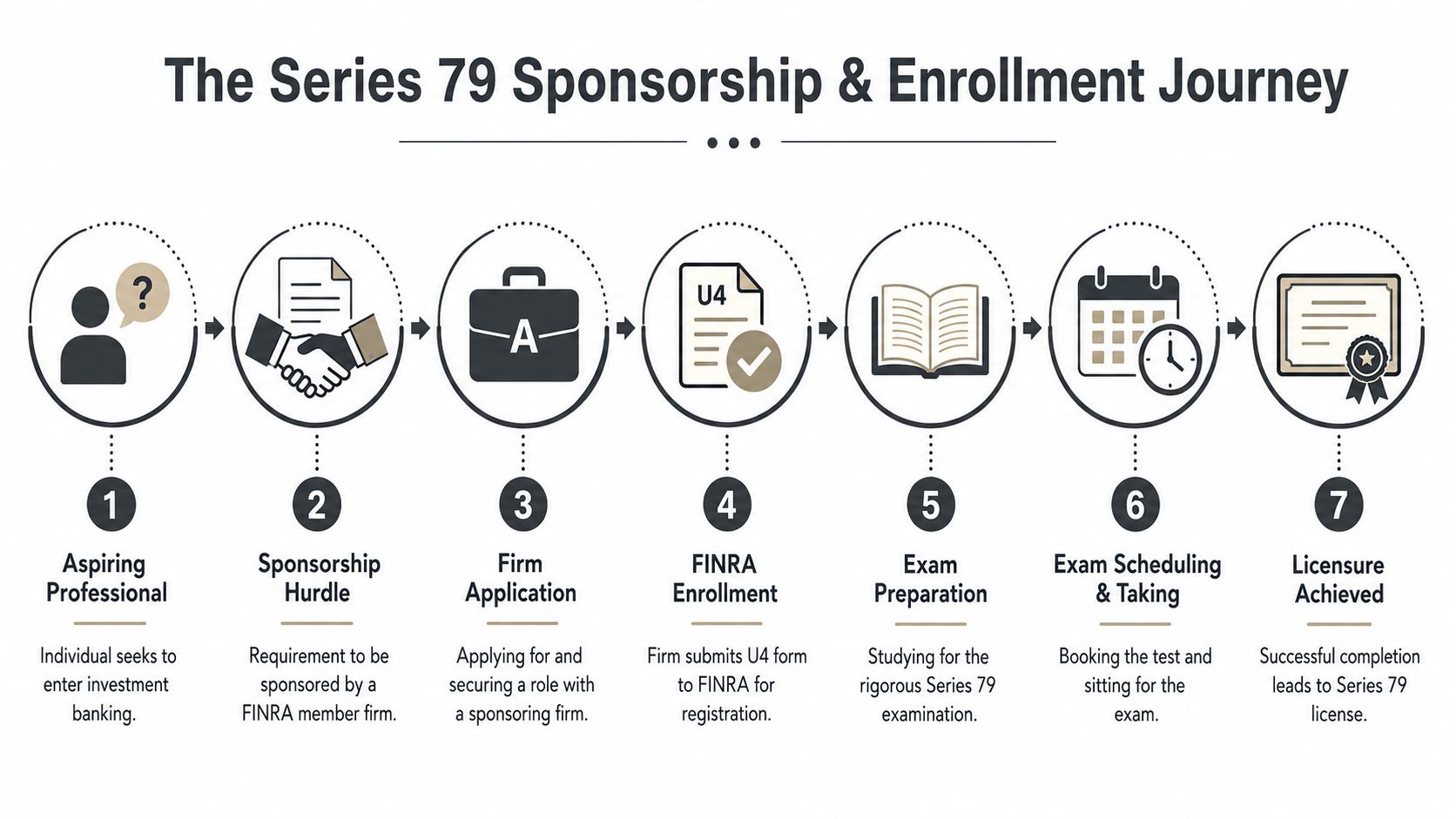
An Axial discussion on broker-dealer licensing issues makes the point directly. Axial's article on licensing and sponsorship barriers notes that existing guides often fail to address the “sponsorship bottleneck,” that many unregistered candidates cannot sit for the exam without a FINRA-member firm sponsor, and that “self-registration” is largely a myth, particularly in light of recent tightening described there.
What actually has to happen
In practical terms, the process usually works like this:
You secure a role with a sponsoring firm.
No sponsor, no ordinary path to the exam.The firm handles your enrollment mechanics.
That typically means filing the registration paperwork tied to your candidate status.You complete the exam process within the available scheduling window.
The administrative clock matters once the firm has moved your registration forward.You also satisfy the SIE co-requirement.
Passing one without the other doesn't complete the registration path.
For professionals who are moving firms, the sponsorship point has another consequence. Your registration status is not just about entry into the industry. It is tied to firm affiliation. That means hiring, departure timing, and internal disputes can all affect your licensing posture.
Why this creates legal exposure
The sponsorship bottleneck isn't just frustrating. It can shape control. A firm that controls your registration path also controls access to the exam and, in many situations, the continuation of your registered status. That's one reason employment disputes in this area become so sensitive. A professional leaving under strain may suddenly care not only about compensation and restrictive covenants, but also about what gets reported and when.
If you're already dealing with separation issues, Form U5 problems in the FINRA context should be on your radar early. The registration system doesn't operate in isolation from employment conflict.
A sponsorship problem is rarely just an administrative problem. It can affect timing, bargaining power, and what options remain open if a firm relationship deteriorates.
Effective Study Strategies and Prep Provider Insights
A candidate passes the Series 79, joins the deal team, and assumes the hard part is over. Then the real pressure starts. Timelines tighten, supervisors expect clean judgment, and any weakness in training shows up in work product, emails, and escalation decisions that can later matter in a SEC investigation defense for financial professionals.
That is why exam preparation should be treated as professional conditioning, not just test prep. The goal is a passing score, but the better objective is to build habits that hold up once you are registered.
Build a study plan around your actual risk areas
Candidates usually waste time in one of two ways. They either reread material they already know, or they spend too long on niche issues that are unlikely to decide the result.
A better plan starts with diagnosis. Early in the process, take a mixed set of questions under light time pressure and sort your mistakes into three categories: knowledge gaps, misread facts, and pacing errors. Those categories require different fixes. Knowledge gaps call for targeted review. Misread facts usually mean the candidate is rushing or not isolating the transaction details that control the answer. Pacing errors mean full-session practice needs to start sooner.
Then allocate study time in proportion to the exam's tested functions, as noted earlier. The heavier-tested areas should get more hours. That sounds obvious, but many candidates still let comfort dictate the schedule.
Choose prep materials that teach applied judgment
No prep provider fixes a poor study process. The right provider gives you usable questions, clear explanations, and a structure that lets you revisit weak areas without wasting time.
| What to evaluate | What to look for |
|---|---|
| Question quality | Fact patterns that test transaction analysis, not isolated definitions |
| Explanations | Reasons why each wrong answer fails, not just why the right one works |
| Structure | A study sequence that supports targeted review by function and topic |
| Analytics | Performance tracking that helps you spot repeat errors quickly |
Question bank size matters less than candidates think. If the explanations are thin, you can answer hundreds of questions and still miss the same issue repeatedly. On the other hand, a polished lecture course with too little practice often leaves candidates fluent in the outline and weak under timed conditions.
Methods that usually work
Several habits produce better results because they mirror how the exam tests judgment.
- Study in layers. Learn a concept, answer questions on it, then review it again after seeing how the exam tests it.
- Keep an error log. Write down the topic, why you missed it, and what fact should have changed your answer.
- Run timed sets early. Do not wait until the final week to discover that pacing is your problem.
- Review wrong answers actively. The post-question review is where a large share of improvement happens.
One more point matters. Candidates with actual deal exposure often assume experience will carry them. Sometimes it helps. Sometimes it hurts, because practical experience can lead to overreading a question or importing facts that are not there. The exam rewards disciplined reading.
What undermines otherwise strong candidates
Passive rereading is a common problem. So is treating high scores on untimed quizzes as proof of readiness.
Another recurring mistake is saving full practice exams for the end. Full exams are not just a final check. They are a tool for identifying fatigue, pacing drift, and careless pattern mistakes while there is still time to correct them.
Candidates also underestimate the employment side of a failed attempt. In some firms, one miss is manageable. Repeated misses can affect credibility, staffing, start dates, and how supervisors assess your readiness for client-facing work. That is not a regulatory event by itself, but it can become the first sign of a larger problem if performance concerns later intersect with supervision, internal reporting, or separation issues.
Treat your first sitting as part of your professional record, even if it never appears on a client document. Your firm may view it that way long before any regulator does.
Regulatory Obligations and Disciplinary Dangers
Passing the Series 79 exam gets you registered. It doesn't make you safe. The larger professional risk begins after licensure, when the day-to-day pressures of deals, internal politics, supervision, and recordkeeping collide with FINRA rules and firm policy.
That's the part many candidates underestimate. They think of the Series 79 license as a credential. In practice, it is also an entry point into a tightly supervised environment where conduct, disclosures, communications, and employment separation all carry consequences.
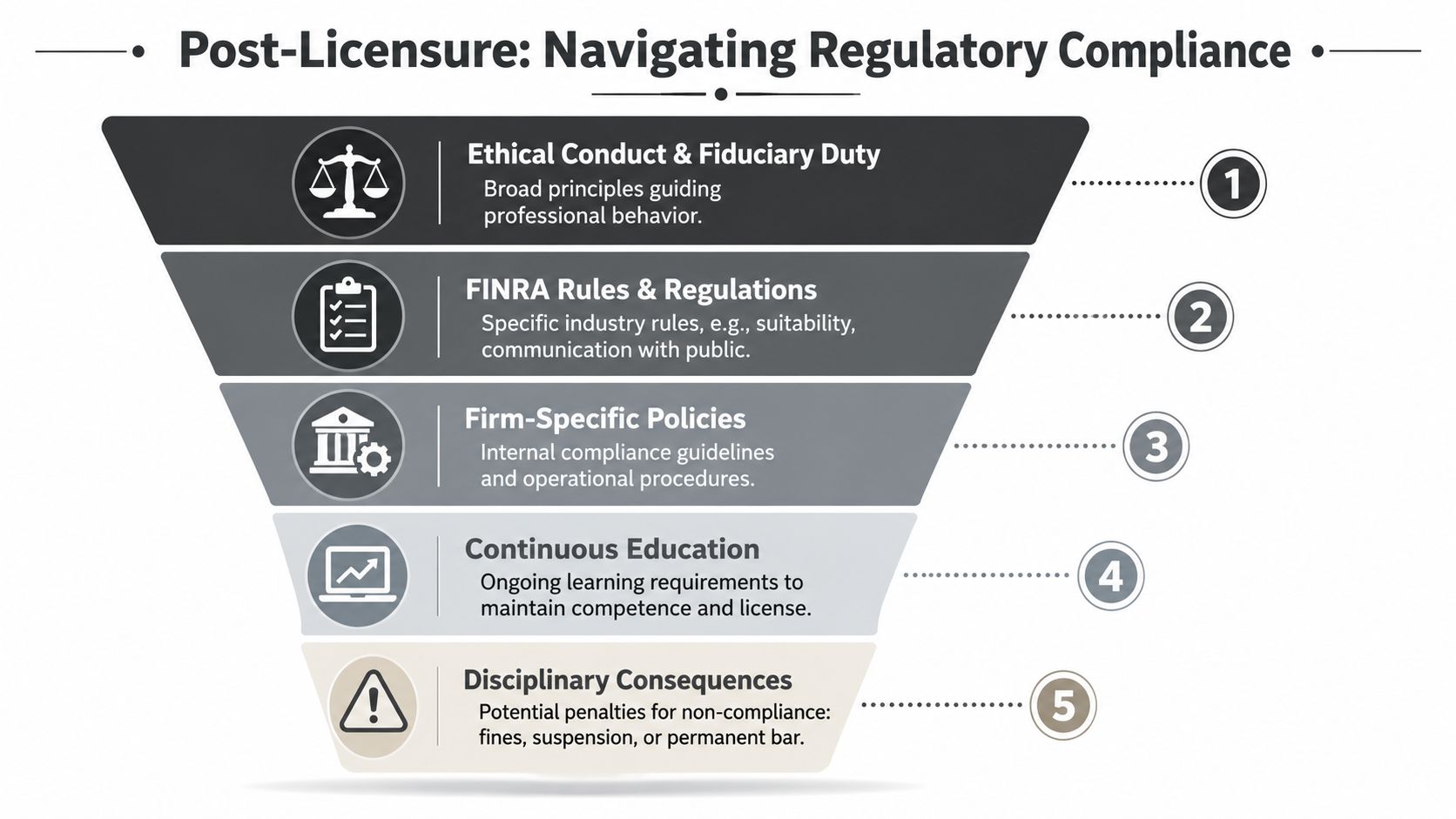
Your obligations don't end with the exam
A registered professional has to operate inside overlapping layers of control. At the broadest level, there are ethical duties and regulatory standards. Beneath that sit FINRA requirements, firm supervision, internal procedures, and training expectations. Those layers often matter more to your career than any exam score ever will.
In practical terms, the danger usually isn't one dramatic event. It's a sequence of smaller choices. An email written too casually. A marketing draft that overstates. Deal communications that drift outside approved channels. Incomplete escalation of a red flag. A disagreement with compliance that turns into a reporting issue.
Where problems typically start
Registered professionals often end up in trouble through one of these paths:
- Scope creep in the role. A banker starts doing work adjacent to sales, solicitation, or communications without checking whether additional registration or approval is needed.
- Documentation failures. The substantive work may be sound, but the file, notes, or approval trail is weak.
- Internal disputes. A disagreement with a supervisor or business head becomes a compliance narrative.
- Departure friction. Resignation, termination, or team movement leads to scrutiny of communications, client contacts, or prior conduct.
Many regulatory matters begin as employment disputes. By the time the professional realizes the issue has become a disclosure problem, the record is already being built.
FINRA inquiries require early judgment
When FINRA asks questions, the worst response is improvisation. Registered professionals sometimes assume they can clear things up informally, explain context later, or trust that the firm's interests align with their own. Sometimes they do. Sometimes they don't.
A FINRA inquiry can force choices about documents, chronology, communications, and strategy. That's especially true in matters involving supervisory concerns, outside business activity questions, alleged policy violations, books-and-records issues, or customer-related allegations. The professional's instinct to “just be cooperative” is understandable, but cooperation is not the same as careless disclosure.
If you're dealing with an active regulatory matter, SEC and securities investigations often overlap with broader defense considerations, including how statements and records may be interpreted later by regulators, firms, or arbitration panels.
Form U5 can change your career path
For many licensed professionals, the most damaging event isn't a final sanction. It's adverse language on Form U5 after a separation from a firm. That filing can follow you into job searches, internal reviews at prospective employers, and future regulatory scrutiny.
The practical problem is simple. Firms control the initial draft of the separation narrative. If the language suggests cause, misconduct, policy violations, or unresolved review issues, the filing can cast a long shadow even before anything has been adjudicated. A professional may be trying to line up a transition while simultaneously dealing with questions from recruiters, registration staff, branch management, and compliance teams.
Here are the trade-offs professionals often miss:
| Situation | Immediate instinct | Better approach |
|---|---|---|
| You're being pushed to resign | Leave quietly to avoid conflict | Evaluate whether the separation language will be cleaner, not just whether the exit is faster |
| A firm says the issue is only internal | Trust that it won't follow you | Assume any serious internal issue may later appear in disclosure language |
| Recruiters want quick answers | Give broad explanations off the cuff | Use disciplined, consistent language grounded in the actual record |
Continuing education and ongoing supervision
Once registered, you also have to stay competent and current. That means continuing education and compliance training aren't box-checking exercises. They are part of the record of whether you took your obligations seriously.
A surprising number of disciplinary situations are aggravated by the appearance that the professional ignored internal systems. Missed trainings, weak attestations, unapproved communications methods, or repeated policy exceptions can turn a manageable issue into a credibility problem.
What to do if trouble is coming
If you believe a problem is developing, act before the firm finalizes its narrative.
- Preserve documents lawfully. Keep records that show chronology, approvals, and communications, subject to your legal and firm obligations.
- Stop casual explanations. Offhand statements to co-workers, recruiters, or supervisors often create inconsistent accounts.
- Identify the core issue. Is this a sales-practice concern, a supervision issue, a personal conduct matter, or an employment conflict being reframed as compliance?
- Assess disclosure risk early. A small internal review can evolve into a U5 issue quickly.
- Get advice before responding strategically. Timing matters. So does wording.
A registered representative rarely gets into trouble because of one label alone. The damage comes from the combination of the event, the written record, and the firm's chosen description of it.
The professional takeaway
The Series 79 license is valuable because it gives you lawful access to important work. That same value is why the post-license environment has to be taken seriously. If your livelihood depends on remaining employable in the securities industry, then regulatory judgment, internal discipline, and disclosure strategy are not side issues. They are central career skills.
Conclusion Your Actionable Next Steps
The Series 79 license matters because it controls access to covered investment banking work. But the practical path is broader than exam prep. You need the right role, the right sponsor, a disciplined study approach, and a clear understanding of what happens after you become registered.
Professionals who handle this well usually do four things. They identify early whether their actual job functions require the license. They pursue firms that can sponsor and support the process. They study according to the exam's tested structure rather than by instinct. And they treat registration as the start of an ongoing compliance career, not the end of an admissions process.
A useful checklist is short:
- Confirm the role fit. Make sure your planned activities fall inside the investment banking representative category.
- Target sponsorship intelligently. Focus on employers that can move the registration process forward.
- Prepare with discipline. Use applied questions, pacing practice, and targeted review.
- Protect your record. Take supervision, communications, investigations, and separation issues seriously from day one.
The biggest mistake is waiting until there's a problem to learn how the system works. By then, the firm may already be drafting the narrative, preserving its own position, and making decisions that affect your registration history.
If you want to discuss your business law matter, contact Kons Law at (860) 920-5181.
If you need guidance on securities industry licensing, FINRA investigations, Form U5 disputes, employment separation issues, or other business law matters, contact Kons Law. If you want to discuss your business law matter, contact Kons Law at (860) 920-5181.
