
A financial firm principal may be weighing two very different paths: combine with a regional broker-dealer and remain involved in the new organization, or sell the advisory practice and transfer the book of business to a buyer. The term sheet may call either path a “merger.” That label doesn't answer the questions that matter.
Who controls the surviving entity? Which liabilities move to the buyer? What happens to client accounts, registered representatives, licenses, deferred compensation, and open regulatory matters? Those answers come from the transaction structure, not the headline.
This guide treats merger vs acquisition as a practical legal and operating decision for financial firm owners, advisors, investors, and counsel. It won't tell you which structure is automatically superior. It will give you a framework for matching the structure to your control objectives, regulatory obligations, tax advice, employee relationships, and integration capacity.
Why the Merger vs Acquisition Choice Matters for Financial Firms
A financial firm transaction rarely transfers only an income statement. It transfers relationships, registrations, supervision systems, client expectations, employment arrangements, and sometimes unresolved disputes. A buyer that focuses on recurring revenue but overlooks the people and permissions supporting that revenue may discover that the acquired economics don't survive closing.
The choice also affects the seller's role. A negotiated merger may preserve an executive position, board representation, or negotiated voting rights. An acquisition may provide a cleaner exit, but it can also leave the seller negotiating employment, earn-out, restrictive covenant, and client-transition obligations from a weaker control position.
The label is a starting point, not a conclusion
The basic distinction is straightforward. Two independent firms becoming one is generally described as a merger, while one company purchasing control of another is an acquisition. The legal structure can produce a different result from the public language, however. A transaction marketed as a merger of equals may give one party control of the board, superior voting rights, or the authority to appoint senior management.
For a financial firm, that difference changes the diligence agenda. Counsel must examine ownership and voting arrangements, regulatory approvals, client-consent requirements, advisor retention, and the allocation of pre-closing conduct. The deal team should also identify which representatives generate the revenue, which licenses support the business, and which client relationships depend on a particular individual.
Practical rule: Treat “merger of equals” as a negotiation position until the governance documents prove equality.
Merger vs acquisition at a glance
| Feature | Merger | Acquisition |
|---|---|---|
| Control | May be negotiated between two ownership groups, although control can still concentrate in one party | Buyer generally obtains control of the target |
| Legal form | Often a statutory merger or consolidation, with one surviving or newly formed entity | May be a stock purchase, asset purchase, tender offer, or statutory merger |
| Consideration | Frequently involves an exchange of equity, cash, or a combination | May involve cash, stock, debt, or mixed consideration |
| Governance | Requires negotiated board, voting, and management arrangements | Buyer typically determines post-closing governance |
| Liabilities | Often move by operation of law into the surviving structure | Allocation depends heavily on whether the buyer acquires stock or selected assets |
| Financial-firm focus | Align supervision, registrations, client continuity, and ownership | Underwrite control, liabilities, retention, and integration before committing to price |
The rest of the analysis should begin with those mechanics. A seller who wants continued influence may need merger-style governance protections. A buyer concerned about legacy liabilities may prefer an asset transaction, even if the parties use merger language in public communications.
Defining the Two Forms of Combination
A merger combines two previously independent entities into one enterprise. The parties typically negotiate governance, ownership, exchange ratios, shareholder approvals, and the identity of the surviving or newly formed entity. The shareholders of both businesses may receive ownership in that continuing enterprise, but the final governance arrangement can still give one group greater practical authority.
An acquisition occurs when one company purchases control of another. The acquired business may remain a separate legal subsidiary, be absorbed into the buyer, or have its assets transferred. Consideration may be cash, stock, debt, or a combination, and the buyer generally negotiates the rights it will receive after closing.
The terminology becomes broader in securities and transaction documents. SEC-filed definitions can treat an acquisition as including mergers, reorganizations, consolidations, share purchases, asset sales, tender offers, and exchange offers. That makes M&A an umbrella term, while the chosen structure determines approval rights, assumed liabilities, tax treatment, securities issuance, and post-closing control. The economic and legal basics of mergers and acquisitions for entrepreneurs provide useful introductory context, but financial firms need to take the analysis further.
Separate the marketing label from the legal instrument
Start by asking four questions:
- Who buys what? Is the buyer acquiring equity, selected assets, or control through a shareholder offer?
- Which entity survives? Does the target continue as a subsidiary, or does it disappear into the buyer?
- Who controls governance? Review board appointment rights, voting agreements, veto rights, management contracts, and reserved matters.
- What consideration changes hands? Cash, stock, debt, rollover equity, contingent payments, and escrow arrangements create different economic and legal consequences.
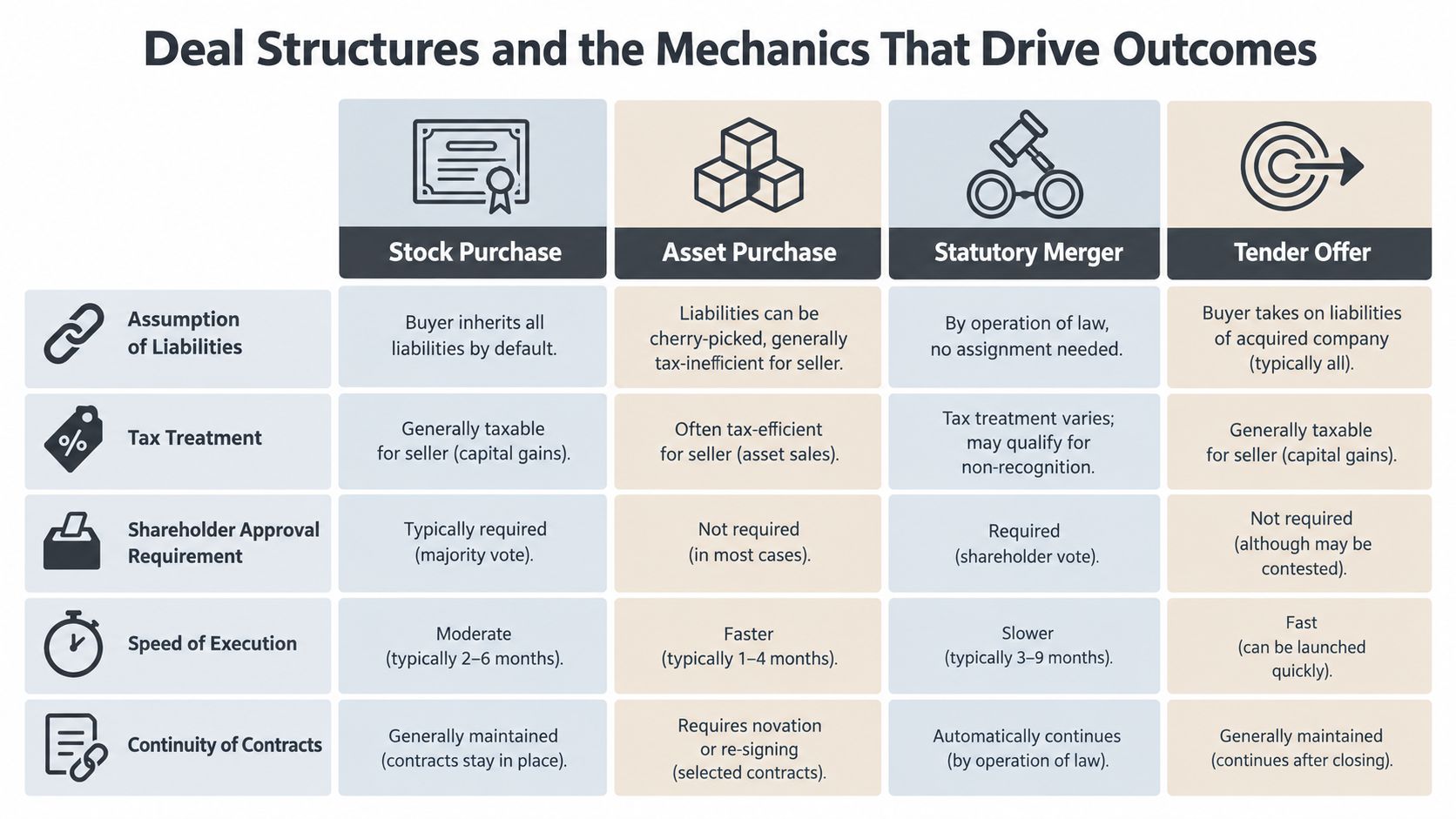
A strict statutory merger may transfer rights and obligations by operation of law, subject to the governing statute and the transaction documents. A stock purchase generally leaves the target entity in place, which can preserve contracts and licenses but also leaves the buyer exposed to the target's historical liabilities. An asset purchase can allow the buyer to identify what it will assume, although customer contracts, licenses, and other rights may require separate transfer steps.
For a deeper comparison of the two principal purchase formats, review this analysis of asset purchase versus stock purchase. The important point is not which label sounds collaborative. It's whether the documents create the control, liability, approval, and continuity result that the parties intend.
Deal Structures and the Mechanics That Drive Outcomes
Financial firms commonly encounter four structures. Each solves a different problem, and each creates a different set of execution risks.
| Structure | What changes hands | Principal advantage | Principal concern |
|---|---|---|---|
| Stock purchase | Equity in the target entity | Contracts, licenses, and operating entity may remain intact | Buyer generally inherits the target's liabilities |
| Asset purchase | Specified assets and assumed obligations | Buyer can define the liability perimeter | Assignments, consents, and continuity issues can delay closing |
| Statutory merger | Entities combine under applicable corporate law | Rights and obligations may transfer by operation of law | Governance, appraisal, and regulatory consequences require careful planning |
| Tender offer | Buyer solicits target shareholders directly | Can provide a direct path to shareholder control | Disclosure and offer-conduct rules apply, and a back-end merger may follow |
Stock and asset purchases
A stock purchase is often attractive when the target's contracts, licenses, registrations, and operating history are central to value. The buyer acquires the entity that holds those relationships. That continuity can be commercially useful, but the buyer must diligence unresolved customer complaints, arbitration claims, employment disputes, regulatory inquiries, books and records, and other liabilities that remain inside the target.
An asset purchase offers more control over the liability perimeter. The buyer can identify the accounts, contracts, intellectual property, equipment, and obligations it intends to acquire. That selectivity doesn't guarantee a clean transfer. Client relationships may require notices or consents, contracts may restrict assignment, and licenses or registrations may not move automatically.
Statutory mergers and tender offers
A statutory merger may be efficient when the parties want one surviving entity and the governing corporate law permits the needed transfer mechanics. It can also produce a result that looks like a combination while functioning as an acquisition. The exchange ratio, board composition, voting rights, and management arrangements reveal who actually controls the combined firm.
A tender-offer acquisition follows a different procedural path. Section 14(d) of the Securities Exchange Act and SEC Regulations 14D and 14E govern information supplied to target public-company shareholders and the conduct of the offer. An acquirer may solicit shareholders directly and later complete a back-end merger, while a traditional long-form merger generally proceeds through a board-approved agreement and shareholder approval process.
That distinction matters even when the financial objective is similar. The tender offer places greater emphasis on offer disclosures, timing, conditions, and shareholder communications. The negotiated merger places greater emphasis on board process, voting mechanics, fiduciary considerations, and the merger agreement's allocation of risk.
A letter of intent should identify the intended structure early. The practical role of a letter of intent in an M&A process helps the parties avoid negotiating price while leaving control, liability, regulatory conditions, and break rights undefined.
Regulatory and Human-Capital Consequences in Financial Services
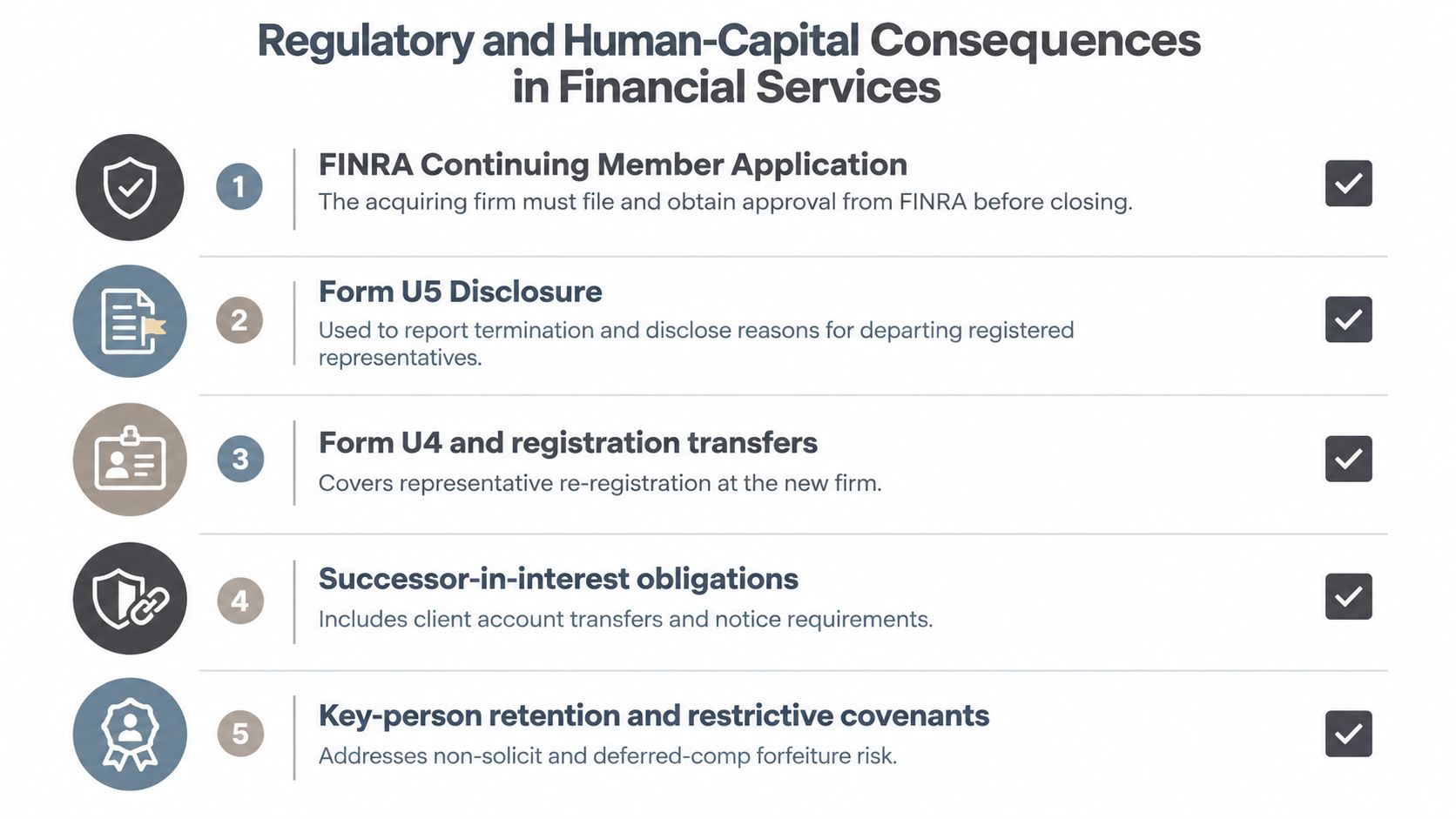
A financial-firm transaction is not complete when the purchase agreement is signed. The buyer and seller must coordinate regulatory filings, supervision, registrations, client communications, and personnel decisions against a closing timetable.
A significant acquisition or merger may require pre-closing notification under the Hart-Scott-Rodino Act, subject to exemptions and size-of-person tests. The FTC announced that the basic size-of-transaction threshold would rise from $126.4 million to $133.9 million for 2026 in applicable transactions, so counsel must confirm the threshold and filing requirements at the time of the deal. The waiting-period process can affect the outside date and the conditions that permit either party to walk away. FTC merger-review guidance provides the relevant federal framework.
FINRA and entity continuity
The transaction team should determine whether the change requires a FINRA continuing-member application or other regulatory filing before signing a definitive agreement. The answer can depend on the entities involved, ownership changes, business activities, and the transaction structure. A buyer that treats regulatory approval as a post-closing administrative item may create a closing condition it can't satisfy on schedule.
The diligence file should connect each regulated activity to the entity and individual authorized to perform it. That includes broker-dealer registrations, investment adviser registrations, supervisory principals, written supervisory procedures, customer complaint histories, open arbitration matters, and pending inquiries. The practical question is whether the combined firm can supervise and service the business on Day One, not merely whether the buyer has acquired the target's revenue.
Form U5 and client-account transfers
Departing registered representatives may face Form U5 disclosures describing the reason for termination. The wording, supporting facts, and timing can affect future employment, regulatory scrutiny, and disputes between the representative and the broker-dealer. Counsel should establish who prepares the disclosure, who reviews it, how disagreements are documented, and how the parties handle a later amendment request.
Client accounts create another continuity risk. Transfers may require notices, consents, new agreements, custodian procedures, or changes to account registrations. A financial firm should map the client population by custodian, account type, advisory agreement, fee arrangement, and relationship owner before announcing the transaction.
The human-capital map
Revenue often follows people. Identify the advisors, producers, supervisory personnel, service staff, and relationship managers whose departure could impair retention. Review restrictive covenants, deferred compensation, bonus plans, promissory notes, employment agreements, and any change-of-control protections.
The buyer isn't acquiring a book of business in isolation. It's acquiring a system of people, permissions, contracts, and trust that produces the book.
Tax, Employment, and Due Diligence Implications
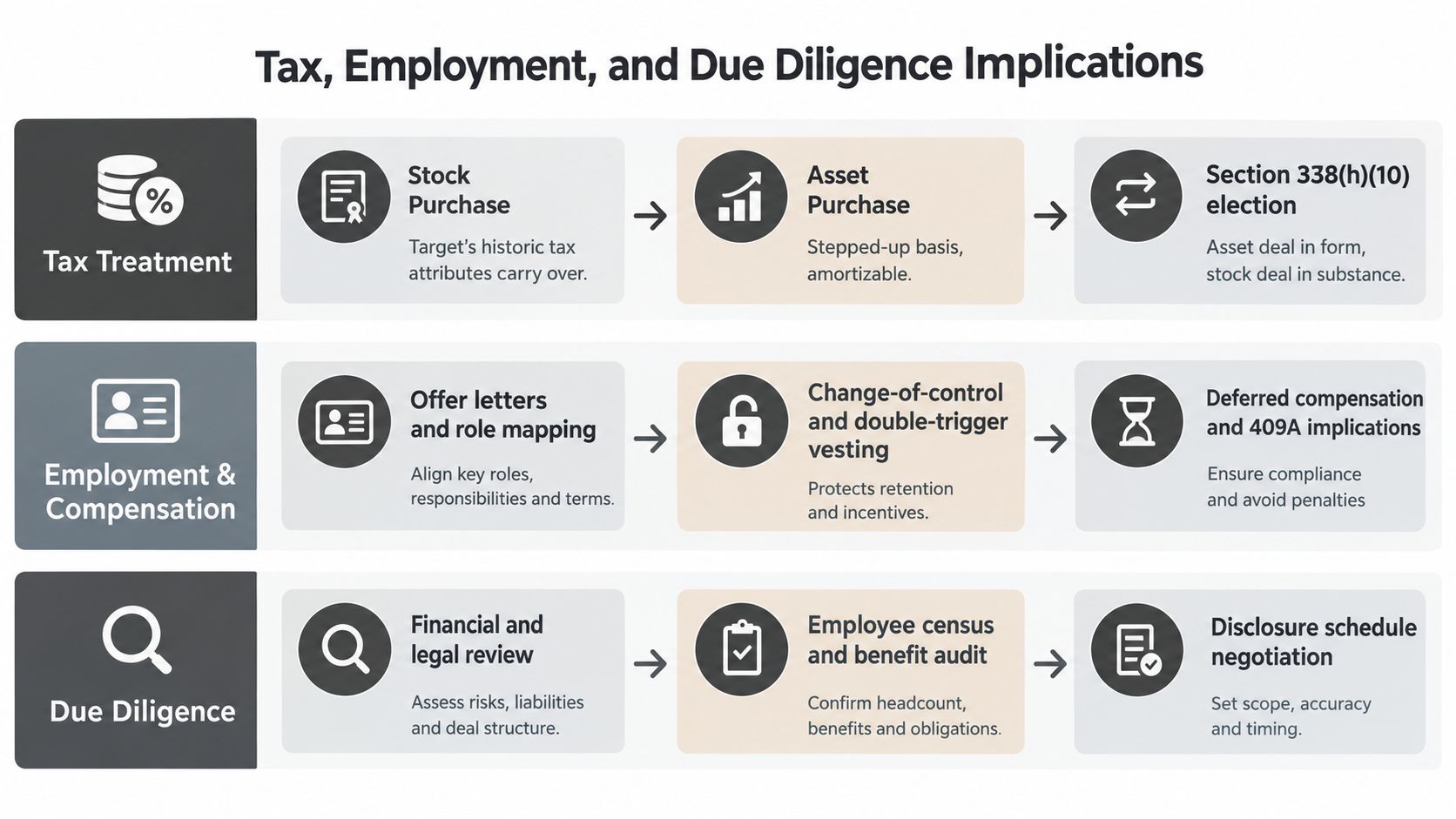
The purchase price is only one part of deal economics. The structure determines how the parties allocate tax attributes, liabilities, employee obligations, and the risk that an expected revenue stream won't remain after closing.
Tax and consideration
A stock purchase generally preserves the target entity and its historical attributes, while an asset purchase allows the buyer to allocate price among acquired assets and assumed liabilities. The tax results can differ materially for buyer and seller, so the parties should involve tax counsel before the letter of intent hardens the structure.
Consideration also affects shareholder remedies. Under Delaware General Corporation Law § 262, a qualifying stockholder in certain merger or consolidation transactions may seek judicial appraisal instead of accepting the merger consideration. The stockholder generally must hold the shares on the appraisal-demand date, continuously hold them through the effective date, comply with the demand procedure, and avoid voting for or consenting to the transaction. The Delaware appraisal statute sets out the statutory requirements.
Delaware's market-out rule can eliminate appraisal rights for certain publicly traded shares, but appraisal may remain available when the consideration isn't qualifying stock, depositary receipts, cash for fractional shares, or a combination of those forms. That makes the cash-versus-stock decision relevant to remedies as well as valuation. For an additional tax-oriented discussion, this resource on capital gains on corporate takeovers can help frame questions for tax advisors.
Employment and incentive compensation
The employee census should identify more than names and salaries. Review:
- Deferred compensation: Determine whether a transaction accelerates payment, changes vesting, or creates a forfeiture risk.
- Production credits: Confirm how trailing revenue, chargebacks, and post-closing adjustments will be calculated.
- Promissory notes: Identify repayment obligations for representatives who leave or move to another firm.
- Change-of-control provisions: Check whether equity, bonuses, or retention awards vest on a single trigger or require a qualifying termination.
- Restrictive covenants: Test enforceability, duration, geographic scope, client-contact restrictions, and applicable state law.
A compensation plan that looks inexpensive on the buyer's model may become expensive if key producers leave after closing or if the seller disputes withheld bonuses.
Diligence that protects the economics
Give counsel a focused schedule rather than a generic request list. It should cover financial statements, revenue by producer, customer concentration, regulatory correspondence, litigation, arbitration, insurance, employment records, benefits, intellectual property, vendor contracts, data practices, and change-of-control clauses. The M&A due diligence checklist can serve as a starting point for organizing those materials.
Counsel's checklist: Every material revenue stream should have an identified owner, a transferable contract or account relationship, a regulatory path, and a documented retention plan.
Negotiation Points and Post-Transaction Integration
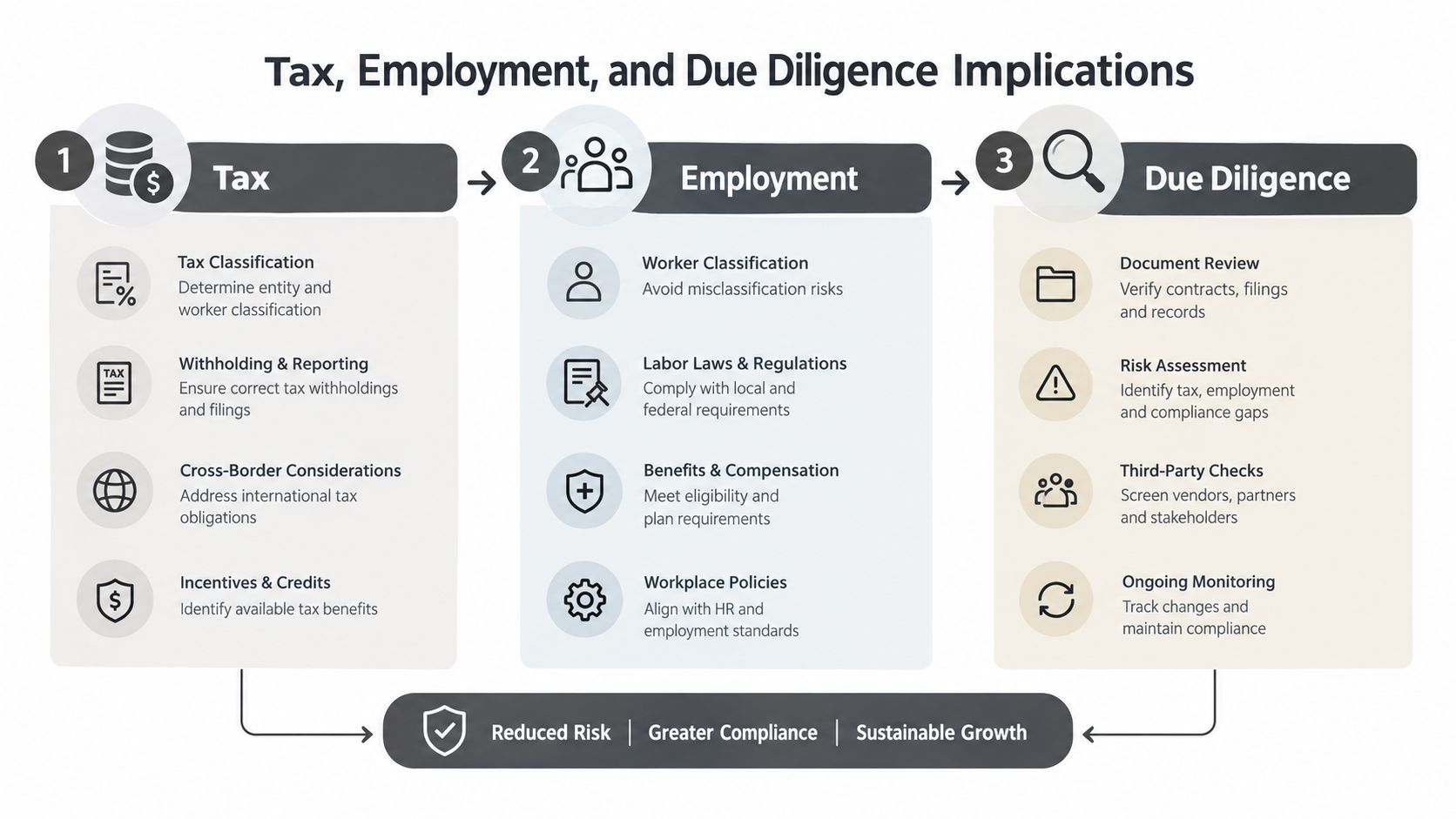
Negotiation and integration should be designed together. If the buyer wants the seller's advisors to retain clients, the purchase agreement, employment documents, retention plan, client-communication strategy, and post-closing governance should all support that objective.
Terms that deserve precision
An earn-out tied to retained assets can align the seller with the buyer, but only if the agreement defines measurement, reporting, client attribution, permitted business changes, and dispute resolution. If the buyer can move accounts, alter pricing, reassign service teams, or change product availability without limits, the seller may bear the risk of decisions outside the seller's control. This explanation of earn-out agreements is useful when building the economic terms.
Restrictive covenants should match the actual business risk. A buyer may need protection against solicitation of clients, employees, and referral sources. The seller needs clarity about permitted activities, pre-existing relationships, professional obligations, and the consequences of a disputed departure.
Other negotiation points include:
- Regulatory exposure: Allocate responsibility for pre-closing conduct, pending inquiries, customer complaints, arbitration, and cooperation after closing.
- Producer recovery: State how the parties handle chargebacks, repayment claims, trailing commissions, and compensation earned before but paid after closing.
- Retention funding: Tie retention awards to clear service periods and measurable obligations, not vague promises of continued loyalty.
- Governance: Define board seats, voting rights, reserved matters, management authority, deadlock procedures, and exit rights.
Integration starts before closing
The integration plan should identify the Day One operating model. Decide which entity supervises representatives, whose policies apply, who communicates with clients, how accounts move, how complaints are routed, and which systems remain available during the transition.
Track early-warning indicators that connect operations to deal value:
- Client retention: Monitor account transfers, withdrawals, complaints, service interruptions, and relationship-owner changes.
- Producer stability: Track departures, recruiting activity, production continuity, and the status of key employment arrangements.
- Regulatory readiness: Confirm filings, approvals, registrations, supervisory assignments, books and records, and open matters.
- Synergy capture: Compare actual expense reductions, revenue retention, and integration milestones with the deal model.
- Integration friction: Escalate unresolved system, compensation, workflow, and authority disputes before they become litigation or attrition events.
Academic research supports using several measurement families rather than announcement reaction alone. One study of 146 acquisitions linked integration-process performance to longer-term accounting and financial returns through customer retention and realized synergies, while short-term event-study results weren't linked to the other performance measures. A separate meta-analysis found that 47.6% of worldwide M&A transactions in its sample created value, reinforcing the need for post-closing controls. These findings are discussed in the Academy of Management research on M&A performance.
A practical post-closing review should include customer retention, employee retention, milestone completion, debt levels, cash flow, synergy capture, and longer-term investor returns. Integration difficulty isn't merely an inconvenience. Employee dissatisfaction and failure to establish a workable combined organization can signal that the transaction isn't producing the value the parties modeled.
For a broader operational perspective, this post-acquisition checklist for taking over an Irish company illustrates why legal closing and operational integration should be treated as connected workstreams.
Choosing the Right Structure and Managing Deal Risk
The right structure follows the business objective.
Choose a statutory merger when the parties want one surviving organization, can agree on governance, and need the statutory mechanics to combine entities and obligations. Don't use the term “merger of equals” as a substitute for negotiating voting rights, board composition, executive authority, or economic allocation.
Choose an asset purchase when the buyer needs to ring-fence legacy liabilities or acquire only defined portions of the business. Confirm that contracts, client accounts, licenses, data, and regulatory permissions can transfer. A selective liability perimeter is valuable only if the assets supporting revenue can move.
Choose a stock purchase when the target entity's contracts, licenses, registrations, and operating history are central to value. Price that continuity correctly. The buyer should assume that historic liabilities remain relevant unless diligence, indemnification, insurance, escrow, and purchase-price mechanisms provide meaningful protection.
Choose a tender offer followed by a back-end merger when direct shareholder solicitation is appropriate and the buyer can manage the heavier disclosure and offer-conduct requirements. The structure may be efficient, but speed doesn't eliminate fiduciary, securities-law, regulatory, or integration work.
A decision checklist for the deal team
- Control: Who appoints directors and senior management after closing?
- Consideration: Is the mix of cash, stock, debt, and contingent payments aligned with risk?
- Liabilities: Which regulatory, employment, tax, litigation, and customer obligations move?
- Continuity: Can contracts, accounts, licenses, registrations, and data transfer without unacceptable friction?
- People: Which advisors, producers, supervisors, and service staff are essential to retention?
- Regulation: What filings, approvals, notices, and Form U5 or registration issues must occur?
- Integration: Who owns the Day One plan, and which KPIs will expose value leakage early?
- Remedies: Could the consideration structure affect appraisal rights or other shareholder protections?
The best merger-versus-acquisition recommendation is the one that makes control, liability, regulatory continuity, and human-capital risk explicit. If you want to discuss your business law matter, contact Kons Law at (860) 920-5181.
Kons Law advises financial firms and business owners on transaction structure, letters of intent, due diligence, purchase agreements, regulatory issues, employment arrangements, and post-closing governance. Visit Kons Law to discuss a merger, acquisition, asset purchase, advisor transition, or related business-law matter.
