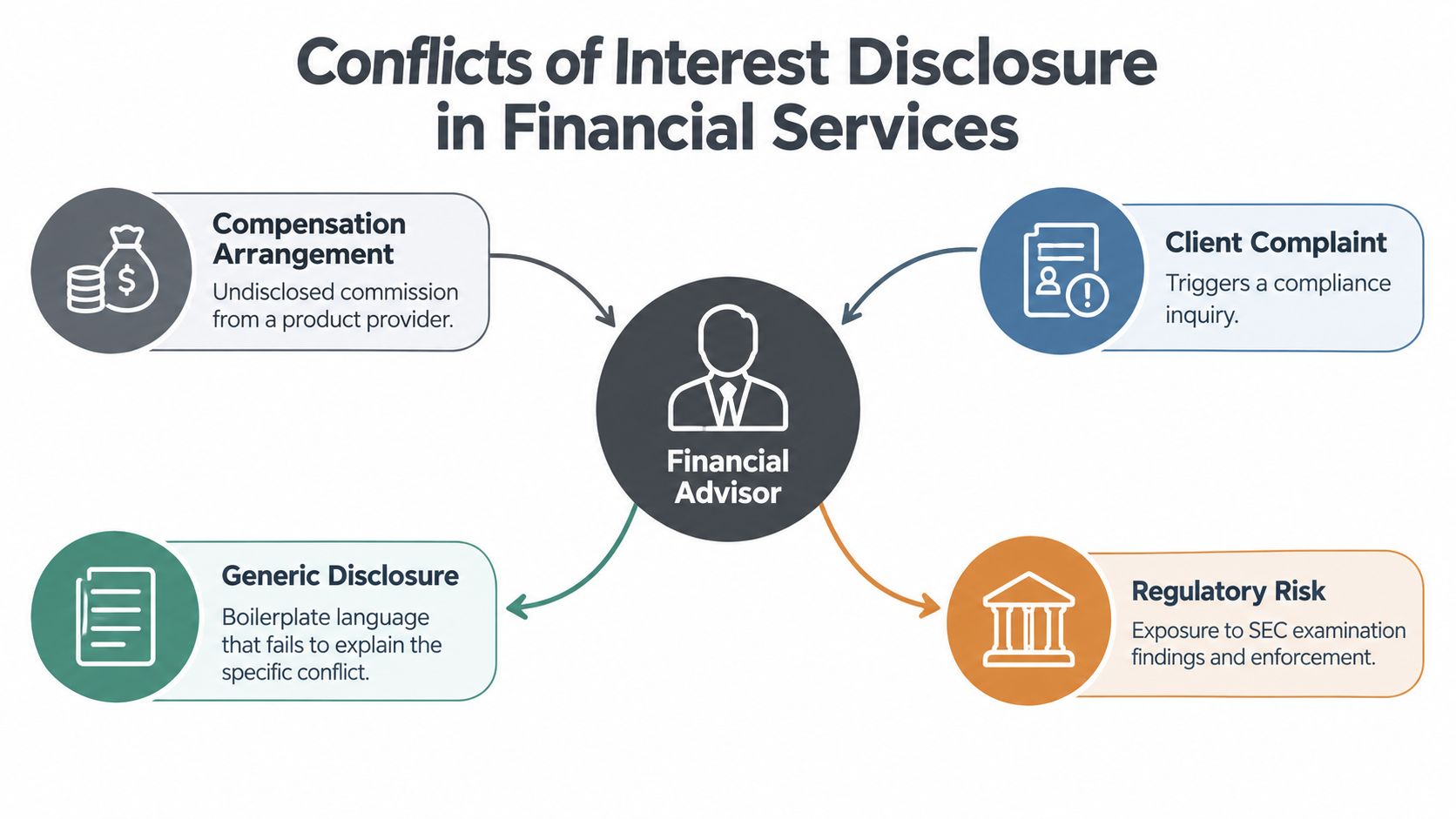
A compliance inquiry often begins with a client complaint that seems narrow. A client says an advisor failed to explain a commission, a product affiliation, or another financial incentive. The firm produces a brochure stating that conflicts “may” exist. The regulator then asks a more difficult question: What conflict existed in this client's transaction, how did it affect the recommendation, and what did the client understand before acting?
That question separates defensible conflicts of interest disclosure from boilerplate. Financial professionals in Connecticut and across the country may face SEC or FINRA scrutiny, a Form U5 dispute, a CFP Board investigation, or an employment claim even when a disclosure document exists. A form can be present and still fail to establish informed consent, effective mitigation, or a reliable compliance process.
Understanding Conflicts of Interest Disclosure in Financial Services
Conflict-of-interest disclosure is a core fiduciary obligation in the United States, particularly for SEC-registered investment advisers. Under Form ADV Part 2, an adviser's narrative brochure must explain material conflicts involving compensation arrangements, other business activities, industry affiliations, and incentives affecting broker-dealer selection or investment recommendations. The SEC expects facts specific enough for clients to understand the conflict and decide whether to consent to or reject the relationship. Generic language that an adviser “may” have a conflict can be inadequate when the practice affects particular clients, services, or transactions. SEC guidance on economic conflicts of interest
What the disclosure must accomplish
A useful disclosure lets a reasonable client answer four practical questions:
- What is the relationship? Identify the adviser, broker-dealer, product provider, affiliate, referral source, or outside business involved.
- What incentive exists? Explain the commission, asset-based charge, 12b-1 fee, bonus, trail payment, sales compensation, or other economic benefit.
- What could the incentive influence? Connect the payment or relationship to product selection, account placement, recommendation frequency, or broker-dealer choice.
- What protection applies? Describe restrictions, supervisory review, recusal, reassignment, product limitations, or another mitigation measure.
The legal purpose isn't to force every conflicted arrangement out of the industry. Disclosure has historically served as one mechanism for addressing conflicts while allowing some business relationships to continue. But the client must receive meaningful information, not a disclaimer that transfers the burden of interpretation to the client.
The same principle matters beyond SEC documents. Professionals working across insurance, securities, and advisory roles can benefit from reviewing practical ethics and standards for agents when assessing how relationships and incentives should be explained. For a broader discussion of the underlying duty, see this analysis of financial planner fiduciary duty.
Practical rule: If the disclosure could be copied into a file involving a completely different client, product, or compensation arrangement, it may be too general to support informed consent.
A regulator, arbitrator, or opposing lawyer will compare the document with the actual transaction. If the client received a recommendation involving a particular proprietary product, referral payment, or compensation stream, the record should identify that relationship and explain how the professional addressed it. A generic paragraph rarely answers those questions.
Navigating Regulatory Frameworks and Compliance Obligations
The applicable rule depends on the professional's role, registration, designation, firm structure, and client relationship. The regimes overlap around specificity and transparency, but they don't impose identical duties.
SEC requirements for investment advisers and retail communications
For SEC-registered investment advisers, Form ADV Part 2 requires a narrative explanation of material conflicts. The relevant discussion can include compensation arrangements, outside business activities, affiliations, and incentives connected to recommendations or broker-dealer selection. The SEC's approach focuses on whether the client can understand the adviser's incentives, not whether the adviser included a conflicts heading.
Form CRS serves a different function. It is a short, accessible document designed to help retail investors compare brokerage and investment-advisory services. Its investment-adviser discussion asks, “How else does your firm make money and what conflicts of interest do you have?” Disclosures that obscure or dilute the existence of conflicts undermine the document's purpose. SEC Form CRS
FINRA supervision and broker-dealer controls
FINRA treats conflict management as an ongoing supervisory obligation. The focus is not limited to whether a customer received a disclosure. Firms must examine how compensation practices influence recommendations, product selection, sales conduct, and supervisory decisions. That requires controls addressing the source of the conflict and the way the firm manages it. FINRA guidance on conflicts of interest
A general conflicts paragraph cannot substitute for supervisory review, documented rationale, or product-level restrictions. This distinction becomes important in a Form U5 dispute, where the stated reason for termination and the firm's records may be examined together.
CFP Board Standard A.5
Under CFP Board Standard A.5, a CFP® professional providing financial advice must fully disclose every material conflict that could affect the professional relationship. The disclosure must give a reasonable client enough specific information to understand both the conflict and the business practice creating it. The professional must obtain informed consent before providing advice involving that conflict, and a good-faith belief that the advice is in the client's best interest doesn't excuse nondisclosure. CFP Board conflict-of-interest guidance
The CFP Board doesn't categorically require the disclosure or consent to be written, but the substantive duty remains. A conversation may satisfy a format requirement while leaving weak evidence of what the client understood. Written follow-up is often the more defensible practice.
State and operational considerations
Connecticut professionals may also operate under firm policies, employment agreements, product-specific requirements, and state rules that add practical obligations. Multi-state practices should maintain a single conflict inventory with jurisdiction-specific overlays rather than assuming that the least demanding rule controls.
A useful companion resource for owners reviewing broader operational controls is the Bookkeeping and Accounting of Florida guide. For Form ADV-specific considerations, see this discussion of Form ADV Part 2.
Determining When Disclosures Are Required
A conflict disclosure should be treated as a living control. The initial relationship disclosure establishes the baseline, but later events can change the incentive, the affected products, or the client's ability to evaluate the recommendation.
Events that should trigger review
At minimum, firms should reassess disclosures when:
- Compensation changes: A new commission, bonus, trail payment, revenue-sharing arrangement, asset-based charge, or other incentive may alter the client's assessment.
- Outside activities begin or change: A board role, referral relationship, ownership interest, employment, or consulting arrangement can create a new conflict.
- Product affiliations change: A proprietary product, affiliated manager, issuer relationship, or preferred platform may affect product selection.
- The advisory relationship changes: A move from planning to implementation, a new account type, or a new service model may create different incentives.
- A complaint identifies a gap: A client's question can reveal that the existing explanation wasn't sufficiently clear or transaction-specific.
The practical test is simple: Would a reasonable client consider this information important when deciding whether to retain the professional, continue the relationship, or implement the recommendation? If so, the conflict deserves specific treatment.
Timing matters
Deliver the relevant explanation before the advice or transaction, not after the client has committed. A later disclosure may document that the firm eventually provided information, but it won't necessarily establish informed consent to the earlier recommendation.
Form CRS must be provided through the applicable retail-investor process, while Form ADV Part 2 operates as a narrative brochure that must remain accurate and current. CFP Board Standard A.5 requires disclosure and consent before advice involving the material conflict. Those obligations should be integrated into the workflow rather than handled by separate teams that don't compare records.
Avoidable and unavoidable conflicts
An avoidable conflict should generally be avoided when the professional can do so without impairing service. An unavoidable conflict requires more than a warning. The firm should identify the incentive, consider recusal or reassignment, apply product restrictions or supervisory review, and document why the remaining relationship is consistent with the client's interests.
The record should show the date of the change, the affected clients or products, the revised language, the reviewer, the delivery method, and the client's acknowledgment or questions. That evidence is more valuable than a document that merely carries a recent revision date.
Examples of Effective and Inadequate Disclosures
A disclosure fails most often because it names a category without explaining the actual relationship. The following examples illustrate the difference between language that sounds cautious and language that gives a client something usable.

Compensation conflict
Inadequate: “We may receive compensation from third parties and may have conflicts of interest.”
That sentence doesn't identify the third party, the product, the payment, or the recommendation affected. It also doesn't tell the client whether the adviser receives compensation only when a product is purchased or continues receiving compensation while the account remains invested.
More effective: “When you purchase the listed mutual fund share class through this account, the firm receives a commission and may receive ongoing trail payments from the product provider. Those payments create an incentive to recommend this product over alternatives that generate less compensation. The firm requires supervisory review of the recommendation and compares available alternatives before implementation.”
The second version gives the client a relationship, an incentive, a possible effect, and a control. It doesn't guarantee that the recommendation is appropriate, but it creates a record that the client received material information before acting.
Proprietary product affiliation
Inadequate: “Our firm may recommend affiliated or proprietary products.”
This wording leaves the client to determine what “affiliated” means and whether the recommendation creates a financial benefit for the firm.
More effective: “The firm's affiliate sponsors the product identified in this recommendation. The firm may receive revenue connected to client investments in that product, and the recommending professional may receive compensation under the firm's standard compensation program. The firm permits comparable unaffiliated alternatives, and the supervisor reviewed the product comparison before approval.”
The language should be adapted to the actual arrangement. Never include a mitigation statement unless the firm can prove that the control occurred.
Layered delivery
Qualitative research on financial planning found that information overload can undermine transparency, even when a document is legally complete. A stronger information architecture uses a short, transaction-specific summary first, followed by definitions, affiliations, compensation schedules, and historical detail in a second layer. The client then provides an affirmative acknowledgment tied to the decision. Research on disclosure quality and information architecture
A long disclosure isn't automatically a clear disclosure. The first page should answer the client's immediate question, while the supporting record preserves the detail needed for review.
For an outside business activity, the summary should identify the activity, the professional's role, the financial or relationship benefit, the clients or products affected, and the recusal or supervisory process. Visual aids can help, but they don't replace plain language. The file should preserve the version delivered, when it was delivered, who received it, and how the client responded.
Building a Compliance Program for Conflict Management
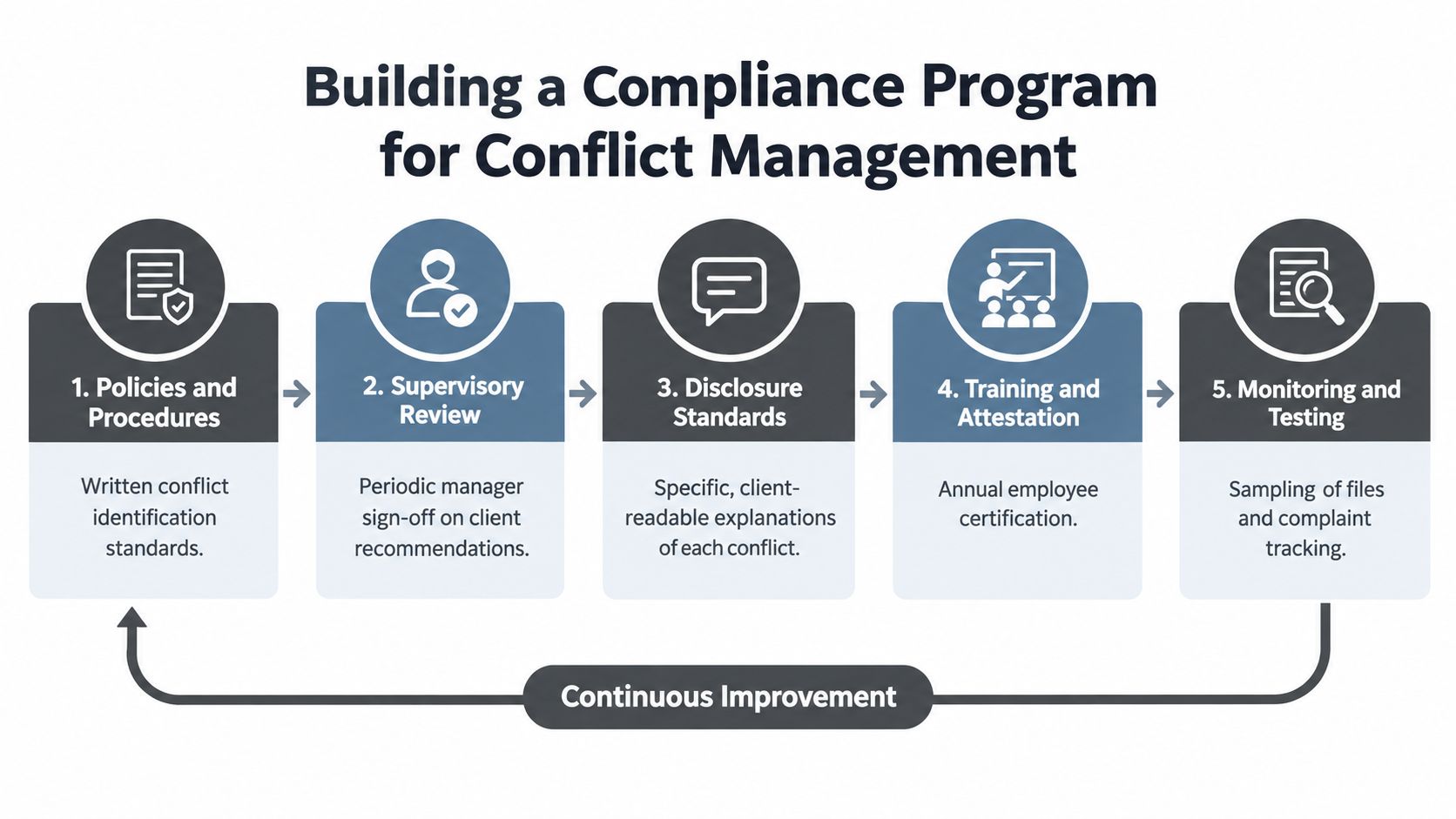
A defensible program connects identification, review, disclosure, mitigation, and testing. It doesn't treat the disclosure document as the program itself.
Start with a conflict inventory
List every recurring source of influence, including compensation, proprietary products, referral arrangements, outside business activities, affiliations, gifts, entertainment, and broker-dealer selection incentives. Assign an owner to each entry and record the affected business line, clients, products, and mitigation control.
Then write procedures that answer operational questions:
- Who identifies a new conflict? Employees need a clear escalation route.
- Who approves the disclosure? Compliance or a designated supervisor should review specificity and accuracy.
- Who may give the recommendation? Some conflicts require reassignment, recusal, or product restrictions.
- What evidence is retained? Preserve the delivered version, acknowledgment, review notes, and recommendation rationale.
- How is the control tested? Sample files, complaints, compensation records, and recommendation patterns.
Put supervision behind the language
FINRA's approach requires firms to examine how conflicts are identified, mitigated, and managed, particularly where compensation can influence recommendations or supervisory decisions. A firm should therefore test whether the stated mitigation operated in practice. FINRA conflict-management guidance
A supervisor's sign-off should address the specific client and transaction, not merely confirm that a standard form was attached. If the record shows a proprietary product recommendation but no comparison, review, or rationale, the disclosure may look like permission to proceed rather than a control designed to protect the client.
Preserve an evidence trail
Version control matters. Keep the language in force, the prior version, the effective date, affected clients, delivery record, acknowledgment, questions, answers, and any escalation decision. Training should use realistic examples, including compensation changes, new affiliations, client complaints, and departures from standard product lists.
A broader compliance framework can help firms integrate these controls with existing governance and review processes. See this resource on corporate compliance programs.
The best file tells the story in chronological order: the conflict appeared, someone assessed it, the client received a clear explanation, a control was applied, and the firm monitored the result.
Testing should include complaint tracking and post-transaction review. If several clients ask the same question, the problem may be the disclosure design rather than client inattentiveness. Revise the language, retrain personnel, and document the corrective action.
Responding to Regulatory Inquiries and Disciplinary Matters
A regulatory inquiry, Form U5 issue, or CFP Board complaint creates a second disclosure problem. The firm must explain what happened without changing history or creating a new inconsistency.
Preserve first, respond second
Issue a litigation hold where appropriate. Preserve emails, client files, versions of Form ADV or Form CRS materials, compensation records, supervisory notes, training records, complaint files, and communications concerning the recommendation. Don't rewrite the original disclosure or backdate an acknowledgment.
Create a chronology that identifies the relationship, the conflict, the recommendation, the disclosure delivered, the response received, the supervisor involved, and any later correction. Separate facts supported by records from assumptions that require investigation.
Address Form U5 issues carefully
A Form U5 statement can affect licensing, employment, arbitration, and future regulatory scrutiny. If a departure involved a conflict, complaint, investigation, or alleged failure to disclose, the firm and the departing professional should evaluate the wording against available records and applicable reporting obligations.
A former employee shouldn't respond by sending an informal accusation to the firm or regulator. A firm shouldn't use a Form U5 narrative to win an employment dispute. The statement should be accurate, supportable, and limited to the relevant facts. Where an amendment is appropriate, the record should explain what changed and why, without suggesting that a retrospective revision was the original disclosure.
Explain mitigation, not just disclosure
Evidence synthesized by the U.S. Department of Labor indicates that clients may discount conflicted advice after disclosure without discounting it enough, while advisers with conflicts may sometimes give more biased recommendations after disclosure. Disclosure can therefore leave clients worse off when the conflict remains unmanaged. Department of Labor analysis of effective disclosures
The response should identify avoidance, reassignment, product restrictions, supervisory review, and recommendation rationale. A regulator is more likely to view the process as credible when the firm can show what people did after identifying the conflict.
For high-risk inquiries, legal counsel should be involved before substantive production or interviews. A focused response strategy, similar to the preparation used for a Wells Notice response, helps protect accuracy, privilege where available, and consistency across the firm's submissions.
Key Takeaways and When to Seek Legal Counsel
A defensible conflicts of interest disclosure has specificity, timing, and proof. It identifies the actual relationship and incentive, explains how the conflict could affect advice, describes the mitigation, and reaches the client before the relevant recommendation or transaction.
A generic statement that conflicts “may” exist can be inadequate when the conflict affects a particular client, product, service, or transaction. Compliance also doesn't end when the form is delivered. Firms need supervision, version control, complaint review, training, and evidence that the stated control operated.
Seek legal counsel when a regulator requests documents or testimony, a client alleges undisclosed compensation, a Form U5 contains disputed conflict language, an employment separation involves reporting obligations, or the CFP Board opens an investigation. Early advice can help preserve records, frame the factual response, evaluate amendment options, and prevent an inaccurate explanation from becoming a larger disciplinary or arbitration issue.
If you want to discuss your business law matter, contact Kons Law at (860) 920-5181.
Kons Law advises financial professionals and businesses on regulatory inquiries, Form U5 disputes, securities arbitration, employment-related claims, and compliance concerns involving conflicts of interest disclosure. To discuss the facts confidentially and assess practical next steps, visit Kons Law.
