
In August 2025, the U.S. Census Bureau recorded 473,679 business applications, but forming an entity is only one milestone in a longer launch sequence. That sequence also includes obtaining an EIN, adopting governance records, opening accounts, executing contracts, and establishing payroll obligations.
A founder can file an LLC certificate in the morning and still discover that the company cannot answer basic questions by afternoon. Who owns the membership interests? Who can sign a loan? Which manager approved the contract? Where is the resolution authorizing the bank account? The state filing may establish the entity, but it doesn't automatically create an operating legal system.
That distinction matters in Connecticut, where a business may operate locally while using a domestic or foreign entity formed elsewhere. It also matters to financial advisory practices, investor-backed companies, and closely held businesses whose ownership and compensation arrangements change over time. The useful question isn't, “What document do I file?” It's, “Which document proves that this decision was authorized?”
Why Formation Is Only the Beginning
A founder forms an LLC, receives confirmation from the state, and assumes the job is finished. Then the bank asks for an operating agreement and a resolution authorizing the account. A prospective customer wants proof that the person signing the contract has authority. An employee is ready to be hired, but the company still hasn't obtained its EIN or established payroll procedures.
The certificate or articles may establish legal existence, but they don't document every act the company must take afterward. The Census Bureau's Business Formation Statistics framework separates business applications, generally based on Employer Identification Number applications through IRS Form SS-4 filings, from employer businesses identified through the first payroll-tax liability associated with those applications. Filing formation documents or applying for an EIN demonstrates an intention to start or organize a business. It doesn't necessarily prove that the company hired employees or started payroll operations.

The practical launch sequence
A defensible launch sequence usually connects these actions:
- Choose and form the entity. File the applicable certificate, articles, or partnership document with the proper state office.
- Obtain the EIN. Use the exact legal name accepted by the state and identify the individual responsible for the entity.
- Adopt governance records. Execute the operating agreement, bylaws, initial consents, and appointment documents.
- Establish financial authority. Approve banking resolutions, contribution records, equity issuances, and payment controls.
- Operationalize compliance. Address contracts, licenses, tax elections, payroll obligations, and recurring reports.
Practical rule: Treat the state filing as the entity's birth record, not its operating manual.
A strong small business compliance checklist helps identify recurring obligations, but the governing documents must still reflect the actual ownership and control arrangement. A short, custom agreement that resolves authority and deadlock is often more useful than a long template nobody follows.
Building a Complete Formation Package
A complete formation package starts with the information required to identify the entity and its people. The U.S. Small Business Administration explains that formation inputs typically include the legal name, business location, ownership or management structure, directors, registered-agent information, and, for corporations, the number and value of shares. The applicable state and entity type determine the exact filing requirements.
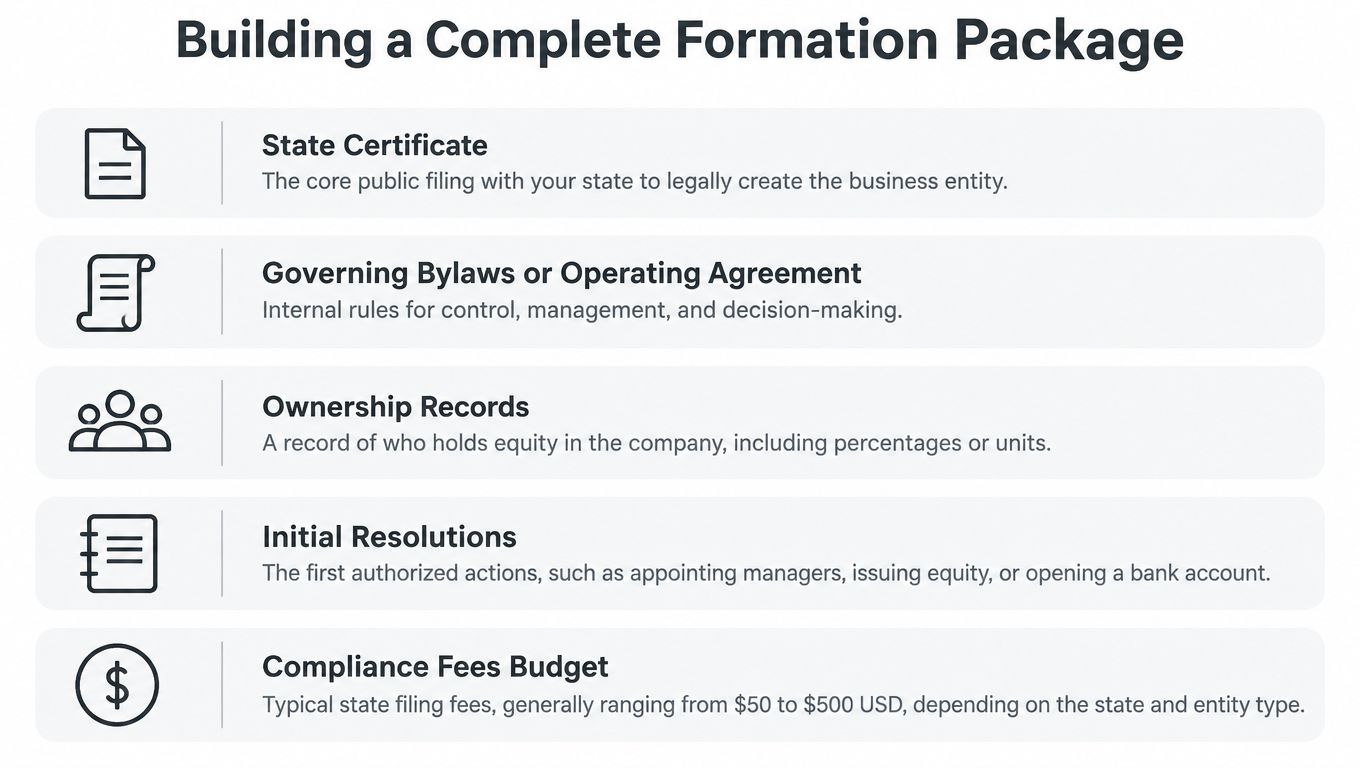
Build the package in layers
The public filing is only the first layer. For an LLC, the SBA's business launch guidance identifies articles of organization as the core formation document, generally addressing the company name, business address, member names, and registered agent. For a corporation, articles or a certificate of incorporation commonly address the name, purpose, authorized shares, directors, and officers.
The internal layer supplies the rules the public filing can't practically contain:
- Operating agreement: Allocates LLC members' financial and functional rights, duties, powers, and responsibilities.
- Bylaws and resolutions: Establish corporate procedures and approve initial actions.
- Ownership records: Show who received membership interests or shares, on what terms, and when.
- Appointment records: Identify managers, officers, directors, and authorized signers.
- Compliance calendar: Tracks registered-agent obligations, annual reports, tax elections, licenses, and other deadlines.
Delaware provides a concrete example of the operational side. Every Delaware entity must continuously maintain a registered agent with a physical in-state street address, and filing fees are due when formation documents are submitted. Those requirements don't replace governance records. They sit beside them.
Use a document-control checklist
Before treating formation as complete, confirm that the file contains registered-agent acceptance, executed initial consents, officer or manager appointments, equity or membership issuance records, banking resolutions, tax elections, and assigned annual-report responsibility. Resources on single company form documents can help organize document categories, but a Connecticut business still needs advice tied to its entity, operations, and filing jurisdictions.
The difference between a filed entity and a functioning entity is document control. The certificate of formation creates the public vehicle. The linked records show who can operate it and why.
Public Certificates Versus Private Governance Rules
Delaware law illustrates why document placement affects both disclosure and legal durability. A corporation comes into existence when its executed certificate of incorporation is filed with the Secretary of State. The certificate must state core matters such as the corporate name, registered agent, purpose or powers, and authorized stock structure under the Delaware General Corporation Law.
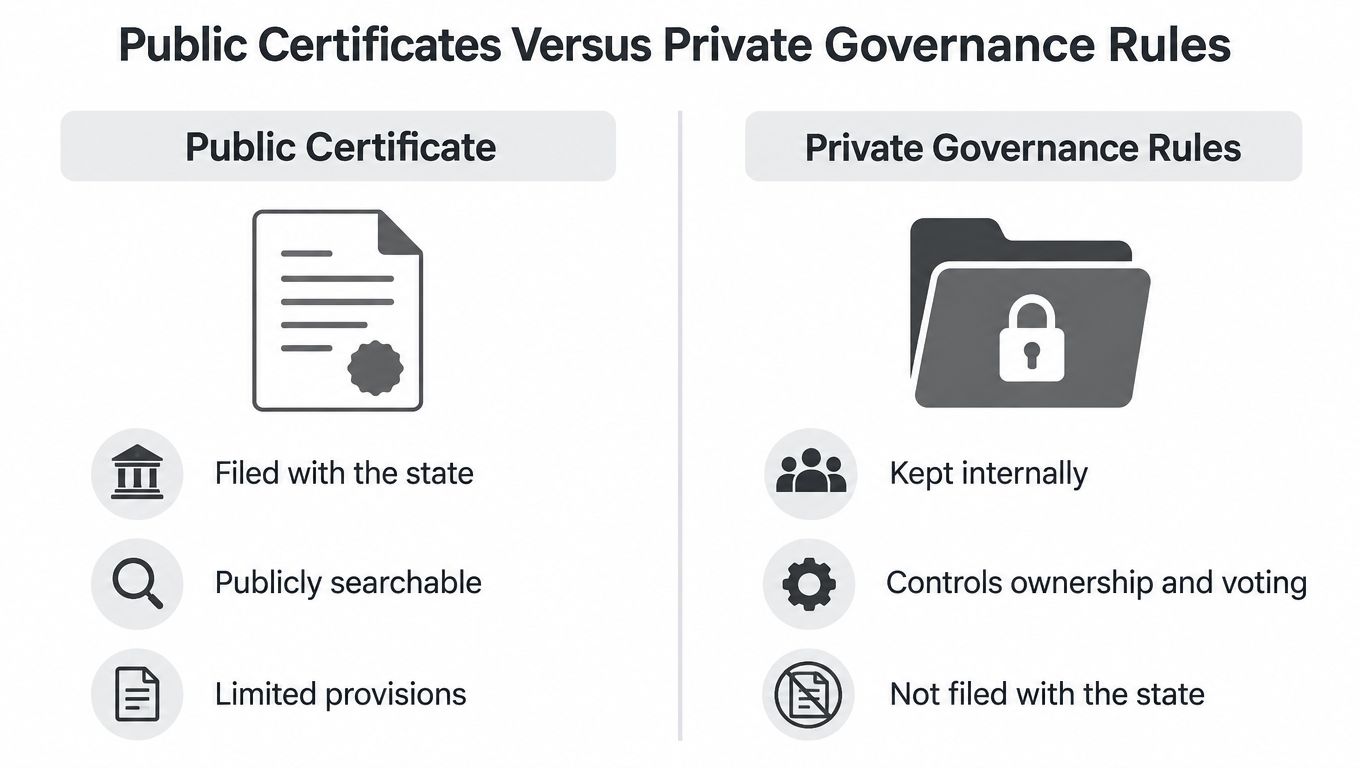
The certificate and bylaws serve different functions. The certificate is filed publicly and establishes constitutional terms. Bylaws and resolutions ordinarily remain internal and handle procedures, approvals, meeting mechanics, and implementation details.
| Document location | Typical function | Practical consequence |
|---|---|---|
| Public certificate | Name, registered agent, purpose or powers, stock structure, and selected structural rights | Public commitment that may be harder to amend |
| Private bylaws | Internal procedures, meetings, officer roles, and governance mechanics | Flexible operating rules kept in company records |
| Resolutions and consents | Specific approvals and authorized actions | Evidence that a transaction or appointment was properly approved |
| Capitalization records | Issued ownership and equity history | Evidence of who owns what and under which issuance |
Decide what deserves constitutional status
Delaware permits certain provisions normally found in bylaws to appear in the certificate. That can allow founders and investors to constitutionalize protective provisions involving voting thresholds, class rights, or director-election mechanics. The trade-off is meaningful. A public structural commitment can give an investor stronger protection, but it may also be more difficult to change and less confidential than an internal rule.
Before financing or an acquisition, counsel should reconcile the certificate, bylaws, capitalization records, equity issuances, and organizational consents. A mismatch can create uncertainty about authority, ownership, or enforceability. A certified filed certificate also has evidentiary value in official proceedings and courts, serving as prima facie evidence of execution, acknowledgment, and filing.
An operating agreement should therefore be drafted with the certificate, not in isolation. The right question is not whether the document is lengthy. It's whether the public and private records tell the same legal story.
How State Formation and Federal Tax ID Work Together
The state filing comes first. The IRS instructs applicants forming an LLC, partnership, or corporation to register the entity before applying for an EIN, and warns that failing to do so may delay the application. The EIN application must use the business name exactly as it appears on the state registration or formation documents, as explained in the IRS EIN guidance.
That sequencing prevents a common administrative error. A founder may submit a state filing under one spelling, abbreviation, or punctuation choice, then use a different version on the EIN application. The mismatch can complicate banking, tax records, contracts, and later diligence.
Identify the responsible party correctly
The EIN application also requires a responsible party. Under the IRS rules for responsible parties and nominees, that person must be an individual who owns, controls, or exercises effective control over the entity and its funds or assets. Except for government entities, the responsible party must be a natural person rather than another company.
A nominee can't substitute for the responsible party. The application generally requires the individual's name and Social Security number, individual taxpayer identification number, or other permitted taxpayer identification information.
The practical sequence is straightforward:
- Confirm the state accepted the formation document.
- Copy the legal name exactly from the accepted filing.
- Identify the individual with actual ownership or control.
- Retain the state acceptance and EIN confirmation with the organizational records.
The EIN is important, but it doesn't replace the operating agreement, bylaws, resolutions, ownership ledger, or banking authorization. It's a federal tax identifier attached to an entity that should already exist under state law.
Mapping Documents to Business Decisions
Organizational documents earn their value when something changes. A company admits an investor, issues a profits interest, authorizes a loan, changes managers, approves a related-party transaction, or sells substantially all its assets. Each event should trigger a defined approval and a record that can be located later.

Match the event to the record
A useful document-to-decision matrix might look like this:
| Business decision | Documents to review or create |
|---|---|
| Admit an investor | Operating agreement or bylaws, subscription or purchase agreement, consent, capitalization ledger |
| Issue a profits interest or shares | Governing document authority, equity approval, issuance record, tax documentation |
| Authorize a loan | Board or member consent, loan agreement, conflict disclosure, banking authorization |
| Change managers or officers | Resignation or appointment record, consent, updated authority matrix |
| Approve a related-party transaction | Conflict review, disinterested approval where applicable, written transaction terms |
| Sell substantially all assets | Governing-document approval, resolution, purchase agreement, closing records |
A short customized operating agreement can outperform a longer template if it clearly addresses deadlock, transfer restrictions, fiduciary duties, buyout mechanics, and authority to bind the company. Template language often fails when the owners' actual economics or working relationships differ from the assumptions built into the form.
This issue is especially acute for financial advisory practices and investor-backed businesses. Undocumented changes can lead to disputes over production credits, ownership, deferred compensation, or who controlled a transaction. Teams that use decision records in other settings may find the discussion of why ADRs matter for content teams useful as a general records-management analogy, although corporate approvals require legally appropriate consents and agreements.
Schedule a post-formation review
Keep the following in the entity file:
- Executed governance records: The signed operating agreement, bylaws, amendments, and initial consents.
- Ownership evidence: The capitalization ledger, membership schedule, stock records, and transfer documents.
- Authority materials: Banking resolutions, officer appointments, manager designations, and signing limits.
- Operational assignments: IP assignments, tax elections, licenses, contracts, and compliance responsibility.
- Annual review trigger: A recurring review after ownership, control, compensation, financing, or business-model changes.
The matrix turns formation from a static folder into a working control system. It also makes diligence faster because the company can show not only what it owns, but how it approved the actions that shaped its ownership and obligations.
Beneficial Ownership Reporting After the FinCEN Update
Many formation checklists still tell every new U.S. LLC or corporation to file a beneficial ownership information report. That is outdated. FinCEN's current BOI reporting guidance and final-rule questions and answers state that U.S.-formed companies and U.S. persons are no longer subject to the federal BOI reporting requirement, while certain foreign entities registered to do business in the United States remain covered.
Sort the entity into the right category
The analysis should begin with where the entity was formed, not where its owners live.
- Domestic U.S. entities: U.S.-formed companies are exempt under the current rule.
- Foreign entities registered in a U.S. state: Certain covered foreign entities remain subject to reporting, generally within 30 days after receiving notice of registration or public notice, whichever comes first.
- Regulated or otherwise exempt entities: The exemption analysis depends on the entity's specific status and applicable rule.
FinCEN also states that previously reported U.S.-person information is subject to deletion under the final rule. That creates a records question for businesses that collected information or submitted reports under the earlier framework. Don't automatically preserve an obsolete filing as though it remains a current obligation, but don't delete internal compliance records without considering retention duties and legal advice.
Replace stale checklists
Formation vendors, software products, and recycled articles may still display old BOI deadlines. A responsible checklist should include an explicit step to verify the current FinCEN rule before filing, then separately evaluate state requirements, bank KYC requests, licensing obligations, and other compliance duties. Federal BOI reporting isn't the same thing as a bank asking for ownership information or a state requiring an organizational disclosure.
If sensitive ownership records must be exchanged with counsel, investors, or service providers, a tool such as protect files with LinkShip may help teams manage secure document sharing. The legal decision remains human and fact-specific. The technology shouldn't decide whether a company is domestic, foreign, exempt, or covered.
What Delaware Formation Data Reveals About Entity Choice
Delaware's formation volume shows why business formation documents support more than a single startup model. The Delaware Division of Corporations reported 334,461 new entities formed in 2025, compared with 289,810 in 2024, a total more than 15% higher than the prior year, according to its 2025 annual report.
The 2025 total included 235,393 LLCs, 74,716 corporations, 21,189 limited partnerships or limited liability partnerships, and 3,163 statutory trusts. LLCs represented approximately 70.4% of the total, corporations approximately 22.3%, and the remaining entity types roughly 7.3% combined, all based on the same Delaware report.
Different vehicles require different records
Those categories aren't interchangeable. A certificate of formation, certificate of incorporation, partnership filing, and statutory trust filing supports a different legal structure, with different governance, ownership, liability, and financing consequences.
An LLC may need a flexible operating agreement addressing member contributions, allocations, transfers, management, and buyouts. A corporation may require bylaws, stock authorization, board procedures, director elections, and detailed capitalization records. A partnership or trust may require documents for fiduciary roles and relationship-specific rights.
The filing creates the legal vehicle. The accompanying organizational records establish how that vehicle is governed and authorized to act. Choosing an entity because another founder used it, without considering financing plans, control rights, tax treatment, professional regulation, and future transfers, can create avoidable restructuring work.
Delaware's 2023 report recorded 298,165 new entities, making the 2025 total approximately 12.2% higher than the 2023 level. The broader lesson isn't that one structure wins. It's that formation activity spans materially different legal forms, so document quality must follow entity choice rather than precede it.
When to Work with Business Formation Counsel
Standard filing forms can handle straightforward situations. They become less reliable when the business has multiple owners, operates across states, expects outside financing, uses a custom equity structure, manages related-party transactions, or works in a regulated industry.
Counsel should review more than the certificate. The useful review aligns the certificate, operating agreement or bylaws, ownership records, equity issuances, initial consents, contracts, tax elections, licenses, and authority procedures. In Connecticut, that analysis may also involve local operations, foreign qualification, professional regulation, employment arrangements, or contracts signed by financial professionals.
Warning signs that justify review
Seek legal guidance before filing or acting when:
- Ownership is shared: Contributions, voting rights, distributions, and exit rights need to match the deal the owners made.
- Investors are involved: Protective provisions, information rights, conversion mechanics, and approval thresholds should fit the financing documents.
- The business is regulated: Licensing and professional rules may affect who can own, control, or bind the entity.
- Operations cross state lines: Formation, foreign qualification, registered-agent duties, and contracts may involve multiple jurisdictions.
- A dispute is developing: Missing consents or inconsistent ledgers can affect authority, compensation, ownership, and enforceability.
A business lawyer's role extends beyond submitting a form. Guidance on what a business lawyer does is most useful when connected to the decisions your company must make, the records it must maintain, and the risks it expects to manage.
Filing a state formation document doesn't prove that the company maintained separate governance records or followed proper authorization procedures. Treat the formation package as a living system, review it when ownership or control changes, and correct gaps before a financing, audit, acquisition, or dispute exposes them.
Kons Law assists companies with entity formation, operating agreements, corporate bylaws, shareholder arrangements, governance, contracts, and ongoing business compliance. If you want to discuss your business law matter, contact Kons Law at (860) 920-5181 or visit Kons Law to arrange a conversation about your formation documents and governance needs.
