
You're probably in one of two places right now. You're either finishing college and trying to figure out the cleanest route into a brokerage firm, or you're already working in finance and realizing that becoming registered is less about market knowledge than is commonly believed.
That surprise trips up a lot of strong candidates.
People think the hard part is learning products, following the markets, and passing the exam. Those things matter. But if you want a durable answer to how to become a stock broker, you need to think like a regulated professional from the beginning. Your education, your disclosures, your sponsorship path, your employment record, and the way you leave one firm for another all shape your future in this business.
A broker's career isn't built only by sales ability or technical knowledge. It's built on a record that regulators, firms, and future employers can scrutinize for years. If you treat the early steps casually, you can create problems that follow you long after your first registration becomes active.
The Reality of a Career in Securities
A new candidate often starts with the same assumption. Get the degree, pass the exams, land the job, build a book.
That's incomplete.
Securities work is highly supervised, heavily documented, and unforgiving of sloppy decisions. If you enter the field thinking charisma or investment enthusiasm will carry you, you're starting from the wrong place. Firms want people who can operate inside rules, document what they do, handle client communications carefully, and avoid creating regulatory exposure for the branch.

What the job really demands
The public image of a stock broker still leans on fast markets and big personalities. The daily reality is narrower and more disciplined.
You'll spend substantial time on client notes, approvals, disclosures, suitability-related thinking, internal procedures, and training. Early in your career, you may have less control than you expect over the products you discuss, the communications channels you use, and the way you market yourself.
A sensible candidate also needs to think about personal sustainability. Long hours, production pressure, and constant oversight can wear people down. If you're serious about staying effective, resources on balancing ambition and well-being are useful because burnout leads to mistakes, and mistakes in this industry rarely stay private.
Your reputation in securities starts forming before you earn your first commission.
Why regulatory awareness matters immediately
The legal risk starts early. Application forms, background checks, and later separation records all carry consequences. A casual answer on a disclosure form can become a credibility issue. An avoidable employment dispute can become a hiring obstacle. A misunderstood compliance rule can become a disciplinary problem.
That's why aspiring brokers should read beyond recruiting material and sales culture messaging. The legal disputes surrounding securities fraud issues and related industry misconduct also tell you what happens when professionals fail to respect the regulatory side of the business.
If you want a career that lasts, build it as if every early decision will be reviewed later. In this profession, it often will be.
Laying the Educational and Professional Foundation
A candidate with strong grades, a polished résumé, and no understanding of how brokerage firms assess risk often gets screened out before licensing even becomes the issue. Firms do not hire future brokers based on market enthusiasm alone. They hire people they believe can handle client communications, follow written procedures, and avoid creating problems that end up on a compliance report.
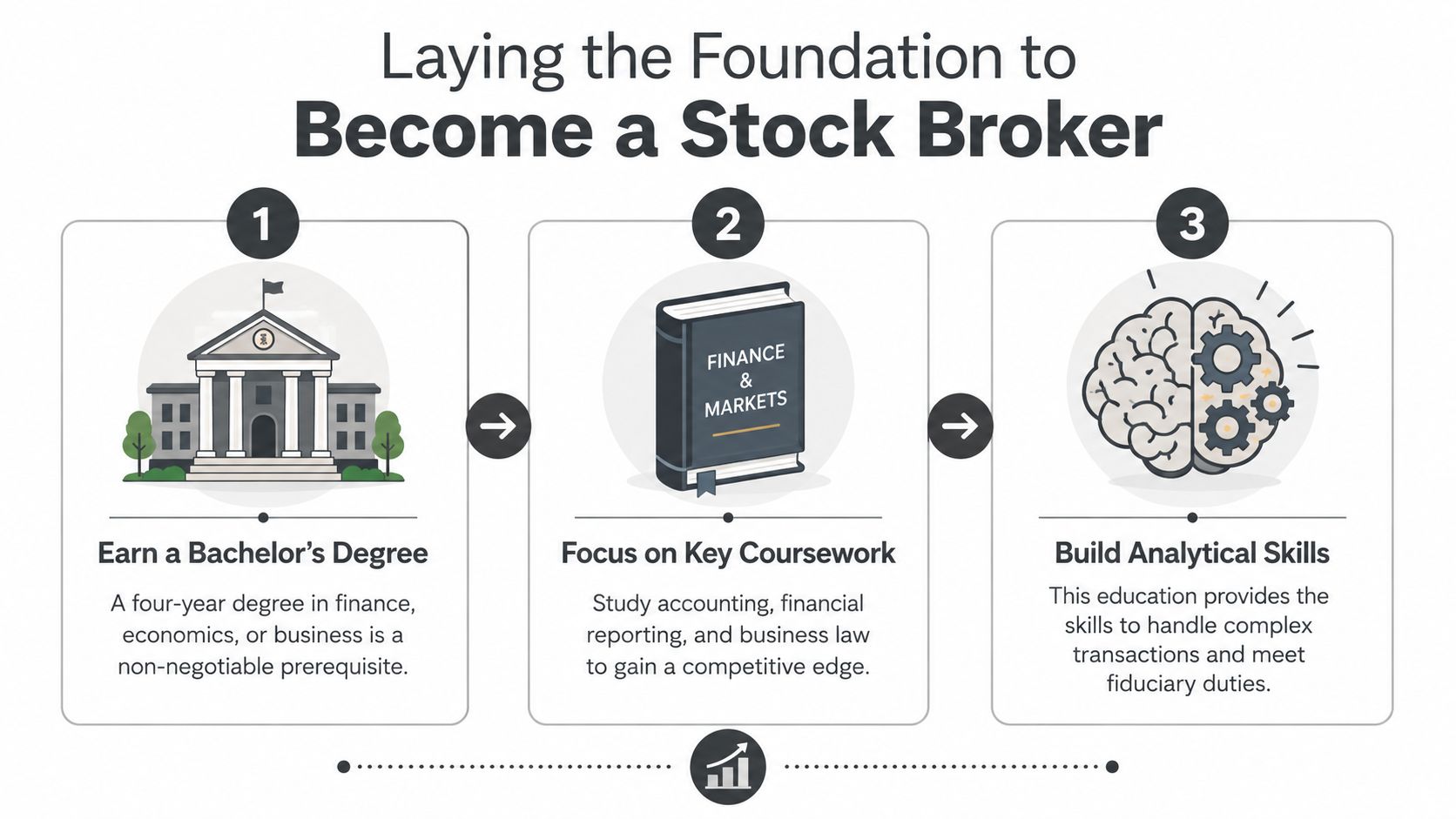
For many firms, that starts with a bachelor's degree in finance, business, economics, or a related field, and Learn How to Become's stock broker career guide notes that entry-level stockbroker roles often favor coursework in accounting, data forecasting, and financial reporting. The degree matters less as a status marker than as evidence that you can process technical material and present it clearly under supervision.
Choose coursework that makes you employable
Course selection matters more than students think. I would rather see a transcript that shows accounting, business law, financial reporting, statistics, and writing than one loaded with broad finance electives and little discipline behind them.
Here is the practical value of each area:
- Accounting: You need to read income statements, balance sheets, and cash flow reports without bluffing.
- Financial reporting: This helps you discuss issuer disclosures with precision and avoid careless summaries.
- Economics: It gives you a working grasp of rates, inflation, market cycles, and client concerns tied to them.
- Business law: This helps with contracts, agency principles, fiduciary issues, and the kinds of disputes that later become regulatory headaches.
- Data forecasting and statistics: Firms want candidates who can interpret information, not just repeat market commentary.
Students who expect the licensing exams to teach them all of this usually fall behind. The exams test baseline knowledge. The job tests judgment.
If you are still choosing classes, add one course that improves your writing and one that forces close reading of rules or cases. Brokers create records every day. Weak writing is not a cosmetic problem in this business. It becomes a supervision problem.
What firms read between the lines
Education signals trainability, but it also signals risk. A hiring manager may see the same finance degree in two candidates and reach very different conclusions after one interview.
One candidate can explain a basic suitability concern, summarize a company's results accurately, and answer questions without overstating certainty. Another cannot organize a response, uses jargon to cover weak understanding, and treats compliance as someone else's job. The second candidate will require more supervision, and supervision costs money.
That is the hiring reality.
| Focus area | Why it matters in practice |
|---|---|
| Analytical coursework | Helps you understand products, risk, and suitability concerns |
| Writing-intensive classes | Improves emails, notes, disclosures, and internal communications |
| Legal and ethics exposure | Reduces careless statements and poor judgment |
| Quantitative training | Supports product analysis and clearer client explanations |
Practical rule: Build your résumé for compliance credibility and client-facing judgment, not just finance prestige.
Early professional signals matter
Internships, operations roles, client service work, and assistant positions often do more for your long-term career than a flashy title with no real supervision. Candidates tend to underrate back-office exposure. That is a mistake. People who understand account opening, documentation standards, transfer procedures, trade corrections, and approval chains usually become better registered representatives because they know how the firm functions.
That experience also helps when you start sorting out licensing paths and registration choices such as the differences between the Series 63 and Series 7 exams. The exam path matters, but firms notice something more basic first. They notice whether you already understand controlled processes, written policies, and the importance of getting details right the first time.
If you are in school, pursue roles that expose you to supervised communications, account procedures, and operational controls. If you are out of school, do not dismiss support roles that put you inside a broker-dealer. Entry through infrastructure still counts, and in many cases it produces a steadier, more defensible start than chasing a sales title too early.
Navigating the FINRA Exam and Sponsorship Gauntlet
You pass the SIE, update your résumé, and start applying. Then the process stops cold because no broker-dealer is willing to sponsor you. That is the point where many stock broker careers stall, and it happens before exam skill becomes the deciding issue.
Most advice treats licensing as a study problem. In practice, it is a hiring and risk-allocation problem. A firm is not just paying exam fees. It is attaching its name to your registration, your supervision, and eventually your conduct record.
The gate most guides describe too casually
The standard sequence is straightforward on paper. Candidates can take the Securities Industry Essentials exam without firm sponsorship, then pursue sponsored qualification exams such as the Series 7.
The SIE helps, but it does not solve the hard part. Sponsorship does. Indeed's overview of how to become a stockbroker notes that many new Series 7 candidates are already working for sponsoring firms, which matches what I see in practice. Candidates usually get sponsored because the firm already knows how they work, how they handle supervision, and whether they create avoidable compliance risk.
That is the bottleneck. Without sponsorship, you cannot sit for the representative-level exam that opens most traditional brokerage paths.
What sponsorship means inside a firm
A FINRA member broker-dealer sponsors you by filing Form U4 and opening the registration process for the exams tied to that role. Firms do not make that decision casually.
Your primary objective is to become a candidate a firm can defend internally. Managers have to justify the hire to compliance, supervision, and often branch leadership. They ask practical questions. Can this person follow written procedures? Will this person disclose issues fully? Will this person take coaching well? Will this person become a production asset without becoming a regulatory problem?
Candidates who get sponsored usually come through one of four channels:
Formal trainee programs
These programs are structured and often demanding. They also solve the sponsorship problem directly because licensing is built into the role.Operations, service, or client associate positions
This route is slower, but it gives the firm a record of your accuracy, judgment, and reliability before it sponsors you.Internship-to-offer pipelines
Prior supervised work lowers the firm's hiring risk. That matters more than enthusiasm in an interview.Direct outreach to the people who control headcount
Branch managers, complex managers, and recruiting leads make sponsorship decisions. Generic networking rarely does much.
What the Series 7 actually requires
Once a firm files Form U4 for the exam, your testing window starts. FINRA states that the Series 7 exam includes 125 scored multiple-choice questions, requires a 72 percent passing score, and allows 3 hours and 45 minutes for completion on FINRA's Series 7 exam page.
Preparation has to match that reality. Candidates often underestimate both the volume of content and the fatigue factor. A study plan that looks fine on a calendar can fail quickly if your job is already consuming your day.
I tell candidates to treat exam prep as a supervised workstream, not a side project. Block the hours, track weak domains, and expect to revisit suitability, options, municipal securities, and account handling more than once. If you want a practical comparison of common registration tracks, review the differences between Series 63 and Series 7 registration paths before assuming one license covers the work you want to do.
What tends to work, and what usually fails
| Approach | Likely result |
|---|---|
| Applying widely with no clear sponsorship plan | Low response rates and scattered interviews |
| Passing the SIE, then targeting firms with defined licensing paths | Stronger position in interviews |
| Presenting yourself as coachable, accurate, and supervision-friendly | More confidence from hiring managers |
| Treating the Series 7 like a cram exam | Preventable failure |
| Talking about production before you show judgment and discipline | Concern about future compliance issues |
Do not ask for sponsorship until you can explain why a prudent firm should trust you with it.
That answer should be concrete. Discuss how you handle documentation, how you study, how you escalate uncertainty, and how you stay within process. Securities firms hire for revenue, but they sponsor for judgment.
How to make yourself sponsor-worthy
Use interviews to show that you understand the firm is accepting legal and regulatory exposure by hiring you.
- Show process discipline. Explain how you prepare, document, and follow instructions.
- Match your pitch to the firm's model. A wirehouse, regional broker-dealer, and independent firm evaluate candidates differently.
- Speak carefully about regulation. If you treat compliance as an obstacle, firms hear future remediation costs.
- Be precise about your background. Inconsistent dates, vague job descriptions, or soft answers about prior issues can trigger closer review before anyone discusses sponsorship.
- Know what screening terms mean. A plain-language background check glossary can help you understand the terms firms may use before and during hiring.
Ambition helps. Reliability gets funded first.
Your Career on Record Form U4 and Background Checks
The most important document at the beginning of your brokerage career may not be your résumé. It's Form U4.
Many candidates treat it like onboarding paperwork. That's a serious mistake. Form U4 creates a regulatory record tied to your registration history, and what you disclose, omit, or phrase poorly can affect licensing, hiring, and later investigations.

Why omissions cause more damage than awkward disclosures
A disclosed issue can often be analyzed. An omitted issue raises a different problem. It suggests unreliability, evasiveness, or poor judgment.
That distinction matters because firms and regulators don't only care about the underlying event. They care whether you were complete and candid. A minor event explained correctly is usually less dangerous than a smaller event hidden badly.
Typical pressure points include:
- Criminal history questions
- Civil judicial matters
- Financial issues such as liens or bankruptcies
- Employment disclosures
- Regulatory or complaint-related history
If you're unsure what a screening term means, a plain-language background check glossary can help you understand common terminology before you complete employer paperwork and authorization forms.
Treat disclosure review like legal drafting
Don't answer disclosure questions from memory if the events are old, emotional, or embarrassing. Pull records. Confirm dates. Review court documents if necessary. Compare the wording of the question against the actual event.
That doesn't mean being evasive. It means being precise.
A rushed disclosure answer can become a long-term credibility problem.
Candidates also underestimate how often firms compare your application materials against later records. If your résumé, interview narrative, internal application, and Form U4 tell slightly different stories, you may create suspicion where none needed to exist.
What background checks are really testing
Background checks aren't just looking for dramatic misconduct. They test consistency.
Fingerprinting, identity verification, education review, employment history checks, and financial history review can all surface issues that force follow-up questions. The primary risk isn't always the event itself. The risk is that the file begins to show carelessness.
Use this checklist before you let a firm submit your paperwork:
Match dates carefully
Employment months, degree dates, and address histories should be internally consistent.Gather supporting documents
If something may require explanation, have the records ready before the question comes.Disclose with clarity
Short, accurate explanations are better than defensive narratives.Ask for review when needed
If a disclosure is complicated, get professional guidance before submission.
There's a related issue many new brokers ignore. Your Form U4 isn't the only career-defining filing in this industry. Your separation record matters too, and disputes involving Form U5 disclosures and FINRA consequences can shape hiring prospects long after you leave a firm.
Maintaining Your License and Building Your Practice
Getting licensed is the front door. Staying employable is the main work.
New brokers often focus so hard on entry that they neglect the habits that keep them in good standing. That's where careers wobble. Once you're active, the industry expects you to keep learning, follow firm procedures, document your work, and build business without creating avoidable compliance risk.
Compliance is part of production
Continuing education isn't optional background noise. Registered professionals deal with ongoing training requirements, internal policy updates, and supervisory expectations throughout their careers.
The right mindset is simple. Don't treat compliance as something that interrupts business development. Treat it as part of business development. The broker who documents well, communicates carefully, and understands approvals is easier for a firm to support and easier for clients to trust.
That applies to ordinary tasks:
- Client notes: Write them as if another reviewer may need to understand the interaction later.
- Email and text practices: Follow approved communication channels, even when clients want convenience.
- Marketing review: Don't improvise with unapproved claims or casual performance commentary.
- Outside activities: Clear them properly instead of assuming they're harmless.
If you want a practical sense of how firms translate policy into operational expectations, the framework behind written supervisory procedures is worth understanding early.
Build a practice that can survive scrutiny
A strong early book usually grows from focus, not sprawl. New brokers often chase any prospect with money and end up with messy service demands, weak fit, and avoidable complaints.
A better approach is to define a niche by experience, communication style, and planning needs. That could mean business owners, medical professionals, retirees, or families with concentrated stock positions. The point is clarity.
The easiest practice to defend is the one built on repeatable, well-documented habits.
Small operational habits prevent bigger problems
The brokers who last tend to be almost boring in their record-keeping. That's a compliment.
You should maintain clean calendars, organized client files, prompt follow-up notes, and reliable expense and business records. Even if your firm provides systems, your own discipline matters. For advisors trying to tighten their office process, resources on practical bookkeeping workflows can be useful because disorganized records often spill into larger supervision and compensation disputes.
Here's a simple operating model:
| Practice habit | Long-term value |
|---|---|
| Clear meeting notes | Supports suitability and client-service explanations |
| Organized records | Reduces chaos during audits or transitions |
| Narrow target market | Improves consistency and messaging |
| Careful internal approvals | Prevents preventable compliance issues |
The brokers who flame out often make the same mistake. They treat structure as something they'll add later, after they're successful. In this business, structure is often the reason they become successful at all.
Navigating Career Transitions and Regulatory Pitfalls
A broker resigns on Friday expecting to start at a new firm on Monday. By Tuesday, the old firm has raised questions about client contacts, records, and the language going into the Form U5. That sequence is common, and it can do more damage to a career than a failed exam.
Career transitions in securities are regulated events. They create records, trigger disclosure questions, and often expose conduct that was ignored while production was strong. A broker can do many things right on the front end and still hurt future opportunities by mishandling a resignation, a team move, a compensation dispute, or an internal review.
Why firm departures turn into legal problems
Departures create pressure from several directions at once. The firm may review emails, devices, customer communications, expense records, and account activity. It may also assert promissory note balances, repayment demands, or restrictions tied to employment agreements.
Form U5 is usually the center of gravity. It is the termination notice filed by the firm, and future firms read it closely. Recruiters do too. If the language suggests misconduct, policy violations, or an unresolved investigation, the broker may spend months explaining a few lines of text.
I tell candidates the same thing every time. The problem is often not just the underlying event. The problem is the permanent record created around it.
Registration history follows you during a move
Your securities career is documented through firm-filed records from the start, beginning with Form U4 and continuing through amendments, disclosures, and eventually a U5 when you leave. That is the practical lesson to carry into any transition. In this business, employment history is also regulatory history.
Treat every move that way.
A rushed resignation, casual explanations to compliance staff, or sloppy handling of client information can create issues that outlast the job change itself. Firms hiring later will review your record, compare your explanations against prior filings, and ask whether you showed judgment under pressure. That question matters more than candidates expect.
Situations that justify legal advice early
Some facts should put you on notice immediately:
- The firm says it is reviewing your conduct. Internal reviews often lead to reportable findings, amended disclosures, or termination language that follows you.
- You expect disputed Form U5 wording. Early counsel can help frame the facts, preserve documents, and reduce avoidable damage.
- You are part of a team breakaway or client transition. Client communications, account documents, and device use need close control.
- You signed promissory notes, forgivable loans, or deferred compensation agreements. Repayment claims can arrive fast and are often pursued aggressively.
- You receive a request from FINRA, a state regulator, or firm compliance. Your first response can shape the rest of the matter.
If the dispute touches disclosure language, customer information, compensation, or registration status, treat it as a legal and regulatory issue at once.
Many brokers wait because they assume a manager, recruiter, or HR contact will smooth things over. Sometimes that happens. Often it does not. Once the issue becomes a filing, arbitration claim, or formal inquiry, your room to fix the record is smaller.
A durable career in this field is built the same way a defensible client file is built. Keep records clean, state facts carefully, and never assume a departure is merely an employment matter.
If you want to discuss your business law matter, contact Kons Law at (860) 920-5181.
