
You're probably reading this while still inside a large firm, producing good work for clients, hitting your numbers, and feeling the limits of someone else's platform every day. The brand isn't yours. The payout isn't fully yours. The service model isn't always the one you'd choose. At some point, many advisors stop asking whether independence sounds appealing and start asking whether they can execute it without creating legal, regulatory, and financial damage on the way out.
That's the core question behind any search for how to start an RIA.
The standard launch guide usually starts with entity formation and ends with filing forms. That's necessary, but it's incomplete. Advisors leaving a broker-dealer or bank platform face a harder problem. They need to build a new firm while managing resignation timing, contract restrictions, client communication limits, custody, registration, compliance infrastructure, and the possibility of a hostile Form U5 or a promissory note demand after departure.
It's still achievable. But the advisors who do this well treat it as both a legal transition and a business launch.
The Dream of Independence and the RIA Reality
The appeal of independence is easy to understand. You want control over pricing, client experience, technology, staffing, and growth. You want to decide whether planning leads the relationship or whether the investment account does. You want to build equity in an enterprise instead of feeding one.
That ambition is no longer fringe. The independent channel is large, established, and still growing. The number of SEC-registered investment advisory firms in the United States reached an all-time high of 26,669, and SEC-registered advisors served 68.4 million clients in 2024, up about 6.8% from roughly 64 million in 2023, according to CircleBlack's RIA industry statistics. The same source says RIAs are projected to manage roughly 33% of all advisor-managed U.S. assets by 2026.
That matters because it changes the frame. Starting an RIA isn't a niche move for a tiny subset of rebels. It's participation in a broad industry shift toward fee-based, advisor-owned businesses.
Practical rule: Independence is not the risky part by itself. Unplanned independence is.
The advisors who struggle usually don't fail because the model is bad. They fail because they underestimate friction. They assume clients will move faster than they do. They assume approval will come quickly. They assume their current firm won't contest the exit. They assume a good planner automatically becomes a good founder.
A new RIA sits at the intersection of law, compliance, operations, and cash flow. If you respect all four, the path is workable. If you treat launch like a branding exercise, it gets expensive fast.
Laying the Groundwork Entity Choice and Registration Strategy
Advisors leaving a broker-dealer often focus on the resignation date, client communications, and custodian paperwork. The harder decisions usually come earlier. Your entity, registration path, and ownership structure will shape how defensible the business is if your former firm scrutinizes the transition, accelerates a promissory note balance, or uses your Form U5 as pressure.
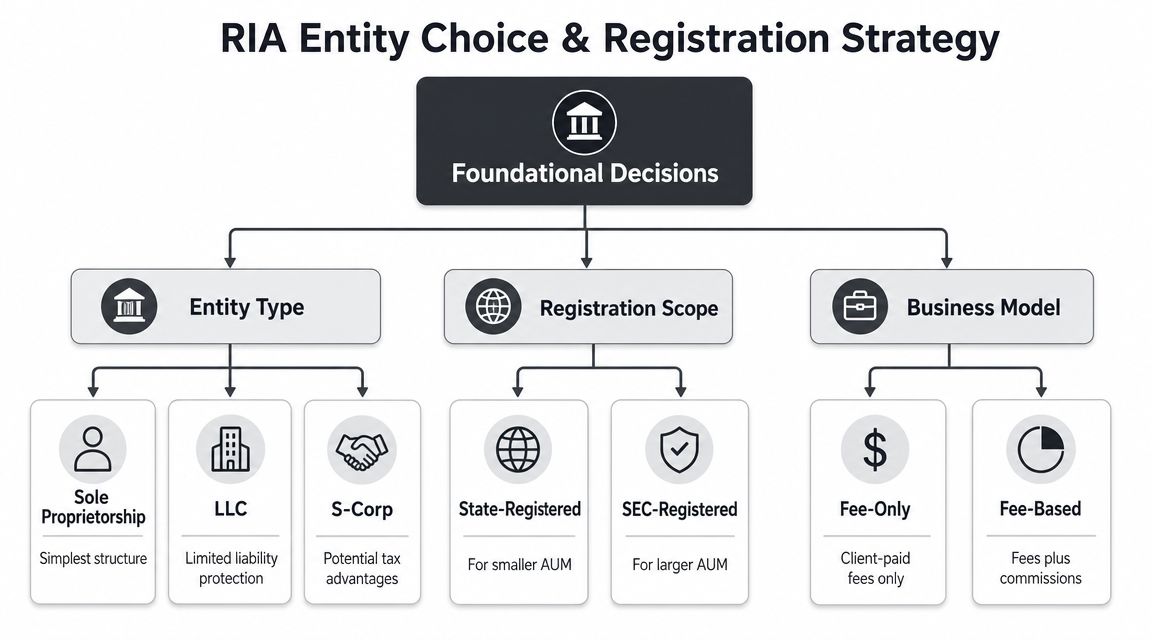
Choosing between an LLC and an S corporation
Entity choice affects taxes, but taxes are rarely the first reason a launch gets messy. The structure also affects governance, owner compensation, liability separation, admission of future partners, and what your books and contracts look like under scrutiny.
For many new RIAs, the decision is an LLC taxed as a disregarded entity or partnership, versus an LLC or corporation with an S election. The legal shell matters. So does the tax election inside it.
| Structure | What usually works | Trade-offs to respect |
|---|---|---|
| LLC | Flexible ownership, cleaner operating agreement mechanics, practical for solo founders and firms expecting future ownership changes | Self-employment tax planning may be less efficient in some fact patterns, and poorly drafted operating agreements create avoidable disputes |
| S corporation election | Useful where owner salary and distributions can be supported and administered correctly | Payroll discipline, reasonable compensation analysis, shareholder eligibility rules, and stricter formalities all matter |
I usually tell founders to start with the operating reality, not the internet summary. If you expect to add an equity partner, issue profits interests, or change economics in the first few years, an LLC often gives you more room. If you have stable projected revenue and want tighter compensation planning, an S election may be worth the extra maintenance.
Poor entity documents create problems fast. A vague operating agreement, weak buy-sell language, or sloppy IP assignment can matter later if an employee leaves, a former firm alleges solicitation, or you need to prove who owns the client-facing business assets.
Deciding whether SEC or state registration applies
Registration strategy should be set before you hire vendors and print a logo on anything. The regulator you answer to affects timing, filing mechanics, notice filings, exam expectations, and how much state-by-state analysis you need at launch.
In general, firms below the SEC threshold begin with state registration, and firms above it move to SEC registration once eligible. Advisors should confirm the rule set that applies to their facts, including office location, client location, expected assets, and any state-specific filing issues. A solid grasp of regulatory compliance requirements for advisory firms helps at this stage because registration is only one part of the supervisory framework.
A few judgment calls matter here:
- Projected assets are not the same as current eligibility. A transition plan that assumes rapid client movement does not automatically put you on the SEC path on day one.
- Multi-state activity needs early review. State notice filings, investment adviser representative registration, and local nuances can slow a launch if they are treated as cleanup work.
- Your transition risk should inform timing. If your broker-dealer exit may trigger a U5 dispute, note acceleration, or temporary restrictions on your ability to contact clients, build a registration plan that survives a slower asset ramp.
That last point gets missed in standard RIA launch guides. If a founder is carrying a forgivable loan or other promissory note exposure, the registration timeline should be stress-tested against the possibility that the note becomes due sooner than expected. The legal answer to that dispute may be strong, but litigation and arbitration still affect cash flow.
Choosing the right business model, not just the most independent one
A standalone RIA is not always the best first structure. For some advisors, joining an existing RIA, affiliating with a platform provider, or using a hybrid model creates a better legal and financial position during the transition year.
The decision should be tied to actual constraints:
- Standalone launch works best when the founder can absorb compliance ownership, vendor contracts, working-capital pressure, and possible transition disputes with the former firm.
- Joining an existing RIA can reduce operational burden and give the advisor more room to handle U5 cleanup, client transfer timing, or note defense without carrying every fixed cost alone.
- Hybrid or corporate RIA models can make sense where the advisor wants independence in stages rather than all at once.
Independence works better when the structure matches the risk. Advisors coming out of a broker-dealer relationship should build for the first 12 months they are likely to have, not the ideal version of the firm they want three years from now.
Constructing Your Regulatory Blueprint Form ADV and Compliance Policies
Registration is where many RIA launches first go off track. A founder has a business plan, a name, and often a custodian relationship lined up, but the filing package still reads like a generic template. Regulators do not approve a concept. They approve a firm with a defined business model, accurate disclosures, and policies that match how the firm will operate.
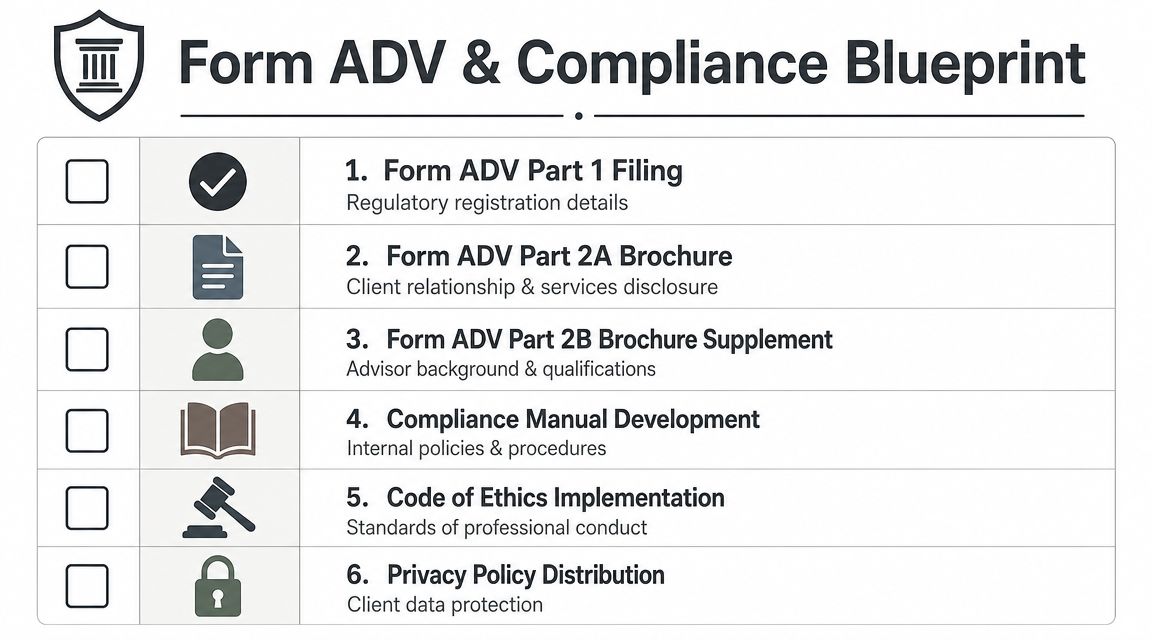
Form ADV is where your business model gets tested
Form ADV is not just an intake form. It is the regulator's first look at whether your firm is internally consistent.
Part 1 covers ownership, control persons, disciplinary history, other business activities, and operational details in a structured format. Part 2A explains the firm in narrative form. It should describe services, fees, conflicts, investment approach, and material risks in plain English. Part 2B applies to supervised persons who require brochure supplements. Form CRS may also apply if the firm serves retail investors and falls within that requirement.
The legal risk is not limited to omission. Mismatch is what causes trouble.
If your ADV says the firm does not take custody, your fee billing process cannot create custody by accident. If the brochure says reviews occur quarterly, your actual service calendar needs to support quarterly reviews. If the ADV describes a discretionary model, your advisory agreement, trading authority, and portfolio procedures need to line up with that description.
That point matters even more for advisors coming out of a broker-dealer environment. During transition, firms often change compensation structure, service model, product mix, and supervision all at once. Those changes have to be reflected cleanly in the ADV. A recycled document from another advisor's launch can create disclosure problems that surface during registration or later in an exam.
A strong ADV sounds like one firm speaking clearly about one business model.
Your compliance manual has to fit the firm you are actually building
A compliance program needs to do more than exist in a PDF. It has to assign responsibility, describe real review steps, and match the systems the firm will use on day one. Advisors who want a plain-language baseline on the subject can review this explanation of regulatory compliance.
Core launch documents usually include:
- A compliance manual specific to your advisory services, supervision model, trading practices, books and records process, marketing activity, and vendor setup
- A Code of Ethics covering personal trading, reporting obligations, gifts, entertainment, conflicts, and standards of conduct
- A privacy notice and data handling procedures that match how the firm collects, stores, shares, and secures client information
- Business continuity procedures for system outages, staffing disruption, and other operational interruptions
- Cybersecurity procedures that define access controls, incident response, vendor oversight, and escalation paths
- Advisory agreements, intake forms, and disclosure acknowledgments that are consistent with the ADV and the actual client experience
Template documents can save time, but only if someone with judgment revises them. I often see manuals that prohibit activities the firm plans to engage in, fail to address activities the firm will engage in, or assign reviews to people who will not even be employed at launch. That is how firms create exam issues before they have their first annual review.
Where approval delays and later exam findings usually start
The common problems are ordinary, not exotic. Inaccurate U4 information, incomplete disciplinary disclosures, inconsistent descriptions of fees or services, and missing state-specific items can all slow approval. The same inconsistencies also tend to reappear in exams.
Three checks catch a large share of preventable mistakes:
- Compare the ADV, client agreement, fee schedule, and website copy line by line
- Reconcile each supervised person's U4 against actual history before filing
- Confirm that your billing method, custody analysis, and operations workflow support what the ADV says
This is also the stage where transition-related legal issues can bleed into compliance if they are ignored. For example, if a departing advisor expects a former broker-dealer to characterize the separation in a way that could trigger a U5 dispute, disciplinary and disclosure questions should be reviewed carefully before submission. The same is true if promissory note claims or forgivable loan disputes are likely. A founder does not need to concede a claim to disclose a reportable event correctly, but the filing strategy should be informed by the actual legal exposure, not by wishful thinking.
Founders who treat Form ADV and compliance policies as operating documents usually build a firmer firm. Founders who treat them as filing exhibits tend to spend the first year correcting avoidable problems.
Navigating the Exit Managing Your Transition from a Broker-Dealer
Many launch plans become fragile when advisors spend months discussing logos, technology, and custodians, then handle resignation as if it's a personal HR event. It isn't. It's often the most legally sensitive part of the entire process.
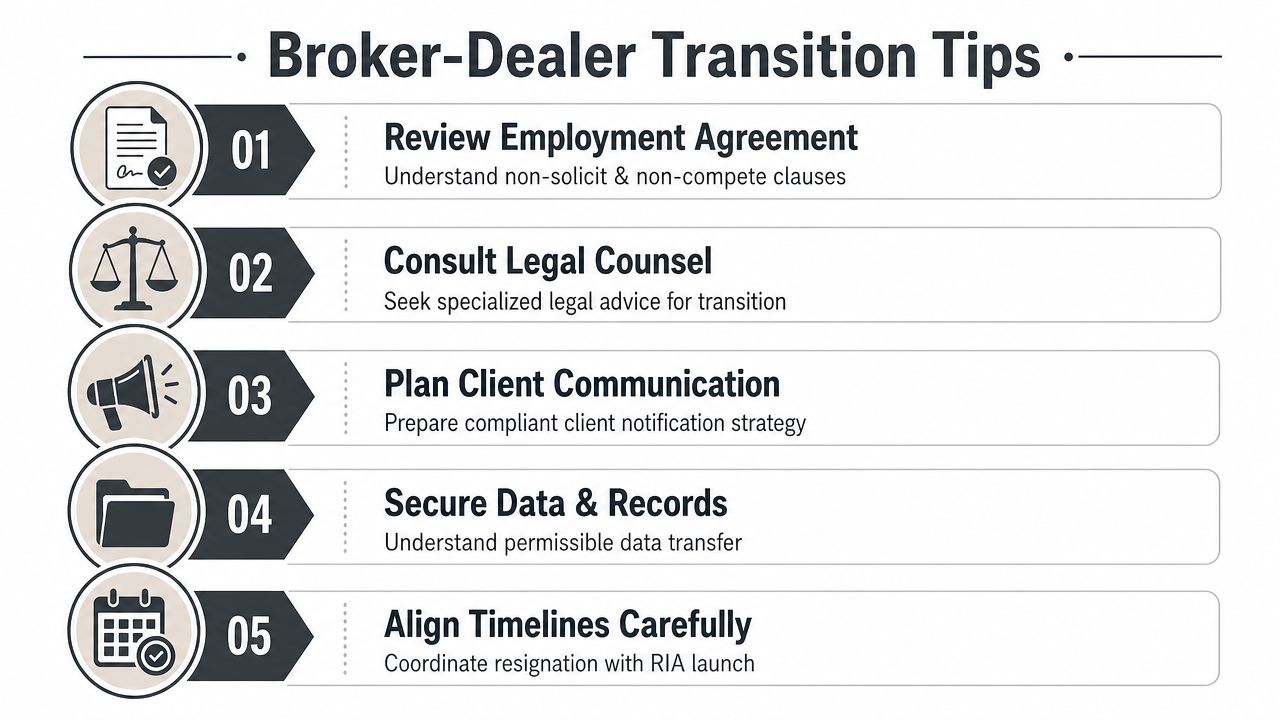
Recent startup guidance now explicitly tells advisors to review current contracts for restrictions before moving forward, and that matters because launch readiness increasingly depends on transition strategy, client portability, and Form U5 issues, not just business planning, as discussed in Kaplan's overview of starting an RIA practice.
Start with your employment documents, not your resignation letter
Before you decide timing, review every governing document you signed. That often includes the employment agreement, compensation plan, forgivable loan or promissory note documents, confidentiality agreements, equity awards, and any branch or team agreements.
Look for restrictions involving:
- Non-solicitation language tied to clients, employees, or referral sources
- Confidentiality provisions that define what counts as firm property
- Return-of-property clauses that become important when devices, files, and CRM access are involved
- Promissory note or forgivable loan terms that may trigger repayment demands on resignation
- Cooperation requirements tied to investigations, complaints, or post-employment obligations
A common mistake is assuming that if a restriction seems overbroad, it can be ignored. That's not a strategy. Even a weak claim can still create urgent litigation, arbitration, temporary restraints, account freezes, or negotiation pressure.
What can be said before and after resignation
Advisors often get into avoidable trouble. The legal answer depends on contract language, firm policy, state law, and the facts of your departure. But as a practical matter, pre-resignation conduct is usually judged more harshly than post-resignation conduct.
Conduct that often creates problems includes:
- Downloading client lists or reports beyond what your role normally requires
- Sending yourself firm documents to personal email
- Telling clients in advance that you are definitely leaving, if your agreements or circumstances make that communication improper
- Coordinating employee departures through firm systems
- Taking physical or electronic records without clear authority
Safer planning usually means discreetly building your launch structure, limiting pre-resignation activity to lawful preparation, and having a scripted post-resignation communication plan that has been reviewed in advance.
The cleanest transition is the one that can be explained line by line to a regulator, a judge, an arbitration panel, and your former firm.
Form U5 is not an administrative footnote
A hostile termination narrative can follow an advisor for years. Form U5 language can affect future registration, recruiting, due diligence, and reputation. If your current firm may frame the departure unfairly, you should treat that risk as part of launch planning, not as cleanup later.
Advisors dealing with that issue should understand how separation language can create downstream exposure. This overview of Form U5 issues in the FINRA context is a useful reference point.
Practical concerns include:
- whether the firm will characterize the departure as voluntary or permitted to resign
- whether internal reviews are underway before you leave
- whether customer complaints, trade reviews, or documentation disputes may be cited after separation
- how quickly you will respond if the filed language is inaccurate or misleading
Promissory note defense needs early attention
Many transitioning advisors focus on client movement and ignore the debt side of the exit. That can be expensive. If you signed an upfront loan, transition bonus agreement, or similar note, your former firm may demand repayment after resignation or termination.
The defense posture depends on the documents and facts. Sometimes the issue is straightforward repayment exposure. Sometimes the note is intertwined with compensation disputes, wrongful termination arguments, setoff questions, or defenses based on the employer's conduct. The point is not that every note can be defeated. The point is that it should be analyzed before the resignation, not after the demand arrives.
A disciplined departure plan usually includes legal review of note documents, separation timing, likely repayment arguments, and whether negotiation or early arbitration strategy should be prepared in advance.
Building Your Operational Engine Technology Custodians and Vendors
A new RIA isn't built on registration alone. Once approval comes through, clients will judge the firm on responsiveness, reporting, billing accuracy, and whether the advice process feels organized. That means your operating stack can't be random.
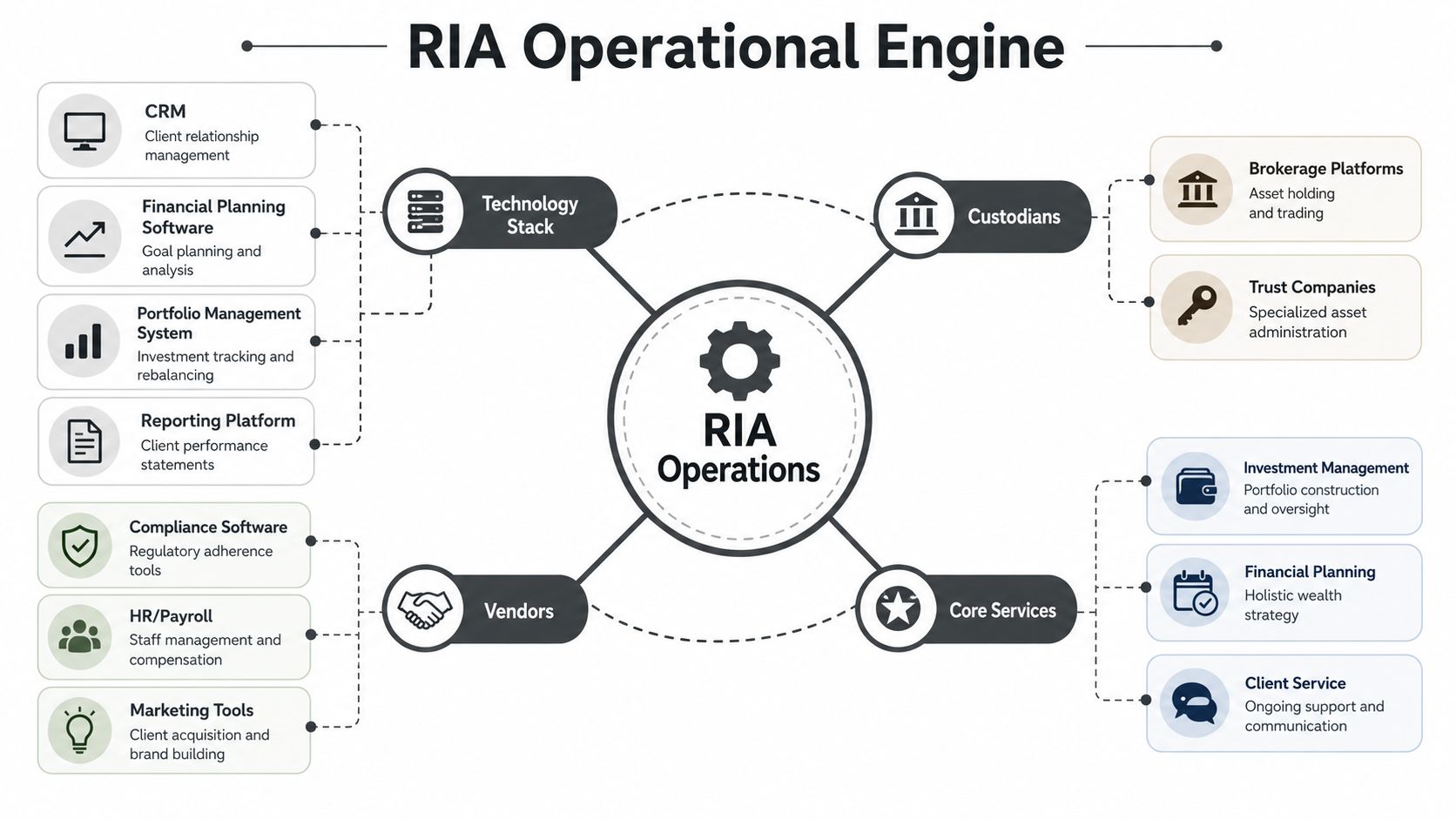
Build the stack around workflow, not brand popularity
Most firms need four core technology layers:
| Category | What it should handle | What often goes wrong |
|---|---|---|
| CRM | Contacts, tasks, workflow, notes, service calendars | Firms buy a system but never define naming rules, task ownership, or review cadence |
| Portfolio management and reporting | Performance reporting, reconciliation, rebalancing support, household views | Reporting and billing data don't align cleanly |
| Financial planning software | Planning deliverables, scenario work, client recommendations | The tool drives the service model instead of supporting it |
| Billing system | Advisory fee calculations, exceptions, invoices, audit trail | Manual workarounds create inconsistency and disclosure risk |
The best stack is the one your team can operate. If you're launching as a solo advisor, don't buy enterprise complexity you won't use. If you expect growth, don't buy disconnected point solutions that will have to be replaced once service volume rises.
Custodian selection is a business decision, not just a platform preference
Founders often choose a custodian based on familiarity from prior employment. That's understandable, but incomplete. You're not choosing where assets sit only. You're choosing service model, digital onboarding experience, support quality, integration depth, and how much operational friction your clients and staff will absorb.
When comparing custodians, ask:
- How clean is the onboarding process?
- What account types and client profiles fit the platform well?
- How responsive is service during transfers and exceptions?
- Which planning, reporting, and billing systems integrate reliably?
- How much manual intervention will your team need?
The wrong custodian fit usually doesn't fail dramatically. It fails slowly through paperwork friction, transfer delays, and staff time drain.
Vendors deserve contract review before signature
New firms sign a surprising number of contracts in a short period. Compliance support, outsourced IT, cybersecurity, payroll, website development, phone systems, marketing tools, and cloud storage all come with terms that deserve review.
A useful legal framework is understanding what belongs in a vendor agreement and when a standard form is too one-sided. This overview of master services agreements is worth reviewing before you lock yourself into critical vendor relationships.
For technology planning, founders who don't have in-house support should also think operationally, not just legally. A practical outside resource is CloudOrbis's guide for small business IT, especially for thinking through support coverage, vendor coordination, and how a small firm should structure ongoing IT help.
Good vendors reduce risk only when their responsibilities, security posture, and support obligations are clear in writing.
Launching and Staying Compliant The First Year and Beyond
The week after approval often feels worse than the weeks before it. Revenue is still uneven. Bills are now real. If you came out of a broker-dealer channel, you may still be dealing with trailing transition problems, including client account movement delays, questions tied to your Form U5, or collection pressure on a promissory note. Those issues do not pause because your registration is effective.
That is why the first year has to be run like a controlled buildout, not a victory lap. Founders who last usually budget for a longer ramp than they want, keep personal and firm cash needs separate, and assume that paperwork errors, transfer friction, and legal cleanup from the exit can consume more time than expected.
The first-year discipline that matters most
New RIAs rarely get into trouble because the idea was bad. They get into trouble because early assumptions were too generous. A client says they are coming over, but transfer paperwork stalls. An expected recruiting hire does not produce revenue quickly. A former firm raises note repayment demands earlier than expected. Each of those events hits the same place. Cash flow.
A sound first-year posture usually means:
- Protect liquidity so fixed costs such as insurance, software, legal, rent, and compliance support do not outrun revenue
- Treat projected asset movement as uncertain until assets arrive
- Add staff only after service demand and recurring revenue justify the expense
- Settle transition-related legal exposure early when possible, especially if a U5 disclosure issue or promissory note dispute could distract management attention
- Keep the service model within operational capacity so growth does not create preventable errors in onboarding, billing, or supervision
Founders often focus on getting open. Regulators and plaintiffs' lawyers focus on what happened after opening.
What your compliance calendar should actually include
A usable compliance calendar assigns dates, owners, and evidence of completion. If an item is not assigned, it is usually not getting done.
For most firms, that calendar includes:
- Annual ADV updating amendment
- Interim ADV amendments when disclosures become inaccurate
- Documented annual review of the compliance program
- Code of Ethics administration, including acknowledgments and personal trading review where applicable
- Books and records checks
- Marketing and website review against actual services, fees, and disclosures
- Privacy, cybersecurity, and incident response review
- Branch office and remote supervision checks if personnel work outside the main office
- Vendor oversight, especially where vendors handle client data or core operations
The record matters as much as the review. If the state examiner or SEC staff asks what was tested, who tested it, and what changed afterward, "we discussed it" is a weak answer.
Prepare for your first exam before you receive the notice
Exams usually expose ordinary sloppiness before they expose fraud. Inconsistent fee billing, stale ADV language, unsigned advisory agreements, missing email retention, and undocumented reviews are common early problems. None of them are complicated. All of them are expensive to fix under exam pressure.
If an examination starts to look like something more serious, review the warning signs in this overview of SEC investigations and regulatory inquiries. The difference between a routine exam response and a matter that needs immediate counsel is not academic.
A few habits lower risk fast:
- Use version control for compliance documents and client-facing disclosures
- Store signed agreements and transfer records in a consistent location
- Maintain billing files that show how each fee was calculated
- Document supervisory reviews, exceptions, and remediation steps
- Update disclosures promptly when business practices, fees, conflicts, or personnel change
There is also a broader founder lesson here. Good launches in any regulated business depend on sequence, testing, and disciplined execution, which is one reason product strategy to launch for founders is a useful comparison point even outside financial services.
The first year sets your operating culture. If compliance is treated as paperwork that gets attention only when a regulator asks for it, the firm will reflect that choice. If compliance is built into billing, onboarding, supervision, and vendor management from day one, the firm is easier to defend, easier to examine, and easier to grow.
Your Path to Independence Starts Here
Starting an RIA is demanding because it asks you to become several things at once. You're not just an advisor anymore. You're a founder, employer, fiduciary, document drafter, vendor manager, and transition strategist. If you're leaving a broker-dealer, you may also need to think like a litigant before you ever think like a marketer.
That isn't a reason to stay put. It's a reason to approach the move with precision.
The path works best when the sequence is right. Form the entity with intent. Choose the registration route based on facts, not assumptions. Build an ADV and compliance program that match the firm you are launching. Treat your resignation as a legal event. Analyze Form U5 and promissory note exposure early. Build an operating stack your team can support. Then protect runway during the first year while you establish a record of disciplined compliance.
Founders in other industries deal with the same sequencing problem in a different form. A useful comparison is product strategy to launch for founders, which reinforces a point that applies here too: launch quality comes from structure, not momentum alone.
If you want to start an RIA, the opportunity is real. So is the friction. The advisors who succeed don't ignore either one.
If you want to discuss your business law matter, contact Kons Law at (860) 920-5181.
