
If you're a registered person with an outside business activity or a reasonable expectation of compensation outside your member firm, FINRA Rule 3270 requires prior written notice before you participate, a requirement tied to the rule's modern effective date of December 15, 2010. The rule was originally adopted by NASD on October 13, 1988, and its modern transition included a grandfathering window through June 15, 2011.
That answer matters to an advisor who has just agreed to serve on a company board, consult for a fintech business, sell real estate part time, or launch a separate venture. The common mistake is to ask whether the activity feels substantial enough to report. The better question is whether your role, compensation expectation, or relationship with another person or entity fits the rule's broad trigger.
The transition now creates a second problem. FINRA's 2026 modernization would replace Rule 3270 with Rule 3290 and eliminate reporting for non-investment-related activity, but legacy disclosures, supervisory records, and pending approvals still need careful treatment. Advisors and firms shouldn't assume that a new framework automatically erases the history created under the old one.
What FINRA Rule 3270 Requires
Suppose you're a registered representative who accepts a paid consulting role with a technology company. You haven't referred a client, used your firm's name, or recommended an investment. You might still have a disclosure obligation because the rule focuses first on the outside relationship and the reasonable expectation of compensation, not merely on whether the side activity has already harmed a customer.
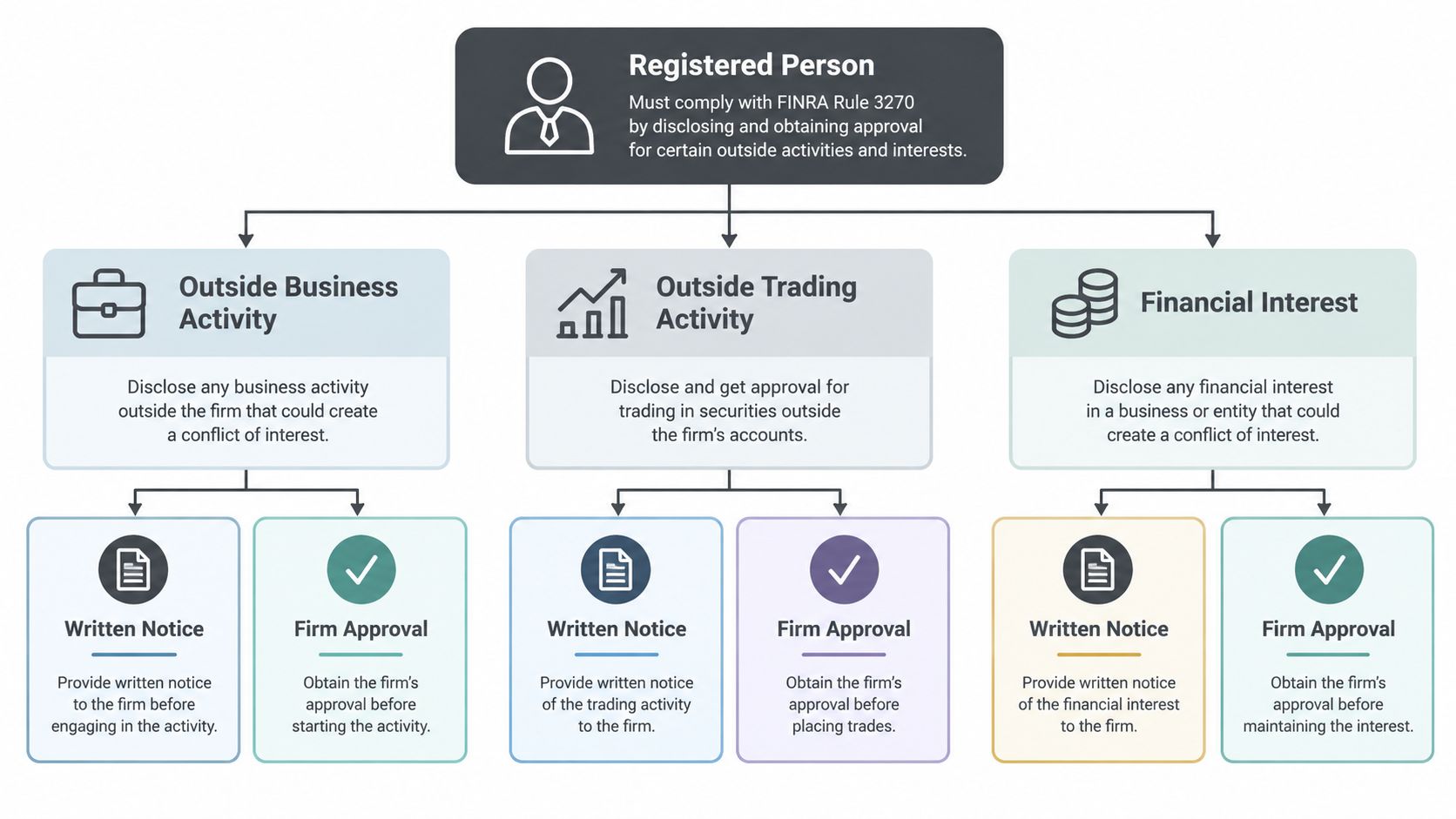
FINRA Rule 3270 requires a registered person to give prior written notice to the member firm before engaging in covered outside business activity. The trigger includes acting as an employee, independent contractor, sole proprietor, officer, director, or partner of another person. It also includes having a reasonable expectation of compensation from an outside person or entity.
The rule is intentionally broad because a firm's supervisory judgment depends on facts that an advisor may not see as regulatory risks. Time demands, customer confusion, competing loyalties, access to confidential information, and compensation incentives can all affect the firm's assessment.
Start with the activity, role, and compensation
Before you participate, write down:
- What you'll do: Describe the actual services, decisions, sales activity, and responsibilities.
- Who benefits: Identify the outside entity, its customers, investors, vendors, or affiliates.
- How you'll be paid: Include salary, commissions, equity, profit distributions, referral fees, or another form of value.
- What the firm may need to control: Consider time, communications, customer contact, branding, records, and conflicts.
That written analysis isn't a substitute for notice. It helps you submit a notice that gives the firm a usable basis for review. FINRA's Rule 3270 text and guidance frame the firm's task around whether the activity could interfere with the registered person's responsibilities or cause customers or the public to view it as part of the firm's business.
The firm's response may be to allow, limit, or prohibit the activity. Your personal view that the venture is harmless doesn't control that decision. The safest operational rule is simple: don't begin the outside role, accept compensation, or represent yourself in the role until the required written notice has been submitted and the firm's process has addressed it.
Outside Business Activities Covered and Excluded
The difficult boundary isn't usually an obvious second job. It's the borderline activity that looks personal, informal, or unrelated to securities work but still creates a business relationship or compensation expectation.
A part-time real estate agent, for example, may have a covered activity because the person is acting in another professional capacity and may receive commissions. A board position can raise similar questions even when the compensation is modest or consists of equity rather than cash. A consulting engagement with a fintech startup deserves close review when the advisor receives ownership interests, options, or another economic benefit.
Three practical classifications
Clearly reportable activity generally includes a role for another business, a compensated consulting arrangement, operating a separate enterprise, or serving as an officer, director, partner, or independent contractor. The fact that the outside entity isn't a broker-dealer doesn't remove the need for analysis.
Potentially reportable activity includes unpaid positions that could create customer confusion, involve investment-related products, use the advisor's financial-services credentials, or place the advisor in a position to influence transactions. Compensation isn't the only concern. The firm also has to assess interference with responsibilities and the way customers may understand the relationship.
Activity that may fall outside the current framework requires more caution than a casual “no.” Ordinary personal conduct with no outside business role or compensation expectation may not fit the core Rule 3270 trigger. But an activity that later becomes commercial, paid, customer-facing, or connected to financial products can change character.
The proposed modernization is important here, but it shouldn't be treated as current permission. FINRA's Notice 26-12 on the Rule 3290 modernization says the replacement framework would eliminate reporting for non-investment-related activity. That proposed shift could remove low-risk side activities from future reporting, while investment-related roles and outside securities transactions remain subject to scrutiny.
Practical rule: classify the facts as they exist today, disclose before participation, and preserve the analysis that explains why the activity was reported, limited, or treated as outside the rule.
Equity compensation deserves particular care. A fintech consultant who receives shares rather than cash still has an economic interest, and the firm may need to understand whether the role touches securities, customers, referrals, or the firm's public identity. Calling compensation “equity” doesn't make the conflict disappear.
Notice Timing, Format, and Firm Supervision
Timing and content work together. A complete notice delivered after the activity begins is still late, while a timely notice that says only “consulting” may leave the firm unable to evaluate the risk.
The notice must come before participation begins. It should describe the proposed activity or transaction in detail, identify your proposed role, and state whether you'll receive selling compensation. FINRA's Regulatory Notice 25-05 emphasizes that vague or partial descriptions don't give a firm enough information to perform its review.
Build a notice that a supervisor can actually assess
A useful submission answers practical questions rather than repeating a job title:
- What services will you perform, and for whom?
- Will you solicit customers, recommend products, handle funds, or communicate about investments?
- What authority will you hold with the outside entity?
- What compensation, equity, reimbursement, or other value may you receive?
- When will the activity occur, and how will you keep it separate from firm business?
- Could a customer reasonably believe the activity is offered, approved, or supervised by the member firm?
The firm's job isn't limited to filing your form. It must evaluate whether the activity interferes with your responsibilities, creates a conflict, or could appear to customers as part of the firm's business. Depending on the facts and the firm's procedures, it may impose conditions, restrict communications, require updates, or prohibit the role.
The firm's supervisory file matters as much as the initial submission. FINRA materials describe a paired disclosure regime involving Rule 3270 and Rule 3280, while distinguishing the registered-person scope of Rule 3270 from the broader associated-person coverage of the private-securities-transaction rule. That distinction makes accurate characterization essential, especially where an outside role involves securities or selling compensation.
Written supervisory procedures define how the firm receives, reviews, escalates, and records notices. Advisors who want a clearer understanding of that infrastructure can review the definition of written supervisory procedures. A notice isn't complete from a risk-management perspective until the advisor knows where it was submitted, what conditions apply, and how later changes must be reported.
Common Violations and Enforcement Outcomes
Most Rule 3270 problems begin with an ordinary business decision. An advisor accepts a role first, assumes compliance can be informed later, and then submits a disclosure only after a routine review, customer complaint, employment dispute, or regulatory inquiry brings the activity to light.
The recurring failures are familiar:
- Late notice: The advisor participates before submitting written notice.
- Incomplete notice: The form omits the advisor's actual role, compensation, ownership interest, customer contact, or investment connection.
- Misclassification: The advisor labels a securities-related activity as a general side business without analyzing the Rule 3280 implications.
- Poor follow-through: The advisor changes the activity, compensation, entity, or customer population without updating the firm's file.
- Weak firm records: The firm can't show what it received, how it evaluated the activity, or why it allowed, limited, or prohibited it.
Why outcomes vary
FINRA's response depends on the facts, including the duration of the conduct, the quality of the disclosure, the existence of customer harm, conflicts, compensation, cooperation, and the firm's supervision. A technical reporting lapse and an undisclosed outside securities venture may present very different enforcement profiles.
This is also why generic penalty summaries can mislead. The verified Rule 3270 materials establish the disclosure and supervision framework, but they don't establish a universal fine, suspension, or outcome for every violation. Counsel should examine the specific allegations and procedural history rather than promise a result based on an unrelated disciplinary matter.

An advisor facing scrutiny should also consider the employment consequences. An outside activity can become part of a termination dispute, a Form U5 issue, a customer claim, or an allegation that the firm failed to supervise. FINRA disciplinary actions involving financial professionals illustrate why the record and the characterization of the conduct matter together.
The strongest defense often starts before an inquiry. A complete notice, contemporaneous communications, documented approval conditions, and evidence that the advisor followed those conditions can distinguish a misunderstood activity from deliberate concealment.
Interplay with Form U4, U5, and CFP Obligations
An advisor can make a disclosure in one system and still create a problem in another. That happens when the firm's Rule 3270 file says one thing, Form U4 contains an outdated description, a Form U5 later characterizes the departure differently, or a professional-certification disclosure uses facts that don't match either record.
Consider an advisor who reports a consulting business to the firm, then changes from occasional consulting to an executive role. The original notice may no longer describe the activity accurately. If the advisor later changes firms, the new member may require a fresh review, while the former firm's records preserve the earlier version and any conditions attached to it.
Keep the factual record consistent
Form U4 and Form U5 questions should be answered from complete facts, not from memory or a shortened version of the Rule 3270 notice. Pay attention to:
- Dates and role changes: Record when the activity began, changed, paused, or ended.
- Compensation: Track cash, equity, commissions, ownership, and other benefits.
- Firm communications: Preserve the notice, follow-up questions, approval conditions, and updates.
- Departure explanations: Make sure the circumstances described during a transition don't contradict the supervisory file.
A Form U5 can carry professional and employment consequences beyond the original outside-activity question. Advisors dealing with a disputed termination or separation can review Form U5 and FINRA considerations before responding to allegations or signing a statement.
CFP Board obligations may create another layer of review for a professional holding the CFP designation. The fact that a firm accepted a Rule 3270 disclosure doesn't automatically resolve separate certification, ethics, or disclosure questions. Conversely, a certification-related disclosure doesn't replace the firm's required notice.
The practical lesson is coordination. Maintain one factual chronology, identify every forum that may require an answer, and avoid improvising different descriptions for the same activity. If a transition exposes inconsistent records, correct the facts carefully and preserve the explanation for why the information changed.
Best Practices for Advisor and Firm Compliance
A strong program treats outside activities as a continuing control, not a form completed once and forgotten. The advisor needs a reliable intake habit, and the firm needs a record that shows how it reached its decision.
Start with a personal inventory. Include paid work, ownership interests, board roles, consulting, referral arrangements, real estate activity, private ventures, and any role that could be viewed as connected to financial services. Ask the compliance department before accepting the position, not after negotiating its final terms.
Habits that hold up under scrutiny
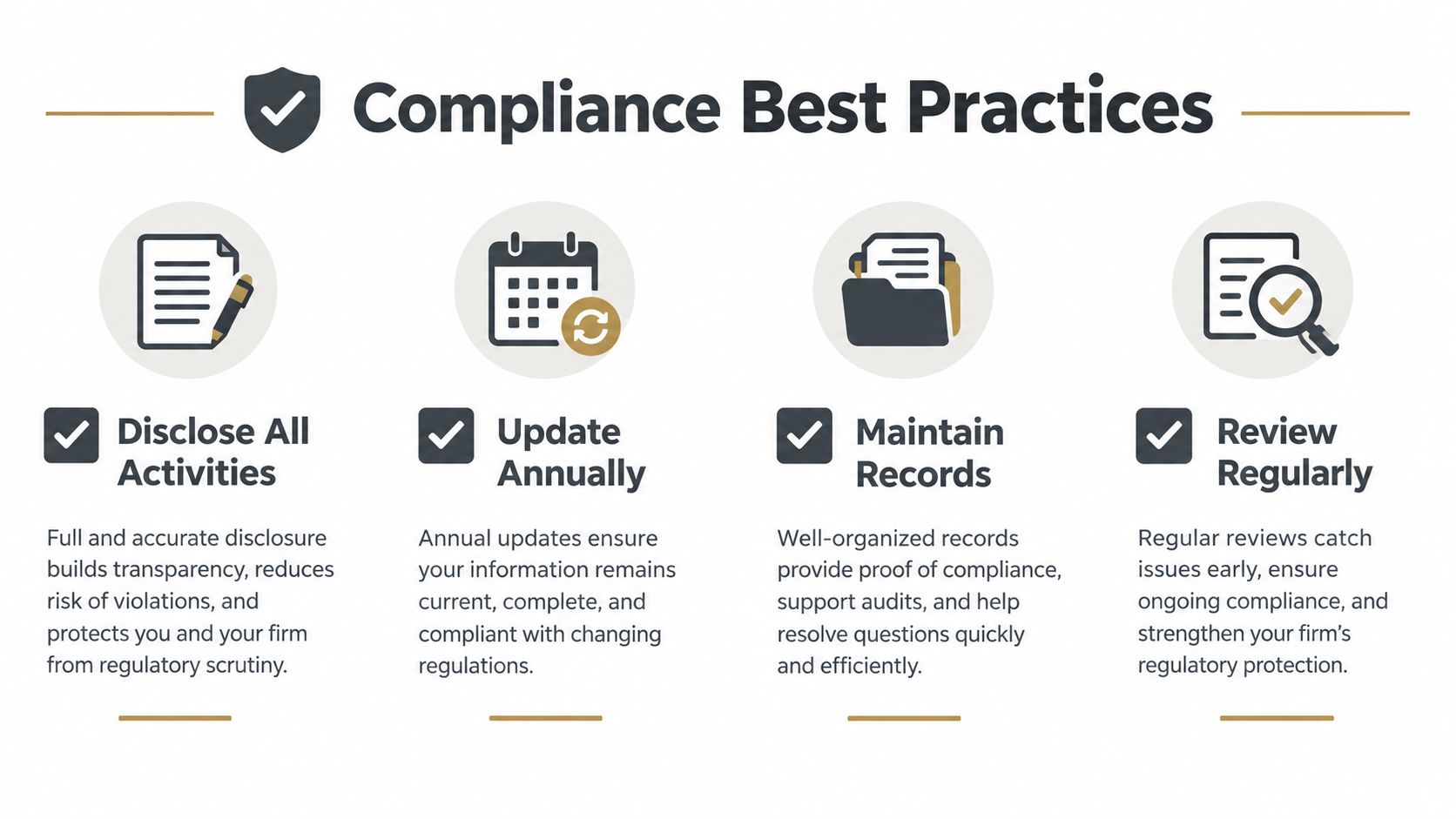
- Disclose the full relationship: Describe the business, your authority, your customers, your compensation, and your expected time commitment.
- Use a change trigger: Revisit the disclosure when ownership, duties, compensation, entity structure, or customer contact changes.
- Keep an evidence file: Retain the submitted notice, attachments, emails, approvals, restrictions, updates, and outside-entity documents.
- Separate business channels: Follow firm rules for email, marketing, social media, customer contact, records, and use of the firm's name.
- Escalate uncertainty: Ask compliance or counsel when the activity involves securities, investment advice, referrals, customer funds, or selling compensation.
Annual review can be useful, but a calendar reminder isn't enough by itself. A material change can happen before the next scheduled review, and waiting for an annual cycle may leave the file inaccurate. Firms should also test whether supervisors understand the difference between a general outside business activity and a private securities transaction.
Record retention deserves equal attention. A firm may later need to show what the advisor disclosed, what questions the firm asked, what decision it made, and whether the advisor complied with conditions. Advisors should understand their own retention duties and can consult guidance on record retention requirements when a dispute or transition makes the file especially important.
The 2026 Rule 3290 transition adds a planning task. Firms should map existing disclosures to the proposed categories, identify records that may remain relevant, and decide how pending notices will be handled if the framework changes. A narrower future reporting obligation doesn't eliminate the need to explain historical decisions.
Facing a FINRA Inquiry or Disciplinary Referral
A FINRA inquiry changes the objective. You're no longer deciding whether an activity feels reportable. You're preserving evidence, understanding the allegation, and answering accurately without creating avoidable inconsistencies.
Take these steps promptly:
- Preserve the complete record. Collect notices, amendments, emails, text messages, compensation documents, corporate records, calendars, social-media posts, customer communications, and firm responses. Don't delete or alter material because it seems embarrassing or irrelevant.
- Identify the exact allegation. Determine whether the issue concerns late notice, incomplete disclosure, selling compensation, customer contact, firm approval, supervision, or the difference between an outside business activity and a private securities transaction.
- Create a chronology. List when the outside relationship was discussed, accepted, disclosed, changed, reviewed, restricted, and ended. Mark disputed dates rather than guessing.
- Coordinate the response. FINRA requests under Rule 8210 require careful attention to scope, deadlines, preservation, and accuracy. An advisor should understand what the firm is producing and where the advisor's interests may differ from the firm's.
- Prepare for interviews. Review the documents first, answer the question asked, distinguish memory from records, and don't speculate about another person's intent.
- Assess employment and licensing exposure. A regulatory inquiry may overlap with termination decisions, Form U5 language, customer complaints, or professional-certification reporting.
A short response isn't automatically a good response. Omitting a role, compensation arrangement, or material change can create a new credibility problem if later documents reveal it. At the same time, sending an unstructured document dump can obscure the chronology and make the firm's review harder.
Preserve first, characterize carefully, and speak with counsel before making a statement that could affect your license, employment record, or defense.
The modernization issue deserves separate treatment during an inquiry. If Rule 3270 is replaced, the firm and advisor still may need to explain what was disclosed under the prior framework, how the firm supervised it, and why a pending approval was handled in a particular way. Historical records don't become irrelevant merely because the governing rule changes.
If you want to discuss your business law matter, contact Kons Law at (860) 920-5181. The firm advises financial professionals on FINRA inquiries, regulatory defenses, employment-related disputes, and disclosure issues, and you can visit Kons Law to discuss the facts and available next steps.
