A Hartford-based SaaS vendor delivers a platform that crashes during a client's peak trading day. The client claims six figures in trading losses, emergency replacement costs, and business interruption damages. The vendor then finds a liability cap in the contract, but the cap covers only a narrow category of direct damages and leaves most of the claimed exposure outside its protection.
That result is common when limitation language is treated as routine boilerplate. A cap isn't useful merely because it appears in the agreement. The parties must define its scope, coordinate it with indemnities and insurance, and present it clearly enough for a court to enforce the bargain.
For financial services companies, technology vendors, and Connecticut businesses, the practical question isn't just whether a contract contains a liability limit. The question is what losses the limit controls, what exceptions consume it, and whether the wording will survive a challenge in the governing forum.
What a Limitation of Liability Clause Does
A limitation of liability clause allocates contractual risk before a dispute arises. It may exclude defined categories of damages, set a ceiling on recoverable losses, or do both. The clause may cover breach of contract, negligence, statutory claims, indemnity obligations, or claims “arising out of or relating to” the relationship. Those scope terms can determine whether a claimant remains subject to the cap or recasts the dispute as a tort, statutory, or other claim outside the clause.
Commercial parties use these provisions for three practical reasons:
- Pricing predictability: Each side can assess its maximum contractual exposure before signing.
- Insurance alignment: The parties can compare the negotiated risk with cyber, professional liability, general liability, and other available coverage.
- Deal feasibility: A vendor may accept a customer's business only if open-ended liability does not make the transaction economically unreasonable.
A limitation provision is not an indemnity. An indemnity assigns responsibility for specified losses, often third-party claims, defense costs, intellectual property claims, or regulatory demands. A warranty disclaimer defines what the seller promises. Liquidated damages establish an agreed amount or formula for a particular breach. The limitation clause must coordinate with each provision, but it does not replace them.
The cap is part of a larger risk system
A master services agreement may also contain service commitments, warranties, indemnities, insurance requirements, dispute procedures, and exclusive remedies. Reading the liability clause in isolation can produce a false sense of protection. For example, a customer may hold a broad indemnity right that appears to sit outside the general cap, while a repair-and-replace remedy may leave its operational losses unaddressed.
Contract review should compare the liability language with the commercial promises throughout the document. A practical master services agreement overview can help identify where those provisions commonly interact. For software providers, a careful review EULA process can expose limits buried in online terms rather than the negotiated order form.
Practical rule: A cap protects the risk allocation the parties documented, not the protection one party assumed it had negotiated.
Scope language can fail in a straightforward dispute. A customer may plead negligent misrepresentation or statutory violations after a service failure, arguing that the claim is independent of the contract and therefore outside a contract-only cap. Whether that argument succeeds depends on the wording, the pleaded facts, and the governing law. Connecticut businesses and financial services companies should review those details before relying on a familiar cap formula.
The Two Building Blocks of Every Liability Cap
A financial services provider can lose a cap before anyone reaches the damages calculation. The waiver may exclude lost profits, while the cap applies only to fees for the affected service. A court could then treat a claimed loss as direct and find that the narrow cap covers only part of the dispute. The drafting relationship between these provisions matters as much as the stated cap amount.
Every commercial liability regime usually has two building blocks. A damages waiver removes specified categories of loss from recovery. A monetary cap limits the recovery that remains after the waiver is applied.
A damages waiver often excludes consequential, incidental, special, exemplary, punitive, or indirect damages. Depending on the agreement and governing law, those terms may address lost profits, business interruption, reputational harm, or losses tied to a customer's separate business opportunity. The labels do not resolve every classification issue. Courts may examine the actual loss, the causal wording, and the contract as a whole.
The monetary cap sets the ceiling. It may be a fixed amount, an insurance-based amount, or a multiple of fees paid or payable under the agreement. According to the 2022 Legal Evolution analysis by Legal Evolution of 880 vendor forms, 117 customer forms, and 289 negotiated agreements, almost 97% of vendor forms included some liability cap, while about 53% of customer forms demanded uncapped vendor liability. The market analysis of vendor liability caps provides a useful market benchmark, but the figures come from a published contract-form analysis rather than a government or court dataset. They show why the clause deserves focused negotiation.
How the two mechanisms interact
| Mechanism | What It Does | Typical Drafting | Where It Fails |
|---|---|---|---|
| Damages waiver | Excludes specified categories of loss | “Neither party will be liable for consequential, incidental, special, indirect, exemplary, or punitive damages” | It may leave direct damages uncapped or rely on undefined terms |
| Monetary cap | Limits total recovery within its scope | “Total liability will not exceed fees paid or payable under the agreement” | It may cover only one claim type or conflict with an indemnity |
| Scope language | Identifies claims subject to the regime | “Claims arising out of or relating to this agreement” | A narrow phrase may leave tort or statutory claims outside the cap |
| Carve-outs | Removes selected risks from the general limit | Separate treatment for fraud, confidentiality, IP, or data security | Broad exceptions can make the general cap largely meaningless |
A common drafting defect is a mismatch between the two devices. The contract may waive consequential damages broadly but limit the cap to “fees paid for the affected services.” If the court classifies the disputed loss as direct, the waiver offers no protection, and the narrow cap may control only a small portion of the claim. A broad cap can also be undermined by a waiver that excludes categories the parties intended to regulate without explaining how both provisions operate together.
Scope and carve-outs require the same review. If indemnity obligations sit outside the cap, a separate review of indemnification clauses in contracts should confirm whether third-party costs, defense expenses, and related losses receive consistent treatment. In a cross-border or multilingual transaction, legal contract language translation should preserve distinctions such as “arising under” and “arising out of.” Small wording changes can affect the claims a court considers subject to the allocation.
When Courts Will and Will Not Enforce the Cap
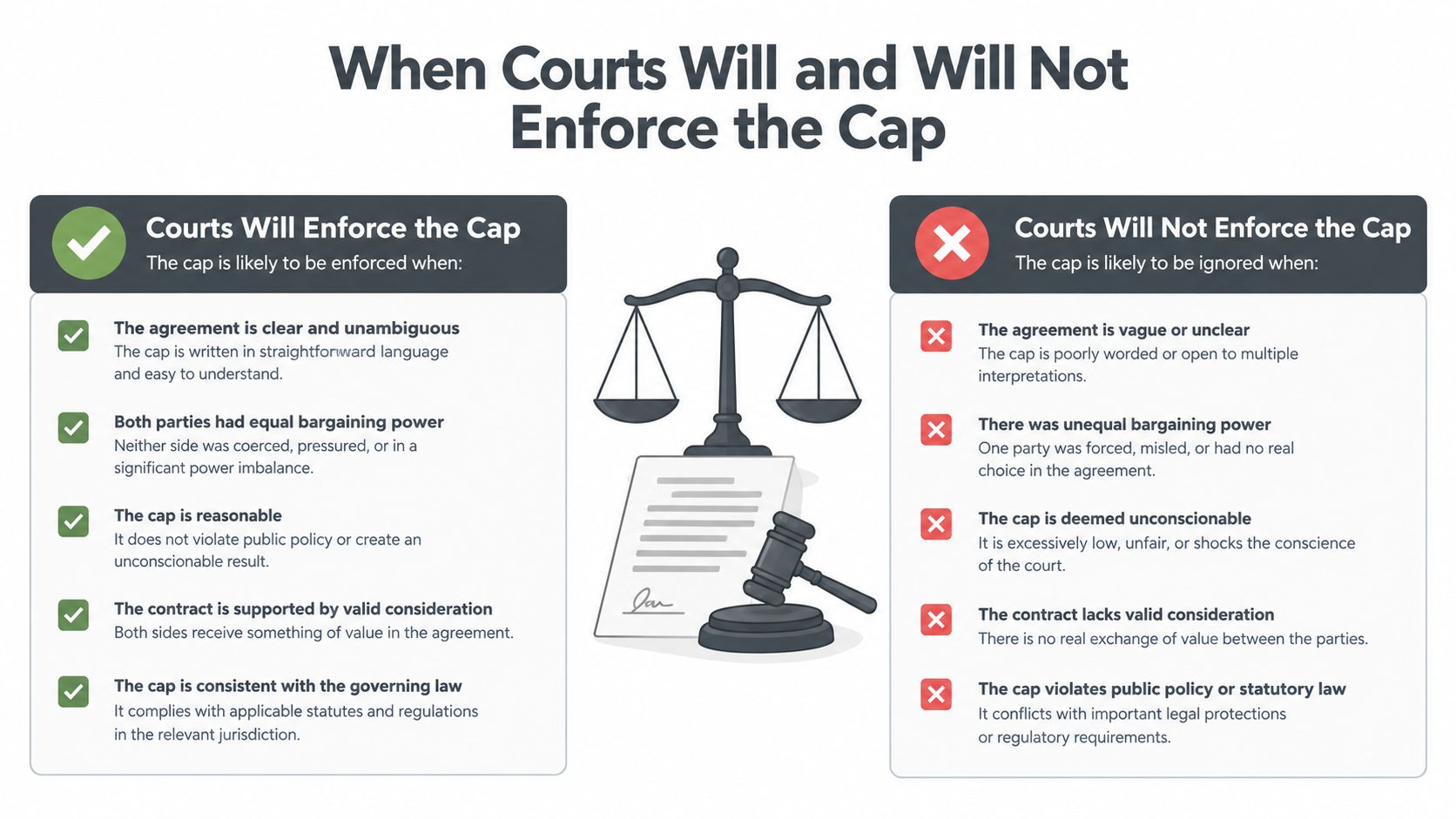
Courts generally examine several layers before enforcing a disputed limitation. A clause can fail because it was never properly incorporated, because its language doesn't cover the claim, because the allocation is unconscionable, or because the law prohibits limiting the particular liability.
Four questions determine the outcome
First, was the clause part of the agreement? The provision should appear in the signed contract, incorporated terms, or another document that the contracting process clearly adopts. A term hidden in an inaccessible web page, attached after agreement, or omitted from the signed version creates an avoidable incorporation dispute. Conspicuous formatting, clear headings, and a documented negotiation record strengthen the argument that the parties knowingly accepted the allocation.
Second, does the language clearly cover the claim? The clause should identify whether it applies to contract, tort, negligence, statutory, and other claims. It should also explain whether the cap is aggregate or applies separately to each claim, event, or policy period. Courts don't reliably enforce a provision that leaves the parties guessing about what is excluded, what is capped, and what survives.
Third, is the allocation reasonable? Courts may scrutinize a clause in an adhesion contract, a consumer transaction, or a relationship involving sharply unequal bargaining power. A negotiated commercial provision between experienced parties receives a different practical assessment than an obscure term imposed without meaningful opportunity to review it. Broad language that leaves a party with no meaningful remedy can create additional risk.
Fourth, does the law permit the limitation? Fraud, fraudulent misrepresentation, willful misconduct, reckless conduct, gross negligence, death, personal injury, and statutory or public-policy restrictions can defeat or narrow a cap. English-law guidance, for example, states that fraud and fraudulent misrepresentation can't be excluded or limited, while the Unfair Contract Terms Act 1977 and reasonableness rules impose additional controls. Guidance on English-law limitation clauses shows why the governing law deserves attention before a party adopts language from another jurisdiction.
Financial services and cybersecurity disputes put these questions under pressure. A clause that seems adequate for a missed service appointment may be inadequate for unauthorized access, regulatory response, customer notification, or loss of sensitive information. Recent guidance warns that the familiar fee-based benchmark can be grossly inadequate for multi-million-dollar breach costs, including notification, credit monitoring, fines, and remediation. SaaS liability cap guidance makes the practical point that operational scope, not contract price alone, should drive the analysis.
The party relying on the cap should also review available remedies. Under UCC § 2-719, commercial parties may modify or limit remedies, and consequential damages may be excluded unless the limitation is unconscionable. The statute treats consumer-goods personal-injury limits as prima facie unconscionable, while commercial-loss limits aren't presumed unconscionable. UCC § 2-719 provides the statutory starting point for sales of goods.
A failed exclusive remedy doesn't automatically invalidate a separate damages waiver. Courts may analyze a repair-or-replacement remedy and a consequential-damages exclusion independently, as reflected in this federal court analysis of UCC remedies. Businesses handling a dispute should therefore evaluate each operative provision rather than assume that one defect collapses the entire liability regime. The relationship between a cap and available breach of contract remedies often determines the practical value of the clause.
Common Cap Levels and What They Mean in Practice
A financial services vendor suffers a security incident after a modest software implementation. The contract contains a general cap of 1x annual fees, but a separate data-security super cap applies to claims involving unauthorized access, confidentiality, and required incident response. That structure may give the customer more recovery than the general cap while keeping ordinary service disputes within a predictable limit. The market data on limitation structures supports using fee-based caps as negotiation benchmarks, not as substitutes for risk analysis.
| Cap Structure | Typical Amount | Best Fit For | Key Trade-Off |
|---|---|---|---|
| Nominal or fixed cap | A stated fixed amount | Limited-scope services with predictable exposure | Easy to administer, but it can become disconnected from operational risk |
| General fee cap | Often 1x annual fees | Ordinary service failures in enterprise software | Familiar and measurable, but it may not fund a serious incident |
| Tiered cap | General cap plus a higher super cap | Data security, confidentiality, IP, or regulated services | Assigns more capacity to selected risks, but the exceptions require precise drafting |
| Insurance-linked cap | Amount tied to required coverage | Vendors with defined policy obligations | Connects the contract to insurance, but exclusions and defense costs may reduce available coverage |
| Uncapped category | No limit for specified claims | Fraud or other legally restricted conduct | Preserves recovery for serious misconduct, but creates potentially material balance-sheet exposure |
An insurance-linked cap can work differently from a data-security super cap. If the vendor must maintain specified coverage, the contract may set recovery by reference to that policy. The customer should still review exclusions, deductibles, policy limits, claims-made requirements, and whether defense expenses erode the available amount. Insurance language does not guarantee that the full stated limit will fund the loss.
The headline number also fails to show how the clause operates. A cap limited to direct damages may leave indemnity obligations, confidentiality claims, or specified security losses subject to separate treatment. A smaller mutual cap with carefully negotiated exceptions can be more balanced than a larger asymmetric cap that leaves one party exposed for routine disputes.
Choose the structure by asking what loss the service could realistically cause, which party can prevent or insure it, and whether indemnities create additional exposure. A vendor handling confidential account information may need distinct treatment for security and privacy risks even when contract value is modest. The drafting should identify the covered claims, the applicable cap, whether defense costs count against it, and how multiple claims share the available amount.
Connecticut and U.S. Rules That Shape Enforceability
Connecticut companies shouldn't select a liability clause by copying language from a form governed by another state. The governing-law provision, transaction type, parties' sophistication, claims asserted, and dispute forum can change the analysis. A clause negotiated for a sale of goods may require a different review from one used for professional services, software licensing, or a financial technology arrangement.
For goods transactions, Connecticut's adoption of Article 2 of the Uniform Commercial Code makes § 2-719 especially important. Commercial parties can modify remedies and limit consequential damages, subject to unconscionability and other legal constraints. The statute's distinction between commercial losses and consumer-goods personal-injury limits should be reflected in the drafting rather than left to a later dispute.
The Connecticut review should be transaction-specific
Connecticut counsel should examine whether the clause is clearly incorporated, whether the parties negotiated it, and whether it preserves a meaningful remedy. The analysis should also account for statutory rights and public-policy limits that a contract can't waive through broad language alone. Claims under consumer-protection statutes, for example, may require a different analysis from an ordinary commercial contract claim.
Federal overlays can matter even when Connecticut law governs. Financial institutions and their vendors may face contractual duties connected to regulatory expectations, data security, recordkeeping, or customer protection. Arbitration provisions can also affect where and how a court or panel considers incorporation, unconscionability, and the interaction between a cap and an indemnity.
Recent legal commentary identifies a post-2025 enforceability concern involving drafting defects, jurisdiction-specific standards, and conflicts with indemnity language. It points to California's VanLaw decision and warns that undefined consequential-damages waivers, vague prefatory language, or misaligned carve-outs can cause a cap to fail under challenge. The 2025 discussion of caps, carve-outs, and indemnification reinforces a practical lesson for Connecticut companies operating across state lines: use a governing-law review, not a universal template.
How to Negotiate and Draft a Clause That Holds Up
Start with the loss scenarios, not the number. List service interruption, data compromise, intellectual property claims, confidentiality breaches, third-party demands, regulatory response, bodily injury, property damage, and unpaid fees. Then decide which risks belong inside the general cap, which require a higher cap, and which cannot lawfully be limited.
Build the clause in a deliberate sequence
- State the covered claims. Say whether the regime applies to claims arising under, arising out of, or relating to the agreement, and whether it covers contract, tort, negligence, statute, and equity.
- Define excluded damages. Identify the categories the parties intend to waive, then address whether specific losses such as lost profits, restoration costs, or business interruption are included or excluded.
- Set the general cap. Specify the amount, fee period, currency if relevant, and whether the limit is aggregate across the relationship or applies per claim or event.
- Coordinate the carve-outs. Address confidentiality, data security, IP infringement, indemnity, payment obligations, fraud, gross negligence, and willful misconduct in a separate, ordered list.
- Resolve conflicts. State whether indemnities are inside the general cap, subject to a super cap, or excluded from the cap. Don't make the reader infer the answer from two inconsistent sections.
- Preserve enforceable remedies. If the agreement includes repair, replacement, re-performance, or refund rights, identify whether the remedy is exclusive and what happens if it fails of its essential purpose.
A typical structure might read in substance as follows: the general cap applies to all covered claims and limits aggregate liability to the agreed fee-based amount; a higher cap applies to specified security, confidentiality, and IP obligations; and no limitation applies to liability that applicable law prohibits the parties from limiting. That is a drafting structure, not a plug-in clause. The exact language must match the services, indemnities, insurance, and governing law.
Negotiation advice: Concede a narrow exception only after defining its scope, duration, proof requirements, and relationship to every other cap.
Small drafting concessions can prevent large disputes. A vendor may accept a super cap for a defined data-security breach if the customer agrees that it applies only to specified incidents and documented losses. A customer may accept a fee-based general cap if the vendor provides a meaningful remedy for security, confidentiality, or IP claims. Resources on how to negotiate SaaS contracts can help business teams prepare positions before counsel exchanges redlines.
Before signature, conduct a final clause-to-clause comparison. The business contract drafting guide should be treated as a review prompt: confirm the parties, definitions, order of precedence, survival language, dispute forum, and incorporated terms all point to the same allocation.
Risk Management Beyond the Boilerplate
A liability cap does not replace operational controls. Consider a financial services vendor whose incident triggers customer notices, credit monitoring, forensic work, remediation, regulatory response, and claims from affected customers. A fee-based cap may cover only a fraction of those costs, even if the contract appears to address security risk. Review cyber insurance sublimits, retentions, exclusions, claims-made conditions, and whether defense costs reduce the available policy limit.
The contract should also identify which obligations survive a cap and which party must perform them. State breach-notification laws, the Gramm-Leach-Bliley Act, and NYDFS Part 500 can impose duties that a private agreement cannot erase. Financial services companies should check indemnities owed to lenders, card networks, clearing partners, and other participants. If an indemnity sits outside the general cap, the business may face an uncapped or separately capped obligation that the headline limitation does not reveal.
Verify the allocation after signing
- Compare documents: Check the executed agreement, order form, data-processing addendum, and incorporated online terms for the negotiated cap, exceptions, and order of precedence.
- Alert finance and claims teams: Circulate the final cap, super cap, carve-outs, and notice obligations so reserves and incident decisions reflect the signed terms.
- Update the repository: Store the signed agreement and negotiation record where the business can retrieve them during an incident or dispute.
- Review insurance: Compare contractual exposure with policy limits, exclusions, sublimits, and the treatment of defense costs.
- Refresh the risk register: Record exposure by customer, vendor, service, and incident type instead of relying on the headline cap.
Indemnity and limitation provisions also need a combined review. One event may produce direct damages, third-party defense costs, remediation expenses, and regulatory demands under different provisions. Reviewing each clause separately can leave the business carrying stacked exposure or assuming that insurance responds when an exclusion applies.
Hartford-area companies can strengthen the allocation by coordinating contract review with insurance and incident-response planning. The written deal should match the people, notices, records, and decisions required during an actual incident.
Key Takeaways and Next Steps
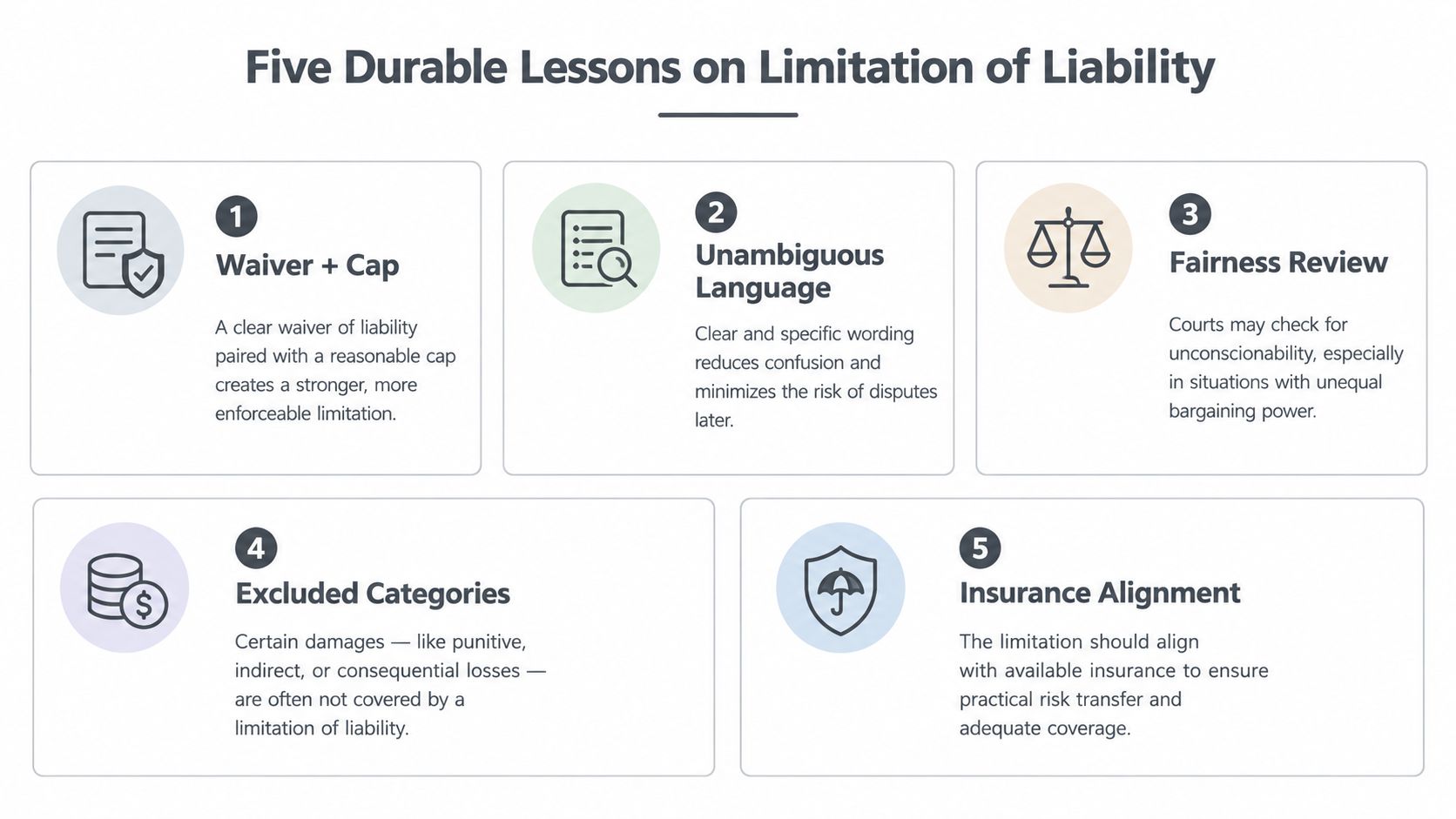
Five principles should guide the review of limitation of liability in contracts:
- A cap has two parts. The damages waiver filters categories of loss, while the monetary cap limits the recovery that remains.
- Clarity controls enforceability. Incorporation, conspicuous presentation, precise scope, and consistent definitions give a court a workable bargain to enforce.
- Some exposure resists limitation. Fraud, fraudulent misrepresentation, willful misconduct, gross negligence, personal injury, death, and statutory or public-policy restrictions can defeat a limitation.
- The governing law matters. Connecticut businesses operating nationally should account for Article 2, forum rules, arbitration, consumer protection standards, and stricter jurisdictions such as California.
- Drafting quality drives practical value. The number at the top of the clause matters less than its relationship to carve-outs, indemnities, remedies, insurance, and real operational losses.
A business can act on these principles without waiting for a dispute. Audit your highest-value revenue and vendor contracts, flag missing or one-sided caps, compare indemnity baskets with insurance coverage, and document the concessions made during negotiation. For financial services businesses, add a focused review of data security, regulatory response, customer notification, and third-party obligations.
If you want to discuss your business law matter, contact Kons Law at (860) 920-5181. For a focused review of a cap, indemnity, or cybersecurity allocation, schedule a contract review with the Hartford business-law team at (860) 717-9000.
Kons Law helps Connecticut companies review, draft, and negotiate commercial contracts so liability caps, indemnities, insurance requirements, and dispute provisions work together. Visit Kons Law to discuss a contract review or a developing business dispute.
