
You might be staring at a job offer, a transfer packet, or a licensing checklist and thinking the same thing many reps think, which license do I need to keep moving? The Series 6 and 63 license question looks simple until a firm, a state, or a Form U4 amendment turns it into a compliance problem. The issue isn't just passing exams, it's understanding how product authority and state registration work together when your career changes.
| License | What it covers | What it does not cover | Practical role |
|---|---|---|---|
| Series 6 | Packaged securities like mutual funds, variable annuities, variable life insurance, unit investment trusts, and 529 plans | It does not broaden into every security type | Defines what you can sell |
| Series 63 | State-law authority for securities-agent registration under the Uniform Securities Act | It does not expand the product set | Defines where you can conduct covered business |
Understanding the Series 6 and 63 License Relationship
A rep can clear onboarding, get the desk assignment, and still run into a licensing problem on day one of production. The firm may support mutual funds and annuities, but compliance still needs to see whether the rep has the right mix of product authority and state registration. That is where the Series 6 and Series 63 split matters in practice.
Product authority and jurisdiction are separate questions
The Series 6 is FINRA's product-focused qualification for packaged securities. The Series 63 is NASAA's state-law exam, and its function is to address securities-agent registration under the Uniform Securities Act. That distinction sits at the center of the licensing structure, because one credential tells you what you may sell, while the other tells you where you may lawfully do that business. For a detailed comparison of the Series 63 versus the Series 7, see Kons Law's analysis.
A representative who looks only at products can reach the wrong conclusion quickly. Mutual funds and variable annuities may fit the business model, but the state-law layer still has to be satisfied before the rep can transact covered business in a given jurisdiction. In practice, that means a broad sales role often requires both credentials, not because they overlap, but because they address different regulatory problems.
Why the difference matters in real work
Practical rule: If compliance asks, “Can this rep sell the product?” start with Series 6. If the question is, “Can this rep do that business in this state?” start with Series 63.
That distinction becomes important during transfers, relocations, and other licensing changes. A representative in one state cannot assume the same registration status follows automatically into another, especially when the filing and the firm's records have not been updated yet. The pair works together like this, Series 6 addresses the product side, and Series 63 handles the state-registration layer that determines where a representative can conduct covered business.
For a broader comparison of the broker-dealer and advisory framework, Parkview Partners on broker-dealer vs RIA helps put the registration issue in context. The licensing labels matter, but the business model behind them matters just as much.
What Each License Authorizes You to Do
A rep can have the right product knowledge and still be missing the right authority to act. The cleanest way to separate the two licenses is to treat Series 6 as product authority and Series 63 as state-law authority. Series 6 lets a representative solicit, purchase, and sell packaged securities such as mutual funds, variable annuities, variable life insurance, unit investment trusts, and municipal fund securities, including 529 plans. Series 63 does not expand the product menu. It permits securities activity within a particular state under that state's law.
Side by side is the easiest way to see the split
| License | Product Authority | Jurisdictional Authority | Primary Purpose |
|---|---|---|---|
| Series 6 | Yes, packaged securities only | No state-law expansion by itself | Sell the covered products |
| Series 63 | No new product authority | Yes, state-law securities-agent registration | Permit covered securities activity in a state |
That difference shows up in day-to-day compliance, not just on an exam outline. A rep with only Series 6 may know exactly how a variable annuity works and still be blocked from transacting because the state-registration piece is missing. A rep with only Series 63 may be aligned on the state-law side and still lack authority to sell the product at all. The two licenses solve different regulatory problems, which is why they are paired in so many retail, bank, and insurance-linked business models.
The operational point matters during real business changes. A person who can discuss a product confidently still needs the proper legal footing before that conversation becomes a sale. A state-registration exam does not widen the list of products a rep can offer. It clears the state-law path for the securities activity the firm and the jurisdiction allow.
A licensing file can look complete on paper and still be incomplete in practice if the rep's product authority and state registration do not match the business being conducted.
That mismatch becomes more visible during job transitions, relocations, and U4 or U5 events, when registration records have to line up with what the rep is doing. Series 6 defines the menu, Series 63 controls where the rep can conduct covered business. For a practical comparison of how those roles fit inside a brokerage business model, Parkview Partners on broker-dealer vs RIA is a useful reference point.
Exam Specifications and Passing Requirements
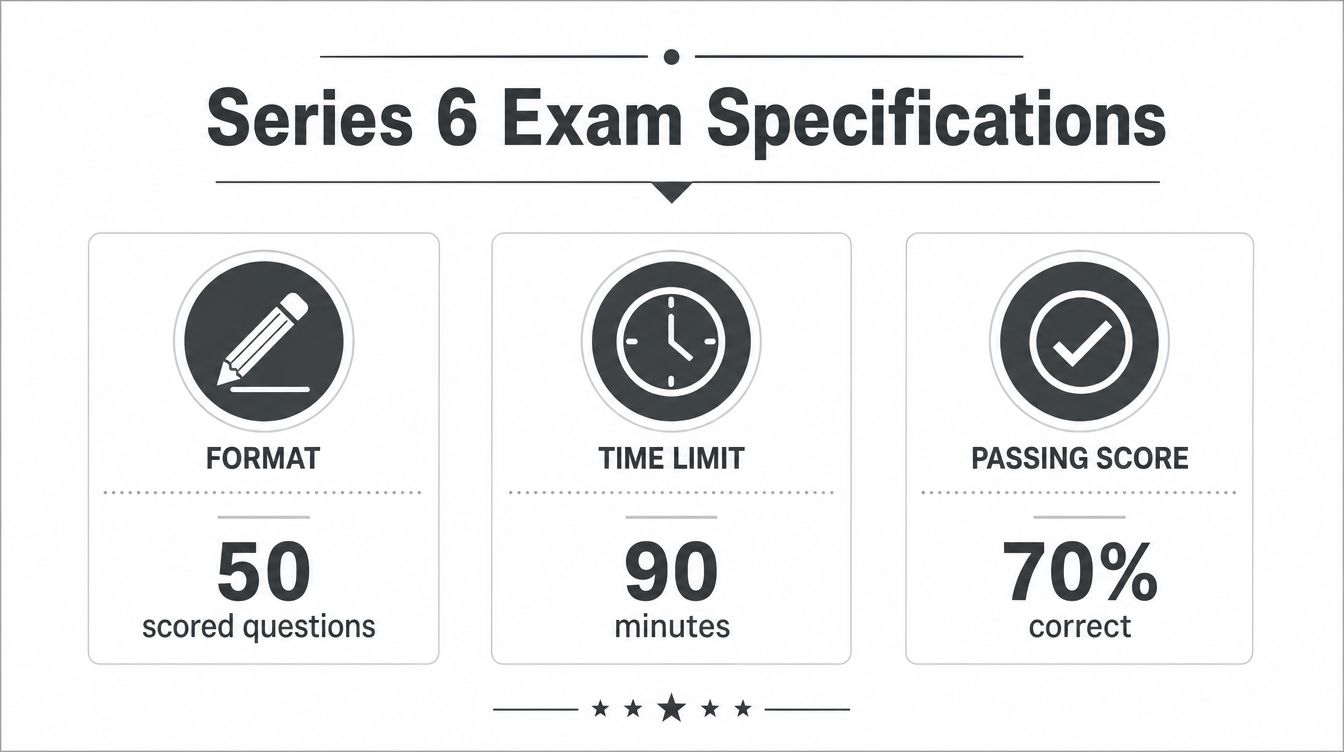
The prep conversation gets more useful once the numbers are on the table. Series 6 is a 90-minute exam with 50 scored questions and a 70% passing score, while Series 63 is a 75-minute exam with 60 scored questions plus 5 unscored questions and requires 43 correct answers out of the 60 scored questions, which is the same as the stated 72% pass threshold. FINRA's exam materials also list the Series 6 as 1 hour and 30 minutes with 50 questions. Kons Law's Series 6 pass-rate discussion is a practical companion if you're mapping study time to the test format.
Fees and structure reflect different roles
The Series 6 exam fee is $100 according to FINRA's qualification-exams page, while industry references commonly cite the Series 63 fee at $147. Those numbers matter because they remind candidates that these exams serve different functions in the licensing system. One is the narrower product exam, the other is the state-law registration exam.
For candidates, the practical takeaway is that the shorter test is not necessarily the easier one, and the longer test is not necessarily the broader one. The Series 63 has fewer minutes and more legal nuance, so pacing becomes a real issue. The Series 6 has a longer window, but the candidate still needs to know how product rules apply to packaged securities and variable contracts.
How to budget your prep
A smart study plan treats the two exams differently. Series 6 prep should focus on the product shelf, suitability, and the mechanics of packaged securities. Series 63 prep should focus on state-law concepts, agent registration, and the way jurisdictional rules are tested under time pressure.
Practical rule: Treat the exam fee as the small part of the cost, the larger cost is the study time needed to learn how the questions are framed.
For licensing teams, the right budget includes the test fee, study materials, and time off from production. For a solo candidate, it also includes the time lost to retesting if the first attempt goes badly. The actual exam structure is part of the strategy, not just a detail on the testing vendor's page.
Sponsorship Requirements and State Registration Rules
The onboarding trap is assuming every securities exam works the same way. It doesn't. Series 6 is not a standalone registration credential, because FINRA says candidates must pass both the Securities Industry Essentials (SIE) exam and the Series 6 exam to obtain registration for the Series 6 representative category. By contrast, Series 63 is one of the few securities exams many candidates can take without sponsorship, which is why it often becomes the first state-law credential a rep handles on the road to registration.
The sponsorship question changes the sequence
A candidate who understands the sequence can avoid a lot of wasted motion. If the business model requires Series 6 registration, the SIE comes first, then the top-off exam, then the firm's registration process. If the candidate is pursuing state-law qualification that doesn't require the same sponsorship path, the sequence may be more flexible. That distinction matters for people changing firms, entering the industry, or trying to get their licensing in place before a start date.
State rules make the picture more uneven. The Series 63 is not required in Colorado, Florida, Louisiana, Maryland, Ohio, the District of Columbia, and Puerto Rico, which proves that state registration is not uniform nationwide. A rep who assumes every jurisdiction works the same way can misread a transfer or relocation and end up out of alignment with the local rule set.
Registration strategy needs a state-by-state check
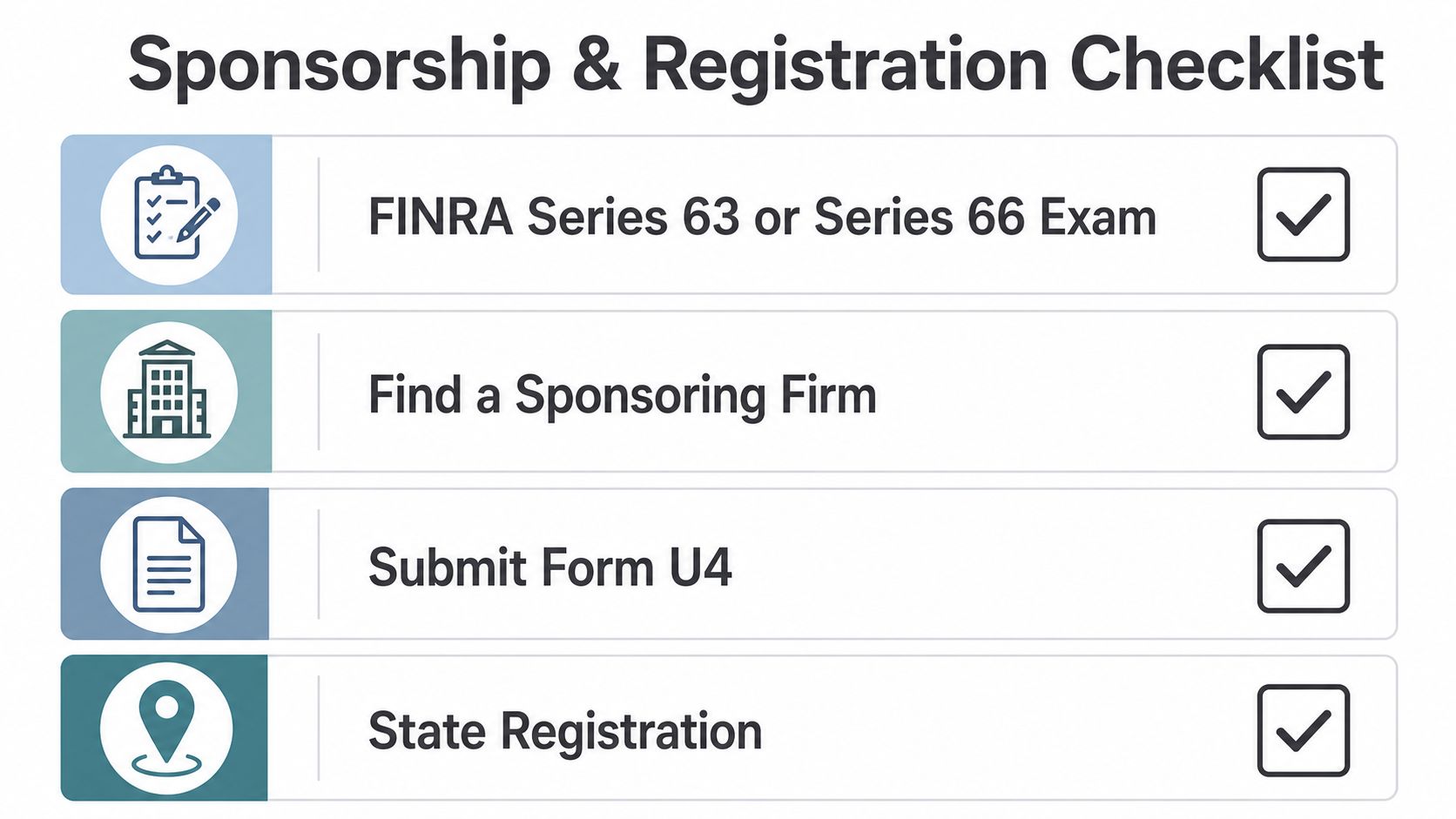
The point of the checklist is simple. A rep needs the right exam, the right firm setup, the right filing, and the right state approval. Miss one of those pieces and the filing can stall, even if the candidate already passed the exam.
A broker-dealer desk may have strong internal onboarding, but the state-law layer still needs to be checked jurisdiction by jurisdiction. That is especially true for a rep who is moving or working across multiple states. If the local filing rule differs, the national firm's general process doesn't cure the mismatch.
Post-Exam Compliance and Registration Obligations
Most study guides treat the exam as the finish line. In practice, it's more like the start of the compliance workload. The operational questions show up after the pass result, especially when a rep changes firms, relocates, or gets pulled into a supervisory issue that touches registration status.
State coverage can change when the rep's life changes
The key point is that Series 63 coverage is state-specific and tied to where an advisor lives or works. That means a move can trigger a registration update even if nobody expects the exam itself to be retaken. For a rep who assumes the credential is “done,” that can create a gap between where the rep is physically doing business and where the paperwork still says the rep is registered.
Many teams undercount the risk. A Form U4 amendment, a jurisdictional dispute, or a post-hire compliance review can force the firm to revisit state registration status. The issue isn't whether the rep once passed the exam, it's whether the current registration footprint still matches the current facts.
The exam content mirrors the later compliance problem
NASAA's outline is weighted toward communications, compensation, and broker-dealer/agent rules, which are the same areas that create trouble after onboarding or after termination. That overlap matters because reps often think of those topics as study material, not living compliance issues. The outline says otherwise. Those topics are exactly where a move, a supervisory inquiry, or a compensation dispute can expose weak documentation.
Practical rule: Don't treat the Series 63 as a one-time hurdle. Treat it as a state-law gate that can matter again when the job, address, or firm relationship changes.
For advisors facing state-registration questions tied to larger compliance concerns, Kons Law's compliance resource for RIAs is relevant because it reflects the broader regulatory environment around ongoing obligations. The main point is not academic. A passing score doesn't end the state-law analysis, it just gets the rep into the system.

Employment Transitions and Regulatory Implications
The hardest licensing disputes usually start with a job change. A rep leaves one firm, joins another, and suddenly the licenses that looked routine become part of a larger paper trail. A Form U5 can complicate the transition, and a bad filing can trigger questions that go well beyond whether the rep passed the right exams.
A move can turn into a registration problem
The Series 63 layer is especially sensitive during transitions because it is state-specific. If a rep changes firms or moves into a state with different registration mechanics, the old filing picture may no longer fit the new one. That is true even if the product license stays intact and the rep keeps doing the same kind of work.
The regulatory reach can widen quickly. FINRA investigations, 8210 requests, and inquiry letters can all put licensing history under the microscope. Once that happens, the rep's registration record, termination record, and current state footprint all become relevant. A rep who thought the issue was just a staffing dispute can find out the compliance record is now part of the defense.
Compensation disputes often ride on the same record
Withheld bonuses, production credits, deferred compensation, and transition-related pay issues often sit beside the licensing file. If a former firm files a problematic Form U5, the rep may need to address not just reputation damage but also how the transition was documented. The licensing status at the time of departure can become evidence in the dispute, especially when the former firm argues that the rep was not properly registered or properly active.
That's why employment disputes in this industry rarely stay in one lane. Licensing, supervision, compensation, and disclosure all overlap. For advisors who face a Form U5 issue or need to understand the employment side of a registration problem, this Form U5 resource is a practical starting point.
A CFP Board matter can add another layer if the rep also holds the CFP designation. The same records that support a state registration issue can matter in a disciplinary defense, which is why these matters are usually better handled as a connected strategy rather than as isolated complaints.
Strategic Recommendations and Common Pitfalls
The best licensing strategy depends on the business model, but the common mistakes are surprisingly consistent. Reps overtrust the firm, undercheck the state rule, and assume the exam result means the work is over. That approach causes unnecessary delays, and it can create avoidable exposure when the rep changes jobs or moves jurisdictions.
What works in practice
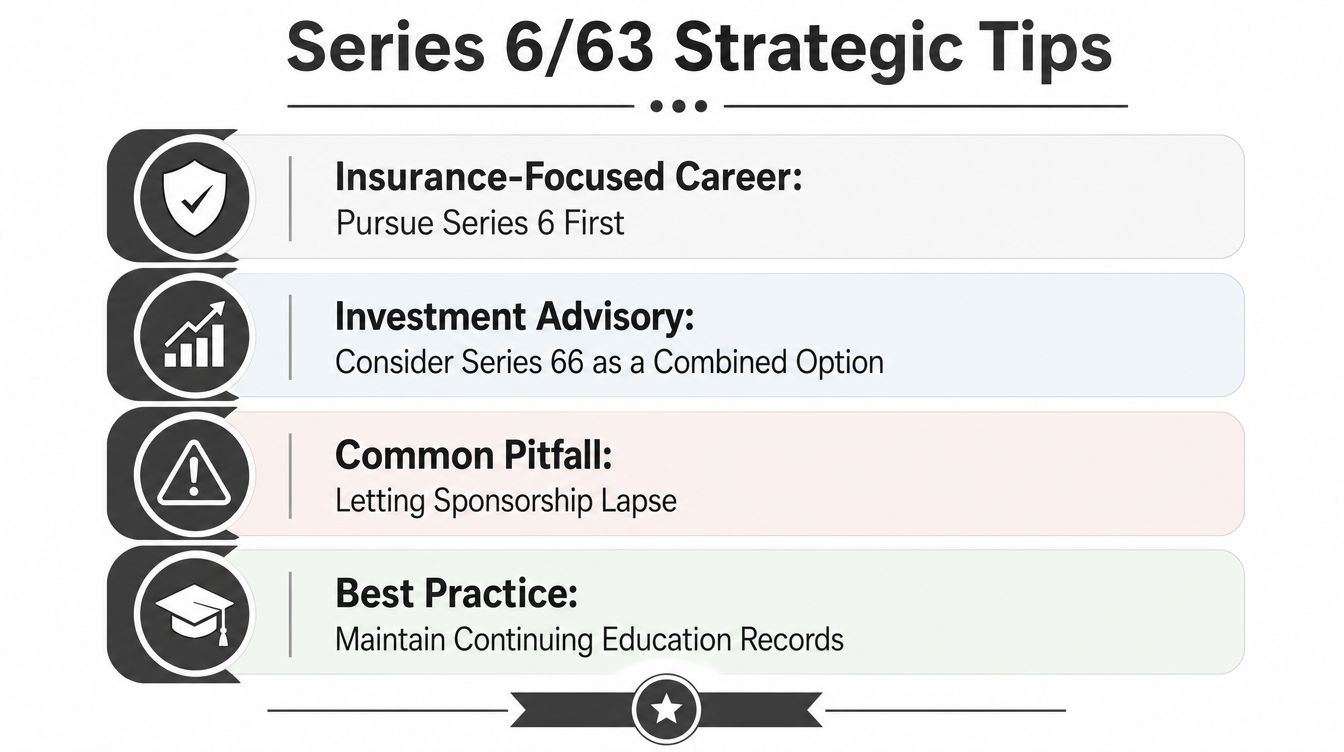
If the business is centered on insurance-linked or packaged products, the Series 6 is usually the right product credential to pursue first. If the role is advisory and fee-based, the state-law and advisory framework shifts, and a different licensing path may fit better. A rep should not guess at the combo, because the wrong sequence can waste time and leave the registration picture incomplete.
The other major mistake is assuming a national firm handles every state issue automatically. Firms do a lot, but they don't change the fact that state registration varies by jurisdiction. A rep who relocates or works across state lines needs to verify that the filing, the supervision structure, and the current business activity still line up.
Where legal help becomes useful
A rep facing a firm break-up, a problematic termination, or a regulatory inquiry should get counsel early, not after the paperwork has already hardened. That is especially true when the issue involves a Form U5, unpaid compensation, or a disputed registration status. In those situations, licensing records can become evidence, and evidence is easier to manage before the story gets locked into the wrong version.
Practical rule: Preserve the licensing trail, the registration trail, and the compensation trail together. Separating them is how people lose leverage.
If your licensing issue is tied to a move, a Form U5 dispute, or a registration problem that's affecting your business, Kons Law handles securities disputes, business law matters, and regulatory defense for financial professionals. If you want to discuss your business law matter, contact Kons Law at (860) 920-5181. You can also visit Kons Law to take the next step.
