Jordan thought the call was routine until the SEC staff attorney said the words every advisor hears too late, “We'd like to speak with you voluntarily.” By the end of that afternoon, the calendar had changed, the compliance team had gone quiet, and every email, note, and chat thread suddenly felt discoverable. That's how securities and exchange commission investigations usually begin, not with a dramatic press release, but with a small contact that forces immediate decisions about documents, communications, and counsel.
A first outreach like that does more than ask for a meeting. It changes how the firm talks internally, how fast records need to be preserved, and whether the matter stays contained or turns into a larger enforcement file. The advisors who handle that first week well usually don't win because they talked the most. They win because they slowed the process down just enough to keep control of the facts.
What Happens When the SEC Contacts You
Jordan's week changed in layers. The first layer was personal, because a staff attorney's call makes every ordinary task feel loaded. The second layer was operational, because once an advisor knows the SEC is looking, it becomes hard to talk casually with colleagues, and even harmless messages can start to look like evidence.
The third layer is strategic. An SEC inquiry rarely arrives with a subpoena first, and that matters because the first response often shapes whether the matter closes without fanfare or moves into a longer, more formal phase. The best reaction is not panic and not performance, it's discipline.
The emotional and practical shock of first contact
The advisor who answers too fast usually gives away more than the SEC asked for. The advisor who ignores the call usually forces staff to assume the worst. Between those extremes is the core work, which starts with identifying what the staff wants, who else inside the firm knows, and what records could be altered if preservation steps lag.
A lot of damage happens in the first 24 hours through ordinary behavior. People forward messages to the wrong inbox, delete clutter from phones, or ask coworkers vague questions that create new discoverable threads. That's why the first conversation with counsel matters more than the first conversation with the SEC.
Practical rule: the first reply should buy time, preserve privilege, and prevent accidental spoliation, not explain the facts in a rush.
Jordan's real task wasn't answering every question on day one. It was keeping the situation from turning into a messy internal scramble. Once that scramble starts, staff notice inconsistency quickly.
Why the first week can decide the rest of the case
SEC staff often build a matter from a credible tip or surveillance signal, then move into a quiet inquiry before anyone outside the office sees a subpoena. The public usually doesn't see that internal rhythm, which means firms misjudge the urgency. If the early response is coordinated, professional, and careful, the file sometimes stays manageable.
That's also the point where outside counsel starts protecting the record for whatever comes next, including broker-dealer review, FINRA questions, or a Form U5 issue. In practice, the first week is less about persuading the SEC and more about preventing avoidable harm.
From Informal Inquiry to Formal Order
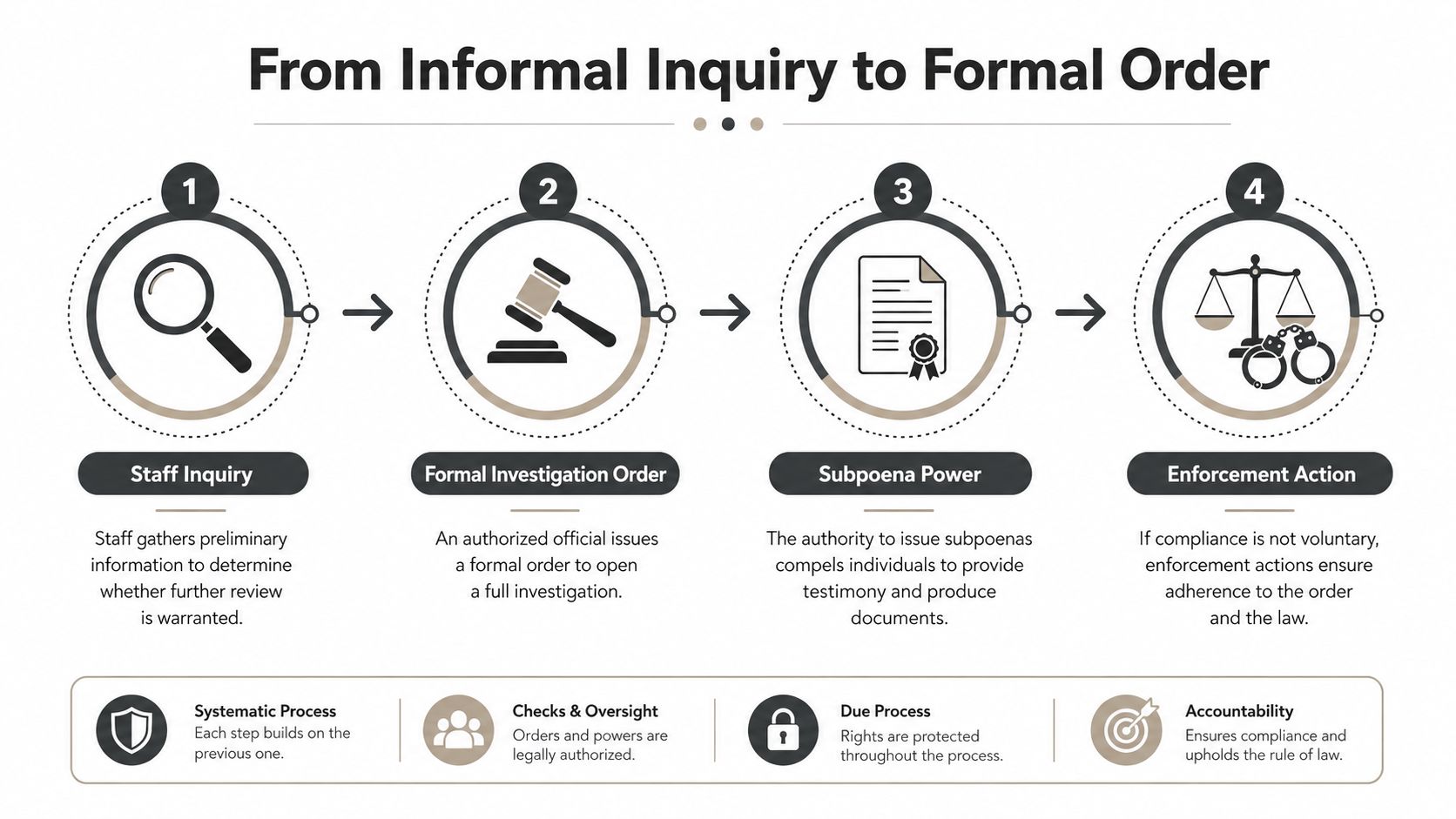
An SEC matter often begins with a short call, a document request, or a quiet email asking for background. The pressure changes fast once the staff decides to formalize the inquiry. At that point, the case moves from informal fact gathering to a formal investigation order, which gives staff subpoena power to compel testimony and documents. The distinction matters because the staff is no longer relying on cooperation alone.
The SEC's Division of Enforcement says matters can begin from market surveillance, investor tips and complaints, referrals from other SEC offices, self-regulatory organizations, and media reports (SEC Enforcement, How Investigations Work). From there, staff usually test the story against interviews, brokerage records, trading data, emails, and other contemporaneous materials. In practice, the paper trail matters more than anyone's recollection, especially when the same conduct may later draw FINRA questions, CFP Board attention, or a Form U5 problem.
The informal stage
At the informal stage, staff may call, write, or request a meeting without using formal compulsory process. Many respondents misread that request as a routine compliance discussion. It stops being routine the moment the SEC is asking about trading, disclosures, compensation, supervision, or sales practices.
The right move is to slow the pace and narrow the scope. Counsel should identify the issue, preserve documents, and decide whether a limited response is better than a broad narrative. A rushed explanation can hand staff the outline for a later subpoena round, and that mistake often spills into related matters under FINRA Rule 8210 or a broker-dealer's internal review.
What a formal order really changes
A formal order draws the line between voluntary discussion and compelled evidence collection. Once the order is in place, staff can use subpoenas to require books, records, testimony, and additional documents. At that point, the inquiry usually has moved beyond preliminary curiosity and toward a file that could support a recommendation.
The SEC frames these proceedings as private fact-finding exercises by Commission staff, a point reflected in its SEC overview of enforcement investigations. That secrecy gives staff time to compare accounts before the subject outside the matter knows how serious the file has become.
Practical insight: the line between informal inquiry and formal order is where many respondents lose the chance to shape the record cleanly.
Staff often want the same categories of materials at both stages, but the posture changes. Early cooperation can narrow the issue. Later cooperation usually just enlarges the file. The better course is to respond with discipline from the start, while the record is still manageable, and to bring in counsel before voluntary answers create problems in the SEC case and the parallel proceeding that follows it. sales intelligence SEC filings can show how public filing patterns are used in business development, but they are no substitute for controlling the response when the SEC is asking for records. The threshold for securities fraud analysis can also matter here, so a careful reading of the alleged conduct against the record is worth using, including resources such as this overview of securities fraud issues.
Common Allegations That Trigger SEC Investigations
Certain conduct patterns draw SEC attention again and again because they leave a paper trail. Fraudulent sales practices show up in emails, scripts, call notes, and complaint patterns. Unsuitable recommendations show up in account profiles, concentration levels, and the way a recommendation fits the client's stated objectives. Disclosure failures show up where the story in marketing materials or account paperwork does not match the underlying economics.
Advisors can benchmark their disclosures by pulling recent client-facing materials and cross-referencing them against trade confirmations, complaint logs, and compensation schedules. That side-by-side review often shows whether the issue is a bad explanation, a missing disclosure, or a recommendation that cannot be defended on the record. The problem is usually not one isolated sentence. It is the record that makes the sentence hard to defend.
What the SEC tends to scrutinize
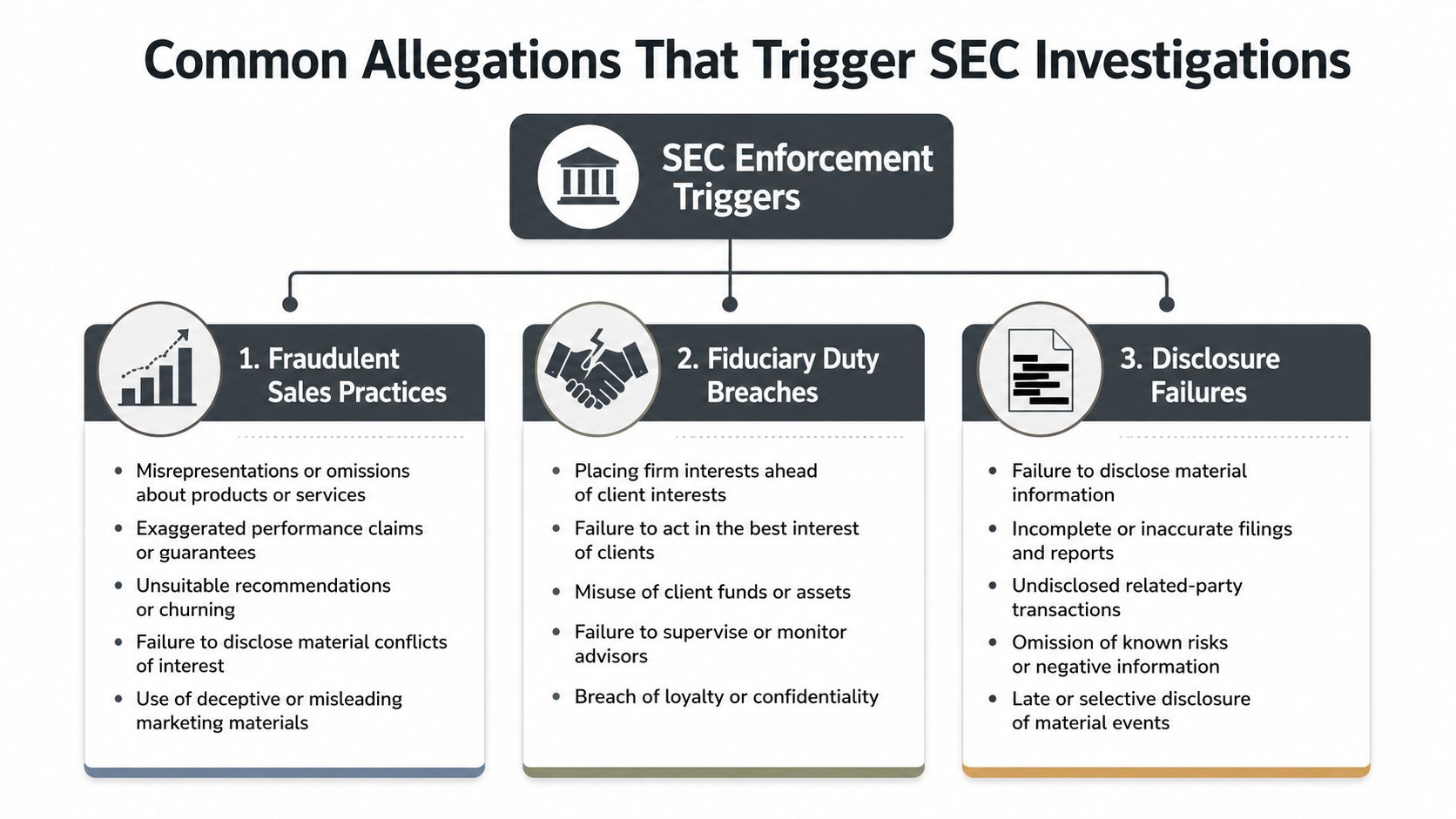
- Fraudulent sales practices: misleading pitch materials, exaggerated return claims, or pressure tactics that leave a compliance trail in email strings and call notes.
- Fiduciary duty breaches: recommendations that benefited the advisor or firm more than the client, especially where compensation or product conflicts were not clearly disclosed.
- Disclosure failures: omitted risks, hidden conflicts, or incomplete account disclosures that become obvious once investigators line up documents with customer communications.
Those categories overlap with what the SEC has emphasized in recent enforcement activity, including fraud, market manipulation, and abuses of trust (SEC FY2025 enforcement results). The agency also said it brought 456 enforcement actions in fiscal year 2025, including 303 standalone actions and obtained $17.9 billion in monetary relief, with $10.8 billion in disgorgement and prejudgment interest, $7.2 billion in civil penalties, about $262 million returned to harmed investors, and about $60 million awarded to 48 whistleblowers. That scale shows the SEC still treats investor harm and misconduct as serious business.
A practical review also means checking how a client story lines up with the file. Pull the pitch deck, the email trail, the suitability notes, the complaint history, and the compensation schedule, then compare each item to what the client was told. That is the kind of record comparison that exposes weak disclosures quickly. For context on how those allegations are usually framed, see the plain-English discussion of what is securities fraud.
For business development teams, the sales intelligence SEC filings resource can help spot filing patterns and enforcement themes that are already public. It is useful background, but it does not change the core defense task when the SEC starts asking for documents and explanations.
How SEC Investigations Interact with FINRA, CFP Board, and Form U5
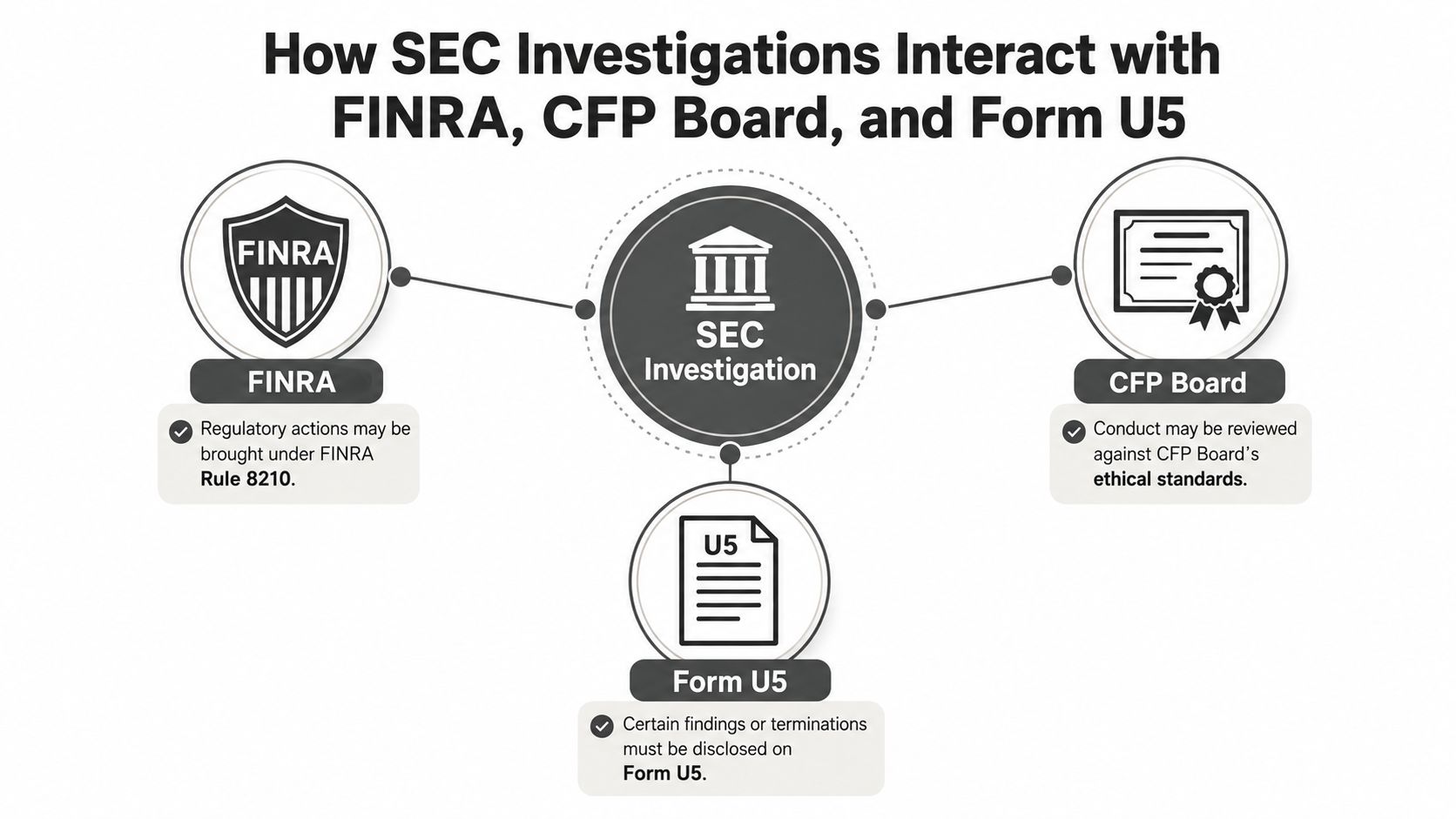
An SEC inquiry rarely stays in one lane. A single fact pattern can lead to a FINRA request under Rule 8210, a CFP Board ethics inquiry for a certificant, and a broker-dealer's internal review that affects Form U5 language. The respondent often thinks these are separate worlds. They're not.
The overlap matters because a statement given in one forum can surface in another. If an advisor gives an incomplete explanation to one regulator and a different version to the firm, the inconsistency becomes its own problem. Coordinated counsel is less about style than survival.
The three-way pressure point
FINRA's Rule 8210 can require testimony or documents in a way that feels much more immediate than an SEC inquiry. CFP Board proceedings turn on ethics and professional status, so even conduct that never becomes a public enforcement case can still threaten designation-related standing. Form U5 adds a different kind of risk, because the disclosure wording can follow the advisor long after the substantive dispute is over.
A key practical issue is that broker-dealers often move quickly once they sense regulatory attention. That can mean internal interviews, supervision reviews, and early decisions about whether to amend or supplement termination disclosures. Those decisions should be made with a full view of the SEC matter, not in a silo.
For a firm-level perspective on termination reporting issues, review Kons Law's page on Form U5 and FINRA.
Why coordination matters
Counsel has to decide which forum speaks first, which record controls, and how to avoid building contradictions. The wrong answer to one investigator can become the exhibit in another proceeding. That's especially true when a broker-dealer is also doing its own internal review.
There's also a logistical issue that gets ignored too often. Locating former coworkers, outside witnesses, or archived records can take time, so a service like UK tracing agents may be useful when a defense team needs to find people who've moved or left the business.
For CFP-designated professionals, the same facts can threaten the credential even if the SEC matter never becomes public. For that reason, the legal strategy has to account for employment, reputation, and licensing at once, not one after the other.
Timelines and Likely Outcomes of an SEC Investigation
SEC investigations usually move slowly because staff verify the same facts from several angles before they decide whether to recommend action. SEC practitioner handbooks and enforcement guidance note that these matters often last months or even years, and the practical range can stretch from 6 to 12 months to 2 to 4 years. A separate Wharton study of undisclosed investigations found the average investigation lasted slightly over three years and that only 44% were disclosed at all, with just 19% disclosed by the 10th trading day after the investigation opened (Wharton study).
Those numbers explain why patience and record discipline matter. A matter can look dormant while staff are still comparing testimony, emails, trade records, and third-party documents in the background. That is often when weak internal habits do the most harm, especially if the broker-dealer, advisor, and outside counsel are not working from the same record set.
Typical phases of an SEC investigation
| Phase | Typical Duration | Likely Outcome |
|---|---|---|
| Informal inquiry | Often early, before any formal order | Quiet closure, request for more information, or escalation |
| Formal investigation | Can run for months or longer | Subpoenas, testimony, document production |
| Wells stage | After staff forms a preliminary recommendation | Wells submission, Wells meeting, settlement discussion, or litigation posture |
| Resolution | Depends on complexity and forum | Closure, settled order, administrative proceeding, or federal court case |
The SEC's FY2025 results show how large the enforcement pipeline can be even when many matters end without charges. The agency said it closed 1,095 matters without bringing an enforcement action in FY2025, while still filing 456 enforcement actions and obtaining $17.9 billion in monetary relief. The scale is a reminder that most inquiries never become headline cases, yet every inquiry still deserves a disciplined response.
What outcomes usually look like
A no-action closure leaves less formal fallout, though it does not always erase broker-dealer or Form U5 issues. A settled order can involve disgorgement, monetary penalties, injunctions, industry bars, and officer or director restrictions. A contested case raises the stakes further, especially when staff want a public record or broader sanctions.
The key trade-off is timing. If you wait too long to organize the file, the investigation may drift into a larger credibility problem. If you move too aggressively without coordination, you can create inconsistencies that show up later in an SEC interview, a FINRA Rule 8210 response, or a CFP Board proceeding. For a compliance-oriented perspective on reducing that exposure, see Kons Law's article on compliance for RIA, and keep a separate trail for any records that need to be sent through a secure fax online guide.
Your First Thirty Days of Defense
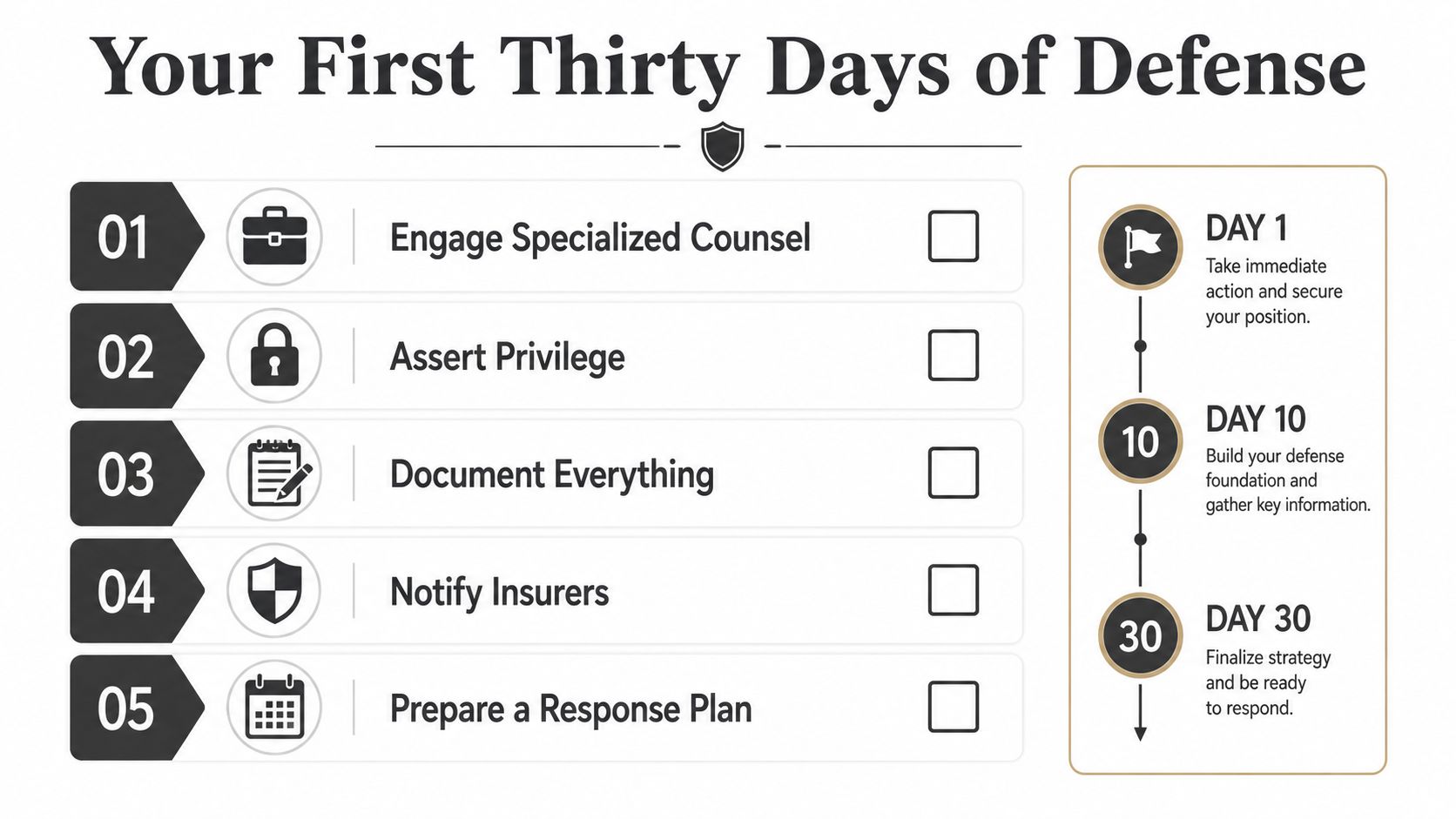
The first month is about building a clean record and keeping the matter inside a manageable lane. Counsel should be engaged before any substantive response goes out, because privilege boundaries and response strategy are easier to protect at the start than after a few casual emails. That's also when the document hold has to reach email, chat, mobile messages, trade archives, and calendars.
The SEC's updated enforcement materials emphasize early preservation, including communications on messaging apps and even personal devices when they relate to the matter. That lines up with the practical reality that investigators will ask how records were searched and who reviewed them. If the search method looks sloppy, staff tend to trust the respondent less.
What to do first
- Engage specialized counsel: bring in a lawyer who handles SEC, FINRA, and Form U5 issues together, not in separate silos.
- Assert privilege early: keep legal analysis and factual collection distinct so internal messaging doesn't waive protection.
- Document everything: preserve chats, emails, trading records, and notes before anyone starts cleaning up files.
- Notify insurers: review any policy notice requirements before a response timeline closes.
- Prepare a response plan: decide who talks to staff, who reviews documents, and who approves any written submission.
The best first-month defense is a disciplined record, not a noisy explanation.
There are practical tools that can help with logistics, too. If records need to be routed securely, a secure fax online guide can be useful for teams still handling sensitive documents across multiple offices.
The response choice that matters
A Wells submission and a written inquiry response are not the same thing. A Wells submission is most valuable when staff has already signaled a preliminary recommendation, because that's when focused legal and factual arguments can still change the result. A generic letter written too early often gives away strategy without changing the trajectory.
For firms working through the compliance side of that process, Kons Law's article on regulatory compliance attorney fits naturally with the first-month planning that a defense team needs.
Misconceptions That Put Advisors at Risk
One dangerous myth is that an informal inquiry doesn't count. It does, because the SEC can use that early period to learn the facts, and careless responses become part of the record. Another is that cooperating fully means volunteering every theory you've ever had. It doesn't. Cooperation works best when it's accurate, targeted, and consistent.
A third mistake is treating a Wells submission like a law review article. Staff want the disputed facts, the legal weaknesses, and the evidence that matters, not a memo padded with every possible argument. Silence can also backfire, because a response-free file can look like indifference or non-cooperation.
The last myth is the most expensive. A quiet closure doesn't guarantee clean Form U5 language, or a clean CFP Board file, or a clean broker-dealer record. The paperwork fallout can outlast the investigation itself.
Questions Advisors Ask After a Wells Notice
A Wells Notice forces a practical choice, and the timing is tight. Settlement makes sense when the staff has documentary support, the proposed remedy is tolerable, and the likely collateral damage from a public fight is worse than the result you can reach. Litigation makes more sense when the record is thin, the staff's theory depends on inferences that do not hold up, or the advisor needs a ruling that protects the licensing record, employment file, or future registrations.
The next question is how to make a Wells submission count. The submission matters most when it does three things well. It narrows the disputed facts, points staff to the documents that undercut the theory, and avoids arguments that sound clever but do not change the analysis. In practice, that means a focused narrative, a clean record citation, and enough specificity for staff to test the case against the file they already have.
Advisors also ask what to do about Form U5 language while the SEC matter is still open. Treat that disclosure as part of the defense plan, not a human resources cleanup item. The goal is to keep the filing accurate, measured, and consistent with the position being taken in the Wells response and any related statement to a broker-dealer. A loose explanation in one place can become the version other firms, regulators, and future employers rely on later.
Parallel FINRA or CFP Board matters change the answer as well. A statement that helps in one forum can hurt in another, especially if it creates a credibility problem around intent, supervision, or customer communications. The defense has to be coordinated early, including who speaks, what gets admitted, and which facts can be framed consistently across SEC testimony, a FINRA Rule 8210 response, and any CFP Board explanation. That coordination usually matters more than trying to make each file look isolated.
If the case involves all three, the safest approach is to assume every document will be compared. That means reviewing the Wells submission, the Form U5 language, and any other regulator-facing statement as a single package before it goes out. A short, disciplined record often helps more than a sprawling response that gives each forum a different story.
If you want to discuss your business law matter, contact Kons Law. The firm handles SEC investigations, FINRA defense, and Form U5 issues with a coordinated approach that fits the demands of securities regulation. Call (860) 920-5181 or visit Kons Law to start the conversation.
