
You're sitting in your car after a Friday afternoon compliance meeting, staring at a separation agreement you haven't read and wondering whether signing it will make the situation disappear. Then the compliance officer says the firm intends to file a Form U5 by Monday. For a financial professional, the termination itself may be only the first problem. The wording placed in the regulatory record can affect registration, recruiting, reputation, and the next conversation with a prospective firm.
The practical question is not whether the firing felt unfair. It's how to deal with wrongful termination quickly, without sacrificing evidence, regulatory rights, or legal options. That requires two parallel tracks: preserving proof of the employment decision and responding to the FINRA process that can move before a discrimination or contract claim is fully developed.
What Wrongful Termination Looks Like in the Financial Industry
Maria had spent nine years at a wirehouse and managed approximately $180 million in assets under management. Her manager called her into a Friday afternoon compliance meeting, handed her a separation agreement, and told her the firm intended to report her departure as a “voluntary resignation” on Form U5 by Monday.
That wording sounded better than “termination for cause,” but Maria still had questions. She had recently raised concerns about sales contests that appeared to pressure representatives to recommend products without adequate customer fit analysis. She had also been told that several client complaints were part of the decision, even though she'd never seen the complaints or been given a meaningful opportunity to respond.
The situation illustrates several recurring patterns:
- Performance explanations after protected activity: A firm may point to production, supervision, or documentation concerns after an employee reports discrimination, regulatory misconduct, or another protected issue. The explanation might be legitimate, pretextual, or a mixture of both. The evidence usually lies in timing, earlier reviews, comparator treatment, and the decision-makers' communications.
- Client complaints used as a termination record: Firms often treat customer complaints as a compliance matter, even when the advisor disputes the allegations or never received the underlying materials. The advisor needs to identify what the firm knew, when it knew it, and whether it applied the same process to other representatives.
- A quiet exit that becomes a career barrier: An advisor may leave under a negotiated agreement, only to discover that the U5 narrative makes re-registration difficult. A disputed characterization can become more consequential than the initial termination because prospective firms and compliance departments review regulatory records before hiring.
Practical rule: A separation agreement can address money and releases, but it usually doesn't erase the regulatory consequences of an inaccurate termination narrative.
Financial-services disputes also involve obligations that ordinary employment cases may not. FINRA Rule 8210 demands can require information about events that appear closed, and the Form U5 follows the registered representative through the Central Registration Depository. A contested filing can therefore create immediate professional consequences before a lawsuit is filed or an agency investigates.
The EEOC confirms that discharge, firing, and layoff are covered employment actions under federal anti-discrimination law. But proving that a firing was unfair isn't enough. The employee must connect the decision to discrimination, retaliation, contract rights, or another legally recognized theory, while meeting the applicable filing requirements. The EEOC's explanation of charge-filing time limits makes the central point clear: the administrative clock starts quickly, and delay can eliminate an otherwise serious claim.
Your First 48 Hours After Being Fired
The first two days should be disciplined and quiet. Emotion is understandable, but angry emails, rushed signatures, and improper downloads can give the firm an argument that would otherwise not exist.
Build a lawful evidence file
Start with documents you're legally entitled to retain. Preserve your offer letter, registered representative agreement, compensation schedules, performance reviews, prior disciplinary records, written complaints, termination notice, and severance proposal. Create a chronology while the meeting remains fresh, including who attended, what each person said, and whether the stated reason changed during the conversation.
You may be able to preserve personal employment records, but don't take client files, customer contact databases, proprietary models, trading information, confidential surveillance material, or internal firm investigations. A claim can be weakened if the employer says you misappropriated confidential information or violated a regulatory obligation.
If you can lawfully keep copies of relevant emails, save them before access disappears. Don't bypass security controls, access systems after authorization ends, or forward entire mailboxes. Preserve only materials connected to your employment, the termination, your complaints, compensation, and the proposed regulatory explanation.
Handle the agreement as evidence, not a formality
Don't sign the separation agreement in the meeting. Take time to review the release, non-disparagement clause, confidentiality terms, arbitration language, commission treatment, deferred compensation provisions, promissory-note language, and any representation concerning the Form U5.
A “neutral” separation letter may still contain language that affects later arguments. Counsel should compare the agreement with the firm's intended U5 filing and determine whether the contract limits your ability to contest an inaccurate statement.
Protect witnesses and your public position
Write down the names and personal contact information of witnesses who observed the meeting, your performance, your complaints, or the firm's treatment of comparable employees. Don't pressure anyone to alter records or coordinate a story. Preserve contact information and record what each person personally observed.
Stop social-media commentary about the firm and former colleagues. Public accusations can create defamation, confidentiality, and regulatory issues, while deleting existing communications can look like spoliation. For a broader checklist on documenting and reporting a suspected unlawful firing, review Kons Law's guidance on reporting wrongful termination.
First-day priority: Preserve the record, avoid unauthorized access, and postpone irreversible decisions until someone has reviewed the agreement and regulatory implications.
The Form U5 Clock and Why Your Termination Narrative Matters
A registered representative can leave a firm believing the dispute is over, then face a damaging account of the separation during the next recruiting process. The Form U5 makes that possible. It is not merely an administrative exit document. The member firm must file it within 30 days of the advisor's employment end date and provide the advisor with a copy within that period, as described in the USA.gov overview of wrongful termination issues. The filing may identify the reason for termination and become part of the record reviewed by future firms and compliance personnel.
The firm controls the initial wording. “Voluntary resignation,” “permitted to resign,” “discharged,” and “termination for cause” can carry very different implications. If the account is inaccurate, act promptly, preserve supporting records, and evaluate whether a written response or amendment request is appropriate. Waiting can allow the firm's version to shape recruiting conversations before you have organized a response.
Read the filing against the underlying record
Compare the Form U5 with the separation agreement, termination email, performance reviews, complaint history, and meeting notes. Check dates, reason codes, allegations, and descriptions of customer or compliance events. Preserve the documents that show what the firm knew, when it knew it, and how the stated reason compares with earlier explanations.
A firm may argue that it reported information in good faith, relied on an internal investigation, or used language required by regulatory obligations. Those positions can make contemporaneous evidence especially important. A performance review, complaint record, or termination communication created before the dispute may carry more weight than a later recollection.
FINRA issues can continue after employment ends. A later Rule 8210 request may seek documents or testimony about the same customer complaint, supervisory issue, or conduct identified in the U5. Leaving the firm does not automatically close the regulatory matter.
The Kons Law discussion of Form U5 issues explains the registration consequences that distinguish these disputes from ordinary termination cases.
Track each procedural phase
| Timeline phase | Trigger | Practical response |
|---|---|---|
| Employment end | The advisor's employment ends | Preserve records and document the termination meeting immediately |
| Form U5 filing | The firm files its termination report | Review the reason, dates, and allegations against the underlying documents |
| Copy delivery | The firm provides the advisor with the filing | Calendar the response process and obtain regulatory counsel if the narrative is disputed |
| Future registration | A prospective firm reviews the advisor's record | Prepare a consistent explanation supported by documents and any written response |
The regulatory consequences may arrive before a legal claim is fully developed. An advisor may still be investigating motive when recruiting discussions begin, while a prospective firm is already reviewing the available record. U5 review therefore belongs at the beginning of the case, before the employment dispute is framed solely around litigation.
Identifying the Legal Claims You Can Bring
A strong case usually begins with the facts, not the label. “Wrongful termination” is a useful description, but the enforceable claim may be discrimination, retaliation, breach of contract, a regulatory whistleblower theory, or a dispute over a promissory note.
Match the facts to the legal theory
| Claim Theory | Statutory or Contract Basis | Typical Triggering Facts | Firm's Common Defense |
|---|---|---|---|
| Discrimination | Title VII, the ADA, or the ADEA | Protected characteristic, qualification, adverse action, and facts suggesting discriminatory motive | The decision was based on performance, conduct, production, or customer concerns |
| Retaliation | Applicable anti-retaliation law, SOX, or SEC Rule 21F | Internal complaint, regulatory report, or protected whistleblowing followed by discipline or termination | The decision was already planned or resulted from an independent investigation |
| Breach of contract | Form U4, representative agreement, compensation plan, bonus terms, or deferred-compensation documents | The firm failed to follow its own termination, payout, notice, or bonus procedures | The agreement allowed termination, withheld compensation, or reserved discretion |
| Promissory-note dispute | Forgivable-loan or promissory-note terms | Termination or departure triggers accelerated repayment or changes forgiveness treatment | The note is clear, the balance is due, and the termination complied with the contract |
For federal discrimination claims, employer size can determine whether a statute applies. Title VII and the ADA generally cover employers with 15 or more employees, while the ADEA generally uses a 20-employee threshold. FMLA retaliation protections generally use a 50-employee threshold within a 12-month rule, which is a different coverage test. These thresholds are summarized in National Employment Law Authority's wrongful-termination overview.
Retaliation often turns on sequence
Retaliation cases require more than a complaint followed by a firing. The complaint must involve protected activity, and the evidence must support a causal connection. Useful proof can include the exact language of the complaint, the recipient's response, changes in supervision, unusual scrutiny, deviations from normal procedures, and the timing of the termination.
Whistleblowing in a financial firm may involve internal reporting about sales practices, customer treatment, books and records, supervisory controls, or regulatory compliance. The firm will often argue that the employee reported ordinary business disagreements, failed to use the required channel, or was terminated for an unrelated conduct issue. Preserve the complaint and the response exactly as they occurred.
Contract claims require close reading
A production grid may determine commissions, but it may not guarantee future compensation after termination. A bonus plan may reserve discretion, while a promissory note may accelerate repayment after a termination described as voluntary or for cause. Review the actual language, amendments, incorporated policies, and how the firm handled comparable departures.
The best contract cases usually identify a specific promise and a specific deviation. A general belief that the firm acted unfairly is less useful than a document showing the firm promised a payout, review process, forgiveness schedule, or notice procedure and then ignored it.
Filing Deadlines and Statutes of Limitation
A termination can create several filing clocks at once. Missing one may defeat a claim even when the evidence is persuasive. An agency charge also does not automatically preserve contract, compensation, promissory-note, or FINRA claims.
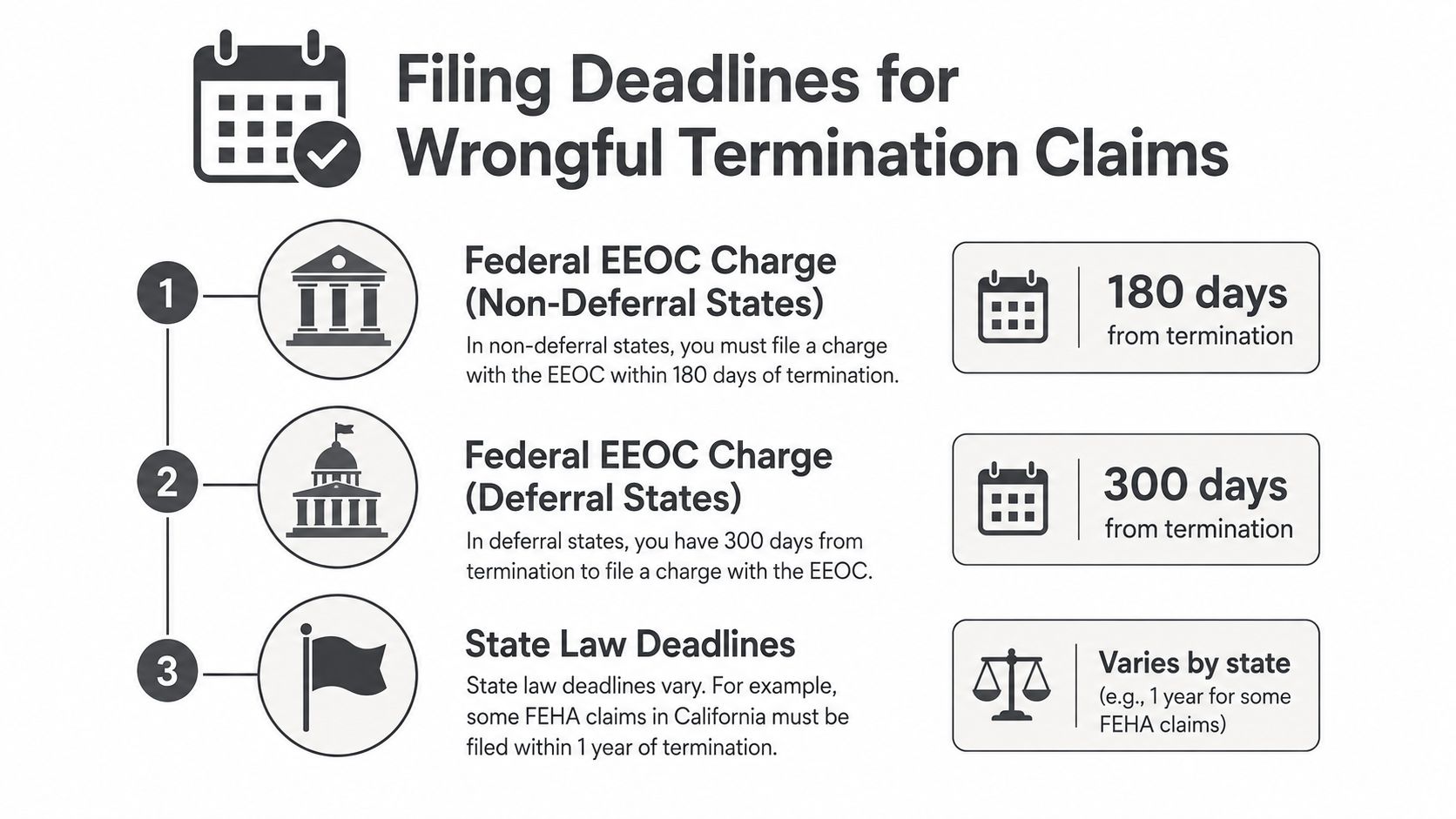
For a federal discrimination charge, the EEOC generally requires filing within 180 calendar days of the discriminatory act. The period extends to 300 calendar days in states or localities with comparable anti-discrimination laws. The EEOC enforcement and litigation statistics resource describes the agency system in which these charges are processed.
Calendar the deadlines separately
- EEOC charge: Determine whether the applicable period is 180 or 300 calendar days from the discriminatory act.
- State or local filing: Check the relevant agency's deadline, filing procedure, and exhaustion requirements. These may differ from federal requirements.
- Right-to-sue lawsuit: After the EEOC issues a Dismissal and Notice of Rights, the worker generally has 90 days from receipt to file a federal lawsuit.
- Contract and arbitration claims: Review the governing agreement and applicable law independently. A discrimination filing does not preserve every separate claim.
The right-to-sue period begins a different clock from the charge deadline. A person may contact the EEOC on time and still lose the federal lawsuit by waiting after the notice arrives. Keep the envelope, email, portal record, and any other proof showing when the notice was received.
State law may offer another route, with separate prerequisites and limitation periods. For Connecticut matters, review this Connecticut statute-of-limitations guidance and have counsel identify the period that applies to each claim.
Use the earliest plausible deadline as the planning date while counsel confirms the correct rule. This approach matters in advisor disputes, where the Form U5 record, employment documents, and FINRA-related issues must be addressed before separate deadlines expire.
Arbitration vs Litigation in Advisor Disputes
For registered representatives, the Form U4 often contains an arbitration agreement broad enough to cover disputes arising from the representative's business activities. That means a claim described as wrongful termination may be headed to FINRA arbitration rather than federal court. The forum question should be analyzed before filing because choosing the wrong forum can create delay, expense, and a motion to compel.
Compare the practical trade-offs
| Factor | FINRA Arbitration | Federal Court Litigation |
|---|---|---|
| Discovery | More limited and managed by the panel | Broader discovery tools, subject to court rules |
| Motion practice | Usually narrower | Dispositive motions and procedural motions are available |
| Speed | Often more streamlined | Typically slower and more formal |
| Precedent | Usually doesn't create broad judicial precedent | Court decisions may provide precedential value |
| Damages and fees | Contract and forum rules may limit available remedies | Statutory remedies and fee provisions may apply, subject to the claim |
| Appeal rights | Very limited judicial review | Ordinary appellate procedures are available |
| Firm response | The firm may seek to compel arbitration | The court may stay or dismiss claims covered by the agreement |
The Supreme Court's arbitration framework means that courts may enforce a delegation of arbitrability questions, depending on the agreement and the dispute. The firm may argue that the dispute falls squarely within the Form U4 clause, while the advisor may contend that a particular statutory or tort claim falls outside its scope.
Discrimination and retaliation claims can be arbitrable. Some state-law tort theories may present different issues, but the existence of a statutory claim doesn't automatically create a right to proceed in court.
Select the forum through case strategy
Arbitration may offer a focused process and decision-makers familiar with brokerage operations. It may also restrict discovery needed to prove pretext, limit motion practice, and provide fewer avenues for appeal. Court litigation can provide broader discovery and public procedural rulings, but it may cost more, take longer, and expose sensitive employment and regulatory facts.
Before filing, counsel should evaluate the U4 clause, the termination agreement, the requested damages, the need for third-party discovery, confidentiality concerns, and whether the firm is likely to seek immediate enforcement. This comparison of arbitration and litigation provides a useful starting point, but the actual agreement and claims control.
Damages, Remedies, and When to Hire Counsel
The financial value of a wrongful-termination case depends on proof, mitigation, the governing statute, the employment agreement, and the regulatory consequences of the termination. An advisor may seek back pay for lost compensation, front pay when returning to the former role isn't realistic, and contractual amounts that the firm withheld.
A Form U5 dispute can add difficult damages questions. If an inaccurate narrative delays registration, the advisor may investigate lost commissions, deferred compensation, recruiting opportunities, and the effect on a book of business. Reputational harm and emotional distress may be available under particular statutes, but they require a legal basis and evidence. Punitive damages aren't automatic, and statutory caps or proof requirements may apply.
Evidence determines leverage
Settlement is common in wrongful-termination matters. Industry summaries estimate settlement rates at approximately 90% to 95%, while trial success is commonly estimated at about 10% to 20% for cases that reach trial. Those estimates appear in Wenzel Fenton's discussion of termination-case outcomes, but they shouldn't replace a case-specific evaluation.
The same summary reports compensation in 64% of cases with attorney help, compared with approximately 30% without counsel, and reports higher success where witness testimony and written evidence were combined, 63%, than where written evidence stood alone, 50%, or witness testimony stood alone, 28%. The practical lesson is straightforward: a compelling chronology supported by documents and independent witnesses is more useful than a broad accusation with no record.
You should consider counsel promptly if:
- The Form U5 contains contested allegations: The response should address inaccuracies without creating new admissions or regulatory problems.
- The firm sends an arbitration demand or Rule 8210 request: Deadlines, document preservation, and the scope of the response require immediate attention.
- The termination followed protected activity: Counsel can separate a legitimate complaint from protected reporting and identify evidence of pretext.
- Compensation or a promissory note is disputed: The analysis should include the agreement, amendments, payment history, forgiveness terms, and termination classification.
- You receive an EEOC or state-agency communication: Your position should remain consistent across the regulatory, administrative, and employment records.
Fee arrangements vary. Strong discrimination or retaliation cases may be considered under a contingency structure, while contract, Form U5, regulatory, and arbitration matters may involve hourly billing, a retainer, a hybrid arrangement, or another agreement. Ask counsel how the firm will coordinate the employment claim with the U5 response, FINRA obligations, compensation dispute, and any confidentiality restrictions.
A confidential review should occur before the Form U5 process closes, not after a prospective employer has already relied on the filing. Kons Law represents financial advisors and brokerage professionals in Form U5, wrongful-termination, securities arbitration, regulatory, compensation, and promissory-note disputes.
If you want to discuss your business law matter, contact Kons Law at (860) 920-5181. The firm can review the termination record, Form U5 concerns, employment agreement, compensation issues, and potential arbitration or regulatory responses. Visit Kons Law to request a confidential case review.
