The EEOC received 88,531 new discrimination charges in fiscal year 2024, up more than 9% from 81,055 the year before, and ended the year with 52,080 charges still pending. The agency's FY 2024 reporting shows why employment discrimination defense now requires more than a carefully drafted position statement. For financial services firms, a workplace claim can affect an arbitration, a Form U5, a FINRA inquiry, client relationships, and the firm's internal supervisory record at the same time.
The defense starts before anyone files a lawsuit. Counsel and leadership must preserve evidence, identify the actual decision-makers, test the stated reason for termination against the firm's records, and coordinate employment, compliance, and regulatory obligations. A generic HR response often creates more risk than it removes.
Why Employment Discrimination Defense Demands Immediate Action
The volume of administrative and court filings makes delay expensive. Federal employment discrimination filings reached 20,265 in 2025, compared with 17,413 in 2024 and 16,116 in 2016, according to the EEOC's federal employment data. Those channels aren't identical, but they create parallel pressure. An employer may be answering an EEOC charge while preparing for arbitration, responding to a regulator, and managing a departing advisor's client relationships.
Financial services firms face additional complications because compensation and supervision records often sit at the center of the dispute. Production credits, deferred compensation, bonus formulas, compliance findings, client complaints, branch-level performance comparisons, and termination codes can all become evidence of either legitimate business judgment or discriminatory pretext. A manager's casual explanation in an email may later conflict with the reason stated in a Form U5 or a litigation response.
Practical rule: Treat the first response as a coordinated legal and regulatory exercise, not as an ordinary personnel file review.
The EEOC reported 42,301 retaliation charges in FY 2024, making retaliation the agency's most common allegation for the seventeenth consecutive year. Harassment, disability, race, and sex discrimination also remained frequent bases of claims. The agency's enforcement report further states that it filed 111 merits suits in FY 2024 and achieved favorable outcomes in 91% of suit resolutions by its federal field legal units. Those figures reinforce the need to assess retaliation theories, timing, comparators, and termination documentation immediately.
The financial services multiplier
A broker-dealer's employment dispute rarely stays confined to employment law. A claim by a registered representative may proceed in a securities-industry arbitration forum, overlap with a Form U5 filing, and prompt questions about supervision or the accuracy of the firm's stated termination reason. An overly aggressive disclosure can invite a defamation theory, while an incomplete explanation can create regulatory questions about whether the firm's account is reliable.
Public discussion also affects risk. Employers assessing workplace policies and workforce decisions may benefit from reviewing practical material on DEI lawsuits and public callouts, particularly when internal communications could be read as inconsistent with the firm's stated approach.
Employment discrimination claims in financial services
| Metric | Value | Industry impact |
|---|---|---|
| New EEOC charges in FY 2024 | 88,531 | A larger administrative pipeline requires early assessment and preservation. |
| Pending EEOC charges at FY 2024 year-end | 52,080 | Matters may remain active long after the initial filing. |
| Retaliation charges in FY 2024 | 42,301 | Termination timing and protected activity deserve focused review. |
| Federal employment discrimination filings in 2025 | 20,265 | Firms must prepare for both agency and court-based proceedings. |
The practical lesson is straightforward. A firm that waits for formal discovery may already have lost key communications, allowed witnesses to develop inconsistent accounts, or issued a regulatory disclosure that narrows its later defense.
Statutory Framework and Critical Filing Timelines
Title VII of the Civil Rights Act of 1964 supplies the central federal framework for employment discrimination defense. The statute prohibits discrimination in employment and informs claims involving race, sex, retaliation, and other protected categories. The Americans with Disabilities Act, the Age Discrimination in Employment Act, and state analogs add separate theories, procedures, and potential remedies.
The filing clock often starts before an employer realizes a dispute exists. An employee generally must file an EEOC charge within 180 calendar days of the alleged unlawful practice. That period extends to 300 calendar days when a state or local agency enforces a law prohibiting discrimination on the same basis, subject to the special rule for age claims described by the EEOC's charge-filing deadline guidance.
The first 72 hours
Counsel should impose order quickly:
- Identify the triggering event. Pin down the termination, compensation decision, denied accommodation, disciplinary action, or other alleged adverse act. Don't assume the employee's discovery of the decision controls the deadline.
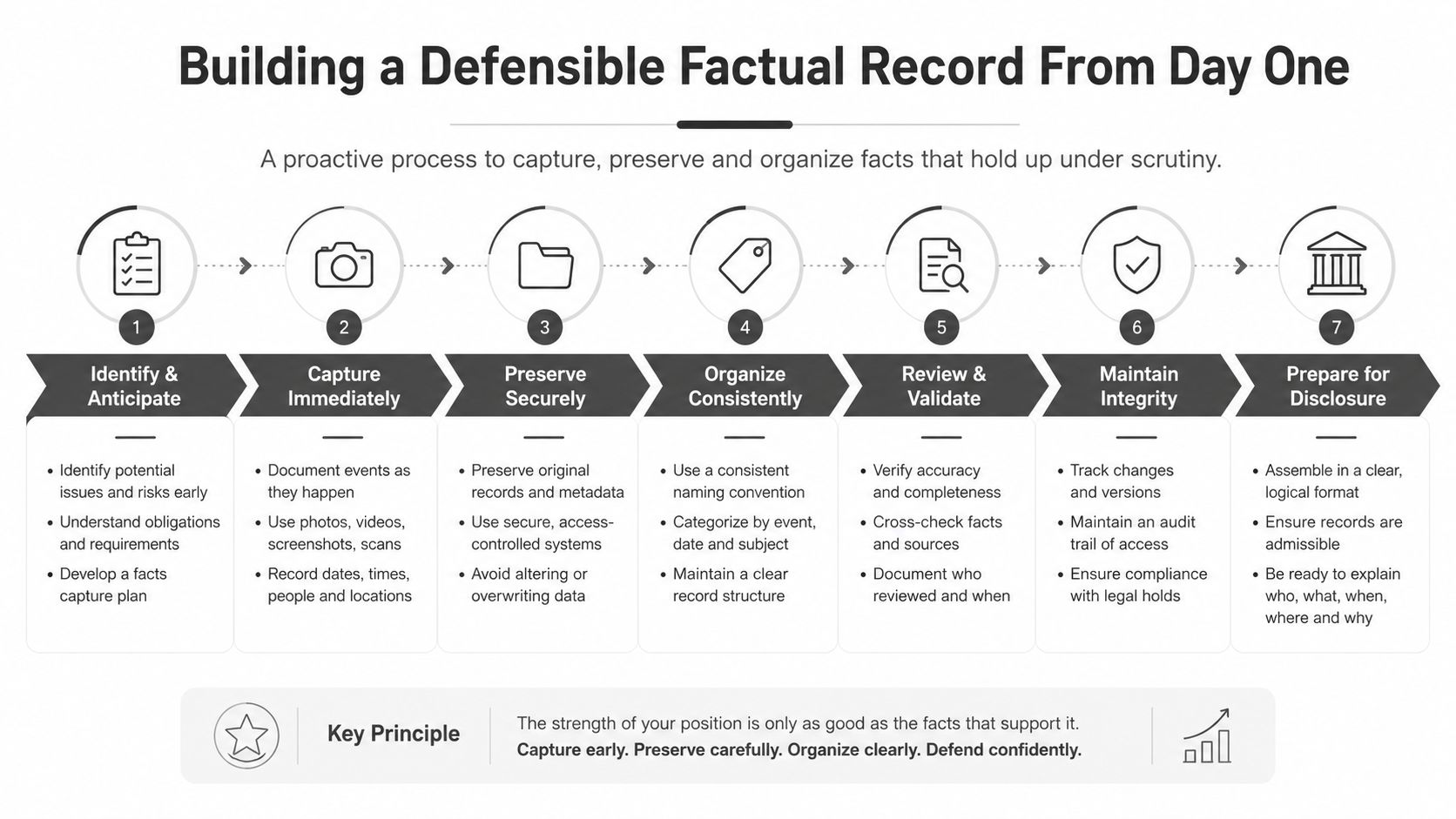
- Issue a preservation notice. Preserve email, text messages, collaboration platforms, HR records, CRM information, trading-related records, supervisory notes, compliance reviews, and relevant personnel files.
- Separate fact gathering from conclusions. Interview the decision-maker, HR representative, compliance personnel, and relevant supervisors. Record what each person knew, when they knew it, and what documents they reviewed.
- Map parallel obligations. Determine whether an arbitration agreement applies, whether a Form U5 filing or amendment is implicated, and whether FINRA or a state regulator may request related material.
The firm should also review the applicable statute of limitations and procedural rules through a reliable jurisdiction-specific resource, such as this discussion of Connecticut statutes of limitations. A deadline analysis should account for the charge date, the alleged act, agency procedures, and any written agreement affecting the timetable.
Coordinate privilege and supervision
An internal investigation can be privileged when counsel directs it for the purpose of providing legal advice, but labeling a document “privileged” doesn't make it so. HR and compliance teams should understand which communications are factual business records and which requests are made for counsel's legal analysis. At the same time, a firm can't use privilege as a reason to ignore supervisory responsibilities or fail to preserve records relevant to a regulatory inquiry.
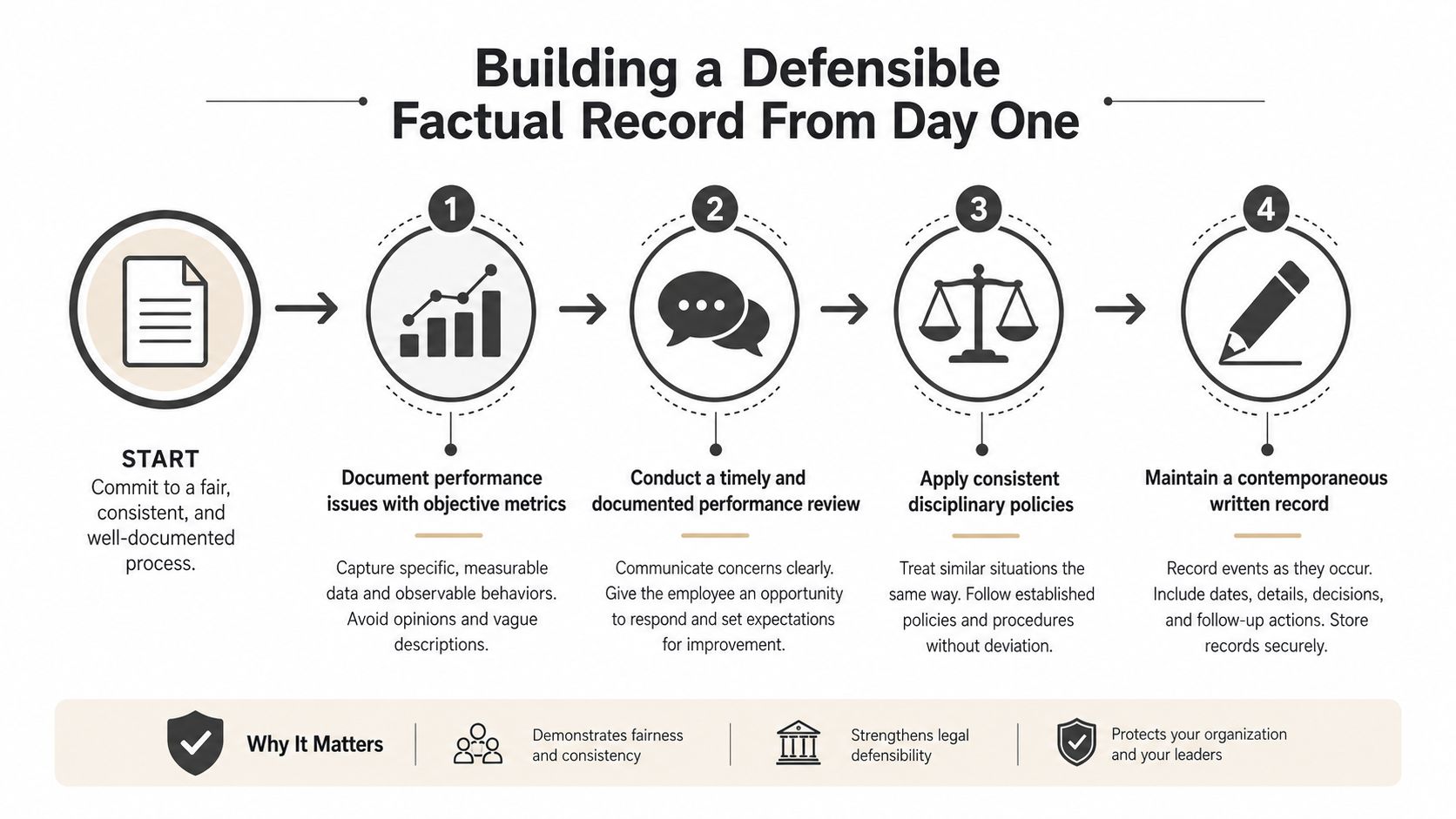
Building a Defensible Factual Record From Day One
Consider a financial advisor whose employment ends after missed production targets over consecutive review periods. The advisor files an EEOC charge alleging age discrimination and later pursues the dispute in arbitration. The firm believes the termination rested on performance, but belief alone won't carry the defense.
The useful record includes performance reviews, production reports, client complaint logs, compliance audit results, written coaching, and contemporaneous communications showing how the firm reached its decision. It should also explain why similarly situated advisors were treated differently, if they were, and whether the firm applied its stated performance process consistently.
Where the record breaks
The most damaging failures are often mundane. A branch manager conducts an informal exit interview and describes the termination as a “culture fit” issue, while the firm later relies on production shortfalls. HR retains a standard performance template but not the underlying client-service records. IT preserves email but omits text messages and collaboration channels. Compliance has supervisory notes that legal never collected.
Securities-industry records create further complications:
- Bonus calculations: The firm should preserve the formula, inputs, approval history, and communications explaining discretionary adjustments.
- Book-of-business transfers: A reassignment may be characterized as ordinary transition planning by the firm and as economic punishment by the advisor.
- Compliance findings: An audit result can support a legitimate reason, but only if the firm can show who reviewed it and how it affected the decision.
- U5 termination codes: The code and narrative should match the underlying record. Inconsistency can become evidence in both arbitration and a regulatory review.
A defensible record explains the decision in the language of the business, not just in legal conclusions.
The investigation should be structured around disputed facts. Counsel should ask who made the decision, what information was available at the time, whether the decision changed after protected activity, and whether the firm departed from its normal process. Witness preparation should focus on accurate recollection rather than rehearsed phrasing. A practical resource on how to prepare for a deposition can help witnesses understand the importance of precision, pauses, and document familiarity.
The firm shouldn't backfill a rationale after the charge arrives. A later-discovered problem may matter under the after-acquired evidence doctrine, but it doesn't automatically prove that the original decision was lawful. The strongest defense identifies the contemporaneous reason and shows that the decision-makers acted on it when they acted.
Affirmative Defenses and the Shifting Burden of Proof
Employment discrimination defense changes substantially depending on the theory. A disparate-treatment claim often turns on whether the employer can articulate a legitimate, nondiscriminatory reason for the challenged action and whether the claimant can show that reason was pretextual. In financial services, production records, compliance violations, documented coaching, and client-service concerns may provide useful evidence, but only when the firm can connect those records to the actual decision.
Retaliation requires a different emphasis. The firm must examine protected activity, decision-maker knowledge, timing, and intervening events. A termination soon after a complaint can create a persuasive narrative even when the firm has a legitimate concern. The defense therefore needs contemporaneous proof that the concern existed independently and that the firm applied its process consistently.
Comparing claim theories
| Claim type | Plaintiff's initial burden | Employer's burden | Plaintiff's reply burden | Key defense leverage |
|---|---|---|---|---|
| Disparate treatment | Show an adverse action and facts supporting an inference of discrimination. | Articulate a legitimate, nondiscriminatory reason. | Show that the stated reason is pretextual. | Objective performance, comparator evidence, and consistent process. |
| Retaliation | Show protected activity, adverse action, and a causal connection. | Establish a nonretaliatory reason supported by contemporaneous evidence. | Show the reason is pretext or that retaliation more likely motivated the action. | Decision-maker knowledge, timing analysis, and independent documentation. |
| Disability accommodation | Show a disability or perceived disability, a need for accommodation, and an adverse consequence. | Show reasonable engagement in the interactive process and a lawful reason for the outcome. | Show failure to accommodate, bad faith, or discriminatory motive. | Accommodation dialogue, medical-information boundaries, and alternatives considered. |
| Harassment | Establish unwelcome conduct tied to a protected characteristic and sufficient severity or pervasiveness under the governing law. | Use applicable employer policies, reporting channels, corrective action, and recognized affirmative defenses where available. | Show inadequate prevention or response, or facts defeating the defense. | Training, reporting access, prompt investigation, and corrective measures. |
Narrow defenses require disciplined proof
A bona fide occupational qualification, or BFOQ, is a narrow defense. Cornell's legal reference explains that it may apply to sex, religion, and national origin where the trait is legally authorized and reasonably necessary to the job's normal operation. It isn't a general justification for preferences in recruiting, promotion, or client assignment.
The Faragher-Ellerth defense in harassment matters depends on the employer's preventive and corrective framework and the employee's use of reasonable reporting opportunities, subject to the doctrine's legal limits. The same-decision defense can matter in mixed-motive cases, but it requires proof that the employer would have taken the same action absent the improper factor. After-acquired evidence may affect remedies or credibility, yet it shouldn't replace an analysis of what motivated the original decision.
Disability cases deserve special care because the interactive process creates its own record. A firm that focuses only on whether termination was justified may miss the more immediate question: did managers engage in a meaningful discussion of restrictions, possible accommodations, and operational impact?
FINRA Arbitration and Regulatory Considerations for Securities Professionals
A securities professional's employment dispute can create three connected narratives. The first is the employment narrative, including discrimination, retaliation, accommodation, compensation, and termination. The second is the arbitration narrative, including the agreement, claims, defenses, discovery, and damages. The third is the regulatory narrative, including the Form U5, supervisory records, and any inquiry into the accuracy or completeness of the firm's reporting.
FINRA arbitration often changes the defense environment. Discovery is more straightforward than in many court proceedings, the panel may not specialize in employment law, and review of an award is highly limited. Counsel must therefore identify the decisive documents early and present the business explanation in a way that is understandable without assuming deep familiarity with broker-dealer operations.
One dispute, multiple records
Form U5 language deserves separate review before filing. The firm should ensure that the termination reason is accurate, supportable, and consistent with the personnel file, the EEOC response, and the arbitration pleading. Overly broad language can invite a defamation claim or a challenge to the firm's motives. Vague language can raise questions about whether the firm withheld relevant information or used a pretextual explanation.
An arbitration claim may also lead regulators to examine the firm's supervision and reporting practices. Counsel should preserve the distinction between a good-faith employment decision and any separate customer or compliance issue, while avoiding contradictory explanations. Expungement requests and related reporting questions require careful attention to the applicable FINRA procedures and the record developed in the underlying dispute.
Coordination point: The Form U5, the arbitration answer, and the regulatory response should be reviewed as one factual narrative.
That coordination doesn't mean every document should use identical language. Each forum has different legal standards and disclosure requirements. It does mean the core facts, dates, decision-makers, and stated reasons must remain accurate and internally coherent.
Firms should also consider who owns the response. HR may know the employment history, compliance may control supervisory material, and legal may manage the claim. Without a single coordinating attorney or executive, each group can create a separate account that later becomes discoverable.
For counsel handling the forum itself, a practical overview of the FINRA arbitration process can help frame filing, discovery, hearing, and award considerations. The central strategic point remains broader: securities-industry employment defense requires simultaneous attention to private dispute resolution and regulatory credibility.
Settlement Versus Trial Strategy for Financial Services Firms
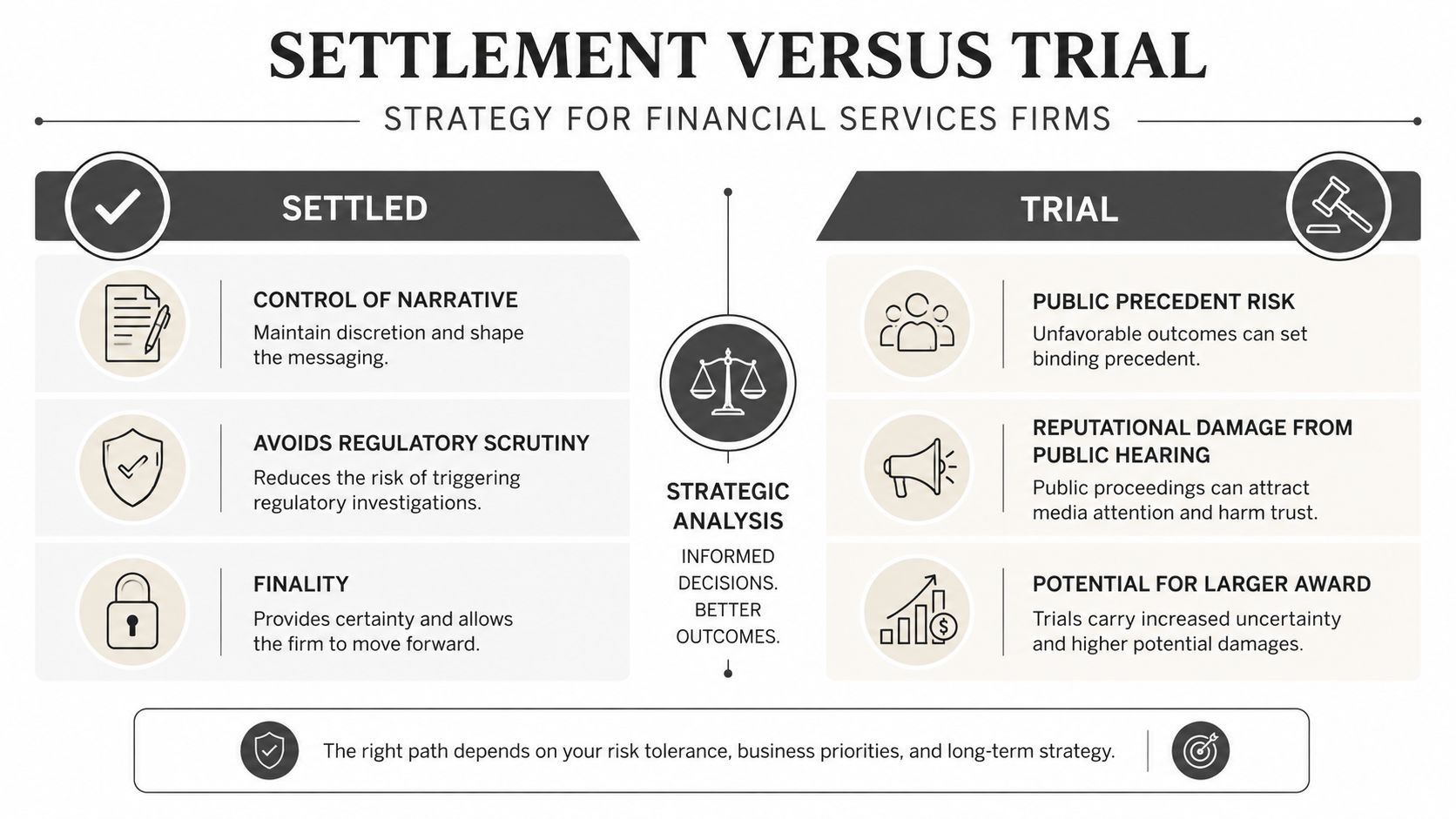
Settlement shouldn't be the default because a claim is uncomfortable, and trial or arbitration shouldn't be the default because the firm believes it acted properly. Financial services leaders should evaluate the dispute as a business decision with legal, regulatory, insurance, recruiting, and client consequences.
A public proceeding can create reputational pressure, particularly when the dispute concerns discrimination, retaliation, or a prominent advisor. A settlement may provide greater control over the narrative and reduce the chance that damaging testimony becomes part of a public record. But confidentiality doesn't eliminate risk. Other employees may view a payment as confirmation that the firm had exposure, especially if multiple complaints involve the same branch, manager, or compensation practice.
A disciplined decision matrix
Counsel should assess:
- Factual strength: Do contemporaneous records support the stated reason, or do later explanations carry most of the defense?
- Comparator risk: Can the firm explain differences in treatment among advisors with similar production, tenure, compliance histories, or protected activity?
- Regulatory consistency: Will the proposed resolution, Form U5 language, and agency response remain accurate and aligned?
- Arbitration economics: What will continued discovery, hearing preparation, expert work, and management time require?
- Insurance constraints: Does the firm's employment practices or errors and omissions coverage affect authority, defense costs, or settlement structure?
- Remedial value: Can policy changes, reporting protections, accommodation procedures, or manager training address the underlying risk?
A strong affirmative defense may justify resisting settlement pressure, particularly when the claimant's theory depends on speculation and the firm's records are consistent. Conversely, an apparently defensible case may still warrant resolution if a key witness is unreliable, the decision followed protected activity closely, or the firm's regulatory narrative is vulnerable.
Settlement terms should be negotiated with the securities context in mind. The parties may address confidentiality, non-disparagement, cooperation, references, compensation treatment, and Form U5 language, but counsel must ensure that contractual terms don't require inaccurate reporting or prevent lawful communications with regulators. The right resolution protects the firm without creating a second dispute over disclosure or compliance.
Tactical Checklist for Counsel and Firm Leadership
A firm can turn its response plan into an incident playbook. The checklist below is designed for the moment leadership receives an EEOC charge, demand letter, arbitration claim, internal complaint, or credible threat of litigation.
Immediate preservation and communication
- Appoint one coordinator: Name the attorney or senior leader responsible for aligning HR, compliance, legal, and business records.
- Preserve broadly: Issue a targeted hold covering email, text messages, CRM records, trading-related material, supervisory notes, performance data, and personnel files.
- Restrict informal commentary: Tell managers not to speculate about motive, protected activity, health information, or the departing advisor's future.
- Secure the decision file: Collect the documents decision-makers reviewed before the action, not just materials created after the charge.
- Monitor communications carefully: Preserve relevant social media or public statements without directing employees to delete or alter anything.
Regulatory coordination
- Review reporting duties: Determine whether a Form U5 filing, amendment, FINRA response, or state regulator communication is required.
- Reconcile narratives: Compare the proposed regulatory language with the personnel record, agency response, arbitration pleadings, and internal investigation.
- Protect privilege correctly: Keep legal advice separate from ordinary business communications and explain the distinction to HR and compliance personnel.
- Anticipate collateral disputes: Consider whether compensation, client transfers, promissory notes, customer complaints, or supervisory issues will become part of the employment claim.
Strategic decisions
- Evaluate mediation early: Consider mediation after the firm understands the key documents and witness accounts, not before basic facts are tested.
- Sequence production intelligently: Produce responsive material accurately while protecting irrelevant confidential customer information and privileged communications.
- Prepare witnesses by issue: Focus each witness on personal knowledge, timing, documents reviewed, and the limits of recollection.
- Reassess the defense: Update the risk analysis when new comparator evidence, accommodation records, or regulatory correspondence appears.
- Use a case-management system: Firms can adapt documented case management best practices for law firms to track custodians, deadlines, productions, interviews, and approval points.
The firm should also select counsel who understands both employment litigation and securities-industry disputes. A business defense attorney can help coordinate commercial, employment, arbitration, and regulatory issues when a single termination creates several connected proceedings.
Kons Law advises financial professionals and firms on employment discrimination claims, wrongful termination, compensation disputes, FINRA arbitration, regulatory inquiries, and Form U5 issues. If you want to discuss your business law matter, contact Kons Law at (860) 920-5181, or visit Kons Law to discuss a coordinated defense strategy.
